Riftbound Vendetta Rules FAQ: Key Rulings Explained
Riot published the Vendetta Rules FAQ on 14 August 2026 and gave it precedence over the Core Rules Document until a new one was released. That new rulebook arrived on 9 October, effective 16 October. The FAQ also reverses a ruling Riot published in January, explains why Kayle can hold three copies of a status the rules call binary, and admits to a bug the Vendetta rules update introduced.

Updated 10 October 2026: Riot released a new Core Rules Document on 9 October, and its patch notes make it effective on 16 October. The FAQ's own preamble gives a newly released Core Rules Document precedence wherever the two differ, so from 16 October at the latest the new rulebook outranks this FAQ. It writes several of the rulings below into the rules, replaces the Rebuttal ruling, and keeps Accelerate text that contradicts the FAQ's shorthand; each is flagged where it comes up. Our Radiance rules update breakdown covers the rest of the 9 October changes.
Riot published the Vendetta Rules FAQ at 01:00 UTC on 14 August 2026, and buried in the preamble is a sentence that changes where you look things up:
The FAQ is a collection of official rulings. In places where the FAQ differs from the Core Rules Document, the FAQ takes precedence.
That put the Core Rules PDF in second place. Riot added an escape hatch - "when a new Core Rules Document is released, it will take precedence over any points that differ" - and that new document arrived on 9 October.
It is also the first FAQ Riot has written for a worldwide simultaneous release, and the company is openly unhappy with its own timing. Release too early and you miss what players actually find confusing; release too late and nobody can prepare a deck for an event. Riot's words: "For future sets, we're looking to try different models that might reduce some of the pain points players are feeling with this timing."
If you have not read the base game yet, start with how to play Riftbound. This is the edge-case layer on top.
When the FAQ outranks the Core Rules
From 14 August, that precedence line meant the Vendetta Rules FAQ beat the July 2026 Core Rules Document wherever the two disagreed. Card wording is a separate question: for the eight cards it changed, the Vendetta errata article (23 July) is the text of record, covered below.
Riot released a new Core Rules Document on 9 October 2026. The PDF itself carries no effective date; Riot's patch notes put it into effect on 16 October, the day the Radiance Pre-Rift starts, and until then the July document is the rulebook in force. Riot does not say whether the FAQ's precedence ended with the 9 October release or ends on the 16 October effective date. From 16 October, the new rulebook wins wherever it and this FAQ differ.
Riot's 9 October patch notes say the new rulebook codifies several of the FAQ's rulings, including Kayle's stacking Empowered, ignored versus negated instructions, and the Dragon Roost requirements. It also replaces the FAQ's Rebuttal ruling, covered under the four things Riot said it would fix later.
The FAQ also fixes shorthand you will see throughout it. [E] is exhaust, [M] is Might, [A] is one power of any domain, and [C] is one power of this card's domain. The FAQ's wrinkle is that [C] in an Accelerate cost takes the domain of the unit, or becomes [A] if that unit has no domain or several.
That last clause is where Riot's documents disagree. Both the July Core Rules (805.1.a.1) and the 9 October Core Rules (805.1.b.1) say a unit with domains can pay the Power part of its Accelerate cost only with Power matching one of its domains, and rule 135.2.e.6.c in both gives the example of Tibbers, a Fury and Chaos unit, paying with Fury or Chaos. Riot's 9 October patch notes repeat the FAQ's [A] shorthand anyway. With the FAQ's own preamble handing precedence to a newly released Core Rules Document, check with your head judge before paying a multi-domain unit's Accelerate with Power from outside its domains.
Riot just reversed one of its own rulings
This is the headline for anyone who has been playing since winter.
In the Spiritforged FAQ, published 14 January 2026, a player asked whether attaching Svellsongur to Aphelios, Exalted gives him a second copy of his attach trigger in time for both to trigger. Riot's answer then was unambiguous: "He does have the second copy of his ability in time, and it will trigger."
The Vendetta FAQ says that is now wrong. In Riot's own words: "the answer in the Spiritforged FAQ is no longer true: if you attach Svellsongur to Aphelios, he will not trigger twice."
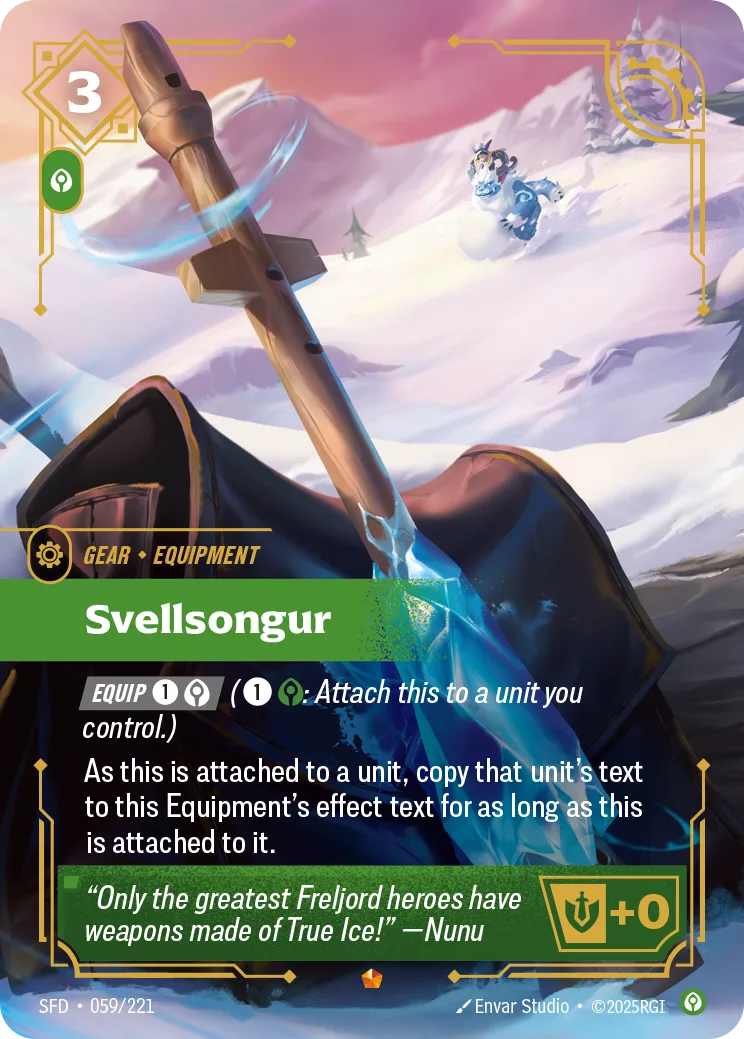
Nothing about Svellsongur changed. What changed is the machinery underneath it, and that reversal is a good reason to re-check any interaction you learned from an older FAQ rather than assuming it survived the Vendetta rules update.
Equipment attaches first, then does its trick
Here is the mechanism that killed the Aphelios trick.
As of the Vendetta rules update, effects like Svellsongur and Shady Spectacles are replacement effects. They replace the event of the equipment being attached with that event plus whatever the card specifies. The two halves are not simultaneous, and the order is fixed:
- Svellsongur: attach, then copy the equipped unit's text to Svellsongur's effect text for as long as it stays attached.
- Shady Spectacles: attach, then choose a friendly unit and make the equipped unit a copy of it for as long as it stays attached.
Because the attach executes first, Svellsongur does not yet carry the copied text at the moment the attachment happens. Aphelios sees one attach event, not two.
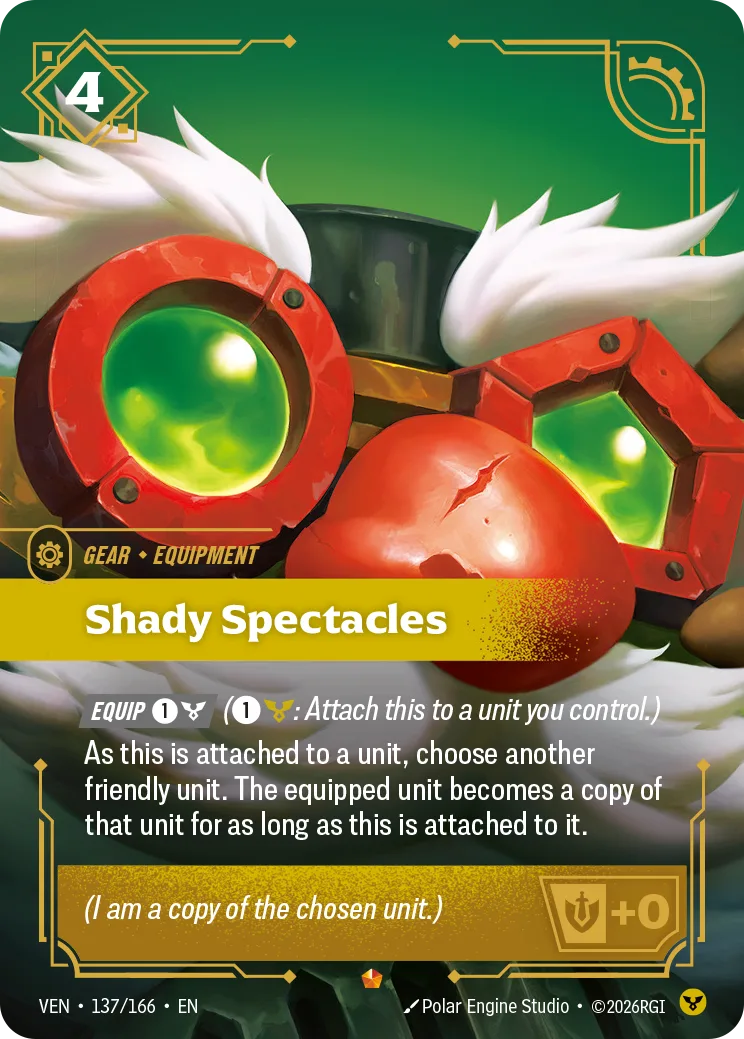
The same logic runs the other way. If an opponent's Akshan, Mischievous steals your equipped Shady Spectacles, the old equipped unit loses its copy effect, Akshan attaches, and only then does he become a copy of a friendly unit his controller chooses. If they pick Aphelios, the attach event has already finished and the newly copied trigger never sees it.
Two smaller consequences worth banking:
- Copy effects do not copy status. Empowered is a status, not a printed trait, so equipping Shady Spectacles onto an unempowered unit and copying an empowered one leaves it unempowered. Might modifiers, buffs, Temporary, attacker and defender designations all stay put on the original object too.
- Detach and reattach refreshes activated abilities. Each instance of a copied ability is a different ability. A Sand Soldier copying Azir, Ascendent can use the copied activated ability, detach the Spectacles, reattach them to the same Sand Soldier as a copy of the same Azir, and use it again.
Kayle stacks a status the rules call binary
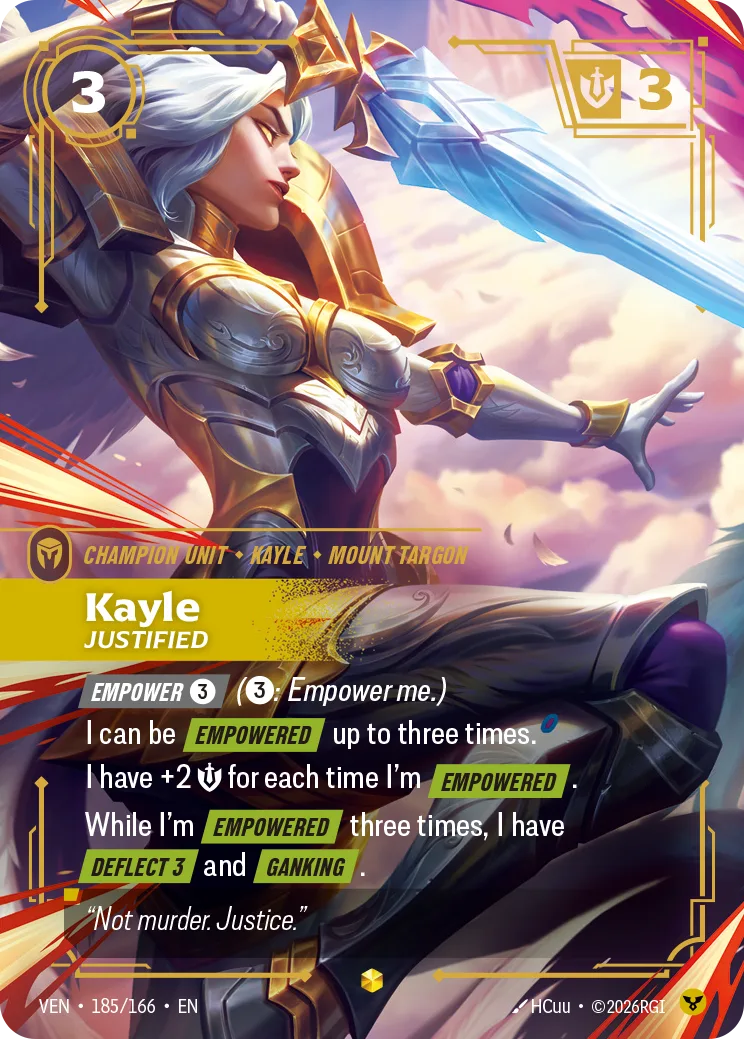
Kayle, Justified is a 3-Energy, 3-Might Order champion from Vendetta, and Riot describes her as an exception to how the empowered status works everywhere else. The FAQ states that for Riftbound cards other than Kayle, empowered is binary - you have it or you do not. Kayle uses the golden rule that card text supersedes rules text to turn it into a stacking status, up to three.
Two rulings follow from that, and both are easy to get wrong:
- Disempowering her removes one status, not all of them. A Kayle empowered three times who eats a disempower is still empowered twice, and still has +4 Might from the remaining stacks.
- You can activate her empower ability while she is already empowered. Below three stacks she gains one. At three stacks the ability still activates legally, it simply does nothing on resolution.
That second point matters because the Empower keyword is shorthand for "[Cost]: Empower this. Play only if not Empowered." Kayle's permission to be Empowered three times overrides that restriction, and Riot's 9 October Core Rules, effective 16 October, write the exception into the rulebook for any object with that kind of permission.
Gangplank needs the event to actually happen
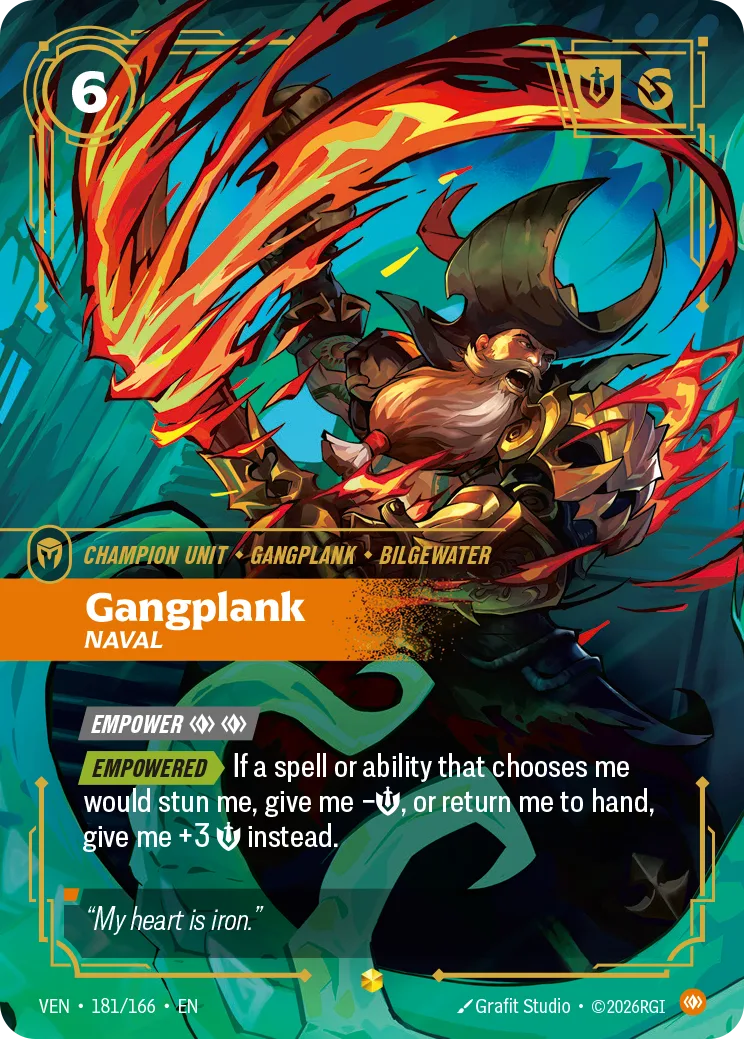
Gangplank, Naval is a 6-Energy, 6-Might Body champion whose empowered ability is a replacement effect, and the FAQ spends four separate questions on the same principle: a replacement effect needs a real event to replace. No event, no replacement.
| Situation | Does Gangplank get +3 Might? | Why |
|---|---|---|
| Blast Cone's exhaust ability stuns him | No | The ability does not choose him, so his effect never applies |
| Back Off played on an already-stunned Gangplank | No | The stun action is negated, so no stun event occurs |
| Stupefy played on a 1-Might Gangplank | No | The reduction snapshots to -0 Might, so no minus-Might event occurs |
| Switcheroo swapping his Might with a 2-Might unit | Yes | Swap generates a real minus-Might event on him |
That last row has arithmetic worth walking through, because it is the most counter-intuitive result in the document. Swap calculates the Might difference first and generates two effects, an increase and a decrease. With a 2-Might unit opposite a 6-Might empowered Gangplank, the replacement fires after the difference is calculated: the small unit goes 2 to 6, and Gangplank goes 6 to 9. Riot concedes this "is not immediately obvious based on how the swap game action rules are written."
The same replacement logic applies to Mel, Newly Awakened. Her empowered ability adds -1 Might to what a spell or ability of yours gives to a unit it chooses. Cast Moonfall and only the chosen unit takes -3; every other enemy unit at that battlefield still takes -2, because only one of them was chosen.
Combat damage effects moved to assignment
The Vendetta rules update changed something structural, and the FAQ gives it a worked example.
Previously, prevention effects applied at combat damage assignment while damage-increasing effects applied when damage was dealt. Now every replacement effect that would modify combat damage applies at assignment. Riot's patch notes are blunt about the trade: assignment maths gets harder, timing gets consistent.
So a 4-Might unit carrying both Ki Barrier and Lotus Trap against a 4-Might defender gives you an ordering choice, and the two orders are genuinely different:
- Ki Barrier first: your unit takes no damage, and 3 damage prevention remains on it.
- Lotus Trap first: your unit takes 1 damage, and no prevention remains.
You order the replacement effects on your own unit, so this is a decision, not a coin flip. Free value if you know it, a lost unit if you do not.
Can't beats can, and Baron Nashor is the exception
Perched Grimwyrm is a 4-Energy, 5-Might Fury dragon from Spiritforged reading "Play me only to a battlefield you conquered this turn." Dragon Roost lets you pay [A][A] to play a dragon there. The two do not combine.
In Riftbound, can't beats can. Grimwyrm's restriction is a "can't", Dragon Roost's ability is a permission, and a permission cannot overcome a restriction. If you have not conquered Dragon Roost this turn you cannot play Grimwyrm there at all, even if you conquered a different battlefield - and if you have no legal location after paying, the whole play is undone and the card returns to where it came from.
Baron Nashor behaves differently for a reason worth learning, because it generalises. His passive generates a delayed replacement effect - "I enter there" - which replaces the event of him entering anywhere else. Replacement effects get around restrictions on where you may play units. Permissions do not. When you read a location-fixing card, the question is always which of the two it is.
A related ruling: when two mandatory positive requirements genuinely contradict, you pick one and ignore the rest. Temporal Breach telling you to play your Elder Dragon to base while Dragon Roost's paid cost says play it to the Roost is a free choice between the two.
Riot's 9 October Core Rules, effective 16 October, write both rulings into rule 355.17: when sets of mandatory requirements contradict, you choose one set and ignore the rest, and a card played in breach of a restriction like Grimwyrm's fails to finalize.
How to name a card whose name you forgot
Naming cards, types and tags is new in the Vendetta rules update, and the rules are friendlier than expected.
The hard limit first: you cannot name something that does not exist in Riftbound. Riot's own examples are the "Locke" tag, the "totem" type, and a card called "Lingering Tentacles" - none printed on any card or token, none nameable.
Beyond that, you do not need the exact name. Any information that uniquely identifies the card works. Riot's examples include "the [3] spell with Flow that makes tentacles", "the red Kai'Sa", and "Illaoi". The one failure mode is ambiguity: saying just "Kai'Sa" when two or more cards answer to it means you have not named a card at all.
Timing note for Fallen Feline, the card that triggered this rules work: you can react to its play effect before its controller names a spell, but once the ability resolves you are too late, because by the time you know the named spell you can no longer play it.
Ignored versus negated, the bug Riot admitted
The most useful section of the FAQ is also the one Riot flags as a mistake. A small rule added in the Vendetta update made the linked-instructions rules too broad, with the result that playing Ride the Wind on your unit at Vilemaw's Lair and trying to move it to base readies it. Riot calls this "smoothing out a bug" rather than a real change.
The fix is a clean two-way split:
- Ignored means the instruction was not performed because it mistargeted - the object was not a legal target on resolution. Ignored instructions take their linked instructions down with them.
- Negated means something stopped the instruction: a replacement effect, an ability like Vilemaw's Lair saying units can't move from here to base, or a game action such as Buff or Ready performed on a unit already in that state. Negated instructions do not drag their linked instructions along.
Riot's four Hidden Blade examples make the distinction concrete. Hidden Blade kills a unit at a battlefield and its controller draws 2:
| What happens to the chosen unit | Does its controller draw 2? |
|---|---|
| Unit says "I can't be killed" | Yes - kill was negated, not ignored |
| Unit is moved to base by Flash in reaction | No - Hidden Blade mistargeted, so both instructions are ignored |
| Unit is protected by Zhonya's Hourglass | Yes - it is still on the board and checkable |
| Unit was hit by Smite earlier this turn | No - Smite banishes it instead, so it is not on the board and has no controller to reference |
Rows three and four look alike at the table - in both, another card replaces the unit dying - and resolve differently, which is exactly the sort of thing that decides a match.
Riot's 9 October Core Rules, effective 16 October, write the split into the rulebook (359.3.e.6), along with the linked-instructions rules that depend on it (359.3.e.14).
Eight cards got errata, and the gallery has not caught up
The 23 July errata article covers eight cards across three sets. Five are pure wording cleanups that fold "If you do" constructions into "to" phrasing - Draven, Vanquisher; Emperor's Dais; Fizz, Trickster; Diana, Lunari; and Astral Heron. Three change something you can actually misplay:
- Stalking Wolf went from "You may play me to its battlefield" to "You may [Ambush] me to its battlefield", which pins the play to the Ambush keyword and its restrictions rather than leaving it as a loose permission. Our keyword breakdown covers why that distinction bites.
- Gangplank, Naval gained the words "this turn" on his +3 Might, which the printed card does not say.
- Resonating Strike had its Reaction reminder text corrected from "(Play on your turn or in showdowns.)" - which is Action's reminder text, printed on a card that has Reaction - to "(Play any time, even before spells and abilities resolve.)"
One practical warning. Checking the official card gallery on 14 August 2026, the ability text shown for Gangplank, Naval, Astral Heron, Stalking Wolf and Resonating Strike is still the pre-errata wording. Printed cards obviously cannot update themselves, but the gallery's text field has not been updated either, so it is not the errata of record. The errata article is.
Four things Riot says it will fix later
The FAQ is unusually candid about its own loose ends, and each of these was a spot where a future Core Rules Document might move the answer. The 9 October document, effective 16 October, has since touched three of them:
- Iascylla's templating. Her delayed trigger references the battlefield she held, while Azir, Sovereign's attack trigger checks the battlefield he is at on resolution. Riot says future sets use "more precise templating and wording for abilities like Iascylla's."
- Rebuttal's remade choices. Under the FAQ, you may remake any number of targets or modes, and any choices you decline to remake must be legal. Riot: "We'll look at shaping up this section in a future rules update." Riot's 9 October update overhauls it. From 16 October, rule 753 says a player making new choices "must choose to remake all choices made for a chain item," even if they pick the same ones again, and rule 754 has a re-chosen target's targeting effects trigger again.
- Swap and Gangplank. The +3 Might result above does not fall out of the July swap rules as written. Riot: "We will clarify this in a future rules update." The 9 October Core Rules add a line to the swap rule (434.1.d): swapping two units' Might "is the equivalent to giving those units a Might increasing effect and a Might decreasing effect respectively." The patch notes do not list it as a change.
- Linked instructions. The ignored-versus-negated split above is the promised clarity for a rule the Vendetta update over-extended, and Riot's 9 October patch notes say it is now codified in the Core Rules.
Quick reference
- The FAQ outranked the July Core Rules. The new Core Rules Document released 9 October takes precedence wherever the two differ, from 16 October at the latest.
- Svellsongur no longer double-triggers Aphelios, Exalted. The January ruling is dead.
- Equipment attaches first, then executes its copy effect. The two are not simultaneous.
- Copy effects do not copy the empowered status, or any other temporary modification.
- Kayle, Justified holds up to three empowered statuses; disempower strips one.
- Replacement effects need a real event. Already stunned, or reduced to -0 Might, means nothing to replace.
- All combat damage replacement effects now apply at assignment, and you order your own.
- Can't beats can. Permissions lose to restrictions; delayed replacement effects beat both.
- Naming works by unique description, not just exact names - but never for cards that do not exist.
- Ignored kills linked instructions. Negated does not.
- From 16 October, remade choices cannot go halfway. Rule 753 makes you remake every choice for the chain item, replacing the FAQ's Rebuttal ruling.
- Accelerate [C] on a multi-domain unit is disputed. The FAQ says any Power; both the July and 9 October Core Rules say one of the unit's own domains.
- The card gallery still shows pre-errata text for four cards. Trust the errata article.
If you are heading to a Nexus Night or the Radiance Pre-Rift, the ignored-versus-negated table and the Ki Barrier ordering choice are the two rulings here most worth having straight, and both carry over into the 9 October rulebook. The rest is worth knowing so you do not argue about it for ten minutes and pick up a slow play warning.
Frequently Asked Questions
Does the Riftbound Vendetta Rules FAQ override the Core Rules?
Does Svellsongur still make Aphelios trigger twice in Riftbound?
How many times can Kayle, Justified be Empowered in Riftbound?
What happens if you disempower a Kayle that has been Empowered three times?
What is the difference between an ignored and a negated instruction in Riftbound?
Can you play Perched Grimwyrm to Dragon Roost in Riftbound?
How do you name a card in Riftbound if you do not know its exact name?
Which Riftbound cards received errata in July 2026?
Keep Reading
- Vendetta Rules FAQ and Clarifications (Riot Games, official) - published 14 August 2026
- Vendetta Errata Updates (Riot Games, official) - eight cards, published 23 July 2026
- Riftbound Core Rules: Vendetta Patch Notes (Riot Games, official) - naming, untargetability, combat damage assignment
- Riftbound Core Rules: Radiance Patch Notes (Riot Games, official) - published 9 October 2026, effective 16 October 2026
- Riftbound Core Rules PDF (Riot Games) - last updated 9 October 2026; making new choices (753), Accelerate (805.1.b.1)
- Riftbound Core Rules PDF (Riot Games) - last updated 16 July 2026, in force until 15 October 2026; Accelerate (805.1.a.1)
- The Radiance Overview (Riot Games, official) - Pre-Rifts 16-22 October 2026, release 23 October 2026
- Riftbound Spiritforged FAQ (Riot Games, official) - the superseded Svellsongur and Aphelios ruling, 14 January 2026
- Riftbound Official Card Gallery (Riot Games) - card text, collector numbers and rarities
- Riftbound Rules Hub (Riot Games) - Core Rules and Tournament Rules PDFs
Related Guides

Riftbound Radiance Rules Update: Neeko Rulings and Errata
Riot published three Radiance rules documents on 9 October: Core Rules patch notes with ten official rulings, an errata article for four cards, and a Tournament Rules update. Together they settle how Neeko works, what happens to Equipment that Orianna turns into a unit, and what changes at your table from the 16 October Pre-Rift.
Riftbound Chains and Focus: The HOT FEPR Timing Rules
Riftbound's turn is always in one of four states, and the state - not the card - decides whether you are allowed to play anything. The Core Rules run the whole timing system on two separate permissions called priority and focus, a stack called the chain, and a five-step resolution loop the rulebook actually names in the text: HOT FEPR.
Riftbound Domains Explained: All 6 Colors and Their Legends
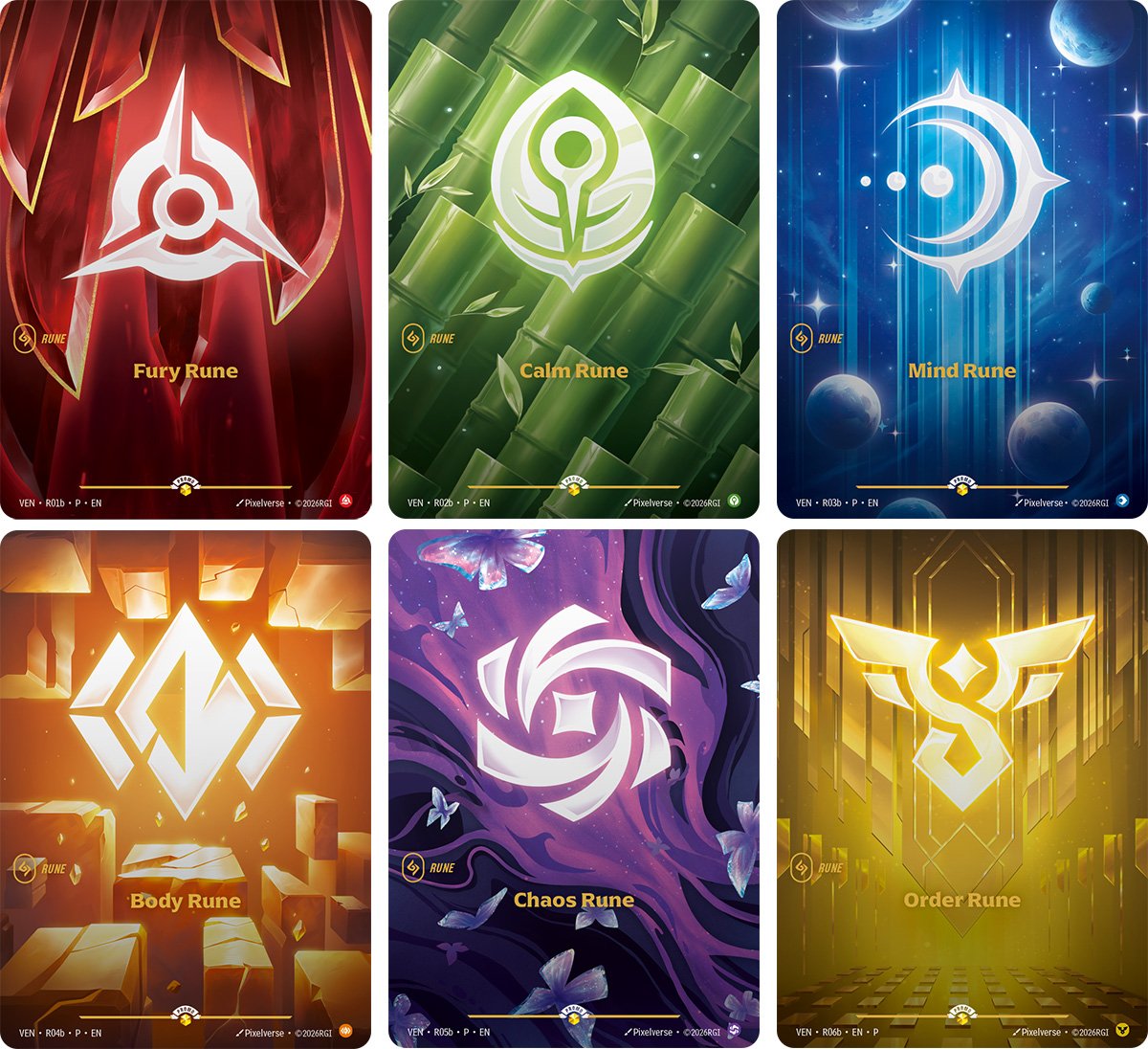
Riftbound has six domains, and your Legend picks two of them for you. Here is what each color actually plays like - its strengths, its blind spots, its signature mechanics - plus the full grid of all 49 Legend cards by domain pairing, and the three rival pairings that did not exist until Vendetta.

Riftbound Tournament Rules Explained - What Actually Gets You a Game Loss
Riftbound has two rulebooks, and the one that decides tournaments is not the Core Rules. The Tournament Rules define three enforcement levels, a round-end procedure that hands out draws, a penalty ladder with hard upgrade thresholds, and - as of 24 July 2026 - a Disciplinary Code that can reach your Riot account.

How to Play Riftbound — The League of Legends TCG Rules, Explained (2026)
Riftbound has no life total. You take objectives. Eight points ends it. Here is the whole rules set as Riot actually wrote it - runes, domains, battlefields, showdowns, deck construction, and the final-point rule that decides more games than any card does.
Riftbound Keywords Explained: All 28 in the Core Rules
The Riftbound Core Rules in force until 15 October 2026 define 25 keywords, and Riot's 9 October update adds Deploy, Disarm and Show Off from 16 October, for 28. The reminder text printed on the card is a summary, not the rule. Here is the whole glossary sorted by what each keyword actually is - passive, triggered, activated, permissive, dependent, cost, or a deck-construction rule that never does anything at the table.