Riftbound Radiance Rules FAQ: 16 Rulings Explained
Riot published the Radiance Rules FAQ on 26 October 2026, three days after the set released. Sixteen questions, and the ones that matter most are Gravity Field, Baron Nashor and what happens when an opponent plays your Neeko.
Three days after Radiance hit shelves, Riot answered sixteen questions about it. The Radiance Rules FAQ and Clarifications went up on 26 October 2026, and it is the follow-up to the Pre-Rift rulings article we covered in the Radiance rules update breakdown, which flagged a full FAQ as still to come. The headline items are Gravity Field, which three separate questions turn on, Baron Nashor, which gets two, and what happens when an opponent plays your Neeko.
What the FAQ is and where it sits
Riot's preamble sets the ranking the same way the Vendetta Rules FAQ did: the FAQ is "a collection of official rulings", and where it differs from the Core Rules Document, the FAQ takes precedence, until a new Core Rules Document is released and supersedes any differing point. It also describes itself as a supplement to the Radiance Release Notes article.
Two other things worth knowing before the rulings:
- It is a rulings article, not a changes article. None of the sixteen answers is errata or a ban. Most are Riot reading an existing rule against a specific card pair, and the Standard Move answer restates what Riot calls established consensus.
- Riot cites rule numbers on ten of the sixteen answers. Where it does, we quote the number so you can find the paragraph in the Core Rules PDF. The other six (Kharox and Neeko, the three Runeblade Anvil answers, Standard Move and Hunker Down) carry no citation.
If you are new to the timing vocabulary the answers use (finalization, replacement effects, the chain), start with Chains and Focus.
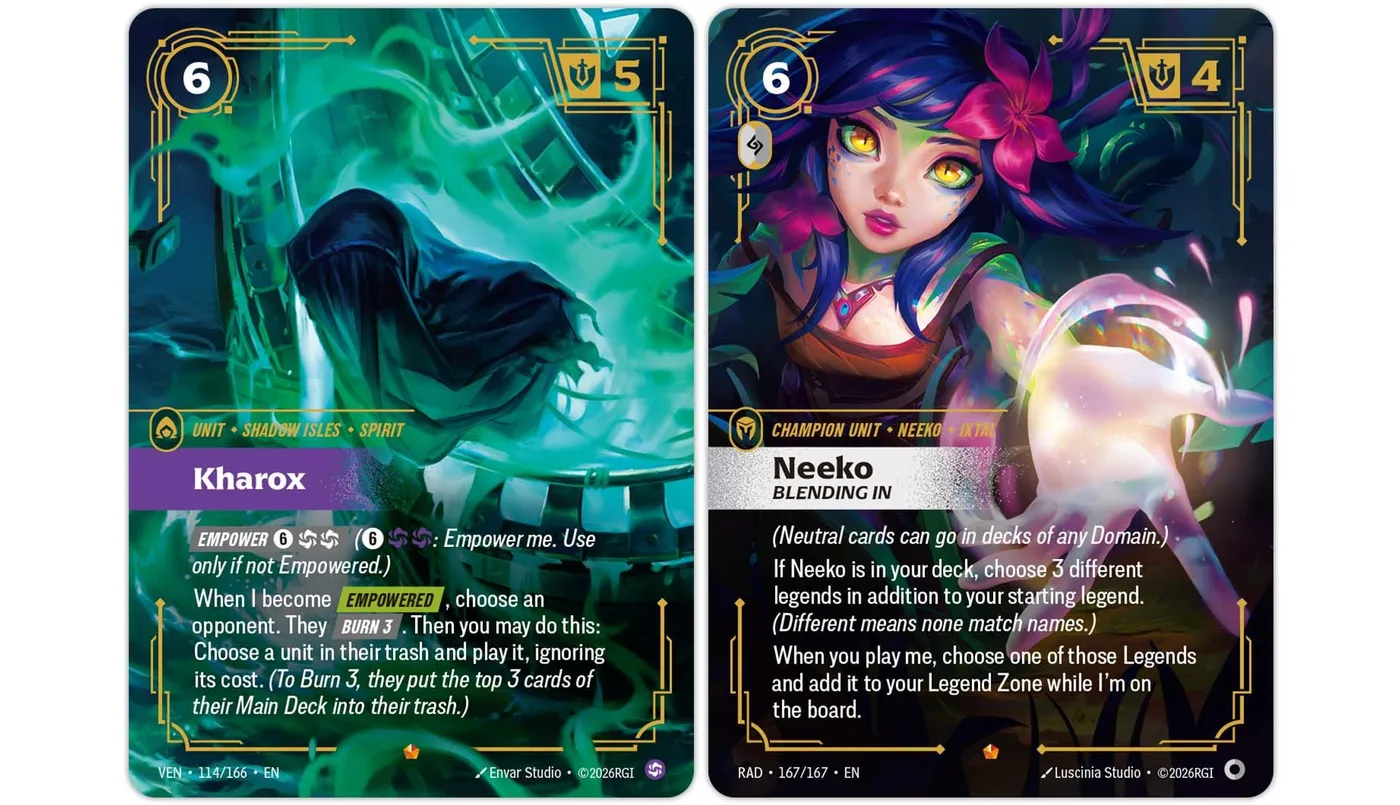
Kharox plays your Neeko, and you keep your Legends
The question: if your opponent empowers Kharox and uses its triggered ability to play your Neeko, Blending In from your trash, do they get one of the Legends you chose at deckbuilding?
No. When the play effect of that Neeko resolves, the player who controls it adds one of the Legends they chose during deckbuilding, "as if they had played a copy of Neeko that they own", but only if their own deck contains Neeko, in the Main Deck or the sideboard. Riot says the added Legends have no relation to the ones their opponent picked. If their deck has no Neeko at all, the instruction is ignored.
The practical read: Neeko is a card that rewards you for what you registered, not for who owns the copy on the table. Stealing yours gives them nothing unless they were already running her. For how the picks work in the first place, see the Neeko section of the rules update.
Seraphic Wyvern does not make Mobilize draw
Mobilize is a 2-cost spell that reads: channel 1 rune exhausted, and if you can't, draw 1. Seraphic Wyvern is a 7-cost Dragon that says if you would channel runes, channel that many plus 1 exhausted rune instead.
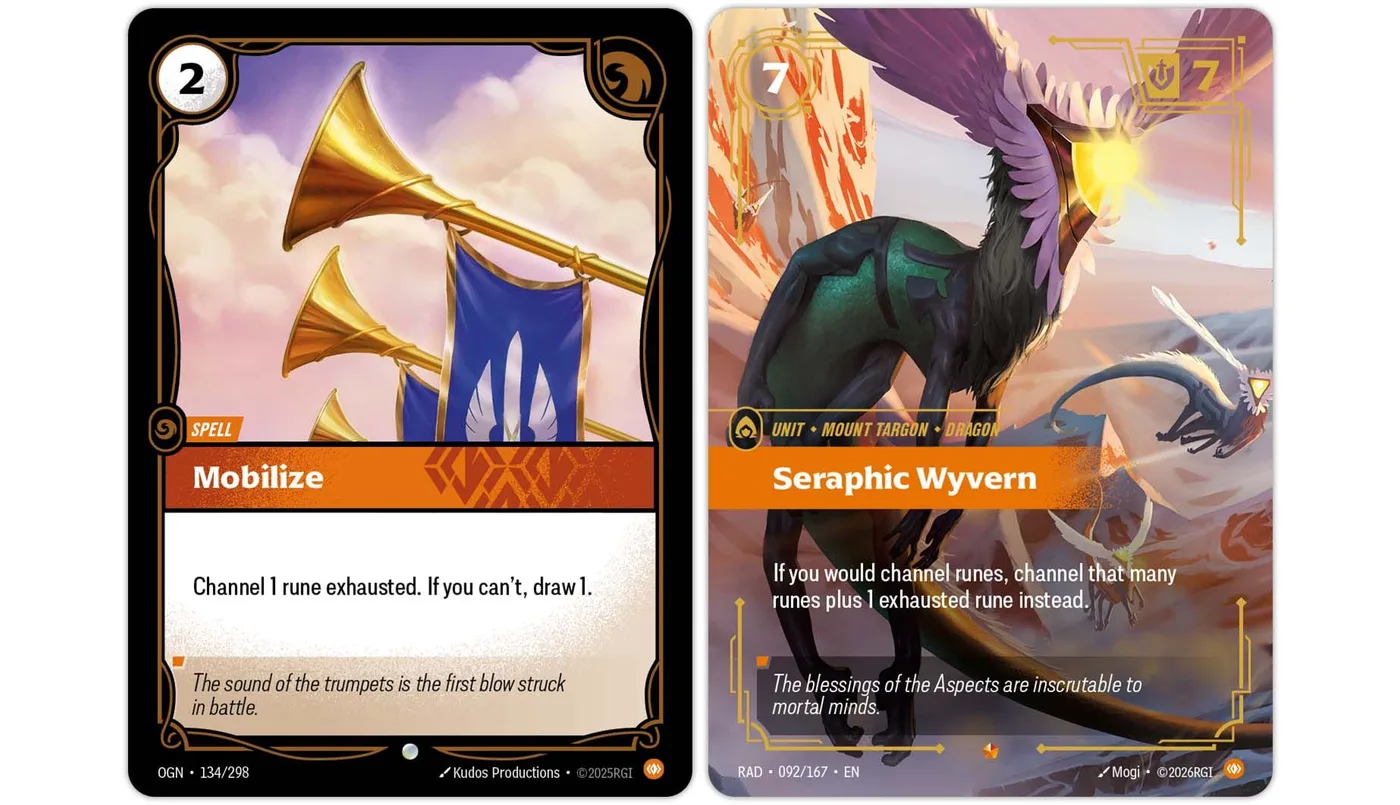
With a Wyvern out and one rune left in your Rune Deck, do you draw? No. Riot's reasoning is that "if you can't" refers only to the original game action, channeling one rune. The extra rune is a new game object introduced by the Wyvern's effect. The Wyvern's extra channel failing does not count as the spell's channel failing, so the draw never turns on.
Riot applies the same logic to Catalyst of Aeons with a Wyvern in play and two runes left: the player was able to channel the 2 runes the spell asked for, even though the Wyvern's additional one was impossible, so they do not draw 1 either. The rule Riot cites is 359.3.e.14.c.
Mordekaiser pays for one thing and not the other
Two questions, one Legend, opposite answers. Mordekaiser, Iron Revenant has a Reaction that banishes a unit or gear from your trash to add Power.
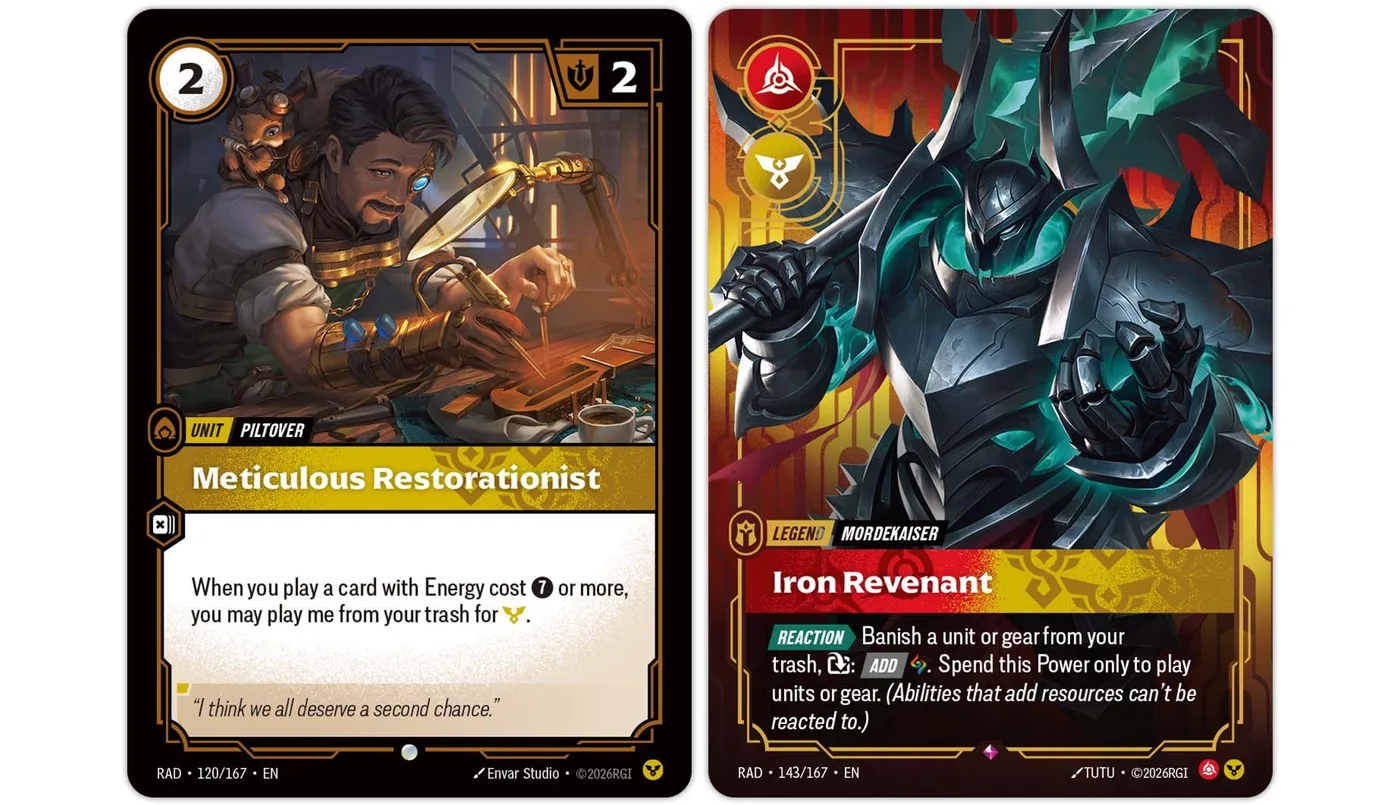
Meticulous Restorationist, yes. You can play it from your trash for its alternate cost via its triggered ability and still banish a unit or gear from the trash with Mordekaiser to pay. Riot's reasoning: "Play me for [Cost]" is an alternate cost that replaces the base cost, and Mordekaiser's added Power can only be spent to play units or gear, and the Restorationist is a unit (Rules 356.1.a).
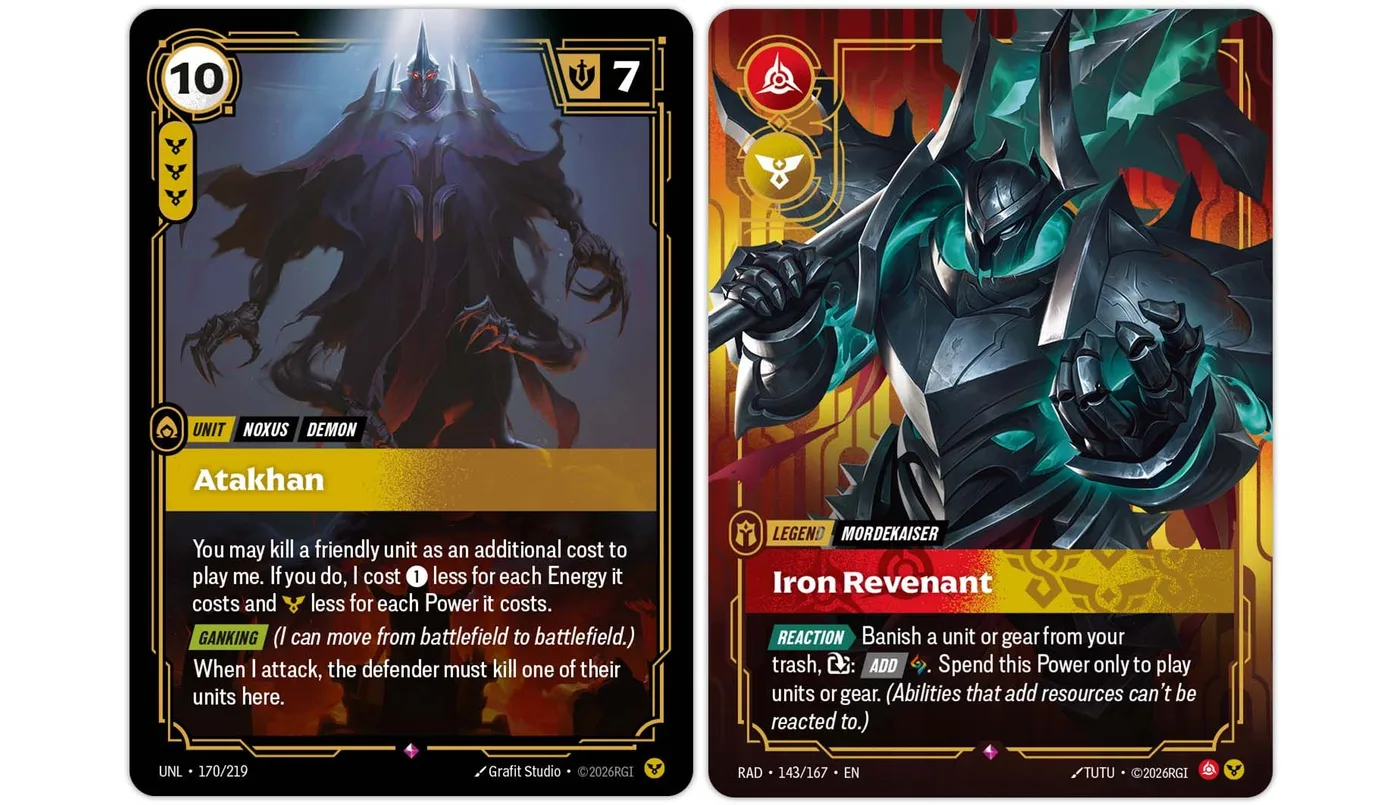
Atakhan, no. If you play Atakhan and kill a non-token unit for its optional additional cost, you cannot then banish that same unit with Mordekaiser to help pay Atakhan's Power cost. The rule is order: Energy and Power costs are paid before the other "non-standard" costs, so when you pay Atakhan's Power the unit you chose to kill is not dead yet and is not in your trash (Rules 357.1 and 357.2).
The line to remember is that additional costs come after Energy and Power. The unit you kill for Atakhan's additional cost is not in the trash yet when Mordekaiser's Power has to be paid.
Runeblade Anvil and the next Ending Phase
Runeblade Anvil is a 1-cost gear. When you play it or when it leaves the board, banish the top card of your Main Deck, and until your next Ending Phase you may play that card. Riot answers three timing questions.
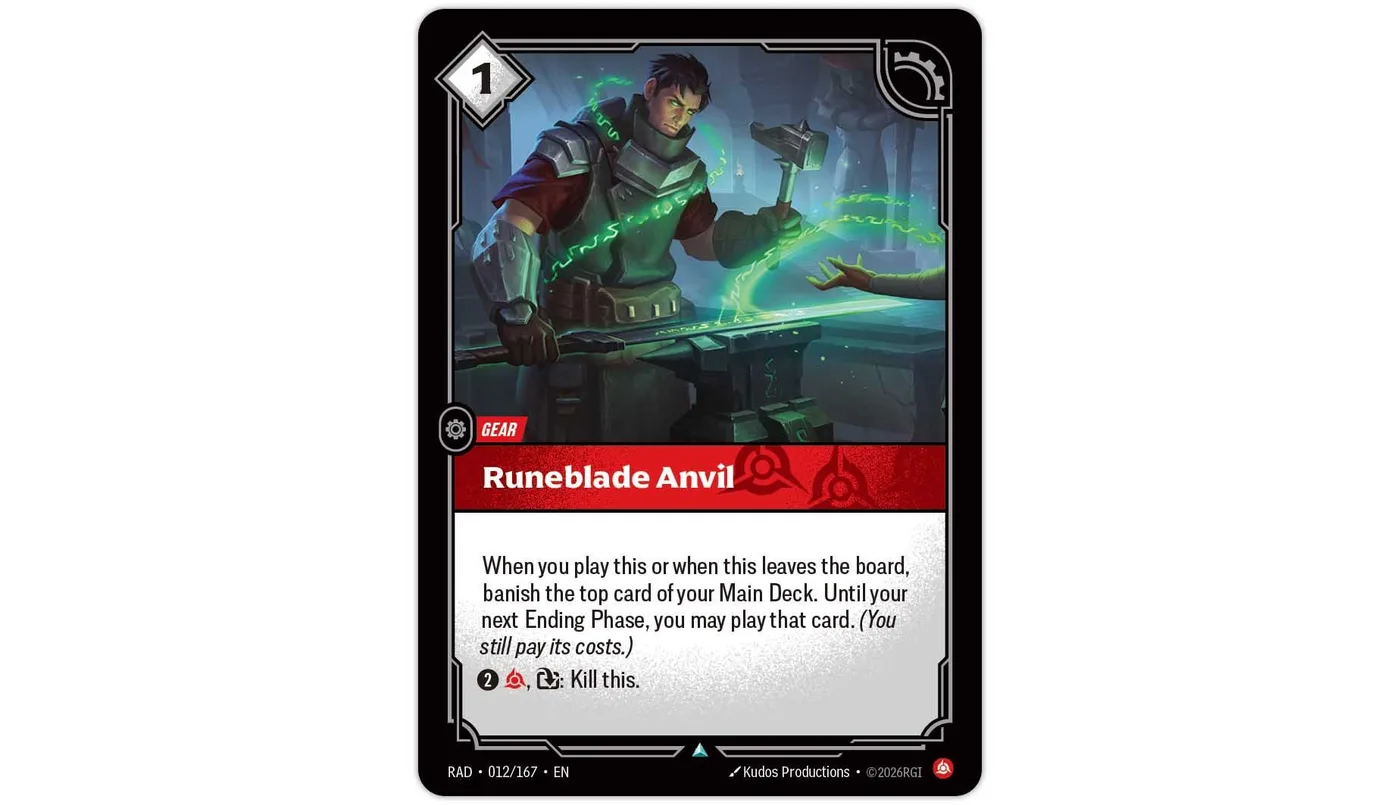
| When Anvil is killed | Last moment you can play the banished card |
|---|---|
| During an opponent's turn | Until the Ending Phase of your next turn begins |
| During your own turn (before your Ending Phase) | You cannot play it in that turn's Ending Phase |
| During your own Ending Phase | Until the Ending Phase of your next turn begins |
The second row is the surprising one. Riot's explanation is that the permission lasts "until your next Ending Phase" and ends at the start of the named point, so an Ending Phase that is still ahead of you in the current turn is too soon to play the card. The permission is lost once that phase begins. Our read: the timing window depends on whose turn it dies on, so if you plan to sacrifice Anvil, do it with the Ending Phase of your next turn in mind rather than assuming you get the card back the same turn.
Baron Nashor and his two replacement effects
Baron Nashor puts the Baron Pit battlefield token onto the board if it is not there already, and enters there. Two rulings cover how that interacts with cost reduction and with Riven.
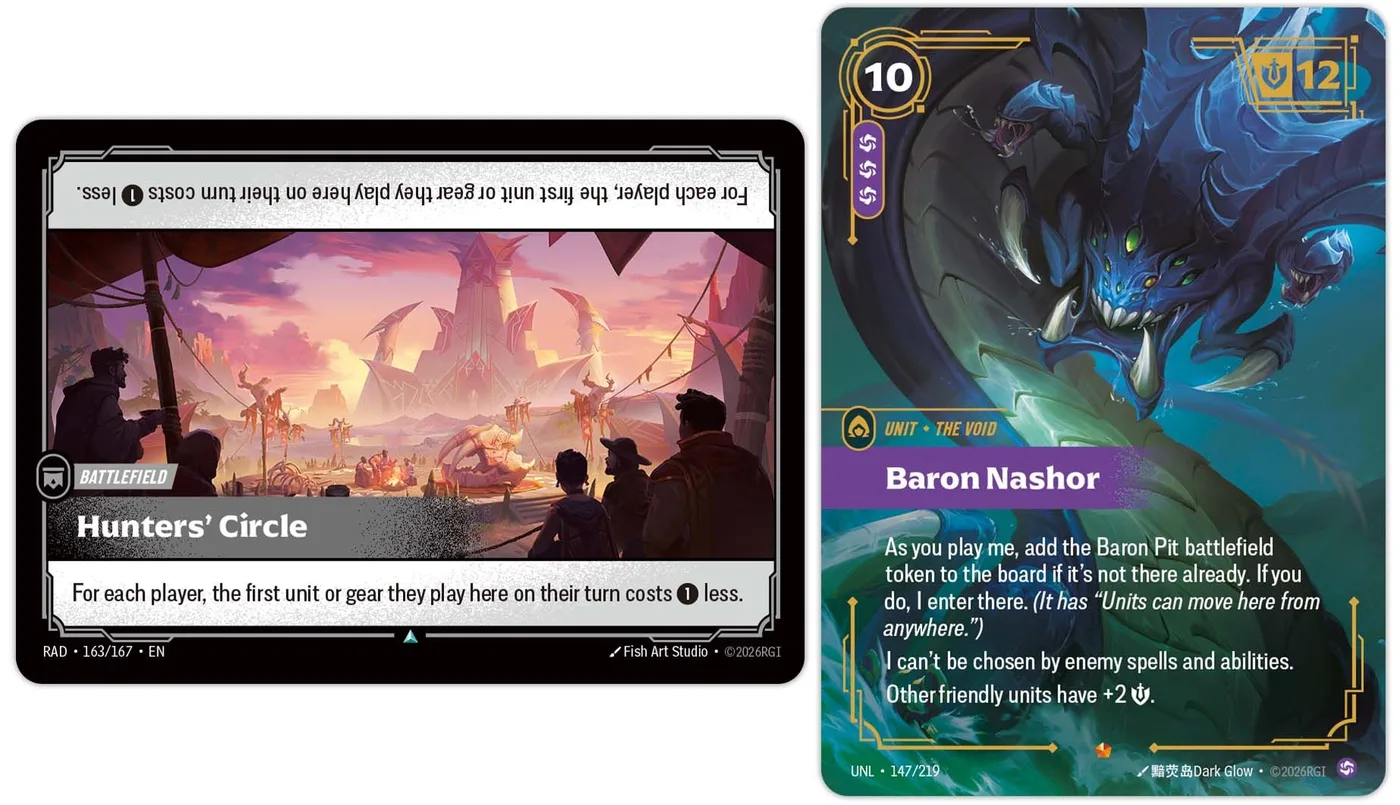
Hunters' Circle. Can you play Baron without a Baron Pit on the board for the reduced cost of [9][C][C][C], with Hunters' Circle in play? Yes. Hunters' Circle reduces the first unit or gear each player plays there on their turn. Riot separates two moments: the cost reduction is applied during finalization, when you pick play locations (step 2) and determine total cost (step 3). Baron's relocation to the Baron Pit is a replacement effect that happens as he resolves and enters the board. By then, his cost has been determined and paid (Rules 355.2).
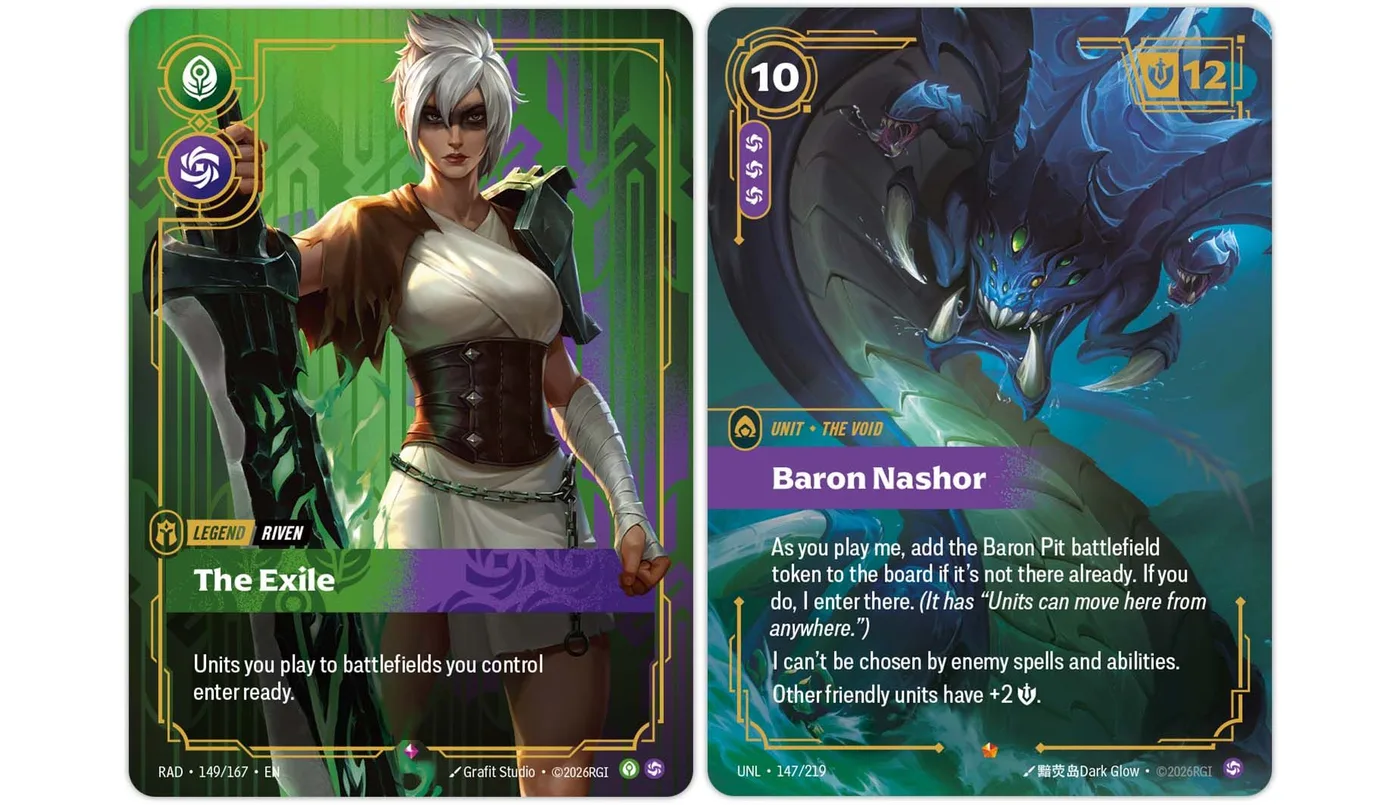
Riven, the Exile. With her as your Legend and a battlefield under your control, can you play Baron with no Pit on the board and have him enter ready? Yes. Riven's effect applies to units you play to a battlefield you control, and it generates a replacement effect that makes them enter ready. Baron's own effect sends him to the Pit. Both replacement effects apply to the same enter event, and Riot says that regardless of order he ends up ready at the Baron Pit (Rules 355.2).
Riven triggers and the order on the chain
Two more Riven questions, about a different card, Riven, Broken Blade.
When do you spend the buff? When the triggered ability resolves, not when you finalize it. Riot's rule of thumb: a cost inside the instructions that is not the first part of a triggered ability's effect belongs to the resolution, not to the ability's base cost. Broken Blade's ability opens with "Choose one that hasn't been chosen this turn", so the buff payment comes after that (Rules 383.3.b).
Which trigger goes first? If you Standard Move Riven, Broken Blade together with a Stellacorn Herder, the exhaust trigger goes on the chain before Stellacorn Herder's move trigger. Riot's stated order is exhaust triggers first, move triggers second, and the move's cost is paid before the move itself happens (Rules 203).
Gravity Field is a cost on the mover
Gravity Field comes up in three of the questions, as many as Runeblade Anvil. It is a 5-cost gear with Deploy, and opponents must pay [1][A] to move one or more units to its battlefield. Riot's three Gravity Field answers share one idea: the cost belongs to whoever is moving the unit, and a move you cannot pay for does not happen. A fourth answer, about Hunker Down, sits next to the Angler Wyrm one.
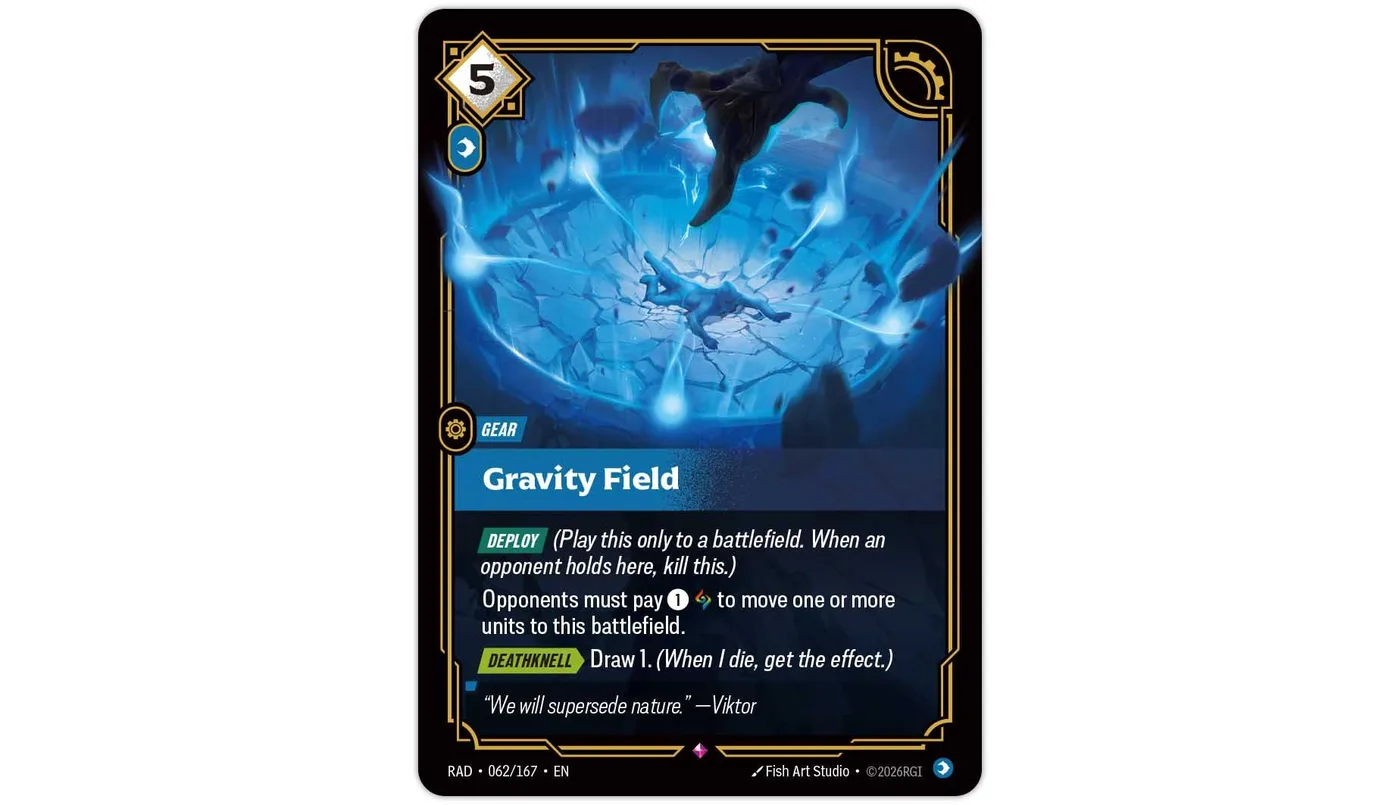
Standard Move. Can you attempt a Standard Move into Gravity Field, decline the cost, and still exhaust your unit? No. Riot describes the Standard Move as an inherent ability and spells out a point it calls "established consensus": you cannot attempt it if the resulting move is impossible or you cannot pay its costs. If a cost you cannot pay comes up mid-move, the whole Standard Move and every action taken as part of it are undone, and the move is cancelled.
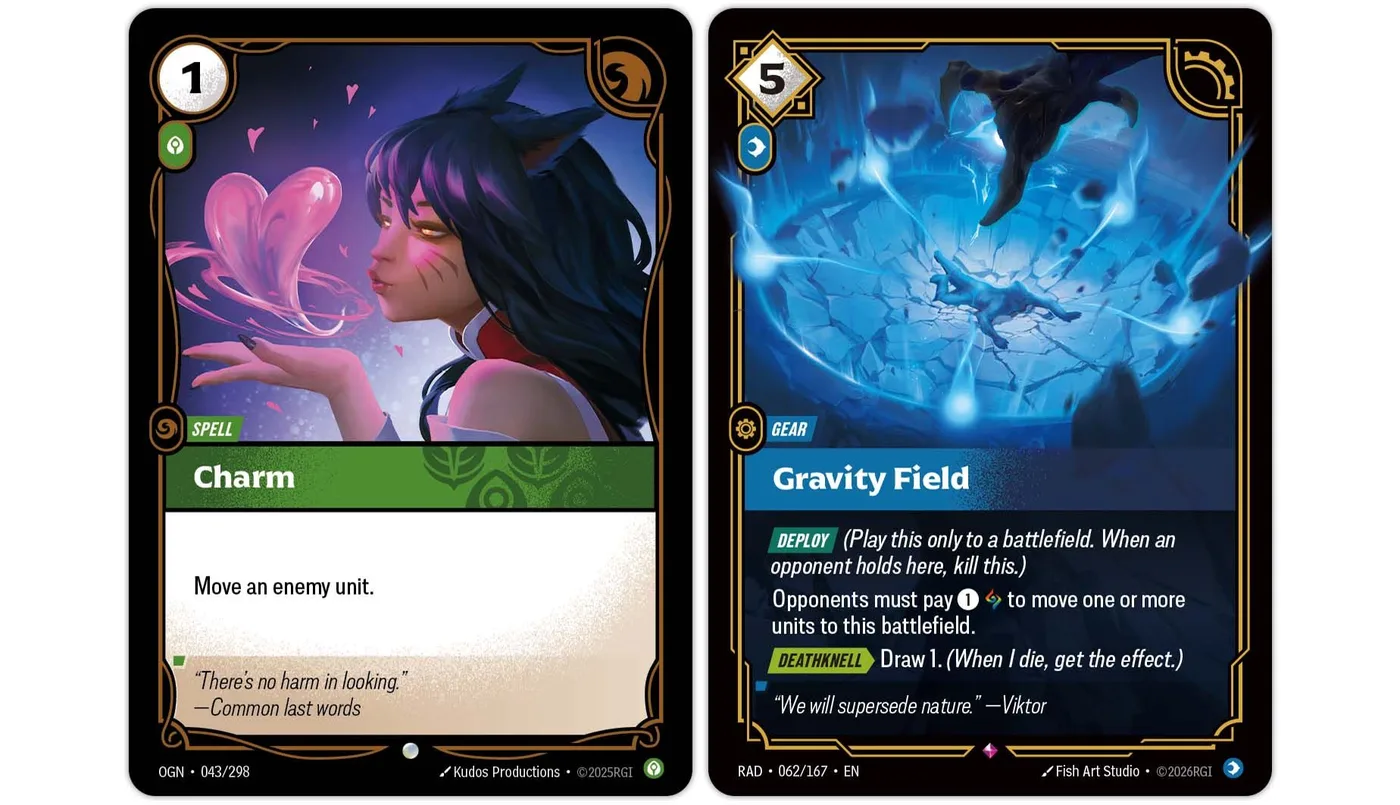
Charm. If you play Charm to move an enemy unit to a battlefield where you control Gravity Field, does its controller pay? No. Charm tells you to move the unit, so the cost would fall on you if your opponent controlled the Gravity Field. Here it is your own gear, so nobody pays (Rules 412.2 and subrules).
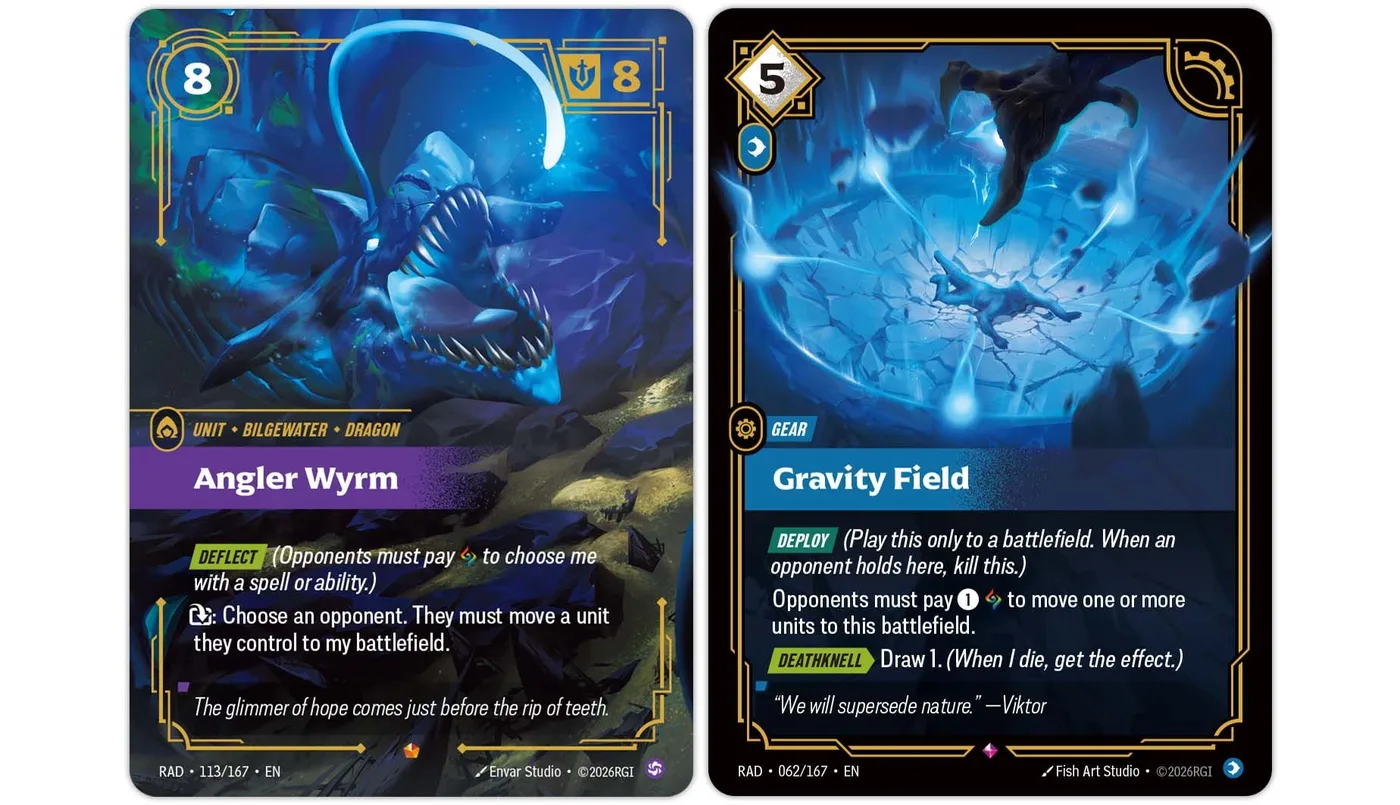
Angler Wyrm. If its activated ability is used while it sits at a battlefield with Gravity Field, does the opponent pay? Yes. Angler Wyrm instructs your opponent to move their unit, so they must pay to move it onto that battlefield. If they choose not to or cannot, the unit does not move (Rules 412.2 and subrules, 204.4, 204.4.b, 204.4.c).
Angler Wyrm and Hunker Down. If your opponent targets you with the Wyrm and you have played Hunker Down on one of your units, can you pick that unit to "move"? No. Riot's wording: the chosen opponent must perform the move game action if they have a unit that can move. Units that cannot move do not satisfy the instruction. If you control none that can move, the instruction is negated. If you control some that can, you must move one of those.
| Situation | Who pays Gravity Field's [1][A] | Does the move happen? |
|---|---|---|
| You Standard Move your unit into an opponent's Gravity Field | You, as the mover | Only if you pay |
| Your Charm moves an enemy unit to your Gravity Field | No one | Yes |
| Your Charm moves an enemy unit to your opponent's Gravity Field | You, as the one instructed | Only if you pay |
| Angler Wyrm instructs your opponent to move | Your opponent | Only if they pay |
The Charm rows come from Riot's own reasoning: the stated answer is the second row, and the third is Riot's "if your opponent controlled the Gravity Field" sentence turned into a table entry.
Possession and Ekko, Revolutionary
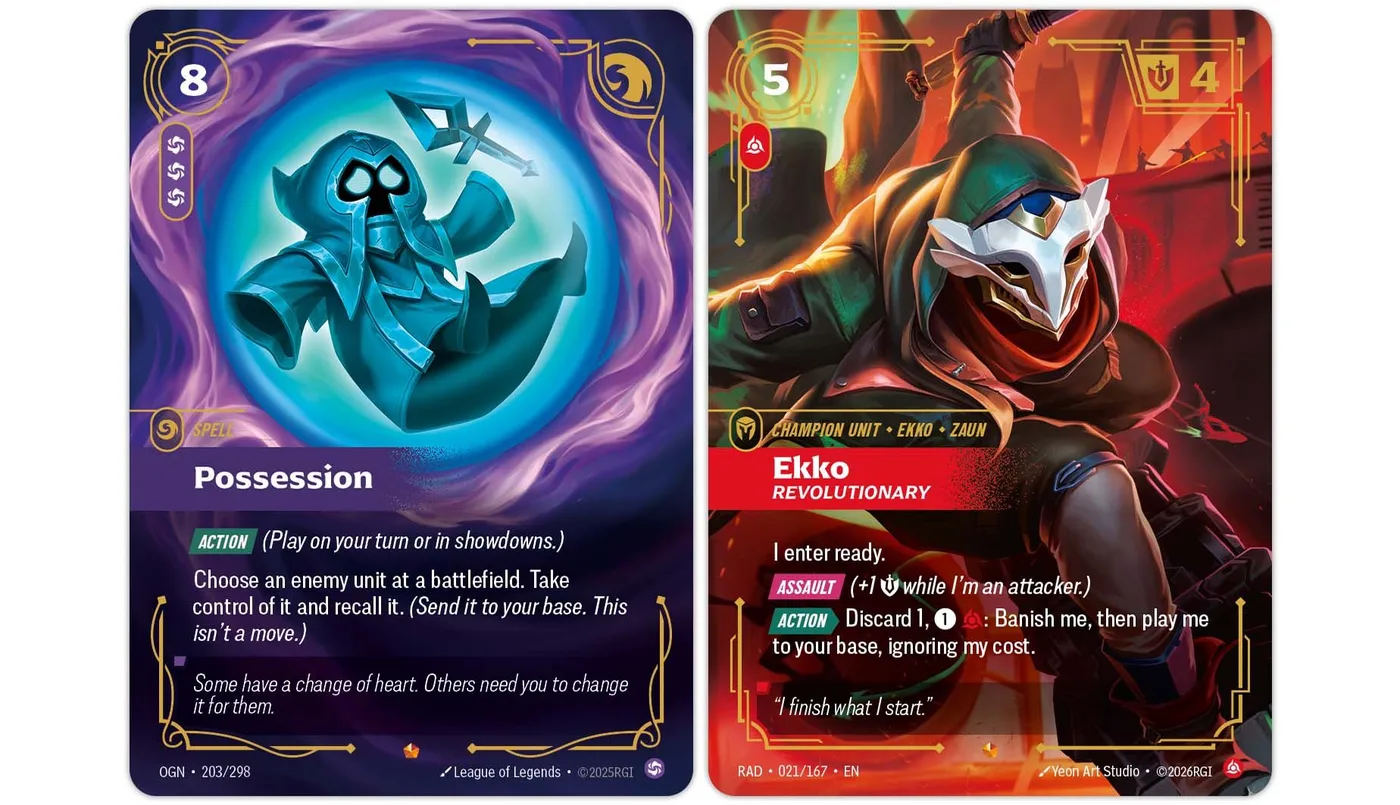
The shortest answer in the article. If you play Possession and take control of your opponent's Ekko, Revolutionary, can you use his activated ability to banish him and then play him, and do you control him when he comes back? Riot's full response is "Yup and yup", citing rules 378 and 191.2. The ability works for you, and the Ekko that returns is yours.
Quick reference
- Kharox plays your Neeko: the player who controls it adds one of their own chosen Legends, only if their deck has a Neeko; otherwise nothing happens.
- Mobilize with Seraphic Wyvern: no card is drawn when the Rune Deck has one rune left. Same for Catalyst of Aeons with two left.
- Mordekaiser: can banish for Meticulous Restorationist's alternate cost; cannot banish the unit you just killed for Atakhan's additional cost.
- Runeblade Anvil: if killed on your own turn before its Ending Phase, you cannot play the card in that Ending Phase.
- Baron Nashor: playable for the Hunters' Circle price without a Baron Pit, and enters ready at the Pit under Riven, the Exile.
- Riven, Broken Blade: the buff is spent on resolution; exhaust triggers go on the chain before move triggers.
- Gravity Field: the mover pays; an unpayable Standard Move is undone entirely; Charm does not make an enemy pay for your own gear.
- Possession: you can use a stolen Ekko, Revolutionary's ability and you control him on return.
Frequently Asked Questions
What happens if my opponent plays my Neeko, Blending In with Kharox in Riftbound?
Can you decline Gravity Field's cost during a Standard Move in Riftbound?
Does Charm make an opponent pay for Gravity Field in Riftbound?
Does Seraphic Wyvern make Mobilize draw a card in Riftbound?
When can you play the card banished by Runeblade Anvil in Riftbound?
Can you play Baron Nashor for less with Hunters' Circle in Riftbound?
Does Baron Nashor enter ready with Riven, the Exile as your Legend in Riftbound?
Keep Reading
- Radiance Rules FAQ and Clarifications (Riot Games, official, 26 October 2026) - every ruling in this post
- Vendetta Rules FAQ and Clarifications (Riot Games, official, 14 August 2026) - the previous FAQ and its precedence wording
- Riftbound Official Card Gallery (Riot Games) - card text and costs
- Riftbound Rules Hub (Riot Games) - Core Rules and Tournament Rules PDFs
Related Guides
Riftbound Going Second: Riot's Start-of-Game Rules Test
Riot says going first wins too often, and on 15 October it published three possible fixes it wants to test at events: the second player starts on 1 point, draws an extra card, or Predicts before their first draw. Turn order would also be settled before battlefields are picked. None of it is a rules change yet. Here is what moves, where the test tables are, and when Riot decides.
Riftbound Radiance Rules Update: Neeko Rulings and Errata
Riot published three Radiance rules documents on 9 October: Core Rules patch notes with ten official rulings, an errata article for four cards, and a Tournament Rules update. Together they settle how Neeko works, what happens to Equipment that Orianna turns into a unit, and what changes at your table from the 16 October Pre-Rift.

Riftbound Vendetta Rules FAQ: Key Rulings Explained
Riot published the Vendetta Rules FAQ on 14 August 2026 and gave it precedence over the Core Rules Document until a new one was released. That new rulebook arrived on 9 October, effective 16 October. The FAQ also reverses a ruling Riot published in January, explains why Kayle can hold three copies of a status the rules call binary, and admits to a bug the Vendetta rules update introduced.
Riftbound Chains and Focus: The HOT FEPR Timing Rules
Riftbound's turn is always in one of four states, and the state - not the card - decides whether you are allowed to play anything. The Core Rules run the whole timing system on two separate permissions called priority and focus, a stack called the chain, and a five-step resolution loop the rulebook actually names in the text: HOT FEPR.

How to Play Riftbound — The League of Legends TCG Rules, Explained (2026)
Riftbound has no life total. You take objectives. Eight points ends it. Here is the whole rules set as Riot actually wrote it - runes, domains, battlefields, showdowns, deck construction, and the final-point rule that decides more games than any card does.

Riftbound Tournament Rules Explained - What Actually Gets You a Game Loss
Riftbound has two rulebooks, and the one that decides tournaments is not the Core Rules. The Tournament Rules define three enforcement levels, a round-end procedure that hands out draws, a penalty ladder with hard upgrade thresholds, and - as of 24 July 2026 - a Disciplinary Code that can reach your Riot account.