Riftbound Tournament Rules Explained - What Actually Gets You a Game Loss
Riftbound has two rulebooks, and the one that decides tournaments is not the Core Rules. The Tournament Rules define three enforcement levels, a round-end procedure that hands out draws, a penalty ladder with hard upgrade thresholds, and - as of 24 July 2026 - a Disciplinary Code that can reach your Riot account.

Riftbound ships two rulebooks, and the one that decides tournaments is not the one you learned the game from. The Core Rules tell you how the game works. The Tournament Rules tell you how events work. The version in force until 15 October runs 50 pages, last updated 16 July 2026 and effective 24 July. Riot's 9 October update, 53 pages, takes effect on 16 October with the Radiance Pre-Rift, and the changes that matter most for this guide are flagged below with that date (the wider 9 October drop, Core Rules included, is covered in the Radiance rules update). Section 104.1 reads the same in both, and it is blunt about which rulebook wins:
In some cases, information in this document may contradict, or provide information not contained in, the Riftbound Core Rules. In all such cases, this document takes precedence for competitions.
So the precedence stack at a sanctioned event runs Tournament Rules, then Core Rules, with any event-specific addenda beating both. Worth internalising before your first Summoner Skirmish, because Riftbound's penalty philosophy is genuinely not a copy of the game you came from.
If you have not read the base game, start with how to play Riftbound. This is the layer that only matters once there is a clock on the table.
Three enforcement levels, and you are probably at the lowest one
Much of the document is gated behind Organized Play Level, or OPL. It is not a difficulty rating. It is a statement of how hard the rules bite.
| OPL | What Riot expects of you | Penalty severity |
|---|---|---|
| Casual (low) | Know most of the Core Rules. Judges focus on "education and sportsmanship" and there is "no priority placed on technically precise play" | Lowest |
| Competitive (high) | Know the Core Rules and the Tournament Rules, while accepting that some entrants are new to precise play | Stricter |
| Professional (high) | Know both documents "completely", and hold "the highest standard of behavior and technically precise play" | Strictest |
The document then refers to "high OPL" as shorthand for Competitive and Professional together, and that phrase appears 22 times in the July document and 23 times in the October update - each one a rule that behaves differently depending on which kind of event you walked into. If you take one structural fact from this article, make it that one.
The ladder, from Nexus Night to Worlds

Riot's organized play structure maps events onto those three levels:
- Prerelease events (one week before a set) and Nexus Nights (weekly, store's choice of 1v1, 2v2 or free-for-all) run at Casual.
- Summoner Skirmish runs twice per set at Competitive. Riot's launch plan listed a participation promo, a Top 8 promo, a Champion playmat and a round one bye at Regional Qualifiers, but the August 2026 State of Play changed that: Skirmishes continue through Radiance and then retire, and the Radiance ones (starting 9 November and 14 December 2026) offer no bye, with augmented prizing instead. An unused bye, including one earned at a Vendetta Skirmish, can still be redeemed at a Riftbound Regional event through 2027. From 2027 the Challenge Series and the monthly Nexus Cup replace Skirmish, as covered in 2027 organized play.
- Regional Qualifiers are open - no qualification needed - and also run at Competitive.
- Regional Championships require an invite and run at Professional. Worlds, first planned for 2027, likewise.
There is now a fourth rung the launch-era coverage predates. The Showdown Series, announced 29 May 2026, is Standard Constructed run by partnered organizers across North America, Europe and Asia-Pacific, and it hands out Regional Championship invites directly, scaled by attendance:
| Tier | Attendance | Regional Championship invites | Regional Qualifier passes |
|---|---|---|---|
| Tier I | 512+ players | Top 4 | Top 16 |
| Tier II | 256-511 | Top 2 | Top 8 |
| Tier III | 128-255 | Top 1 | Top 4 |
Riot's 29 May announcement confirmed nine 2026 events running 4 July through 30 October. The August roadmap put three Showdown Series stops on the single weekend of 15 to 16 August - Auckland, Speyer and Los Angeles.
The other route stays what it was: Top 64 at a Regional Qualifier earns a Regional Championship invitation. Los Angeles, 25 to 27 September, was the last Regional Qualifier of 2026.

Both 2026 Regional Championships now have dates and venues, which the 2026 set schedule was written too early to carry. The European event is in Hall H of Messe Stuttgart, 6 to 8 November 2026, played in Standard with Radiance legal: six Swiss rounds on Friday, 12 or more match points to reach Day 2, six more Swiss rounds on Saturday, Top 8 into single elimination, finals on Sunday. Published prize pool is $50,000, $10,000 of it for first. The North American Regional Championship runs at Convergence Fest in Las Vegas, 11 to 13 December 2026. Top 8 at each earns a Worlds invitation.
What high OPL actually switches on
Here is the practical checklist of what changes the moment an event is Competitive or Professional rather than Casual:
- Decklists become mandatory, registered before round one, and once delivered to an official they cannot be changed. The list must unambiguously record your Champion Legend, battlefields, Main Deck including Chosen Champion, Rune Deck and sideboard. From 16 October it must also record any cards picked under special deckbuilding rules, such as the three Legends chosen for Neeko, Blending In.
- Deck checks happen. At least 10% of decks, chosen at random, get checked over the course of the event - after decks are randomised and presented, before opening hands are drawn. From 16 October, random checks happen at the start of a round, verify every element of the registered deck, and may also run after mulligans as long as play has not begun.
- Sleeves become a requirement on Main Deck, Rune Deck and battlefields, and two extra bans apply: no highly reflective backs, no holographic patterns on either face.
- Board layout is legislated. Runes closer to you than nonrunes, Main Deck and trash together on one side, Rune Deck on the other, Legend between your nonrunes and your Chosen Champion, and all exhausted objects rotated 90 degrees the same way.
- Judges stop answering the question you want to ask. Riot's own example: "If I attack and conquer this battlefield with my Tryndamere, Barbarian, will I score the winning point?" is out of bounds; "Can point scoring abilities like Tryndamere's score you the winning point?" is fine. Judges may ask you to rephrase.
- At Professional only: shuffling your opponent's deck stops being optional and becomes required, spectators lose the right to pause a match to flag an issue, decklists are typically open, and extra cards stored in your deck box that are not on your list upgrade from a Warning to a Game Loss.
Deck construction itself does not change much - exactly 40 Main Deck cards including your Chosen Champion, one Legend, 12 runes, exactly three battlefields with unique names, and a sideboard of 10 or fewer. That side of it is covered in deckbuilding basics.
The clock: three extra turns and a two-point rule
Riot recommends 60 minutes per Swiss round. What happens when that expires is the part worth memorising, because it produces draws.
When time is called mid-game, the current player finishes their turn, then three additional turns are played, untimed. Then:
- If a player is ahead by two or more points, they win the game.
- If nobody has a two-point lead, the game is a draw.
- If you were between games when time hit, no new game starts.
From 16 October, players must also announce and acknowledge each additional turn as it happens.
The match result is then whoever has more game wins, or a draw if that is level. Note what this does to a 6-5 scoreline: a one-point lead after the extra turns is worth nothing. If you are ahead on points with the clock dying, you need the second point, not the first.
Single elimination is supposed to be untimed so games finish naturally. Where a timer is unavoidable, the altered procedure in 408.4 kicks in: same finish-the-turn-plus-three, but here the highest point total simply wins the game, and if both game score and point score are tied, players keep going until the next point is scored - and that sudden-death point still obeys the Final Point restriction from the Core Rules. If a fresh game has to start with the clock already dead, it gets five additional turns instead of three before sudden death.
Standings tiebreakers, in order: opponents' mean match win percentage, then your game win percentage, then opponents' mean game win percentage, then a random method chosen by the scorekeeper.
The penalty ladder and the numbers that upgrade it
Four penalties exist: Warning, Game Loss, Match Loss, Disqualification. Riot's stated philosophy is that errors are assumed unintentional - "If the judge believes it was intentional, it is cheating" - and that judges should not stop errors from happening, only deal with them once they have.
The upgrade thresholds are hard numbers, and they are tracked separately for game play errors (section 702) and tournament errors (section 703):
| Trigger | Result |
|---|---|
| Same category of error, 3+ Warnings in one event | Upgrades to Game Loss |
| Any 6 error Warnings in one event, Competitive OPL | Upgrades to Game Loss |
| Any 5 error Warnings in one event, Professional OPL | Upgrades to Game Loss |
| Same category of unsporting conduct, 2+ Warnings | Upgrades to Game Loss, and possibly further |
That Professional row is the one to sit with. Five sloppy moments across a single event and you are handing over a game, even if no individual one of them was serious. Failure to Maintain Game State is the deliberate exception - it is a Warning that exists for tracking and never upgrades unless a head judge says so.
Game losses apply immediately if a game is running, or to your next game if not. If both players earn one simultaneously, the game is a draw and both are recorded.
Which errors cost you nothing, and which cost you a game
A whole class of common mistakes carries no penalty at all - they get remedied and play continues.
| Error | Penalty | Note |
|---|---|---|
| Missed trigger | No Penalty | Warning if the trigger was mandatory and missing it helped you |
| Forgetting to score a point from hold or conquer | No Penalty | Fixed if within a full round cycle |
| Forgetting to draw | No Penalty | Warning if forgetting helped you, e.g. near burnout |
| Channeling too few runes | No Penalty | Warning if it helped you |
| Overpayment for a cost | No Penalty | Until 15 Oct, the extra resources float if it is still the same turn. From 16 Oct, a simple rewind if possible, otherwise play continues, with nothing floating |
| Forgetting to ready in your Awaken Phase | No Penalty | Warning if it helped you |
| Drawing extra cards | Warning | Opponent picks which cards go back |
| Mispayment for cost, channeling too many runes | Warning | Rewind if possible |
| Slow play | Warning | Intentional stalling is cheating |
| Deck presentation error | Warning | Game Loss if someone else catches it after opening hands. From 16 Oct, a Chosen Champion left in the deck has its own remedy instead, set by OPL |
| Decklist error | Game Loss | No warning tier at all |
| Improperly determining a winner (dice, coin flip) | Match Loss | Includes offering to. From 16 Oct, a Disqualification at Professional, and knowingly attempting it is cheating |
| Bribery | Match Loss | Prize splitting in single elim is explicitly not bribery |
| Wagering, theft, cheating, unsporting major | Disqualification | Automatically opens an investigation |
Two of those deserve a second look. Decklist Error is a flat Game Loss - more or fewer cards than the deck size, four copies of a card between main deck and sideboard, a Chosen Champion that does not match your Legend's identity, or a physical deck that does not match the list you handed in. There is no "first offence" cushion. Count your list twice.
And the "if it helped you" clause runs through the whole no-penalty column. Forgetting to draw when you are close to burning out is not the same mistake as forgetting to draw on turn three, and the document treats it that way.
Late to match has its own ladder: inside 2 minutes is a Warning plus a time extension; inside 10 minutes is a Warning at Casual but a Game Loss at high OPL; past 10 minutes is a Match Loss. You can also ask a judge for up to a 10 minute extension in lieu of penalty before the clock starts or between games - the document's example is a bathroom break.
Missed triggers carry no penalty, which is not the same as no consequence
A trigger you do not acknowledge is forgotten, and a forgotten trigger never goes on the chain at all.
The test is "observable impact". You must acknowledge the trigger before the first moment it would visibly change the game, and acknowledgement now explicitly requires communicating it - saying it out loud, pointing at it, whatever both players have agreed reads as a signal. That communication requirement is new in the July 2026 update; the changelog lists it as added to 502.6.a and 506.3.a.
Riot's own examples of observable impact are unusually concrete: a change to a point total (Ahri, Alluring), a change to a rune total (Startipped Peak), adding a Buff token (Sett, Brawler), a draw or discard (Traveling Merchant), an exhaust or ready (Miss Fortune, Captain), a unit moving (Stealthy Pursuer), or a player asking about public information the trigger would have changed. The counter-example matters just as much: "When you play a spell, give me +1 Might this turn" has no observable impact until that Might is relevant, so you have until combat, not until the spell resolves.
The 16 October update adds three more examples: a trigger that makes a player choose something, such as a unit or gear, even when only one choice is legal; one that gives a player resources such as XP or floating Energy or Power; and one that moves a card between zones, such as a unit taking lethal damage. Non-lethal damage is not an observable impact.
Two consequences worth pinning down:
- A forgotten trigger still counts as having triggered. Anything that counts or restricts "first time" triggers counts the one you missed.
- If it was missed this turn, your opponent chooses. The next opponent in turn order decides whether to resolve it immediately or let it stay missed. Missed on a previous turn, and play simply continues.
There is one carve-out for triggers that fire "At the start of each player's first Beginning Phase" - Obelisk of Power and The Arena's Greatest are the named examples. For those you get the whole turn to acknowledge, regardless of observable impact.
Deliberately playing fast to make your opponent miss their trigger is prohibited outright, and abusing the rule to skip your own mandatory triggers is a penalty.
You can take it back, but only in defined situations
Riftbound's default is that a communicated action is final - 509.2 says so outright - and then the document carves out exceptions. At Casual you may reverse your most recent action freely so long as no new action has been taken by either player. At Competitive and Professional, the July rules in force until 15 October make the same reversal legal in four defined cases:
- Changing a choice for a spell or ability immediately after all choices for putting it on the chain have been communicated - the document's example is playing Discipline, indicating a unit, then switching targets or unplaying it.
- Changing where you played a unit or gear, immediately after playing it - Traveling Merchant to Reaver's Row, changed to base, or not played at all.
- Changing a choice such as a move or a discard immediately after making it.
- Undoing a decision to exhaust or recycle runes.
Riot's 9 October update, effective 16 October, cuts that high-OPL list to the first three and gives runes a rule of their own. The new 509.5 lets a player at any OPL ready runes they just exhausted for Energy, or unrecycle runes they just recycled for Power, as long as no new action has been taken and focus has not been passed. Runes spent on a decision you are allowed to change come back with it.
A new 509.6 then shuts a door at high OPL: once your opponent has to point out information that shows your decision was a tactical error, you cannot reverse it. Riot's example is moving a 3 Might unit to a battlefield and passing focus, only for the opponent to point out that their 2 Might unit there is at 4 Might thanks to their Wuju Bladesman legend. That move now stands. The one opening is a decision based on public information that was misrepresented, which the head judge may still rewind - and misrepresenting information to earn a rewind is cheating.
The guardrail in both versions is section 704.4: doing this to fish for information is angle shooting, a Warning. You may not change a decision based on your opponent's physical reaction or because they started to respond, and take-backs still cannot become a pace problem.
Several other entries on the angle-shooting list are worth reading twice: taking actions quickly to deny an opponent priority, promising a concession to extract information, baiting an opponent into a rules violation, and "attempting to mislead an opponent during gameplay based on cards that have rules errata" - which, given the eight cards that got errata in July whose printed text is now wrong, is not hypothetical.
Sleeves, layout, notes and phones
The small stuff that still has a rule attached:
- Proxies are banned at every OPL, full stop. The only legal proxy is one a head judge issues to replace a card ruled unusable.
- Alters are legal provided they do not obscure the card name or cost (from 16 October, Might and Might Bonus too), do not make the art unrecognisable, contain no substantial strategic advice, and are not offensive. Judges may bar them from streamed matches.
- Cards of any language are legal. You can call a judge at any time for the Watcher wording in the language you prefer.
- Note sheets must be empty and visible to opponents and officials at the start of every match. You may not consult notes from any previous match during a game, though between games you may refer to notes made before the match. From 16 October those pre-match notes are allowed during sideboarding and after battlefields are revealed, but must be put away once opening hands are drawn, before mulligans.
- Phones are fine between matches, not during them. At Casual a device can replace the paper note sheet. From 16 October, breaking the device rules is an Outside Assistance Warning.
- Pile shuffling does not randomise a deck. It is a counting method only, and presenting a deck that has only been pile shuffled is Insufficient Randomization.
- Score must be tracked legibly in writing. Dice or a phone only count at Casual. Floating Energy or Power and XP must be represented clearly, but do not have to be written down.
The Disciplinary Code Riot added in July
The single biggest change in the 24 July update was not a rules tweak. Section 705, the Disciplinary Code, is entirely new, and it applies to every player in a premier or qualifier competition. You accept it by signing a registration form, by clicking accept online, or simply by "participating in any Regional Championship, Regional Qualifier, Showdown Series, or any equivalent events."
What it authorises is a wider set of sanctions than the in-event penalty ladder: public or private warnings, prize forfeiture including the return of money and trophies already awarded, venue bans, forfeiture of points or ranking, suspension or ban from Riftbound competitions, and Riot game account suspension or termination. A paper card game infraction can now reach an account.
Two clauses have teeth beyond the tournament hall. The Code "applies globally anywhere Riftbound competitions are held" and can reach conduct outside competition play entirely where Riot judges it could damage a Riftbound competition or be associated with Riot. And 705.2.g removes the obvious defence: violations are actionable "whether or not they were committed intentionally or as part of a joke, a stunt, or some form of social media performance."
Quick reference
- Tournament Rules beat Core Rules at events. Event addenda beat both.
- Three OPLs: Casual, Competitive, Professional. "High OPL" means the latter two, and the phrase appears 22 times in the July document, 23 in the October update.
- Riot's 9 October update takes effect 16 October. The July rules apply until then.
- 60 minutes recommended per Swiss round. At time: finish the turn, three more turns, then you need a two-point lead or it is a draw.
- Decklist Error is a straight Game Loss. No warning tier.
- Missed triggers carry no penalty - unless the trigger was mandatory and missing it helped you.
- Warnings upgrade at 3 of the same category, or 6 total at Competitive, 5 total at Professional. Unsporting conduct upgrades at 2.
- Late to match: under 2 minutes a Warning, under 10 a Game Loss at high OPL, over 10 a Match Loss.
- Take-backs exist at high OPL in four defined situations until 15 October, and three from 16 October, when undoing a rune exhaust or recycle becomes its own rule at every OPL, allowed only before a new action or a focus pass. Using take-backs to fish for information is angle shooting.
- Improperly determining a winner is a Match Loss, and from 16 October a Disqualification at Professional OPL.
- Deck checks hit at least 10% of decks at high OPL, chosen at random.
- Proxies are banned everywhere. Alters are allowed within limits.
- Section 705 is new. Sanctions run up to Riot account termination and can reach conduct outside events.
If you are stepping up from Nexus Nights to a Summoner Skirmish, three things are worth checking twice: your decklist count, the round one start time, and the habit of saying your triggers out loud. None of them are skill. All three are free to fix.
Frequently Asked Questions
Do the Riftbound Tournament Rules override the Core Rules?
What is Organized Play Level in Riftbound?
What happens when time runs out in a Riftbound tournament round?
Is a missed trigger a penalty in Riftbound?
How many warnings before a game loss in Riftbound?
What is the Riftbound Showdown Series and how do you qualify from it?
Can you take back a play in a competitive Riftbound match?
What is the Riftbound Disciplinary Code?
Keep Reading
- Riftbound Tournament Rules PDF, July version (Riot Games, official) - last updated 16 July 2026, 50 pages, in force until 15 October
- Riftbound Tournament Rules PDF, October version (Riot Games, official) - last updated 9 October 2026, 53 pages, effective 16 October
- October 2026 Tournament Rules Changelog (Riot Games, official) - published 9 October 2026, effective with the Radiance Pre-Rift on 16 October
- August 2026 State of Play (Riot Games, official) - published 4 August 2026, Summoner Skirmish retires after Radiance and drops byes
- The Radiance Overview (Riot Games, official) - Radiance Summoner Skirmish dates and prizing
- All Eyes on Los Angeles (Riot Games, official) - published 11 September 2026, the final Regional Qualifier of 2026
- Riftbound Rules Hub (Riot Games) - Core Rules, Tournament Rules and the Constructed and 2v2 ban lists
- July 2026 Tournament Rules Update & Changelog (Riot Games, official) - published 17 July 2026, effective 24 July
- April 2026 Tournament Rules Update & Changelog (Riot Games, official) - published 29 April 2026
- Riftbound Organized Play (Riot Games, official) - the OPL system and the Nexus Night to Worlds structure
- Announcing the Showdown Series & Le Rift Tour (Riot Games, official) - published 29 May 2026
- 2026 Regional Championship Info (Riot Games, official) - Stuttgart and Las Vegas dates, format and prizing
- August 2026 Roadmap (Riot Games, official) - published 5 August 2026, the event calendar into 2027
Related Guides
Riftbound Sealed and Draft: The Limited Format Rules
Riftbound Limited is not constructed on a budget - it switches off most of the deckbuilding rules you learned. Sealed hands you six packs and a 25-card minimum, Draft hands you three packs and a 20-card minimum, and both let you run ten copies of the same card, ignore Unique, and play cards that are banned in Standard.
Riftbound Multiplayer Rules - How 2v2, Skirmish and War Actually Work
Riftbound has five sanctioned modes and almost everyone plays one of them. The team format is called Magma Chamber, it wants 11 points instead of 8, your partner cannot reinforce your battlefield, and it has a ban list of its own containing exactly one Legend that is legal everywhere else.

Riftbound Radiance Rules Update: Neeko Rulings and Errata
Riot published three Radiance rules documents on 9 October: Core Rules patch notes with ten official rulings, an errata article for four cards, and a Tournament Rules update. Together they settle how Neeko works, what happens to Equipment that Orianna turns into a unit, and what changes at your table from the 16 October Pre-Rift.

Riftbound Vendetta Rules FAQ: Key Rulings Explained
Riot published the Vendetta Rules FAQ on 14 August 2026 and gave it precedence over the Core Rules Document until a new one was released. That new rulebook arrived on 9 October, effective 16 October. The FAQ also reverses a ruling Riot published in January, explains why Kayle can hold three copies of a status the rules call binary, and admits to a bug the Vendetta rules update introduced.

How to Play Riftbound — The League of Legends TCG Rules, Explained (2026)
Riftbound has no life total. You take objectives. Eight points ends it. Here is the whole rules set as Riot actually wrote it - runes, domains, battlefields, showdowns, deck construction, and the final-point rule that decides more games than any card does.
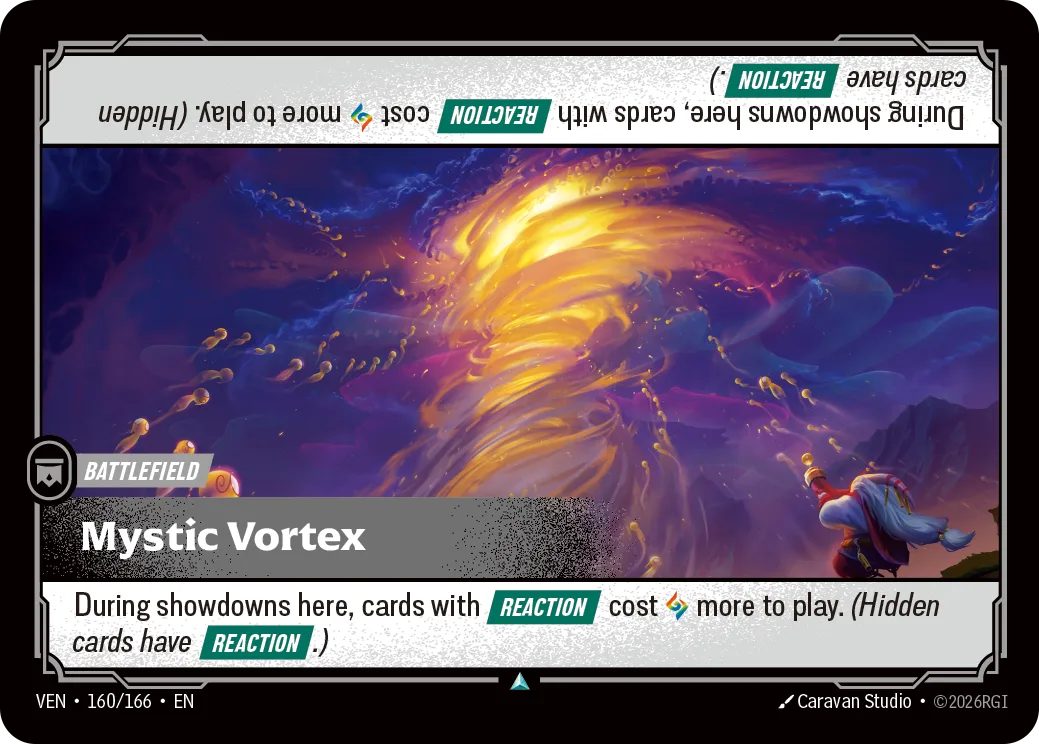
Riftbound Chains and Focus: The HOT FEPR Timing Rules
Riftbound's turn is always in one of four states, and the state - not the card - decides whether you are allowed to play anything. The Core Rules run the whole timing system on two separate permissions called priority and focus, a stack called the chain, and a five-step resolution loop the rulebook actually names in the text: HOT FEPR.