Riftbound Going Second: Riot's Start-of-Game Rules Test
Riot says going first wins too often, and on 15 October it published three possible fixes it wants to test at events: the second player starts on 1 point, draws an extra card, or Predicts before their first draw. Turn order would also be settled before battlefields are picked. None of it is a rules change yet. Here is what moves, where the test tables are, and when Riot decides.
Riot thinks the player who goes first in Riftbound wins too often, and on 15 October it put that in writing. Its Organized Play article Testing Start of Game Rules says the first player's win rate is higher than Riot wants, and sets out three possible fixes it will trial at events before deciding whether to adopt one. What it does not give is the win rate itself.
Nothing in the article changes how you play at your store this week, and Riot says so directly. What it does tell you is what a test table will ask of you, where those tables are, and when Riot plans to decide. Here is what it says, with the current rules alongside so you can see what moves. If you want the basic setup first, our how to play guide walks through it.
What Riot announced on 15 October
The test changes two things at the start of a 1v1 game:
- Turn order is decided before battlefields are selected, in both best-of-three and best-of-one play.
- The second player gets one more perk. On top of the three runes they already channel on their first turn, they either start the game on 1 point, draw an extra card, or Predict before their first draw. Event staff announce which of the three is in use before each event.
Riot is explicit that this is not a rules update. You are not expected to play this way at a Nexus Night or in a normal tournament match. Some of it may end up in the Core Rules, but only after Riot has the data to choose between the options.
Riot ties the timing to the rules and templating overhaul it already has planned for Legacy, Set 6, and states the target plainly: a win-rate split between going first and going second that is closer to 50%.
What the second player gets today
In both 1v1 modes, the Core Rules give the second player one compensation: an extra rune channelled during their first Channel Phase (rules 487.7 and 488.7 in the Core Rules updated 9 October). Everyone channels two runes a turn (rule 315.3), so the second player opens with three. Neither player skips a draw in a duel. Both draw four, mulligan up to two, and draw one on every turn, the first included (rules 116, 117 and 315.4).
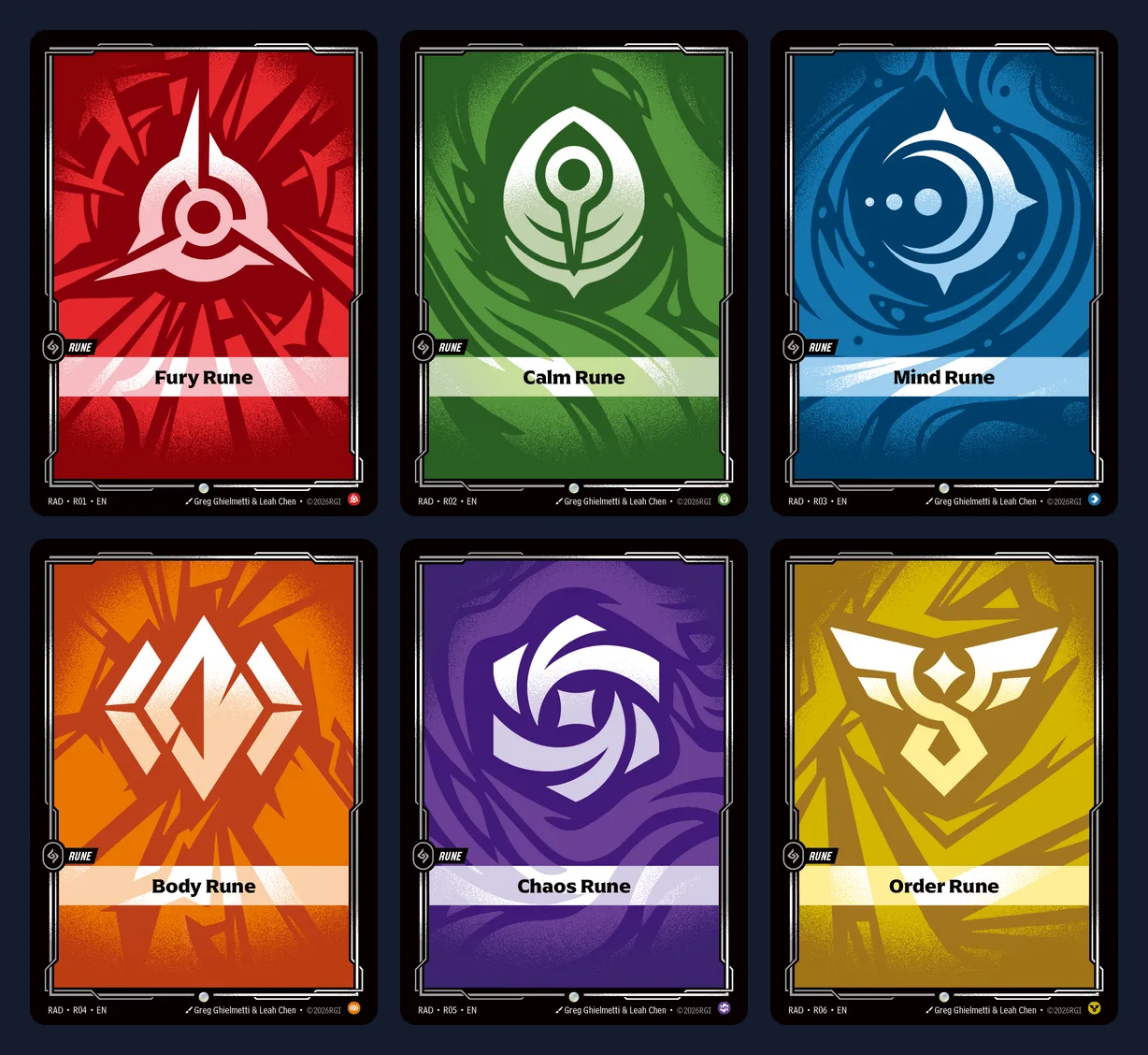
Here is what that extra rune is worth, by my arithmetic, for a player who recycles nothing:
| Your turn | Runes on board going first | Runes on board going second |
|---|---|---|
| 1 | 2 | 3 |
| 2 | 4 | 5 |
| 3 | 6 | 7 |
| 4 | 8 | 9 |
| 5 | 10 | 11 |
| 6 | 12 | 12 |
A Rune Deck holds exactly 12 runes, so the second player's lead is one rune on each of their first five turns. On the sixth, both players have all twelve out and the lead is gone. Each of those turns also comes after the first player's matching turn, so the first player has already acted on the board before the extra rune arrives. Riot's verdict is that the extra rune is not enough to offset going first.
Turn order moves ahead of battlefields
The Core Rules setup process handles battlefields at rule 113 and turn order at rule 115. In a best-of-three match each player picks one of their three battlefields and both are placed at the same time (rule 488.5). Then Tournament Rule 407 hands the choice of going first or last to a randomly chosen player in game one, or to the higher Swiss seed in a high-level playoff. In games two and three it goes to whoever lost the previous game. The test reverses that order.
| Step | Best of three today | Best of three in a test | Best of one in a test |
|---|---|---|---|
| 1 | Sideboard after the previous game (games 2 and 3) | Decide who goes first | Decide who goes first |
| 2 | Each player picks a battlefield; both are placed at once | Each player picks a battlefield and places it facedown | Each player's battlefield is picked at random; you look at your own and keep it hidden |
| 3 | Going first or last is chosen | Sideboard (games 2 and 3) | Sideboard |
| 4 | Draw 4, then mulligan in turn order | Reveal battlefields | Reveal battlefields |
| 5 | Second player channels 3 runes on their first turn | Mulligan; second player channels 3 runes and takes the test perk | Mulligan; second player channels 3 runes and takes the test perk |
Riot's reason is that choosing to go first or second should be a firm commitment made before the opponent's battlefield is known. Read the two best-of-three columns side by side and you can see where the information moves. In a test game, whoever chooses turn order does it without seeing either battlefield. Both players then pick battlefields, and in games two and three sideboard, already knowing who goes first. Riot says it is removing a layer of guesswork from the later games of a match, where a player has to pick cards and a battlefield without knowing whether the opponent will choose to go first or second.
Best of one changes too. Today a head judge can opt into an alternative best-of-one setup (Tournament Rule 406.1.h). In that version both battlefields are placed at random first, then turn order is chosen, and then players sideboard as if between games of a best-of-three. The test version still picks battlefields at random, but keeps your opponent's hidden until after sideboarding. Riot's summary: in both test procedures you sideboard knowing your own battlefield and the turn order, but not your opponent's battlefield.
Three perks for the second player
Riot says the three options test which of three things matters most for the going-second gap: card advantage, card quality or points.
| Option | What the second player gets | Riot's reasoning, paraphrased |
|---|---|---|
| A | Starts the game on 1 point | Going second mostly costs you scoring chances. The first player stays ahead on board development and the second player gets ahead on points. Riot calls this the most extreme of the three. |
| B | Draws one extra card | Many card games give the second player an extra card. It keeps deckbuilding incentives close to today's and pairs naturally with the extra rune. |
| C | Predicts before their first draw | A softer version of B, in case a whole extra card proves too strong. The second player gets to shape their first draw after seeing the opponent's battlefield and first turn. |
Predict is an existing game action. You look at the top card of your Main Deck and choose whether to recycle it to the bottom (Core Rule 437.1). Riot writes it as Predict 1, which is also what a bare Predict means (437.3.a).
Riot also says what it chose not to test: taking away the first player's first draw. It judged that would change how players need to build decks too much. Riftbound already uses that lever outside the duel. In the three-player and four-player free-for-alls and in 2v2, the first player skips their first draw and the last player channels an extra rune (rules 489.7, 490.7 and 491.7). Our multiplayer rules guide covers those modes.
What each option adds up to
Each option shifts the balance in a different place. This is my reading of the rules, not Riot's:
- Option A moves the finish line. The Victory Score in 1v1 is 8 (rules 487.3 and 488.3). Starting on 1, the second player needs seven more points to the first player's eight. That also brings forward the final-point rule: once you are within one point of victory, a point from conquering only counts if you scored every battlefield that turn (rule 473.1.b). The second player reaches that 7-point mark after six scores instead of seven, setting aside other point sources. The point also counts at time in Swiss: after time is called and three extra turns are played, a game goes to whoever leads by two or more points (Tournament Rule 408.2.b).
- Option B outlasts the extra rune. The rune lead in the table above is gone by turn six. An extra card is a one-card lead in cards drawn that stays for the whole game.
- Option C adds no cards. It improves the quality of one draw. On the test's own sequence, both battlefields are revealed before the mulligan, and the first player takes a whole turn before the second player's first Draw Phase. So the second player makes the Predict decision with both of those in view, which is the information Riot says it wants them to use.
The battlefield Riot already banned over turn order
This test is not the first time Riot has acted on the going-first edge. The Arena's Greatest, an Origins battlefield, gives each player 1 point at the start of their first Beginning Phase. Riot banned it in Standard from 24 July 2026, along with Aspirant's Climb.
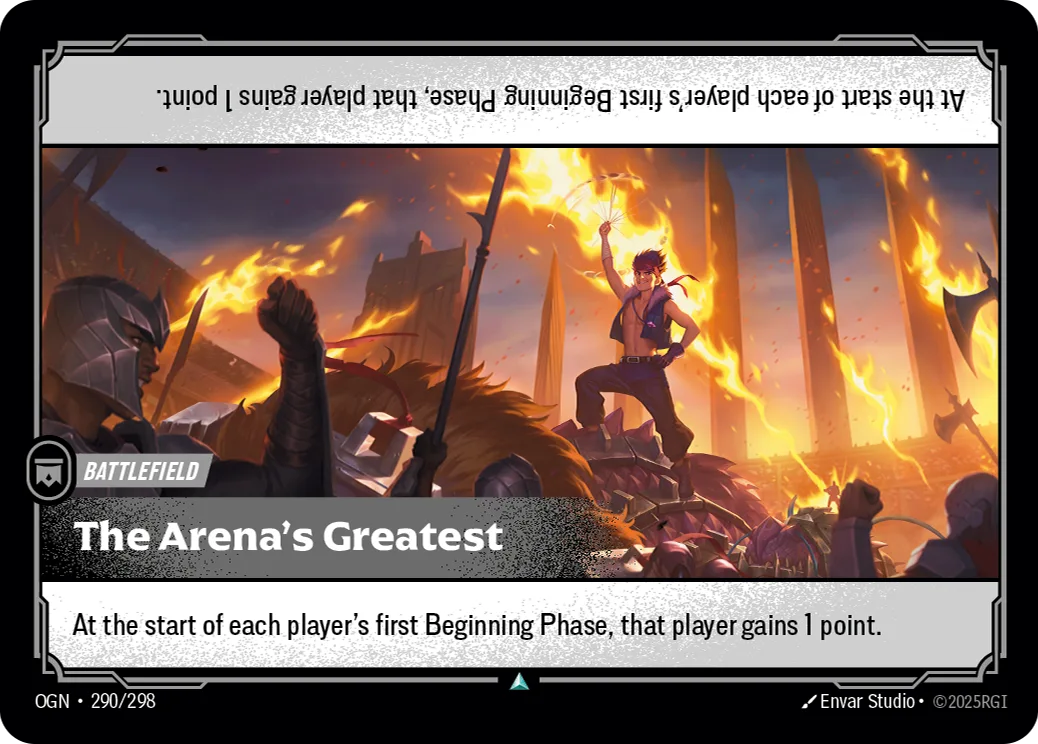
Riot's July ban note made two points. For many decks, a point battlefield had become the default pick in games two and three once the player knew whether they were going first or second. And The Arena's Greatest "is particularly powerful when going first," handing the first player an edge Riot did not want reinforced so consistently. Both battlefields are still on the Rules Hub's Constructed ban list, last updated 18 September.
Set that next to the October test. July's note already treated turn order as the thing battlefield picks depended on, and the test makes turn order known before each best-of-three battlefield pick. Option A also reverses The Arena's Greatest: a starting point for the second player only, where the banned battlefield gave one to both players and favoured the first. If you are choosing battlefields for a test event, our battlefields breakdown shows which ones tournament players actually registered.
Where the test rules apply
Riot will run the test at events worldwide, but not at premier tournaments, and the rules in use will be announced to everyone attending.
| Event | Test rules? |
|---|---|
| Radiance-season City Tournaments in China | Yes |
| Friday and Sunday Standard Challenges at the European Regional Championship, Stuttgart, 6 to 8 November | Yes |
| Summoner Skirmishes, Showdowns and other high-OPL events | No, unless Riot has told the organizer directly |
| Nexus Nights and casual games | Not required. Riot encourages local and casual games to try them and says it is watching the feedback |
In Stuttgart, Riot names only the Standard Challenges, not the Regional Championship itself. Riot also published an article the same day changing Regional Championship prizing and conduct rules, including open decklists and a ban on arranged match concessions. None of it touches turn order. Our tournament rules guide covers what the higher Organized Play Levels switch on.

When Riot decides
Riot will analyse the Radiance-season data and decide in the run-up to Legacy. The result, whether that is a rules change or an announcement that nothing changes, will be in Legacy's patch notes along with Riot's reasoning and findings. Legacy's Pre-Rift runs 22 to 28 January 2027 and the set releases on 29 January. Riot has not dated the patch notes. As of 23 October, the rules in force are the Core Rules and Tournament Rules dated 9 October 2026, and their First Turn Process for both duel modes gives the second player the extra rune and nothing else (rules 487.7 and 488.7).
If you want to try it before then, one test game costs nothing: agree on A, B or C with your opponent, decide who goes first, then pick battlefields. Riot asked for feedback on how the options feel to play, not just for the numbers.
Quick reference
- Announced: Testing Start of Game Rules, Riot Organized Play article, 15 October 2026. It is a test, not a rules update.
- Problem Riot names: going first wins more often than Riot wants. Riot gives no figure. Its target is a split closer to 50%.
- Today: the second player channels 3 runes on their first turn instead of 2. Both players draw on turn one in a duel.
- Test change 1: turn order is decided before battlefields are picked and revealed, in best of three and best of one.
- Test change 2: the second player also gets one of A) start on 1 point, B) draw an extra card or C) Predict before their first draw. Staff announce which before each event.
- Ruled out: removing the first player's first draw, which Riot judged too disruptive to deckbuilding.
- Test events: Radiance-season City Tournaments in China, and the Friday and Sunday Standard Challenges at the Stuttgart Regional Championship (6 to 8 November). Not premier tournaments, and not Skirmishes or Showdowns unless Riot tells the organizer.
- Decision: in Legacy's patch notes. Legacy releases 29 January 2027.
Frequently Asked Questions
Is Riftbound changing the rules for going first?
What does the second player get in Riftbound now?
What are the three going-second options Riot is testing in Riftbound?
How does Riot's test change battlefield selection in Riftbound?
Where are the Riftbound start-of-game test rules being used?
Do I have to use the new start-of-game rules at a Riftbound Nexus Night?
Keep Reading
- Testing Start of Game Rules (Riot Games, official, 15 October 2026) - the going-first problem, the three go-second options, the new start-of-game order, test events and the Legacy decision timeline
- Riftbound Core Rules, last updated 9 October 2026 (Riot Games, PDF) - 110-118 (setup process), 315.3-315.4 (Channel and Draw Phases), 437 (Predict), 473.1.b (final point), 487-491 (modes of play and first-turn processes)
- Riftbound Tournament Rules, last updated 9 October 2026 (Riot Games, PDF) - 406.1.a and 406.1.h (start of game and the optional best-of-one setup), 407 (Play First Rule), 408.2.b (two-point lead at time)
- Riftbound Rules Hub (Riot Games, official) - Core Rules and Tournament Rules last updated 9 October 2026; Constructed ban list last updated 18 September 2026
- July Ban List Updates (Riot Games, official, effective 24 July 2026) - why The Arena's Greatest and Aspirant's Climb were banned
- Riftbound Card Gallery (Riot Games, official, checked 23 October 2026) - The Arena's Greatest (OGN 290/298) and the Radiance basic runes
- Regional Championships: Competitive Integrity & Prizing (Riot Games, official, 15 October 2026) - Regional Championship prizing and conduct changes
- 2026 Regional Championship Info (Riot Games, official, 4 August 2026) - the European Regional Championship in Stuttgart, 6-8 November 2026
- Products and Sets into 2027 (Riot Games, official, 3 August 2026) - Legacy Pre-Rift 22-28 January 2027 and release 29 January 2027
Related Guides

Riftbound Radiance Rules Update: Neeko Rulings and Errata
Riot published three Radiance rules documents on 9 October: Core Rules patch notes with ten official rulings, an errata article for four cards, and a Tournament Rules update. Together they settle how Neeko works, what happens to Equipment that Orianna turns into a unit, and what changes at your table from the 16 October Pre-Rift.

Riftbound Vendetta Rules FAQ: Key Rulings Explained
Riot published the Vendetta Rules FAQ on 14 August 2026 and gave it precedence over the Core Rules Document until a new one was released. That new rulebook arrived on 9 October, effective 16 October. The FAQ also reverses a ruling Riot published in January, explains why Kayle can hold three copies of a status the rules call binary, and admits to a bug the Vendetta rules update introduced.
Riftbound Chains and Focus: The HOT FEPR Timing Rules
Riftbound's turn is always in one of four states, and the state - not the card - decides whether you are allowed to play anything. The Core Rules run the whole timing system on two separate permissions called priority and focus, a stack called the chain, and a five-step resolution loop the rulebook actually names in the text: HOT FEPR.
Riftbound Sealed and Draft: The Limited Format Rules
Riftbound Limited is not constructed on a budget - it switches off most of the deckbuilding rules you learned. Sealed hands you six packs and a 25-card minimum, Draft hands you three packs and a 20-card minimum, and both let you run ten copies of the same card, ignore Unique, and play cards that are banned in Standard.

How to Play Riftbound — The League of Legends TCG Rules, Explained (2026)
Riftbound has no life total. You take objectives. Eight points ends it. Here is the whole rules set as Riot actually wrote it - runes, domains, battlefields, showdowns, deck construction, and the final-point rule that decides more games than any card does.

Riftbound Tournament Rules Explained - What Actually Gets You a Game Loss
Riftbound has two rulebooks, and the one that decides tournaments is not the Core Rules. The Tournament Rules define three enforcement levels, a round-end procedure that hands out draws, a penalty ladder with hard upgrade thresholds, and - as of 24 July 2026 - a Disciplinary Code that can reach your Riot account.