Riftbound Radiance Rules Update: Neeko Rulings and Errata
Riot published three Radiance rules documents on 9 October: Core Rules patch notes with ten official rulings, an errata article for four cards, and a Tournament Rules update. Together they settle how Neeko works, what happens to Equipment that Orianna turns into a unit, and what changes at your table from the 16 October Pre-Rift.
Neeko, Blending In was the Radiance card our Radiance Legends roundup couldn't fully explain on 2 October, because Riot had not yet said how she works. On 9 October Riot answered most of it, in an article that is not called an FAQ but contains ten official rulings, and errata'd her card text on the same day.
That article is one of three Riot published together, a week before the Radiance Pre-Rift opens on 16 October. Between them they codify the set's three new keywords, rule on what Riot calls some of the set's trickier interactions, errata four cards, and change several tournament procedures you may already rely on. Here is what is in them, sourced to the documents themselves, with links out to the posts on this site that cover the basics.
What Riot published on 9 October
| Document | What it is | Takes effect |
|---|---|---|
| Radiance Patch Notes | Ten rulings on tricky Radiance interactions, plus a summary of the Core Rules changes | 16 October 2026 |
| Core Rules, last updated 9 October 2026 | The full rulebook, 142 pages | 16 October 2026 |
| Radiance Errata Updates | New text for four Radiance cards | Published 9 October |
| October 2026 Tournament Rules Changelog | 31 line items, plus the updated Tournament Rules document | With the Radiance Pre-Rift on 16 October 2026 |
Riot is explicit about the status of those ten rulings: "Although this article is not an FAQ, it still is a collection of official rulings." They are based on the 9 October Core Rules, and Riot says a separate FAQ will follow "after Radiance is released" to clear up whatever is still confusing once people are playing. For scale, the Vendetta Rules FAQ arrived on 14 August, two weeks after Vendetta's 31 July release.
One thing this drop does not include is a ban. The Constructed legality list on Riot's Rules Hub is still dated 18 September, so the September ban list is the one you take into Radiance.
How Neeko actually works now
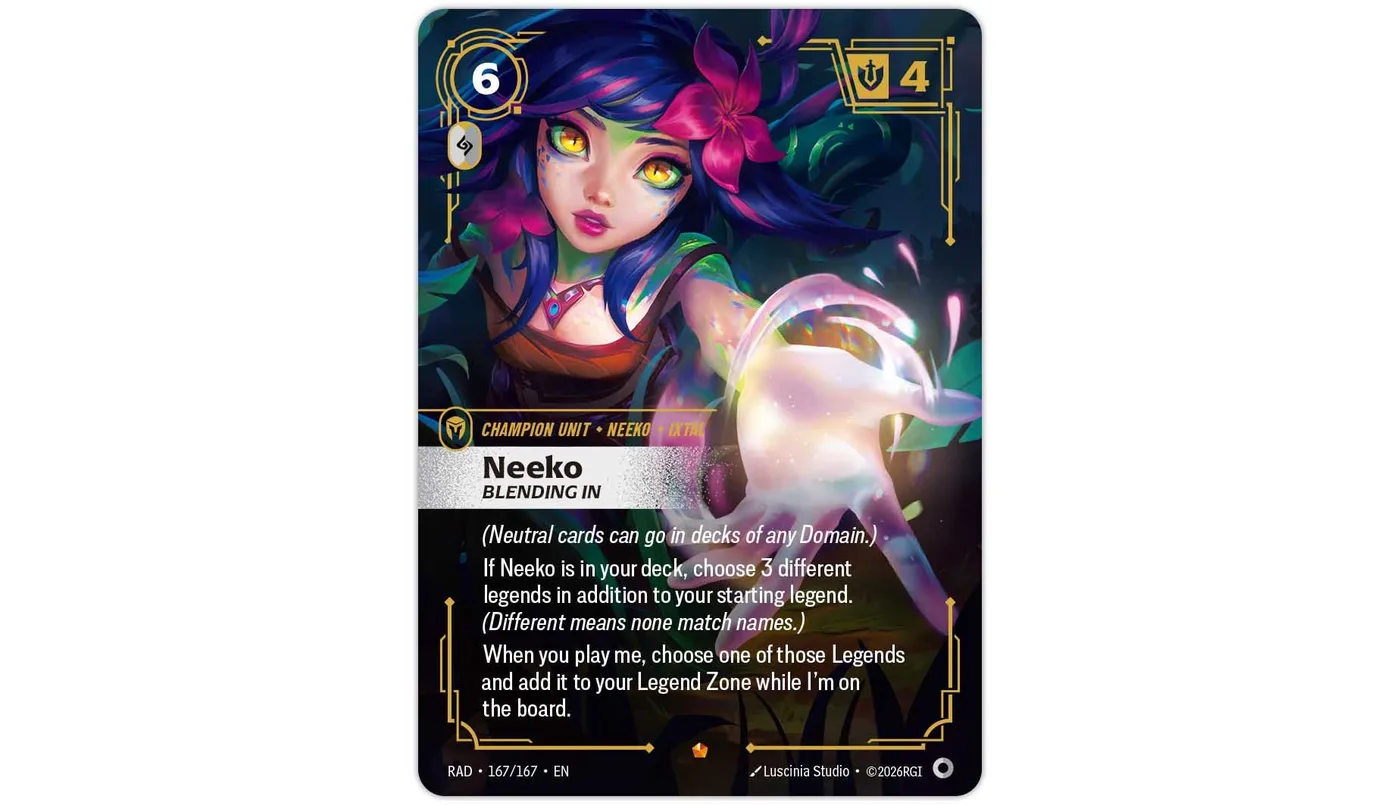
Neeko is a 6-Energy, 1-Power, 4-Might Champion Unit with no domain, and a new Core Rule, 103.2.b.5, now states that a card with no domain is permitted in a deck of any Domain Identity. If she is in your deck, you name extra Legends; when you play her, one of them joins your Legend Zone for as long as she stays on the board. Riot's ruling answers the practical questions in one go:
- You pick the Legends while building the deck. The new Core Rule 103.1 makes "additional choices to be made while building the deck" a rule in its own right, with Neeko's text as its example. At Competitive and Professional events you write them on your decklist and can store them with your sideboard, and Tournament Rule 401.2.a says they "can't be changed once they are submitted".
- One set of picks for the whole deck. The three Legends are shared by every Neeko you run. They must differ from each other and from your Champion Legend.
- Never two of the same. You can't add a Legend that is already on the board. Riot's example: if you somehow played a fourth Neeko with all three picks already out, she adds nothing. Core Rule 440.3.c is the rule behind it.
- They enter ready. Our Legends roundup flagged this as the question that decided whether an exhaust ability like Ziggs's or K'Sante's works the turn Neeko lands. The added Legend arrives ready, so being exhausted is not what stops you.
- They stay secret until used. You don't reveal your picks to your opponent until one is added to the Legend Zone.
- They are real Legends, not tokens. An effect that readies "a friendly legend" can target one, and "your legend" refers to any legend you control. If Neeko leaves the board, the added Legend stops existing; Riot says the picks "don't exist at all" while they are outside the Legend Zone.
Then the errata. Neeko's printed text says "choose 3 different legends". Riot's errata article changes that to "choose up to 3 different legends", so the card now lets you name fewer than three. The ruling article, published at the same time, still describes picking three. Errata is Riot's updated card text, so "up to 3" is what the card now says. Riot's errata article gives no card-specific reason, only its general one: errata exists "to make cards more easily understood and to clarify how they work within the rules of the game."
One question from our Legends roundup is still open: whether the extra Legends have to fit your deck's Domain Identity. Neither the ruling nor rule 103.1 says either way. That is a question for the post-release FAQ.
Orianna and the no-attached-units rule
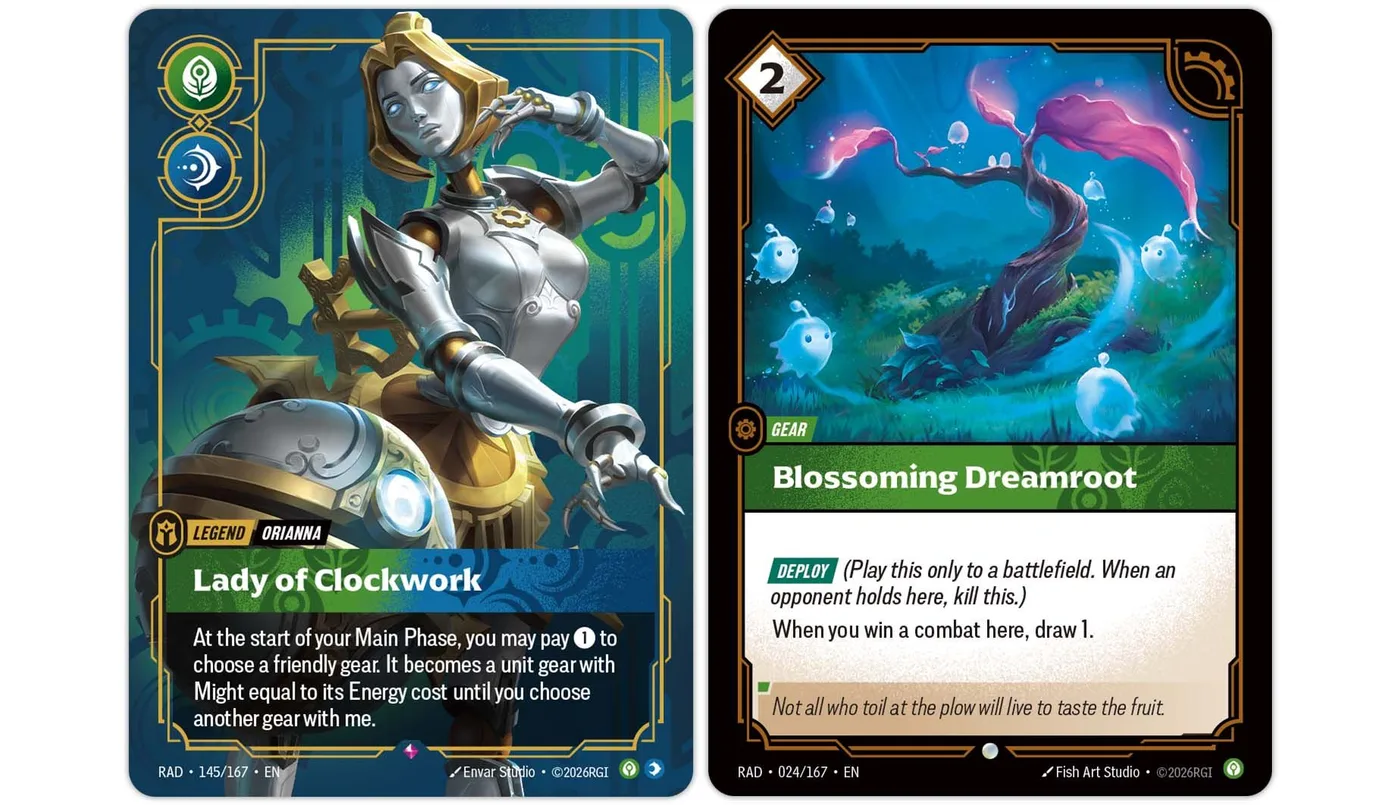
Orianna, Lady of Clockwork turns one friendly gear at a time into a unit, which raised an obvious problem: what happens to an Equipment that is attached to something when it becomes a unit? Riot's answer is a Core Rule, 143.5, rather than a one-off ruling. Units cannot be attached to other permanents. If an attached non-unit object becomes a unit, it detaches as it becomes one. If an effect tries to attach a unit to something without first making it stop being a unit, nothing happens.
Three rulings follow from that:
- Animating an attached Equipment detaches it. Its Equip ability can still be activated and Weaponmaster can still target it, but both resolve to nothing while it is a unit.
- Animating a Deploy gear at a battlefield can start a fight. It becomes a unit-gear where it stands. If you don't control that battlefield, it applies Contested status, and a showdown or combat is staged at the next cleanup and opens once the chain clears.
- Switching Orianna to a new gear leaves the old one where it is. Equipment attached to the old unit-gear stays attached (its Might bonus does nothing, since gear has no Might, but its other effect text still applies). A Deploy gear that ended up in your base stays there. To get it back onto a battlefield, animate it again or use an effect that moves Deploy gear, such as Command: Attack. Riot also notes a brief gap during the switch when neither gear is a unit.
The Overview's one-line version, "when an Equipment becomes a Unit, it's automatically unequipped", which our Radiance mechanics breakdown quoted, is now a rule with edges you can check.
Deploy, Disarm and Show Off in the rulebook
The mechanics post covers what the three keywords do from the reminder text. The 9 October Core Rules add them to the keyword glossary as rules 830, 831 and 832, and each entry says more than the reminder does.
| Keyword | Rule | What the Core Rules add |
|---|---|---|
| Deploy | 830 | A passive and triggered keyword on gear. It is short for four things: this may be played or created to any battlefield; play or create it only to a battlefield; if it is not a unit, it is not recalled in cleanups; when an opponent holds here, kill this. "Any battlefield" explicitly includes enemy-occupied and open ones. Deploy gear can be moved by effects, and extra instances do nothing. |
| Disarm | 831 | A triggered attack keyword on units: "When I attack, give an enemy unit here -X [M] this turn," with X defaulting to 1. However many instances a unit has, it triggers once using the total. Riot's example: Clanging Sentry gives your Mechs Disarm, so with two Sentries out, both have Disarm 2. |
| Show Off | 832 | A passive keyword: as you play the card, you may reveal the qualifying object from your hand and/or pick it from friendly objects on the board. You decide while finalizing. A required set can mix hand and board. What the card reads off the shown object is locked in at that moment. |
The Deploy row matters most. Gear is normally played to your base (Core Rule 152.2), and our keyword glossary notes that even a unit with Action can only go to your base or a battlefield you control. Deploy goes further: you can drop the gear onto a battlefield your opponent occupies. Rule 830.1.b.3 also explains why it stays there: non-unit Deploy gear skips the cleanup step that recalls unattached gear from battlefields.
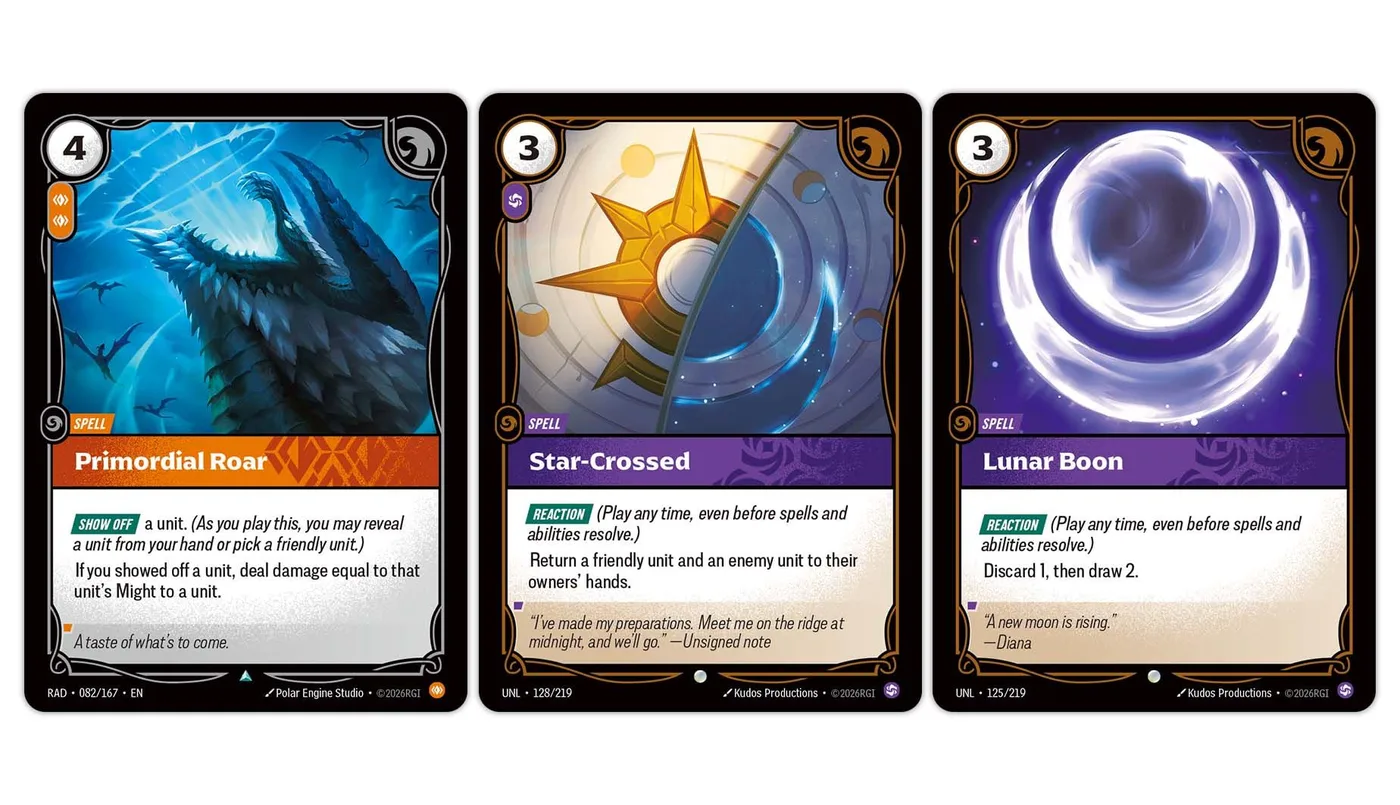
The locking rule decides a real interaction. You show off a unit from your board with Primordial Roar, and before the spell resolves that unit is returned to your hand by Star-Crossed, or you then discard it to Lunar Boon. Riot's ruling: you still deal the damage. The Core Rules example runs the other way and gets the same answer. Show off a 4-Might unit, take -2 Might from Frigid Touch in response, and Primordial Roar still deals 4, because "any later changes to the shown off objects will not be considered."
Two smaller Show Off points, both from Riot's Gutter Guardian ruling:
- You can't show off a facedown card. Riot's example is Gutter Guardian, which shows off a card with Hidden. A facedown card at a battlefield has none of its front-side characteristics available to reference, so it doesn't qualify.
- Only the card from hand gets revealed. Objects on the board are picked, not revealed, so you can't use Show Off as an excuse to flip a hidden card face up.
Three more rulings worth knowing
Ekko's discount can outlive the turn. Ekko's Legend, Boy Who Shattered Time, makes the next unit you play cheaper and gives it "Kill me at end of turn." Riot rules that this text means "at the end of this turn." If something replaces that death, the unit survives and the text never triggers again. Riot's example is Unlicensed Armory (OGN 023/298): discard 1 and exhaust it to choose a friendly unit, and the next time that unit dies this turn you may pay one Fury Power to recall it to base exhausted instead. Unlicensed Armory is a Fury card, so it fits Ekko's Fury and Mind identity, and this is a line you can actually build. The discount stops being a one-turn loan.
Chronobreak's "(You choose the order.)" only covers your own units. Ekko's Signature spell banishes units you control and has each owner play them back. You order the ones you own. If you banish units you control but don't own, each owner orders their own, and the owners add them to the chain in turn order, starting with the turn player.
Transpositionist reads the Might you replaced. Its ability returns a friendly unit to hand and lets you play a unit "with less Might than that unit had", free. Point it at an empowered 6-Might Gangplank, Naval: his empowered text replaces the bounce with +3 Might, he stays on the board at 9, and Transpositionist reads that current 9. An 8-Might Angler Wyrm qualifies. You keep Gangplank and get the Wyrm for free.
The tenth ruling covers what counts as reducing a unit's Might for Ahri, Confident, using a stunned unit next to an enemy Leona, Zealot. It is precise and narrow, and best read in Riot's own words if you play that matchup.
The rest of the Core Rules update
Riot says the Unleashed and Vendetta revisions left it "fewer logical holes to patch", and most of this update is Radiance support. Besides the three keywords, these are the changes worth knowing:
| Change | What it means at the table |
|---|---|
| Copy effects get their own layer | Copy effects now apply in a new first layer, ahead of trait-altering effects. Riot says copy effects only ever interacted with other copy effects, so this is a clarity change rather than a new interaction. |
| Copy game action added | Objects created as copies, such as the tokens from Zilean, Time Mage, are created with the copied traits as if printed on them, rather than carrying a copy effect. |
| Additional deckbuilding decisions | Rule 103.1, written for Neeko. |
| Units can't be attached | The Orianna rule above. |
| Layer calculation procedure | Each object's layers are worked out separately. If two objects depend on each other's information, both are calculated together, layer by layer. |
| "Pick" versus "choose" | "Choose" means you are targeting. "Pick" means a choice that isn't a target. Riot says many cards that say "choose" will switch to "pick" when Legacy's templating lands, and some Radiance cards already use it. |
| Making new choices | A full overhaul for cards like Rebuttal and Mystic Reversal. If you remake choices, you remake all of them, and any ability that triggers on being targeted triggers again, even on the same target. |
| Pending items can't be targeted | A spell or ability still being played on the chain is not a legal target. Riot blames Promising Future for the edge case. |
| 2v2 scoring aligned | The final-point and scoring-eligibility exceptions now apply only to a team holding a battlefield on its own or a teammate's turn, not on an opponent's turn. |
What this does to the Vendetta FAQ
Our Vendetta Rules FAQ breakdown covered a document Riot said would outrank the Core Rules only until the next rulebook shipped. The next rulebook has now shipped, and it codifies several of that FAQ's rulings:
- Kayle, Justified's stacking Empower is now a general rule: an object with permission to be Empowered more than once ignores "Play only if not Empowered." You can still activate it at the cap, and Riot says it doing nothing there "is also intentional."
- Ignored versus negated is now in the rules as the FAQ described it. A mistargeted instruction is ignored, and so are the instructions linked to it. One that is replaced, skipped or impossible is negated, and the linked instructions still execute if they can.
- Can't beats can. The Dragon Roost and Perched Grimwyrm ruling is now two rules, one for mandatory requirements and one for restrictions.
- Rebuttal's remade choices are no longer handled the FAQ's way. They follow the "making new choices" overhaul above.
- Switcheroo and Gangplank get the rule the FAQ promised, though the patch notes don't list it. New Core Rule 434.1.d says that swapping two units' Might "is the equivalent to giving those units a Might increasing effect and a Might decreasing effect respectively", the kind of event an empowered Gangplank, Naval's text replaces.
The FAQ's Iascylla answer was about templating, and Riot said future sets would word that kind of ability more precisely. Neither the patch notes nor the errata article mentions it, so treat that answer as still resting on the August FAQ.
Four Radiance cards got errata
| Card | Printed text | Errata text |
|---|---|---|
| Elnuk Herd | "give another friendly unit +3 [M] this turn" | "give a friendly unit +3 [M] this turn" |
| Last Caress | "The next unit you play this turn (even from face down) can be played to any battlefield." | "The next unit you play this turn, even from face down, can be played to any battlefield." |
| Forbidden Technique | "...you may play this from your trash for [1][C][C]. Banish this." | "...you may play this from your trash for [1][C][C]. Then banish this." |
| Neeko, Blending In | "choose 3 different legends" | "choose up to 3 different legends" |
Two of the four plainly change what the card allows. Elnuk Herd can now give the +3 to itself, and Neeko no longer requires three picks. Last Caress moves "even from face down" out of parentheses. Riftbound prints reminder text in italics and parentheses and gives it no effect on play (Core Rule 135.2.d), so the new wording leaves no doubt the phrase is rules text. Forbidden Technique gains a "Then" before "banish this". Riot's article gives no per-card reasoning, but the patch notes repeat a standing policy: "we do not update the rules of Riftbound or introduce card errata to manage the power level of any card or effect."
Printed cards won't change, and at the time of writing neither has Riot's Card Gallery. Its text for Elnuk Herd, Last Caress and Neeko is still the pre-errata wording, the same gap our Vendetta FAQ post found after the July errata. The errata article is the text of record.
Tournament Rules changes from the 16 October Pre-Rift
The Tournament Rules update takes effect with the Radiance Pre-Rift on 16 October. Riot calls most of its 31 items cleanup. These are the ones a player will notice:
| Change | Rule | What it means |
|---|---|---|
| Radiance added to Standard | 601.3.c.6 | Listed with its 23 October release date |
| Neeko picks on the decklist | 401.2.a | Registered with your deck and locked once submitted |
| Rune take-backs rewritten | 509.5 | Readying a rune you just exhausted, or un-recycling one, is allowed at any OPL until a new action is taken or focus is passed. It was one of four high-OPL exceptions. |
| No take-backs after the reveal | 509.6 | At high OPL you can't reverse a decision once your opponent has to point out information that shows it was a mistake. Riot's example: you move a 3-Might unit and pass focus, they note Wuju Bladesman makes their defender 4, and you're stuck with it. |
| Bluffing is legal | 502.11 | You don't have to share private information and may bluff about it |
| Loops must be deterministic | 505.2, 505.13 | A loop can't rely on probability, decision trees or conditional actions. Anything else has to be played out by hand in a timely fashion or it's Slow Play. You can't loop to stall, and running a loop that changes nothing while other actions are available is cheating. |
| Improperly Determining a Winner | 703.10.d-e | Now a Disqualification at Professional OPL. Knowingly attempting it, or goading an opponent into it, is cheating. |
| Overpayment for Cost | 702.8.b.1 | Rewind if that's simple; otherwise play on. The July version left the excess floating in your pool. |
| Game loss after battlefields are revealed | 406.1.c | Any later games in the match use different battlefields |
| Notes between games | 416.5 | Allowed during sideboarding and after battlefields are revealed, but not once opening hands are drawn |
| Extra turns at time | 502.4.b | Players must announce and acknowledge each additional turn |
Two changes apply at low-OPL constructed events like Nexus Nights. Deck registration is only required if the head judge asks for it, and you are expected to play the same deck all event unless the organizer allows a change.
If you learned the high-OPL take-back rules from our tournament rules guide, the four exceptions it lists are now three plus a general rune rule. The new 509.6 limit is the one to take to heart. Once your opponent has to point out the information that makes your move a mistake, the move stands, and Radiance is about to add nine Legends whose effects you haven't learned to read yet.
What is still to come
- 16 October, 10:00 AM PT. The Radiance Overview's last update, with both Showdown Deck decklists and the Nexus Night promo list. The Pre-Rift opens the same day. If it's your first, our Sealed and Draft rules post covers the format.
- After the 23 October release. A Radiance FAQ, the obvious place for Riot to settle Neeko and Domain Identity, the "up to 3" errata, and anything that surfaces once people are playing the set.
- January 2027, with Legacy. Riot is "completely reformatting the rules documents", rewriting them from the ground up for readability. Riot says "it won't change how Riftbound's mechanics actually work", but a ground-up reformat is likely to move rule numbers. The 9 October edition has already shifted the deck-construction subsections: the Chosen Champion and Signature rules are now 103.3.a.2 and 103.3.d.2.
Quick reference
- Published 9 October 2026: Radiance Patch Notes with ten official rulings, the Core Rules dated 9 October, four card errata, and the October Tournament Rules changelog. The rules updates take effect on 16 October.
- Neeko: picks are made at deckbuilding, registered and locked at high OPL, shared across every Neeko in the deck, one copy each on the board, enter ready, hidden until used, real Legends rather than tokens. Errata: "up to 3" rather than "3".
- Orianna: units can't be attached. Animating an attached Equipment detaches it, and animating a Deploy gear on a battlefield you don't control contests it.
- Keywords: Deploy (830), Disarm (831) and Show Off (832) join the glossary, so it now runs from 805 to 832. Deploy gear can go to any battlefield, including enemy-occupied ones. Disarm triggers once with its summed value. Shown-off information is locked in when shown.
- Errata: Elnuk Herd (can target itself), Last Caress, Forbidden Technique, Neeko. The Card Gallery still shows the old text for Elnuk Herd, Last Caress and Neeko.
- Tournament Rules: Radiance in Standard, Neeko picks on decklists, rune take-backs at any OPL, no reversing a decision your opponent's reveal exposed, bluffing confirmed legal, Disqualification for Improperly Determining a Winner at Professional OPL.
- No ban changes: the Constructed list is still dated 18 September.
Frequently Asked Questions
How does Neeko, Blending In work in Riftbound?
Which Riftbound Radiance cards received errata?
What happens when Orianna, Lady of Clockwork turns an attached Equipment into a unit?
When do the Riftbound Radiance rules changes take effect?
Can you show off a facedown card in Riftbound?
What changed in the Riftbound Tournament Rules in October 2026?
Keep Reading
- Radiance Patch Notes (Riot Games, official, 9 October 2026) - ten official rulings on Radiance interactions and the full list of Core Rules changes effective 16 October
- Radiance Errata Updates (Riot Games, official, 9 October 2026) - new text for Elnuk Herd, Last Caress, Forbidden Technique and Neeko, Blending In
- October 2026 Tournament Rules Changelog (Riot Games, official, 9 October 2026) - 31 changes effective with the Radiance Pre-Rift on 16 October
- Riftbound Core Rules, last updated 2026-10-09 (Riot Games, PDF) - rules 103.1, 103.2.b.5, 135.2.d, 143.5, 152.2, 434.1.d, 440.3.c, 830 Deploy, 831 Disarm, 832 Show Off
- Riftbound Tournament Rules, last updated 9 October 2026 (Riot Games, PDF) - rules 401.2.a, 406.1.c, 502.11, 505.2, 509.5-509.6, 601.3.c.6, 702.8.b.1, 703.10
- Riftbound Tournament Rules, last updated 16 July 2026 (Riot Games, PDF) - the previous 509.4 take-back list and 702.8 Overpayment remedy, for comparison
- Riftbound Rules Hub (Riot Games, official) - current Core Rules and Tournament Rules (9 October 2026) and Constructed legality (18 September 2026)
- Riftbound Card Gallery (Riot Games, official) - card text for the errata'd cards and the cards in each ruling
- The Radiance Overview (Riot Games, official, updated 5 October 2026) - Pre-Rifts 16-22 October, release 23 October, final update due 16 October
- Vendetta Rules FAQ and Clarifications (Riot Games, official, 14 August 2026) - the rulings the Radiance Core Rules now codify
Related Guides
Riftbound Vendetta Rules FAQ - The Rulings That Overrule the Rulebook
Riot published the Vendetta Rules FAQ on 14 August 2026, and it does something a FAQ is not supposed to do: it outranks the Core Rules Document. It also reverses a ruling Riot published in January, explains why Kayle can hold three copies of a status the rules call binary, and admits to a bug the Vendetta rules update introduced.
Riftbound Chains and Focus: The HOT FEPR Timing Rules
Riftbound's turn is always in one of four states, and the state - not the card - decides whether you are allowed to play anything. The Core Rules run the whole timing system on two separate permissions called priority and focus, a stack called the chain, and a five-step resolution loop the rulebook actually names in the text: HOT FEPR.
Riftbound Sealed and Draft: The Limited Format Rules
Riftbound Limited is not constructed on a budget - it switches off most of the deckbuilding rules you learned. Sealed hands you six packs and a 25-card minimum, Draft hands you three packs and a 20-card minimum, and both let you run ten copies of the same card, ignore Unique, and play cards that are banned in Standard.

Riftbound Tournament Rules Explained - What Actually Gets You a Game Loss
Riftbound has two rulebooks, and the one that decides tournaments is not the Core Rules. The Tournament Rules define three enforcement levels, a round-end procedure that hands out draws, a penalty ladder with hard upgrade thresholds, and - as of 24 July 2026 - a Disciplinary Code that can reach your Riot account.

How to Play Riftbound — The League of Legends TCG Rules, Explained (2026)
Riftbound has no life total. You take objectives. Eight points ends it. Here is the whole rules set as Riot actually wrote it - runes, domains, battlefields, showdowns, deck construction, and the final-point rule that decides more games than any card does.
Riftbound Keywords Explained: All 25 in the Core Rules
Riftbound has exactly 25 keywords, and the reminder text printed on the card is a summary, not the rule. Here is the whole glossary sorted by what each keyword actually is - passive, triggered, activated, permissive, dependent, cost, or a deck-construction rule that never does anything at the table.