Super Mario 64 Myths and Rumors, Debunked
A blurry plaque in Peach's Castle produced a $100 bounty from IGN, an April Fools joke from Nintendo, and a 2020 source-code leak that made the rumor half-true in the strangest way possible. Here is what "L is real 2401" actually says, why Ninja Mario and DS-era Waluigi were never real, and what got cut from Super Mario 64 for genuine, documented reasons.
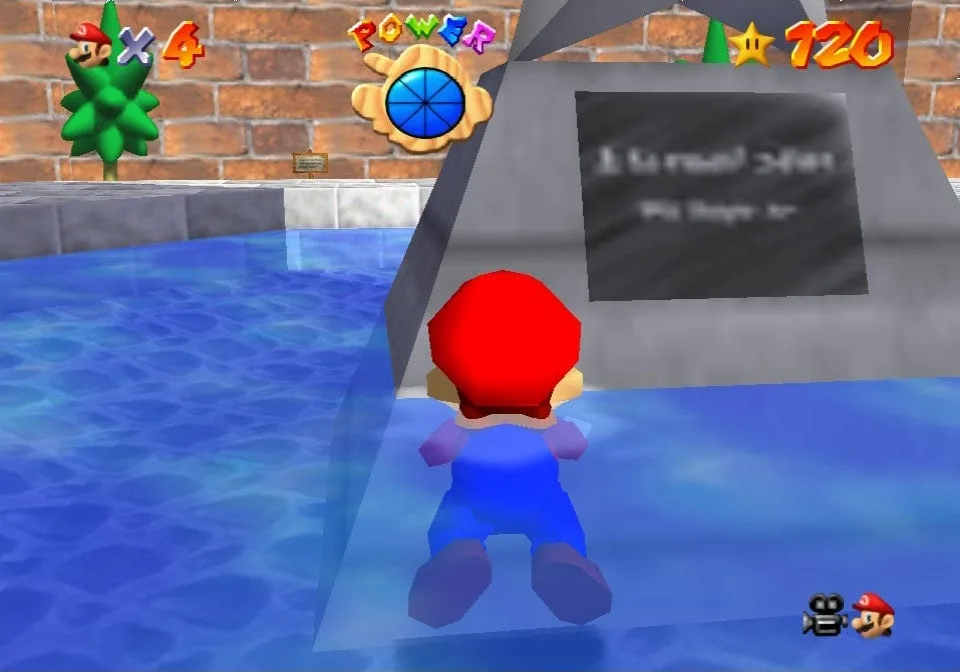
Walk into the courtyard of Peach's Castle, past the moat and the Big Boo that only shows up once you have 12 stars, and look at the base of the star statue by the front doors. There is a plaque on it, and it has always been almost impossible to read — blurry on the original N64 cartridge, still blurry in Super Mario 3D All-Stars nearly three decades later. Generations of players have squinted at that texture and typed the same four words into a search bar: "L is real 2401."
That plaque produced a real $100 reward from IGN, an April Fools joke from Nintendo itself, and — 24 years later — a source-code leak that made the rumor half-true in the strangest way possible. Here is what the plaque actually says, what people believed it meant, and what a 2020 Nintendo leak really confirmed about Luigi and Super Mario 64 — plus the two smaller hoaxes that grew directly out of it.
The plaque nobody could read
The rumor centers on the Star Fountain in the castle courtyard, the same statue whose surrounding plaza is otherwise known for the Big Boo who drops the Big Boo's Haunt key. Its base carries a plaque of small, blurry characters that many players read as "L is real 2401" — the "L" taken to stand for Luigi, absent from the game despite having been a playable co-star alongside Mario in Super Mario Bros., Super Mario Bros. 3 and Super Mario World. The Super Mario Wiki notes the same text has also been read as "Eternal Star," which happens to be the name of the final board in the original Mario Party — a coincidence that has never stopped anyone from betting on the Luigi reading instead.
Once players decided the message meant something, the number became the puzzle. "2401" had to be a code, and the guesses that followed were, per the Wiki's own catalogue of the rumor, genuinely unhinged: running 2,401 laps around the statue, or collecting a supposed 2,401 coins across the whole game. Neither has ever produced anything, because neither was ever real to begin with.
Every way fans invented to "unlock" Luigi
Before the internet had a reliable way to debunk anything at scale, a fake claim could travel for years on nothing but repetition. On April 1, 2000, a user going by Hairball posted doctored screenshots to the blog Super Mario 128 Central claiming to have found Luigi and, with him, a hidden co-op mode — an April Fools joke that plenty of readers took at face value long after the date on the post should have given it away.
None of the supposed unlock methods that circulated in that pre-broadband era ever worked, because Super Mario 64's code has no playable Luigi to unlock — a fact the game's actual creators would eventually confirm from the other direction entirely.
IGN's bounty and Nintendo's own joke
The rumor got big enough that a major outlet put money on it. On November 13, 1996 — seven weeks after the North American launch — IGN offered a $100 reward for anyone who could produce a genuine, repeatable method for unlocking Luigi in Super Mario 64. A week later, on November 20, IGN followed up: the flood of fake codes had dropped off, no legitimate method had surfaced, and the outlet's own conclusion was that Luigi's presence in the game was simply a myth.
Nintendo eventually acknowledged the joke on its own terms. The April 1998 issue of Nintendo Power ran an April Fools bit claiming it would explain the "L is real 2401" message on "page 128" — a page number that does not exist in the magazine. That same year, a fan wrote directly to Nintendo of America asking what the plaque meant, and Game Play Counselor Michael D. Chandler wrote back with the actual answer: the programmers put the text in as a joke, expecting players to obsess over cracking it, and it does not mean anything at all.
A later variant of the rumor moved the target: some players claimed "2401" pointed at Paper Mario, the next game Luigi would appear in, reading it as the date February 4, 2001. Paper Mario's North American release was actually February 5, and the game had been rescheduled more than once from an original December 2000 target — a release date Super Mario 64's 1996 development team could not plausibly have predicted years in advance, no matter how the digits are arranged.
The twist: Luigi actually was real
Here is where the story stops being pure hoax. Post-release interviews — including entries in Nintendo's own Iwata Asks series for New Super Mario Bros. Wii and Super Mario 3D World — confirm that Super Mario 64's development team genuinely planned a cooperative multiplayer mode with Luigi, letting two players explore the same open space as Mario and Luigi at once. It was cut specifically because the Nintendo 64 hardware could not support it alongside the level design the team wanted to ship.

That cut Luigi stayed theoretical until July 25, 2020, when a massive leak of Nintendo's internal pre-release source code and assets — since nicknamed the "Gigaleak" — reached the public. Inside the Super Mario 64 development files was an incomplete, unused Luigi model, assembled and shared by leak researchers that same day. It had never been referenced by any code in the shipped game and was never playable, but it was real: a genuine cut asset, twenty-four years after launch. The Super Mario Wiki flags the timing itself as a coincidence worth noting — July 25, 2020 lands 24 years and one month after the game's June 1996 Japanese debut, which the community was quick to shorthand as "24-01," an echo of the plaque's own number that nobody planned and nobody can take credit for.
Luigi's actual video game debut as a playable Super Mario 64 character came years earlier and through the front door: Super Mario 64 DS, released November 21, 2004, made him one of four playable characters alongside Mario, Yoshi and Wario, unlocked by beating the King Boo boss fight. He plays nothing like the courtyard rumors imagined — best air control and swimming of the cast, a Power Flower ability that turns him briefly invisible — and the version differences guide has the full rundown of what else changed in that remake. It is worth the contrast: Super Mario 64 does hide one genuinely secret character in MIPS the rabbit, covered in the secret stars guide — real code, a real reward, just never Luigi.
Ninja Mario: a myth invented by repetition
Not every Super Mario 64 rumor started from an in-game clue. Former Nintendo Power columnist Dan Owsen wrote, in a subscriber-exclusive feature in the magazine's January 1998 issue (volume 104, "Insider Collector's Edition"), that one question kept arriving at his desk no matter how many times he answered it: how do you unlock "Ninja Mario"? Owsen said flatly, repeatedly, that no such form exists in the game. Fans kept asking anyway. By his own account, his answers drifted from tongue-in-cheek deflections — "a ninja never reveals his secrets," "I'd tell you, but then I'd have to kill you" — to open irritation at anyone who brought it up.
There was no statue, no blurry text, no leaked model to eventually vindicate any part of this one. Ninja Mario is the purest version of the pattern: a form that was never planned, never coded, and never hinted at by Nintendo, kept alive purely because enough people asked as if it must be true.
The other hoax: Waluigi in Super Mario 64 DS
Super Mario 64 DS's real addition of three new playable characters in 2004 immediately reopened the same playbook. Rumors that Waluigi was secretly hiding in the remake started circulating fast, and some of the "unlock methods" people invented explicitly borrowed the original statue, claiming a connection to "L is real 2401" that had nothing to do with either game.
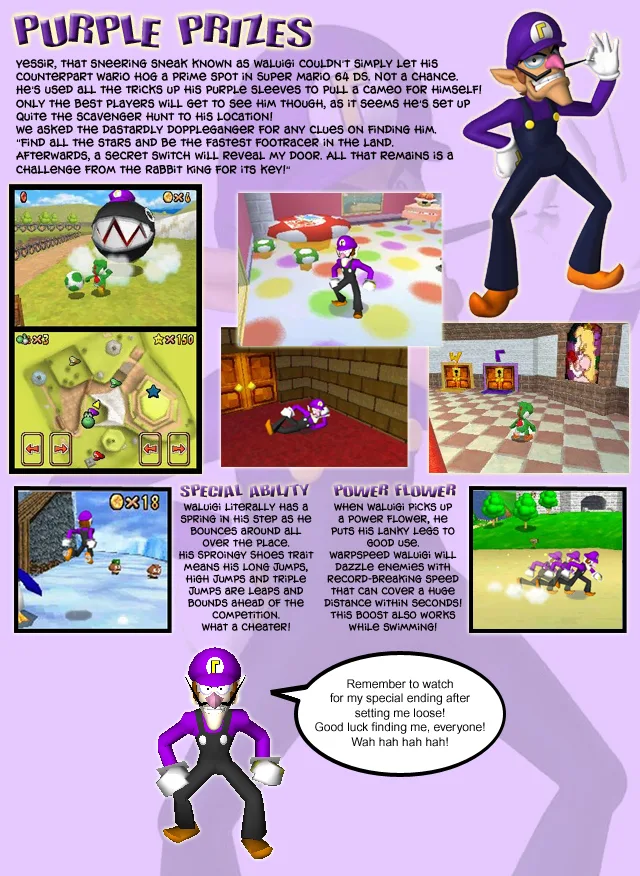
The specific piece of "proof" that spread furthest was a fake magazine page known as "Purple Prizes." It described collecting every Power Star, becoming the game's fastest footracer, throwing a hidden switch, and beating a "Rabbit King" for a key — all to unlock Waluigi, complete with an invented moveset, a Power Flower ability, and a "special ending." The image was created by a fan named Andrew Brown, who edited a custom Waluigi model into real Super Mario 64 DS screenshots and posted it to DeviantArt as an April Fools joke on April 1, 2005. Brown published a full explanation of how he made it just two days later — and the image still spread as genuine leaked material for years afterward. There is no trace of Waluigi in Super Mario 64 DS's game files. The remake's roster stops at four: Mario, Luigi, Yoshi and Wario.
What's actually true, at a glance
| Claim | Verdict | What's actually documented |
|---|---|---|
| "L is real 2401" unlocks a playable Luigi | False | Nintendo's own Game Play Counselor confirmed in writing that the plaque is a meaningless joke |
| Running 2,401 laps or collecting 2,401 coins unlocks Luigi | False | No such trigger has ever been found in the game's code; IGN's 1996 $100 reward went unclaimed |
| Luigi was planned for Super Mario 64 | True | Iwata Asks interviews confirm a cut co-op mode; the 2020 Gigaleak recovered an unused, unfinished Luigi model |
| Luigi is playable in Super Mario 64 | Only in the DS remake | Added in Super Mario 64 DS (2004), unlocked by beating King Boo — never in the N64 original |
| "Ninja Mario" is a hidden form | False | Invented entirely by fans pestering Nintendo Power columnist Dan Owsen in 1997–98; never planned or coded |
| Waluigi is unlockable in Super Mario 64 DS | False | Based on a fabricated 2005 "Purple Prizes" magazine scan; its creator confirmed the hoax two days after posting it |
The throughline across all three is the same: Nintendo left one genuinely ambiguous clue — a blurry plaque with no attached mechanic — and the internet spent decades filling that vacuum with codes, screenshots, and magazine scans that got more elaborate as the actual answer got more boring. The one rumor that turned out to have real substance did so by accident, recovered from a leak nobody who started the myth in 1996 could have anticipated.
Frequently Asked Questions
What does "L is real 2401" mean in Super Mario 64?
Is Luigi hidden and unlockable in the original Super Mario 64?
Was a version of Luigi ever actually built for Super Mario 64?
Is Ninja Mario a real hidden form in Super Mario 64?
Can you unlock Waluigi in Super Mario 64 DS?
Keep Reading
Related Guides

Super Mario 64 Camera Guide: C-Buttons, R and the Fixed Cam
Super Mario 64's camera is a dozen-plus cameras in a trench coat. Here is what every C-button and R press actually does, the LAKITU ↔ STOP setting hiding on the pause screen, why the camera buzzes at you, which camera each course loads with, and how it all changes on Switch and DS.

Super Mario 64 Swimming Guide: Tap A, Don't Hold It
Holding A is the slow way to swim in Super Mario 64. Here is the stroke rhythm the code rewards, how the stick steers, how to jump out of the water, what each current does, and the eight seconds of free speed hiding in two clams.
Super Mario 64 Lives and Game Over: What You Actually Lose
A Game Over in Super Mario 64 is a file reload: you keep everything you saved and lose everything you did not. Here is when the game actually writes your file, exactly what a Game Over rolls back, the five courses where a fall is free, and every way to earn a life, from the coin tally to the Monty Mole streak that never runs dry.
Super Mario 64 Music: Every Track and Where It Plays
Super Mario 64 scores 15 courses with seven songs, and only one of them belongs to a single course. Here is which track plays in every course and secret level, the five levels whose music rearranges itself as Mario moves, what triggers the boss music and the jingles, all 36 soundtrack tracks under their 1996 and current names, and where to listen today.
Super Mario 64 Beginner Guide: Your First 30 Power Stars
Super Mario 64 does not gate you on difficulty, it gates you on Power Stars. Here is exactly which doors need what, which stars are fastest to grab, and the route that gets a first-timer from one star to thirty without wandering the castle in circles.
Super Mario 64 Bowser Levels Guide: All 24 Red Coins
Bowser in the Dark World, the Fire Sea and the Sky each hide one Power Star behind eight red coins on the obstacle course in front of the fight. Here is the route through all three, where every red coin sits, and what else the level data holds.