Super Mario 64 Swimming Guide: Tap A, Don't Hold It
Holding A is the slow way to swim in Super Mario 64. Here is the stroke rhythm the code rewards, how the stick steers, how to jump out of the water, what each current does, and the eight seconds of free speed hiding in two clams.
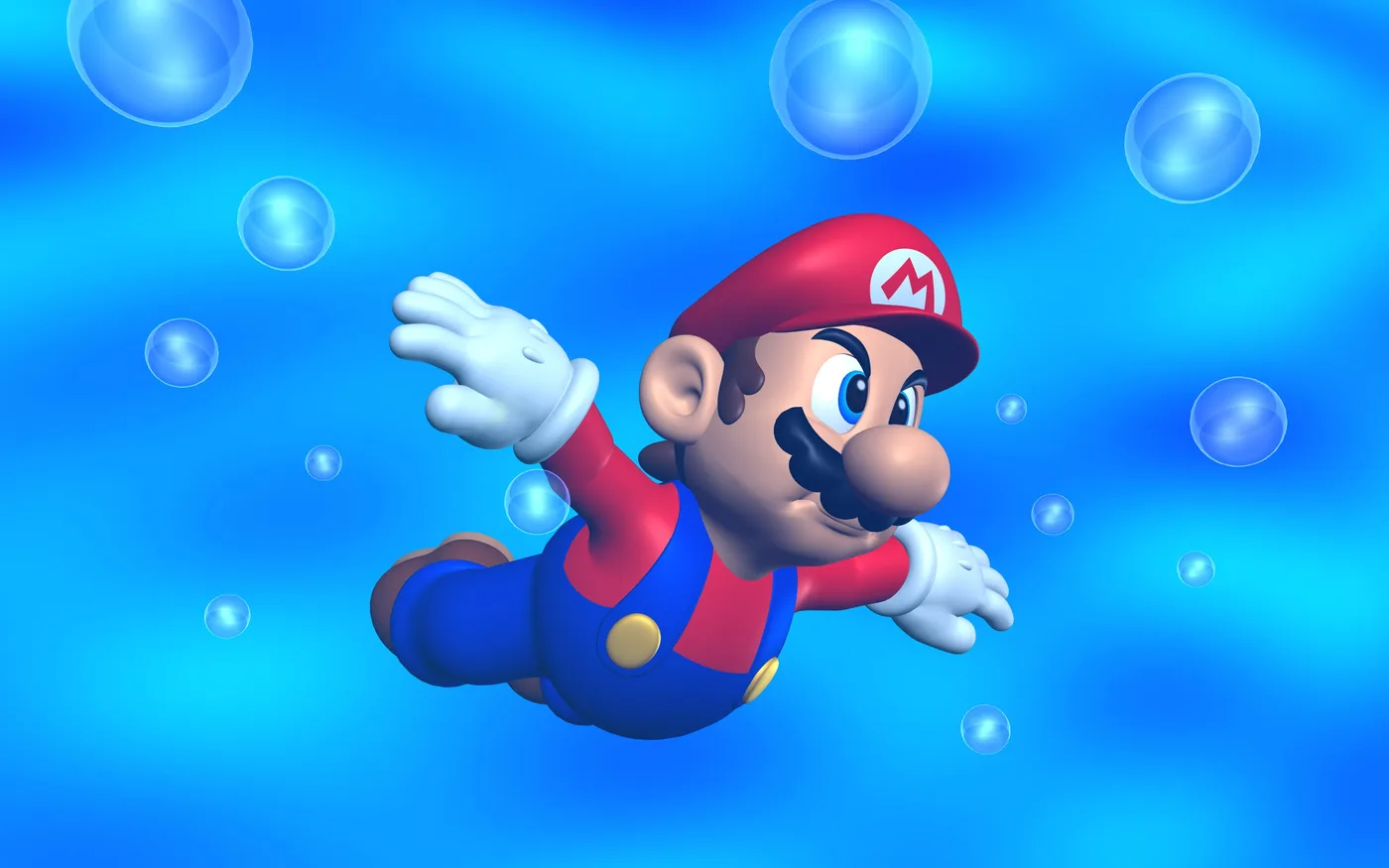
Holding A is the slow way to swim in Super Mario 64. Hold it and Mario switches to a flutter kick that settles at 12 units per frame. Tap it in the right rhythm and his breaststroke climbs to 28, the ceiling the game's code puts on swimming speed. Same button, more than twice the speed.
The breaststroke has a real-world origin. The Guardian's 2020 feature on Mario's 35th anniversary notes that Shigeru Miyamoto took up swimming, and got very keen on it, while Super Mario 64 was in development, and points to Mario's breaststroke as the result. The code behind that stroke is fussier than the animation suggests, and the n64decomp decompilation of the game spells it out. Everything here comes from that decompilation unless a sentence says otherwise, with Ukikipedia and the Super Mario Wiki filling in the rest.
Speeds are in the game's own units per frame. Super Mario 64 runs at 30 frames per second, per Ukikipedia, so 28 units per frame is 840 units per second. This covers the N64 game, which Super Mario 3D All-Stars and the Nintendo Switch Online app both run a version of; the DS remake's differences are near the end.
Every swimming input in one table
| Input (N64) | What Mario does in the water | Notes |
|---|---|---|
| Control Stick forward | Tips his head down and dives | The further you push, the steeper, up to just short of vertical |
| Control Stick back | Tips his head up and climbs | Hold it to head for the surface |
| Control Stick left or right | Turns | Turn speed builds up; a U-turn takes about 2.4 seconds |
| Tap A | One breaststroke | The fast way to swim, if you keep a rhythm |
| Hold A | Flutter kick | Steady, and slow |
| B | Grabs, or throws what Mario is holding | It is not an attack |
| Stick pulled back, then A, at the surface | Water jump | How you jump out |
| Z | Nothing | The decompiled swimming code never reads it |
Two of those rows are worth a sentence each before the speed numbers.
B is a grab, not a punch. In the decompiled interaction code, a hit on an enemy has to come from a move flagged as an attack, such as a punch, a kick, a ground pound, a slide kick or a shell ride, or from jumping onto or into something in mid-air. No swimming action qualifies, so Mario has no way to hit an enemy while he swims. Everything in the water is something to steer around, and the health guide has what each one costs you.
The stick works like a plane's. Forward points Mario down, so pushing forward to swim ahead takes him toward the floor. Pull back to level out.
Why holding A is the slow way
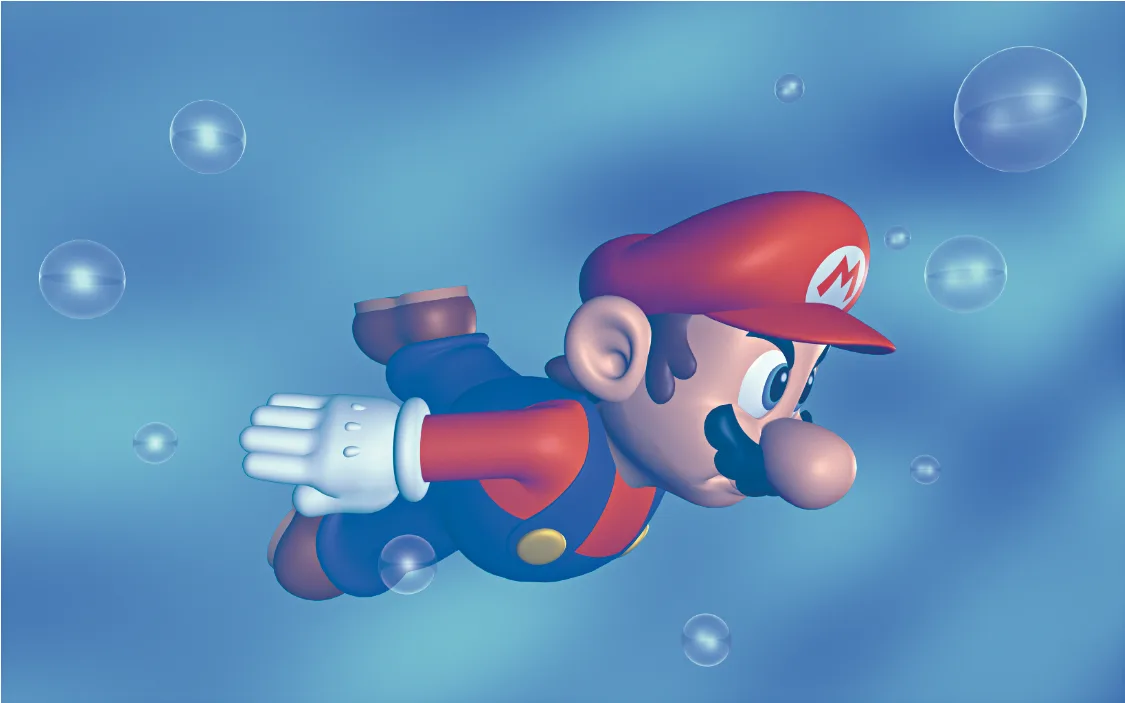
Tap A and Mario does a breaststroke: a 13-frame stroke that adds speed in two bursts, then a glide that bleeds a quarter of a unit every frame. Keep A held through the end of a stroke and the game turns it into a flutter kick, which eases his speed toward 12 and keeps it there.
The difference between slow and fast swimming is a hidden number Ukikipedia calls swimming strength. It starts at 160 and tops out at 280, and the code divides it by 10 to get the speed above which Mario loses an extra half unit every frame. At 160, that drag starts above 16. At 280 it starts above 28, which is the cap anyway, so it stops applying.
Run the code's speed rules frame by frame, in a straight line with no current, and the input habits sort themselves out:
| How you press A | What the code does | Average speed once it settles |
|---|---|---|
| Hold it down | Flutter kick, easing toward 12 | 12 |
| One tap a second | Each glide runs out and strength resets before the next stroke | About 14 |
| Mash it | Each early press restarts the stroke and resets strength to 160 | About 17 |
| Let go mid-stroke, press and hold again as each stroke ends | Strength climbs to 280 | About 27.5, against a cap of 28 |
Those averages are our own model of the decompiled code, not a figure from either wiki. They match Ukikipedia's description of strength rising from 160 to 280 and raising Mario's top speed as it goes.
The stroke rhythm, step by step
Strength only goes up at two moments, both in the decompiled stroke code:
- Let go of A before the stroke finishes. When a stroke ends with A up, the game adds 10 as Mario rolls into his glide.
- Have A down seven frames into the glide. The game adds 10 more and starts the next stroke on that frame.
It drops straight back to 160 if you hold A through the end of a stroke (that is the flutter kick), press A again early in a stroke (on its second to fifth frames, which queues a restart and resets the count), or do not have A down by the time the glide is seven frames old. A stroke started from a standstill also begins at 160.
So the method is: press A, let go while Mario is still stroking, then press and hold A again as soon as the stroke ends. You do not have to hit that frame yourself. If A is already down, the game starts the next stroke right on it, so pressing early in the glide is free and pressing late resets you. One stroke plus that glide is 20 frames, which makes the beat three strokes every two seconds, and six well-timed strokes take strength from 160 to the 280 ceiling.
There is an audio cue for it. At the start of each stroke, the decompiled code checks strength and plays a different stroke sound effect whenever it is above 160, which only happens when the stroke before it was chained correctly. When the sound changes, the rhythm is landing.
Steering: the stick flies Mario like a plane
Push forward and Mario points down; pull back and he points up. The further you push, the steeper he goes, up to just short of vertical. The code adds two details worth knowing:
- He tilts twice as fast while level or pointing up as while pointing down. His angle changes by 512 angle units a frame (out of 65,536 in a full circle) while he is level or pointing up, and by 256 while he is pointing down. From level, pointing straight up takes about a second and pointing straight down about two.
- Turning builds up. Turn speed rises by 16 angle units a frame to a top of 640, about 3.5 degrees a frame. From a straight swim, a full U-turn takes roughly 2.4 seconds, so line up long swims before you start them.
Swim into the sea floor and the code levels Mario out along it; swim into a ceiling and it tips him down. The camera changes with depth as well: within 400 units of the surface the game uses its water-surface camera, and deeper than 800 it moves to one behind Mario. The camera guide notes that those two keep their own cameras even with Mario cam on.
Getting in: what a dive keeps
Mario only starts swimming once he is more than 100 units below the surface. Shallower water is for wading: he walks through it like ground.
When he falls into deeper water, the entry code:
- keeps a quarter of his forward speed and half his falling speed,
- places him 100 units under the surface, however far he fell,
- and runs no fall-damage check at all, which is why the movement guide lists landing in water as a way to cancel fall damage.
Arrive in a dive (B in the air with more than 28 units a frame of forward speed; any slower and B is a jump kick) and Mario keeps pointing downward as he goes in. Hold A as you hit the water and a flutter kick starts as soon as the splash ends.
Getting out: the water jump and the shoreline
Mario has two ways to get himself out of deep water, plus a third for Metal Mario further down.
Swim to a shore. When Mario reaches the surface over ground that rises to the waterline, the code stands him up and he walks out.
The water jump. At the surface, with Mario level or pointing up, pull the stick almost all the way back and press A. The code wants the stick past 60 on a scale that tops out at 64, so a half-hearted tilt gives you a stroke instead. Mario leaves the water at 42 units a frame upward, the same launch the code gives a standing single jump, with at least 15 units a frame of forward speed. He can grab a ledge on the way up, so a bank you cannot clear may still be one you can catch and climb.
That stick requirement is the whole trick. Press A at the surface with the stick neutral and Mario strokes along the top; press it with the stick forward and he heads back down.
Floating, sinking and the surface
- The surface is a lid. The code never lets a swimming Mario rise above 80 units under the water level, which is why he floats with his head out rather than climbing out.
- Near the top he drifts up; deep down he sinks. Within 400 units of that line, the water lifts Mario 1.25 units a frame. Deeper than that, a Mario who has stopped swimming sinks at 2 units a frame. The Super Mario Wiki's Swim page says Mario does not sink when he is not actively swimming, which only holds near the surface.
- The top 60 units heal. Once Mario is within 140 units of the water level, which leaves a 60-unit band at the top of his range, warm water adds 26 HP a frame, about a tenth of a wedge, so a nearly empty Power Meter is full again in under three seconds. Below that band the meter loses 1 HP a frame, one wedge roughly every 8.5 seconds. The health guide covers the rest of the meter, including Snowman's Land's cold water, which drains three times as fast and does not heal at the surface.
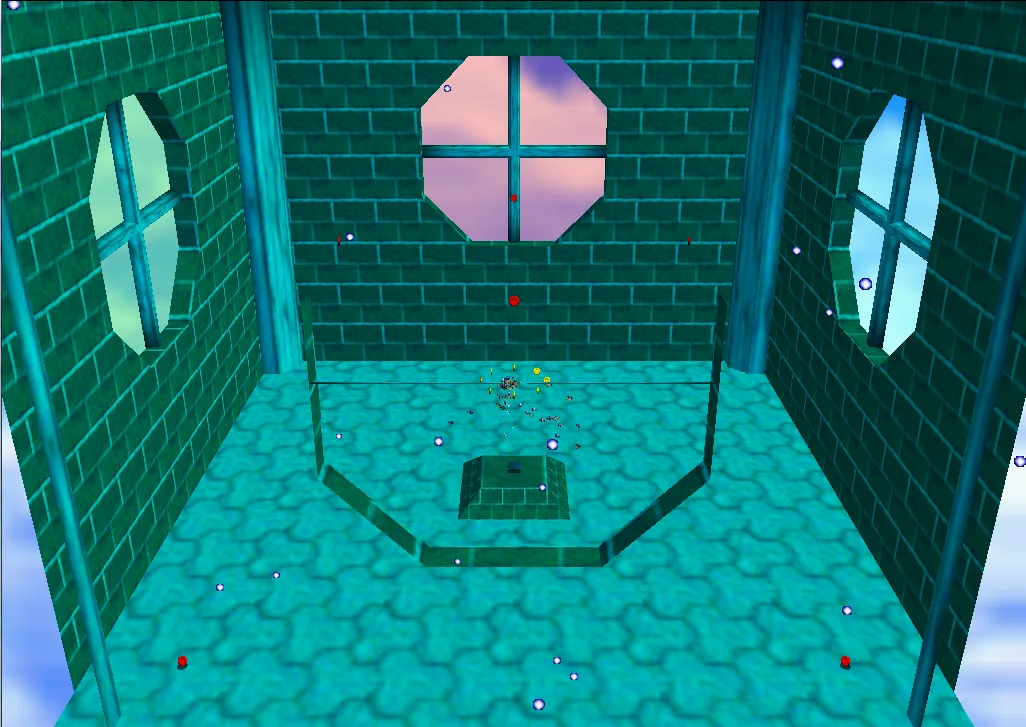
- The Secret Aquarium has no surface. The Super Mario Wiki notes there is nowhere to come up for air in it, and the level data agrees: the tank's collision tops out below its water level. Coins are your air supply in there, which is why the secret stars guide has you sweep its coin rings.
Currents: whirlpools, jet streams and the stream
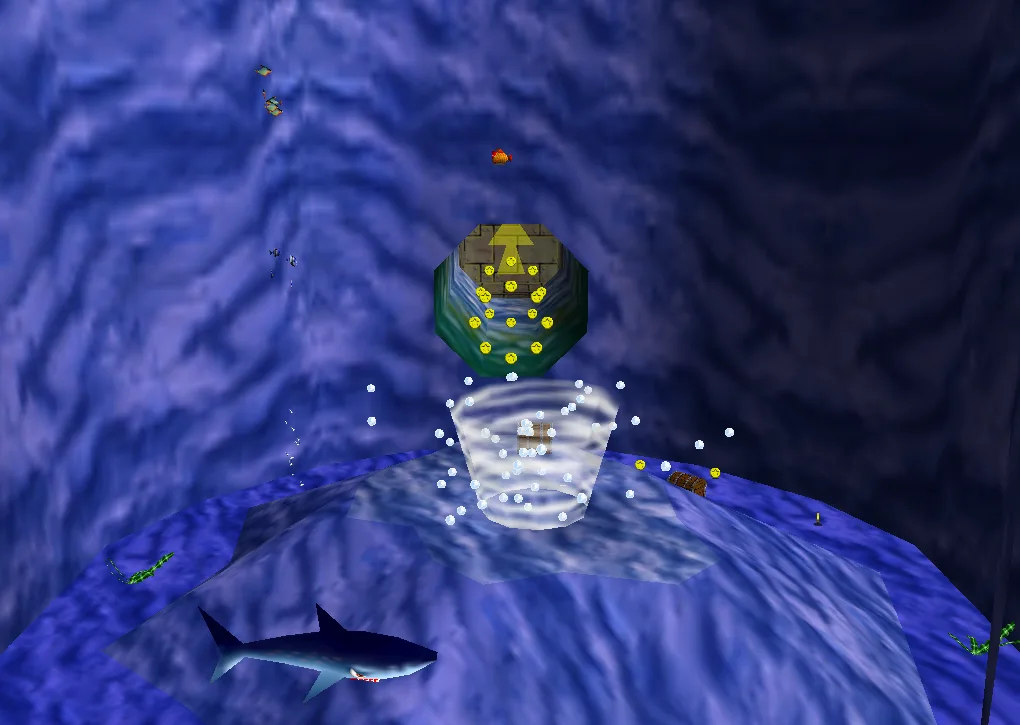
The level scripts place four currents between them, and the collision data adds flowing-water floors in four more places:
| Current | Where | What it does | Peak push (units per frame) |
|---|---|---|---|
| Whirlpool pull | Dire, Dire Docks, first area | Drags Mario toward the vortex in a spiral, fading to nothing 2,000 units out | 20 |
| The vortex itself | The same spot | Touching it catches Mario, spins him down and kills him | Fatal |
| Jet stream | Dire, Dire Docks, second area, from the grate; Jolly Roger Bay, from the second star's version of the bay onward | Pushes Mario away from its source, fading to nothing 2,000 units out | 30 |
| Exit pull | Dire, Dire Docks, second area, once Bowser in the Fire Sea is beaten | Drags Mario toward the opening to the Castle Grounds, reaching 4,000 units | 50 |
| Flowing water | The stream in the Cavern of the Metal Cap; floors in Tall, Tall Mountain, on the Castle Grounds and in the castle basement | Pushes Mario one way | 28 in the Cavern of the Metal Cap |
Three rules from the code make those manageable:
- Currents only move a swimming Mario. The current code runs inside the swimming actions alone. Metal Mario walking the floor is not pushed, which is why the Dire, Dire Docks guide and the Jolly Roger Bay guide both send you through their jet streams with the Metal Cap.
- A jet stream outpushes Mario at its source. It pushes at 30 there, and his top swimming speed is 28. It weakens with distance, which is why the no-cap route the Jolly Roger Bay guide mentions exists, and why it is fiddly.
- The whirlpool loses to a good stroke. Its pull peaks at 20: stronger than a flutter kick inside roughly 800 units, weaker than a stroke at full strength. If it is dragging you in while you hold A, stop holding A.
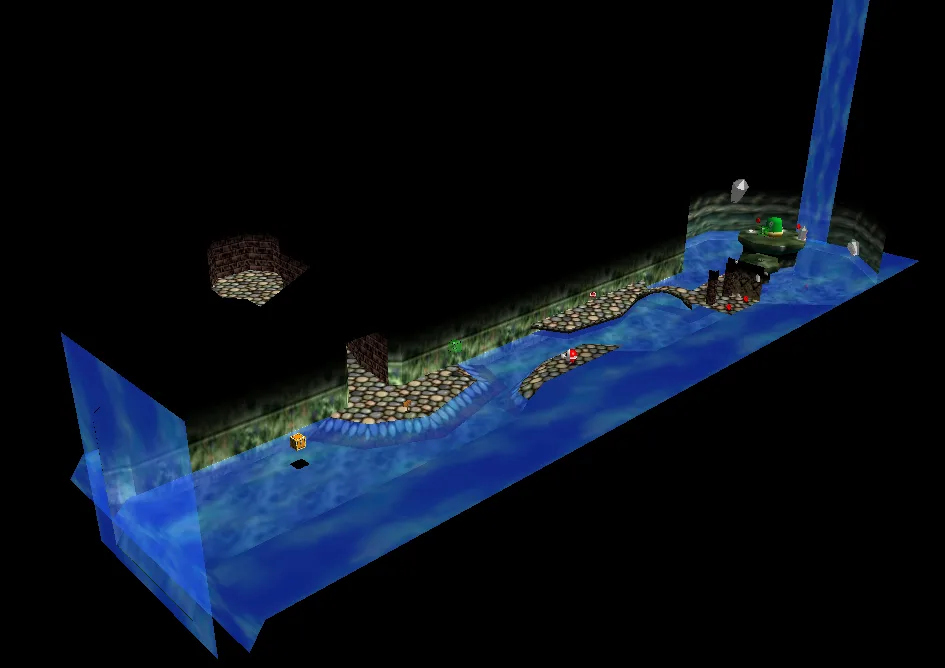
The stream in the Cavern of the Metal Cap is the other number worth knowing. Its riverbed pushes at 28, Mario's top stroke speed, so swimming straight against it at full strength holds position at best. Go with it.
The Koopa Shell: eight seconds at top speed
Two Koopa Shells sit underwater in the N64 game, going by the level data and Ukikipedia's Water Shell page: one in Jolly Roger Bay, in the right-hand of the two clams below the cannon (the Super Mario Wiki says the other one holds a red coin), and one in a clam in the second area of Dire, Dire Docks. Wait for the clam to open, face the shell and press B. Mind the clam itself: the Super Mario Wiki notes that touching one while it opens or closes knocks Mario away for two wedges.
Once you have it, per the decompiled code:
- Mario swims at the 28-unit cap with no button presses. No rhythm, no strength to build.
- It lasts 240 frames, eight seconds, then the shell disappears and Mario drops into a flutter kick. At 28 units a frame, that is up to about 6,700 units of travel.
- B throws it, and a thrown shell is gone. So is a shell carried out onto land.
- It is not a weapon. Riding a shell on land counts as an attack; swimming with one does not, so enemies still hit you.
- No water jump while you hold it. The shell-swimming action never checks for one.
The music guide notes that swimming with a shell also cues the Powerful Mario music.
Metal Mario does not swim at all
With the Metal Cap on, the swimming actions hand Mario over to a separate set of metal-water actions, and the rules change:
- He sinks fast, at up to 18 units a frame.
- He walks the floor at about 21 units a frame with the stick fully pushed: quicker than a flutter kick, slower than a full-strength stroke.
- A jumps. If the jump carries him up near the surface, he leaves the water in a water jump that keeps his upward speed.
- Air does not drain and the surface does not heal him: the health code only touches a swimming Mario.
- Currents do not move him.
- When the cap's 20 seconds run out underwater, he goes straight back to treading water where he stands, with whatever meter he had, so finish the job somewhere you can surface.
The cap guide covers the green switch, and the Hazy Maze Cave guide covers the lakebed switch the Metal Cap is built for.
What changes on DS and Switch
| Version | Swimming |
|---|---|
| Super Mario 3D All-Stars and Nintendo Switch Online | They run the N64 game's code, so everything above applies. The Super Mario Wiki's control table for the Switch Online version keeps swim on A by default |
| Super Mario 64 DS | Luigi is the fastest swimmer of the four characters and Yoshi a slow one. Wario's metal form walks underwater at his normal speed and shrugs off freezing water. The remake also adds a blue tint and a layer of mist underwater |
The DS details are from the Super Mario Wiki's page for the remake. The version differences guide covers which build each release runs.
Mistakes that slow you down in the water
- Holding A to go faster. That is the flutter kick, and it settles at 12. Tap.
- Mashing A. A press early in a stroke restarts it and resets strength to 160.
- Waiting too long between strokes. If A is not down seven frames into the glide, strength resets. Press early and hold.
- Pressing A at the surface without pulling back. You get a stroke, not a jump.
- Treading water in deep water. More than 400 units below the top, an idle Mario sinks.
- Swimming into a jet stream at its source. It pushes at 30, and you top out at 28. Bring the Metal Cap.
- Throwing the shell away with B out of habit. Once thrown, it is gone.
- Looking for the surface in the Secret Aquarium. There is none; route through the coin rings.
Quick Action Checklist
- Tap A, do not hold it: let go during each stroke, then press and hold again as soon as the stroke ends.
- Aim for three strokes every two seconds, and listen for the stroke sound to change.
- Stick forward dives and stick back climbs; from level, Mario points straight up in half the time it takes to point straight down.
- To jump out, get to the surface, pull the stick almost all the way back and press A.
- Fall into deep water from any height without fall damage; dive in to keep pointing downward.
- Heal by bobbing in the top 60 units of warm water: a nearly empty meter refills in under three seconds.
- Grab the underwater Koopa Shells in Jolly Roger Bay and Dire, Dire Docks with B for eight seconds at top speed.
- Use the Metal Cap for jet streams: currents only push a swimming Mario.
- Outswim the Dire, Dire Docks whirlpool with strokes, not a flutter kick.
Frequently Asked Questions
How do you swim faster in Super Mario 64?
How do you get out of the water in Super Mario 64?
What is the difference between the breaststroke and the flutter kick in Super Mario 64?
How do you dive underwater in Super Mario 64?
What does the Koopa Shell do underwater in Super Mario 64?
Can Mario attack underwater in Super Mario 64?
Keep Reading
- Mythras blog
- Super Mario 64 coverage hub
- Super Mario 64 health guide
- Super Mario 64 movement guide
- Super Mario 64 camera guide
- Super Mario 64 Dire, Dire Docks guide
- Super Mario 64 Jolly Roger Bay guide
- Super Mario 64 secret stars guide
- Super Mario 64 cap guide
- Super Mario 64 Hazy Maze Cave guide
- Super Mario 64 music guide
- Super Mario 64 version differences
- mario_actions_submerged.c (breaststroke, flutter kick, swimming strength, water jump, currents, shell swimming, Metal Mario underwater) — Super Mario 64 decompilation (n64decomp)
- mario.c (water entry, underwater health drain and surface healing, jump launch speeds) — Super Mario 64 decompilation (n64decomp)
- mario_actions_airborne.c (water jump, entering water from the air, and B in the air diving only above 28 forward speed) — Super Mario 64 decompilation (n64decomp)
- interaction.c (what counts as an attack; whirlpool capture) — Super Mario 64 decompilation (n64decomp)
- sm64.h (swimming and metal-water action flags) — Super Mario 64 decompilation (n64decomp)
- game_init.c (Control Stick range) — Super Mario 64 decompilation (n64decomp)
- level_script.c (whirlpool and jet stream conditions) — Super Mario 64 decompilation (n64decomp)
- Dire, Dire Docks level script (whirlpool, jet stream and exit current) — Super Mario 64 decompilation (n64decomp)
- Jolly Roger Bay level script (jet stream) — Super Mario 64 decompilation (n64decomp)
- Jolly Roger Bay object placements (underwater Koopa Shell) — Super Mario 64 decompilation (n64decomp)
- Dire, Dire Docks second-area object placements (underwater Koopa Shell) — Super Mario 64 decompilation (n64decomp)
- koopa_shell_underwater.inc.c (thrown or dropped shells are deleted) — Super Mario 64 decompilation (n64decomp)
- Cavern of the Metal Cap collision (flowing-water floor) — Super Mario 64 decompilation (n64decomp)
- The Secret Aquarium collision (tank height and water level) — Super Mario 64 decompilation (n64decomp)
- Swimming optimization (swimming strength 160 to 280) — Ukikipedia
- Water — Ukikipedia
- Water Shell — Ukikipedia
- Frame (30 frames per second) — Ukikipedia
- Swim — Super Mario Wiki
- Koopa Shell — Super Mario Wiki
- Clam — Super Mario Wiki
- Jolly Roger Bay — Super Mario Wiki
- The Secret Aquarium — Super Mario Wiki
- Super Mario 64 (control tables, including Nintendo Switch Online) — Super Mario Wiki
- Super Mario 64 DS — Super Mario Wiki
- Super Mario at 35: Mario's makers on Nintendo's most enduring mascot — The Guardian (Keza MacDonald, 14 September 2020)
Related Guides
Super Mario 64 Lives and Game Over: What You Actually Lose
A Game Over in Super Mario 64 is a file reload: you keep everything you saved and lose everything you did not. Here is when the game actually writes your file, exactly what a Game Over rolls back, the five courses where a fall is free, and every way to earn a life, from the coin tally to the Monty Mole streak that never runs dry.
Super Mario 64 Music: Every Track and Where It Plays
Super Mario 64 scores 15 courses with seven songs, and only one of them belongs to a single course. Here is which track plays in every course and secret level, the five levels whose music rearranges itself as Mario moves, what triggers the boss music and the jingles, all 36 soundtrack tracks under their 1996 and current names, and where to listen today.
Super Mario 64 Bowser Levels Guide: All 24 Red Coins
Bowser in the Dark World, the Fire Sea and the Sky each hide one Power Star behind eight red coins on the obstacle course in front of the fight. Here is the route through all three, where every red coin sits, and what else the level data holds.
Super Mario 64 120-Star Reward: Yoshi and the Castle Roof
Super Mario 64 does not announce your 120th Power Star. The reward is outside: a cannon grate that stops loading, Yoshi on the castle roof, and a gift that quietly resets the next time you load your file. Here is what 120 stars changes, checked against the wikis and the decompiled code.
Super Mario 64 Beginner Guide: Your First 30 Power Stars
Super Mario 64 does not gate you on difficulty, it gates you on Power Stars. Here is exactly which doors need what, which stars are fastest to grab, and the route that gets a first-timer from one star to thirty without wandering the castle in circles.
Super Mario 64 Snowman's Land Guide: All 7 Stars
Snowman's Land looks like the throwaway snow level, and the wiki record on it backs that read up in one specific way: it is the only one of the game's 15 main courses with no Blue Coins at all. What it does have is two freezing ponds that hurt you in two different ways, an enemy species that appears nowhere else in the game, and a cap-stealing snowman nobody warns you about. Here is every star, the full 127-coin breakdown, and the course's last remaining gap in this vertical.