How to Fly in Super Mario 64: Dive for Speed, Then Climb
Wing Mario can't flap for height. Every bit of height costs speed and every dive buys it back. Here is how takeoff works, the one glide the code holds steady, why the nose lifts on its own, how each flight ends, and the A-button trick that cancels fall damage.
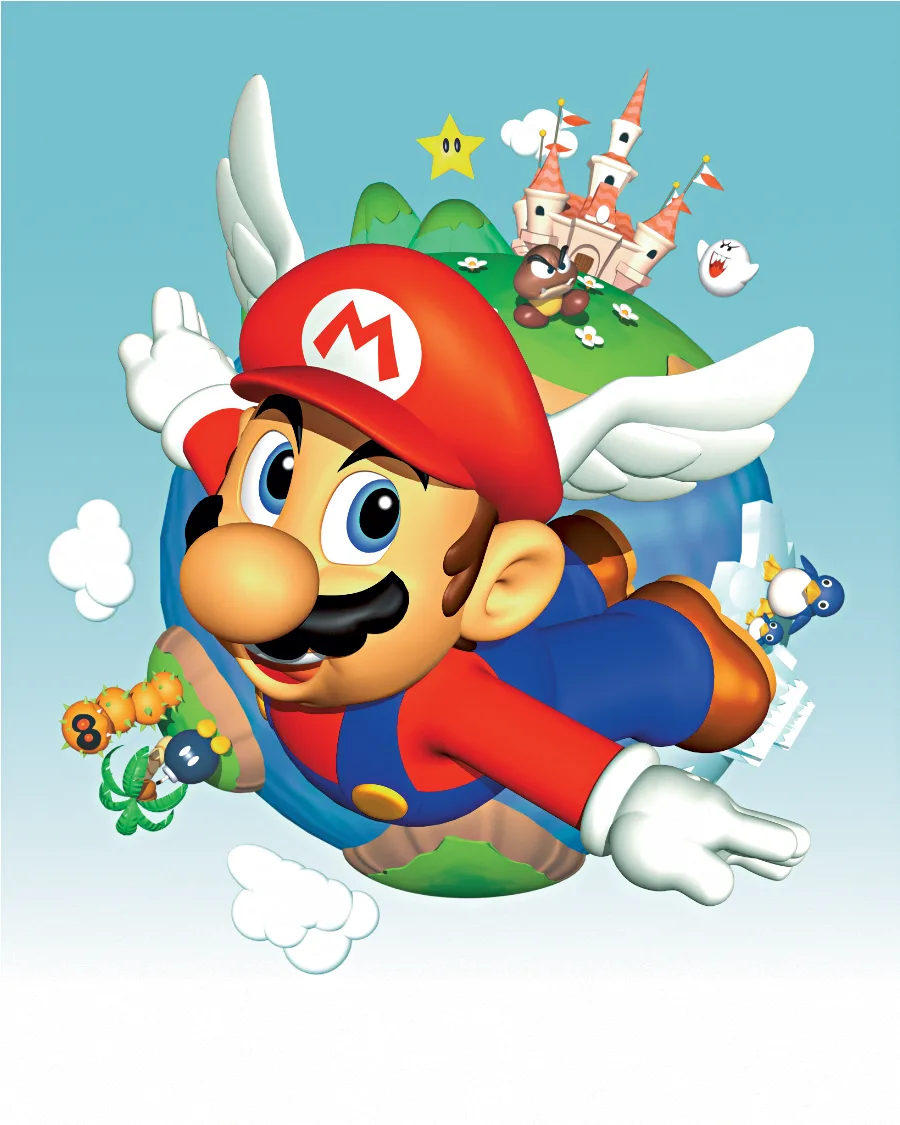
Wing Mario can't flap for height. Nothing in Super Mario 64's flying code gives you height for free: every bit of altitude is paid for in speed, every dive pays it back, and the game skims a little speed off the top on every frame you stay up. Fly the Wing Cap like a jet, holding the stick back to climb, and Mario stalls and drops nose first. Fly it like a glider and a single minute of wings will carry you clean across a course.
The Super Mario Wiki puts the feel of it in one line: to stay airborne you have to keep raising and lowering Mario, the way Caped Mario flew in Super Mario World. The n64decomp decompilation of the game's code shows why in one short function. Unless a sentence says otherwise, the mechanics here come from that decompilation, with Ukikipedia and the Super Mario Wiki filling in the rest.
Speeds are in the game's own units per frame, and the game runs at 30 frames per second, per Ukikipedia. This covers the N64 game, which Super Mario 3D All-Stars and the Nintendo Switch Online app both run a version of; the DS remake's differences are near the end. Where to find each cap switch is the cap guide's job, so this post starts once the red switch is pressed.
Every flight input in one table
| Input (N64) | What Mario does | Notes |
|---|---|---|
| Triple jump, wearing the Wing Cap | Takes off | No running speed needed |
| Fire a cannon, wearing the Wing Cap | Switches to flight once he starts to fall | The cap timer stops while you aim |
| Control Stick back | Nose up: climbs, loses speed | Pitch tops out at 60 degrees |
| Control Stick forward | Nose down: dives, gains speed | Pitch bottoms out at 60 degrees |
| Control Stick left or right | Turns | The faster he flies, the faster he turns |
| Z | Ends the flight in a ground pound | He keeps the cap |
| A or B | Nothing, while flying | The flying code reads only the stick and Z |
| Hold A while falling (not flying) | Wings flutter, and he falls at half speed | No fall damage on the N64 |
Two of those rows deserve a sentence before the numbers.
The stick flies like a plane's. Forward points Mario's nose down, back points it up, exactly as the decompiled pitch code and Ukikipedia's flying page describe it. It is the same layout as swimming, which the swimming guide covers.
The camera takes over. As Mario takes off, the code switches to a camera that sits behind him (ten frames into a triple-jump takeoff, or as a cannon shot turns into flight), and it hands back the area's normal camera when the flight ends. The camera guide has what that normal camera is in each area.
Taking off: three ways into the air
The triple jump. Normally the third jump of a chain only becomes a triple jump if Mario is running faster than 20 units a frame. With the Wing Cap on, the decompiled landing code skips that check outright (its comment says so), so the third jump becomes a flying triple jump even from a standstill. That is why the cap guide tells you to triple jump in place. The takeoff jump also launches harder: it leaves the ground at 82 units a frame upward, against 69 for an ordinary triple jump. Flight starts near the top, once Mario's upward speed falls below 4, and the code raises his speed to at least 32 on the way in.
Two things to know about that takeoff jump. Mario cannot turn during it (the code uses its no-turning air movement), so face where you want to go before the third jump. And B or Z during it cancels the takeoff into a dive or a ground pound.
The cannon. In a cannon you aim from level up to 80 degrees, and the shot leaves at 100 units a frame, split between forward and up by the angle. With the Wing Cap on, the code switches Mario to flight on the first frame he is moving downward, which is the top of the arc. A level shot starts flying almost at once, at close to the full 100. A steep one starts higher but slower, because forward speed is 100 times the cosine of the angle: a 45-degree shot reaches the top of its arc at about 67. Better still, the cap timer stops while Mario sits in a cannon aiming, so line up the shot as long as you like.
Arriving in flight. The Tower of the Wing Cap is the one place Mario enters already flying. The Super Mario Wiki says so, and in the decompiled level scripts it is the only level that uses the flying spawn. Its cap is shorter, though; the timer section below has the numbers.
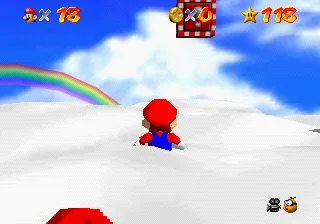
Wing Mario Over the Rainbow, despite the name, does not start you in flight. Its level script drops Mario onto the first cloud from above, without wings, and the course's red blocks are where the wings come from.
Speed is altitude
Every frame, the flying code takes speed off Mario in proportion to how far his nose points up, and adds it back in proportion to how far it points down, then takes a flat 0.1 on top. Run that at the angles that matter:
| Nose angle | Speed change per second | Height change per frame, at a speed of 32 |
|---|---|---|
| 60 degrees up (the limit) | Loses about 43 | Up about 27.7 |
| 30 degrees up | Loses about 23 | Up 16 |
| Level | Loses 3 | None |
| 4.5 degrees down | None | Down about 2.5 |
| 30 degrees down | Gains about 17 | Down 16 |
| 60 degrees down (the limit) | Gains about 37 | Down about 27.7 |
The row that runs the whole system is 4.5 degrees down. Level flight still bleeds 3 speed a second, so the one attitude that holds speed steady is a shallow descent, sinking about 2.5 units a frame, roughly 75 a second. You cannot cruise flat forever. You glide.
That is why the Super Mario Wiki recommends taking the Tower of the Wing Cap's red coins starting with the pair on the east side and going counterclockwise: each pair sits lower than the last, and Mario slowly loses altitude while he flies.
Ukikipedia's flying page adds the efficiency tip that follows from the formula. Speed changes in step with the nose angle, but height changes with its sine, so a fast, steep dive followed by a slower, shallow climb nets more than holding one straight line.
The nose has a mind of its own
The code does one more thing every frame: it tilts Mario's nose by itself, based on his speed.
- Above 32, the nose rises on its own, by 6 angle units a frame for every unit of speed over 32 (65,536 units make a full circle).
- Below 32, it sinks on its own, by the same rule.
- Below 16, it sinks faster, 10 units a frame for every unit under 32.
- At 4 or less, it drops 1,024 units a frame, about 5.6 degrees. That is the stall: the game pushes the nose down until a dive rebuilds your speed.
So 32 is the balance point, and the two rules together explain how flying feels:
- Hands off, Mario bobs. Faster than 32 his nose lifts and he slows; slower, it drops and he speeds up. Leave the stick alone after a triple-jump takeoff and he swings around that 4.5-degree glide, between roughly 28 and 36 speed, and our frame-by-frame model of the decompiled code has him covering about 57,000 units forward and losing about 4,600 of height over a full minute.
- You cannot hang in the air. Haul the stick back from cruising speed and, in the same model, Mario gains about 300 units of height and runs out of speed in under two seconds, and then the stall rule takes the nose down.
- A cannon shot climbs by itself. Fired level at 100, the nose rises about 2.2 degrees a frame with no input. Left alone, the model has Mario hitting the 60-degree limit in about a second, climbing roughly 3,000 units and stalling about three seconds after the shot. If you want to stay low, hold the stick forward.
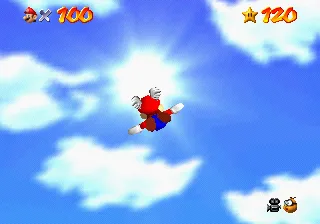
There is an audio cue for speed, too. When Mario's nose comes up through level while he is flying at 48 or faster, the code plays a whoosh and one of his yahoo, waha or yippee voice clips. If you hear it, you are carrying real speed into the climb.
Steering scales with speed
The stick does not set a turn rate. It sets a target, and the target is your stick position multiplied by your speed: speed divided by 4 for turning, divided by 5 for pitching. At full stick and a speed of 32, Mario's turn tops out at about 2.8 degrees a frame, around 84 degrees a second. At 16 he turns half as fast, and at 64 twice as fast.
The rate also builds up rather than snapping to the target, so in our model a full-stick U-turn at a speed of 32 takes about three seconds. Turning does cost a little speed in the code, but at the turn rates the stick can reach that cost is a small fraction of the 3-a-second that level flight already loses.
The practical rule: make big direction changes while you are fast, and do not expect a slow, stalling Mario to answer the stick.
How a flight ends
| What happens | What the code does | The Wing Cap | Damage |
|---|---|---|---|
| You press Z | Ground pound, straight down | Kept | Ordinary fall-damage rules, unless you hold A |
| Mario touches the ground | He lands in a belly slide | Kept | None: this landing skips the fall-damage check (a lava floor still burns) |
| Mario flies into a wall | Bonk: knocked backward, flight over | Kept | Fall damage on landing if the drop is long, unless you hold A |
| Mario flies into a lava wall | Lava boost | Kept | 3 wedges |
| The timer runs out | He drops into a freefall | Gone | Ordinary fall-damage rules |
Two rows of that table are the useful ones.
Touching down is free. However fast and steep you come in, the flying code sends Mario straight into a belly slide with no fall-damage test. The cap stays on, so you can stand up and triple jump straight back into the air.
Ceilings do not end a flight. Fly up into one and Mario stops against it instead of bonking. Scrape one on the way down, or fly out past the edge of the level, and you hear a thud while the game tips his nose down about 2.8 degrees a frame until he is clear. He keeps flying throughout.
Hold A: the flutter that cancels fall damage
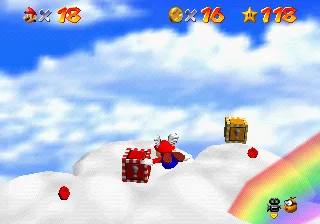
Outside of flight, the Wing Cap still changes how Mario falls. In the decompiled gravity code, if he is wearing it, falling, and A is held down, his wings flutter and gravity softens: he gains 2 units a frame of downward speed instead of 4, and tops out at 37.5 instead of 75.
That number matters because fall damage only applies when Mario hits the ground falling faster than 55 units a frame, per Ukikipedia's fall damage page and the same code. Start fluttering early in a fall and he never gets that fast, so on the N64 holding A cancels fall damage outright. The Super Mario Wiki's Wing Mario page says the same.
Put that together with the table above and you have a safe way down from any height:
- Press Z, then hold A. The ground pound drops you straight onto your target, and holding A keeps its fall below the damage line. Without A, a ground pound speeds up like any other fall, and a drop of more than 1,150 units from the top of the ground pound's spin costs 2 wedges (4 past 3,000).
- Hold A after a bonk. The knockback fall flutters too, as long as the cap is still on.
It does nothing during flight itself, since the flying code ignores gravity, and it is gone the moment the cap runs out. The health guide has the full fall-damage thresholds.
The timer: 60 seconds, 40 in the tower
- A Wing Cap from a red block lasts 1,800 frames, 60 seconds, in the decompiled pickup code. Ukikipedia and the Super Mario Wiki both give a minute.
- The Tower of the Wing Cap gives you 1,200 frames, 40 seconds, the cap you spawn with there. The tower has its own red block, so once you have pressed the switch, break it for a fresh 60.
- A second Wing Cap tops you back up to 60. Picking up a cap only ever raises the timer.
- It stops in a cannon, at a sign and in conversation. The timer pauses while Mario is reading, talking or sitting in a cannon, except in its last two seconds.
- You get about two seconds of warning. With 60 frames left the Powerful Mario music fades out, and over roughly the last two seconds the wings blink on and off.
- Red blocks come back. A cap block you break reforms about 10 seconds later. A cap you leave on the ground lasts 10 seconds, blinks for a little over one more, then vanishes.
- Landing does not end it. Touching down leaves the cap on and the timer running.
Where you can fly
The decompiled level data puts 15 Wing Cap red blocks in six places, and the Super Mario Wiki's Wing Cap page lists the same six places:
| Where | Red Wing Cap blocks | Cannons | Getting airborne |
|---|---|---|---|
| Bob-omb Battlefield | 3 | 6 | Triple jump or the cannon network |
| Lethal Lava Land | 1 | None | Triple jump only |
| Shifting Sand Land | 3 | 1 | Triple jump or the cannon |
| Tower of the Wing Cap | 1 | None | You arrive flying |
| Wing Mario Over the Rainbow | 6 | 2 | Triple jump, or either cannon once the Bob-omb Buddy opens them |
| Castle Grounds (the roof) | 1 | 1, by the lake, at 120 stars | The cannon puts you on the roof |
The course guides linked in the table cover what the wings are for in each course, the secret stars guide covers the tower and the rainbow course, and the 120-star guide covers the roof. Falling off the bottom of the tower or the rainbow course costs no life, as the lives guide explains, which makes them good places to practise.
One more pair of wings is not yours to steer. Per the Super Mario Wiki, grabbing the star Bowser leaves behind after the final fight turns Mario into Wing Mario for the ending.
What changes on DS, Switch and the 1996 cartridge
| Version | Flying |
|---|---|
| Original Japanese cartridge (1996) | No voice clip when you pull out of a fast dive; the code only plays the whoosh. Ukikipedia also notes that B or Z during the takeoff jump can leave the flying camera stuck behind Mario on this version |
| Super Mario 3D All-Stars and Nintendo Switch Online | They run a version of the N64 game; the version differences guide covers which build each one uses |
| Super Mario 64 DS | A white feather called Wings replaces the Wing Cap, and only Mario can use it in the single-player game. Yoshi, Luigi or Wario hitting the same block gets a Power Flower instead. The Wings appear in the same places plus Snowman's Land and Tall, Tall Mountain, and slowing your fall no longer prevents fall damage |
The DS details are from the Super Mario Wiki's pages for the Wings and for Wing Mario. The Tall, Tall Mountain guide covers the DS-only star that uses them there.
Mistakes that drop you out of the sky
- Holding the stick back to gain height. Climbing at the limit costs about 43 speed a second, and from cruising speed you stall in under two seconds. Dive first, then climb.
- Expecting level flight to hold altitude. It loses 3 speed a second. The steady glide sinks.
- Leaving a cannon shot alone. At 100 speed the nose climbs by itself into a stall. Push forward to hold your line.
- Turning while slow. Turn rate scales with speed. Make your big turns fast.
- Pressing A or B to flap. Neither does anything in flight. The stick and Z are the whole control set.
- Ground pounding from altitude without holding A. It is an ordinary fall without the flutter.
- Turning during the takeoff jump. You cannot. Face your heading before the third jump.
- Spending the cap on the ground. Break the red block only when you are ready to launch, and aim cannons at leisure, because the timer stops while you sit in one.
- A camera stuck behind Mario after a takeoff goes wrong. Ukikipedia documents this as a Wing Cap camera glitch, triggered by landing just after starting to fly. Getting fired from a cannon, knocked back by an enemy, or leaving the course clears it.
Quick Action Checklist
- Press the red switch first; then any red block gives you the Wing Cap.
- Take off with a triple jump in place, or fire from a cannon; face your heading before the third jump.
- In a cannon, take your time: the cap timer is paused while you aim.
- Remember the plane controls: stick forward dives, stick back climbs.
- Treat speed as altitude: dive to build speed, then trade it for height with a shallow climb.
- Expect the nose to rise on its own above 32 speed and sink below it; at 4 or less it drops hard.
- Turn while you are fast, because turn rate scales with speed.
- Land without fear: touching down from flight skips the fall-damage check, and you keep the cap.
- To come straight down from height, press Z and hold A.
- Watch for the two-second warning: the music fades and the wings blink.
- Practise in the Tower of the Wing Cap or Wing Mario Over the Rainbow, where a fall costs no life.
Frequently Asked Questions
How do you fly in Super Mario 64?
How long does the Wing Cap last in Super Mario 64?
How do you gain altitude while flying in Super Mario 64?
How do you stop flying in Super Mario 64?
Does the Wing Cap prevent fall damage in Super Mario 64?
Where is the Wing Cap in Super Mario 64?
Keep Reading
- Mythras blog
- Super Mario 64 coverage hub
- Super Mario 64 cap guide
- Super Mario 64 swimming guide
- Super Mario 64 camera guide
- Super Mario 64 health guide
- Super Mario 64 Bob-omb Battlefield guide
- Super Mario 64 Lethal Lava Land guide
- Super Mario 64 Shifting Sand Land guide
- Super Mario 64 secret stars guide
- Super Mario 64 120-star reward
- Super Mario 64 lives and Game Over guide
- Super Mario 64 Tall, Tall Mountain guide
- Super Mario 64 version differences
- mario_actions_airborne.c (flying physics, takeoff jump, cannon shot, how flight ends, ground pound, fall damage) — Super Mario 64 decompilation (n64decomp)
- mario_step.c (Wing Cap flutter gravity, air collision with walls and ceilings) — Super Mario 64 decompilation (n64decomp)
- mario.c (triple jump speed rule, takeoff launch speed, cap timer and its pauses) — Super Mario 64 decompilation (n64decomp)
- interaction.c (Wing Cap duration and music) — Super Mario 64 decompilation (n64decomp)
- level_update.c (flying spawn and the Tower of the Wing Cap starting cap) — Super Mario 64 decompilation (n64decomp)
- mario_actions_automatic.c (cannon aiming range and launch speed) — Super Mario 64 decompilation (n64decomp)
- exclamation_box.inc.c (cap blocks turning solid and reforming) — Super Mario 64 decompilation (n64decomp)
- cap.inc.c (uncollected caps despawning) — Super Mario 64 decompilation (n64decomp)
- game_init.c (Control Stick range) — Super Mario 64 decompilation (n64decomp)
- Tower of the Wing Cap level script (flying spawn) — Super Mario 64 decompilation (n64decomp)
- Tower of the Wing Cap object placements (Wing Cap block) — Super Mario 64 decompilation (n64decomp)
- Wing Mario Over the Rainbow level script (airborne spawn) — Super Mario 64 decompilation (n64decomp)
- Wing Mario Over the Rainbow object placements (Wing Cap blocks, cannons) — Super Mario 64 decompilation (n64decomp)
- Bob-omb Battlefield object placements (Wing Cap blocks, cannons) — Super Mario 64 decompilation (n64decomp)
- Shifting Sand Land object placements (Wing Cap blocks, cannon) — Super Mario 64 decompilation (n64decomp)
- Lethal Lava Land object placements (Wing Cap block) — Super Mario 64 decompilation (n64decomp)
- Castle Grounds object placements (roof Wing Cap block, lakeside cannon) — Super Mario 64 decompilation (n64decomp)
- Flying (entering flight, update_flying and the dive-then-climb tip) — Ukikipedia
- Wing Cap (60-second duration, slow fall, camera glitch) — Ukikipedia
- Fall damage (the 55-units-per-frame condition) — Ukikipedia
- Frame (30 frames per second) — Ukikipedia
- Wing Cap — Super Mario Wiki
- Wing Mario — Super Mario Wiki
- Wings (Super Mario 64 DS) — Super Mario Wiki
- Tower of the Wing Cap — Super Mario Wiki
- Wing Mario Over the Rainbow (Over the Rainbows) — Super Mario Wiki
Related Guides
Super Mario 64 Swimming Guide: Tap A, Don't Hold It
Holding A is the slow way to swim in Super Mario 64. Here is the stroke rhythm the code rewards, how the stick steers, how to jump out of the water, what each current does, and the eight seconds of free speed hiding in two clams.
Super Mario 64 Lives and Game Over: What You Actually Lose
A Game Over in Super Mario 64 is a file reload: you keep everything you saved and lose everything you did not. Here is when the game actually writes your file, exactly what a Game Over rolls back, the five courses where a fall is free, and every way to earn a life, from the coin tally to the Monty Mole streak that never runs dry.
Super Mario 64 Music: Every Track and Where It Plays
Super Mario 64 scores 15 courses with seven songs, and only one of them belongs to a single course. Here is which track plays in every course and secret level, the five levels whose music rearranges itself as Mario moves, what triggers the boss music and the jingles, all 36 soundtrack tracks under their 1996 and current names, and where to listen today.
Super Mario 64 Bowser Levels Guide: All 24 Red Coins
Bowser in the Dark World, the Fire Sea and the Sky each hide one Power Star behind eight red coins on the obstacle course in front of the fight. Here is the route through all three, where every red coin sits, and what else the level data holds.
Super Mario 64 Beginner Guide: Your First 30 Power Stars
Super Mario 64 does not gate you on difficulty, it gates you on Power Stars. Here is exactly which doors need what, which stars are fastest to grab, and the route that gets a first-timer from one star to thirty without wandering the castle in circles.
Super Mario 64 120-Star Reward: Yoshi and the Castle Roof
Super Mario 64 does not announce your 120th Power Star. The reward is outside: a cannon grate that stops loading, Yoshi on the castle roof, and a gift that quietly resets the next time you load your file. Here is what 120 stars changes, checked against the wikis and the decompiled code.