Super Mario 64 Lives and Game Over: What You Actually Lose
A Game Over in Super Mario 64 is a file reload: you keep everything you saved and lose everything you did not. Here is when the game actually writes your file, exactly what a Game Over rolls back, the five courses where a fall is free, and every way to earn a life, from the coin tally to the Monty Mole streak that never runs dry.
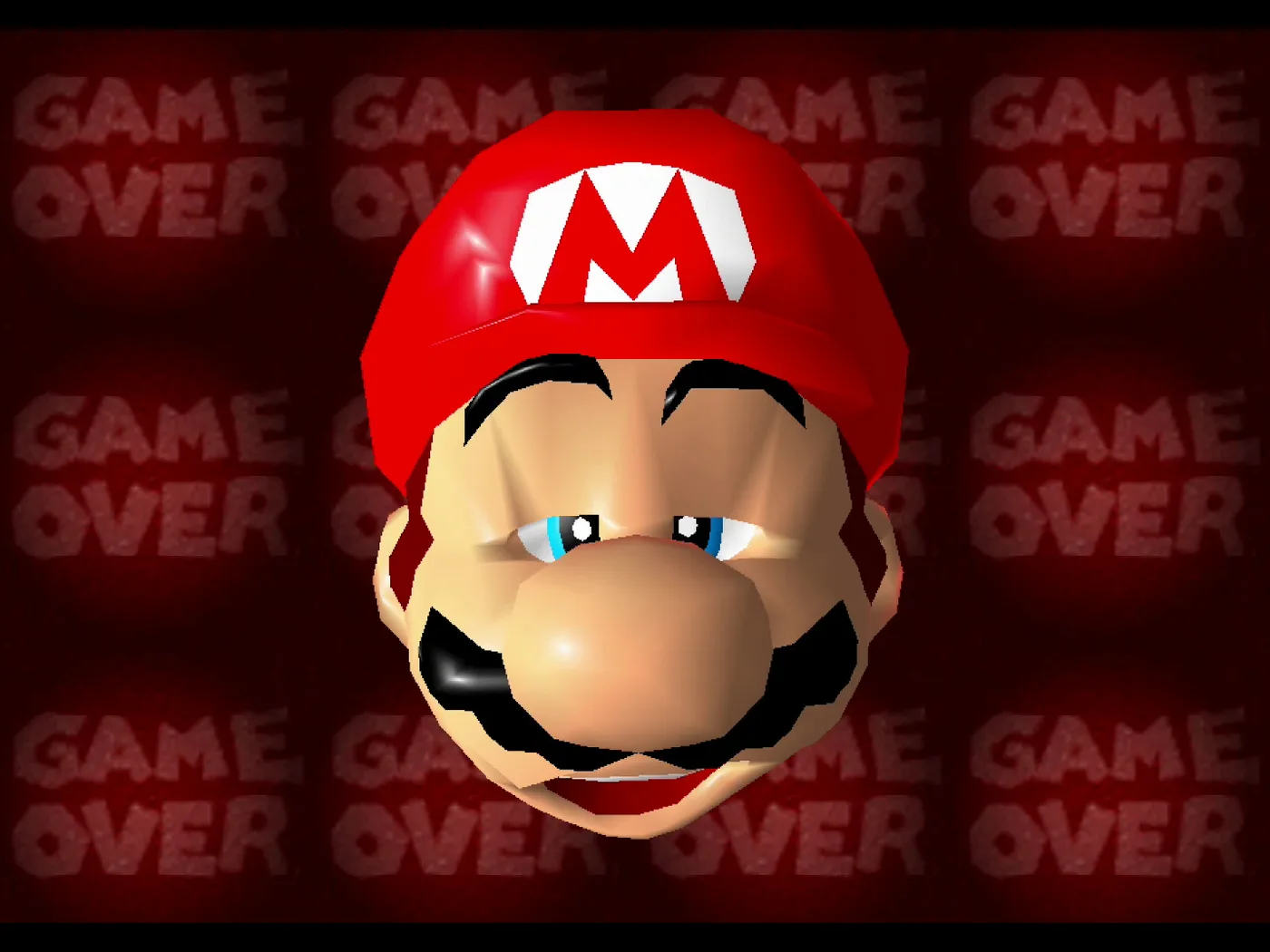
A Game Over in Super Mario 64 sounds final, and mostly it is not. When Mario dies with the life counter already on zero, the decompiled code reloads your file from the last version written to the cartridge, then shows the red Game Over screen. Everything you saved survives. Everything you did not save is gone. The catch is that the game only saves when it asks you, and saying no is one button press.
So the questions worth answering are about saving as much as lives: when the game actually writes your file, what a Game Over rolls back, and, if you want a cushion anyway, where extra lives come from. All of it has exact answers in the n64decomp decompilation of the game's code, with Ukikipedia and the Super Mario Wiki filling in the rest. This covers the N64 game, which Super Mario 3D All-Stars and the Nintendo Switch Online app both run a version of; the DS remake's differences are near the end.
A Game Over is a file reload
The cartridge holds four save files, and the decompiled save code keeps two copies of each, so that if one copy goes bad the other can stand in. Saving writes your file and refreshes that backup copy at the same time. A Game Over runs a routine that copies the backup over the file you were playing, a copy the decompilers' own comment describes as "a cached copy of what has been written to EEPROM." In plain terms: your file as of your last save.
Then comes the Game Over screen. The Super Mario Wiki describes it as a red version of the title screen reading "Game Over," with a slowed, falling take on the Main Theme and Mario's face looking worn out; in the decompiled title-screen code, every version except the original Japanese release also plays his "Game over!" voice line. Press Start and the code sends you to file select, the same place the normal title screen leads. Load the file and Mario starts on the Castle Grounds with four lives.
That is the entire penalty. The Super Mario Wiki calls the effect of a Game Over marginal, and if you save at every prompt, it is: you lose your place, a walk back, and anything you unlocked since your last star. If you have been turning saves down, it can cost a great deal more.
How the life counter works
| Rule | What the decompiled code does |
|---|---|
| Lives when you load a file | Set to 4, every time |
| Lives on the save file | Not stored at all |
| Maximum | 100; anything higher is clamped back down |
| When a life comes off | When Mario lands outside the level after dying, not at the moment he dies |
| What triggers a Game Over | Dying while the counter already reads 0 |
The last two rows mean the 0 is a real life. From a fresh load you can die four times and keep playing; the fifth death is the Game Over. And because lives are not saved, every power-on, reset and Game Over puts you back on four, including after Yoshi counts you up to 100 at the end of the game, which the 120-star reward guide covers.
A death also refills the Power Meter as Mario lands outside, so every life starts at full health. The health guide has the numbers behind that.
When the game actually saves
Super Mario 64 does not save in the background. In the decompiled code, progress goes to the cartridge at two prompts; the other writes are file-menu housekeeping, such as copying or erasing a file:
| Prompt | When it appears | Choices |
|---|---|---|
| The save menu | After the results screen, whenever a Power Star or a Bowser key sends you out of a level | Three: SAVE & CONTINUE; SAVE & QUIT; or CONTINUE, DON'T SAVE |
| A yes/no box | Straight after a star that leaves you in the level: the 100-coin stars, the red coin stars in the three Bowser levels, the three Toad stars and both MIPS stars | Yes or No after 100 coins; You Bet or Not Now for the rest |
SAVE & QUIT writes the file and drops you back to the title screen.
Saying no does not throw the star away. Collecting a star updates the file in memory on the spot, and your star total, the number the star doors check, is recounted from that copy immediately. Declining only skips writing it to the cartridge. The next time you do save, everything in memory goes in together, including any stars you passed on earlier. Until then, those stars are exposed to three things: a Game Over, the Reset button and the power switch.
What a Game Over takes back
This is everything the save format stores, from the decompiled file layout. A Game Over rewinds each item to your last save and touches nothing else.
| On the save file | What a Game Over can undo |
|---|---|
| All 120 Power Stars, course by course | Any star you collected and did not save |
| Each course's cannon | A cannon a Bob-omb Buddy opened since |
| The two Bowser keys and the doors they open | A key you won, or a door you unlocked with one |
| The star doors you have opened | A star door you opened since |
| The three cap switches | A switch you pressed since |
| The drained moat, and the Dire, Dire Docks portal sliding back in the basement | Either change, if it came after your last save |
| Your best coin score in each course | A new high score |
| Where your lost cap is | The loss itself |
Things that never touch the file at all, such as your lives, the coins you are carrying, where you are standing and Yoshi's special triple jump, are lost to any reload, Game Over or not.
The last row produces the strangest result. If Klepto or Ukiki snatched your cap, or a gust blew it off, since your last save, a Game Over gives it back: the reloaded file has no record of the theft, and when the game finds no record of a lost cap it puts the cap on Mario's head. The health guide covers what playing without it costs.
The rule all of this points to: take SAVE & CONTINUE every time. It is one button press, and it turns a Game Over into a walk back from the Castle Grounds.
Five courses where a fall is free
Five of the castle's secret courses put a net under their void. Their level data routes a fall to a spot outside instead of to a death, so the life counter does not move. The Super Mario Wiki describes where each one drops you:
| Course | Where a fall puts you |
|---|---|
| The Princess's Secret Slide | The castle foyer |
| Tower of the Wing Cap | The castle lobby |
| Cavern of the Metal Cap | Swept out by the current to the pool west of the castle moat |
| Vanish Cap Under the Moat | Up through a hole in the pool where the waterfall drains |
| Wing Mario Over the Rainbow | The lake in front of the castle |
Running out of health is still an ordinary death and still costs a life; the wiki notes it for the Cavern of the Metal Cap and Wing Mario Over the Rainbow. Rainbow Ride and the three Bowser levels have no net at all, so a fall there is a death, as the Bowser levels guide also warns.
Every way to earn a life
| Source | Lives | Where |
|---|---|---|
| 1-Up Mushroom | 1 each | Every main course (81 across the 15 by the Super Mario Wiki's counts), plus more in the castle, on its grounds and in the secret courses |
| Results-screen coin bonus | 1 at 50 coins, 1 at 100, 1 at 150 | Any star or key that sends you out of a level |
| Eight Monty Moles in a row | 1 per streak | Hazy Maze Cave and Tall, Tall Mountain |
| Butterfly trio | Up to 1 per trio | The Castle Grounds, Whomp's Fortress, Tall, Tall Mountain and Tiny-Huge Island |
| Yoshi | Counts you up to 100 | The castle roof, at 120 stars |
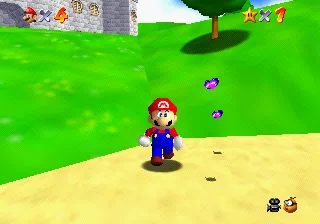
The butterfly row needs explaining. The 1-Up kind comes in trios (the Castle Grounds also has ordinary butterflies that never turn into anything), and in the decompiled behaviour one of the three is picked at random when the trio appears; get close and stay close for a few seconds and that one turns into a 1-Up. On Tall, Tall Mountain and Tiny-Huge Island the other two turn into bombs that chase you, per the Super Mario Wiki. The two trios the level data places on the Castle Grounds, and the one in Whomp's Fortress, are the harmless kind, but the same code gives them a bug: the first butterfly of a harmless trio is numbered 4 instead of 0, so when the random pick is 0, no butterfly matches and no 1-Up appears. UncommentatedPannen's breakdown of the code puts that at about one time in three, so the Castle Grounds trios are two risk-free chances at a life at the start of a session that began on four, not two guaranteed ones.
Coin lives are paid on the results screen
Grab your 50th coin mid-course and nothing happens: the decompiled code has no life check on picking coins up. The lives are paid on the results screen that follows a star exit, where the tally counts your coins up one at a time and adds a life as it passes 50, 100 and 150. That makes three lives the most one exit can pay, which matches the Super Mario Wiki's summary that no more than 150 coins count.
What that means in practice:
- The results screen is the trigger. It appears after any star or key that sends you out of a level: the 15 main courses, the castle's secret courses, and the keys from Bowser in the Dark World and Bowser in the Fire Sea.
- No results screen, no coin lives. Dying pays nothing for your coins. Neither does Exit Course on the pause menu, which returns you to the castle without costing a life but without a tally either. Stars that leave you in the level have no results screen of their own.
- Repeat stars still pay. A star you already own still sends you through the results screen, so 150 coins plus any star is three lives on a course you have already finished.
- Bank the 100-coin star, then leave on another. The 100-coin star does not end the visit. Carry those coins out on a mission star and the tally pays at least two lives for them.
Only four courses hold 150 coins or more by the Super Mario Wiki's counts: Tiny-Huge Island with 192, Cool, Cool Mountain with 154, Wet-Dry World with 152 and Big Boo's Haunt with 151. Only Tiny-Huge Island has real slack; the other three clear 150 by four coins or fewer. On the other eleven courses, two lives is the ceiling. The 100-coin stars guide has the margins course by course.
Six kinds of 1-Up, and the ones that run
Ukikipedia sorts the game's 1-Ups into six types by behaviour, and the decompiled code matches its numbers:
| Type | How it appears | What it does | When it disappears |
|---|---|---|---|
| Stationary | Already sitting there | Nothing | Never, on its own |
| Pole | Climb to the top of certain poles and trees | Pops out, loops in the air, then flies at Mario | It follows you instead of leaving |
| Slide | Placed on slides | Slides away once you are within 1,000 units | Flickers out if you get 5,000 units away |
| Hidden | Touch all of its invisible trigger points: one to four of them, most often four | Pops out, then runs from Mario | When it hits a wall, or you get 3,000 units away |
| Spawned | Breaking a box, eight Monty Moles, or a butterfly | Walks slowly in a straight line | After about 10 seconds |
| Fleeing box | Breaking certain boxes | Runs from Mario | When it hits a wall, or you get 3,000 units away |
Two habits follow from that table. A runner starts to vanish the moment it touches a wall, so do not try to corner one; cut it off in open ground. And the spawned kind is on a ten-second clock, which includes every Monty Mole and butterfly 1-Up. The Super Mario Wiki's course pages call the pole kind "homing" and the hidden kind "triggered"; the homing ones in trees come to you once you climb.
Monty Moles never run out
Ukikipedia states the rule: kill eight Monty Moles in a row and you get a 1-Up, and the decompiled code plays the puzzle-solved jingle as it appears. The code adds three details that turn it into a farm:
- The moles are endless. A mole you stomp drops back underground and surfaces again from one of the holes within 1,500 units of Mario. Ukikipedia counts one mole cycling through three holes in Hazy Maze Cave, and two moles through nine in Tall, Tall Mountain.
- The streak does not reset when it pays. The ninth kill in the same spot earns nothing, and neither does the fiftieth.
- It resets when a kill lands 1,500 units or more from the previous one, and that kill counts as the first of a new streak.
So the loop is eight kills in one place, then eight somewhere far enough away, then back again. Tall, Tall Mountain is laid out for it. The level data puts its holes in two groups: four on a higher level, all within about 525 units of each other, and five on a level roughly 1,500 units below. Take eight up top, drop down and take eight below, and repeat. The closest pair of holes across the two groups is only about 1,540 units apart, barely past the limit, so take your first kill after switching at a hole away from the one you just left.
One warning about the lower level, flagged in a comment by the decompilers themselves: its two farthest holes are just over 1,500 units apart, so kills at those two back to back quietly restart your count. If a set of eight fails to pay, that is the likely reason.
Hazy Maze Cave works the same way, since two of its three holes sit together and the third is roughly 2,700 units or more from both. The Super Mario Wiki places those moles in the toxic maze, though, where the gas drains you for as long as you stand in it, so Tall, Tall Mountain is the comfortable farm. Each payout is a spawned 1-Up that walks off and disappears after about 10 seconds, and the counter stops at 100. The Super Mario Wiki lists two mole 1-Ups per course; the code itself sets no limit.
Where the 1-Ups are, course by course
Counts come from each course's statistics on the Super Mario Wiki, along with the one 1-Up in each course that only appears when you do something:
| # | Course | 1-Ups | The triggered one |
|---|---|---|---|
| 1 | Bob-omb Battlefield | 3 | Collect coins from the ring around the flower bed |
| 2 | Whomp's Fortress | 4 | Collect the coins above the spinning bridge |
| 3 | Jolly Roger Bay | 2 | Swim through the coin ring by the eel |
| 4 | Cool, Cool Mountain | 6 | None; one of the six cannot be collected without glitches |
| 5 | Big Boo's Haunt | 2 | None |
| 6 | Hazy Maze Cave | 4 | None; two are Monty Mole streaks |
| 7 | Lethal Lava Land | 8 | Run around the spinning flame platform past the Bowser picture |
| 8 | Shifting Sand Land | 9 | Step on all five platforms over the quicksand at the back of the pyramid |
| 9 | Dire, Dire Docks | 1 | Swim into the clam shell by the chests at the start |
| 10 | Snowman's Land | 4 | None |
| 11 | Wet-Dry World | 4 | Run around the spiked platform in the middle of downtown |
| 12 | Tall, Tall Mountain | 11 | Walk into all four corners of the slide's entry room |
| 13 | Tiny-Huge Island | 10 | Collect the two coins on the Huge Island beach |
| 14 | Tick Tock Clock | 4 | Stand on the three moving bars |
| 15 | Rainbow Ride | 9 | Ride the falling block on top of the maze |
That is 81 in all. Tall, Tall Mountain leads with 11, two of them Monty Mole streaks and one a butterfly. Tiny-Huge Island's 10 include three butterflies. Dire, Dire Docks has a single 1-Up, hidden in a clam. The unreachable one in Cool, Cool Mountain is covered in the Cool, Cool Mountain guide.
Outside the paintings there are more. The level data puts three on the castle roof, reached at 120 stars; a homing 1-Up, a triggered one and the two butterfly trios elsewhere on the Castle Grounds; two on the Princess's Secret Slide, one of them triggered; and others inside the castle, in the Bowser levels and in the other secret courses. None of this is written to the save file, so every 1-Up is back the next time you enter.
Switch Online: suspend points beat lives
The Nintendo Switch Online app adds a net the cartridge never had. Nintendo's support page covers suspend points for the Nintendo 64 – Nintendo Classics library, which needs an active Nintendo Switch Online + Expansion Pack membership: press Minus, or ZR on the Nintendo 64 controller, to open the Suspend Menu and save to one of four slots. Restore one from before a bad run and the Game Over never happened. On Nintendo Switch 2 the library also gets Rewind, which Nintendo's store page lists as a Switch 2 exclusive.
Both are emulator features sitting on top of the game, so the in-game rules above still apply underneath. On a cartridge, the save prompts are all the protection you get. The version differences guide covers which build each platform runs.
What Super Mario 64 DS changes
The remake keeps the life system and changes the details, per the Super Mario Wiki:
| N64 | Super Mario 64 DS | |
|---|---|---|
| Save files | 4 | 3 |
| Game Over screen | Red, with Mario's tired face | No face; purple GAME OVER letters slide in over a dark gray gradient |
| Collecting a 1-Up | No on-screen marker | Orange "1UP" text |
| Mega Mushroom | Not in the game | After the first seven things destroyed, every further one is a life |
| End-game reward | Yoshi counts lives up to 100 at 120 stars | No Yoshi; the roof holds Luigi's last rabbit, reached at 150 stars |
The 120-star reward guide covers that last row in full.
Mistakes that cost you progress
- Choosing CONTINUE, DON'T SAVE to save a few seconds. The star is safe until a Game Over, a reset or a power cut, and then it is not.
- Reading x0 as Game Over. It is your last life, not your lack of one. Play it carefully and save at the first chance.
- Leaving through the pause menu with a pocket full of coins. Exit Course pays no tally. With 100 or more coins in hand, any star to leave on is worth two or three lives.
- Farming one Monty Mole hole. After the first 1-Up, the same spot pays nothing until a kill far enough away restarts the count.
- Walking away from a box 1-Up. The spawned kind wanders off and disappears after about 10 seconds.
- Cornering a running 1-Up. Touching a wall makes it vanish.
- Treating the Princess's Secret Slide like Rainbow Ride. A fall off the slide is free; a fall off Rainbow Ride is a life.
Quick Action Checklist
- Take SAVE & CONTINUE, Yes or You Bet at every prompt; a Game Over then costs you little more than your position.
- Treat the 0 on the counter as one more life, not none; dying on 0 is the Game Over.
- Expect 4 lives after every file load, Game Over or not; the counter tops out at 100.
- Leave courses on a star, not through Exit Course, when you carry 50 coins or more: a life each at 50, 100 and 150.
- Bank the 100-coin star, then exit on another star with the same coins.
- Climb to the top of trees and poles: some hide homing 1-Ups that fly straight at you.
- Stand near the butterfly trios on the Castle Grounds: each is a risk-free 1-Up about two times in three.
- For a lives farm, take eight Monty Moles on Tall, Tall Mountain's upper level, then eight on the lower one, and repeat; grab each 1-Up within 10 seconds.
- In the five castle-secret courses with a net, a fall costs nothing; in Rainbow Ride and the Bowser levels it costs a life.
- On Switch Online, make a suspend point before a risky stretch.
Frequently Asked Questions
What happens when you get a Game Over in Super Mario 64?
Does Super Mario 64 save automatically?
How many lives do you start with in Super Mario 64?
Do you get an extra life for 50 coins in Super Mario 64?
How do you get more lives in Super Mario 64?
Is there an infinite lives trick in Super Mario 64?
Does falling off the Princess's Secret Slide cost a life in Super Mario 64?
Keep Reading
- Mythras blog
- Super Mario 64 coverage hub
- Super Mario 64 120-star reward guide
- Super Mario 64 health guide
- Super Mario 64 100-coin stars guide
- Super Mario 64 Bowser levels guide
- Super Mario 64 Tall, Tall Mountain guide
- Super Mario 64 Tiny-Huge Island guide
- Super Mario 64 Cool, Cool Mountain guide
- Super Mario 64 version differences
- save_file.c (saving, backup copies and the Game Over reload) — Super Mario 64 decompilation (n64decomp)
- save_file.h (save file layout and progress flags) — Super Mario 64 decompilation (n64decomp)
- level_update.c (death warps, Game Over trigger, life cap, Exit Course) — Super Mario 64 decompilation (n64decomp)
- mario_actions_cutscene.c (save prompts and life loss on death exit) — Super Mario 64 decompilation (n64decomp)
- ingame_menu.c (results screen coin tally and lives) — Super Mario 64 decompilation (n64decomp)
- mario.c (starting lives and cap state on file load) — Super Mario 64 decompilation (n64decomp)
- interaction.c (star collection) — Super Mario 64 decompilation (n64decomp)
- spawn_star.inc.c (stars that do not end the level) — Super Mario 64 decompilation (n64decomp)
- mushroom_1up.inc.c (1-Up behaviours) — Super Mario 64 decompilation (n64decomp)
- monty_mole.inc.c (kill streak 1-Up) — Super Mario 64 decompilation (n64decomp)
- triplet_butterfly.inc.c (butterfly 1-Ups, bombs and the no-bomb trio bug) — Super Mario 64 decompilation (n64decomp)
- Tall, Tall Mountain level script (Monty Mole holes) — Super Mario 64 decompilation (n64decomp)
- Hazy Maze Cave object placements (Monty Mole holes) — Super Mario 64 decompilation (n64decomp)
- Castle Grounds object placements (butterfly trios and 1-Ups) — Super Mario 64 decompilation (n64decomp)
- Castle Grounds level script (ordinary butterflies) — Super Mario 64 decompilation (n64decomp)
- The Princess's Secret Slide object placements (1-Ups) — Super Mario 64 decompilation (n64decomp)
- title_screen.c (Game Over screen and voice line) — Super Mario 64 decompilation (n64decomp)
- The Princess's Secret Slide level script (fall warp) — Super Mario 64 decompilation (n64decomp)
- text_strings.h.in (save menu text) — Super Mario 64 decompilation (n64decomp)
- 1-Up Mushroom — Ukikipedia
- Monty Mole — Ukikipedia
- Game Over — Super Mario Wiki
- Super Mario 64 — Super Mario Wiki
- Extra life — Super Mario Wiki
- 1-Up Mushroom — Super Mario Wiki
- Butterfly — Super Mario Wiki
- Butterfly Triplets (why a no-bomb trio gives no 1-Up about one time in three) — UncommentatedPannen, YouTube
- The Princess's Secret Slide — Super Mario Wiki
- Tower of the Wing Cap — Super Mario Wiki
- Cavern of the Metal Cap (Behind the Waterfall) — Super Mario Wiki
- Vanish Cap Under the Moat (The Secret Under the Moat) — Super Mario Wiki
- Wing Mario Over the Rainbow (Over the Rainbows) — Super Mario Wiki
- Tall, Tall Mountain — Super Mario Wiki
- Tiny-Huge Island — Super Mario Wiki
- Hazy Maze Cave — Super Mario Wiki
- Super Mario 64 DS — Super Mario Wiki
- How to Create a Suspend Point in Nintendo Classics Games — Nintendo Support
- Nintendo 64 – Nintendo Classics — Nintendo
Related Guides
Super Mario 64 Music: Every Track and Where It Plays
Super Mario 64 scores 15 courses with seven songs, and only one of them belongs to a single course. Here is which track plays in every course and secret level, the five levels whose music rearranges itself as Mario moves, what triggers the boss music and the jingles, all 36 soundtrack tracks under their 1996 and current names, and where to listen today.
Super Mario 64 Bowser Levels Guide: All 24 Red Coins
Bowser in the Dark World, the Fire Sea and the Sky each hide one Power Star behind eight red coins on the obstacle course in front of the fight. Here is the route through all three, where every red coin sits, and what else the level data holds.
Super Mario 64 120-Star Reward: Yoshi and the Castle Roof
Super Mario 64 does not announce your 120th Power Star. The reward is outside: a cannon grate that stops loading, Yoshi on the castle roof, and a gift that quietly resets the next time you load your file. Here is what 120 stars changes, checked against the wikis and the decompiled code.
Super Mario 64 Snowman's Land Guide: All 7 Stars
Snowman's Land looks like the throwaway snow level, and the wiki record on it backs that read up in one specific way: it is the only one of the game's 15 main courses with no Blue Coins at all. What it does have is two freezing ponds that hurt you in two different ways, an enemy species that appears nowhere else in the game, and a cap-stealing snowman nobody warns you about. Here is every star, the full 127-coin breakdown, and the course's last remaining gap in this vertical.
Super Mario 64 Beginner Guide: Your First 30 Power Stars
Super Mario 64 does not gate you on difficulty, it gates you on Power Stars. Here is exactly which doors need what, which stars are fastest to grab, and the route that gets a first-timer from one star to thirty without wandering the castle in circles.
Super Mario 64 Jolly Roger Bay Guide: All 7 Stars
Jolly Roger Bay is the only main course in Super Mario 64 with no Star Marker, and it hides two separate treasure chest puzzles that open in two different orders. Here is every star for both games, the eel you have to lure out twice, the version that only exists after you've earned the first star, the full 104-coin breakdown, and the mission order Super Mario 64 DS actually reshuffles rather than just extends.