Classic Tetris World Championship Explained
Every other guide on this site covers a Tetris built after 2001, when the Guideline standardized rotation, hold and 7-bag. The one tournament with real prize money and 129 entrants in 2026 ignores all of it and plays the 1989 NES cartridge instead. Here is how that tournament is actually run.
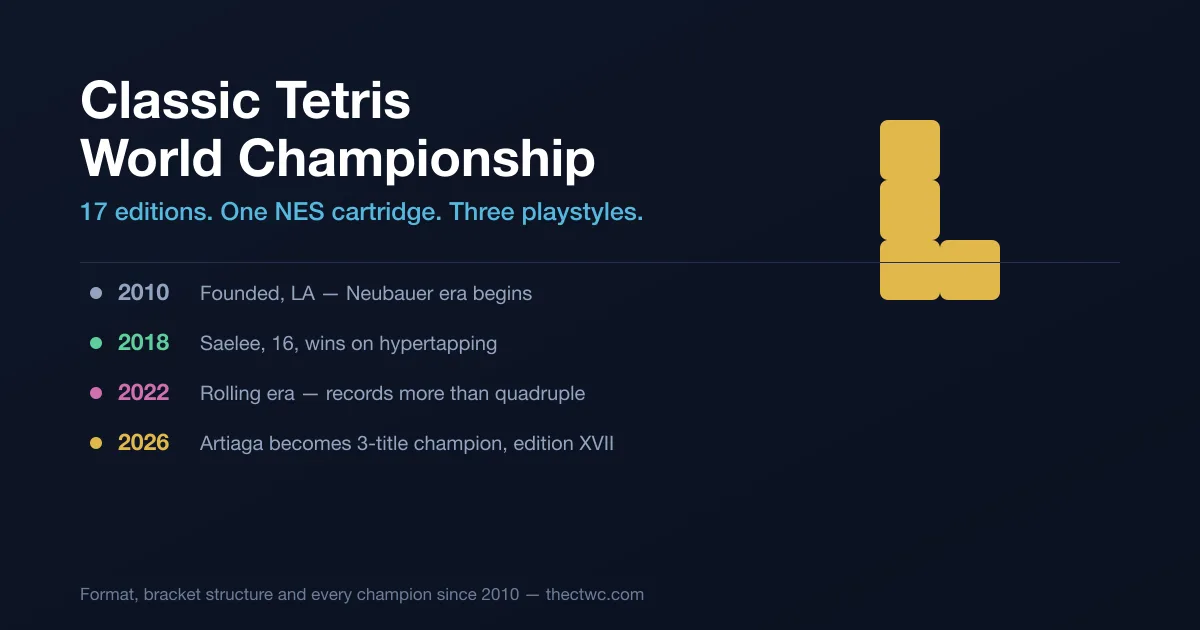
Every other guide on this site is about a Tetris built after 2001, when The Tetris Company's Guideline standardized SRS rotation, hold, the ghost piece and 7-bag across TETR.IO, Tetris Effect, Jstris and everything else. The single tournament in competitive Tetris with real prize money, a televised recap history and 129 entrants at its most recent event ignores every one of those rules. The Classic Tetris World Championship plays the 1989 NES cartridge — no hold, no SRS, no bag randomizer, an uncapped reroll that can starve you of an I-piece for twenty drops — and has done since 2010.
This is not a technique guide. Our NES DAS, hypertapping and rolling guide already covers how those three input styles physically work, and our randomizers guide already covers why the NES reroll punishes you in ways 7-bag never will. What neither of those posts explains, and what this one does, is the tournament itself: how you actually get a seat in it, how the bracket is built, what changed in the rules for 2026, and who has actually won it.
Not Guideline Tetris
CTWC launched on August 8, 2010, at the Downtown Independent theater in Los Angeles, organized by the SoCal Gaming Expo during the filming of the documentary Ecstasy of Order: The Tetris Masters. It was explicitly modeled on the 1990 Nintendo World Championships, and the first champion, Jonas Neubauer, beat Harry Hong in the final for a $1,000 purse. The 2011 event moved to USC's Bovard Auditorium with sponsorship from Electronic Arts and, in a detail that has no equivalent today, also ran side tournaments for EA's Tetris on PlayStation 3 and the physical board game Tetris Link. That second event was, by the organizers' own account, expensive and poorly attended — the tournament nearly ended there. The Portland Retro Gaming Expo picked it up for 2012, and the Oregon Convention Center hosted every edition through 2019 and again in 2022 and 2023, with 2020 and 2021 held online during the pandemic and the event relocating to the Pasadena Convention Center from 2024 on.
Seventeen editions have been held, one every year since 2010 without a gap — the 2020 and 2021 events just moved online instead of skipping. The 2026 tournament, held June 5–7 in Pasadena, was the seventeenth.
How qualifying actually works
There is no online qualifier and no pre-seeding by rating. Per the current official rules, a $50 entry fee (plus Start.gg processing fees) buys one live 90-minute qualifying session on a fixed NES-and-CRT station at the venue itself, where you play Type A Tetris — the standard endless-marathon mode, as opposed to Type B's 25-line clear objective — starting on Level 9 or higher, for as many attempts as you can fit in the window. A scorekeeper records your best result. That is the entire qualification path: no remote play, no submitted video, no regional feeder events. If you cannot be in the room, you cannot qualify.
The format has changed how it processes people, not what it demands of them. Entrants used to wait in a physical line and could requeue after every attempt; 2022 replaced that with the fixed time-slot system still in use. Seeding math has occasionally forced its own drama — at the 2018 event, seven players maxed out the old 999,999 score cap, four of them twice, and officials had to fall back to third-highest scores just to sort the top four seeds.
Gold, Silver and Bronze
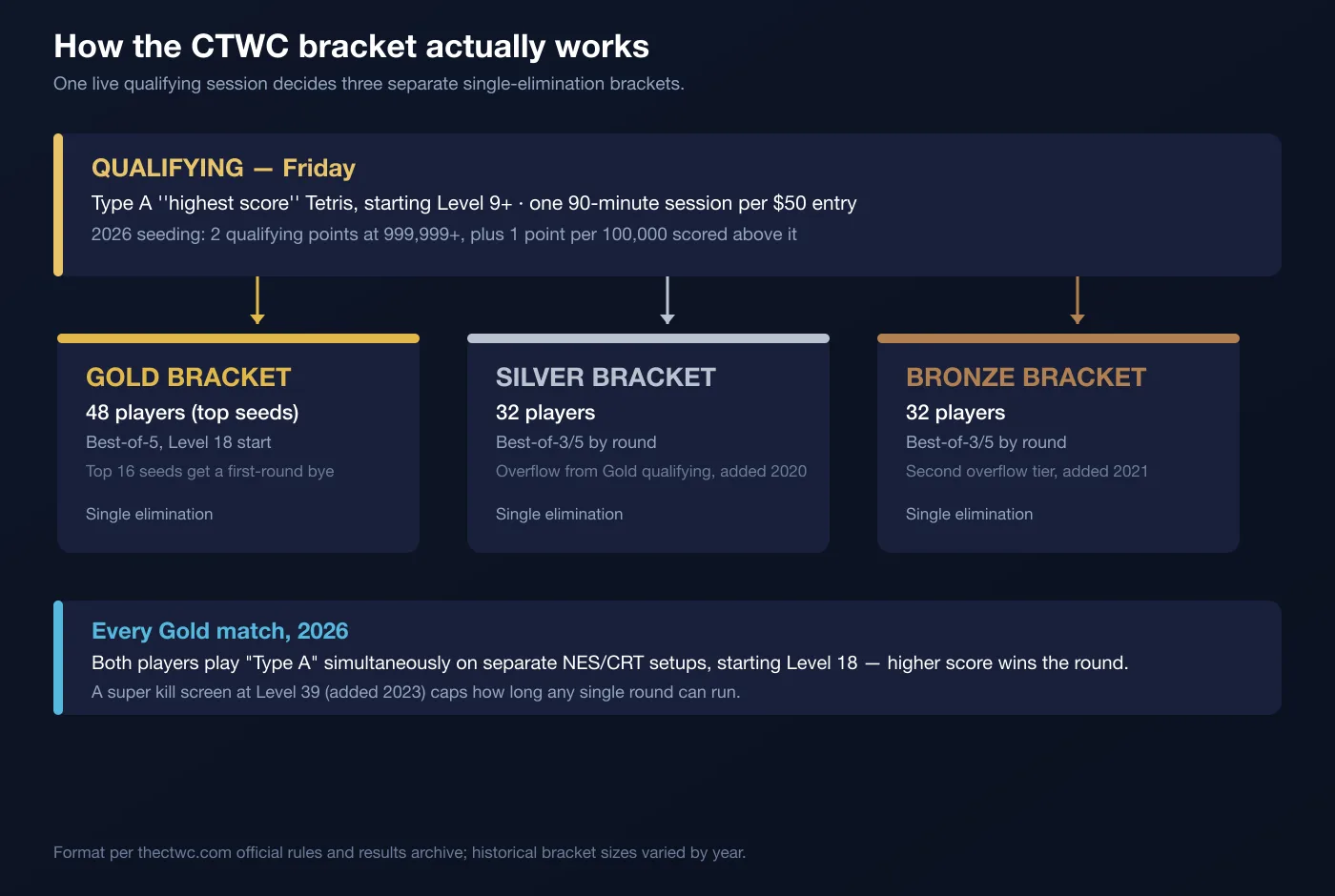
Qualifying scores don't just decide who's in — they decide which of three separate single-elimination brackets you land in. Gold is the actual World Championship: the top seeds, with the highest 16 seeds awarded a bye into the second round and the remaining bracket built by pairing opposite ends of the seeding list. Silver and Bronze are consolation tournaments introduced in 2020 and 2021 for players who qualify but miss the Gold cut — same single-elimination format, same full broadcast, and a real trophy and interview for whoever wins each one. The distinction gets lost on people outside the scene: a local news outlet covering the 2022 event mistakenly reported a Silver Bracket winner as the Tetris world champion, which the organizers had to publicly correct.
Every Gold match, start to finish
Every match in the Gold Bracket is best-of-five as of the current rules (earlier years mixed best-of-three into the early rounds). Both players play Type A simultaneously on separate NES-and-CRT setups, both starting on Level 18 rather than Level 9 — higher score at game-over wins the round, and first to three round wins takes the match. Two rule changes since the tournament's founding exist purely to keep matches finishable: the game code was modified in 2016 to display seven-figure scores instead of hard-capping at 999,999, and modified again starting in 2023 to add an artificial "super kill screen" at Level 39, where pieces fall two cells per frame and cross the well in about a sixth of a second. Neither is a nerf to skilled play — they exist because rolling got good enough that matches without them would not reliably end.
The 2026 point system
Qualifying used to be a flat high-score ranking, full stop. The 2026 rules added a wrinkle specifically for anyone clearing the old maxout: reaching 999,999 or higher earns 2 qualifying points, and every additional 100,000 points scored past that adds one more. The official rules give two worked examples — a score in the 999,999–1,099,999 band is worth 2 points, while a score in the 2,000,000–2,099,999 band is worth 13. The effect is that "I maxed out" stopped being a ceiling for seeding purposes; two players who both clear the old cap can still be separated by how far past it they got.
Seventeen years of prize money
| Year | Purse | Champion |
|---|---|---|
| 2010 | $1,000 | Jonas Neubauer |
| 2011 | $1,000 | Jonas Neubauer |
| 2012 | $1,500 | Jonas Neubauer |
| 2013 | $3,000 | Jonas Neubauer |
| 2014 | $2,000 | Harry Hong |
| 2015 | $2,000 | Jonas Neubauer |
| 2016 | $1,500 | Jonas Neubauer |
| 2017 | $1,500 | Jonas Neubauer |
| 2018 | $1,500 | Joseph Saelee |
| 2019 | $10,000 | Joseph Saelee |
| 2020 | $10,000 | Michael Artiaga |
| 2021 | $10,000 | Michael Artiaga |
| 2022 | $23,012 | Eric Tolt |
| 2023 | $21,016 | Justin Yu |
| 2024 | $32,069 | Alex Thach |
| 2025 | $23,256 | Alex Thach |
| 2026 | $14,124 | Michael Artiaga |
The purse jumped roughly sevenfold between 2018 and 2019 — the same year the Neubauer-Saelee video was closing in on its eventual 20-million-view total and ESPN2 aired the first CTWC recap on air. 2024's $32,069 is the high point on record; 2026's $14,124 is the lowest total since the hypertapping era began, without a stated reason in the tournament's public results archive.
Every champion since 2010
| Year | Champion | Runner-up | Score |
|---|---|---|---|
| 2010 | Jonas Neubauer | Harry Hong | 2–0 |
| 2011 | Jonas Neubauer | Alex Kerr | 2–0 |
| 2012 | Jonas Neubauer | Mike Winzinek | 3–0 |
| 2013 | Jonas Neubauer | Harry Hong | 3–2 |
| 2014 | Harry Hong | Jonas Neubauer | 3–1 |
| 2015 | Jonas Neubauer | Sean Ritchie | 3–1 |
| 2016 | Jonas Neubauer | Jeff Moore | 3–1 |
| 2017 | Jonas Neubauer | Alex Kerr | 3–0 |
| 2018 | Joseph Saelee | Jonas Neubauer | 3–0 |
| 2019 | Joseph Saelee | Koji Nishio | 3–2 |
| 2020 | Michael Artiaga | Andrew Artiaga | 3–2 |
| 2021 | Michael Artiaga | Jacob Huff | 3–1 |
| 2022 | Eric Tolt | Justin Yu | 3–1 |
| 2023 | Justin Yu | Eve Commandeur | 3–2 |
| 2024 | Alex Thach | Michael Artiaga | 3–2 |
| 2025 | Alex Thach | "Meme" | 3–0 |
| 2026 | Michael Artiaga | "Meme" | 3–2 |
Neubauer's run is the one number that dwarfs everyone else's: seven titles from nine straight final appearances (2010–2018), broken only by a 2014 loss to Harry Hong — which he avenged the very next year — and the 2018 final that ended the streak for good, lost to a 16-year-old hypertapper named Joseph Saelee. Michael Artiaga is the only other player to reach three titles, and did it across two different technique eras — a hypertapper at 13 years old in 2020, a roller six years later in 2026. His 2026 run had one asterisk worth stating plainly: he advanced to the final after two-time defending champion Alex Thach was forced to forfeit their semifinal due to injury, not because Artiaga beat him on the field.
Three eras, one championship
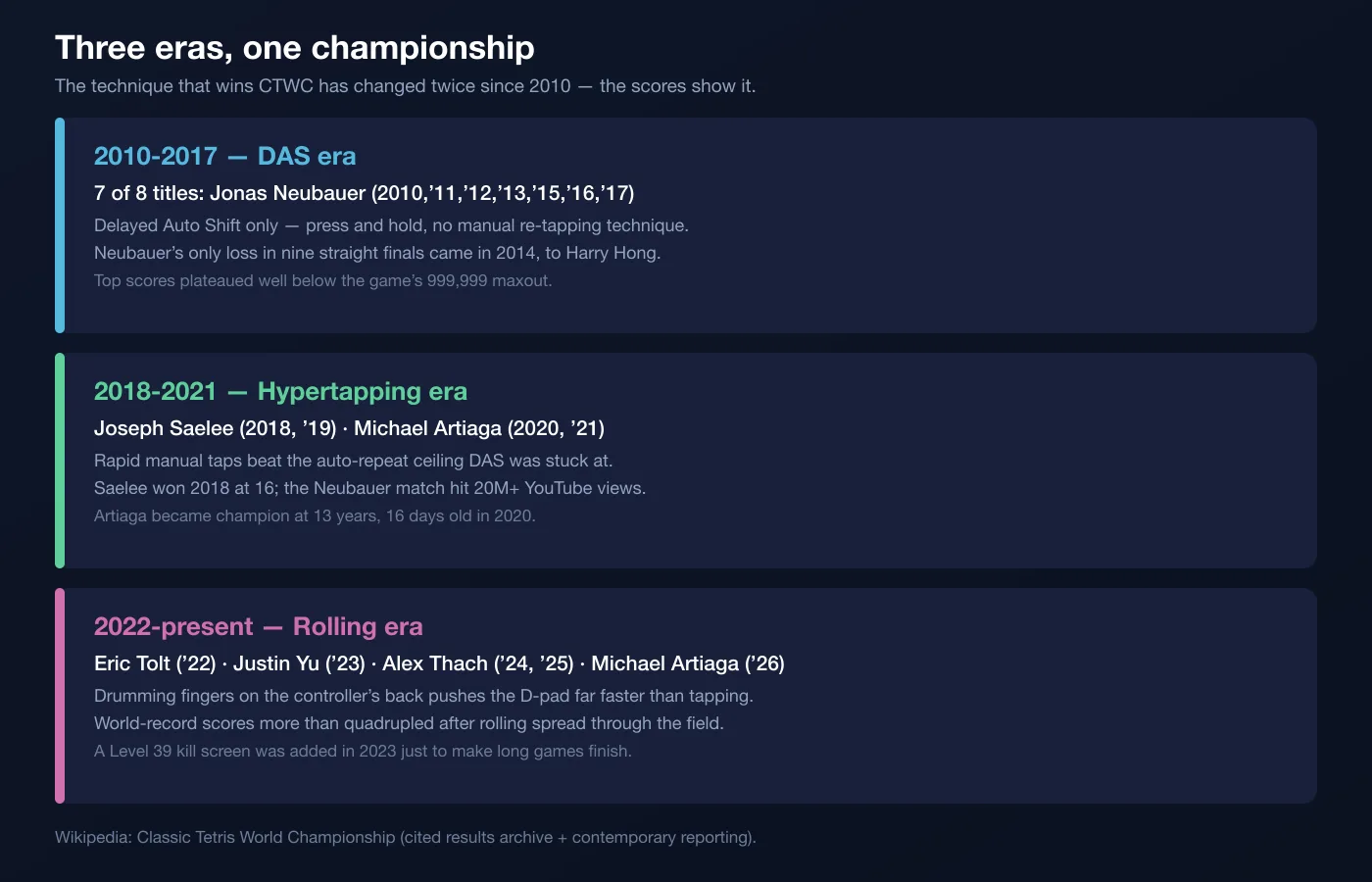
The technique that wins CTWC has changed twice, and the champions list above is really a list of who adapted first. The DAS era (2010–2017) ran on nothing more exotic than Delayed Auto Shift — press and hold, no manual re-tapping — and Neubauer's seven titles came almost entirely from within it. The hypertapping era (2018–2021) began when 15-year-old Joseph Saelee, inspired by watching the viral 2016 Neubauer-vs-Jeff-Moore final on YouTube, taught himself a technique previously used competitively by only two players, Thor Aackerlund and Koji "Koryan" Nishio. He beat Neubauer 3–0 in his first-ever CTWC appearance. Michael Artiaga carried the hypertapping era through 2020 and 2021, becoming champion at 13 years and 16 days old in the process. The rolling era (2022–present) began with a technique developed by CTWC regular Chris "Cheez" Martinez — partially depressing the D-pad with one hand while drumming the fingers of the other on the controller's back, pushing it the rest of the way in — that is both faster than hypertapping and far less physically punishing. World-record scores more than quadrupled once it spread through the field, and it's why the Level 39 kill screen exists at all: without it, rolled games routinely threatened to run past any reasonable broadcast window. Willis Gibson, playing outside tournament play in December 2023, rode the technique to the first-ever game-crashing run, reaching level 157.
The Jonas Neubauer Trophy
Jonas Neubauer died in January 2021, four years after his last CTWC final appearance. The tournament's championship trophy — a J-tetromino, cast in gold for the winner and silver for the runner-up — was renamed in his honor later that year. Its reverse carries an engraved line from him: "If you're a high visibility player, it's on you to move the community in a positive direction."
How to watch, or actually enter
Every CTWC event is broadcast live in full, with the Gold Bracket final drawing the largest audience of the weekend; recaps have aired on ESPN2 and later under the ESPN8: The Ocho banner in years the network picked the event up. Watching costs nothing and needs no advance planning. Entering does: qualifying is in-person only, at the venue, during the qualifying day of that year's event, for a $50 entry fee plus processor fees — there is no way to qualify remotely, and no regional feeder tournament sends players to Gold. If you can play a stick or pad NES Tetris to a level-9-plus standard and can be in the room, the only real gate is the travel.
Quick Action Checklist
- CTWC plays 1989 NES Tetris on real CRT hardware — no hold, no SRS, no 7-bag, none of the Guideline rules the rest of this site's coverage assumes.
- Qualifying is in-person only: a $50 entry fee (plus Start.gg fees) buys one 90-minute session of Type A Tetris starting Level 9+, scored by a tournament scorekeeper.
- Results split into three single-elimination brackets — Gold (the actual championship), Silver and Bronze — all best-of-five in Gold as of the current rules, all matches starting Level 18.
- The 2026 rules added qualifying points for scores past the old 999,999 maxout: 2 points at 999,999–1,099,999, rising to 13 points by 2,000,000–2,099,999.
- Jonas Neubauer won 7 of the first 8 titles (2010–2017), losing only the 2014 final to Harry Hong; his nine-year run of straight final appearances ended in 2018, beaten by 16-year-old Joseph Saelee.
- Michael Artiaga is the only other three-time champion, winning as a hypertapper (2020, 2021) and again in the rolling era (2026), the latter after 2024–2025 champion Alex Thach forfeited their semifinal to injury.
- Purses have ranged from $1,000 (2010–2011) to a peak of $32,069 (2024); 2026's $14,124 is the lowest total since 2018.
- The championship trophy, a gold J-tetromino, was renamed for Jonas Neubauer after his death in 2021.
Frequently Asked Questions
What is the Classic Tetris World Championship?
How do you qualify for CTWC?
What version of Tetris does CTWC use?
Who has won the most Classic Tetris World Championship titles?
What is "rolling" and why did it take over CTWC?
How much prize money does CTWC pay out?
Keep Reading
Related Guides
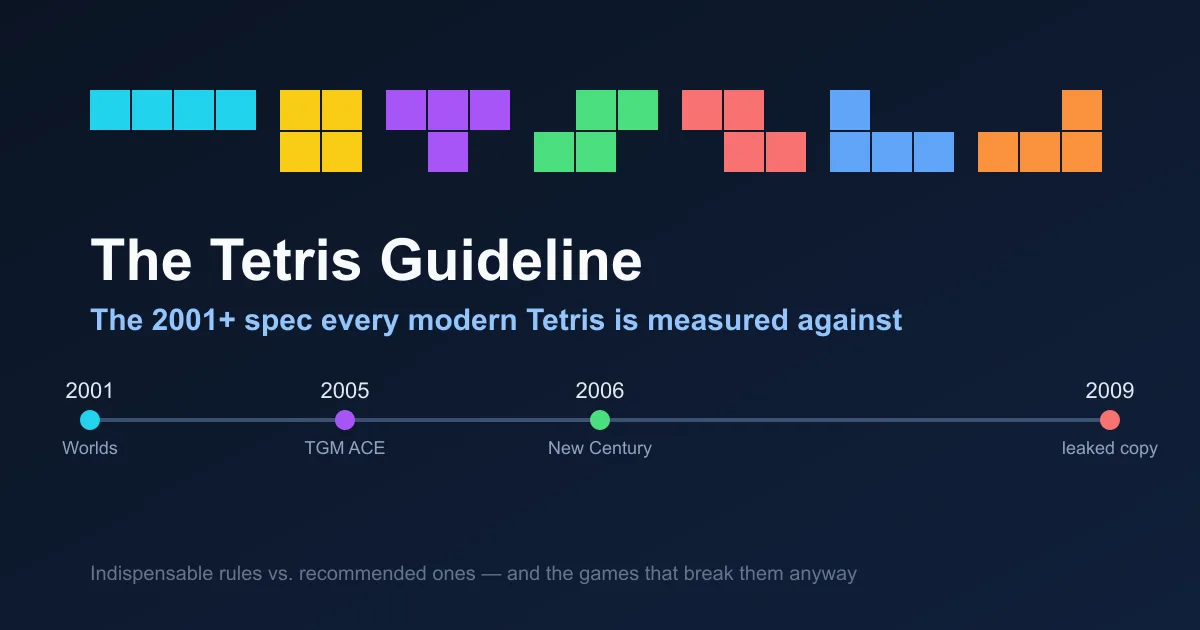
Tetris Guideline Explained: Rules, Versions, Exceptions
Every guide on this site says "modern Guideline Tetris" as background and moves on. Here is what that word is actually short for: a yearly document, four known revisions, an indispensable list and a recommended one, a trademarked theme song, and at least four officially licensed games that break it anyway.
NES Tetris Level Transition and Scoring Explained
Start NES Tetris on 18 and you stay there for 130 lines. Start on 19 and it is 140. Start on 12 and it is 100. One missing conversion in the cartridge explains all three, and it also decides which clear gets paid at the higher rate.
NES Tetris DAS, Hypertapping and Rolling: How the Kill Screen Died
NES Tetris moves your piece sideways ten times a second. At level 29 a piece falls the whole well in twenty frames. That gap is why hypertapping and rolling exist, and why the kill screen is not a kill screen anymore.
Tetris Forever Games: All 21 and Which Are Worth Playing
Digital Eclipse counts 21 playable games in Tetris Forever after its free updates, and one of them is a game of Go. What each one is, how its rules differ from modern Tetris, what each patch added, and which to open first.
Tetris Stacking Fundamentals: Build a Board That Wins
Most players do not lose to speed. They lose to a board they built themselves three minutes earlier. Here is how stacking actually works in modern Guideline Tetris, and the habits that stop you from burying your own well.
Tetris DX Explained: How It Differs From Game Boy Tetris
Tetris DX keeps the 1989 Game Boy well and points table but changes how pieces move: a second rotation center that lets pieces climb walls, auto shift every 3 frames, a randomizer that deals the T about 24% of the time, and a seven-digit score.