NES Tetris DAS, Hypertapping and Rolling: How the Kill Screen Died
NES Tetris moves your piece sideways ten times a second. At level 29 a piece falls the whole well in twenty frames. That gap is why hypertapping and rolling exist, and why the kill screen is not a kill screen anymore.
NES Tetris has no hold slot, no hard drop, no wall kicks, no lock delay, and a preview window that shows exactly one piece. None of that is the reason it is hard.
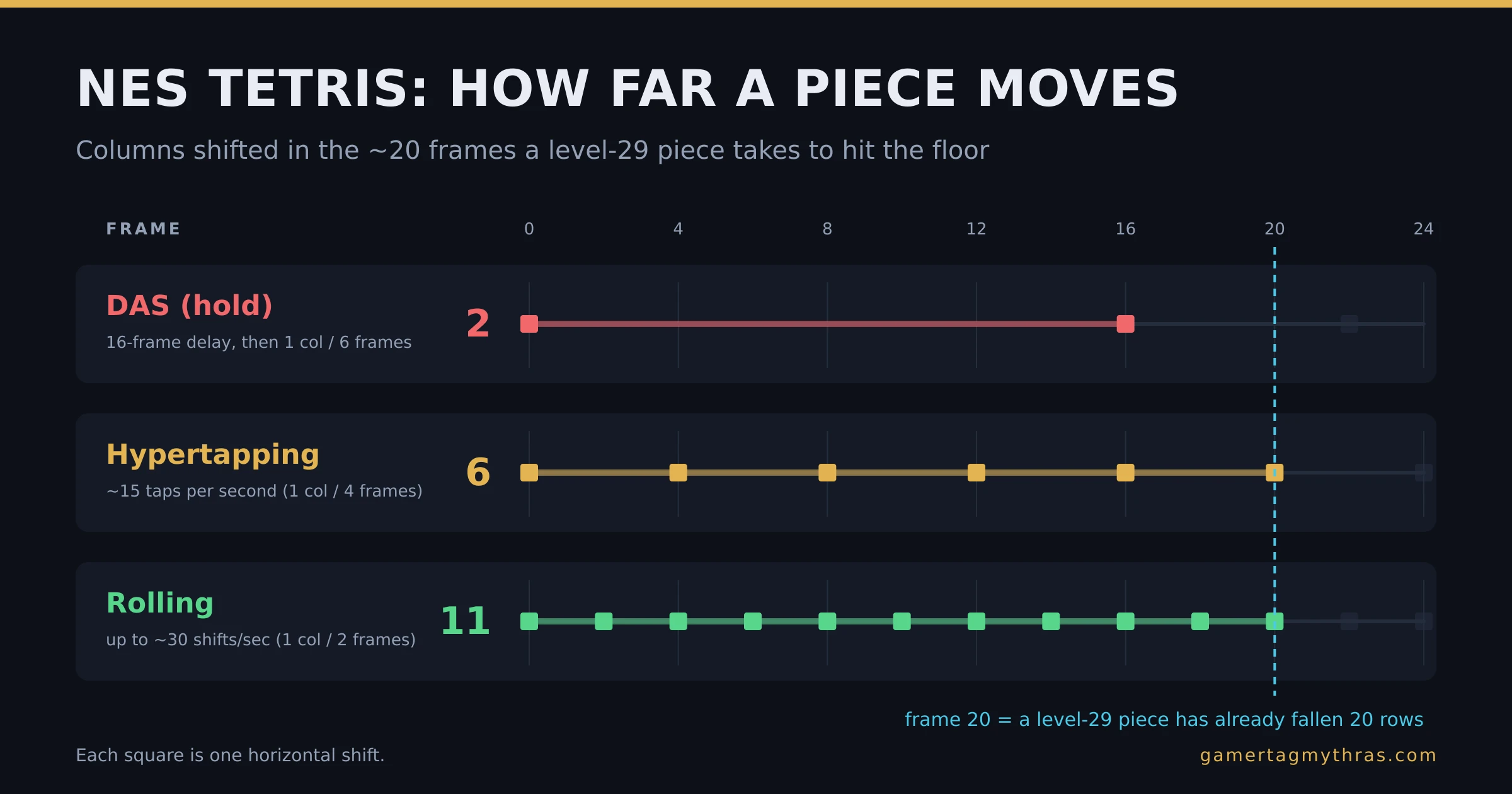
The reason it is hard is that the game will only slide your piece sideways about ten times per second, and on level 29 a piece falls the entire 20-row well in 20 frames — roughly a third of a second. Do the arithmetic once and the last thirty years of classic Tetris history stops being mysterious. Everything the top scene has invented since 2011 is a workaround for one specific number.
Everything below is the NTSC (North American) release running on a console specified at 60.0988 frames per second. The PAL version is a different game in the ways that matter, and it gets its own paragraph at the end.
The 16-frame problem
Press left or right and the piece moves one column immediately. Good. Then it stops. Hold the direction and nothing happens for 16 frames — the delayed auto shift, or DAS. Only then does the piece start walking, and it walks at one column every 6 frames, which at 60 fps is almost exactly 10 columns a second.
At level 0, a piece spends 48 frames on every single row. You have all the time in the world. At level 29, gravity is 1 frame per row, so a piece that spawns at the top of an empty well is on the floor 20 frames later.
Twenty frames buys you the instant shift on press, plus one auto shift at frame 16. Two columns. Pieces spawn near the middle of a ten-wide board, so either wall is four or five columns away. That is the falsifiable claim this whole article rests on: on the level-29 kill screen, holding a direction cannot physically walk a piece to the wall before it lands. Not "is difficult." Cannot.
So you either stop needing the wall, or you stop using DAS.
How the DAS counter actually works
The mechanics were not properly understood for decades — the community only nailed them down when player Kitaru dug through the game's memory and found the counter the game keeps behind the scenes.
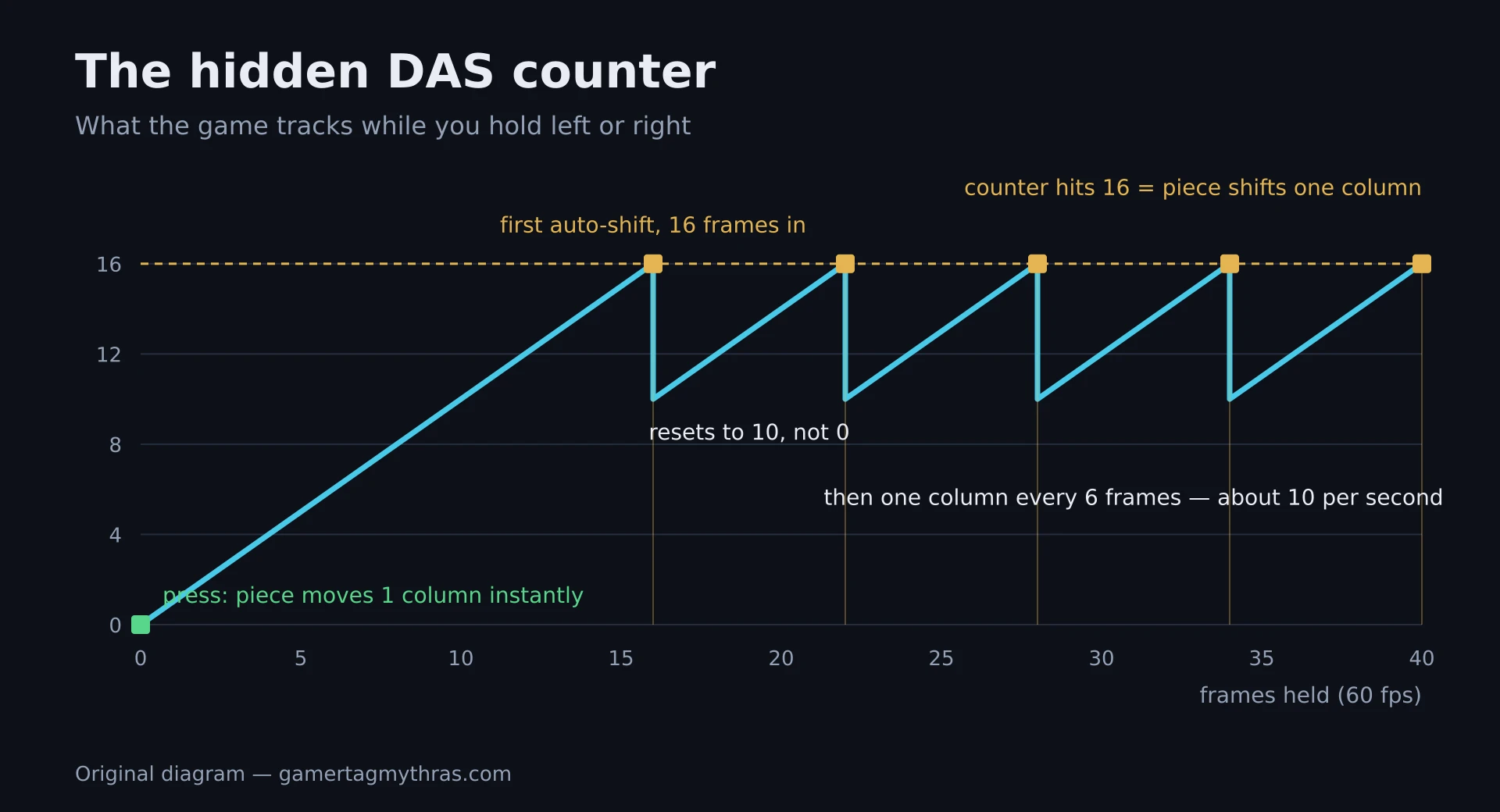
Here is the whole system:
- The game keeps a hidden DAS counter of how many frames left or right has been held.
- When the counter reaches 16, the piece shifts one column.
- The counter then resets to 10, not 0 — which is why every shift after the first only takes 6 more frames.
- Letting go of the d-pad does not clear the counter. Only a fresh press of left or right does, and only if that press lands outside the pause between pieces.
That last bullet is the one people miss. The charge is a resource that persists. You are not "holding" DAS so much as maintaining a battery, and the game gives you two ways to top it off for free.
Wall charge: the free 16 you are throwing away
The first freebie: if a tap is blocked — by the wall or by your own stack — the counter is instantly set to 16. A shift you were never going to get anyway hands you a full charge.
The second: the counter is frozen during the entry delay between pieces (10 to 18 frames, longer the higher the piece locked) and during the line clear animation (another 17 to 20 frames). Inputs during those windows cannot reset it to zero. So you can release the direction, press the opposite direction during the pause, and the next piece spawns with the charge intact and pointed the other way.
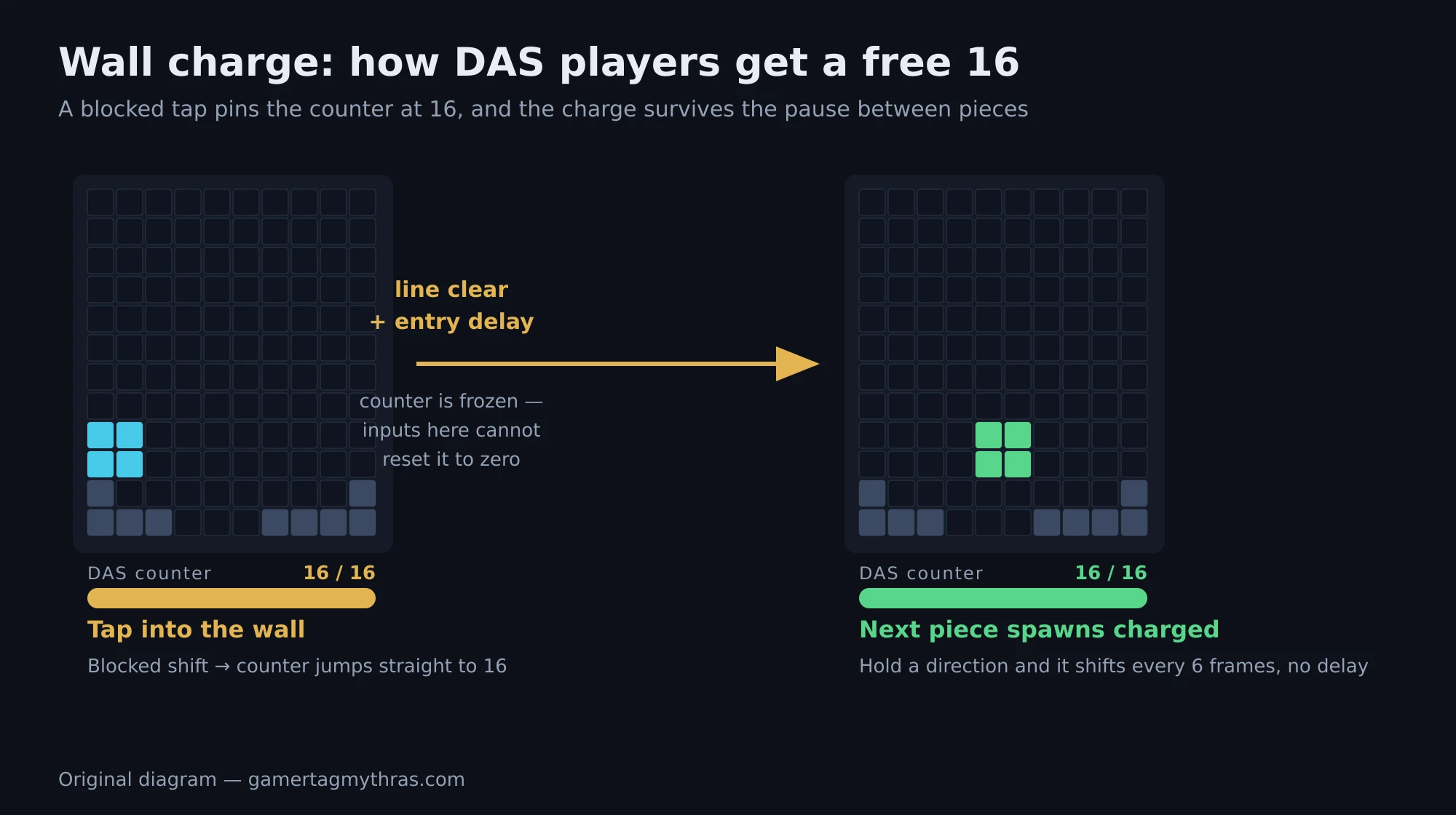
In practice that means a DAS player is doing three things at once every piece: placing the current tetromino, deliberately mashing it into a wall or ledge on the way down to bank a charge, and flipping direction during the entry delay so the next piece arrives ready to sprint. Skip that routine and you eat the 16-frame delay on every single placement — which at level 18 and above is most of a piece's life.
Learn this before you learn anything exotic. It is free speed, it costs nothing physically, and it is the difference between a level-19 start being playable and being a coin flip.
Hypertapping: turning your forearm into a motor
If the hardware caps auto shift at 10 per second, the obvious move is to out-tap it by hand. That is hypertapping: abandoning DAS entirely and machine-gunning the d-pad faster than the game's own repeat rate. Land a tap every four frames and you are at 15 shifts a second, half again as fast as DAS, and the piece moves the instant you press rather than 16 frames later.
The technique is genuinely strange to watch. Players flex the bicep until the arm tremors, then park the thumb where the shaking does the tapping for them. The New Yorker described it as turning a thumb into a jackhammer, which is about right.
Thor Aackerlund was the first hypertapper, and for years he and Japanese player Koji "Koryan" Nishio were nearly the only ones doing it at a high level. Then Joseph Saelee won the 2018 Classic Tetris World Championship at fifteen using it, and the whole scene changed shape in about a year.
The receipts on what it unlocked:
- 2011 — Aackerlund reaches level 30 on camera in the documentary Ecstasy of Order, proving the kill screen was survivable at all.
- 2018 — Saelee is first to level 31.
- 2020 — hypertappers have pushed as far as level 38.
The catch is that hypertapping is brutal. It is a sustained muscle tremor, it degrades your accuracy as you tire, and it is the kind of thing that ends careers rather than extending them.
Rolling: the technique that killed the kill screen
In 2020, competitive player Chris "Cheez_fish" Martinez did something simple and slightly insane: he turned the controller into a drum.
The thumb stays parked on the d-pad, not moving. The other hand drums its fingers across the back of the controller, pushing the buttons up into the stationary thumb. Many players wear a glove on the drumming hand to cut friction. The result is horizontal movement at up to 30 shifts per second — three times what DAS gives you — with far less strain than hypertapping, because you are cycling four fingers instead of vibrating one arm.
That is the technique that ended the kill screen as a concept. Level 29 stopped being a wall and became just another level you play at, indefinitely.
What followed:
- The 2022 CTWC final had Eric Tolt and Justin Yu both cross two million points, reaching levels 73 and 69.
- Games got so long that from 2023 the CTWC started using a modified cart with a super kill screen at level 39, where pieces fall two cells per frame and cross the well in about a sixth of a second, purely to make matches end.
- On 21 December 2023, 13-year-old Willis Gibson — "Blue Scuti" — pushed past the level 146 and 148 palette-overflow levels nicknamed "dusk" and "charcoal", where the pieces render black against a black background, and rode the game to a hard crash at level 157. Because NES Tetris games had always ended in a top-out, that crash is widely counted as the first time anyone has beaten it, 34 years after release.
Rolling is not a glitch or an exploit. It is legal at CTWC, it is what the record holders use, and if you are starting classic Tetris today it is the technique to learn.
What the speed curve is actually doing
The gravity table is baked into the ROM, and it explains the shape of competitive play better than any strategy guide.
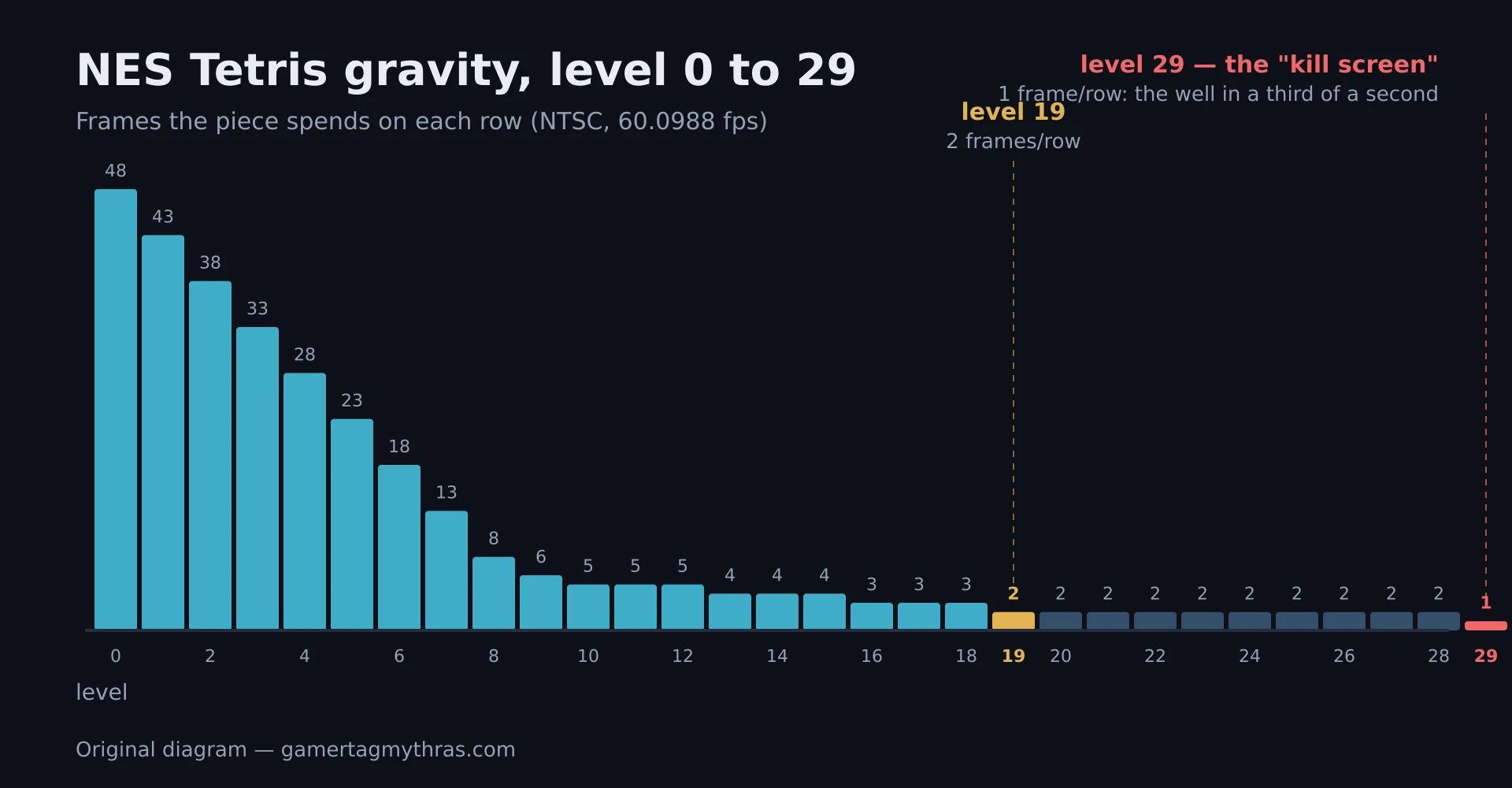
Levels 0 through 9 tighten every single level, from 48 frames per row down to 6. Then it staircases: 5 frames for levels 10 to 12, 4 for 13 to 15, 3 for 16 to 18. Level 19 drops to 2, and then nothing changes for ten straight levels. Level 29 drops to 1, and nothing ever changes again.
Two consequences fall straight out of that table. First, levels 19 to 28 are a single flat plateau, which is exactly why "start on 19" is the standard practice and tournament mode — you are training one speed, not a curve. Second, because level 29 is the last speed increase the game has, surviving it is a pure technique problem. There is no escalating difficulty waiting for you at level 40 or level 90. Beat 29 once and you have beaten every speed the ROM contains.
Worth knowing while you are down there in the machine: the piece randomizer is a 16-bit shift register with a light anti-repeat reroll, and its distribution is slightly uneven. Over every 224 pieces you get one fewer long bar than an even deal would give you. It is a small bias, but it is a real one, and it is in the wrong direction for a game where the entire scoring model is built on Tetrises.
Speaking of which: line clears pay 40, 100, 300 and 1200 points multiplied by one more than the current level. A Tetris is 7.5 times the value of four separate singles. Push that to level 29 and a single Tetris is worth 36,000 points — which is the entire reason anyone wants to be up there. The scoreboard itself caps at 999,999, the "maxout" that Harry Hong first put on independently verified tape in 2009.
Which one should you learn
If you are picking up NES Tetris now, the honest order is:
- DAS, properly, with wall charging. You cannot skip this. It teaches you stack shape, and charge management is still useful even after you learn to roll.
- Rolling. Faster than hypertapping, less painful, and it is what the current record holders use. There is no longer a good argument for a new player choosing anything else.
- Hypertapping — only if you already do it. It is a legitimate top-level technique with a real history, but as a starting point in 2026 it is strictly worse ergonomics for less speed.
One footnote for anyone playing a European cart: the PAL release runs at 50.0070 fps and was rebalanced rather than simply slowed. Its DAS is genuinely better — a 12-frame initial delay, then a shift every 4 frames — but the gravity table hits 1 frame per row at level 19 instead of 29, ten levels earlier. Faster movement, far less runway. It took until 8 March 2021 for EricICX to record the first PAL maxout, at 1,096,300 points. If your DAS feels suspiciously snappy and the game feels impossible ten levels early, that is why.
Quick Action Checklist
- Count in frames, not seconds. 16 to the first auto shift, 6 between shifts after that.
- Tap into the wall or your own stack on purpose — a blocked shift pins the DAS counter at 16 for free.
- Flip direction during the line clear and entry delay. The counter is frozen there and cannot be reset.
- Practise on a level 19 start. Levels 19 to 28 are all one speed, so it is the only speed worth drilling before 29.
- If you want to pass level 29, learn to roll. DAS mathematically cannot cross the board in 20 frames.
- Do not build a strategy that assumes a fair piece distribution — you are short roughly one long bar every 224 pieces.
Frequently Asked Questions
Why can you not just hold left or right in NES Tetris?
What is wall charging in NES Tetris?
What is the difference between hypertapping and rolling?
Is level 29 still a kill screen?
Is the PAL version of NES Tetris easier?
Keep Reading
Related Guides
NES Tetris Level Transition and Scoring Explained
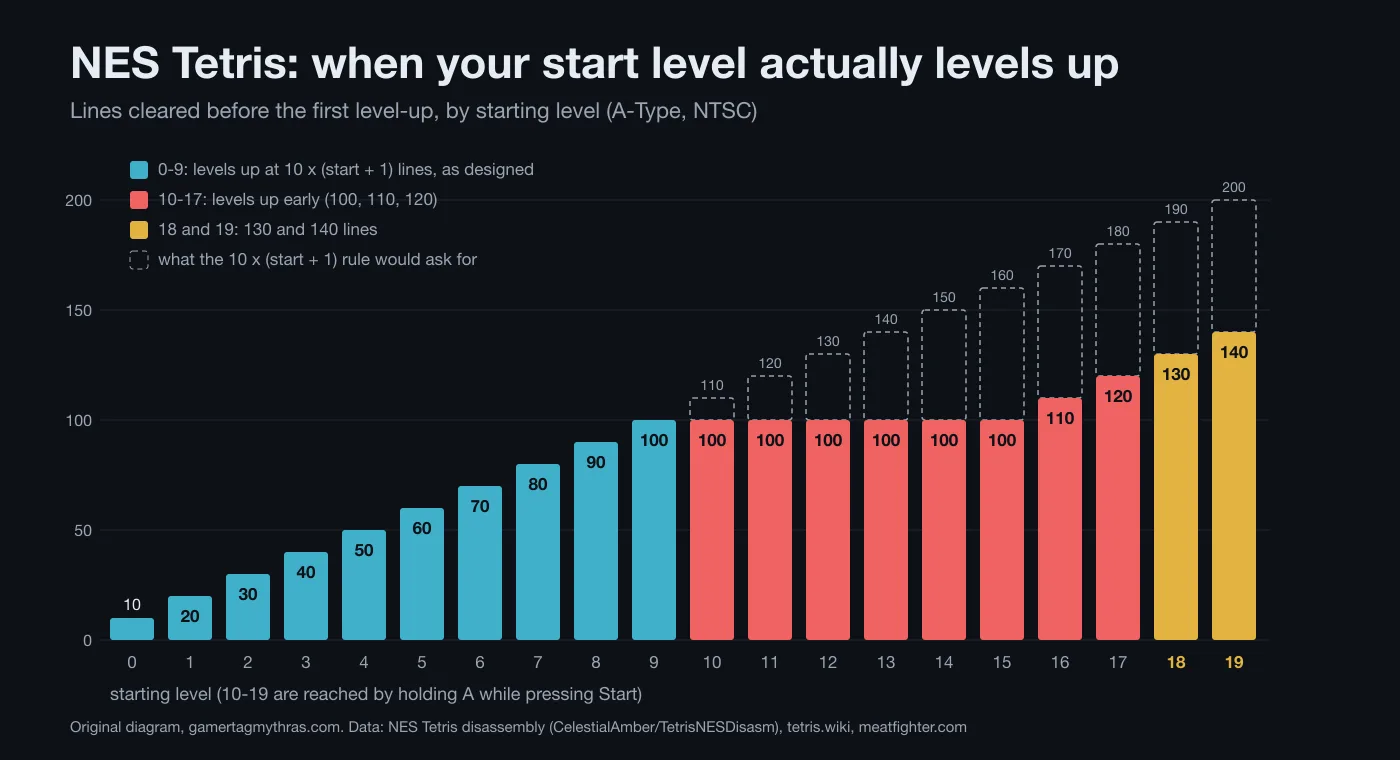
Start NES Tetris on 18 and you stay there for 130 lines. Start on 19 and it is 140. Start on 12 and it is 100. One missing conversion in the cartridge explains all three, and it also decides which clear gets paid at the higher rate.
Game Boy Tetris Explained: How It Differs From NES
Game Boy Tetris and NES Tetris share a points table, but the handheld game stops speeding up at level 20, pays a level-up Tetris at the old rate, deals the L about 10.7% of the time, and makes a held direction wait 23 frames.

Classic Tetris World Championship Explained
Every other guide on this site covers a Tetris built after 2001, when the Guideline standardized rotation, hold and 7-bag. The one tournament with real prize money and 129 entrants in 2026 ignores all of it and plays the 1989 NES cartridge instead. Here is how that tournament is actually run.
TETR.IO Handling Settings Explained: DAS, ARR, SDF, DCD
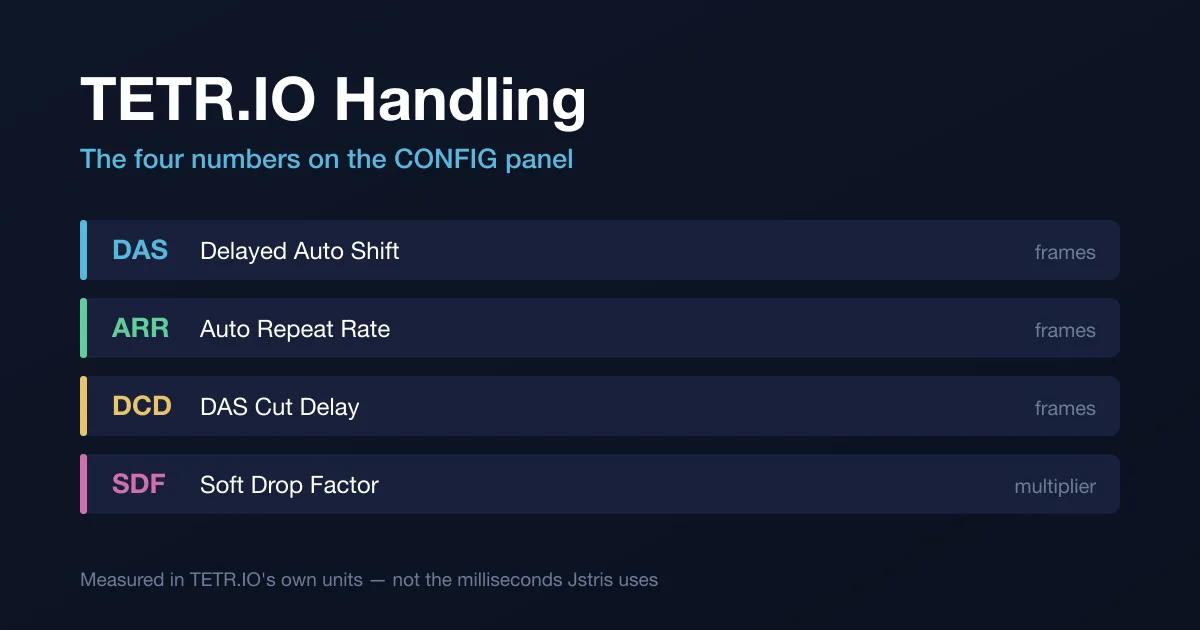
TETR.IO gives you four handling numbers and explains none of them in the panel. One of them had its ceiling raised out from under a warning, and one is described differently by the two sources that document it. Here is the whole panel, with the version and date each behaviour arrived.
Tetris Stacking Fundamentals: Build a Board That Wins
Most players do not lose to speed. They lose to a board they built themselves three minutes earlier. Here is how stacking actually works in modern Guideline Tetris, and the habits that stop you from burying your own well.
Tetris Finesse: Place Every Piece in Two Keypresses
Under SRS, every placement on the board is reachable in two keypresses before the drop. If you are spending five, you are not slow because of your hands — you are slow because of your habits.