NES Tetris Level Transition and Scoring Explained
Start NES Tetris on 18 and you stay there for 130 lines. Start on 19 and it is 140. Start on 12 and it is 100. One missing conversion in the cartridge explains all three, and it also decides which clear gets paid at the higher rate.
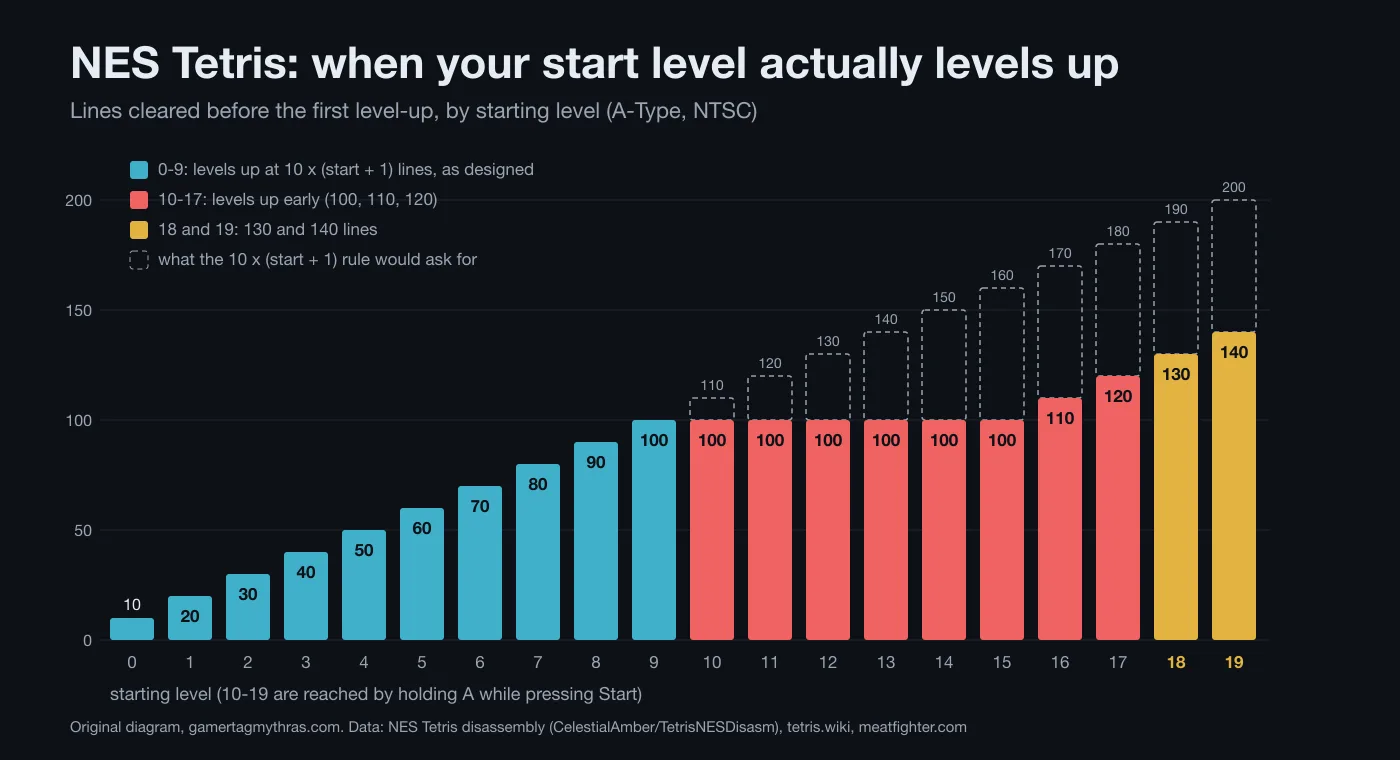
Start NES Tetris on level 18 and the game keeps you there for 130 lines. Start on 19 and it holds you for 140. Start on 12 and it lets you go at 100, the same line count as a start on 9, 10, 11, 13, 14 or 15. The 18, 19 and 12 counts are not what the game's own level rule asks for. They fall out of one comparison in the cartridge that checks a decimal counter without converting it first.
That comparison decides when classic Tetris speeds up and which clear gets paid at the higher rate, and it is why every start from 15 to 19 reaches level 29 at the same 230 lines, the mark TetrisGYM's pace trainer measures against. Our NES DAS, hypertapping and rolling guide covers how fast you can move a piece at each speed, and quotes the basic points table in one paragraph. This post is about the counters themselves: lines, level and score, read from the community disassembly of the ROM and checked against tetris.wiki and Mike Birken's long technical write-up of the game at meatfighter.com.
Everything below is the NTSC A-Type game, the endless mode the Classic Tetris World Championship plays.
The rule on paper and the rule on the cartridge
The level menu shows 0 to 9. The other ten are hidden: hold A while you press Start and the game adds 10 to whatever you picked, so 19 is the highest start. The disassembly has that check in the menu code, and Birken notes it is the instruction booklet, not the menu, that tells you about it.
From level 0 the system is simple. You level up every 10 lines. Birken states the intended rule for any start: to reach level X you clear 10X lines, so a level 5 start stays put until 60 lines and then climbs every 10. That holds for starts 0 to 9. Above 9 it breaks, and tetris.wiki gives the rule the cartridge actually runs: your first level-up comes at whichever is reached first, 10 times your start level plus 10 lines, or the larger of 100 and 10 times your start level minus 50. After that first level-up, it is every 10 lines.
| Start level | First level-up (lines) | 10 x (start + 1) would be | Reaches level 19 at | Reaches level 29 at |
|---|---|---|---|---|
| 0 to 9 | 10 x (start + 1) | Same | 190 | 290 |
| 10 | 100 | 110 | 180 | 280 |
| 11 | 100 | 120 | 170 | 270 |
| 12 | 100 | 130 | 160 | 260 |
| 13 | 100 | 140 | 150 | 250 |
| 14 | 100 | 150 | 140 | 240 |
| 15 | 100 | 160 | 130 | 230 |
| 16 | 110 | 170 | 130 | 230 |
| 17 | 120 | 180 | 130 | 230 |
| 18 | 130 | 190 | 130 | 230 |
| 19 | 140 | 200 | Starts there | 230 |
The first-level-up column matches tetris.wiki's formula and the actual line counts in Birken's table, and the next column is his expected count. The last two columns are our own, made by running the disassembly's level routine line by line.
Why 100 lines looks like 160 to the game
NES Tetris keeps its line count in binary-coded decimal: each decimal digit sits in its own four bits, so 130 lines is stored as the digits 1, 3 and 0. Every time the ones digit rolls over to 0, the level routine shifts that number right by four bits. That drops the ones digit and leaves a single byte holding the tens and hundreds. The routine then compares the byte with your level number and, if your level is lower, adds one.
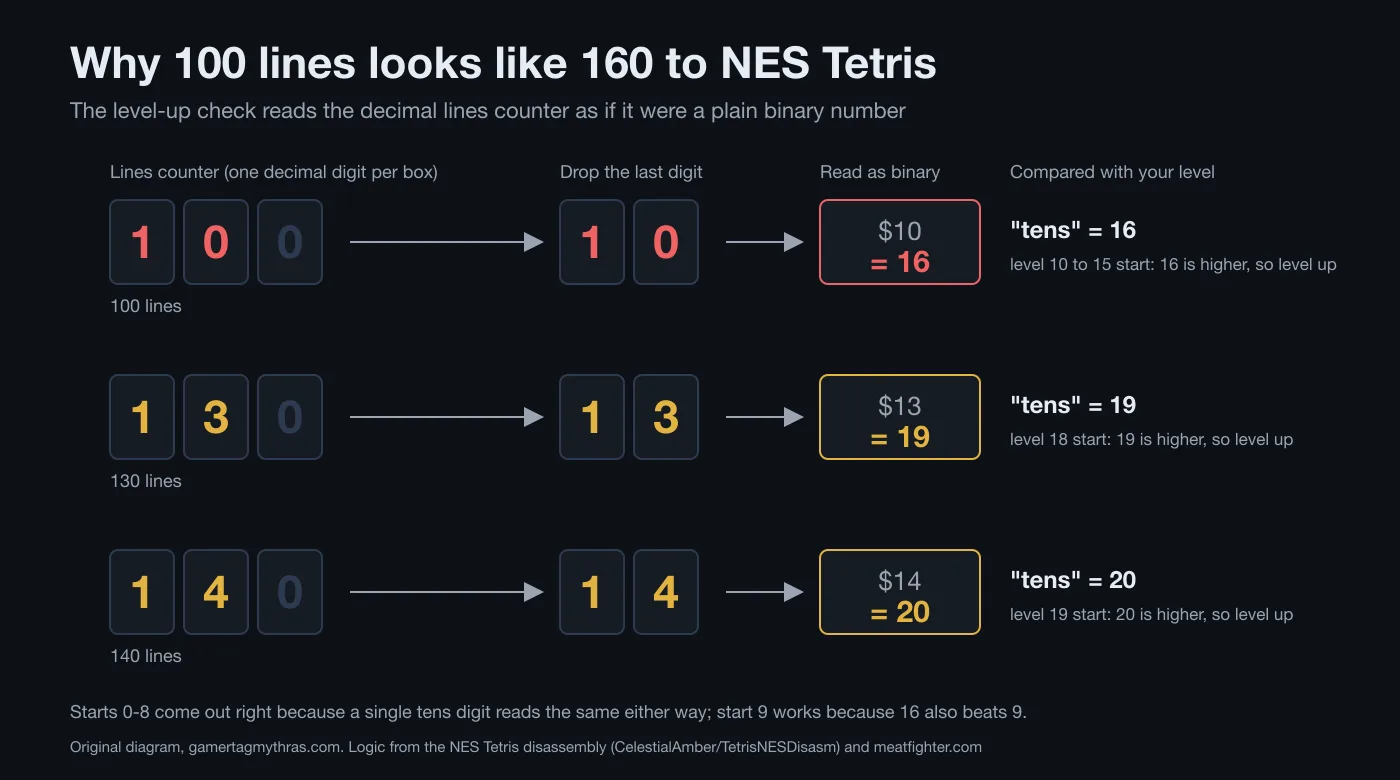
The missing step is a conversion. Your level is stored as an ordinary binary number, and the byte is still decimal digits. Birken calls it "an apparent bug": a table lookup to convert the BCD value is missing. So at 100 lines the byte holds the digits 1 and 0, which the comparison reads as hexadecimal 10, which is 16. Every start from 10 to 15 is below 16, so all six level up at 100 lines. A level 16 start has to wait until 110 lines (read as 17), 17 until 120 (18), 18 until 130 (19) and 19 until 140 (20).
Starts 0 to 8 come out right because their first level-up is due below 100 lines, where the byte holds a single tens digit, and a single digit reads the same in decimal and in hexadecimal. Start 9 is due at 100 lines, where the byte reads 16, which also happens to beat 9. Birken's line on level 9 is that it "only works coincidentally". He also guesses at the cause: the hidden A-plus-Start option feels like a late addition that may not have had much testing. That is his suspicion, not a documented history.
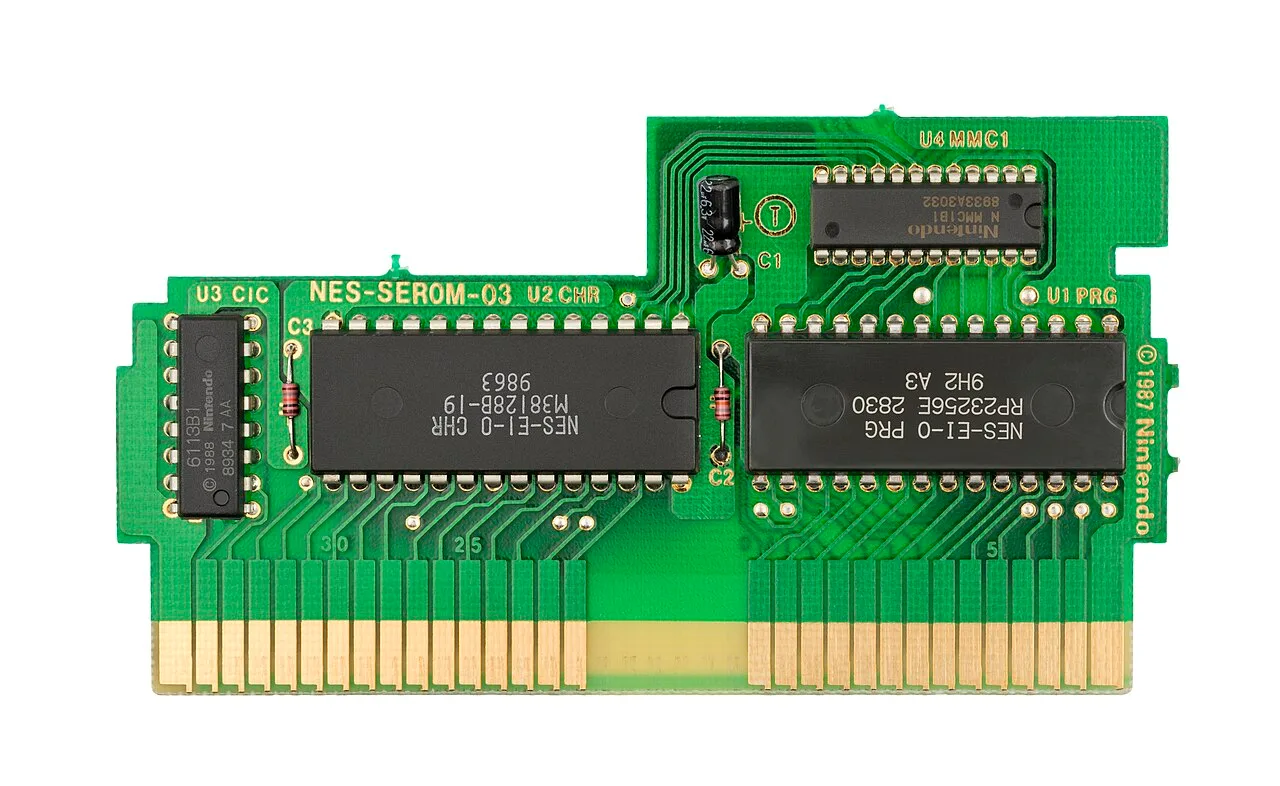
The check lives in the program ROM, the chip marked PRG on the board above, and it runs on every line you clear.
Starts from 15 to 19 all reach level 29 at 230 lines
Once the first level-up has happened, every later one is 10 lines apart, through level 29 and far beyond. So the only number that matters is where the climb starts, and the bug makes five different starts line up:
- Starts 15, 16, 17 and 18 all reach level 19 at 130 lines. A 15 start reaches 16 at 100 lines, then 17, 18 and 19 at 110, 120 and 130.
- A 19 start is already there and climbs to 20 at 140.
- From level 19 onward it is 10 lines per level, so all five reach level 29 at 230 lines.
The gravity table on tetris.wiki shows what each of those starts costs. Level 15 drops a piece one row every 4 frames, levels 16 to 18 every 3 frames, levels 19 to 28 every 2, and level 29 every frame.
| Start | Gravity at the start | Reaches 19 at | Reaches 29 at | Perfect all-Tetris score at 232 lines |
|---|---|---|---|---|
| 15 | 4 frames per row for 100 lines, then 3 until 130 | 130 lines | 230 lines | 1,407,600 |
| 16 | 3 frames per row for 130 lines | 130 lines | 230 lines | 1,436,400 |
| 17 | 3 frames per row for 130 lines | 130 lines | 230 lines | 1,468,800 |
| 18 | 3 frames per row for 130 lines | 130 lines | 230 lines | 1,503,600 |
| 19 | 2 frames per row from the first piece | Starts there | 230 lines | 1,542,000 |
The score column is our own calculation for a game made entirely of Tetrises, with the 999,999 cap removed. A run of Tetrises lands on multiples of four, so 232 lines is the first point past 230. Dropping from 18 to 15 does not delay the speed-up into 19 or into 29 by a single line. It buys slower gravity for the first 100 lines and costs 96,000 points of perfect-game ceiling.
The 230-line mark also turns up in practice tools. TetrisGYM, a practice mod for NES Tetris, has a Pace trainer that its README describes as showing "how close you are to achieving a score by 230 lines".
How a line clear is scored
The points table in the ROM holds 0 for no clear, then 40 for a Single, 100 for a Double, 300 for a Triple and 1,200 for a Tetris. Each is multiplied by your level plus one.
| Clear | Base | Level 18 | Level 19 | Level 29 | Points per line at level 18 |
|---|---|---|---|---|---|
| Single | 40 | 760 | 800 | 1,200 | 760 |
| Double | 100 | 1,900 | 2,000 | 3,000 | 950 |
| Triple | 300 | 5,700 | 6,000 | 9,000 | 1,900 |
| Tetris | 1,200 | 22,800 | 24,000 | 36,000 | 5,700 |
The last column is the one that shapes classic play. A line burned as a Single at level 18 earns 760 points; the same line inside a Tetris earns 5,700, seven and a half times as much. A Triple is the best of the rest, and it still pays a third of a Tetris per line.
Three details sit underneath that table:
- The multiplication is a loop. The 6502-family chip in the NES has no multiply instruction, so the game adds the base value to your score once for every level plus one, and Birken notes it runs that loop on every piece lock, adding zero when nothing clears. At very high levels the loop takes long enough to push the game past its frame timing. Birken traces the game's real kill screen, around 1,550 lines, to this routine. That is the crash our NES DAS guide covers, which Willis Gibson reached at level 157 in December 2023.
- Push-down points are flat and small. Holding Down to soft drop scores one point per row of your last unbroken push before the piece locks, per tetris.wiki; earlier presses on the same piece do not count, and the level does not multiply it. tetris.wiki also notes the addition is miscoded. A push can only cover the rows the piece falls through, so it is worth less than 20 points a piece next to a 22,800-point Tetris.
- The score stops at 999,999. The score is six decimal digits, and the disassembly shows that when an addition would carry past the top digit, the game writes 999,999 instead. That frozen number is the "maxout".
The transition clear pays at the new level
The order of operations in the routine is: count the lines one at a time, check for a level-up after each one, then pay the points at whatever level you are on when the counting is finished. tetris.wiki's scoring page flags NES Tetris for exactly this, noting that its level multiplier uses the level after the line clear, not the level before it.
That makes the clear that crosses a transition worth more than it looks. Sit on a level 18 start at 128 lines and land a Tetris: the counter passes 130 halfway through, you become level 19, and the whole Tetris pays 24,000 instead of 22,800. The same 1,200-point bump applies to every later Tetris that triggers a level-up, because each one is paid at the level it just reached.
Guideline games do it the other way. tetris.wiki's scoring page says modern Guideline scoring always uses the level before the clear, which is one more reason the Guideline scoring and attack guide cannot be carried over to the NES game number for number.
Maxout math: 18 start against 19 start
Put the level routine and the scoring routine together and you can work out the ceiling exactly. These figures are ours, from running the disassembly's rules for a game that clears nothing but Tetrises:
- Level 18 start: 32 Tetrises reach 128 lines and 729,600 points. The 33rd crosses the transition and pays 24,000, for 753,600 at 132 lines. The unmodified cartridge hits 999,999 on the 43rd Tetris, at 172 lines, on level 23.
- Level 19 start: every Tetris pays at least 24,000 from the first one. The cap arrives on the 42nd Tetris, at 168 lines, on level 22.
- Uncapped, at 232 lines: 1,542,000 from a 19 start against 1,503,600 from 18. That is 38,400 points, about 2.6%, in exchange for playing the first 130 lines at 3 frames per row instead of 2.
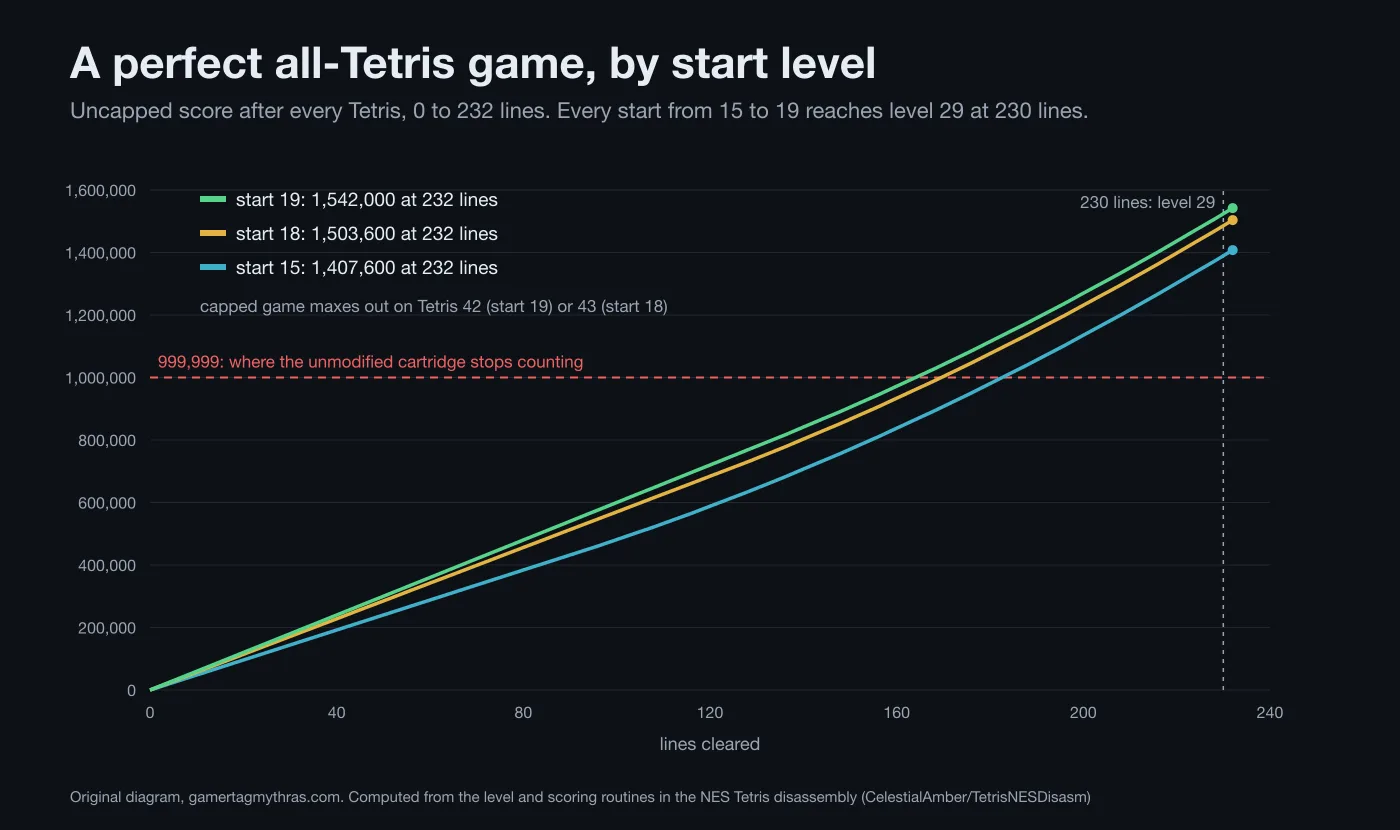
Two things follow. First, a perfect game from 18 or 19 reaches the old cap before level 29 even starts, around level 22 or 23. A real game burns lines, and Wikipedia records Harry Hong's 2009 game as the first independently verified maxout recording, twenty years after release. Second, the gap between an 18 and a 19 start is small next to the gap your Tetris share makes: every four lines you burn as Singles at level 18 instead of taking a Tetris costs 19,760 points.
Level 18 in competition

The CTWC's rules for its 2026 World Championship say every Gold bracket match is played on level 18, every game is set to a level 39 super kill screen, and before each game the referee gives both players a seed so they get the same pieces. Qualifying is played on a modified version of the game that lifts the 999,999 cap and keeps score in seven digits. The championship explainer covers the brackets and the qualifying point system; what the level rules mean for the counters is this:
- 130 lines at level 18, then the transition to 19.
- 230 lines to level 29.
- 330 lines to level 39 and the super kill screen, since an 18 start gains one level every 10 lines after 130. A Tetris on level 39 pays 48,000.
The same page's section on CTWC regional tournaments says the standard start options at CTWC events are typically 18 for Gold matches and 15 and 18 for Silver, where players take turns choosing, and that some regionals allow starts as low as 9. Per the table above, a 15 start and an 18 start both reach level 19 at 130 lines. A 15 start does level up sooner, at 100 lines, but Silver players choosing between them are choosing between slower early gravity and a higher multiplier, not between two different arrivals at level 19.
Past level 29, the counters stop telling the truth
Birken's reading is that the designers assumed nobody would pass level 29, and the displays bear that out.
- The level number. The table the game uses to draw your level has 30 entries, 0 to 29. From level 30 it reads whatever bytes come after it in the ROM. In the disassembly the next table starts with a zero, so level 30 is drawn as "00". Wikipedia's NES Tetris article puts it plainly: from level 30 the level counter stops working correctly. The real level keeps counting, and so does the score multiplier.
- The score. With the cap removed, for example with a Game Genie code, tetris.wiki notes that scores of a million or more show a letter in place of the leftmost digit, so 1,000,000 reads as A00000. TetrisGYM's Classic score mode copies that style and uses A to F, rolling over at 1.6 million.
- The level byte itself. Level is stored in one byte, so after 255 it wraps to 0. Wikipedia calls a game that does this a rebirth, and notes a second bug on the way there: from 2,190 lines an underflow stops the level counter from rising for hundreds of lines, so the 10-lines-per-level rule does not hold that deep into a game. Michael Artiaga was first, on 6 October 2024, using a modified version of the game built not to crash.
The rocket is a score readout
When an A-Type game ends, the disassembly picks an ending by score. Below 30,000 you get none. Above it, the thresholds are 30,000, 50,000, 70,000, 100,000 and 120,000, and Birken describes the five endings as rockets of growing size launched beside St. Basil's Cathedral: the fourth is the Soviet Buran shuttle, and in the best one the cathedral itself takes off.
At level 18, six Tetrises are already 136,800 points, past the top threshold. The rocket matters for a different reason at a tournament. The CTWC's qualifying rules tell players to leave their game on the rocket screen and call a judge, who photographs it before the player moves on to the high-score screen. TetrisGYM's Qual Mode puts the rocket, legal and title screens back for the same kind of qualifier, so nobody gains time by skipping them.
How to drill transition
TetrisGYM is a practice mod distributed as a patch for the US version of the ROM, so you supply your own copy. Its newest tagged release is 6.0.0, from 21 May 2024. Three of its features line up with this post:
- Transition trainer. It starts you ten lines before transition and adds a score value you choose. The README suggests setting it to 5 on a level 18 start for a "maxout trainer" style mode.
- Pace trainer. It tracks you against a target score by 230 lines, in steps of 100,000 up to 1.5 million, with a separate table of score-at-130-lines figures for transition games. The highest setting there, F, lists 752,310 at 130 lines, close to a perfect all-Tetris 18 start, which has 729,600 at 128 lines and 753,600 at 132.
- Any start level. Press right on 9 in the level menu to pick any start level with up and down, instead of using the A-plus-Start trick.
If you want the unmodified game, NES Tetris has been on Nintendo Switch Online since 12 December 2024, per tetris.wiki and Wikipedia. For where it sits next to the modern clients, see which Tetris to play.
The rest is opinion, built on the tables above. If level 18 still outruns you, start on 15. You reach 19 at the same 130 lines, you get 100 lines at 4 frames per row to build a clean stack first, and the only cost is points. Once 18 is comfortable, the 2.6% that 19 adds over a perfect game is worth less than the stack quality you keep by staying on 18. The NES speed curve itself, frame by frame, is in the DAS guide, why NES Tetris has no lock delay to save you at those speeds is in the gravity and lock delay guide, and the reason NES droughts make Tetris-only play so hard is in the randomizers guide.
Quick Action Checklist
- Hold A while pressing Start on the level menu to add 10 to your start level; 19 is the highest.
- Expect your first level-up at 130 lines from 18, 140 from 19, 110 from 16, 120 from 17, and 100 from any start between 9 and 15.
- Remember that starts 15 to 18 all reach level 19 at 130 lines, and starts 15 to 19 all reach level 29 at 230.
- Score each clear as 40, 100, 300 or 1,200 times level plus one, using the level after the clear.
- Know the transition bonus: a Tetris that crosses 130 lines from an 18 start pays 24,000, not 22,800.
- Count burns in points: four Singles at level 18 pay 3,040, one Tetris pays 22,800.
- Ignore push-down points for strategy; they are flat, small and miscoded.
- Know the CTWC Gold shape: level 18, transition at 130 lines, level 29 at 230, super kill screen at 330.
- Drill with TetrisGYM's Transition and Pace trainers, or start on 15 until 18 feels comfortable.
Frequently Asked Questions
When does a level 18 start transition in NES Tetris?
Why does a level 19 start take 140 lines to level up in NES Tetris?
How is NES Tetris scored?
How many Tetrises does it take to max out NES Tetris?
Is it better to start NES Tetris on level 18 or level 19?
How do you start NES Tetris above level 9?
Keep Reading
- CelestialAmber/TetrisNESDisasm: NES Tetris disassembly (main.asm): A+Start level bonus, level-up check, points table, score cap, level display table, ending thresholds
- Mike Birken: Applying Artificial Intelligence to Nintendo Tetris, the mechanics section on line counting, the level-up bug, scoring and the kill screen
- tetris.wiki: Tetris (NES), gravity table and the first level-up formula
- tetris.wiki: Scoring, the original Nintendo system, level after the clear, and push-down points
- tetris.wiki: Maxout, the 999,999 cap and letter-digit scores above a million
- Classic Tetris World Championship: official rules, level 18 Gold matches, level 39 super kill screen, seeds, uncapped qualifying and regional start levels
- kirjavascript/TetrisGYM: NES Tetris practice mod README, Transition and Pace trainers, scoring modes and Qual Mode
- Wikipedia: Tetris (NES video game), level counter past 29, rebirth, and the Nintendo Switch Online release
Related Guides
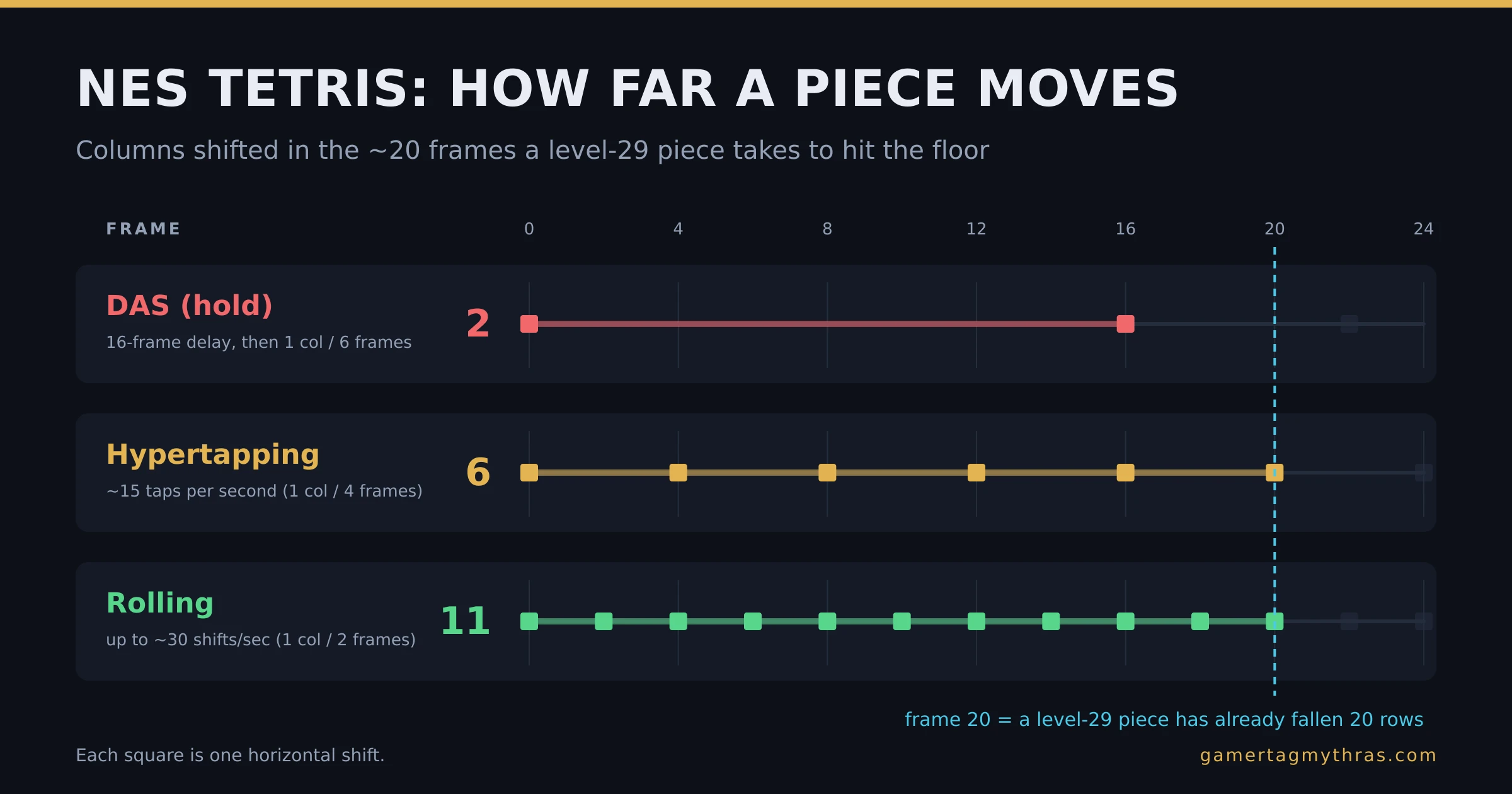
NES Tetris DAS, Hypertapping and Rolling: How the Kill Screen Died
NES Tetris moves your piece sideways ten times a second. At level 29 a piece falls the whole well in twenty frames. That gap is why hypertapping and rolling exist, and why the kill screen is not a kill screen anymore.
Tetris Scoring and Attack Explained: Points, B2B, Combos, and Garbage
Points and garbage are two completely different economies, and most players optimise for the wrong one. Here are the actual numbers behind Guideline scoring, versus attack, back-to-back, combos, and perfect clears.

The Tetris T-Spin Guide: Detection, Setups, and Damage
A T-spin double sends the same 4 garbage rows as a Tetris while using half the rows. That is the whole argument. Here is how the game decides what counts, and the setups that let you do it on purpose.

Tetris DX Explained: How It Differs From Game Boy Tetris
Tetris DX keeps the 1989 Game Boy well and points table but changes how pieces move: a second rotation center that lets pieces climb walls, auto shift every 3 frames, a randomizer that deals the T about 24% of the time, and a seven-digit score.

Tetris Stacking Fundamentals: Build a Board That Wins
Most players do not lose to speed. They lose to a board they built themselves three minutes earlier. Here is how stacking actually works in modern Guideline Tetris, and the habits that stop you from burying your own well.
Game Boy Tetris Explained: How It Differs From NES
Game Boy Tetris and NES Tetris share a points table, but the handheld game stops speeding up at level 20, pays a level-up Tetris at the old rate, deals the L about 10.7% of the time, and makes a held direction wait 23 frames.