Tetris Guideline Explained: Rules, Versions, Exceptions
Every guide on this site says "modern Guideline Tetris" as background and moves on. Here is what that word is actually short for: a yearly document, four known revisions, an indispensable list and a recommended one, a trademarked theme song, and at least four officially licensed games that break it anyway.
Every guide on this site eventually says some version of "modern Guideline Tetris" and moves on, because the word is doing a lot of quiet work: it is the reason TETR.IO, Tetris Effect, Jstris and Puyo Puyo Tetris all rotate pieces the same way, hold the same way, and queue the same way, while NES Tetris and the Grand Master series play by different rules entirely. Almost nothing on this site has actually opened the document that word refers to.
It is a real thing with a name, a publisher, a revision history, and a leak. Here is what is actually in it, according to the two wikis that have spent two decades cataloguing it.
A spec, not a game
The Tetris Guideline is a yearly specification The Tetris Company has stipulated for new Tetris titles since 2001, starting with Tetris Worlds. It was originally called "What is Tetris?" and is developed by Blue Planet Software. The rules are decided by committee, with Alexey Pajitnov holding final say. In later years, summits were held with other developers to hash out revisions.
The stated goal is portability: someone who has played one Guideline game should be able to sit down at any other one and already know the controls, the piece behavior and the scoring shape. That is why so many of this site's guides can say "TETR.IO, Jstris, Tetris Effect, Puyo Puyo Tetris and tetris.com" in the same breath — they are all implementations of the same underlying document, not five unrelated games that happen to converge.
The Tetris Company has never published the Guideline itself. Everything known about it, including everything below, comes from interviews, a document that leaked in 2011, and close observation of what actual released games do.
Indispensable vs. recommended
Both tetris.wiki and the Hard Drop Tetris Wiki organize the known rules into two tiers, and the split matters more than any single rule on the list: one tier is load-bearing, the other is a strong convention a game is still allowed to skip.
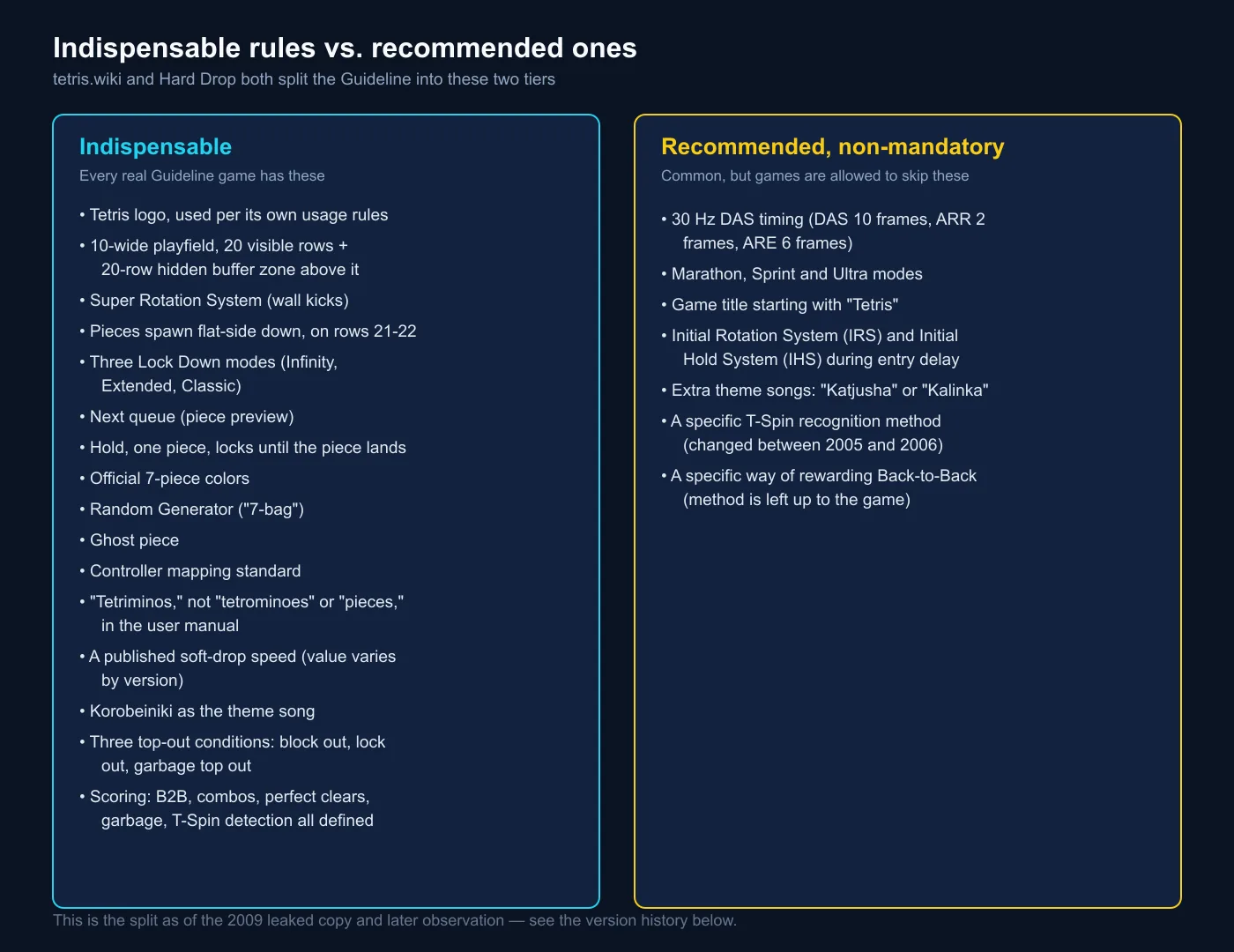
Indispensable covers the load-bearing mechanics this site's other guides already go deep on — and rather than re-deriving them here, this is the reference to link back to. The Super Rotation System and its wall kicks are covered move-by-move in our rotation systems and wall kicks guide. The three Lock Down modes, the 0.5-second lock delay and the 20-row hidden buffer zone above the visible field are covered in the gravity and lock delay guide, including the exact DAS, ARR and ARE frame counts the Guideline recommends. The Random Generator, better known as 7-bag, has its own randomizers guide. What indispensable also includes and none of those posts dwell on: the Tetris logo itself (usage rules and all), a published soft-drop speed that varies by version, the requirement that a manual say "Tetriminos" rather than "tetrominoes" or "pieces," a standard controller mapping, and — genuinely surprising the first time you read it — a specific piece of music.
Recommended, but non-mandatory is the shorter list: 30 Hz DAS timing, Marathon/Sprint/Ultra as the standard mode trio, and a game title that starts with "Tetris." Where the version history actually lives — T-Spin recognition and Back-to-Back rewarding — sits here per Hard Drop's copy of the page; tetris.wiki instead files both under its indispensable Scoring rule, one of a few places the two wikis draw the indispensable/recommended line differently rather than disagreeing on what either rule says.
The official piece colors
This is the one indispensable rule that never gets stated anywhere else on this site, despite showing up in every screenshot of every guide here.
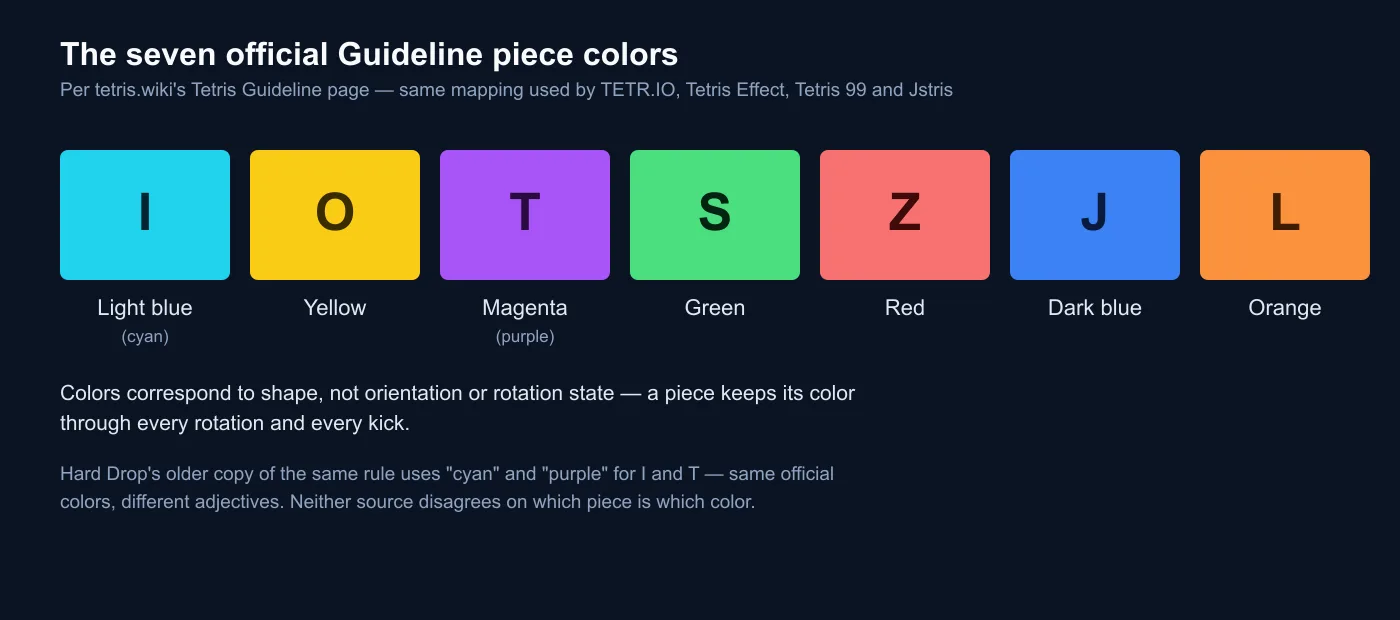
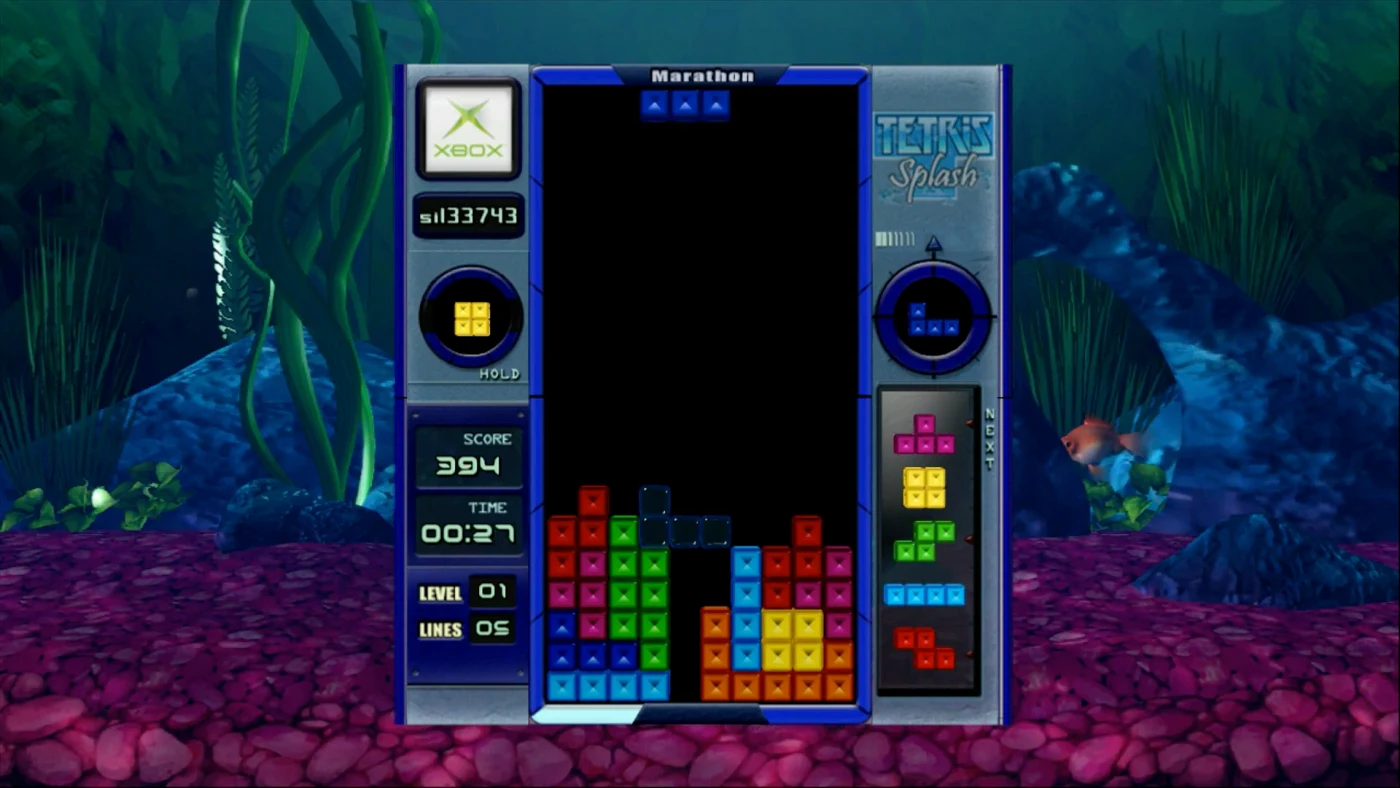
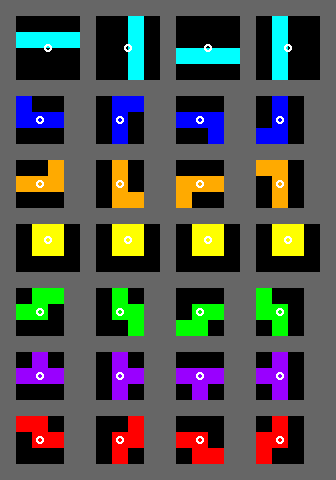
Per tetris.wiki: I is light blue, J is dark blue, L is orange, O is yellow, S is green, Z is red, and T is magenta. Hard Drop's older copy of the same rule uses "cyan" for I, plain "blue" (not "dark blue") for J, and "purple" for T instead — different adjectives for three of the seven colors, not a disagreement about which piece is which. Colors are tied to shape, not to orientation or rotation state, so a piece keeps its color through every kick and every spin.
The rules nobody quotes
A handful of indispensable and recommended rules are specific enough, and unrelated enough to anything already covered on this site, that they are worth stating outright rather than folding into the color table above.
- The logo has its own usage rules, and the current official mark has been in place since June 2019.
- Korobeiniki is mandatory. The Guideline requires a version of the song, and The Tetris Company holds a sound trademark on the specific arrangement used in Tetris games. Hard Drop dates the requirement to the 2005 revision onward and adds two more suggested tracks, "Katjusha" and "Kalinka," under the recommended tier.
- The title should start with "Tetris." This one sits under recommended rather than indispensable, which is presumably why a handful of licensed products get away with names that don't.
- Initial Hold System (IHS) exists alongside Initial Rotation System (IRS). Our rotation guide already covers IRS — holding a rotation button through entry delay so the piece spawns pre-rotated. IHS is the same idea applied to Hold: hold the Hold button during entry delay and the next piece is held the instant it would have spawned. Tetris Effect: Connected documents both in its own community guide, cited on tetris.wiki.
- The Guideline lists three ways to top out — block out, lock out (a piece locking entirely inside the hidden buffer), and garbage pushing a block above that buffer — which is the same three-way breakdown our gravity and lock delay guide covers with the full mechanical detail. What is worth adding here is where it comes from: it is one of the document's indispensable rules, not a convention games happened to converge on independently.
Four known versions, 2002 to 2009
Henk Rogers has said in interviews that the Guideline is revised annually. In practice, only four versions have ever been confirmed to exist: 2002, 2005, 2006, and 2009. The 2009 copy is the one that actually leaked, in 2011 — everything about the earlier three comes from observing which games shipped with which behavior and when.
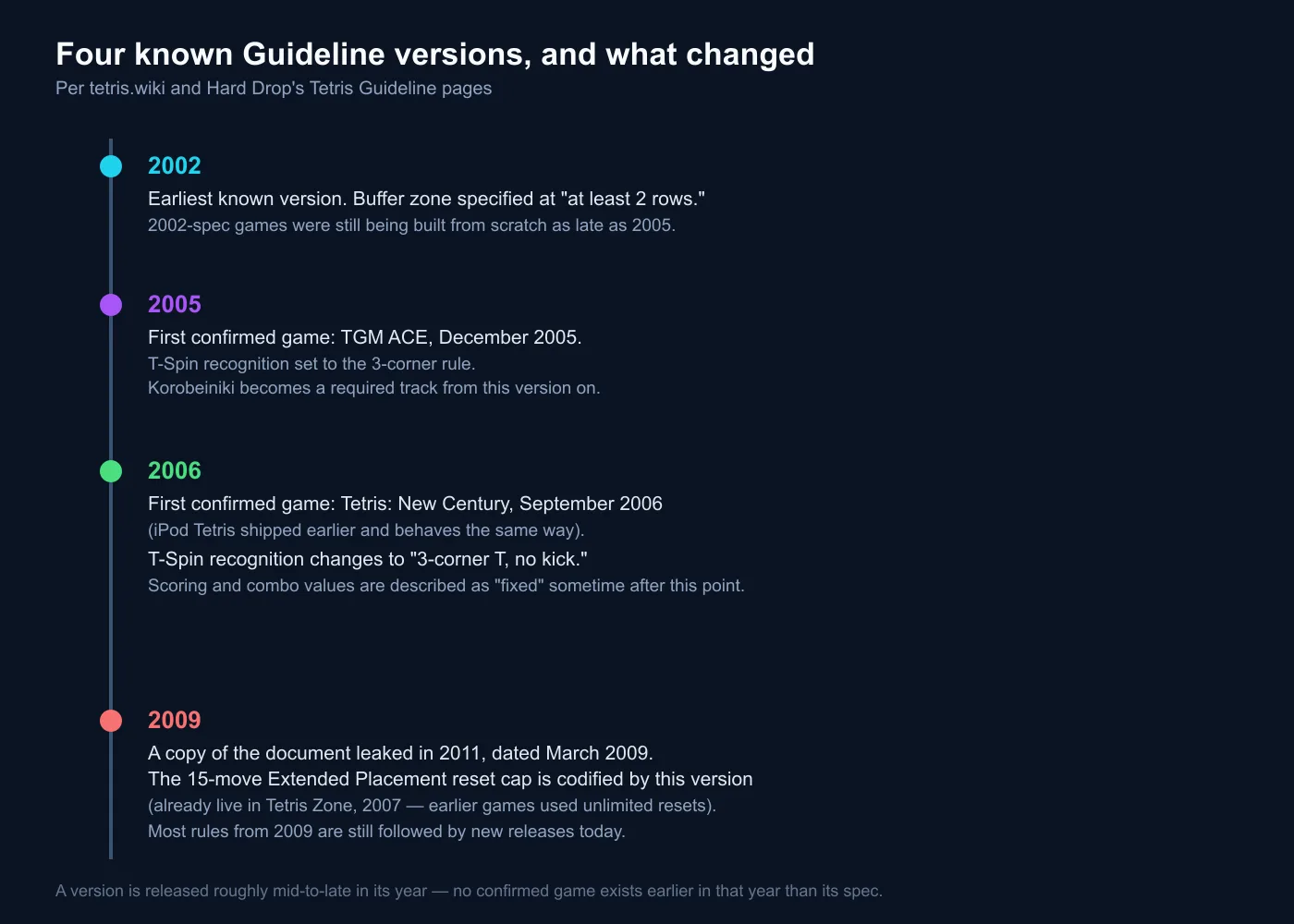
The dating method is indirect but consistent across both wikis: find the earliest confirmed game built to each version, and assume the spec predates the game by at least a little. TGM ACE, released December 2005, is the first confirmed 2005-spec game. Tetris: New Century, released September 2006, is the first confirmed 2006-spec game — iPod Tetris shipped earlier that same window and behaves the same way, but isn't confirmed as the trigger. From those two data points, both wikis draw the same conclusion: a new version tends to land somewhere in the middle-to-late half of its year, and 2002-spec games were still being built from scratch as late as 2005, so an old version staying in active use for years is normal, not a sign anything is wrong with it.
What changed between versions
Four specific rules are documented as moving between revisions, and this is the part of the Guideline that never shows up anywhere else on this site because it isn't a "how to play" question — it's a "why does this old wiki page disagree with this new one" question.
| Rule | 2002 | 2005 | 2006 | 2009 |
|---|---|---|---|---|
| Buffer zone size | At least 2 rows | — | — | — |
| T-Spin / Mini recognition | — | 3-corner T | 3-corner T, no kick | — |
| Extended Placement reset limit | Unlimited (pre-2007 games) | — | — | Capped at 15 moves |
| Back-to-Back rewarding | Left to the game throughout | — | — | — |
The lock delay row deserves its own note: the 15-move reset cap was already live in Tetris Zone (2007) before the 2009 document confirmed it in writing, and every earlier game used unlimited resets instead. Our gravity and lock delay guide covers what that cap actually costs you in play; this is where it came from. Scoring and combo values are described by tetris.wiki as having been "fixed" — standardized — sometime after 2006, with no more precise date given. Hard Drop's page takes the opposite position on this specific point: it says the extent to which the Guideline specifies scoring "is not yet known to the public" — one more spot where the two wikis disagree outright rather than merely leaving detail out.
The reference implementations
Both wikis name the same small set of games as the closest thing to a living copy of the Guideline at their respective release windows: Tetris Worlds, Tetris Deluxe, and Tetris Zone, plus Tetris DS as another widely cited compliant release. None of them is the Guideline itself — The Tetris Company has never published the document — but if two sources disagree on how a rule should behave in practice, these are the games both wikis point to first.
Official does not mean compliant
The single most useful thing in either source is the list of games that are unambiguously official, licensed Tetris products, and still break a rule every other Guideline game follows.
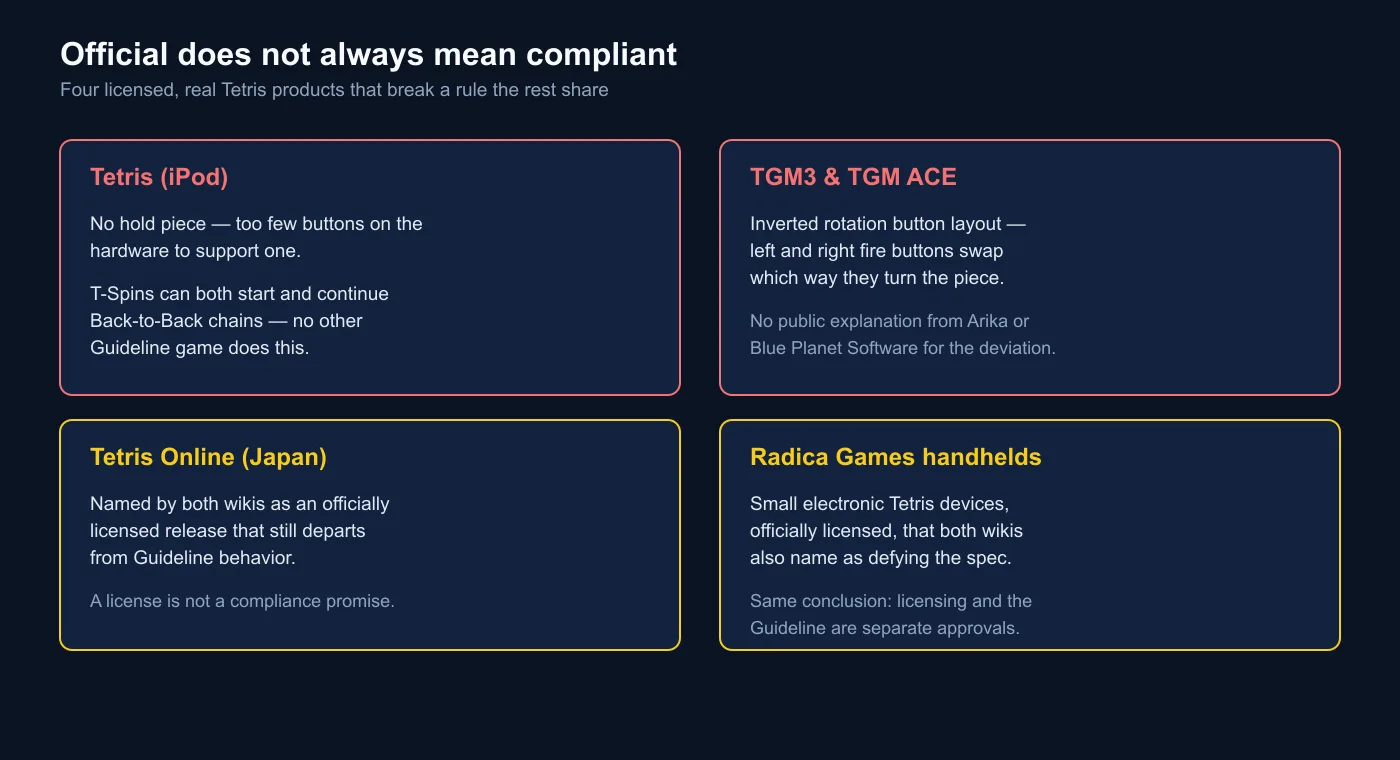
Tetris (iPod) has no hold piece — the hardware didn't have the buttons to support one — and its T-Spins can both start and continue Back-to-Back chains, which no other Guideline game is documented as doing. TGM3 Terror-Instinct and TGM ACE ship with an inverted rotation button layout, where the left and right fire buttons turn the piece the opposite direction from every other Guideline game. Neither Arika nor Blue Planet Software has ever explained why. And Tetris Online (Japan) and the handheld electronic Tetris devices made by Radica Games are both named by both wikis as officially licensed releases that depart from documented Guideline behavior anyway.
The takeaway isn't that these games are broken. It's that "official Tetris product" and "Guideline-compliant Tetris" are two separate approvals, and a game can clear the first without fully clearing the second.
The Borg clause
One more rule, sourced only to Hard Drop's copy of the page, worth knowing if you have ever wondered why unlicensed Tetris-likes borrow guideline mechanics but still can't call themselves Tetris: the Guideline reportedly includes a "Borg clause" stating that every variation introduced by a Guideline game — cascade gravity, the bag randomizer, and so on — is owned by The Tetris Company, regardless of which developer actually built it into their game first.
Where the rest of this site plugs in
This page is meant to be the one other Tetris posts on this site link back to when they say "Guideline," rather than re-explaining the concept from scratch each time. If you want the numbers instead of the history: the rotation systems and wall kicks guide has the full SRS kick tables, the gravity and lock delay guide has the speed curve and every top-out condition in mechanical detail, and the randomizers guide covers 7-bag and what happens in games that don't use it. If you're deciding which Tetris to actually play, the which Tetris to play guide puts the Guideline-compliant options next to the ones that aren't.
Quick Action Checklist
- The Guideline is a yearly spec from The Tetris Company, developed by Blue Planet Software, in force since Tetris Worlds in 2001.
- Only four versions are confirmed: 2002, 2005, 2006, and the 2009 copy that leaked in 2011.
- Indispensable rules include the logo, playfield and buffer zone, SRS, Lock Down, the official piece colors, 7-bag, Hold, the ghost piece, and Korobeiniki as the theme song.
- Recommended-but-optional rules include 30 Hz DAS timing, the Marathon/Sprint/Ultra trio, the "Tetris"-first title convention, and IRS/IHS.
- T-Spin recognition changed between 2005 ("3-corner T") and 2006 ("3-corner T, no kick") — the one rule most likely to explain why two sources disagree on a T-Spin edge case.
- The 15-move Extended Placement reset cap was live in Tetris Zone (2007) before the 2009 document confirmed it in writing.
- An official Tetris license is not proof of Guideline compliance — Tetris (iPod), TGM3/TGM ACE, Tetris Online (Japan) and Radica's handhelds are all documented exceptions.
- The Tetris Company has never published the Guideline itself; everything here is reconstructed from interviews, the 2009 leak, and observed game behavior.
Frequently Asked Questions
What is the Tetris Guideline?
How many versions of the Tetris Guideline are there?
What are the official Tetris piece colors?
Does every official Tetris game follow the Guideline?
What is the difference between indispensable and recommended Guideline rules?
Keep Reading
Related Guides
Classic Tetris World Championship Explained
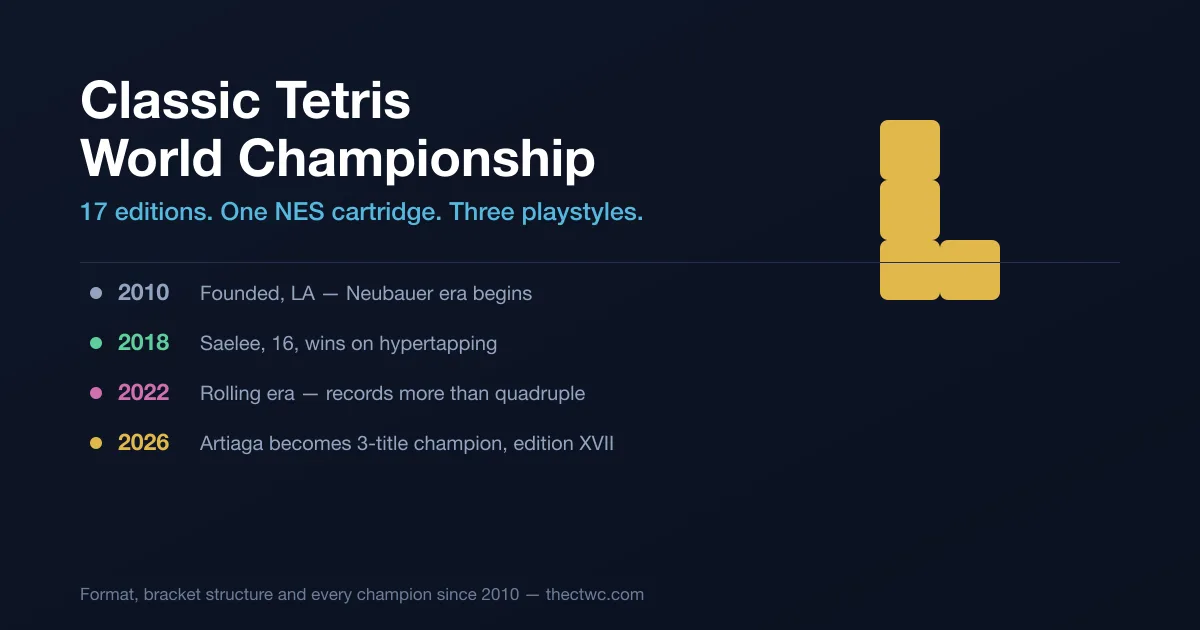
Every other guide on this site covers a Tetris built after 2001, when the Guideline standardized rotation, hold and 7-bag. The one tournament with real prize money and 129 entrants in 2026 ignores all of it and plays the 1989 NES cartridge instead. Here is how that tournament is actually run.
Tetris All-Spin Explained: S, Z, L, J and I Spins
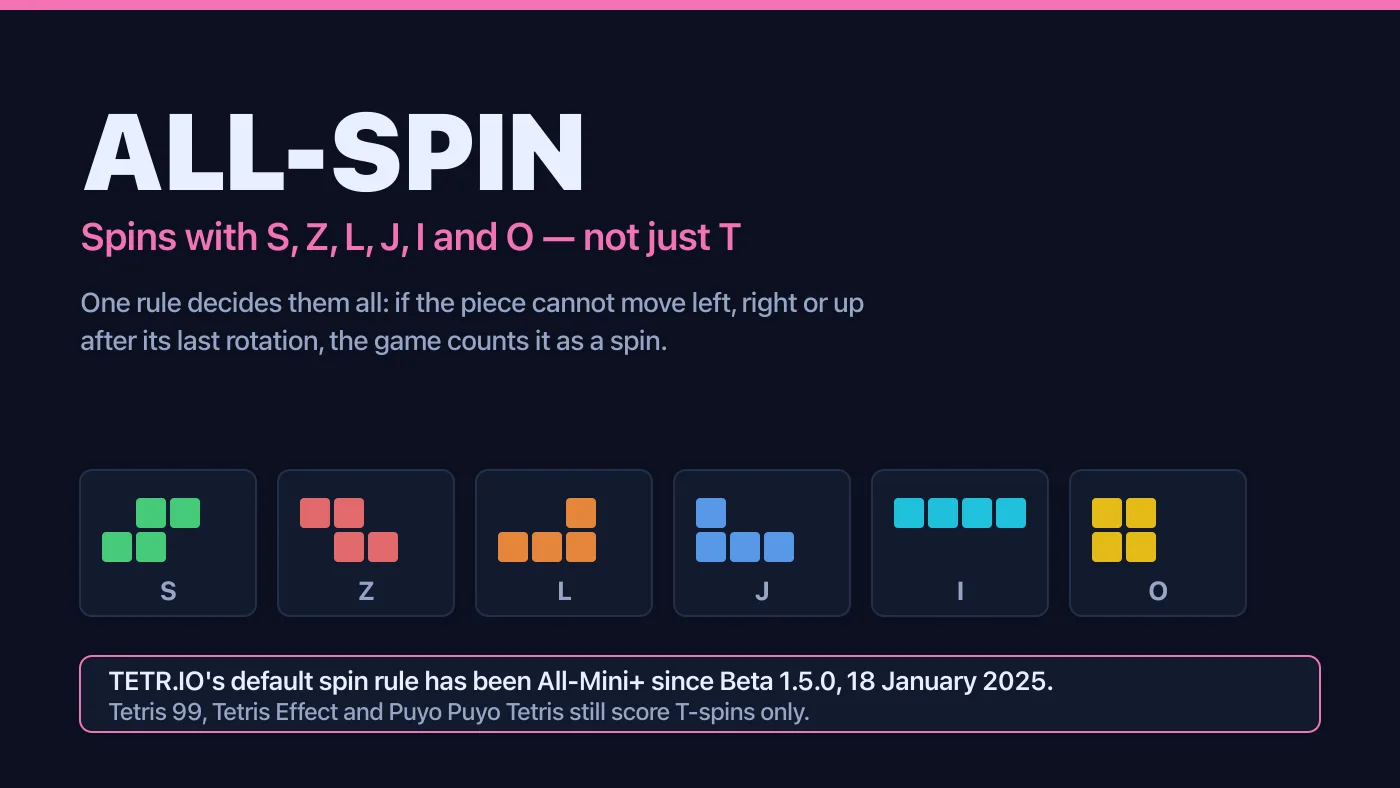
A Z piece rotated into a slot nothing else reaches is either a scored spin or an ordinary Double, and which one it is has nothing to do with you. It is a setting, and most Tetris games have it switched off.
Tetris Openers: TKI-3, DT Cannon and Albatross
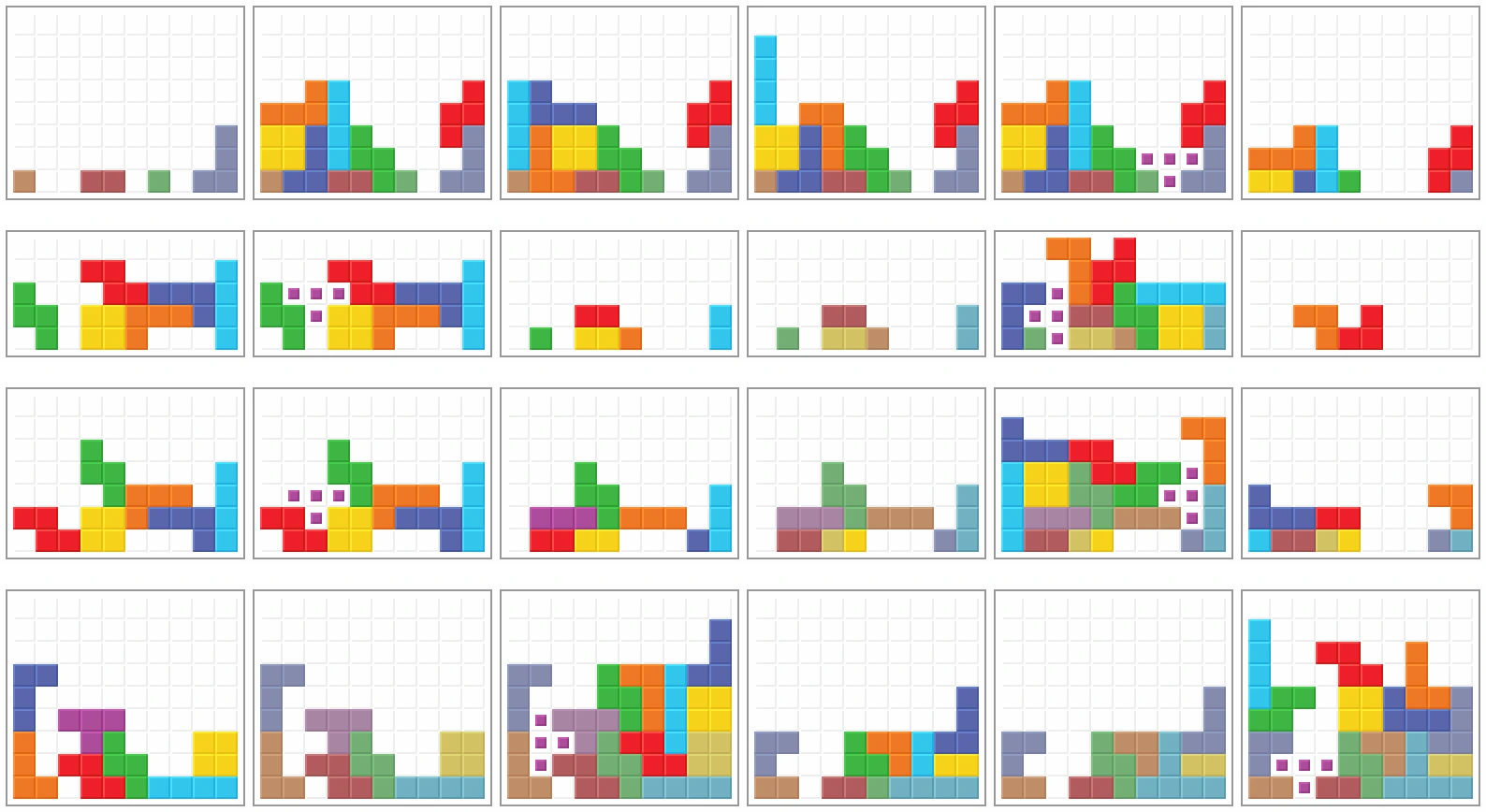
Your first seven pieces decide which opener is even legal. Memorising one build and forcing it every game is why your opening dies half the time. Here is the actual decision tree, from the I-piece TKI family down to the SZT bags nobody wants.
Tetris Gravity and Lock Delay Explained: The Speed Curve, the 15-Move Limit, and 20G
Every modern Tetris game runs on three clocks you never see: gravity, lock delay, and entry delay. All three are published numbers, and they explain exactly why level 15 feels like a different game than level 5.

Tetris Stacking Fundamentals: Build a Board That Wins
Most players do not lose to speed. They lose to a board they built themselves three minutes earlier. Here is how stacking actually works in modern Guideline Tetris, and the habits that stop you from burying your own well.
Tetris Wall Kicks Explained: SRS Kick Tables, ARS, and NES
Your I piece did not glitch. It jumped two columns left because test 2 of its kick table says to, and the game ran that test before it ran the one you wanted. Here is what every modern Tetris is actually checking when you press rotate.