Tetris DX Explained: How It Differs From Game Boy Tetris
Tetris DX keeps the 1989 Game Boy well and points table but changes how pieces move: a second rotation center that lets pieces climb walls, auto shift every 3 frames, a randomizer that deals the T about 24% of the time, and a seven-digit score.
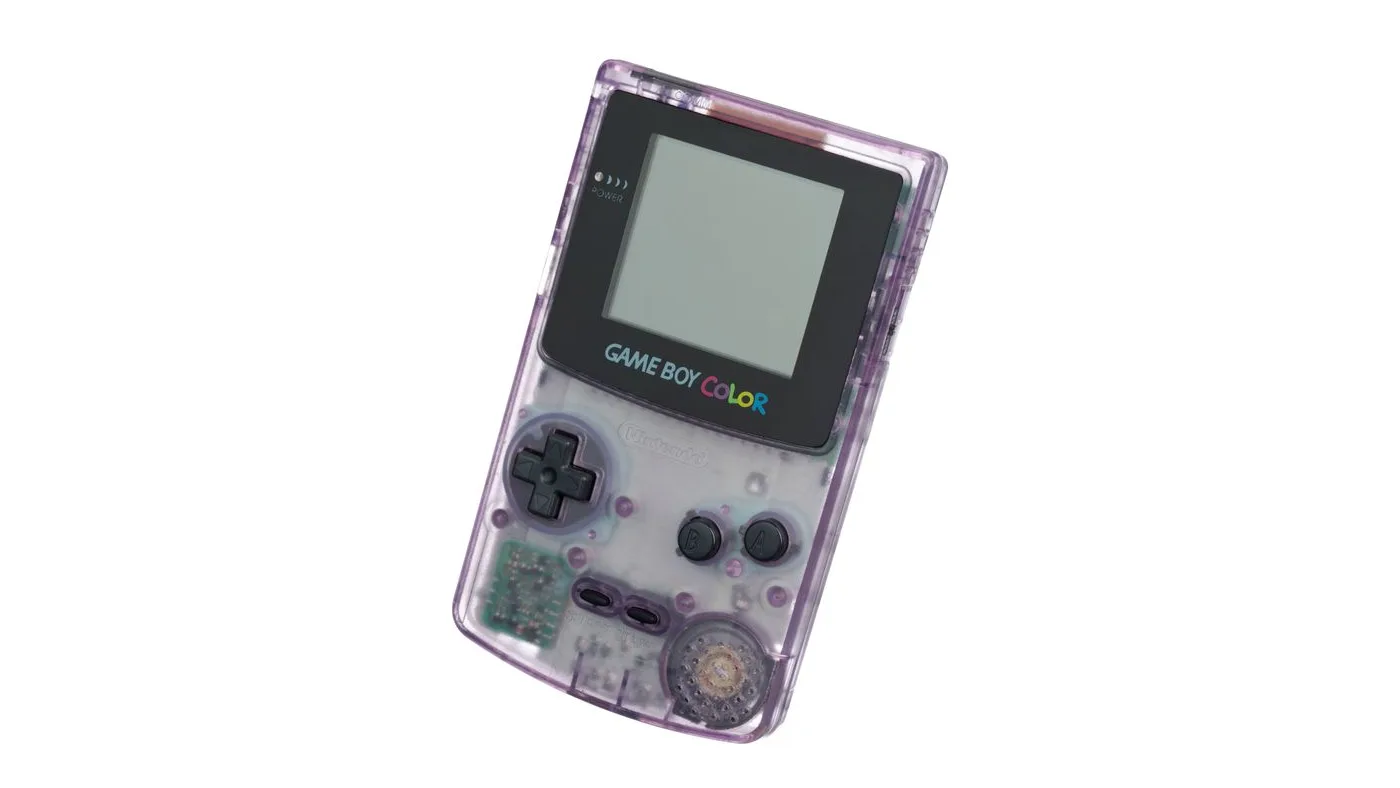
Tetris DX deals a T roughly once in every four pieces. In a test of about 10,000 pieces logged on the Hard Drop wiki, the T came up 24.4% of the time, where an even deal gives each piece 14.3%. The 1998 Game Boy Color remake also lets a piece climb a wall, repeats a held direction every 3 frames instead of every 9, and keeps score to seven digits. It shares a 10-by-18 well and a points table with the 1989 Game Boy Tetris it was built from, and very little about how the pieces move.
Both games now sit in the same Game Boy library on Nintendo Switch Online, so the difference is one menu choice away. Our Game Boy Tetris explainer takes the 1989 original apart from its disassembly. This post does the same job for DX: the modes, the rotation system, the handling, the randomizer, the score and the Power rating behind VS. COM. We could not find a full disassembly of DX, so the mechanics come from tetris.wiki, the Hard Drop wiki, Dunspixel's partial code analysis on GitHub (tdxpower), a forum reading of the piece routine, and Nintendo's own mode descriptions. Where a number is our own calculation, the text says so.
One naming trap first. Tetris DX is not Tetris Deluxe, the mobile-phone game our Guideline explainer names among the Guideline's reference implementations. tetris.wiki's DX page opens with that warning.
Tetris DX vs Game Boy Tetris at a glance
| Game Boy Tetris (1989) | Tetris DX (1998) | |
|---|---|---|
| Playfield | 10 wide, 18 tall | 10 wide, 18 tall |
| Preview, hold, hard drop | 1 piece, no hold, no hard drop | 1 piece, no hold, no hard drop |
| Modes | A-Type, B-Type, two-player link | Marathon, Ultra, 40 Lines, VS. COM, 2PLAYER |
| Rotation | Nintendo Rotation System, left-handed, no wall kicks | Bounding box with a second rotation center, an early version of SRS |
| Auto shift | 23 frames, then every 9 | 9 frames, then every 3 |
| Fastest gravity listed | 3 frames per row at level 20 | 2 frames per row at level 20 (see the caveat below) |
| Score counter stops at | 999,999 | 9,999,999 |
| Most common piece | O, S and T, about 16.1% each | T, about 24.4% |
| On Nintendo Switch Online | Since 8 February 2023 | Since 12 December 2024 |
The Game Boy column comes from the Tetris (Game Boy) pages on tetris.wiki and Hard Drop. The DX column comes from both wikis' Tetris DX pages and Nintendo's Switch Online announcement. Hard Drop gives the Game Boy piece shares, and our Game Boy explainer works through why the L comes up least.
Five modes, and B-Type is gone
Nintendo's announcement of the Switch Online release lists five modes: MARATHON, ULTRA, 40LINES, VS. COM and 2PLAYER.
- Marathon is the endless mode. Nintendo's description is that you only get a game over when the pieces reach the top, and both wikis note that its score counter maxes out at 9,999,999.
- Ultra gives you three minutes to score as much as you can. Nintendo's US announcement and its UK product page both say three minutes. Wikipedia's Tetris DX article says two, citing two 1999 magazines, Planet Game Boy and Electronic Gaming Monthly; the publisher's own wording is the better source.
- 40 Lines races the clock to clear 40 lines, and the game records your fastest times, per Nintendo's UK page. Wikipedia, citing contemporary reviews, adds that you choose a starting level and a starting height first.
- VS. COM puts you against the computer at three difficulty levels, per Nintendo, or against a CPU built from a saved profile's past results, covered in the Power section below.
- 2PLAYER is head-to-head play with a friend over the link cable.
What is missing is the 1989 game's B-Type, the 25-line clear-out with a garbage height setting. It is not in Nintendo's list, tetris.wiki's or Hard Drop's. 40 Lines, with its height option, is the nearest thing DX has to it.
DX also saves. The back of the game's box, as quoted by Gematsu, describes battery-backed memory that saves up to three game files, and tdxpower's map of the save RAM shows Profile 1, 2 and 3 plus a Guest slot. Each profile stores its games played, total lines and Power.
A second rotation center
Game Boy Tetris uses the left-handed Nintendo Rotation System, which tetris.wiki says generally has no wall kicks: a rotation that does not fit is simply refused. The same page notes that DX, like Nintendo's later Tetris games, uses a different system. DX gives a blocked rotation a second try. Per tetris.wiki and Hard Drop:
- Three-wide pieces turn inside a bounding square, as they do in SRS, but the L, J and T spawn flat side up, which SRS pieces do not.
- The first attempt rotates about the center of that box.
- If that fails, the game tries an alternate center one cell away: one cell above the normal center for the I, S and Z, and one cell below it for the L, J and T, measured in the spawn orientation.
Both wikis describe the system as an early version of what became SRS. It is one fallback position, not SRS's full kick tables, which our wall kicks guide lays out next to the kick-free Nintendo system the 1989 game uses. Even so, a piece pressed against a wall or tucked under an overhang has a second chance to turn in DX, where in the original it would simply refuse.
Wall climbing and infinity
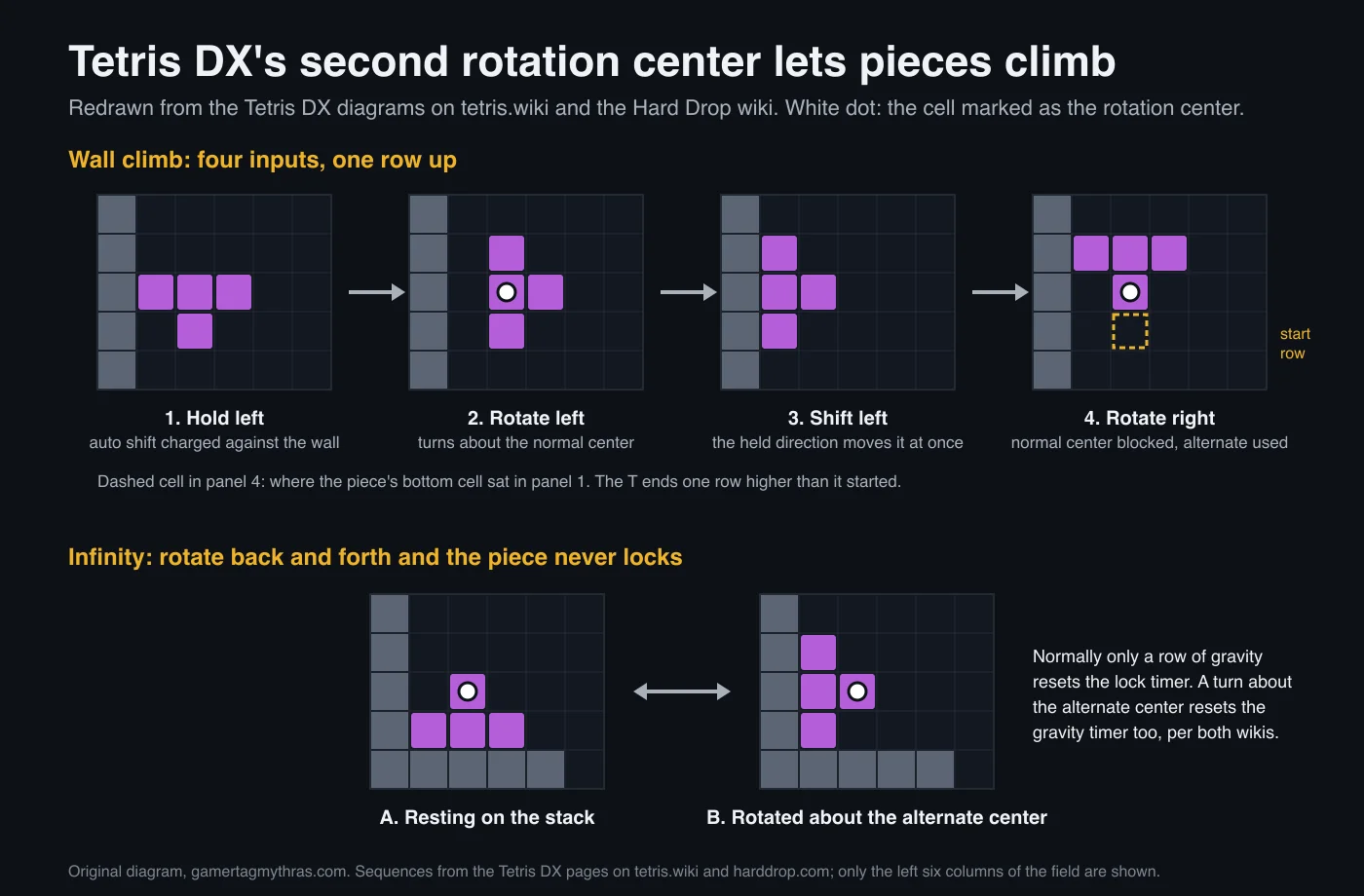
The alternate center has two side effects, and both wikis document them with the same diagrams, redrawn above.
Wall climbing. In the wikis' example, hold left against the left wall, rotate left, let the held direction push the piece flush against the wall, then rotate right. The normal center is now blocked by the wall, the alternate one is not, and the piece finishes one row higher than it started. tetris.wiki sums it up as holding a direction against a wall and rotating the opposite way. tetris.wiki says every piece except the O can do it, both wikis say it is most exploitable on low levels, and tetris.wiki notes that SRS fixed this particular exploit.
Infinity. DX normally uses step reset: only a piece moving down a row under gravity resets the lock delay timer. A rotation about the alternate center, though, resets the timer used for gravity. Put a piece in a corner, rotate it back and forth about the alternate center, and it never locks.
This part is opinion. Neither trick is fast; a climb takes two rotations and a held direction to gain one row. Their value is as a rescue. A piece that slides into the wrong spot against a wall can climb back up at low levels, and a stalled piece gives you as long as you want to read the preview before you commit.
Handling: 9 frames, then every 3
tetris.wiki lists DX's auto shift as 9 frames before the repeat starts and 3 frames between repeats. Hard Drop gives the 1989 game 23 and 9; tetris.wiki's Game Boy page lists the first as 24. The millisecond figures below use the 59.7 frames per second that Pan Docs, the Game Boy hardware reference, gives for one frame.
| Timing | Tetris DX | Game Boy Tetris |
|---|---|---|
| Wait before a held direction repeats | 9 frames, about 151 ms | 23 frames, about 385 ms |
| Time between repeats | 3 frames, about 20 shifts a second | 9 frames, about 6.6 shifts a second |
Three more DX timings from tetris.wiki:
- Lock delay is 32 frames or the level's frames per row plus 4, whichever is larger. By tetris.wiki's speed table, that is 56 frames at level 0 and a flat 32 frames, about 0.54 seconds, from level 6 up. tetris.wiki's Nintendo Rotation System page says games built on that system, the 1989 Game Boy Tetris among them, generally have no lock delay at all.
- Line clear delay is 50 frames, about 0.84 seconds.
- Entry delay is listed as equal to the lock delay, and cancellable.
At every 3 frames, a held piece crosses the well about three times as fast as in the 1989 game, and the 9-frame start means a tap that lasts a little too long becomes a slide. Our finesse guide covers the same trade-off in modern games, where you set those two numbers yourself.
The speed table, with one caveat
| Level | Tetris DX frames per row (tetris.wiki) | Game Boy Tetris frames per row |
|---|---|---|
| 0 | 52 | 53 |
| 1 | 48 | 49 |
| 2 | 44 | 45 |
| 3 | 40 | 41 |
| 4 | 36 | 37 |
| 5 | 32 | 33 |
| 6 | 27 | 28 |
| 7 | 21 | 22 |
| 8 | 16 | 17 |
| 9 | 10 | 11 |
| 10 | 9 | 10 |
| 11 | 8 | 9 |
| 12 | 7 | 8 |
| 13 | 6 | 7 |
| 14 | 5 | 6 |
| 15 | 5 | 6 |
| 16 | 4 | 5 |
| 17 | 4 | 5 |
| 18 | 3 | 4 |
| 19 | 3 | 4 |
| 20 | 2 | 3 |
Look at the two columns together. Every DX value is exactly one frame below the 1989 game's. Both wikis note that the Game Boy original stores its own speed table in the ROM as one less than the real frame count. So either DX really is one frame faster at every level, or tetris.wiki's DX table lists the stored values without adding the frame back. With no DX disassembly to check against, we cannot tell which. The shape of the curve is the reliable part: slow through level 8, a drop from 16 to 10 frames at level 9, then a slow squeeze to the last listed speed at level 20.
The gravity and lock delay guide covers how speed curves work across Tetris generally.
Almost every fourth piece is a T
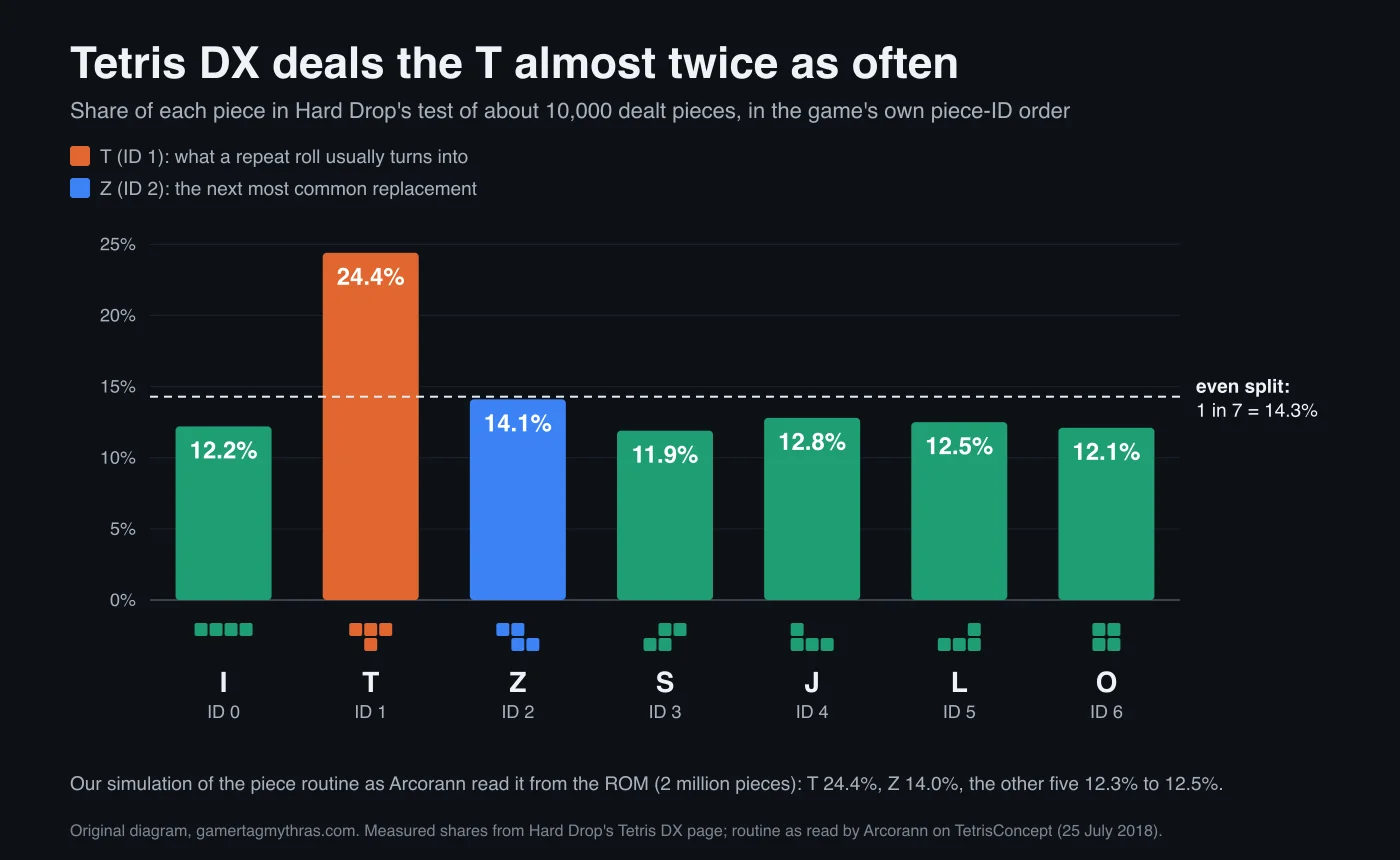
Hard Drop's test of about 10,000 pieces:
| Piece | Piece ID | Share | One every (average) |
|---|---|---|---|
| I | 0 | 12.2% | 8.2 pieces |
| T | 1 | 24.4% | 4.1 pieces |
| Z | 2 | 14.1% | 7.1 pieces |
| S | 3 | 11.9% | 8.4 pieces |
| J | 4 | 12.8% | 7.8 pieces |
| L | 5 | 12.5% | 8.0 pieces |
| O | 6 | 12.1% | 8.3 pieces |
The last column is our arithmetic, one divided by the share. The explanation comes from Arcorann on the TetrisConcept forum in July 2018, reading the piece routine at address 58B6 in the ROM, and Hard Drop's page follows it:
- The game reads the Game Boy's divider register and keeps a number from 0 to 7.
- 0 to 6 is a piece ID. A 7 falls back to a counter that cycles through the seven IDs.
- If the result differs from the last piece the routine accepted, it is dealt, and a repeat counter resets to zero.
- If it matches, the game does not reroll. It adds one to the repeat counter and deals the counter's value as the piece. Because the counter resets every time a non-matching piece is dealt, that value is almost always 1, and ID 1 is the T. When it reaches 2, you get a Z. At 5, the counter resets and the routine starts over.
Arcorann's reading also notes that the matching branch does not update the "last piece" it compares against.
We ran that routine for 2 million pieces, treating each roll of 0 to 7 as even: T came out at 24.4%, Z at 14.0% and the other five between 12.3% and 12.5%. That reproduces Hard Drop's T and Z. Its measured S, 11.9%, sits a little under the routine's prediction, which Hard Drop suggests may come from a bias in the random source. The same simulation repeated the previous piece only about 3.4% of the time, against 14.3% for a fair deal. So the routine does what Hard Drop says it was meant to do, and rarely deals the same shape twice running, at the cost of flooding the queue with Ts.
What that means at the stack: plan your surface for Ts, and expect the I less often than in either the 1989 game, where Hard Drop puts it at 13.7%, or a fair deal. DX scores with the original Nintendo system, which pays for lines cleared, so the extra Ts buy you no spin bonus; they are just a shape you will be placing a lot. Our randomizers guide compares other games' approaches, from the NES reroll to modern 7-bag.
Seven digits of score
Clears pay 40, 100, 300 or 1,200 points times (level + 1), the original Nintendo system covered in our Game Boy explainer, but tetris.wiki notes that DX caps the multiplier at 21. A Tetris is never worth more than 25,200 points, however high the level climbs.
The counter is where DX opens up. It stops at 9,999,999, ten times the 1989 cap of 999,999. tdxpower's analysis of the save data adds that the game also keeps a separate internal score that keeps counting past the display, up to 4,294,967,295.
How far is the maxout? tdxpower works out that a perfect Marathon of nothing but Tetrises from level 9 reaches the cap on the 417th Tetris, at 1,668 lines, with 10,010,400 points (soft drop excluded). We reproduced that total exactly by assuming DX levels up the way tetris.wiki describes the 1989 game doing it, first at 10 x (start + 1) lines and then every 10, and pays each clear at the level before it. No DX source states that level rule outright, so treat it as inferred. By the same rule, a level 0 start needs 423 Tetrises and 1,692 lines. The start level is worth six Tetrises out of more than 400; the cap is a stamina test.
One display bug on the way: the line counter is capped at 999,999 lines, but once it passes 99,999 the top digit disappears, so 100,000 lines reads as 00000, per tetris.wiki and tdxpower.
Power: the rating behind VS. COM
Each profile carries a number called Power, shown on the file select screen. Hard Drop describes it, loosely, as a recent score-per-line average, and says it updates after a Marathon, Ultra or 40 Lines game. tdxpower reverse-engineered the Marathon and Ultra formula from the game's code, and both wikis carry it:
- Game Power = (score minus soft-drop points) / lines x a line multiplier. Strictly, the subtraction rounds the soft-drop points down to a multiple of 16.
- Profile Power = (game Power + old Power x N) / (N + 1), where N is the number of games played before, capped at 5.
| Lines in the game | Line multiplier |
|---|---|
| 0 | 0 |
| 1 to 10 | 0.25 |
| 11 to 15 | 0.5 |
| 16 to 20 | 0.75 |
| 21 or more | 1 |
Three things follow from the formula, by our reading:
- Short games are discounted. A game of 10 lines or fewer counts at a quarter of its points per line, and only from 21 lines does the rating take you at face value.
- It rewards Tetris rate and level, not survival. Power is points per line, so a game of Singles scores far worse than a game of the same length made of Tetrises, however long you last.
- Each new game counts for one-sixth of the result once a profile has five games behind it.
tdxpower also gives the ceilings. In Ultra the top is 3,000: start on level 9, clear only Tetrises and reach at least 24 lines, so each line is worth 12,000 / 4. In Marathon the top by intended play is 6,001, from the 417-Tetris maxout above, topping out at 1,668 lines. Its analysis of the 40 Lines formula is not finished, so we leave that one out.
The reason Power exists is VS. COM. tetris.wiki says the mode can pit you against a CPU that plays from a local profile's data or from a profile transferred from another cartridge over the link cable. Nintendo's announcement puts it as playing against your own levels or your friends' levels, based on prior game results.
Where to play it, and which one to open
Tetris DX joined the Game Boy library for Nintendo Switch Online alongside NES Tetris. Nintendo's announcement is dated 11 December 2024, Gematsu reported it at 8:11 PM Eastern that evening, and tetris.wiki gives the release as 12 December 2024. The Game Boy explainer covers the app itself, and our which Tetris to play guide puts the modern options side by side.
This part is opinion. Open DX for Ultra and 40 Lines, which the 1989 game does not have, and for the faster handling. Open the 1989 game when you want its exact rules, B-Type and the scarce L included. Comparing a score from one with the other means comparing two different games: a T-heavy queue, a second rotation center and a three-times-faster repeat all change what a good run looks like. More on the Tetris coverage hub.
Quick Action Checklist
- On Switch Online, pick Tetris DX for Marathon, Ultra (three minutes), 40 Lines and VS. COM; pick the 1989 Tetris for A-Type and B-Type.
- Expect a T about once every four pieces and an I about once every eight.
- Use the second rotation center: if a turn is blocked, DX tries again one cell away.
- Climb the left wall at low levels: hold left, rotate left, let the piece slide flush, then rotate right.
- Tap, do not hold: auto shift starts after 9 frames and repeats every 3.
- Remember a Tetris tops out at 25,200 points, and the counter at 9,999,999.
- Play at least 21 lines before judging your Power; shorter games count at a discount.
- Build Power with Tetrises from a high start level, not with long games of Singles.
Frequently Asked Questions
What is the difference between Tetris DX and Game Boy Tetris?
What modes does Tetris DX have?
Why does Tetris DX give so many T pieces?
What is Power in Tetris DX?
What is the max score in Tetris DX?
Can you play Tetris DX on Nintendo Switch?
Is Tetris DX the same as Tetris Deluxe?
Keep Reading
- tetris.wiki: Tetris DX: modes, Marathon speed curve, rotation system, wall climbing, infinity, Power formula, timings and the score multiplier cap
- Hard Drop Tetris Wiki: Tetris DX: rotation system, wall climbing and infinity, measured piece shares and randomizer explanation, Power, display bugs
- TetrisConcept forum, Randomizer Theory thread: Arcorann's reading of the Tetris DX piece routine at 58B6 (25 July 2018)
- Dunspixel/tdxpower: Tetris DX Power calculator and partial assembly analysis: Power formula, save RAM map, maximum Power and the 417-Tetris maxout
- Nintendo: Tetris for NES and Tetris DX join the NES and Game Boy libraries (11 December 2024): MARATHON, ULTRA, 40LINES, VS. COM and 2PLAYER
- Nintendo UK: Tetris DX product page: Marathon, Ultra with a three-minute limit, 40 Line Mode and link play
- Gematsu: Game Boy – Nintendo Switch Online adds Tetris DX (11 December 2024, 8:11 PM ET), quoting the back of the box: battery-backed memory saves up to three game files
- Wikipedia: Tetris DX: release, modes, 40 Lines level and height options, VS. COM difficulties and save profiles
- Hard Drop Tetris Wiki: Tetris (Game Boy): 23-frame DAS, 9-frame repeat, speed table and its stored-minus-one note, piece shares
- tetris.wiki: Tetris (Game Boy): playfield, Nintendo Switch Online release (8 February 2023), speed table and score cap
- tetris.wiki: Nintendo Rotation System: generally no wall kicks and no lock delay; left-handed version used by Game Boy Tetris; DX uses a different system
- Pan Docs: Rendering: one Game Boy frame is 70,224 dots at 59.7 frames per second
Related Guides
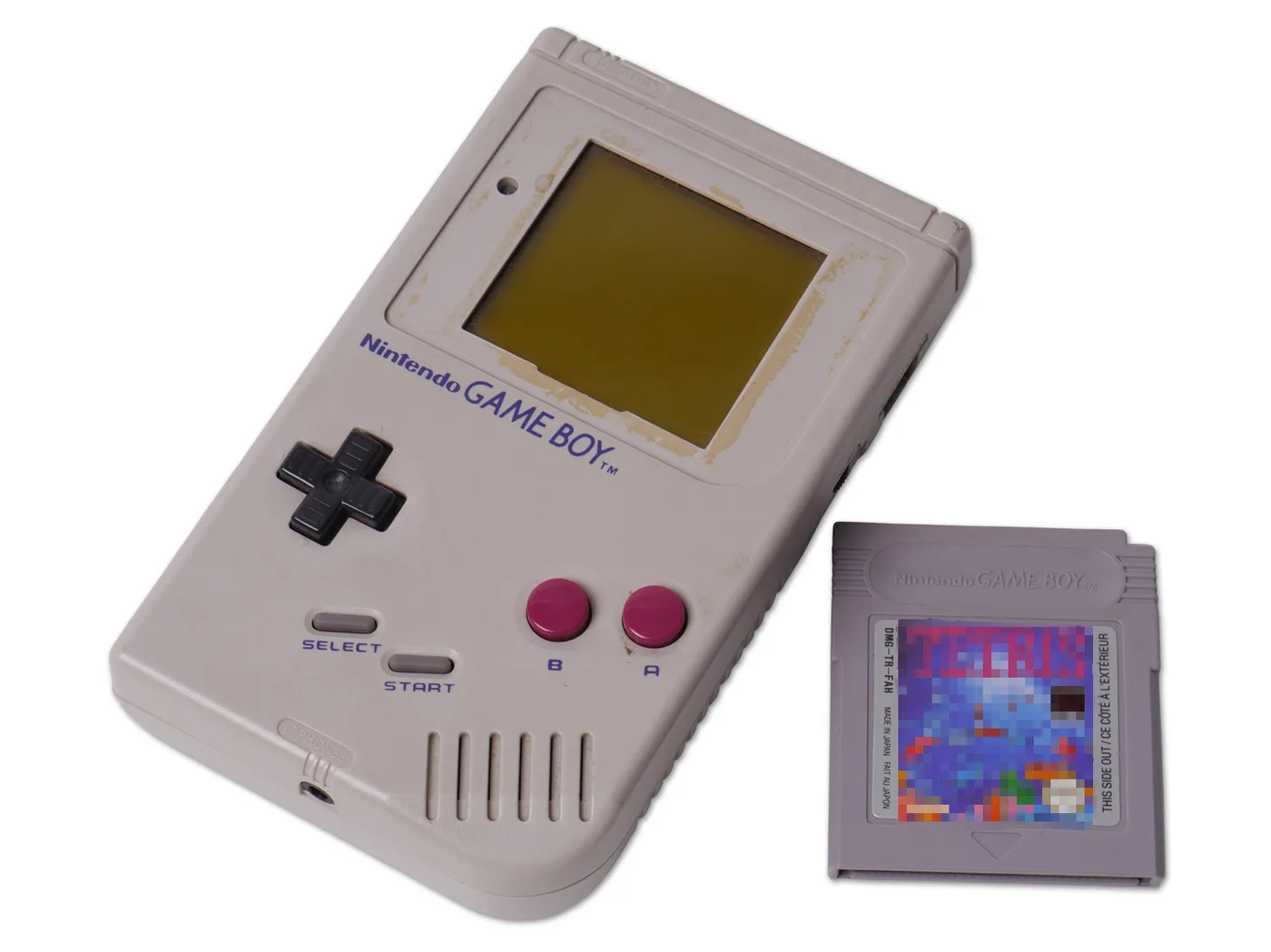
Game Boy Tetris Explained: How It Differs From NES
Game Boy Tetris and NES Tetris share a points table, but the handheld game stops speeding up at level 20, pays a level-up Tetris at the old rate, deals the L about 10.7% of the time, and makes a held direction wait 23 frames.
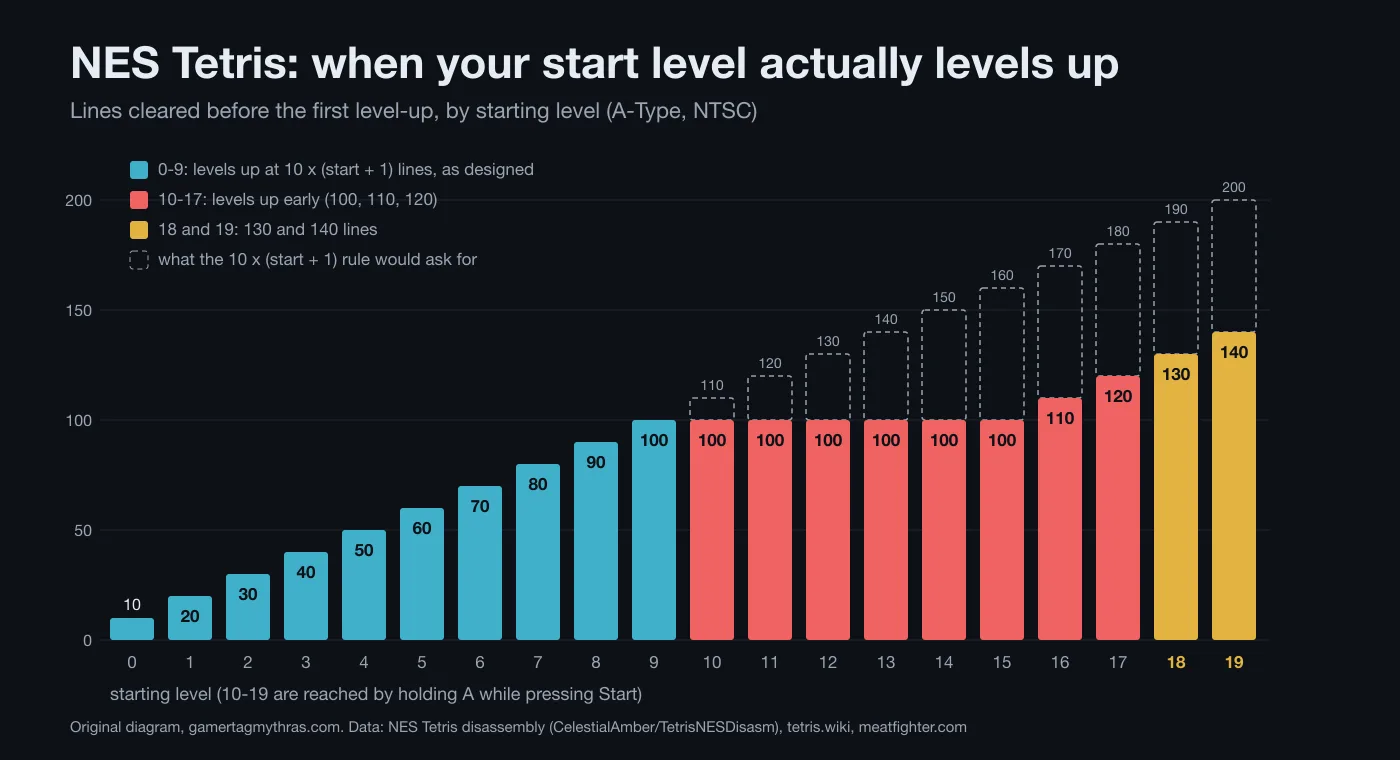
NES Tetris Level Transition and Scoring Explained
Start NES Tetris on 18 and you stay there for 130 lines. Start on 19 and it is 140. Start on 12 and it is 100. One missing conversion in the cartridge explains all three, and it also decides which clear gets paid at the higher rate.
Tetris Randomizers Explained: 7-Bag, TGM History Rolls, and Why NES Owed You Nothing
Every version of Tetris answers the same question differently: what comes next? The answer ranges from a shuffled bag with hard mathematical guarantees to a single polite reroll that owes you nothing, and knowing which one you are playing against changes how you stack.
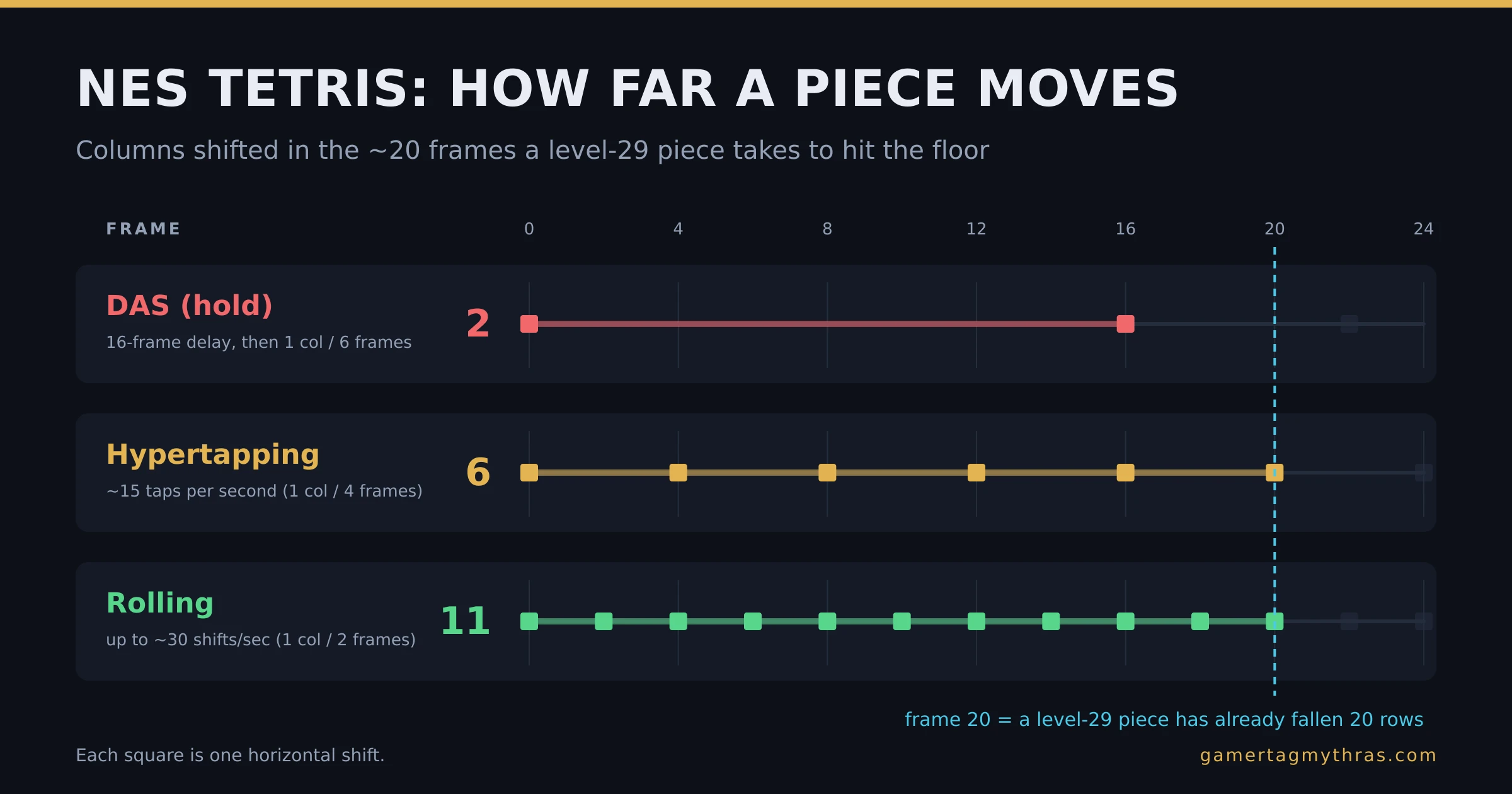
NES Tetris DAS, Hypertapping and Rolling: How the Kill Screen Died
NES Tetris moves your piece sideways ten times a second. At level 29 a piece falls the whole well in twenty frames. That gap is why hypertapping and rolling exist, and why the kill screen is not a kill screen anymore.

Tetris Stacking Fundamentals: Build a Board That Wins
Most players do not lose to speed. They lose to a board they built themselves three minutes earlier. Here is how stacking actually works in modern Guideline Tetris, and the habits that stop you from burying your own well.
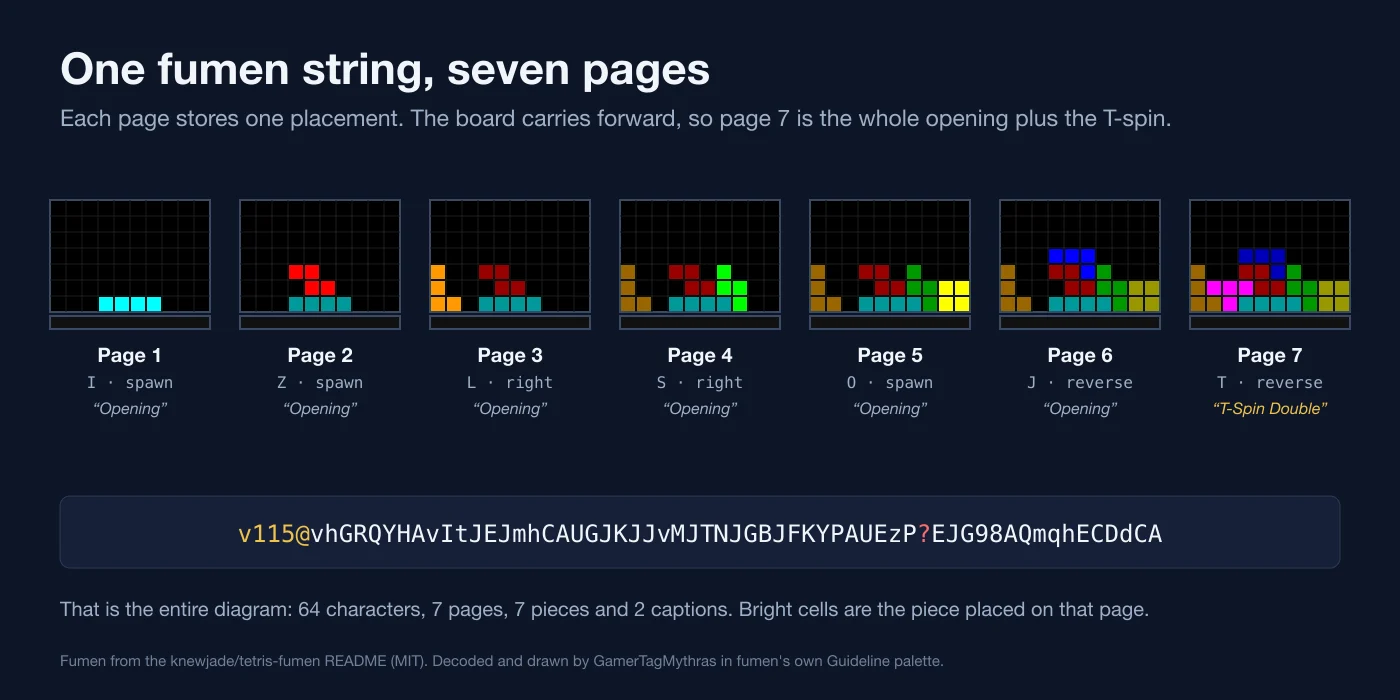
Tetris Fumen Explained: Read, Make and Share Diagrams
The v115@ string attached to Tetris setups is a whole multi-page board packed into a link. Here is what is inside it, which editor to open it in, what Lock, Rise and Mirror do, and where numbers like 84.64% come from.