Tetris The Grand Master Explained: 20G, the Grade Ladder, and the Invisible Roll
Most Tetris games ask you to survive. Arika's ask you to justify yourself. Here is how the TGM series actually grades a run — the piece-counted level, the 20G cliff at level 500, TAP's decaying grade points, and the promotion exam standing between Ti players and Grand Master.
Most Tetris games ask you to survive. Arika's ask you to justify yourself.
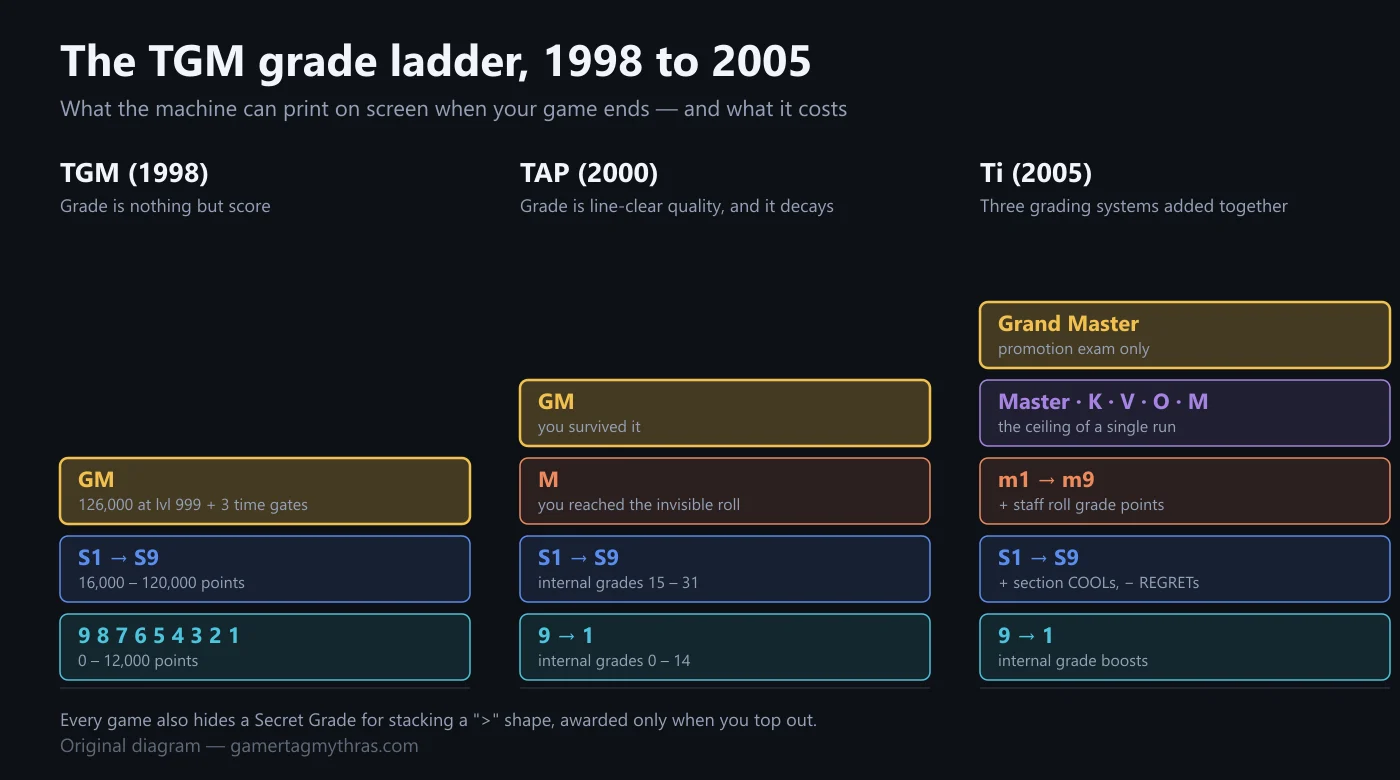
Every game in the Grand Master series ends the same way: the machine stops, thinks about it, and prints a letter at you. In the 1998 original that letter is just your score wearing a costume. By 2000 it is a running judgement on the quality of your line clears that leaks away while you hesitate. By 2005 the cabinet is keeping a profile on you, tracking your last seven games, and it will not hand over the top grade until you have passed an exam it decides to give you.
This is the series that coined the term 20G, invented the torikan, and produced a rank so rare that most of its own playerbase assumed it was fake. Here is what is actually going on inside it — and, since two of the three arcade games are now $7.99 on a console you already own, how to start.
Level counts pieces, not lines
In Guideline Tetris, level is a function of lines cleared. In TGM it is mostly a function of pieces.
Every tetromino that enters the playfield adds 1 to the level counter. Every line you clear adds 1 more on top. Nothing else moves it. That means a 999-level Master run is a race of roughly 700 to 800 placements, and it means a player who never clears anything still climbs — slowly, and straight into the ceiling.
The exception is what makes it interesting. The level counter refuses to cross a hundreds boundary on a piece alone. Sit at 199, 299 or 399 and only a line clear pushes you over. The same trap sits at 998: you need one final clear to reach 999 and end the game. So at every century mark the machine stops and demands proof of work, which is exactly where a lot of runs die — you arrive at level 499 with a stack full of holes and no way to make a line.
Terror-Instinct, the third game, bends this in Master and Shirase modes: a triple gives +4 levels instead of 3, a Tetris gives +6 instead of 4. Clear well and you eat the mode faster. You also reach the fast part sooner, which is the joke at the centre of the whole series — playing well is how you make the game harder.
20G is not faster, it is different
TGM stores gravity as a fraction over 256. At level 0 the value is 4, meaning a piece spends 64 frames falling a single row. It tightens from there, and if you have only ever played Guideline Tetris the shape of the curve is genuinely strange.
Gravity climbs to 144/256 by level 170 — and then at level 200 it resets to 4/256, right back to the crawl you started on. It climbs again, hits 1G at level 251, 2G at 300, and peaks at 5G at level 400. Then it drops: 4G at 420, 3G at 450. The series teaches your hands a speed and then takes it away twice before the real thing arrives.
At level 500 the value jumps to 5120/256. That is 20 rows per frame in a well 20 rows tall, so the piece is resting on your stack the same frame it appears. There is no fall to watch and nothing to react to.
What that actually changes is horizontal movement. A piece that is already grounded cannot fly over your stack to reach the other side; it slides along the surface and stops at the first column taller than the one it is standing on. Everything Guideline players are taught about keeping a flat board is wrong here. In 20G you want a shallow pyramid in the middle, because with the Arika rotation system every piece has an orientation you can reach during the entry delay that lands on the tip of a centre hump — and from the tip it can walk left or right. Overstack the middle and you lose that; flatten it completely and pieces get marooned on whichever side they spawned.
Two tools exist for this. The Initial Rotation System lets you hold a rotation button during the entry delay so the piece appears already turned, which at 20G is the only way to get some orientations at all. And from TAP onward, sonic drop is a hard drop that does not lock, so you can slam a piece to the floor and still slide it — the low-gravity rehearsal for what 20G forces on you later.
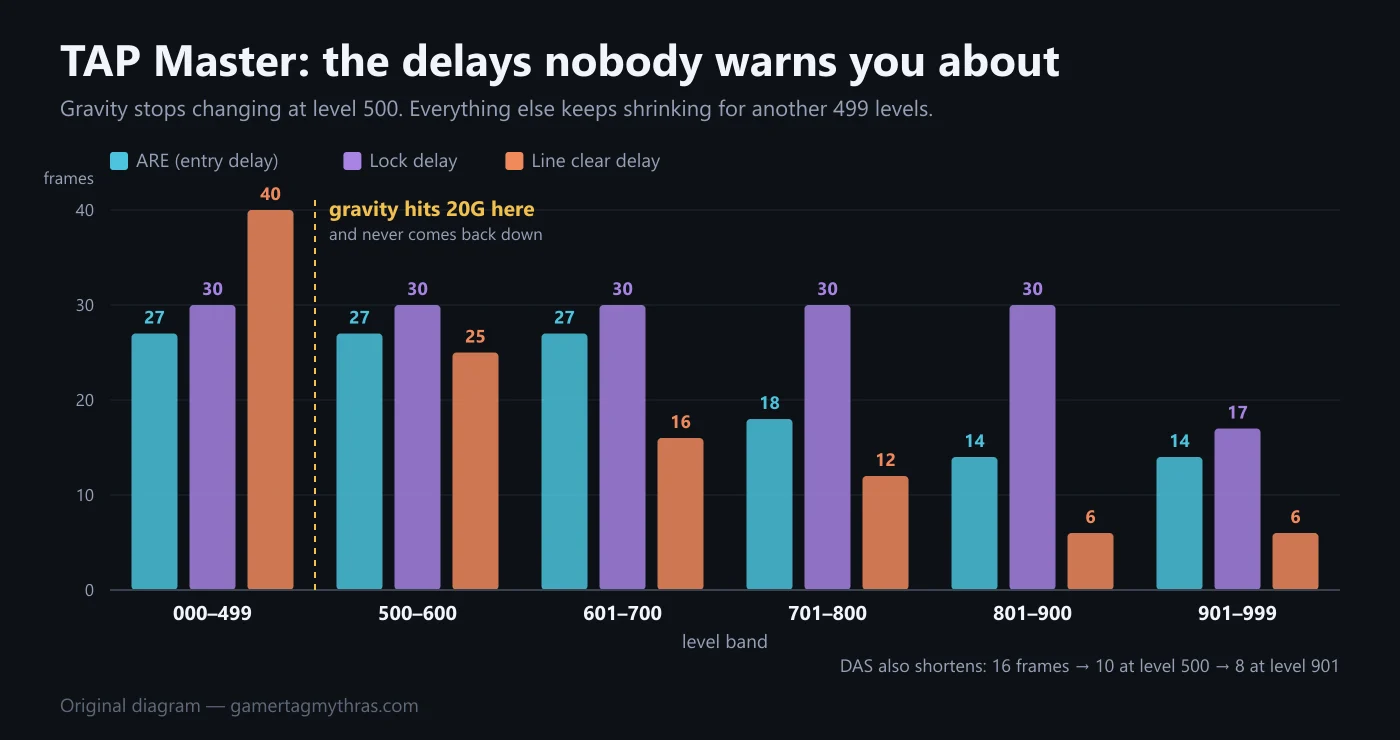
And 20G is not the last difficulty increase. In TAP's Master mode gravity is finished at 500, but everything else keeps contracting for another 499 levels. Line clear delay goes from 40 frames to 6. Entry delay drops from 27 to 14. DAS shortens from 16 frames to 10 at level 500 and to 8 at level 901. And at level 901 the lock delay finally falls from 30 frames to 17 — from half a second to 0.28 seconds — which is why the last hundred levels break so many runs that looked comfortable at 800.
TGM (1998): your grade is just your score
The first game is the simple one, and it is the right place to start.
Grades run 9 down to 1, then S1 up to S9, and each is a pure score threshold: grade 1 at 12,000, S1 at 16,000, S9 at 120,000. Score comes from a formula built around the level, the number of lines cleared at once, how long you held down, and a combo counter that grows by two per line cleared and collapses to 1 the moment you place a piece without clearing. Clear the entire playfield and a bravo bonus multiplies the whole thing by four.
The practical read: singles pay almost nothing, and the thresholds are really Tetris-rate thresholds in disguise.
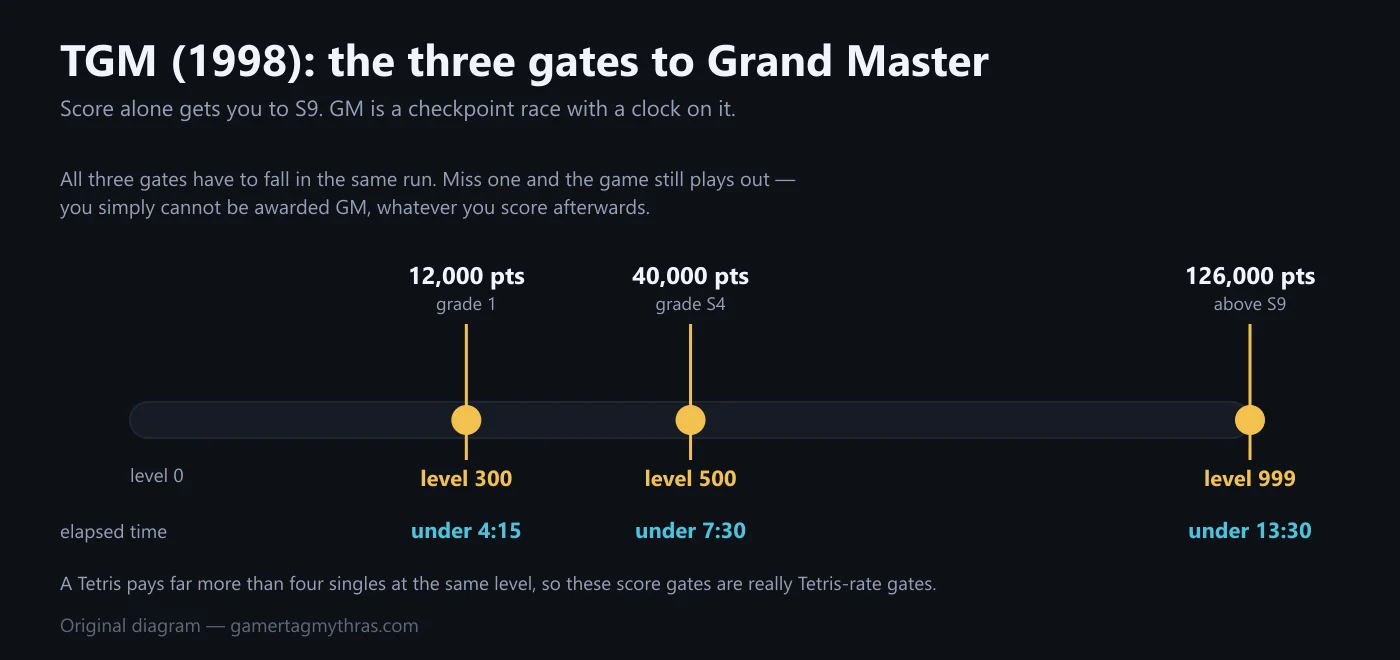
GM sits outside that ladder. It needs three checkpoints hit in a single run: 12,000 points by level 300 inside 4:15, 40,000 by level 500 inside 7:30, and 126,000 at level 999 inside 13:30. Miss any one of them and nothing visible happens — the game plays on, you can still finish, and you will still be handed S9. You simply are not eligible for GM any more.
TGM1 also never changes its timings. Entry delay is 30 frames, DAS is 16, lock delay is 30 and the line clear animation is 41 frames, from level 0 to level 999. That built-in slack is a real gift, and it is why the original's GM is the most reachable of the three arcade games rather than the hardest.
TAP rewrote grade as a leaking bucket
The Absolute threw the score-equals-grade model out. Your score is still tracked; it no longer decides anything.
Instead the game keeps a hidden internal grade from 0 to 31, mapped onto the displayed 9-through-S9 ladder, plus a pool of internal points. Every line clear adds points. When the pool reaches 100 the internal grade goes up and the pool resets to zero — the overflow is discarded, not banked.
How many points a clear is worth depends on how good the clear was, how high your grade already is, and where you are in the run. Once you are in the S grades a single is worth 2 base points and a Tetris is worth 30. That figure is then multiplied by 1, 2, 3 or 4 depending on whether you are below level 250, 500, 750 or above.
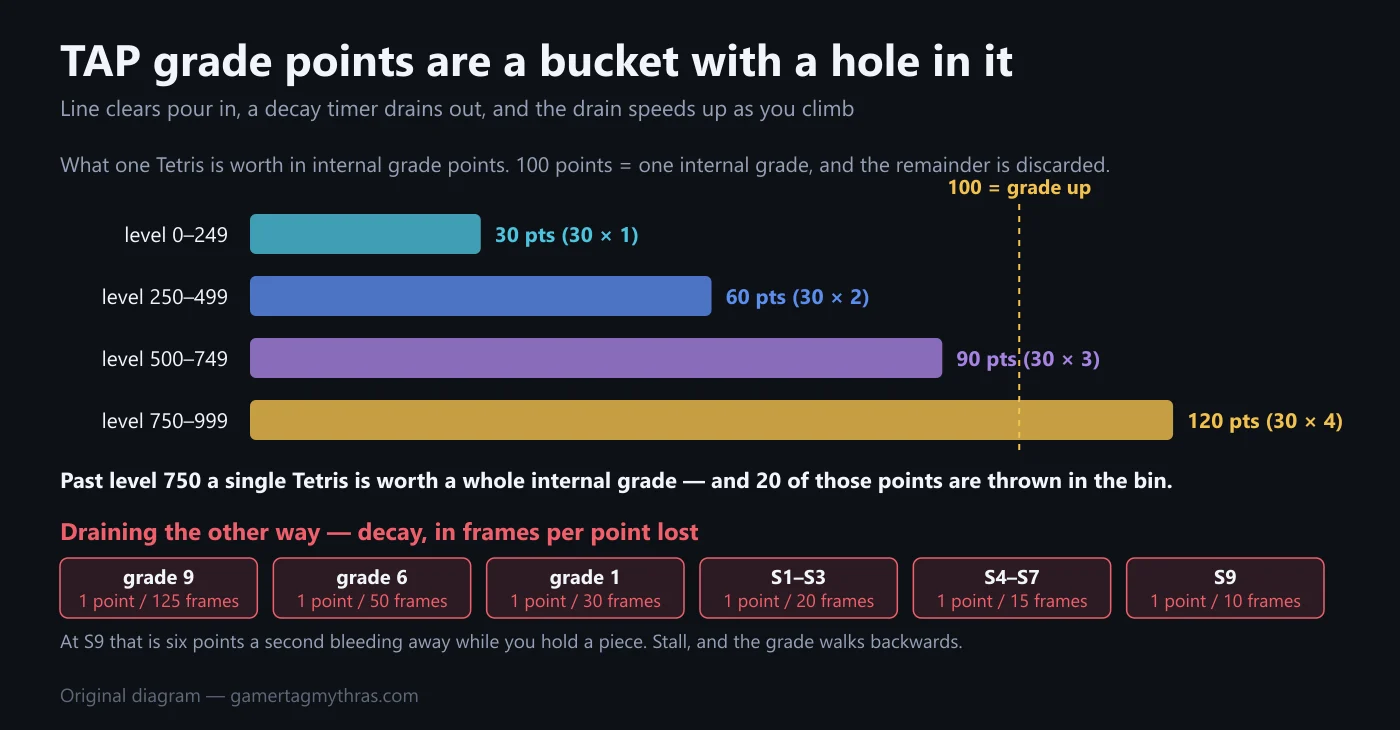
Multiply it out and a Tetris after level 750 is worth 120 points — a whole internal grade from one clear, with 20 points thrown straight in the bin. That is a concrete, exploitable fact: build height through section 7, then cash in once the music changes and the multiplier flips to 4, and you can take two grades from two Tetrises instead of one.
Working against you is the decay. A timer ticks while you have a live piece, more than zero points and no combo running, and every so often it takes a point back. At grade 9 that is one point every 125 frames. At S9 it is one point every 10 frames — six points a second. Sit there thinking about a placement at high grade and you are visibly losing progress you already earned.
That single mechanic is why TAP feels so different from every other Tetris. Playing safe is not neutral. It is negative.
The M-Roll: they switch the lights off
Reach level 999 in TAP Master and the field clears, the credits roll behind the playfield, and you keep playing. Which credit roll you get is the entire point.
The ordinary version is the fading roll: pieces stay visible for four seconds after locking, then fade out. Survive it and your entry on the leaderboard gets an orange underline instead of a green one.
The other one is the M-Roll, and it is invisible. A piece vanishes the instant it locks. You are stacking from memory in 20G.
TAP will only unlock it if the run was clean enough. You need S9 at 999, a total time of 8:45 or under, each of the first five hundred-level sections completed in 1:05 or less with at least two Tetrises, and then every section from 500 onward no more than two seconds slower than the one before it, with at least one Tetris in each. Miss the standard and the credits are just credits.
Then the grading forks one more time. Reach the M-Roll and top out during it and you are awarded M. Clear it having cleared fewer than 32 lines and you get a green-line GM. Clear it with 32 lines or more and you get the orange-line GM, which is the highest thing the machine can print.
So Grand Master in TAP reads, in full: play a near-flawless nine-minute run, then play blind for the encore.
Death mode and the torikan
T.A. Death is what happens when Arika removes the runway. Gravity is 20G from level 0, and the timings start roughly where Master mode's end. By level 500 the entry delay is 6 frames, the line clear animation is 4 frames, and lock delay is 15 — a quarter of a second per piece, forever.
It also introduced the nastiest idea in the series. If you reach level 500 slower than 3:25, the game quietly stops the timer, rolls the credits, prints "Excellent!" and awards you no grade at all. It is a fake ending. The mode could have run to 999; it decided you had not earned the rest of it.
That cutoff is a torikan, short for toriaezu kansuto — roughly "maxed out, for now". Later games use several of them. If you are learning any TGM mode, find out where its torikan sits before you convince yourself the run is going fine, because the machine will happily let you play for three minutes toward a wall it never mentions.
Death is also, indirectly, why the West knows the series exists at all. A clip of a player breaking level 800 in Death circulated for years mislabelled as "Tetris Japan Finals", and it did more recruiting for TGM than any advertisement Arika ever ran.
Ti stacks three grading systems
Terror-Instinct keeps TAP's internal grade engine and bolts two more systems on top. The final rank is the floor of the three added together, and it is hidden from you until the game ends.
The ladder grows to match: above S9 come m1 to m9, then Master, MasterK, MasterV, MasterO, MasterM, and finally Grand Master.
The second system is section COOL and section REGRET. Reach level *70 of a section inside the target time and then finish that section, and you gain a full grade. Take too long over the whole hundred levels and you lose one — and a REGRET also wipes your accumulated grade points back to zero.
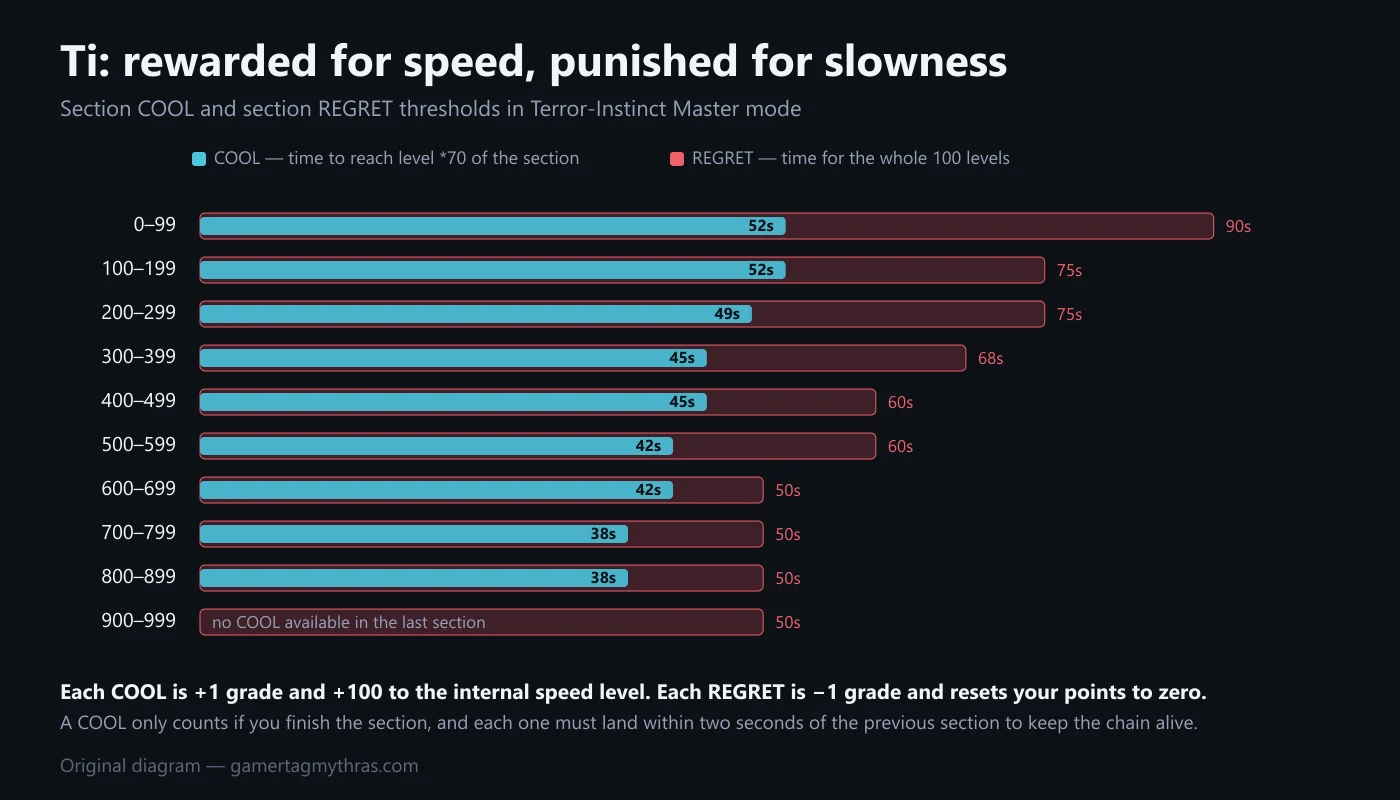
The COOL targets tighten from 52 seconds in the opening sections to 38 by the 800s, each one has to land within two seconds of the previous section to keep the chain alive, and there is no COOL available at all in the final 900-999 stretch. The reward for earning one is beautifully hostile: the game bumps your internal speed level by 100. You are paid in difficulty.
Ti's Master mode carries a torikan too — level 500 inside 7:00, or the run ends there. The one exception is during a promotion exam, when the cutoff is switched off.
The third system is the staff roll, and it works like TAP's with the stakes raised. The disappearing roll fades blocks five seconds after they lock; the invisible roll deletes them instantly, and you only unlock it by taking every section COOL and reaching internal grade 27 or better. In the invisible roll a Tetris is worth a full grade and surviving to the end is worth 1.6 more. In the disappearing roll the same Tetris is worth 0.26.
Grand Master in Ti is an exam, not a run
Here is the part that broke people's brains for two years after release.
Max out all three systems in one game — nine section COOLs, internal grade at the ceiling, six or more grade points earned in the invisible roll — and Terror-Instinct will still only give you MasterM. Grand Master cannot be awarded in an ordinary game. Ever.
Ti has user accounts, and each account carries a qualified class. The cabinet watches your last seven games. If the average of your second, third and fourth best grades, rounded down, is higher than your current class, then each new game has a one in three chance of becoming a promotion exam: the tetrion shakes, the frame turns gold, and you are told what you are being tested for. Pass and your class rises. Play badly enough for long enough and you get a demotion exam instead, announced only by a mild periodic shake, and the higher your class the easier you fall.
To be examined for Grand Master, you must already be qualified as MasterM, four of your last seven games must have been Grand Master standard, and you have to survive the staff roll during the exam itself. Only once your class is Grand Master does the game start printing it in normal play — and if you are ever demoted, you sit the exam again.
TetrisWiki records the first known Ti Grand Master as the player jin8, on 28 July 2007, two and a half years after the game shipped. Before that, a good chunk of the community had concluded the grade did not exist.
Shirase: 1,300 levels and rising garbage
Shirase is Ti's answer to Death, and it does not stop at 999.
Gravity is 20G from the first piece and the mode runs to level 1300. Torikans sit at level 500 (2:28 on the Classic ruleset, 3:03 on World) and again at level 1000 (4:56 and 6:06). From level 500 to 1000, the game periodically shoves a garbage row up from the floor that duplicates whatever your own bottom row currently looks like, on a quota that tightens from one row per 20 pieces-without-a-clear down to one per 8. From level 1000 the tetrominoes turn monochrome — plain blocks with none of the coloured outlines you have been reading the stack with.
Your grade is simply S-however-many-sections-you-survived, capped at S13 for the full 1300, minus one for every REGRET. The credit roll, if you get there, is 20G with every piece rendered at four times normal size.
For a sense of the ceiling: at level 1200 the lock delay is 8 frames. That is 0.13 seconds to finalise a piece that is already sitting on your stack.
Where to actually play TGM in 2026
This used to be the hard part. It mostly is not any more.
- TGM (1998) — released worldwide on PS4 and Switch through Arcade Archives on 1 December 2022, at $7.99, with online leaderboards plus new Hi Score and Caravan modes bolted on.
- TAP / TGM2 PLUS (2000) — same route, 1 June 2023, also $7.99. That single purchase covers Normal, Master, TGM+ and T.A. Death.
- Ti (2005) — still arcade only, twenty-one years on. There has never been a home release.
- TGM4 Absolute Eye — Arika's own, and the first TGM on PC: Steam on 4 April 2025 at $34.99, with a Switch port on 4 June 2026. It plays on a 10x22 field, offers up to six previews, a toggleable hold and 180-degree rotation, and lets you pick between the classic Arika rotation system and standard SRS. Its Master mode does not stop at 999 either — the Grand Master title asks for 2,600 levels, with a torikan demanding you get there inside 7:15.
If you have never touched the series, buy the $7.99 original, aim at S9 rather than GM, and let the level-999 run be a next-year problem. If you already play Guideline Tetris at a decent level, the thing that will actually hurt is not the speed. It is being told, for the first time, that a clean survival is not good enough.
Quick Action Checklist
- Know which game you are in: in TGM (1998) grade is score, in TAP and Ti grade is line-clear quality and it can go down.
- Clear a line at every century mark. The level counter will not cross 199, 299, 399 or 998 on a piece alone.
- Stop stacking flat once you hit 20G. Build a shallow centre hump so pieces can land on the tip and walk to either side.
- Use initial rotation. Holding a rotation button during the entry delay is the only way to get some orientations at 20G.
- In TAP, stop stalling — at S9 you are bleeding six grade points a second while a piece is live.
- In TAP, stack height through the 700s and cash your Tetrises after level 750, where each one is worth 120 points and a full internal grade.
- Look up the torikan before you start a mode. Death wants level 500 in 3:25, Ti Master wants it in 7:00, Shirase wants it in 2:28.
- Do not chase Ti's Grand Master directly. Get qualified as MasterM first; the grade only arrives through a promotion exam.
Frequently Asked Questions
What does 20G mean in Tetris?
How do you get GM in Tetris The Grand Master?
What is a torikan?
Why does my TGM grade go down when I stop clearing lines?
Which Tetris The Grand Master games can I buy at home?
Keep Reading
- TetrisWiki — TGM level system, gravity table, grade thresholds and GM conditions
- TetrisWiki — TAP Master and T.A. Death speed timings, modes and versus rules
- TetrisWiki — Grade Recognition System, internal grade points, decay and M-Roll conditions
- TetrisWiki — Terror-Instinct section COOL/REGRET, staff roll grading, exams and Shirase
- TetrisWiki — torikan cutoffs across the TGM series
- HAMSTER — Arcade Archives TETRIS THE GRAND MASTER
- Gematsu — Tetris The Grand Master 4 Absolute Eye Switch release date
Related Guides
Tetris Randomizers Explained: 7-Bag, TGM History Rolls, and Why NES Owed You Nothing
Every version of Tetris answers the same question differently: what comes next? The answer ranges from a shuffled bag with hard mathematical guarantees to a single polite reroll that owes you nothing, and knowing which one you are playing against changes how you stack.
Tetris Gravity and Lock Delay Explained: The Speed Curve, the 15-Move Limit, and 20G
Every modern Tetris game runs on three clocks you never see: gravity, lock delay, and entry delay. All three are published numbers, and they explain exactly why level 15 feels like a different game than level 5.
TGM4 Absolute Eye Modes Explained: Where to Start
Arika's first Grand Master in twenty years is not one game. It is six modes, four unlockable variants behind Normal, two control types that change the randomizer, and a 2,600-level Master mode that freezes your own stack. Here is what each one asks and where to start.
Tetris Mid-Game T-Spins: STSD, Imperial Cross, Kaidan
Once the opener is spent, the board decides your T-spins. Hard Drop files 63 pages of mid-game T-spin setups; this guide covers three families: lend your well to a T-spin, stack two TSD slots, or kick a T two rows deeper to save a bad board.
Tetris Stacking Fundamentals: Build a Board That Wins
Most players do not lose to speed. They lose to a board they built themselves three minutes earlier. Here is how stacking actually works in modern Guideline Tetris, and the habits that stop you from burying your own well.
NES Tetris Level Transition and Scoring Explained
Start NES Tetris on 18 and you stay there for 130 lines. Start on 19 and it is 140. Start on 12 and it is 100. One missing conversion in the cartridge explains all three, and it also decides which clear gets paid at the higher rate.