Tetris Openers: TKI-3, DT Cannon and Albatross
Your first seven pieces decide which opener is even legal. Memorising one build and forcing it every game is why your opening dies half the time. Here is the actual decision tree, from the I-piece TKI family down to the SZT bags nobody wants.
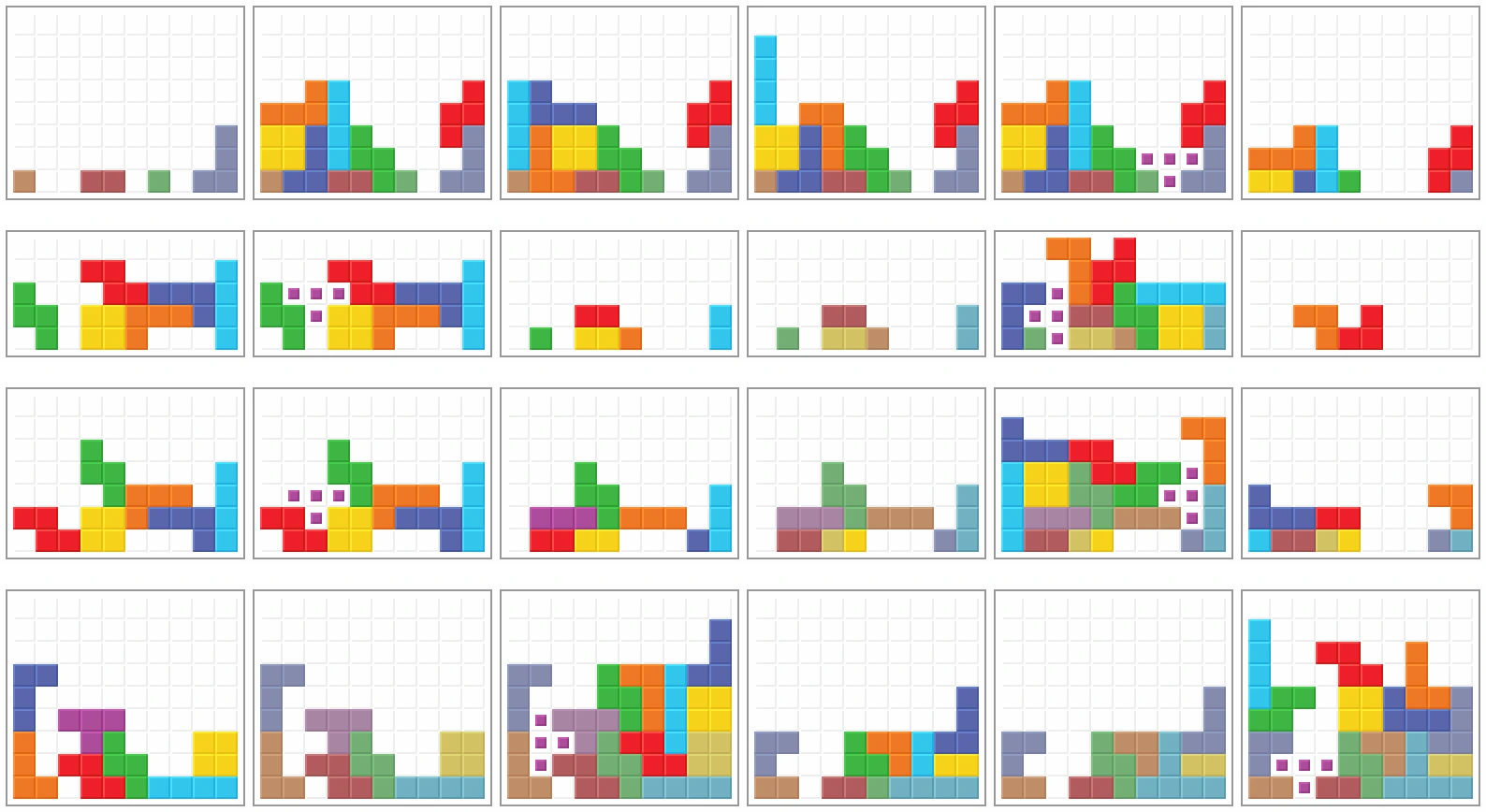
The single biggest mistake in competitive Tetris openings is picking your opener before you have looked at your queue. You decided last week that you are a DT Cannon player, the game hands you an S, Z, T start, and now you are twelve pieces deep in a build that was never going to work.
Openers are not a personality. They are a lookup table keyed on your first bag, the table is small — roughly eight setups cover almost every legal opening — and the entries sort themselves by which of I, L, J, or O shows up early. Everything below applies to modern Guideline Tetris: TETR.IO, Jstris, Tetris Effect: Connected, Puyo Puyo Tetris, and Tetris 99. It does not apply to NES Tetris, and it applies to the Tetris The Grand Master series only in part — the next section explains where the line falls.
Why openers only exist in Guideline Tetris
Hard Drop's opener article opens by listing the rules an opener depends on, and that list is the whole argument. A named, memorised opening sequence needs all of the following:
- A bag randomizer. Every tetromino appears exactly once per seven pieces, so "I will get an O in this bag" is a fact, not a hope.
- A hold slot. Almost every T-spin opener parks a T or an I in hold at some point.
- SRS kicks. The T-spin triple in a DT Cannon or a C-Spin only exists because the Super Rotation System tests a kick that drops the T two rows down and one column across.
- Multiple previews. Guideline games show up to six upcoming pieces. Without that, you cannot verify the build is routable before you commit the first placement.
- A bonus for T-spins, combos, and perfect clears. Otherwise a flat Tetris well beats every build here.
NES Tetris has none of those five. The Grand Master series is where the usual shorthand falls apart, because it is two rulesets in one box. TGM1 and TAP deal from a four-piece history randomizer, show one preview, have no hold at all, and run the Arika Rotation System — nothing on this page transfers there, and the same goes for the Classic rule in TGM3 Terror-Instinct and the TGM Type in TGM4. But TGM3's World rule runs SRS with modified I kicks on top of hold and a three-piece preview (while keeping TGM3's own 35-piece pool randomizer), and TGM4 -Absolute Eye- — Steam on 4 April 2025, Nintendo Switch on 4 June 2026 — ships a Standard Type with Guideline controls, SRS, a toggleable hold, up to six previews, a 7-bag that only bars S, Z and O from the first slot, and genuine T-spin payoffs: a T-SPIN medal for a T-spin double or triple, and T-spin garbage in versus worth 2 for a single, 4 for a double and 6 for a triple. So opener theory partly does transfer, to those two rulesets specifically. Everywhere else in the series it does not, which is why "best Tetris opener" advice is implicitly about Guideline versus play. For the mechanical background, the rotation systems and wall kicks guide covers what SRS actually tests and the randomizers guide covers why 7-bag makes any of this predictable.
Read your first bag before you commit
The useful way to organise openers is by which piece arrives early, because that is the constraint you cannot negotiate with. Here is the decision table.
| Early piece | Openers available | Payoff |
|---|---|---|
| I | TKI-3 (Castle Top, Flat Top, Fonzie, Dingle), ajanba TSD | Two T-spin doubles in two bags |
| L or J | DT Cannon (LS/JZ base), MKO Stacking, Pokemino's STD | TSD into TST, or a 4-line perfect clear |
| O | Albatross, Hachispin, Number One, Mr. T-Spin's STD | Platform TSD into TST, no wasted T |
| S, Z or T only | Pelican, C-Spin, BT Cannon, DT Cannon (TSZ base), Hummingbird | Salvage — usually TST into TSD |
| Anything | Perfect Clear Opener, side or center 4-wide | 10 garbage on a PC, or a combo spike |
Starting with S, Z or T is, in Hard Drop's own words, basically the worst thing that can happen if you want a T-spin opener. A T start forces you to either waste the T in the stack or hold it for a long time; an S or Z start forces a soft drop, a platform spin, or a downgrade to a T-spin single.
One coverage trick is worth memorising above all others. If your first piece is an O and you place it three columns from the left wall, either Hachispin or Albatross will always be executable — Hachispin wants J before L, Albatross wants L before J, and one of those is always true. One placement, guaranteed T-spin opener from any O start.
TKI-3: the I-piece opener with four faces
TKI-3 (Japanese 開幕TSD) was invented by Tetris DS player TKI, and confusingly the name means something narrower in Japanese than in English — in the Japanese community "TKI" refers to triple-double attacks generally, while the English scene uses TKI-3 for this specific opening family.

The base never changes: I flat in the middle, an S or Z horizontally on top of it, the O in the opposite corner. What changes is where the J goes, and that single choice names the variation.
| Variation | J placement | What it gives you |
|---|---|---|
| Castle Top | J vertically on the O | Two TSDs in two bags, third TSD in bag three, TST possible in bag four |
| Fonzie | J flat on top of the O | Two TSDs, then a perfect clear opportunity after 6 lines |
| Flat Top | J upside down on the Z | Two TSDs, very likely third TSD if bag two goes right |
| Dingle | J placed after the TSD, in the valley it left | Newest branch, found by Agent RO in April 2021 |
Castle Top is the usual first variation to learn, because it routes into an Imperial Cross with an early Z in the second bag, and that branch carries an 89.68% perfect clear rate — the best of the Castle Top and Flat Top continuations, and both variations can reach it. Flat Top's Yack's PC branch sits at 68.77%, climbing to 88.33% if you place the Z piece first, and its Mechanical TSD line is 71.67%. Dingle's 8-line PC example is 75.08%. If you get an early J alongside the I there is a dedicated Early J setup whose 8-line PC example runs 93.10%.
Those numbers are the actual reason strong players pick a variation mid-build rather than pre-committing. You are not choosing an aesthetic, you are choosing a probability.
DT Cannon: one wasted T, two big spins
Double Triple Cannon — DT砲 in Japanese, DT Cannon or just DT in English — is also a TKI design. It produces a T-spin double that feeds directly into a T-spin triple, using the SRS T-spin triple wall kick to drop the T through the gap.

There are two common bases and they build the identical stack:
- LS base. Fastest in keypresses. L, J, S and Z need no rotation at all — they either hard-drop immediately or sit against a wall. This is why DT is so popular despite being piece-inefficient.
- JZ base. Always available when your first piece is a J, because the Z can still be spun into place after the T and O have already been placed.
Two things to know before you commit. First, the first T piece is wasted in the stack — that is the cost of the setup, and Albatross and Hachispin exist specifically to avoid paying it. Second, the first T-spin is normally delayed as long as possible so both spins land back to back. In any variant without instant lock down, hold the soft drop button until the T-spin double completes, so the T falls through the gap instead of rotating early into the wrong slot.
Hard Drop makes a counter-intuitive point about DT's inefficiency: more pieces sitting in the stack is sometimes an advantage, because that stack transitions into a 4-wide or a Tetris well faster than a piece-efficient build does. Wasteful is not automatically wrong.
The standard three-bag continuation leaves a flat stack with a perfect clear opportunity after 10 cleared lines. If the PC does not solve, the documented fallback is a donation T-spin double.
There is also a DT STSD variant, identical in appearance except one extra cell is left empty at the bottom, converting the follow-up into an STSD for three T-spin doubles total and no leftover overhang. It is more fragile: a garbage row arriving with its hole in the wrong column breaks it outright.
Albatross and Hachispin: the O-piece pair
Starting with an O looks like a dead hand and is actually one of the best openings in the game. Both of these setups drop an S or Z on top of the O and place its counterpart beside it — Hachispin places the top piece vertically, Albatross places it horizontally.

Albatross Special is a single-bag opener that produces a platform (air) T-spin double, and its headline feature is that it wastes no T pieces, unlike DT Cannon or C-Spin which each burn one to build. It is always executable from an O start when L arrives before J. The orientation rule is trivially simple: if L comes first, prop the S on the left and spin left; if J comes first, prop the Z on the right and spin right.
Its follow-up is a T-spin triple, usually completed at the end of the second bag, then another platform T-spin double — with a documented 26.67% perfect clear rate on both the O-then-L and L-then-O routes, two solutions each. Albatross into Infinite TST is specifically called out as the strongest way to open a game of Ultra, because you attack with your first two T pieces instead of burying one.
Two real weaknesses. If you cannot see an O in your five previews, play something else — a late O means the S and Z occupy the space and the O no longer fits. And Albatross is garbage-sensitive: roughly a 10% chance an incoming garbage hole lands along the edge before you place your J or L, which nullifies the T-spin triple and the T-spin double after it. An S, Z, T or Z, S, T start kills it too; that is Pelican territory.
Hachispin is the mirror-dependency twin: always executable from an O start when J arrives before L, producing a T-spin single into a T-spin triple across the first two bags. Its third bag always allows a T-spin of some kind, and a T-spin double needs nothing more than an L piece.
MKO, Pelican and the bags nobody wants
MKO Stacking (MKO積み), named after its creator MKOMIZ, is the L-and-J opener that pivots toward a perfect clear rather than a spin. Both L and J must arrive early. You place them flat-side down one column apart, drop the S and Z vertically on top of them, and keep the T on hold. The payoff is a 33.3% chance of a perfect clear after ten pieces, which needs an early O in the second bag. That is a gamble, not a plan — which is why the STMB Cave and S-on-S continuations matter. The S-on-S branch, where you drop an S vertically onto an S (or Z onto Z), reaches an 88% perfect clear chance after 8 lines if the LJ or OI pair goes on the S. Those solves are hard to spot, because a piece usually gets split by an in-between line clear.
MKO's honest flaw: the first T-spin cannot be fully prepared inside the first bag. If the T arrives first in bag two you are holding two T pieces and must spend one on the overhang.
For the bags nobody wants, three salvage options:
- Pelican. Albatross-shaped, single bag, platform TSD into TST. From an S start it is always executable if the J arrives before both the L and the O, and its three-bag continuation adds a TSD plus a perfect clear chance after 10 cleared lines.
- C-Spin. A triple-double attack: T-spin triple first, then a T-spin double, across three bags. Built on an S, Z, T core with the L and J forming the overhang — the natural home for the exact start that kills Albatross.
- BT Cannon. DT-shaped — TSD then TST within three bags — but usable from a T start with early S and Z. It chains into a reversed C-Spin and another T-spin triple, with a perfect clear window after five bags.
Also worth knowing: Pokemino's STD has almost no first-bag dependency at all, just J before Z, which makes it nearly always stackable — and also one of the weakest options here, because its T-spin triple cannot be finished inside the second bag.
What each opener actually sends
Attack values are not universal, and quoting them without naming the game is how bad advice spreads. The table below is Hard Drop's garbage table for four specific clients. Note that TETR.IO and Tetris 99 use their own systems — Tetris 99 layers badge multipliers on top, which the Tetris 99 strategy guide covers separately.
| Line clear | Tetris Friends E+ | Puyo Puyo Tetris | Tetris Online | Tetris Battle |
|---|---|---|---|---|
| Tetris | 4 | 4 | 4 | 4 |
| Back-to-back Tetris | 5 | 5 | 5 | 6 |
| T-spin single | 2 | 2 | 2 | 2 |
| T-spin double | 4 | 4 | 4 | 4 |
| Back-to-back T-spin double | 5 | 5 | 5 | 6 |
| T-spin triple | 6 | 6 | 6 | 6 |
| Back-to-back T-spin triple | 7 | 7 | 8 | 9 |
| Perfect clear | 10 | 10 | 6 | 10 |
Run the openers through the Puyo Puyo Tetris column and it clarifies fast. Two TKI T-spin doubles are 4 plus 5 with back-to-back, so 9 rows across two bags. DT Cannon is a T-spin double into a back-to-back T-spin triple: 4 plus 7, 11 rows. Albatross adds a third spin — TSD, b2b TST, b2b TSD — for 16 rows across roughly three bags, without burying a T. A Perfect Clear Opener sends 10 rows in ten pieces, which is why it competes despite failing outright on a meaningful share of bags; the perfect clear guide covers its 61.2% base rate and the Grace System fallback.
One more variable most players ignore: how messy the garbage you send actually is. In Tetris Friends the hole column never shifts during an attack, so garbage arrives clean and cheap to clear. In Puyo Puyo Tetris there is a 30% chance the hole column shifts between rows inside a single attack, so even T-spin and perfect clear garbage lands messy by luck. Games with garbage blocking — Tetris Friends and Tetris Online among them — hold garbage back until a combo breaks, which is exactly what makes side-stacked combo openers stronger there. The scoring and attack guide has the full points side of this.
Combo openers: 4-wide changes the format
Combo openers reject the T-spin premise entirely. You build a tall rectangular tower, leave a fixed number of columns empty, and clear one line per piece for as long as you can hold it together.
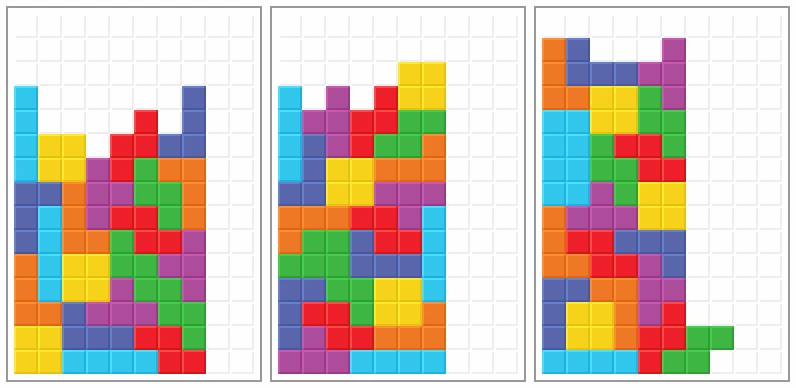
Four wide beats two wide for a mechanical reason worth understanding: a 2-wide stack shrinks by about 2 lines per dropped piece, while a 4-wide shrinks by only 1. More residual height per piece means a longer combo. A 4-wide tower also ends up slightly taller for the same pieces, so it builds faster. Three wide is the compromise — slightly worse than 4-wide, but you can run it without soft drops.
The cost is control. On a 6-wide tower you have far fewer legal placements than on an 8-wide, and in a 4-wide your pieces must clear exactly one line to keep the count alive, with very few exceptions. Three filled cells in the empty columns — the residuals — is the standard, and that number holds as long as every piece clears exactly one line.
Center 4-wide is worth knowing about even if you never build one. Instead of a 6-wide tower on one side, you build two 3-wide towers with the four empty columns down the middle. There are only two ways to top out in Guideline games: place a piece entirely above the visible field, or have a piece spawn into a filled cell. Center 4-wide sidesteps both, because you only die once garbage has pushed the bottom of the center channel to the very top. That makes it the defensive answer to T-spin and perfect clear openers, at the price of keeping two towers at matching heights.
Combos are also where an opener can be interrupted mid-run. A tower that breaks at combo six sends a fraction of what it promised, and a well-timed spike tops you out before you reach your own garbage. Highest ceiling, worst floor.
Quick Action Checklist
- Look at all five or six previews before your first placement, not after it.
- Learn one opener per first-piece category — I, L/J, O, and the S/Z/T salvage — rather than one opener total.
- Place an O start three columns from the left wall so either Hachispin or Albatross is always available.
- If you cannot see an O in previews, do not start an Albatross.
- Learn the DT Cannon LS base first, and hold soft drop through the T-spin double so the T falls through the gap.
- Know which client you are on before you trust an attack number — perfect clears send 10 in Puyo Puyo Tetris and 6 in Tetris Online.
- Practise center 4-wide as a defensive answer, not as your default opening.
Frequently Asked Questions
What is the best Tetris opener for a beginner?
Which Tetris opener wastes no T pieces?
What do I do if my first bag starts S, Z, T?
Do Tetris openers work in NES Tetris or TGM?
How much garbage does a perfect clear opener actually send?
Why is 4-wide better than 2-wide for combos?
What is the difference between TKI-3 Castle Top and Flat Top?
Keep Reading
- Hard Drop Tetris Wiki — Opener (T-spin, combo and perfect clear openers, attack and garbage tables)
- Hard Drop Tetris Wiki — TKI 3 opening variations and perfect clear rates
- Hard Drop Tetris Wiki — Double Triple Cannon setups
- Hard Drop Tetris Wiki — Albatross Special and Pelican
- Hard Drop Tetris Wiki — MKO Stacking
- Hard Drop Tetris Wiki — Tetris Friends (Expert and Expert Plus arena modes, combo tables, rank list)
- TetrisWiki — TGM4 Absolute Eye: Standard Type vs TGM Type rulesets, 7-bag, previews, hold and versus attack table
- TetrisWiki — TGM3 Terror-Instinct: Classic rule vs World rule, hold, 3-piece preview and T-spin detection
Related Guides
Tetris T-Spin Triple Setups: Triple Double to Infinite TST
A T-spin triple sends 6 lines from one T where a double sends 4, but it costs a three-deep hole and leaves an overhang behind. How to spot one mid-game, pay off the overhang, and turn it into a Triple Double, a second triple or the Infinite TST loop.
Tetris Mid-Game T-Spins: STSD, Imperial Cross, Kaidan
Once the opener is spent, the board decides your T-spins. Hard Drop files 63 pages of mid-game T-spin setups; this guide covers three families: lend your well to a T-spin, stack two TSD slots, or kick a T two rows deeper to save a bad board.
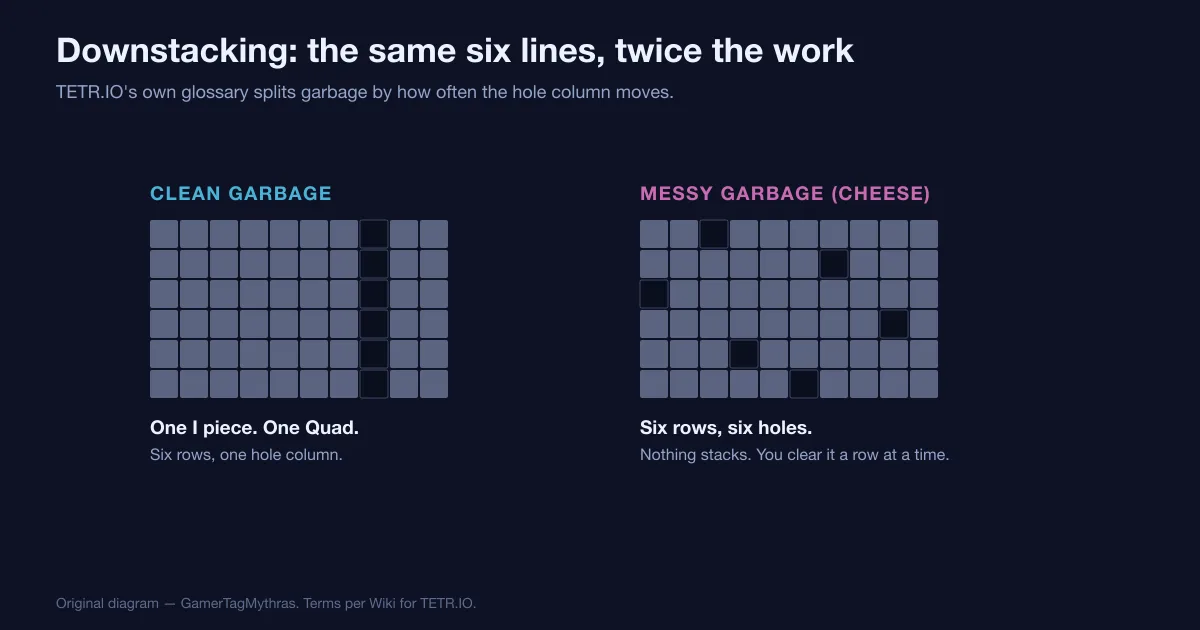
Tetris Downstacking: How to Dig Out of Garbage
Garbage is not one obstacle, it is two. Where the hole column sits from row to row decides whether six lines cost you one piece or six, and TETR.IO scores the lines you dig out at exactly the same rate as the lines you send.
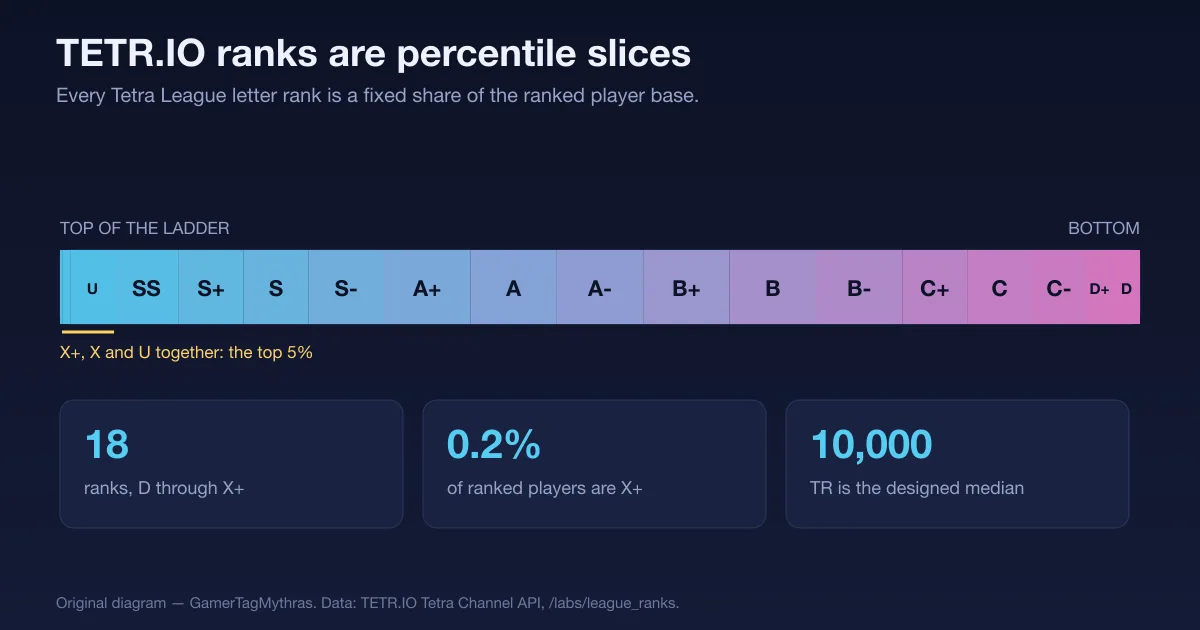
TETR.IO Ranks Explained: TR, Percentiles and Cutoffs
A Tetra League letter is not a skill score, it is a slice of the leaderboard — and TETR.IO publishes exactly how big each slice is, what TR it currently costs, and how fast the people inside it play.
Tetris Stacking Fundamentals: Build a Board That Wins
Most players do not lose to speed. They lose to a board they built themselves three minutes earlier. Here is how stacking actually works in modern Guideline Tetris, and the habits that stop you from burying your own well.
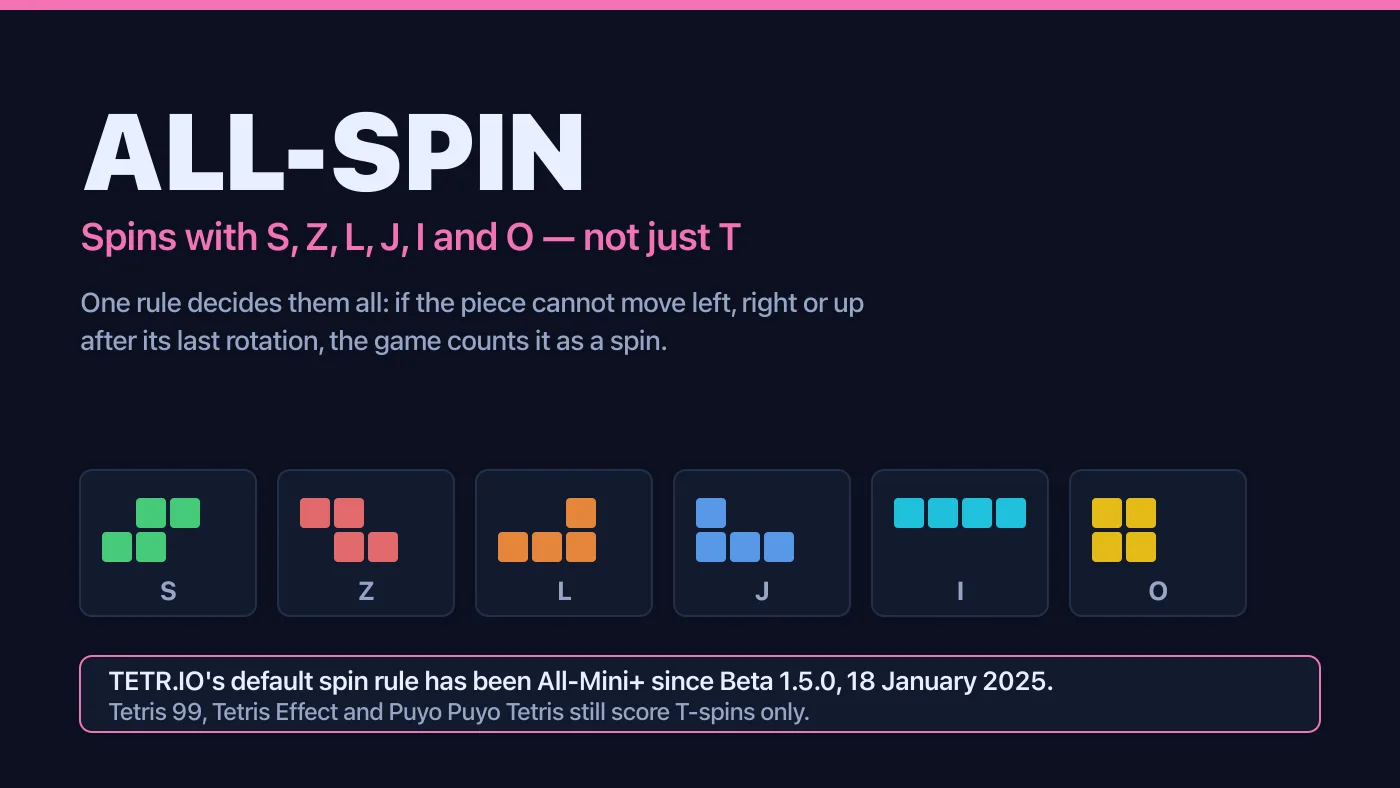
Tetris All-Spin Explained: S, Z, L, J and I Spins
A Z piece rotated into a slot nothing else reaches is either a scored spin or an ordinary Double, and which one it is has nothing to do with you. It is a setting, and most Tetris games have it switched off.