Tetris All-Spin Explained: S, Z, L, J and I Spins
A Z piece rotated into a slot nothing else reaches is either a scored spin or an ordinary Double, and which one it is has nothing to do with you. It is a setting, and most Tetris games have it switched off.
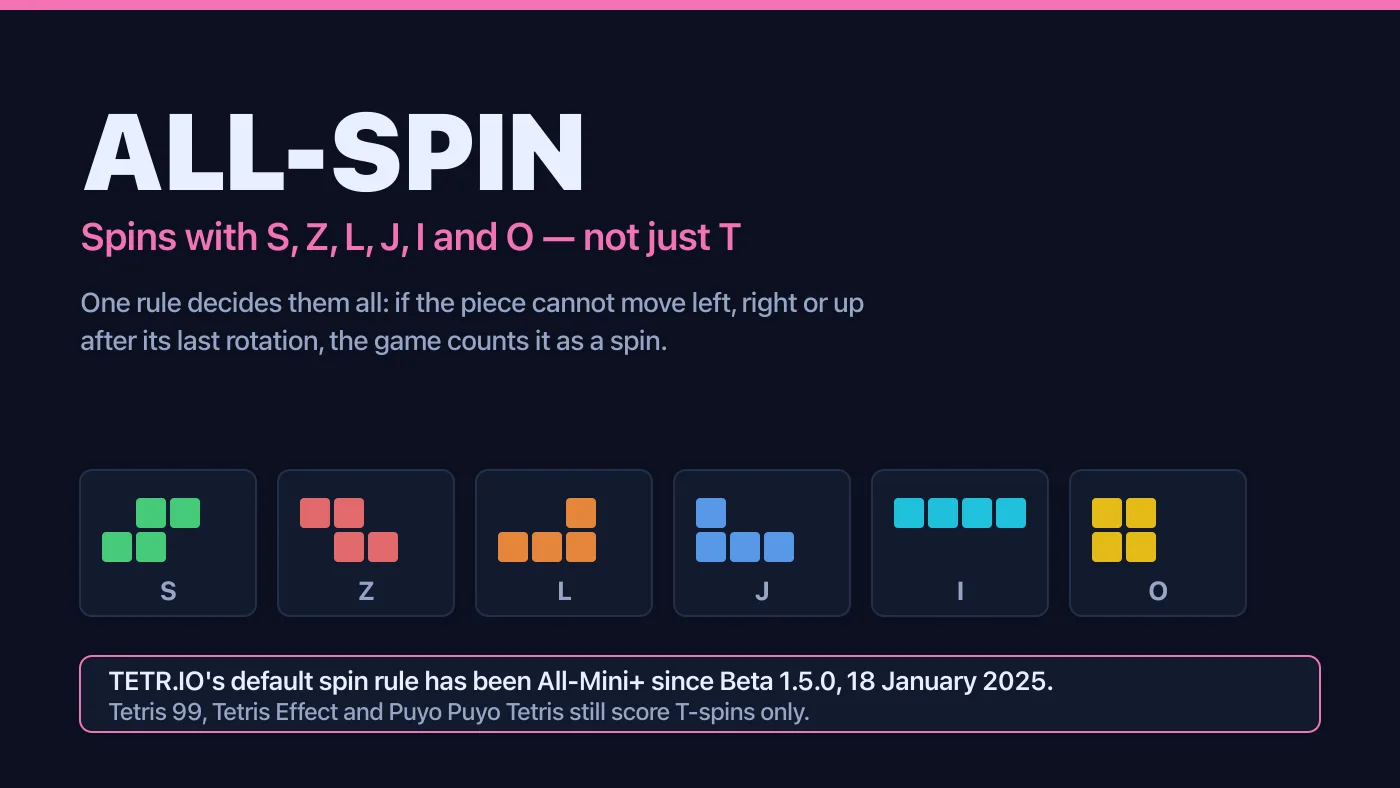
You wedge a Z into a slot that nothing else reaches, the kick drops it home, two rows go — and the game says nothing. No spin banner, no back-to-back tick, no extra line sent. You did the difficult thing and got paid for a Double.
Whether that placement counted has nothing to do with your technique. It is a question about which spin-detection rule the game you are playing was built around, and the answer varies enough between clients that a skill worth grinding in one is worth zero in another. All-spin is the umbrella term for the rules that pay you for the other six pieces. This is how it gets detected, what it is actually worth, and which games have it at all.
Everything here is about Guideline-descended stackers with wall kicks — TETR.IO, Jstris, Tetris Effect, Puyo Puyo Tetris, Tetris 99. Classic NES Tetris has no wall kicks and no spin bonus to detect, so none of it applies there.
Two algorithms, and most games use the strict one
There are only two ideas in play, and the community names for both come from the fan game Lockjaw rather than from any publisher.
3-corner T is the rule Guideline games use. A spin bonus is awarded when three things are true at once:
- The tetromino being locked is a T.
- Its last successful movement was a rotation, not a sideways shift, a soft drop or a fall due to gravity.
- Three of the four cells diagonally adjacent to the T's centre are occupied.
Condition 1 is doing all the damage. Under 3-corner T, an S piece rotated into a slot no drop could reach scores as an ordinary line clear, however tight the fit. Our T-spin guide covers what that rule means when you are actually playing a T.
Immobile is the older and looser idea, and it comes from The New Tetris on Nintendo 64, released in North America on 31 July 1999 — the manual called them "spin moves". There, a twist is recognised when a tetromino locks in a position where it cannot move left, right or up. Notice what is missing from that sentence: any mention of which piece it is. That single omission is the whole of all-spin.
Guideline itself is not one rule either. Two documented variants tighten it further:
- 3-corner T no wall, used in Tetris Worlds: the playfield walls and floor do not count as occupied, so a kick that plants the T's flat side against a wall does not register.
- 3-corner T no kick, used in Tetris: New Century, iPod Tetris and Tetris Evolution: the final rotation must not involve a wall kick at all, which restricts you to the plain soft-drop-and-turn twist.
Which games score spins with the other six pieces
For most of Tetris history the answer has been no, and it still is in most official releases.
| Game | Twists with pieces other than T | T-spin detection |
|---|---|---|
| The New Tetris (N64) | All pieces | Immobile |
| TETR.IO | All pieces, on by default | 3-corner, plus immobile as a Mini |
| Jstris | All pieces when All-spin is enabled for the room | 3-corner |
| Tetris Party | J, L, S and Z | 3-corner standard |
| Tetris: Axis | J, L, S and Z | 3-corner standard |
| Tetris Journey | J, L, S and Z, tutorials only | 3-corner standard |
| Tetris Worlds | Square mode only | 3-corner T no wall |
| Tetris 99 | None | 3-corner standard |
| Tetris Effect | None | 3-corner standard |
| Puyo Puyo Tetris | None | 3-corner standard |
| Tetris (tetris.com) | None | 3-corner standard |
| Tetris DS | None | 3-corner T nerfed kick in single player, 3-corner T in multiplayer |
Read the bottom half of that table again. Tetris 99, Tetris Effect, Puyo Puyo Tetris and the browser game on tetris.com all score the T and nothing else. If those are the versions you play — and our version comparison covers what each one is for — then an S-spin is a party trick, not a tactic.
The three outliers are Tetris Party, Tetris: Axis and Tetris Journey, all of which recognise J, L, S and Z twists, and Journey only does it inside its tutorials. As a live, default part of competitive play, all-spin in 2026 is essentially a TETR.IO phenomenon.
The immobile test comes down to one question
The immobile rule reads like four checks. In practice three of them are already decided before you press anything, and the TETR.IO wiki spells out the reduction:
- Down is irrelevant, because a piece can only lock while it is resting on something.
- Left and right are nearly irrelevant, because a piece with open space beside it is not sitting in a slot that completes a row anyway.
- That leaves up, which the community just calls the overhang.
So the whole of all-spin collapses into one instruction: build something over the hole. A gap with open sky above it is a gap you can drop into, and a piece you could have dropped in is not a spin.
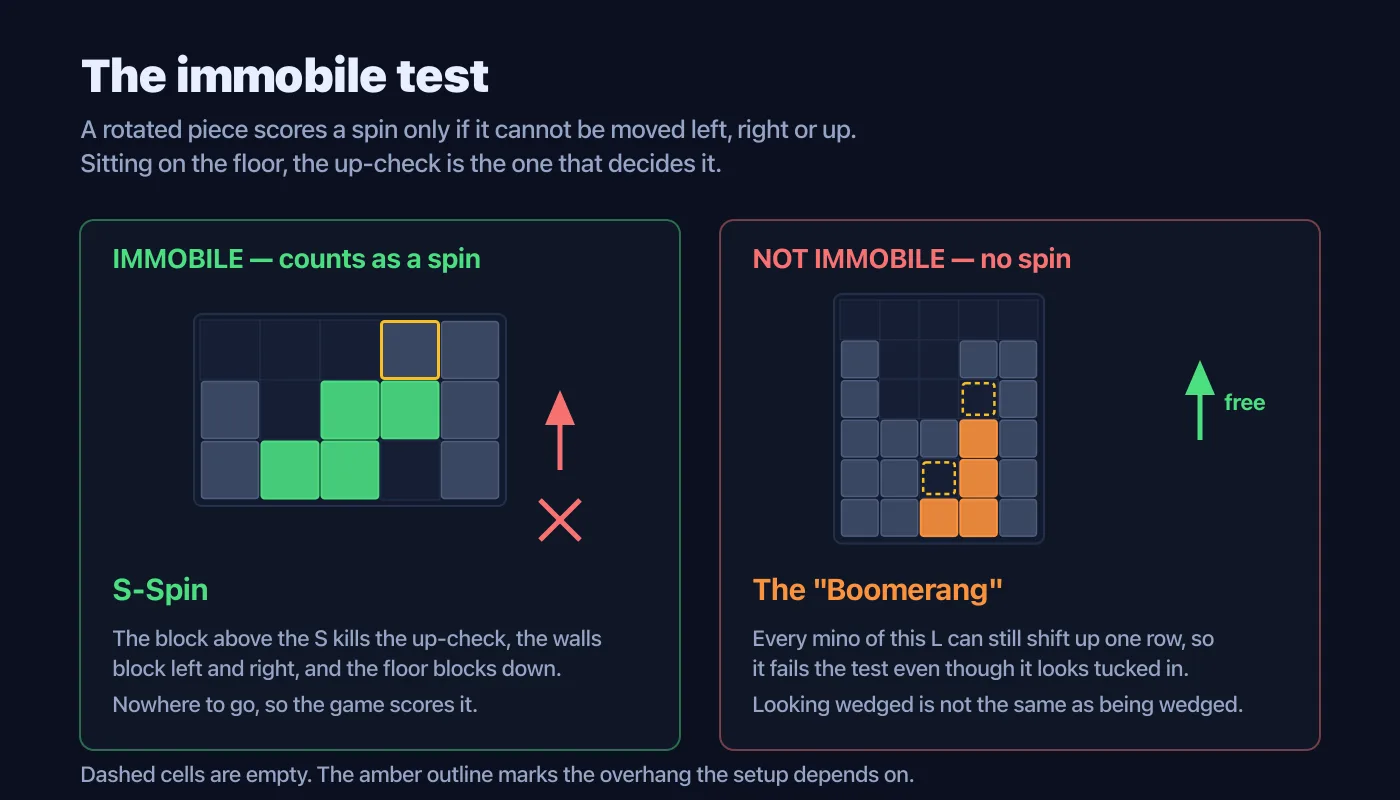
The right-hand board is the case that catches people, and the TETR.IO wiki lists it by name as the Boomerang. That L looks thoroughly tucked in. It is not: shift the whole piece up one row and every mino has somewhere to go, so the check fails and you get an ordinary clear. Looking wedged and being wedged are different states, and the game only cares about the second one.
The corollary is worth keeping: because the up-check is the one doing the work, the overhang is not a flourish on top of the setup. It is the setup.
What an all-spin is actually worth
This is where enthusiasm usually outruns the numbers. TETR.IO's own patch notes, from the update that made All-Mini the rule, put it about as plainly as a developer can:
All-Spins (immobile spins with pieces other than T) will be detected as a Mini. They do not send, but they do add (and keep) Back-to-Back.
No spin bonus at all, then. An S-spin Double sends exactly what a plain Double sends. What you are buying is the back-to-back status, and under TETR.IO's rules that is not nothing:
| Clear | Base lines sent | Back-to-back |
|---|---|---|
| Single | 0 | Breaks it |
| Double | 1 | Breaks it |
| Triple | 2 | Breaks it |
| Tetris (Quad) | 4 | Starts or continues |
| T-Spin Single | 2 | Starts or continues |
| T-Spin Double | 4 | Starts or continues |
| T-Spin Triple | 6 | Starts or continues |
| Spin Mini with S, Z, L, J, I or O | Whatever the plain clear sends, no spin bonus | Starts or continues |
Those base values are the general Guideline garbage table; TETR.IO then applies its Multiplier combo system on top, which the scoring and attack guide works through in detail. Three mechanics turn a bonus-free Mini into real pressure:
- Back-to-back charging adds one extra line to every attack while the streak is alive. Your all-spin sends nothing, but the Quad after it sends one more than it otherwise would.
- A streak of 4 begins charging a Surge, starting at 1 line in Quick Play and 4 in other multiplayer modes, gaining a line per back-to-back level with no cap, and firing all at once in three segments when the streak finally breaks. Every Mini you land is another line on that star.
- Garbage Special Bonus, added in Beta 1.3.0 on 22 September 2024, gives Quads and Spins — All-Spins included — that clear garbage a flat +1 extra line, not influenced by multipliers. The design note attached to it, from the developer credited as garbo, flagged "the potential for more all-spin mastery and greater spikes".
So the honest summary: an all-spin is not a spike. It is a chain you no longer have to break, and a small tax you get to add every time you dig with one.
The TETR.IO spin rule menu
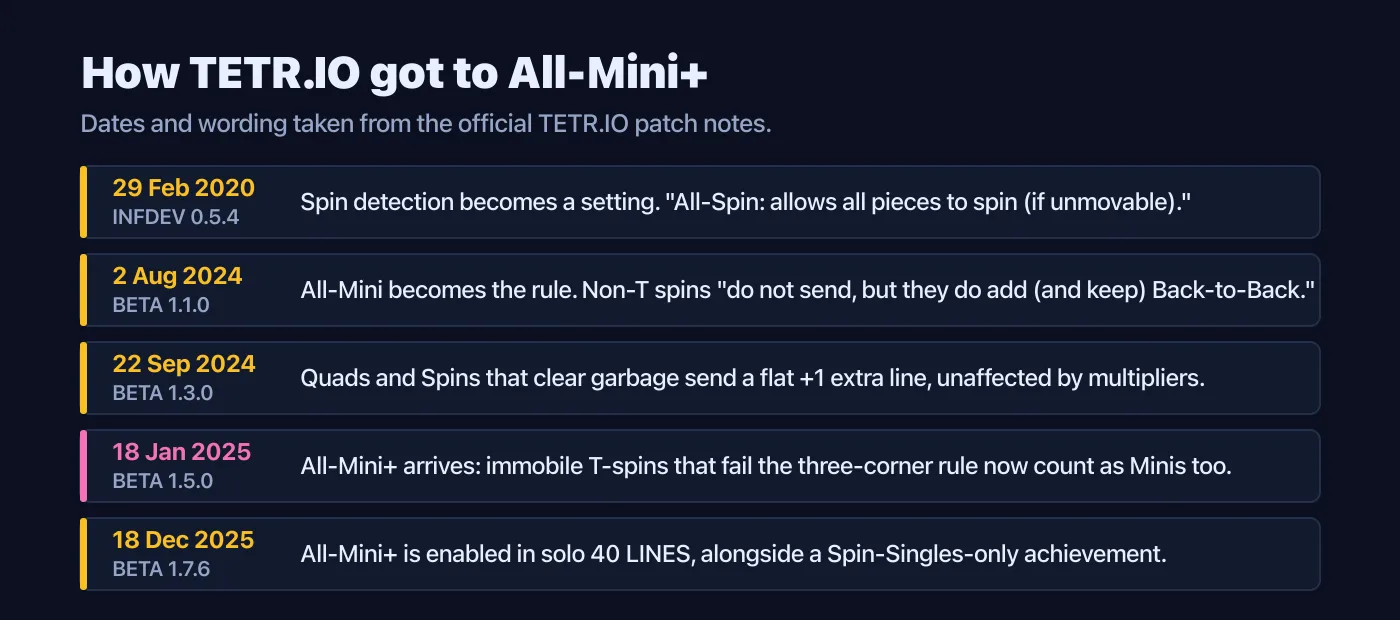
TETR.IO has been shipping selectable spin detection since 29 February 2020, and the modern all-spin rules arrived in a cluster during the 2024 rework. These are the tables you can pick between, with the update each one landed in.
| Rule | What it does | Arrived in |
|---|---|---|
| All-Spin | Selectable detection allowing all pieces to spin when unmovable | Infdev 0.5.4, 29 Feb 2020 |
| All-Mini | Non-T immobile spins register as Spin Minis | Beta 1.1.0, 2 Aug 2024 |
| All-Mini+ | As All-Mini, and an immobile T that fails the three-corner rule also counts as a Mini | Beta 1.5.0, 18 Jan 2025 |
| All+ | Companion reward table added alongside All-Mini+ | Beta 1.5.0, 18 Jan 2025 |
| T-Spins+ | T-spins only, but an immobile T is allowed | Beta 1.5.1, 25 Jan 2025 |
| Mini-Only | Like All-Mini+, with T-spins also demoted to Minis | Beta 1.5.1, 25 Jan 2025 |
All-Mini+ is the current default for multiplayer and ZEN, and it stopped being a purely multiplayer concern in Beta 1.7.6 on 18 December 2025, which switched it on in solo 40 LINES and shipped an achievement called Naga Eyes asking how fast you can clear 40 lines using only Spin-Singles. Any sprint advice written before that patch predates a rule that now applies to the mode.
One consequence of All-Mini+ that surprises T-spin players: an immobile T that does not satisfy the three-corner rule now scores as a Mini rather than as nothing. The patch note frames it as making T behave "more in-line with all other piece spins" — which is a polite way of saying the T lost its exemption.
The Quick Play All-Spin mod is a different thing
Do not confuse the default detection rule with the All-Spin mod in Quick Play, which is a much sharper trade. The mod upgrades non-T spins from Minis to full Spins, so they finally send real damage — and then charges you for repetition. Performing the same action twice in a row is penalised with Wounds. Clearing a Double and then another Double is a penalty; clearing a T-Spin Single and then a Z-Spin Single is not.
Two details that decide runs under it:
- Spin-Zeros count as a unique action. A spin that clears no lines resets what "the same action" means, which is your escape hatch when the queue keeps handing you the same clear.
- Downstacking gets much harder, because digging naturally repeats clear types. The wiki's advice is to spend the boosted attack on cancelling incoming garbage rather than tanking it.
Since Beta 1.7.0 on 21 March 2025, penalty lines from All-Spin can also spawn with two holes if Double Hole Garbage is enabled, so stacking the two mods compounds worse than it looks. The rest of the tower's economy — Climb Speed, Windup, Cancelling Sickness — is in our Quick Play guide.
The setups worth learning first
Three shapes carry most of the practical value, and all of them mirror.
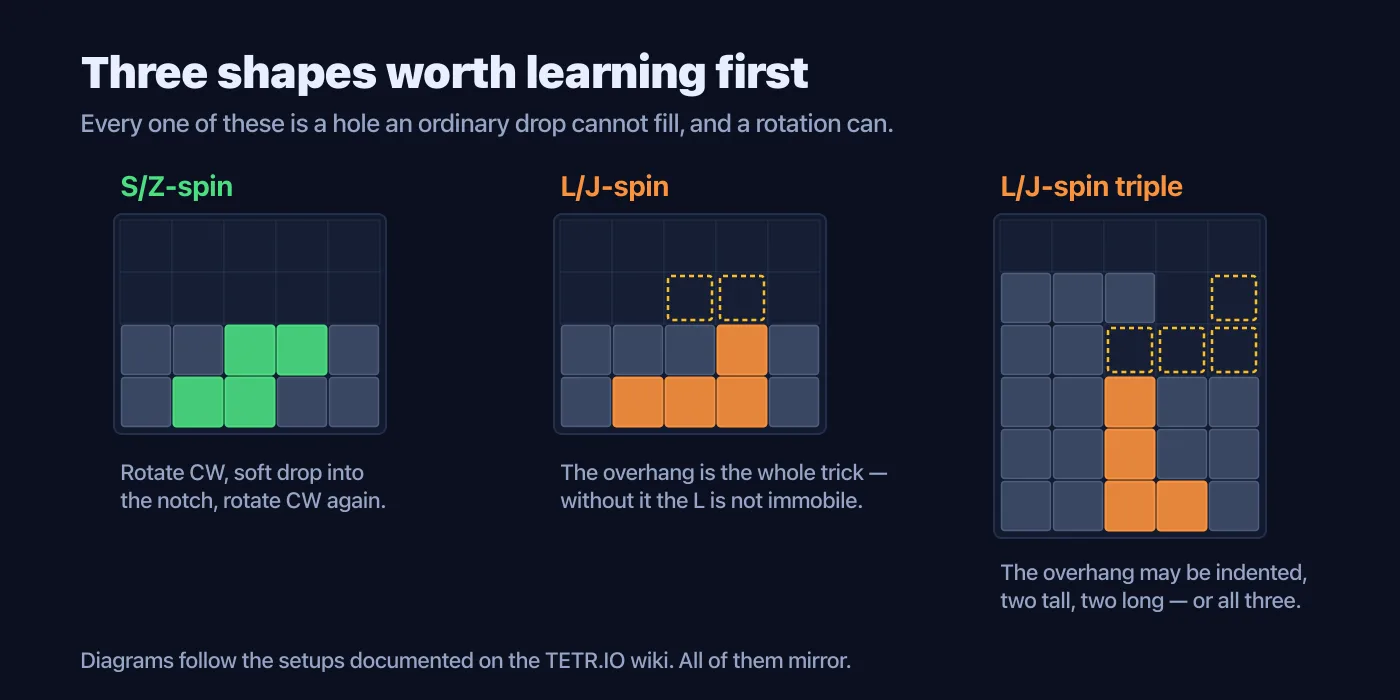
The S/Z-spin notch. A two-cell step with a one-cell offset beneath it. There are two ways in depending on which side your stack sits: rotate clockwise, soft drop into position, then rotate clockwise again — or do the mirror with two counter-clockwise turns. If the piece can be soft-dropped in without rotating, rotate counter-clockwise once at the bottom instead.
The L/J-spin. The flat three-cell body with one mino tucked under an overhang. This is the one that most rewards a bound 180 key: TETR.IO added a custom 180 kick table back in Infdev 0.6.0-pre0, and the wiki's own example is a downstack that otherwise demands building a wall on the far side and spinning a Z in, versus soft-drop-and-180 with an L. That is not a marginal saving, it is a different plan.
The L/J-spin triple. Same idea, three rows deep, and more forgiving than a TST tower about how the overhang is shaped — it can be indented, two tall, two long, or all three at once, where the T-spin triple gives you one shape and no negotiation.
Two more, for completeness:
- I-spins are the awkward ones because the I kick table varies so much. The rule of thumb from the TETR.IO wiki: using the first three kicks, rotate twice in the same direction when kicking onto the second row, and in different directions when kicking onto the third.
- O-spins exist and are close to useless. They need an overhang built above the spawn position in a highly specific arrangement. Jstris does have a rotation system literally called O-spin, described on the wiki as a meme system, whose kick table runs to sixteen tests and produces O-spin Triples and O-spin Quadruples. It is a novelty ruleset, not a competitive one.
If the kick behaviour underneath all of this is fuzzy, the wall kick guide covers the SRS tables these setups are exploiting.
Where all-spin actually changes your play
Three situations worth naming.
Digging without losing the chain. The classic bind in versus is being buried with a live back-to-back and no difficult clear available. A Single ends the streak and cashes whatever Surge you had charged, whether or not that was the moment you wanted to spend it. An immobile Spin Single on a garbage row does the same job to the board and keeps the chain armed — and with Garbage Special Bonus on, it sends a line while doing it. This is the reason to learn all-spin, and it is a defensive reason, not an offensive one.
Terrain that used to be dead. An overhang over a narrow gap has two answers under T-only rules: a T, or a hole you dig back out later. All-spin adds whichever of the other six pieces fits that particular shape, which changes how much you are willing to build over a gap in the first place. Do not over-read that — good stacking still beats clever recovery — but the risk calculus genuinely moves.
Solo sprints, as of December 2025. With All-Mini+ live in 40 LINES, a Spin Single that keeps a chain going is now part of a solo route as well as a versus one.
The thing to avoid is the opposite failure: hunting spins on a clean board. A Mini that adds no damage, on a board where you could have set a Quad, is a placement you spent on a status effect. Spend it when the status is worth something. The rest of our coverage lives on the Tetris coverage hub.
Quick Action Checklist
- Check which spin rule your game uses before drilling any of this; Tetris 99, Tetris Effect and Puyo Puyo Tetris score T-spins only.
- In TETR.IO, confirm you are on All-Mini+, the default for multiplayer and ZEN since 18 January 2025.
- Treat the overhang as the setup, not a garnish — the up-check is what the immobile rule turns on in practice.
- Test yourself against the Boomerang: if the whole piece can shift up one row, it is not a spin.
- Expect no damage bonus from a non-T Spin Mini; the payoff is back-to-back, not lines.
- Land your spins on garbage rows, where Garbage Special Bonus adds a flat +1 line.
- Use a Spin Single instead of a panic Single when you are buried and your streak is charged.
- Bind a 180 key before drilling L and J spins; TETR.IO's 180 kick table is what makes them quick.
- Learn the S/Z notch first, then the L/J overhang, then the L/J triple.
- Leave I-spins and O-spins until the other three are automatic.
- Do not hunt spins on a clean board — a bonus-free Mini costs you the Quad you could have built.
Frequently Asked Questions
What is all-spin in Tetris?
Do S and Z spins send garbage?
Which Tetris games recognise spins with pieces other than T?
What is the difference between All-Mini and All-Mini+ in TETR.IO?
What does immobile spin detection mean?
Why did my L-spin not count?
Keep Reading
- TetrisWiki — List of twists: immobile vs 3-corner T detection and per-piece setups
- TetrisWiki — Guideline compliant game differences: T-spin recognition and non-T twists per game
- TetrisWiki — The New Tetris: immobile spin detection and 1999 release
- TetrisWiki — Jstris: attack table, All-spin footnotes and the O-spin rotation system
- Wiki for TETR.IO — Spins: immobile detection, the Boomerang case, S/Z, L/J, I and O setups
- Wiki for TETR.IO — Mechanics: All-Mini, All-Mini+, Back-to-Back Charging and Garbage Special Bonus
- Wiki for TETR.IO — QUICK PLAY mods: the All-Spin mod and its repetition penalty
- TETR.IO — official patch notes: Infdev 0.5.4, Beta 1.1.0, 1.3.0, 1.5.0, 1.5.1, 1.7.0 and 1.7.6
Related Guides
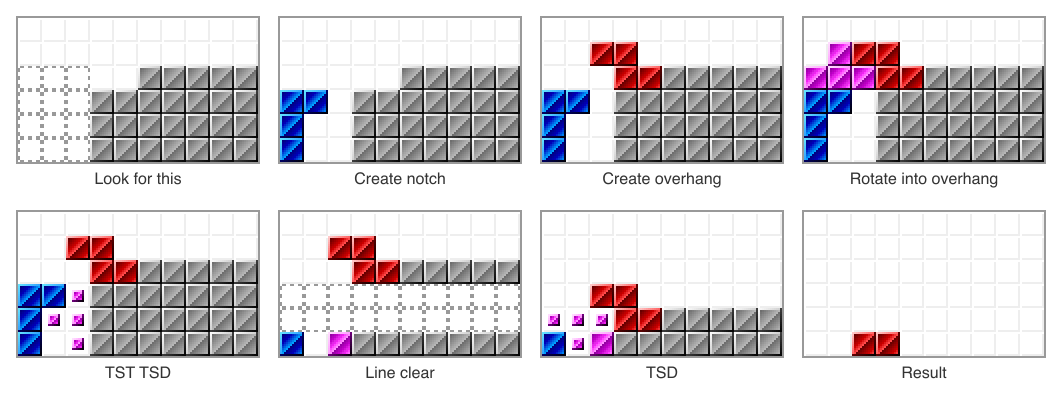
Tetris Mid-Game T-Spins: STSD, Imperial Cross, Kaidan
Once the opener is spent, the board decides your T-spins. Hard Drop files 63 pages of mid-game T-spin setups; this guide covers three families: lend your well to a T-spin, stack two TSD slots, or kick a T two rows deeper to save a bad board.
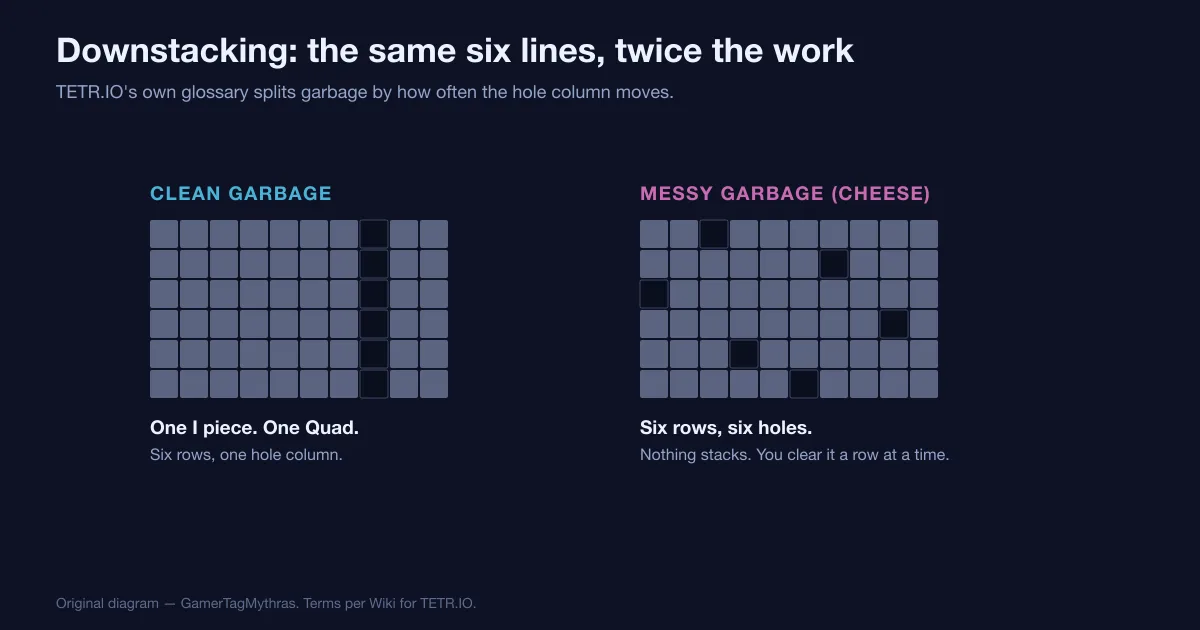
Tetris Downstacking: How to Dig Out of Garbage
Garbage is not one obstacle, it is two. Where the hole column sits from row to row decides whether six lines cost you one piece or six, and TETR.IO scores the lines you dig out at exactly the same rate as the lines you send.
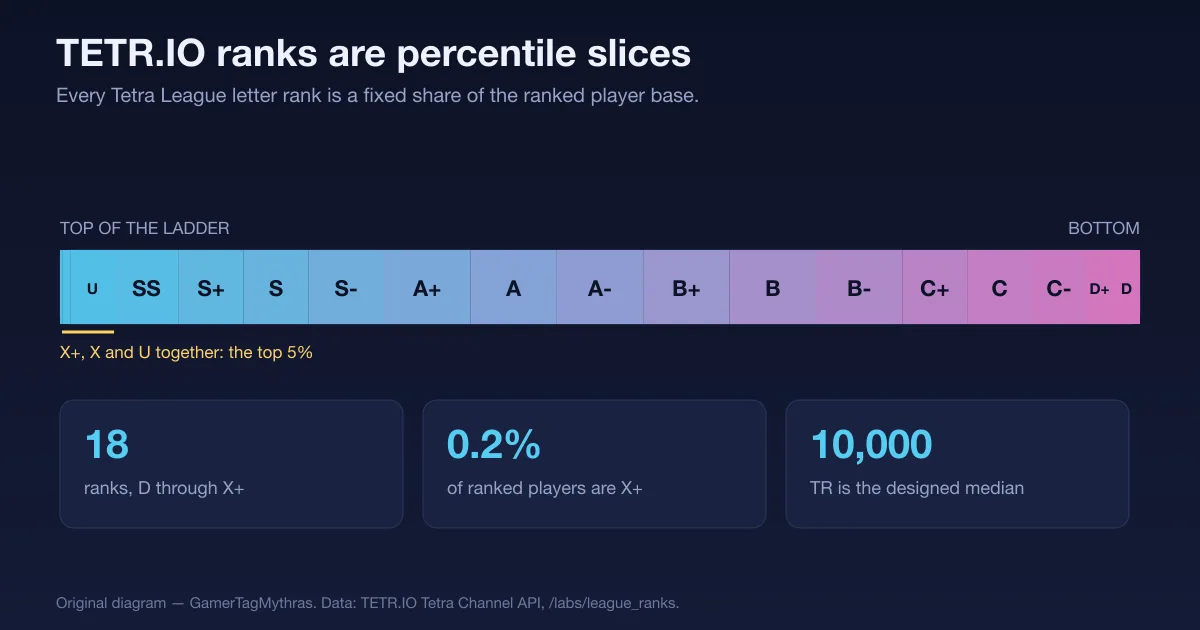
TETR.IO Ranks Explained: TR, Percentiles and Cutoffs
A Tetra League letter is not a skill score, it is a slice of the leaderboard — and TETR.IO publishes exactly how big each slice is, what TR it currently costs, and how fast the people inside it play.
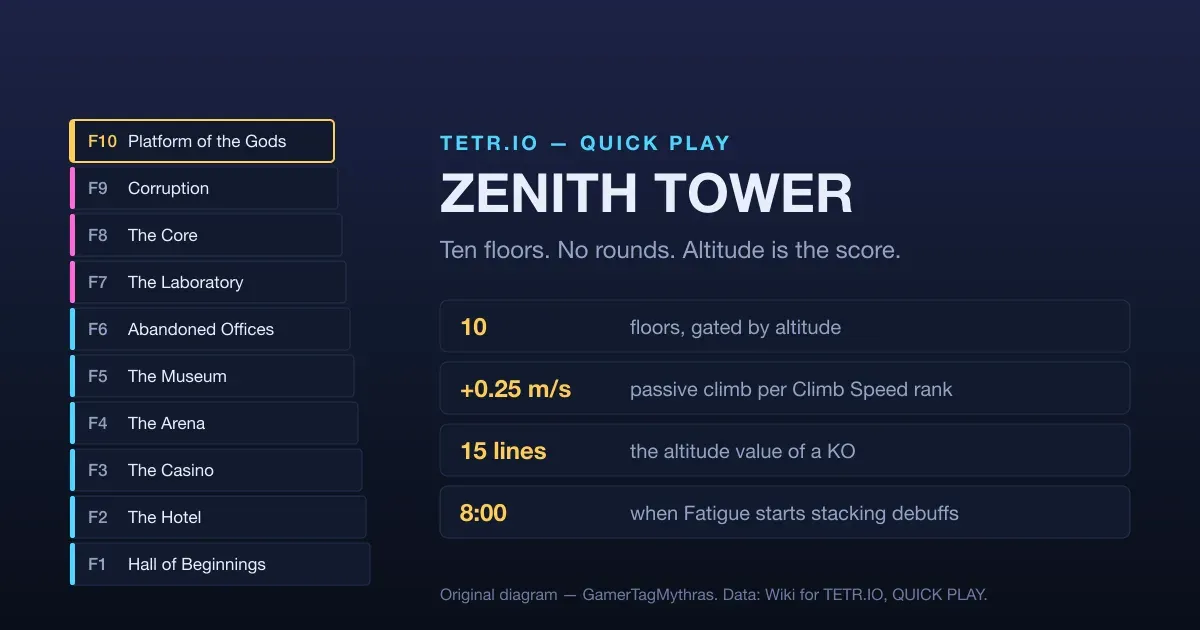
TETR.IO Quick Play Explained: The Zenith Tower, Climb Speed, and HYPERSPEED
Quick Play looks like a battle royale and scores like a speedrun. There is no round to win and nobody to outlast — only altitude, and altitude is bought mostly with the lines you send at other people.
Tetris Stacking Fundamentals: Build a Board That Wins
Most players do not lose to speed. They lose to a board they built themselves three minutes earlier. Here is how stacking actually works in modern Guideline Tetris, and the habits that stop you from burying your own well.
The Tetris Effect Zone Guide: Ultimatris, the Attack Table, and When to Press It
Zone is sold as a get-out-of-jail button, and used as one it pays a fraction of what it could. The published Zone Bonus Attack table says the same lines can be worth 40 garbage rows or 80, depending only on when you pressed it.