Tetris Gravity and Lock Delay Explained: The Speed Curve, the 15-Move Limit, and 20G
Every modern Tetris game runs on three clocks you never see: gravity, lock delay, and entry delay. All three are published numbers, and they explain exactly why level 15 feels like a different game than level 5.
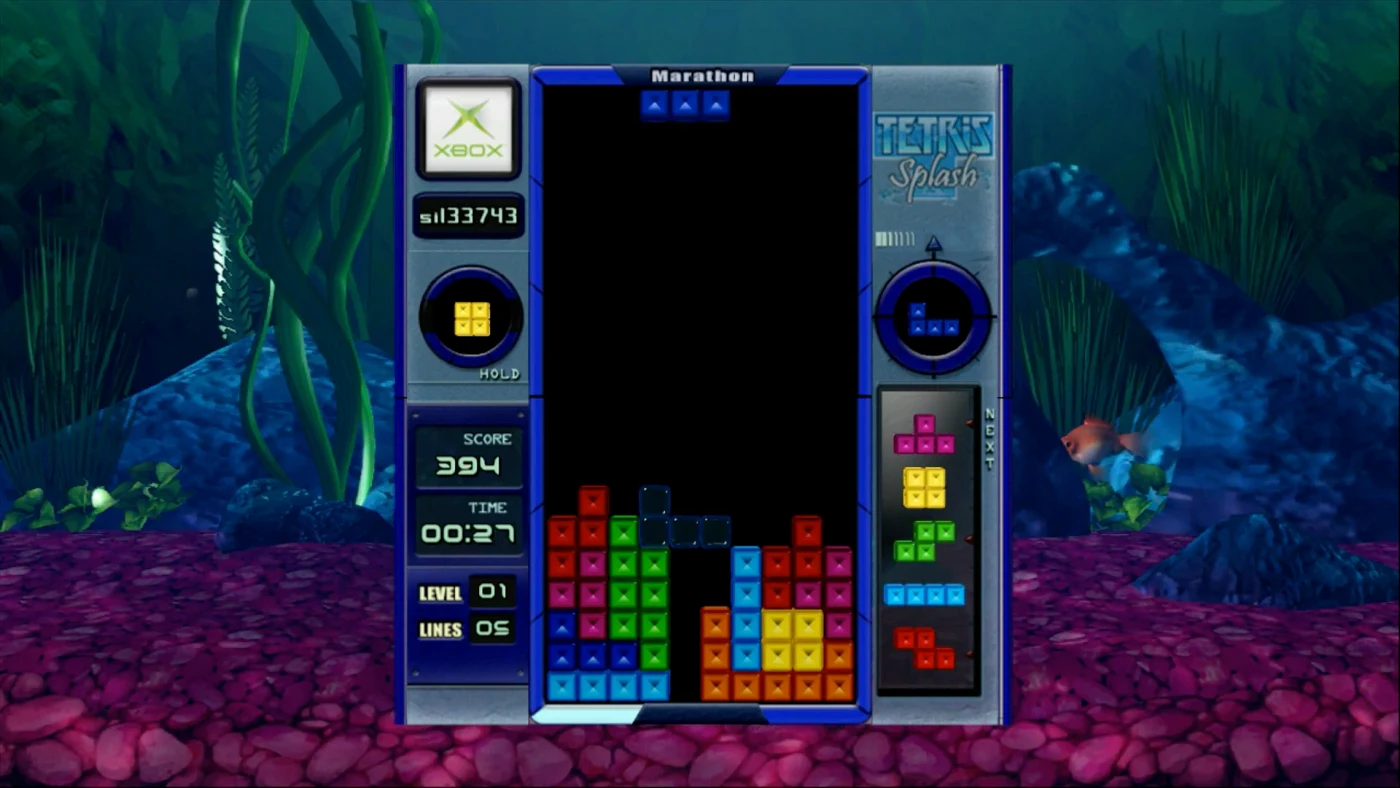
There is a point in every Marathon run where the game quietly stops being about stacking. You place a piece, glance up at the queue, and the next one is already sitting on your stack. You did not get worse. The clock changed.
Modern Tetris runs on three separate timers that almost nobody reads: gravity (how fast the piece falls), lock delay (how long it sits on the stack before committing), and entry delay (how long you wait for the next one). All three are published values in the Tetris Guideline, and once you know them, the difficulty curve stops feeling like vibes and starts looking like arithmetic.
Half a second is most of the game
Start with the number that never moves. Under the Guideline, a piece that lands on the stack gets 0.5 seconds — 30 frames at 60 fps — before it locks, and that value stays fixed at every level where gravity is below 20G. It does not shrink as you climb. What shrinks is everything around it.
Run the two ends of the curve against each other:
- Level 1 is 0.01667G, which is exactly one row per second. A piece falling the full 20 rows of an empty board spends 20 seconds in the air, then 0.5 seconds locking. Lock delay is about 2 percent of that piece's life.
- Level 15 is 2.36G. The same 20-row trip takes roughly 8 frames — about 0.14 seconds. Add the same unchanged 0.5 second lock delay and suddenly 78 percent of the piece's existence is the grounded window.
That inversion is the whole story of high-level Tetris. Early on you are steering a falling piece. Later on you are doing all of your work in a fixed half-second after it has already landed, which is why finesse and rotation knowledge scale so violently with level — see our finesse guide for the input-count side of that.
The speed curve level by level
Almost every Guideline game since 2001 inherits the speed curve from Tetris Worlds. The time for a piece to fall one row is:
Time = (0.8 − ((Level − 1) × 0.007)) raised to the power of (Level − 1), in seconds.
The formula spits out absurd decimal tails, so the wiki publishes frame-accurate G values instead. Here they are, with the seconds-per-row conversion done for you:
| Level | Gravity (G) | Seconds per row |
|---|---|---|
| 1 | 0.01667 | 1.000 |
| 2 | 0.021017 | 0.793 |
| 3 | 0.026977 | 0.618 |
| 4 | 0.035256 | 0.473 |
| 5 | 0.04693 | 0.355 |
| 6 | 0.06361 | 0.262 |
| 7 | 0.0879 | 0.190 |
| 8 | 0.1236 | 0.135 |
| 9 | 0.1775 | 0.094 |
| 10 | 0.2598 | 0.064 |
| 11 | 0.388 | 0.043 |
| 12 | 0.59 | 0.028 |
| 13 | 0.92 | 0.018 |
| 14 | 1.46 | 0.011 |
| 15 | 2.36 | 0.0071 |
| 16 | 3.91 | 0.0043 |
| 17 | 6.61 | 0.0025 |
| 18 | 11.43 | 0.0015 |
| 19 | 20.23 | 0.00082 |
| 20 | 36.6 | 0.00046 |
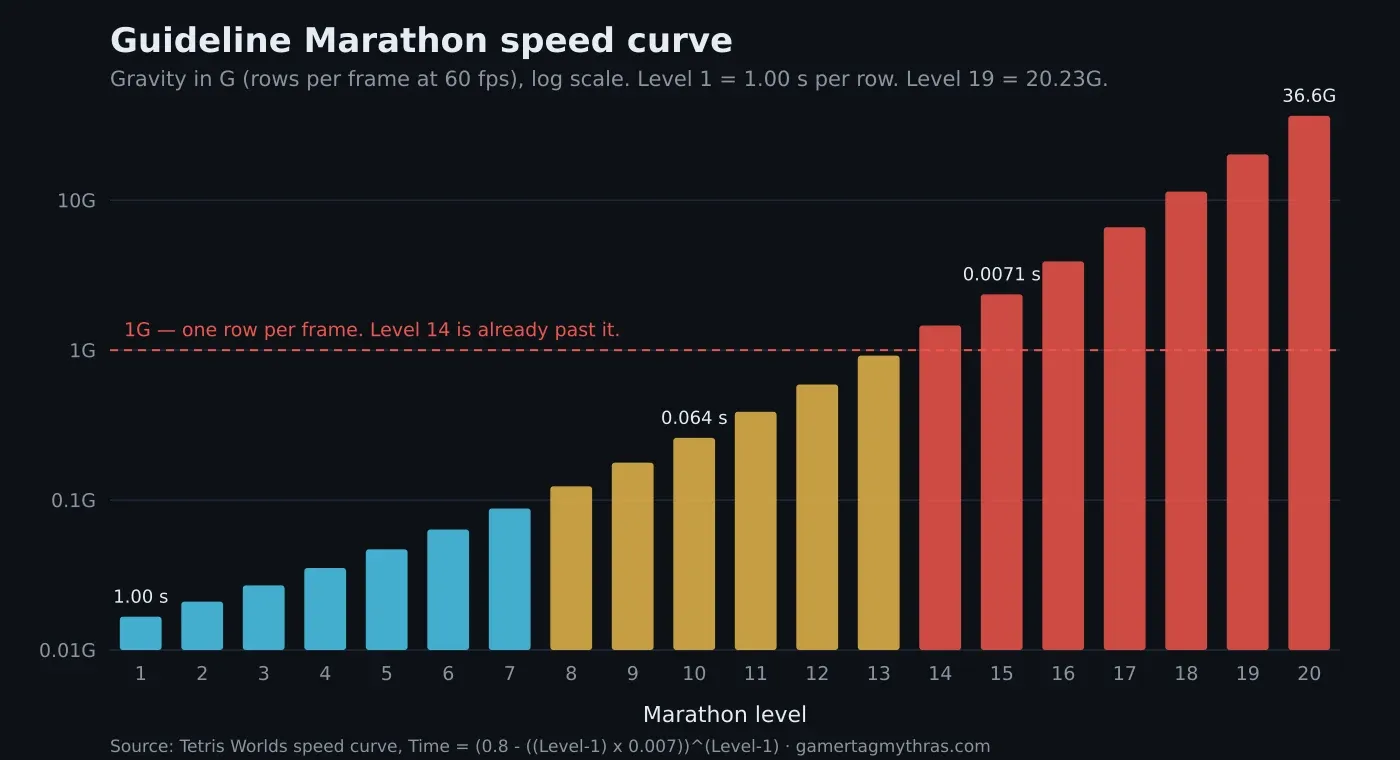
Two things jump out of that table. First, it is exponential, not linear — the jump from level 1 to level 10 is a factor of 15, and the jump from level 10 to level 19 is a factor of 78. Second, level 1 to level 5 barely matters. You go from 1.000 to 0.355 seconds per row. Most players treat the early levels as the "real" game and then get surprised at level 12.
There is no agreed rule past level 19. Tetris Online (Japan) ran 20G with a fixed lock delay in Endless Marathon; tetris.com and Tetris Ultimate instead shorten the lock delay between levels 20 and 30. Tetris DS shifts the whole curve by one level and rounds to the nearest frame. Tetris 99's 999 Line Marathon stretches the curve gently across the first 50 levels and then slams to 20G across the last 49.
Level 14 is the real difficulty spike
Look at where the table crosses 1G. Level 13 is 0.92G. Level 14 is 1.46G.
1G means one row per frame. Below it, you can watch a piece descend and correct mid-fall. At and above it, the piece is moving faster than your display can show you as motion — it does not fall through rows, it appears further down. At level 15 (2.36G) a piece crosses the entire board in under nine frames.
This is the exact moment when your habits stop transferring. Everything you learned about steering during the fall becomes worthless, and the only control surface left is the fixed 0.5-second lock delay plus whatever rotations you can land inside it. If you have ever felt a Marathon run fall apart between 130 and 150 lines, that is not a coincidence — under a fixed-goal system, 10 lines per level puts level 14 at exactly 130 lines cleared.
How levels are actually awarded
Two systems exist, and which one a game uses changes how fast you hit the wall.
Fixed-goal is the modern default: every level requires 10 lines, regardless of the level you started on. Start at level 5 and you still clear 50 lines to reach level 6. Most games cap at level 15 — a total goal of 150 lines — though the maximum can be set as high as 30. Turn Endless on, or push the goal past 150, and gravity simply stops increasing.
Variable-goal was the pre-2010 standard: each level needs a goal of 5 × level, and each clear contributes its base score divided by 100, rounded down. So a Single is worth 1 goal, a Double 3, a Triple 5, a Tetris 8, and a T-Spin Double 12. Excess goal does not carry between levels, which means dumping a T-Spin Triple to finish a level that needed 2 more goal throws away 14 of it. Variable-goal also caps at 15, for 600 total goal.
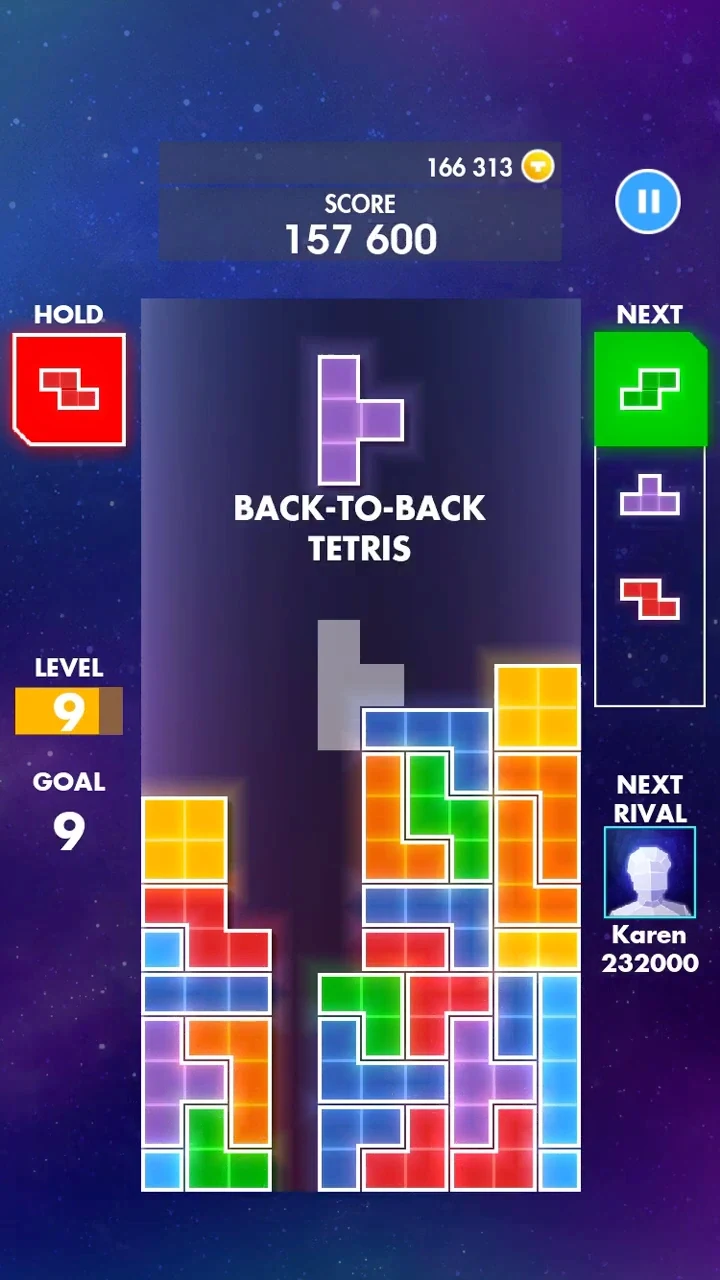
The practical read: under variable-goal, big clears level you up faster, which means chasing T-Spins accelerates you into speeds you may not want yet. Under fixed-goal, a Single and a T-Spin Triple advance you at the same per-line rate, so there is no speed penalty for playing greedy. Our scoring and attack guide has the full base-score table those goal values come from.
The three lock down modes
The Guideline defines three lock down behaviours. All three start the same 0.5-second timer when the piece touches down. They disagree completely on what restarts it.
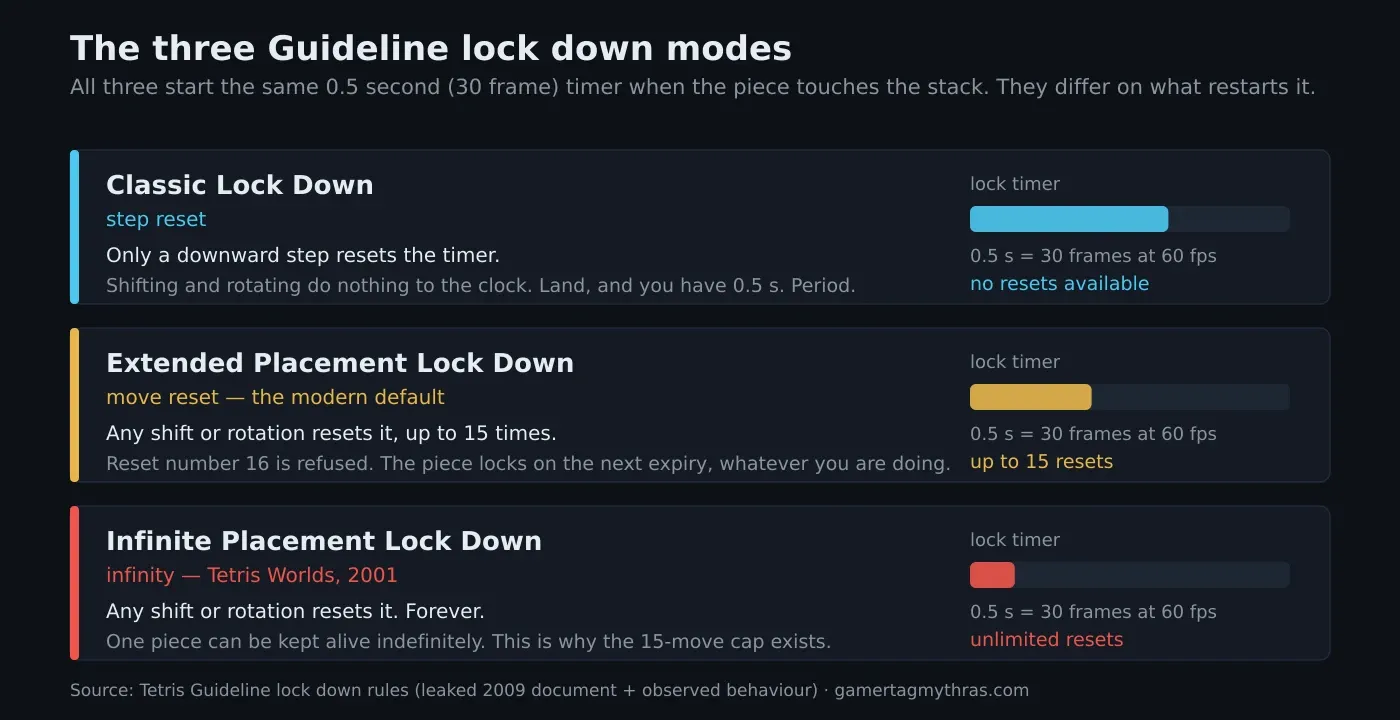
Classic Lock Down (step reset). Only a downward step resets the timer. Shifting and rotating do nothing to the clock. This is the TGM-lineage behaviour and it is brutally honest: you land, you have half a second, spend it.
Extended Placement Lock Down (move reset). Any successful shift or rotation resets the timer, up to a limit of 15 resets before the piece steps down a row. This is what basically every modern game uses.
Infinite Placement Lock Down (infinity). Any shift or rotation resets the timer, with no cap at all. A single piece can be kept alive forever.
Infinity showed up first in Tetris Worlds (2001), where the in-game name for it was Easy Spin. It was not popular. GameSpot's Ryan Davis wrote in his review that infinity "actually breaks Tetris", and the criticism stuck. The 15-reset cap was present in Tetris Zone in 2007 and formally specified by the leaked 2009 Guideline document; games before that generally allowed unlimited resets.
One detail people miss: the reset applies to any move or rotation, including rotating the O piece, which does not visually change anything. If your game has infinity enabled, tapping rotate on an O is a legal stall.
The 15-move budget and how to spend it
Treat 15 as a currency, because that is exactly what it is.
Every shift and every rotation you perform while the piece is grounded spends one reset. Fifteen sounds generous until you are at level 13 doing a five-input relocation, changing your mind, and doing a four-input correction. Blow through the allowance and the piece locks on the next timer expiry no matter what you are mid-way through.
The allowance refreshes when the piece steps down a row, which is the part that makes it survivable. At low gravity you will basically never see the cap, because a piece sitting on an overhang keeps getting fresh steps. At high gravity there are no more steps to take — you landed on the stack and the board is not going to give you another row — so the 15 you have is genuinely all you get.
Two habits follow directly from that. Decide your column before the piece lands, not after, and stop using rotation as a thinking pause. If you need the extra time, clean finesse buys it more cheaply than spinning does.
20G turns rotation into the whole toolkit
20G is a term coined by the developer of Tetris The Grand Master, and it means 20 cells per frame — enough that a piece appears already resting on the stack the instant it spawns. There is no fall. There is only lock delay.
At that point, rotation is not a way to orient a piece, it is the only movement system you have, and it has to work while grounded. That is exactly why the ARS rotation family leans on floor kicks and why the two systems feel so different — the full comparison lives in our rotation systems and wall kicks guide.
Games that go to 20G also start cutting the one number that had been constant:
- Tetris Effect: Connected's Master mode is a 20G mode with 30 speed levels, each with a shorter lock delay and line clear delay than the last, and a 300-line requirement to complete it.
- TGM2's T.A. Death mode drops lock delay as low as 15 frames. TGM3's Shirase mode takes it to 8 frames — about 0.13 seconds of grounded control.
- TETR.IO's Zenith Freefall mod starts at 20G with a 24-frame lock delay and shortens it every floor.
Also worth knowing: Tetris Effect's Zone mechanic pauses gravity entirely, but a piece touching the top of the stack still locks after its delay. Zone stops the fall, not the clock.
One more distinction the Guideline is strict about. Hard drop is mandatory and it locks instantly. Soft drop under SRS is non-locking — it accelerates the fall and hands you the normal lock delay when you land. Under ARS, soft drop locks on contact. TGM also offers a sonic drop, which drops the piece instantly like a hard drop but preserves lock delay, and that is the whole reason grounded overhang tricks are possible in those games.
TGM built a rollercoaster instead of a curve
If you only know Guideline Marathon, TGM1's speed table is genuinely startling. Its gravity is stored as a fraction over 256, so G equals internal gravity divided by 256. It does not climb monotonically. It climbs, resets, and climbs again:
| Level | Internal gravity (of 256) | In G |
|---|---|---|
| 0 | 4 | 0.016 |
| 90 | 64 | 0.25 |
| 160 | 128 | 0.5 |
| 170 | 144 | 0.56 |
| 200 | 4 | 0.016 |
| 230 | 64 | 0.25 |
| 251 | 256 | 1 |
| 300 | 512 | 2 |
| 360 | 1024 | 4 |
| 400 | 1280 | 5 |
| 420 | 1024 | 4 |
| 450 | 768 | 3 |
| 500 | 5120 | 20 |
Read level 200 again. After 170 levels of steady acceleration the game drops you all the way back to its opening speed, then rebuilds. It does the same trick at 420 and 450, slowing down from 5G to 3G — right before detonating into 20G at level 500 and staying there for the rest of the run.
Meanwhile TGM1's other timings never move at all. Across the entire 000–999 run: ARE 30 frames, DAS 16 frames, lock delay 30 frames, line clear 41 frames. The gravity is the difficulty; everything else is a constant you can build muscle memory around. TGM also levels differently, gaining a level for every piece that enters plus one for every line cleared, with the hundreds digit gated behind a line clear so you cannot piece-spam past 199.
The three ways a Guideline game kills you
"Topping out" is three different rules wearing a trench coat, and modern Guideline games run all three at once.
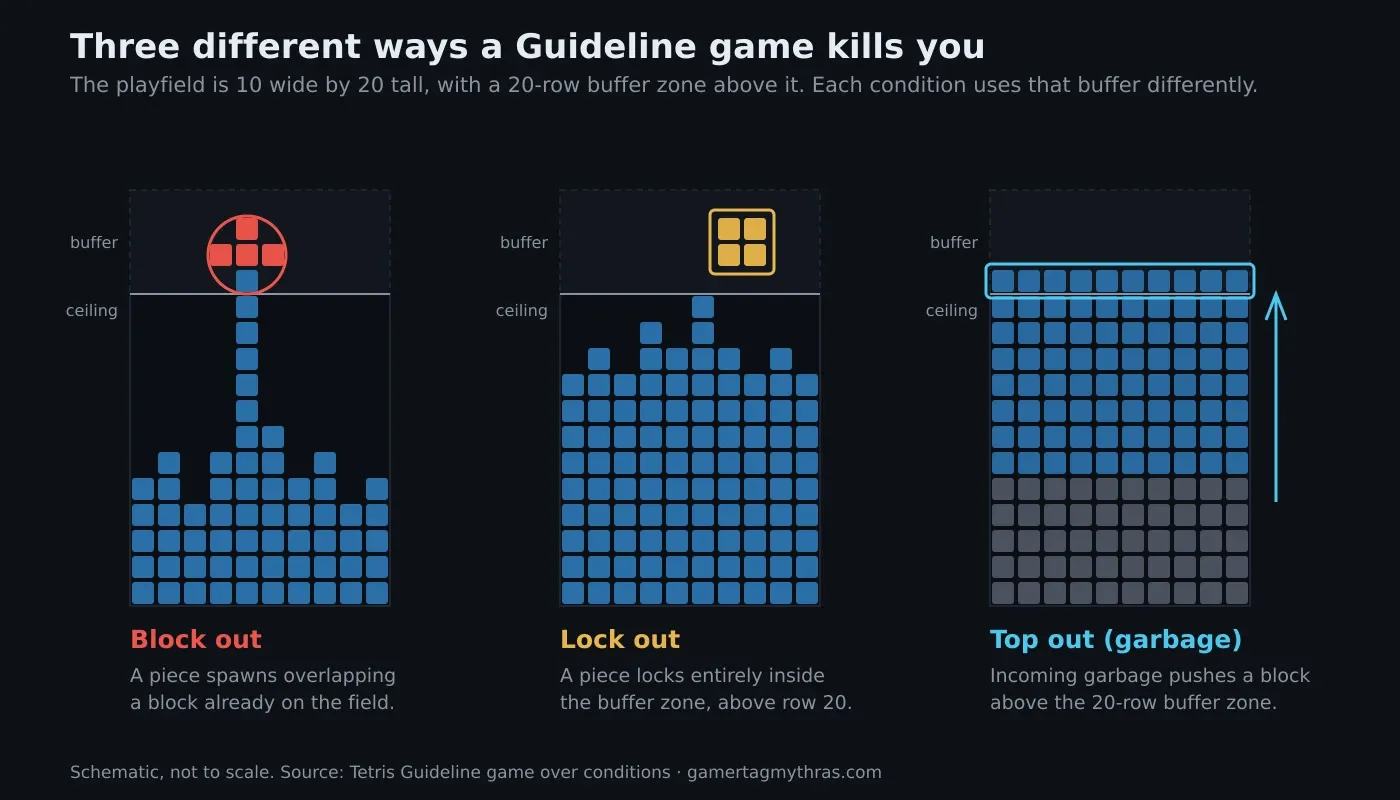
Block out. A piece spawns overlapping at least one block already in the playfield. This is the common one, and it is why a stack that reaches spawn height is fatal even if you had a plan.
Lock out. A piece locks while entirely out of bounds, inside the buffer zone above the visible ceiling. Note the word entirely — the Guideline uses lock out, not the older partial lock out, so a piece hanging half in bounds is legal. Older games including Atari Tetris, Tengen's NES version, The New Tetris and Tetris DS push mode use partial lock out instead, which kills you even if the placement would have cleared a line.
Top out (garbage). After lines resolve and garbage is inserted, a block ends up pushed above the 20-row buffer zone that sits over the playfield. This is the versus killer, and it is a big part of why holding a tall board while eating garbage is so much worse than the row count suggests.
Older games are messier still. NES Tetris kills you when a piece locks overlapping a block, though in some cases you can move or rotate out of the situation first. Game Boy Tetris waits for two consecutive pieces to lock in their spawn positions. TGM only gives you a one-row buffer above the field, and anything locking above that row is deleted outright rather than stored.
DAS ARR and ARE are separate clocks
Gravity and lock delay decide how long the piece exists. Three more numbers decide how fast you can actually move it, and the Guideline lists them as recommended rather than mandatory:
- DAS (delayed auto shift): 10 frames, roughly 167 ms — how long you hold a direction before it starts repeating.
- ARR (auto-repeat rate): 2 frames, roughly 33 ms — how fast it repeats after that, so about 30 shifts per second.
- ARE (entry delay): 6 frames, roughly 100 ms — the pause between one piece locking and the next appearing.
Most Guideline games ship with little or no ARE outside the line clear animation, which is why TETR.IO's 40 LINES mode — no ARE, and an ARR of 0 available in handling settings — is limited only by how fast you can physically stack. TGM went the other way entirely: 30 frames of ARE, half a second of dead air between pieces, which is precisely what makes initial rotation, initial hold and DAS preloading meaningful mechanics rather than curiosities.
And then there is NES Tetris, which has no lock delay whatsoever. A piece locks the moment it tries and fails to move down, so its effective lock delay is just the gravity interval for one row — 48 frames at level 0, and 1 frame at level 29. Our NES DAS, hypertapping and rolling guide covers what players did about that.
What to actually do with this
- Know which level your game breaks at. Under fixed goal, level 14 crosses 1G at 130 lines cleared. Plan a clean board before that, not during it.
- Stop steering mid-fall past level 12. There is not enough airtime left. Commit the column at spawn.
- Treat the 15 resets as a budget, not a safety net. It only refreshes on a downward step, and at high gravity those steps stop coming.
- Check whether your game uses fixed or variable goal. Under variable goal, big clears push you into higher gravity faster.
- If you play a 20G mode, learn its kick table first and its stacking second. Rotation is your only movement system in there.
More Tetris breakdowns live on the Tetris coverage hub.
Quick Action Checklist
- Lock delay under the Guideline is 0.5 seconds, or 30 frames at 60 fps, whenever gravity is below 20G.
- Level 1 gravity is 0.01667G, exactly one row per second. Level 15 is 2.36G.
- 1G is crossed between level 13 (0.92G) and level 14 (1.46G). That is the real difficulty spike.
- Fixed goal is 10 lines per level and usually caps at level 15, or 150 lines.
- Variable goal is 5 × level, each clear giving base score divided by 100, with no carryover.
- Extended Placement allows 15 move resets before the piece steps down. Spend them deliberately.
- Infinity, from Tetris Worlds in 2001, has no reset cap. The 15-move limit exists because of it.
- 20G means the piece is on the stack the frame it spawns. Lock delay is your entire control window.
- TGM1 gravity is not monotonic — it resets to opening speed at level 200 and slows from 5G to 3G before hitting 20G at 500.
- Guideline games kill you three ways: block out, lock out, and garbage pushing a block above the buffer zone.
Frequently Asked Questions
How long is lock delay in Tetris?
What is the Tetris speed curve formula?
What level does Tetris reach 1G?
What is the 15-move limit in Tetris?
What does 20G mean in Tetris?
Why does TGM gravity go backwards at level 200?
What are the different ways to top out in Tetris?
What DAS and ARR does the Tetris Guideline recommend?
Keep Reading
- TetrisWiki — Guideline Marathon speed curve, fixed-goal and variable-goal systems
- TetrisWiki — Tetris Guideline lock down modes, buffer zone, handling values and game over conditions
- TetrisWiki — lock delay, entry reset, step reset and move reset
- TetrisWiki — Infinity (Easy Spin) and the 15 move reset limit
- TetrisWiki — gravity in G, soft drop, hard drop and sonic drop
- TetrisWiki — block out, lock out, partial lock out and garbage out conditions
- TetrisWiki — TGM1 internal gravity table and fixed ARE, DAS, lock and line clear timings
- TetrisWiki — ARE (entry delay) and its role in DAS preloading, IRS and IHS
Related Guides
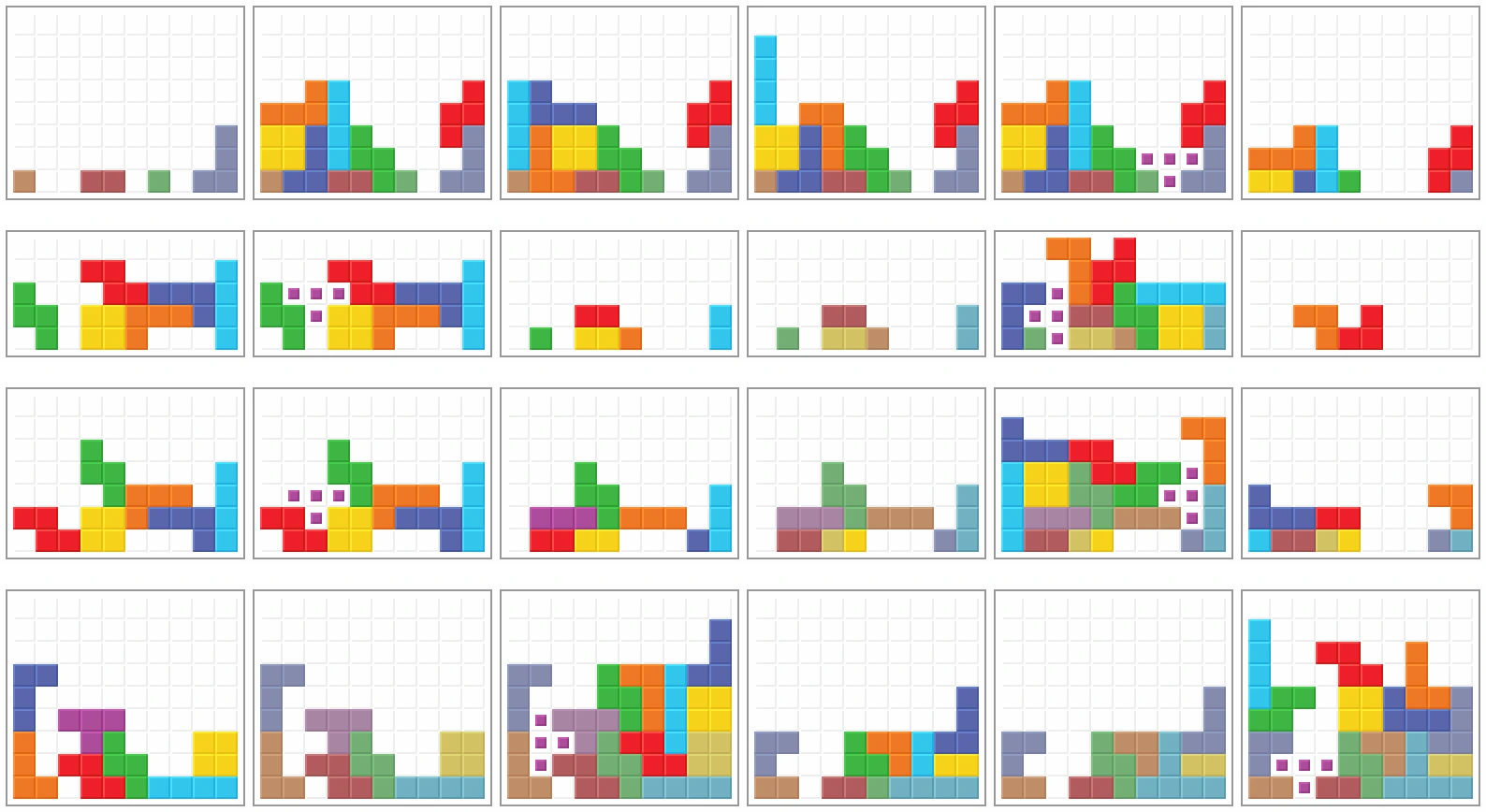
Tetris Openers: TKI-3, DT Cannon and Albatross
Your first seven pieces decide which opener is even legal. Memorising one build and forcing it every game is why your opening dies half the time. Here is the actual decision tree, from the I-piece TKI family down to the SZT bags nobody wants.
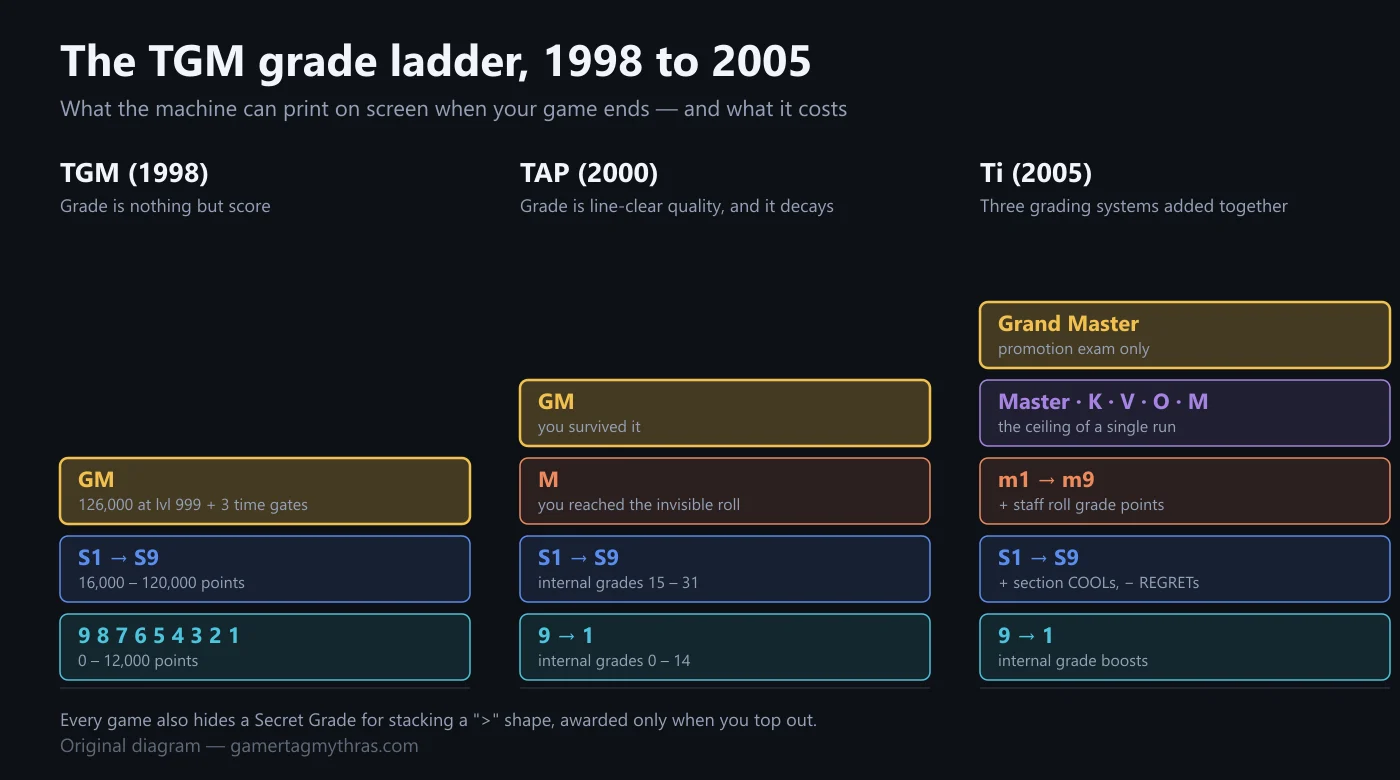
Tetris The Grand Master Explained: 20G, the Grade Ladder, and the Invisible Roll
Most Tetris games ask you to survive. Arika's ask you to justify yourself. Here is how the TGM series actually grades a run — the piece-counted level, the 20G cliff at level 500, TAP's decaying grade points, and the promotion exam standing between Ti players and Grand Master.
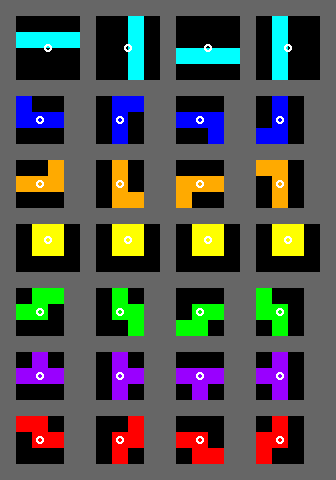
Tetris Wall Kicks Explained: SRS Kick Tables, ARS, and NES
Your I piece did not glitch. It jumped two columns left because test 2 of its kick table says to, and the game ran that test before it ran the one you wanted. Here is what every modern Tetris is actually checking when you press rotate.

TGM4 Absolute Eye Modes Explained: Where to Start
Arika's first Grand Master in twenty years is not one game. It is six modes, four unlockable variants behind Normal, two control types that change the randomizer, and a 2,600-level Master mode that freezes your own stack. Here is what each one asks and where to start.
Tetris Stacking Fundamentals: Build a Board That Wins
Most players do not lose to speed. They lose to a board they built themselves three minutes earlier. Here is how stacking actually works in modern Guideline Tetris, and the habits that stop you from burying your own well.
TETR.IO Blitz Explained: Levels, Gravity, and Score
TETR.IO's own wiki calls Blitz "similar to Ultra" and leaves it there. What that skips: a 15-level gravity ladder that multiplies every point you score and eventually outruns your reaction time, a Perfect Clear bonus that does not work the way Tetris Effect's does, and a spin rule the all-spin rework never touched.