The Tetris Perfect Clear Guide: PCO Openers and Setups
The Perfect Clear Opener wipes your board in ten pieces and dumps the attack table's biggest single-clear bonus on your opponent before they have a well. It succeeds nearly two thirds of the time blind, and 84.64% if you hold the I. Here is how it is built.
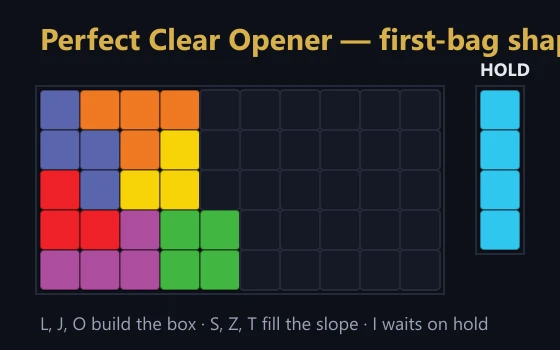
A Perfect Clear Opener empties your board in ten pieces and drops the attack table's biggest single-clear garbage bonus on your opponent before they have finished building their first well. It succeeds on 61.19% of random opening sequences with no hold usage, and on 84.64% when you hold the I piece where the sequence allows. Those are not trick-shot odds. That is the single highest expected-value opening in competitive Tetris, and it is why every serious versus player has it in muscle memory.
Everything here describes modern Guideline Tetris running the Super Rotation System with 7-bag randomization and a hold slot: TETR.IO, Tetris Effect, Puyo Puyo Tetris, Jstris, tetris.com. The perfect clear as a repeatable opening only exists because 7-bag guarantees the piece distribution of your first fourteen pieces. In classic NES Tetris, where pieces are effectively random and there is no hold, you cannot plan one — so this guide assumes a Guideline title.
Why the perfect clear is worth learning
A perfect clear is the fattest single payout in the game, in both currencies that matter.
On score, recent Guideline games such as Tetris Effect and the 2020 mobile Tetris add a flat bonus on top of the normal line-clear points: 800 × level for a single-line PC, 1200 for a double, 1800 for a triple, 2000 for a Tetris PC, and 3200 × level for a back-to-back Tetris PC. A back-to-back Tetris perfect clear therefore pays 3200 plus the 1200 for the Tetris itself — 4400 × level from four rows.
On garbage, the all clear row is the one place the reference wikis disagree: Harddrop's general Guideline table lists it as +7 rows, while Tetris Wiki's lists 10, plus the clear's own value — either way, more than a Tetris (4) and a back-to-back bonus combined. Individual titles tune it further: Tetris 99 dials the all clear down to +4. The relationship holds everywhere even when the exact number moves: a perfect clear is the biggest burst of pressure you can send in a single placement.
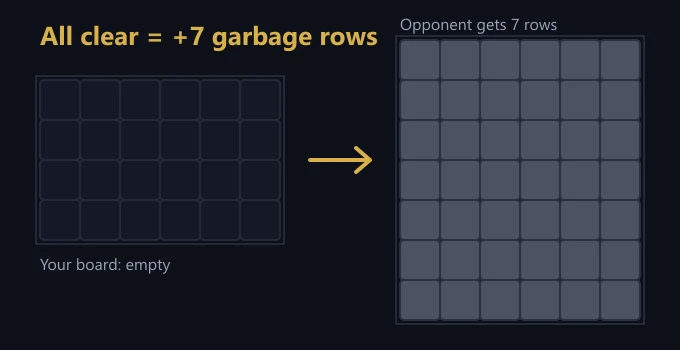
Land a PCO on turn one and your opponent is staring at a wall of garbage before they have thrown a single line back. That is not a scoring flourish. In versus, it is a game-defining head start.
What actually counts as a perfect clear
A perfect clear — also called an all clear or bravo — is awarded when a line clear leaves the entire playfield empty. Every cell. The key word is line clear: the board has to become empty as the result of clearing lines, not by never placing anything. You cannot perfect clear an already-empty board.
That definition has one practical consequence people miss: the PC is granted on the placement that clears the lines, so your final piece both fills the last gaps and completes the rows in the same drop. If your last piece fills the board without completing a row, you have not cleared anything — you have topped off your own stack.
The PCO: the opener that runs the meta
The Perfect Clear Opener is the standard route to a perfect clear inside the first four lines, using the first ten pieces you are dealt. The idea is simple to state and takes real practice to execute: build a specific four-row-tall shape out of your first bag, then complete the perfect clear with the opening pieces of your second bag.
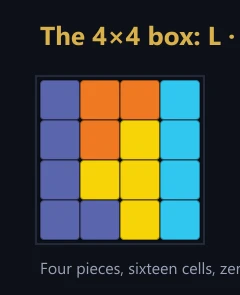
The structural core is a 4×4 box on the left built from L, J, O and I — four pieces, sixteen cells, no holes. In the standard first-bag build, the L, J and O pieces form a rectangle while the T, S and Z pieces form a slope beside it, and the I piece is kept on hold. Then the first four pieces of your second bag (and, ideally, that held I) drop in to complete the four rows all at once.
The coverage is the reason it dominates. The PCO handles the vast majority of opening bags — around 92.46% of them can be routed into some PCO path. You will not always take the identical placements, because the exact order your bag arrives changes which branch you follow, but the shape and the goal stay constant. That is what makes it learnable: one target, many small variations.
Building the first bag, step by step
Here is the practical build, in the order it actually happens at the board:
- Reserve the left four columns for the box. L, J and O are your box-builders. Lay them so the leftmost four columns fill flat and holeless across the bottom rows.
- Slope the T, S and Z beside the box. These three do not want to be flat; S and Z are diagonal by nature, and the T fills the notch they leave. Let them form the trapezoid the box leans against.
- Hold the I if the order allows it. The I is your most flexible completion piece. Sitting in hold, it can drop in vertically or horizontally to close whichever gap the second bag leaves.
- Read the second bag before you commit the fifth piece. By the time you are placing piece five or six, you can see enough of bag two to know which completion path is live. Choose the branch, then place into it.
- Make the final piece both fill and clear. The last drop has to complete all four rows simultaneously. If it only fills without clearing, the PC is gone.
The pieces to avoid leaning on as your first cavity-solvers are S, Z and O — they have the fewest useful orientations, so committing them early into the gap reduces your options. L, J and T, with their many orientations, are the ones you want flexibility with. That single habit — hold the flexible pieces, spend the rigid ones into the structure early — is most of what separates a reliable PCO from a coin flip.
The I-on-hold decision that nearly doubles your odds
This is the single most important number in the whole technique. Drop the I piece into the structure immediately, treating it as just another block, and the PCO solves on 61.19% of opening sequences. Keep the I on hold through the first bag, so it is available to slot into whichever gap remains, and the success rate jumps to 84.64%.
That is a 23-point swing from one decision. The I is the only piece that can fill a one-wide, four-tall column or a flat one-by-four in a single drop, which makes it the universal patch for whatever hole the second bag leaves you. Spend it too early and you have thrown away your safety valve.
The discipline is unglamorous: when the I shows up in bag one, resist the urge to place it, hold it, and build around the gap it would have filled. New PCO players lose most of their perfect clears not to bad sequences but to reflexively hard-dropping the I on sight.
When the PCO won't solve, use the Grace System
No opener is universal, and roughly one in thirteen opening bags simply does not route into a clean PCO — often when the I and O arrive as your first two pieces, or when L, J, S and Z all show up early and jam the box.
For those, the Grace System is the standard fallback. Instead of a 4×4 box it builds a 6×4 rectangle, and with the T piece held it reaches an 88.57% perfect-clear rate — higher than the PCO's own headline number.
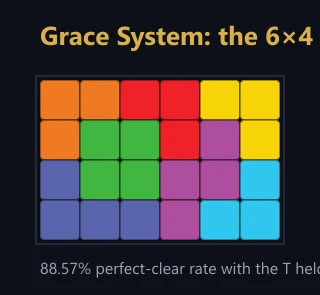
The sensible decision tree most guides teach:
- If the Grace System fits the bag, use it — it has the highest raw success rate.
- Otherwise run the PCO with the I held, the 84.64% path.
- Fall back to the plain PCO as your last resort.
You do not need all three memorized to benefit. Learn the I-held PCO cold first; it covers the overwhelming majority of games. Add the Grace System later, once the PCO is automatic and you can recognize the handful of bags where it stalls.
Looping perfect clears, and why most people shouldn't
There is a level above single openers: loopable perfect clears that chain PC after PC indefinitely. The Lorax Continuation, a documented extension of the PCO, reaches a 100% PC chance on the fourth bag in some branches and is tall enough — up to 14 lines in certain paths — to loop. There are freestyle systems where S, T and Z go left, L, J and O go right, I pieces fill the middle, and the whole pattern repeats every four bags.
These are real and genuinely devastating in the right hands. They are also a rabbit hole. Loop setups demand that you memorize dozens of branch solutions and read three or four pieces of queue at once, and a single misread doesn't just cost you a PC — it leaves you with a tall, committed board and no easy recovery. For all but the most dedicated players, the return on that study time is worse than simply learning the opening PCO plus solid mid-game stacking.
The honest recommendation: get one PCO path to a reflex, learn the Grace System fallback, and put the rest of your practice into downstacking and T-spins. A player who lands a clean opener every game and then plays a competent mid-game beats a player who knows three loop branches and tops out when the loop breaks.
The mistakes that blow up your PC
- Hard-dropping the I on sight. The single most common PCO killer. Hold it — that one habit is the 23-point gap between 61% and 85%.
- Filling the board without clearing. The final piece must complete all four rows in the same drop it fills them. Fill-only means you just topped off your own stack.
- Leaning on S, Z and O to solve the cavity. They have the fewest orientations. Spend them into the structure early; keep L, J and T flexible.
- Forcing a PCO onto a bag that won't take it. About 7.5% of openings don't route cleanly. Recognize those and switch to the Grace System or just stack normally instead of building a hole.
- Ignoring the queue before committing. By piece five you can see which second-bag branch is live. Placing blind is how a 90% setup becomes a 50% guess.
- Chasing loops before the basics are automatic. A broken loop leaves you with a tall board and no plan. Master the single opener first.
For the stacking discipline these setups sit on top of, see our Tetris stacking fundamentals guide, and for the full attack math behind the all clear garbage number, the Tetris scoring and attack guide. More on the Tetris coverage hub.
Quick Action Checklist
- Learn one PCO first-bag build until the shape is automatic, not memorized move-by-move.
- Reserve the left four columns for the L, J, O and I box; slope T, S and Z beside it.
- Hold the I through the first bag every time the order allows — it is worth 23 points of success rate.
- Spend S, Z and O into the structure early; keep L, J and T flexible for the cavity.
- Read the second bag by piece five and pick your completion branch before committing.
- Make the final piece complete all four rows in the same drop it fills them.
- Keep the Grace System in your pocket for the ~7.5% of bags the PCO can't route.
- Bank the all clear garbage as a turn-one lead, then play a clean mid-game — don't chase loops until the opener is a reflex.
Frequently Asked Questions
What is the Perfect Clear Opener (PCO) in Tetris?
What is the success rate of the PCO?
How much garbage does a perfect clear send?
Why should I hold the I piece during the PCO?
Is the PCO worth learning for a casual player?
Keep Reading
Related Guides
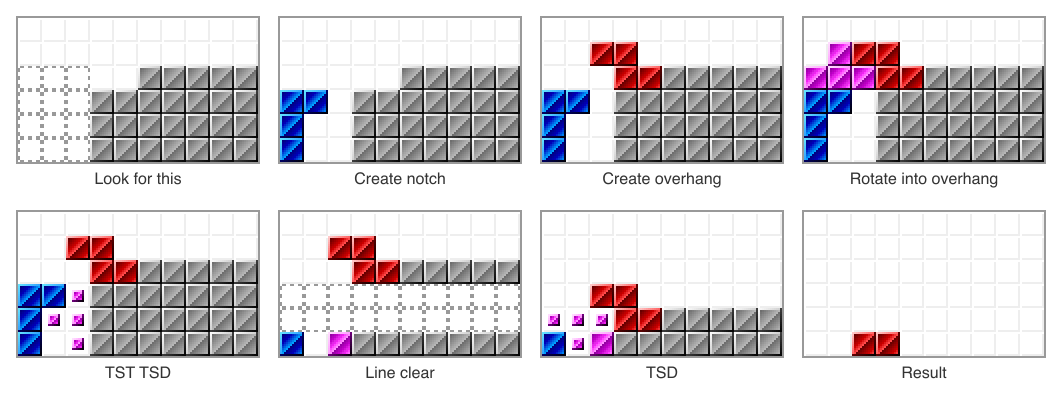
Tetris Mid-Game T-Spins: STSD, Imperial Cross, Kaidan
Once the opener is spent, the board decides your T-spins. Hard Drop files 63 pages of mid-game T-spin setups; this guide covers three families: lend your well to a T-spin, stack two TSD slots, or kick a T two rows deeper to save a bad board.
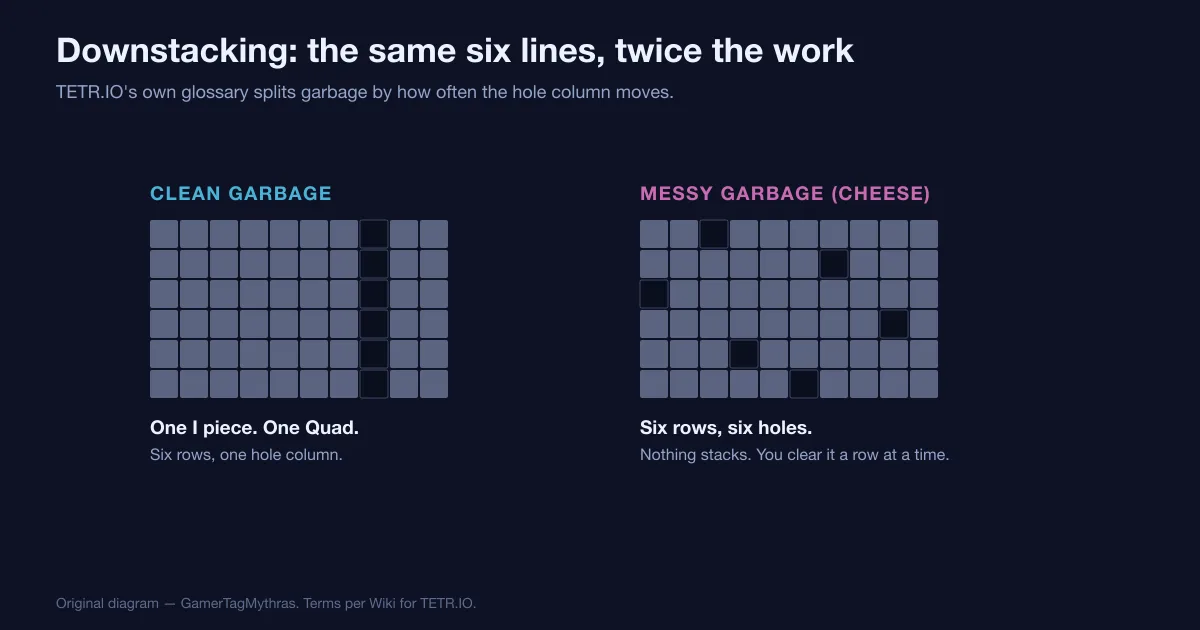
Tetris Downstacking: How to Dig Out of Garbage
Garbage is not one obstacle, it is two. Where the hole column sits from row to row decides whether six lines cost you one piece or six, and TETR.IO scores the lines you dig out at exactly the same rate as the lines you send.
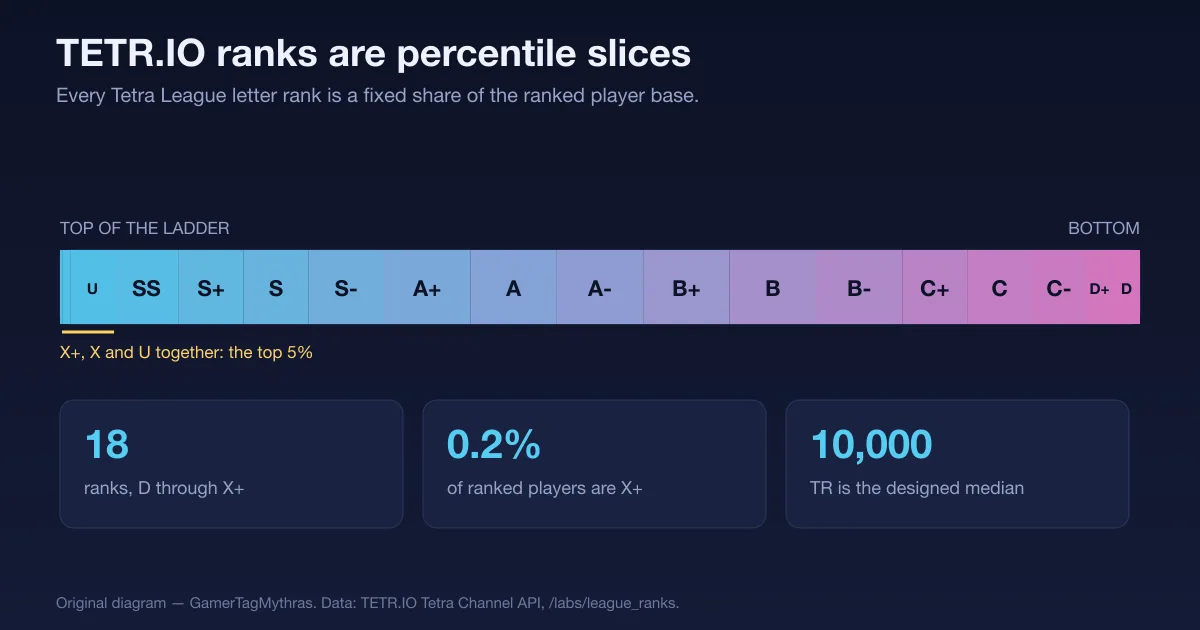
TETR.IO Ranks Explained: TR, Percentiles and Cutoffs
A Tetra League letter is not a skill score, it is a slice of the leaderboard — and TETR.IO publishes exactly how big each slice is, what TR it currently costs, and how fast the people inside it play.
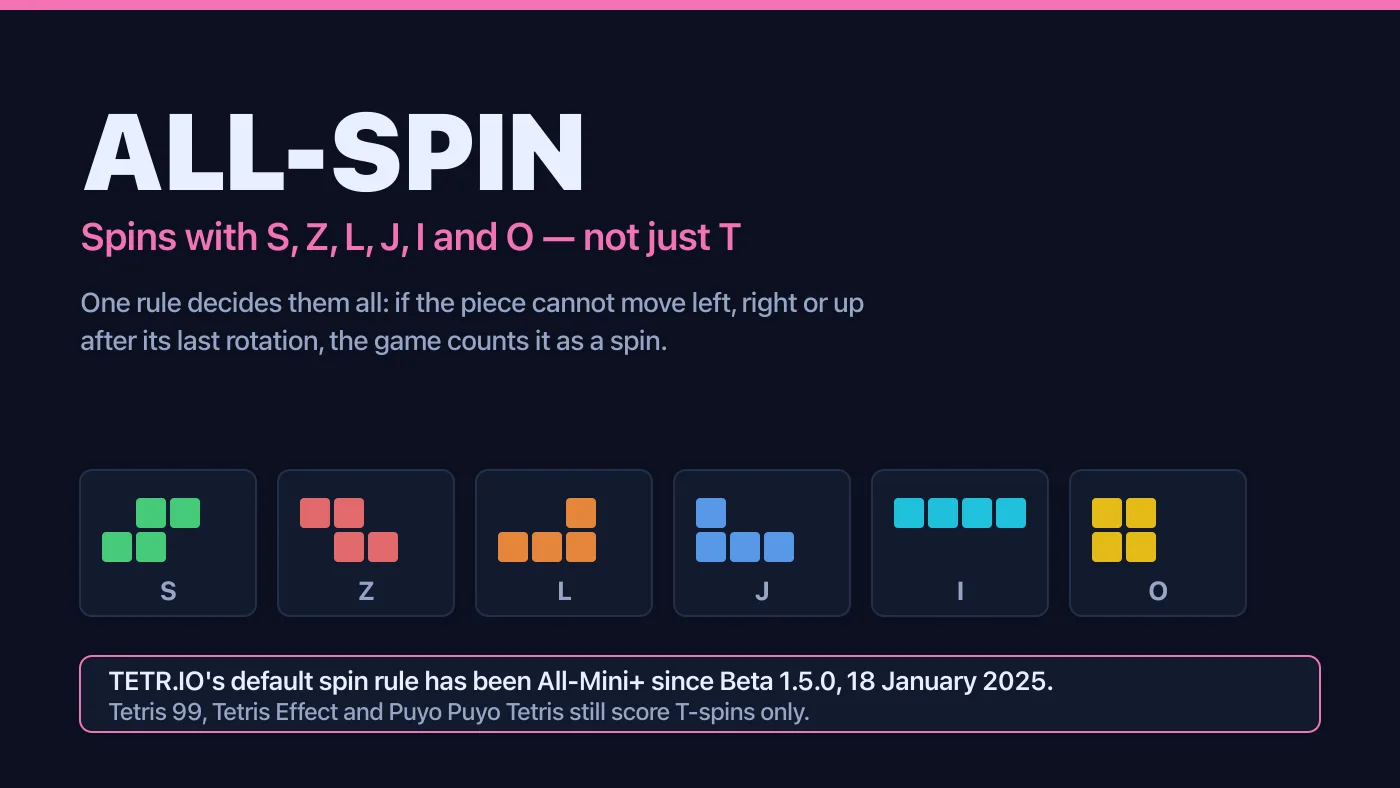
Tetris All-Spin Explained: S, Z, L, J and I Spins
A Z piece rotated into a slot nothing else reaches is either a scored spin or an ordinary Double, and which one it is has nothing to do with you. It is a setting, and most Tetris games have it switched off.
Tetris Stacking Fundamentals: Build a Board That Wins
Most players do not lose to speed. They lose to a board they built themselves three minutes earlier. Here is how stacking actually works in modern Guideline Tetris, and the habits that stop you from burying your own well.
TETR.IO Quick Play Explained: The Zenith Tower, Climb Speed, and HYPERSPEED
Quick Play looks like a battle royale and scores like a speedrun. There is no round to win and nobody to outlast — only altitude, and altitude is bought mostly with the lines you send at other people.