Tetris Scoring and Attack Explained: Points, B2B, Combos, and Garbage
Points and garbage are two completely different economies, and most players optimise for the wrong one. Here are the actual numbers behind Guideline scoring, versus attack, back-to-back, combos, and perfect clears.
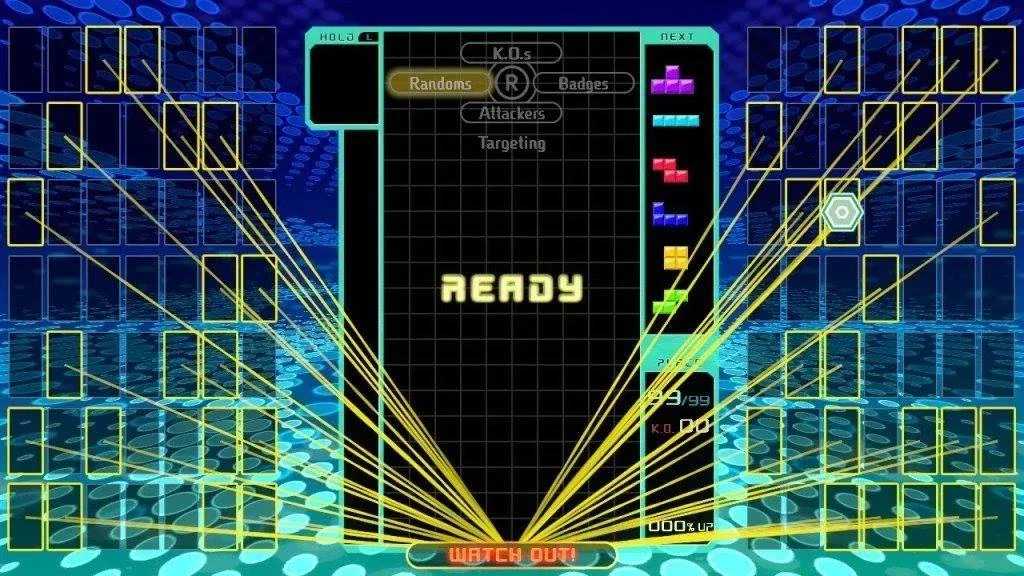
Two players clear the same forty lines. One finishes with triple the score of the other, and in a versus match one of them sends roughly twice as much garbage. Nothing about their stacking speed explains the gap. The gap is entirely in which clears they chose, and both scoring and attack in modern Tetris are governed by published tables that most players have never actually read.
This is a numbers guide for Guideline Tetris — the shared ruleset behind Tetris Effect, Tetris 99, Puyo Puyo Tetris, tetris.com and, with heavy modifications, TETR.IO. Everything below is the values themselves and what they imply about how you should be playing.
Points and garbage are two different economies
The single most useful thing to understand up front: the score table and the attack table are not the same table, and they do not rank clears in the same order.
Score cares about how difficult a clear is to set up. Attack cares about how much it hurts. They agree on some things (a Tetris is good, a Single is not) and disagree on others (a Triple is worth 500 points but sends only 2 rows, while a T-Spin Single is worth 800 points and sends 2). If you play Marathon and think you have learned versus, you have not. If you play ranked and think you know how to chase a score, same.
Both tables are also multiplicative in ways that punish inconsistency. Back-to-back and combo bonuses mean a player who strings clears together and one who spaces them out end up in wildly different places from identical line counts.
The Guideline scoring table
Here are the base values used by essentially every Guideline game since Tetris DS. Level always means the level before the clear, so the last clear that levels you up is paid at the old rate.
| Action | Points |
|---|---|
| Single | 100 × level |
| Double | 300 × level |
| Triple | 500 × level |
| Tetris | 800 × level (difficult) |
| Mini T-Spin, no lines | 100 × level |
| T-Spin, no lines | 400 × level |
| Mini T-Spin Single | 200 × level (difficult) |
| T-Spin Single | 800 × level (difficult) |
| Mini T-Spin Double | 400 × level (difficult) |
| T-Spin Double | 1200 × level (difficult) |
| T-Spin Triple | 1600 × level (difficult) |
| Combo | 50 × combo count × level |
| Soft drop | 1 point per cell |
| Hard drop | 2 points per cell |
Read that column twice. A T-Spin Double pays 1200 for two rows while a Tetris pays 800 for four. Per row, a T-Spin Double is three times as efficient as a Tetris and twelve times as efficient as a Single. A T-Spin Triple at 1600 is the largest single non-perfect-clear payout in the game.
This is why every high scoring player's board is built around T pieces rather than around the well. If you are still stacking flat and waiting on I pieces, that is a fine foundation — see our stacking fundamentals guide for the version of the board you should be maintaining — but it is a score ceiling, not a score strategy.
Note the drop points too. Hard drop pays 2 per cell, soft drop 1. Over a long Marathon that is real money, and it is one of the few places where playing faster literally scores more.
Back-to-back: the 1.5x nobody plans around
The word difficult in that table is doing enormous work. Any clear marked difficult — a Tetris, or any T-Spin line clear — starts and continues a back-to-back chain. Every difficult clear performed while the chain is live is multiplied by 1.5, excluding drop points.
The rules that matter:
- Only a Single, Double, or Triple breaks the chain. Nothing else.
- A T-Spin with no lines cleared does not break it. You can rotate a T into a slot, clear nothing, and your chain survives.
- Not clearing at all does not break it either. You can place twenty pieces without a clear and your back-to-back is still armed.
Run the arithmetic on a chained T-Spin Double: 1200 × 1.5 = 1800 × level, from two rows. A back-to-back Tetris is 1200. Once you understand that the chain only dies to non-difficult clears, the whole game reframes. You are not choosing between clears — you are choosing between keeping the multiplier and cashing out.
The practical failure is the panic Single. Player is buried, clears one row to breathe, and drops a chain they had been building for a minute. Sometimes that is correct. Recognise it as a cost.
Combos: loud for points, quiet for damage
A combo counter starts at -1 and increases by 1 for every placed piece that clears at least one line. Place a piece that clears nothing and the counter resets. So two clears in a row is a 1-combo, not a 2-combo.
For points, the formula is 50 × combo count × level, added on top of the line clear itself. That is meaningful in Marathon but it is not where the money is.
For attack, combos matter much more, and the tables vary by game. The Guideline standard table adds nothing at 1 combo, 1 extra row at 2 and 3, 2 rows at 4 and 5, 3 rows at 6 and 7, and tops out around 5 extra rows at 12 and above. Tetris 99 is more generous, giving +1 as early as a 1-combo and reaching +5 at 10. Tetris Effect: Connected is stingier, capping at +4 in normal play and +3 with ZONE enabled.
Add it up across a full chain and the totals converge more than you would expect: a maximal Guideline-standard combo run sends 39 extra rows, Tetris 99 sends 44, and Tetris Effect: Connected sends 30. Long combo chains are a real strategy — that is what the 4-wide setup exists for — but the per-clear damage is low, which is why combo players lose to a single well-timed spike.
Perfect clears are the fattest payout in the game
A perfect clear (also called an all clear or bravo) happens when a line clear empties the playfield completely. Recent Guideline games including Tetris Effect and the 2020 mobile Tetris award a bonus on top of the normal line clear score:
| Perfect clear type | Bonus points |
|---|---|
| Single-line perfect clear | 800 × level |
| Double-line perfect clear | 1200 × level |
| Triple-line perfect clear | 1800 × level |
| Tetris perfect clear | 2000 × level |
| Back-to-back Tetris perfect clear | 3200 × level |
The bonuses stack with the clear itself. A Triple perfect clear pays 1800 + 500 = 2300 × level. A back-to-back Tetris perfect clear is 3200 + 1200 = 4400 × level, from four rows.

In versus, the all clear row is the one place the reference wikis disagree: Harddrop's general Guideline table lists it as +7 rows of garbage, while Tetris Wiki's lists 10, plus the clear's own value. Either figure is more than a Tetris and a back-to-back bonus combined, and individual games tune it anyway — Tetris 99 dials it down to +4.
The reason perfect clears are practical at all is 7-bag. The Perfect Clear Opener builds a 4×4 box from I, J, L and O plus a stack of T, S and Z, and succeeds on 61.19% of starting sequences; hold the I where the sequence allows and that rises to 84.64%. The Grace System, which builds a 6×4 rectangle, hits 88.57% with the T held. Those are not gimmick odds. That is a coin flip you win two thirds of the time for the biggest payout in the game.
What actually sends garbage
Here is the general Guideline attack table, the one most versus games start from:
| Clear | Rows cleared | Garbage sent |
|---|---|---|
| Single | 1 | 0 |
| Double | 2 | 1 |
| Triple | 3 | 2 |
| Tetris | 4 | 4 |
| T-Spin Single | 1 | 2 |
| T-Spin Double | 2 | 4 |
| T-Spin Triple | 3 | 6 |
| Back-to-back bonus | — | +1 |
| All clear | any | +7 (Harddrop's table) or 10 (Tetris Wiki's) |
Three consequences, and they are the whole of versus Tetris.
Singles send nothing. Zero. Every Single you clear in a versus match is a row you gave up for free, unless you are digging.
T-Spins are the best damage-per-row in the game. A T-Spin Double sends the same 4 rows as a Tetris using half the board height, and it sets up faster. If you do not have T-Spins in your toolkit yet, that is the single highest-leverage thing you can learn — our T-spin guide covers the corner rules and the standard setups.
The back-to-back bonus is flat. Only +1 row, not a multiplier. In scoring, back-to-back is a 50% raise; in attack, it is one extra line. That asymmetry catches people who learn the game in Marathon and then wonder why their beautiful chains are not killing anyone.

One more mechanic worth knowing: incoming garbage sits in a queue before it appears, and clearing lines while it is pending cancels it. That is why a fast, clean board beats a slow, huge one. Speed is not just a sprint stat — if you want to raise yours, the 40-line sprint guide and the finesse guide both attack it from different directions.
Tetris 99 bends the table with badges and targeting
Tetris 99 keeps the standard base table (except the +4 all clear) and layers a badge economy on top. Knock a player out and you take badges; knock out a player who has badges and you inherit some of theirs. Badges multiply your attack:
| Badges | Attack boost | Badge points required |
|---|---|---|
| 1 | +25% | 2 |
| 2 | +50% | 6 |
| 3 | +75% | 14 |
| 4 | +100% | 30 |
A four-badge player sends double. That is why the late game snowballs so violently and why the Badges targeting mode is a genuine strategic choice rather than a preference.
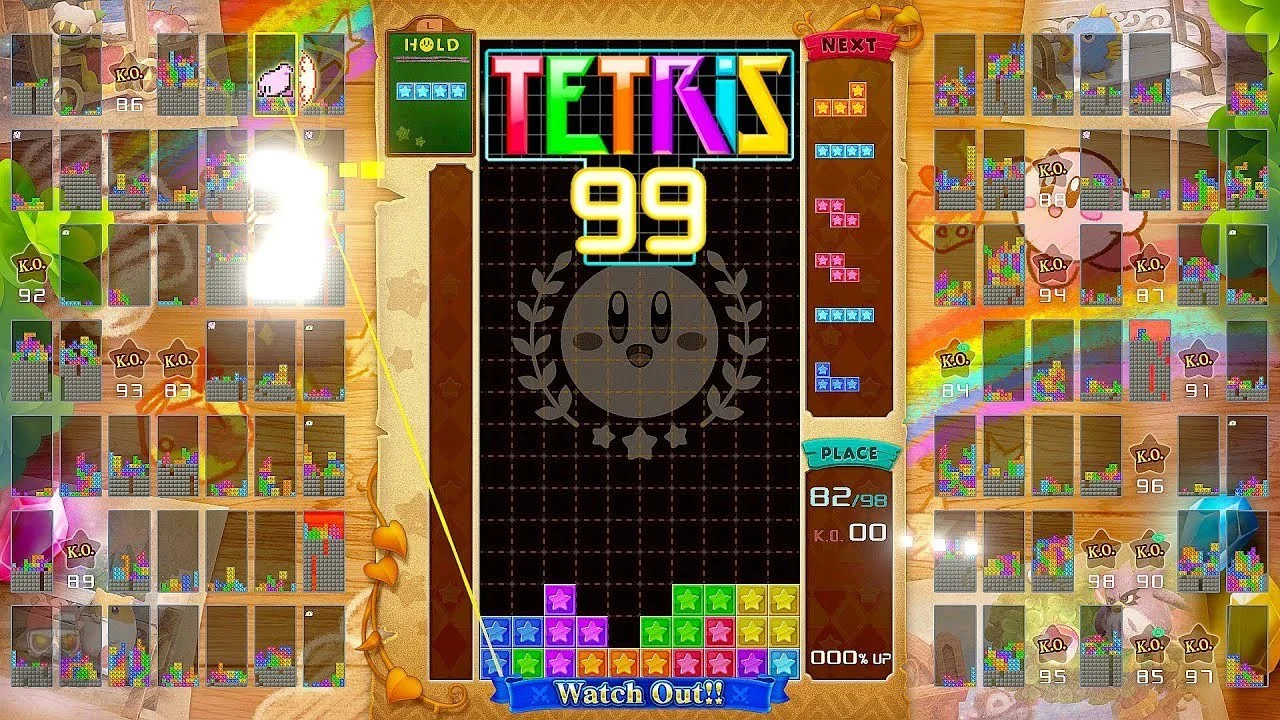
Two more Tetris 99 specifics that decide matches:
- Being targeted pays. If multiple opponents target you, you get bonus rows per clear: +1 when two players are on you, +3 at three, +5 at four, +7 at five, +9 at six or more. This is applied before the badge boost, so a targeted four-badge player is terrifying.
- There are hard caps. You can hold at most 12 rows of pending garbage and send at most 20 with one clear. Anything past those numbers is discarded, which means gigantic setups can literally waste damage.
Gravity also ramps once 50 players remain, eventually reaching 1G — one row per frame. Plan your endgame board before that happens, not during.
TETR.IO threw the table out
TETR.IO uses its own systems by default and they are different enough that habits do not transfer cleanly.
Its Multiplier combo system scales attack by base × (1 + 0.25x) where x is the combo count, so combos amplify big clears rather than adding a flat row. A 4-wide combo of Singles, with a base of 0, is handled by a separate logarithmic curve and is deliberately weak — the system exists specifically to nerf 4-wide and reward combos that finish in a quad or a T-Spin.
Its back-to-back charging replaces the flat +1. Difficult clears add one extra row each, and once your streak hits 4 you start charging a Surge: every additional back-to-back level adds another line to a stored attack. When the streak finally breaks, the Surge is sent, split into three separate attacks. Break a long chain and you unload something a normal Guideline game cannot produce. A later balance patch (September 2024) also gave Quads and Spins that clear garbage a flat +1 extra garbage, uninfluenced by multipliers.
The takeaway is not that one system is correct. It is that "how do I do damage here" is a question you have to re-ask per game, and the answer is published in each one's wiki.
How to actually raise your numbers
- In Marathon, hunt T-Spin Doubles and keep the chain alive. 1800 × level per two rows beats anything else you can do repeatedly.
- In versus, stop clearing Singles unless you are digging. Zero rows sent, chain broken, and you gave your opponent free time.
- Learn one perfect clear opener. PCO at a 61% hit rate is the highest expected value opening in the game, in both currencies.
- Count your back-to-back cost before you break it. Ask what you lose, not just what you gain.
- Check the attack table of the game you actually play. Tetris 99, Tetris Effect: Connected and TETR.IO all differ from the baseline in ways that change correct play.
More of our Tetris breakdowns live on the Tetris coverage hub.
Quick Action Checklist
- Memorise four numbers: Single 100, Double 300, Triple 500, Tetris 800, all × level.
- Remember the outlier: a T-Spin Double is 1200 and a T-Spin Triple is 1600.
- Keep back-to-back alive; only Singles, Doubles and Triples break it.
- A chained T-Spin Double is 1800 × level. That is your scoring engine.
- In versus, Singles send zero rows. Treat them as a cost, not a clear.
- T-Spin Double and Tetris both send 4, but the T-Spin uses half the height.
- Back-to-back sends only +1 row in versus, not a 1.5x multiplier.
- An all clear is the biggest single-clear attack — +7 on Harddrop's Guideline table, 10 on Tetris Wiki's, +4 in Tetris 99.
- In Tetris 99, four badges double your attack and being targeted adds up to +9 rows.
- In TETR.IO, combos multiply big clears and a broken back-to-back streak fires a Surge.
Frequently Asked Questions
What scores the most points in Tetris?
How does the back-to-back bonus work?
Why do my Singles not send any garbage?
How much is a perfect clear worth?
How likely is the Perfect Clear Opener to actually work?
Are combos worth building around?
How do Tetris 99 badges change attack?
Does TETR.IO use the same scoring as other Tetris games?
Keep Reading
- TetrisWiki — Guideline scoring table, back-to-back and perfect clear bonuses
- TetrisWiki — combo counters and per-game combo garbage tables
- Hard Drop Tetris Wiki — general Guideline garbage table
- TetrisWiki — Tetris 99 badges, targeting bonuses and garbage caps
- TetrisWiki — TETR.IO Multiplier combos and back-to-back charging
- TetrisWiki — Perfect Clear Opener and Grace System success rates
Related Guides
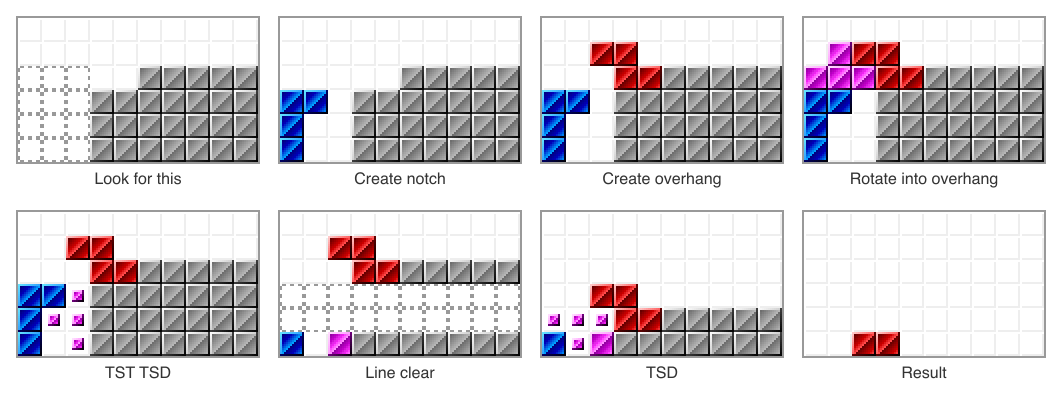
Tetris Mid-Game T-Spins: STSD, Imperial Cross, Kaidan
Once the opener is spent, the board decides your T-spins. Hard Drop files 63 pages of mid-game T-spin setups; this guide covers three families: lend your well to a T-spin, stack two TSD slots, or kick a T two rows deeper to save a bad board.
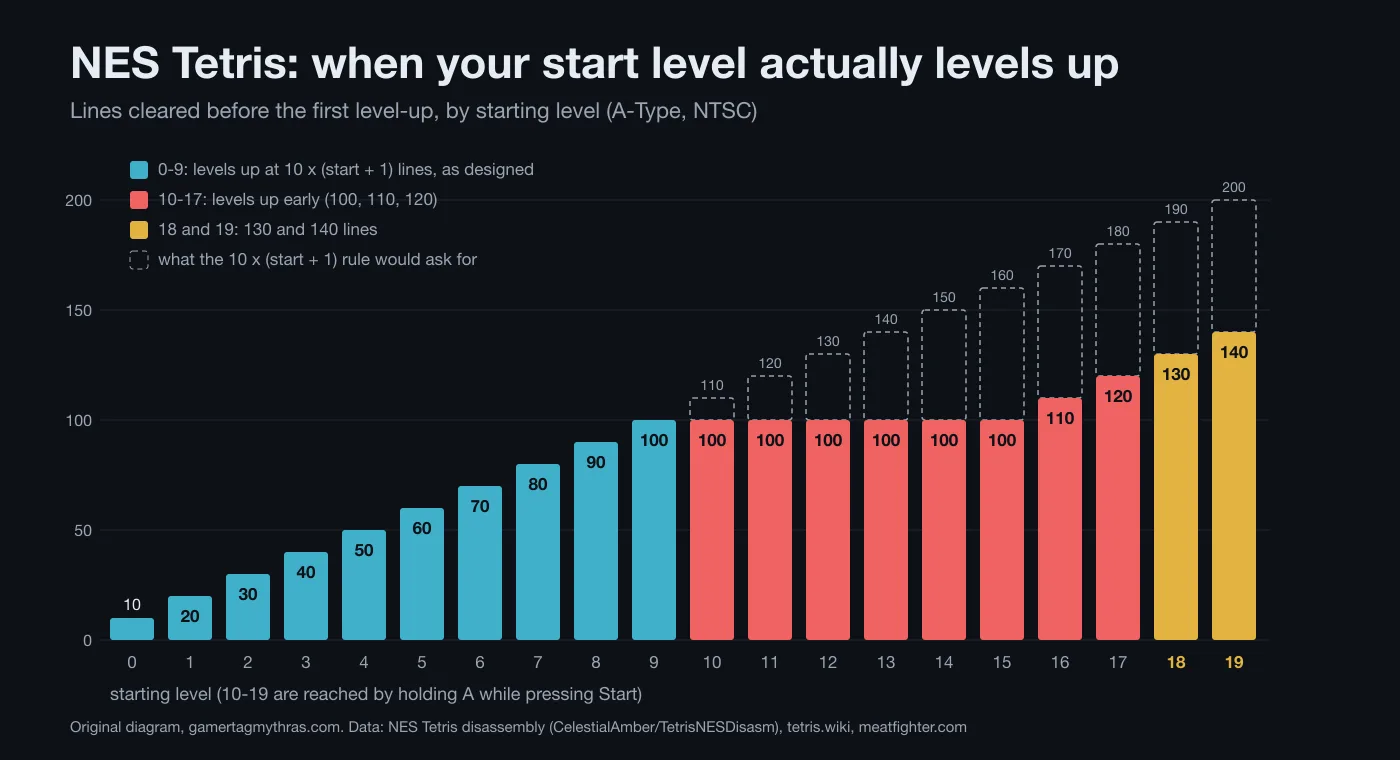
NES Tetris Level Transition and Scoring Explained
Start NES Tetris on 18 and you stay there for 130 lines. Start on 19 and it is 140. Start on 12 and it is 100. One missing conversion in the cartridge explains all three, and it also decides which clear gets paid at the higher rate.
Tetris Downstacking: How to Dig Out of Garbage
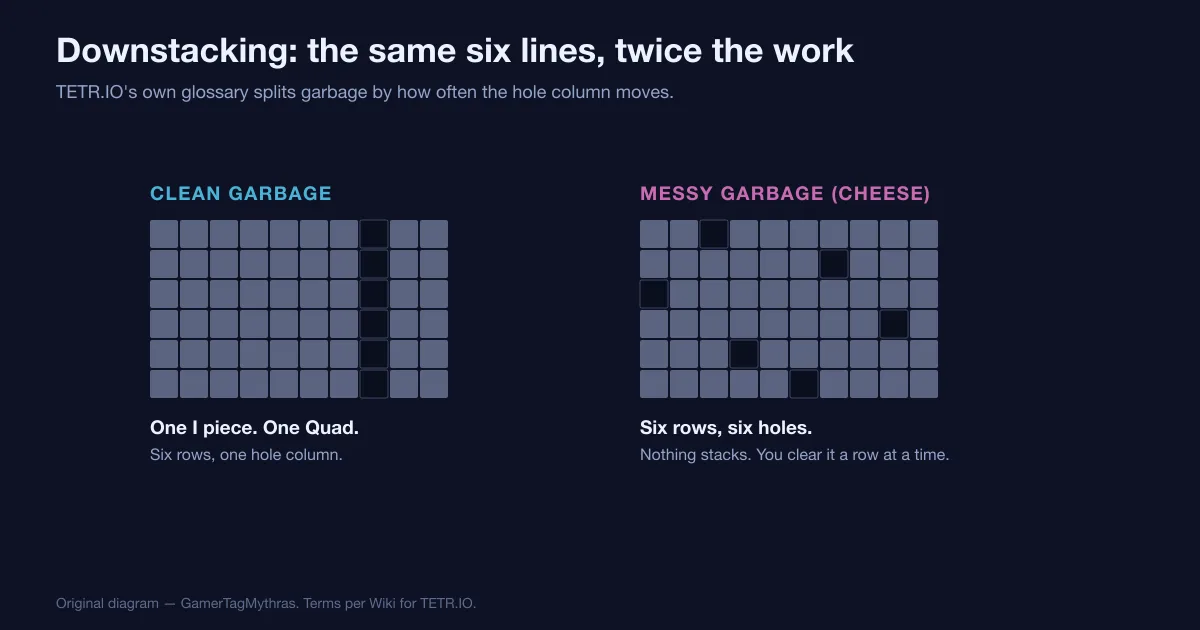
Garbage is not one obstacle, it is two. Where the hole column sits from row to row decides whether six lines cost you one piece or six, and TETR.IO scores the lines you dig out at exactly the same rate as the lines you send.
TETR.IO Ranks Explained: TR, Percentiles and Cutoffs
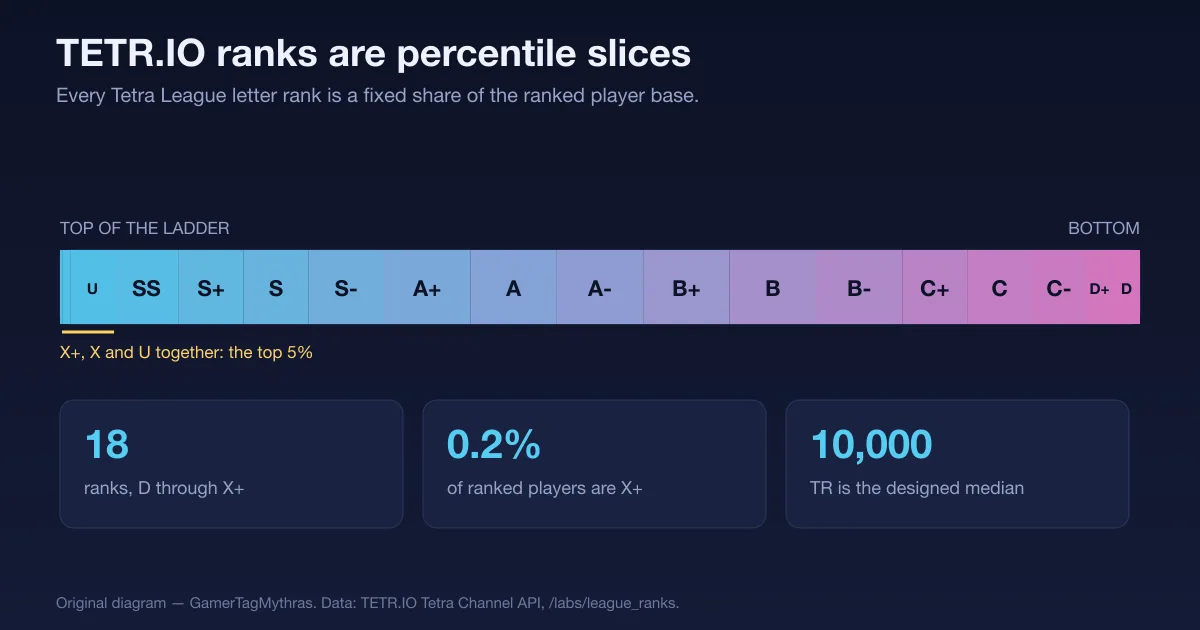
A Tetra League letter is not a skill score, it is a slice of the leaderboard — and TETR.IO publishes exactly how big each slice is, what TR it currently costs, and how fast the people inside it play.

Tetris Stacking Fundamentals: Build a Board That Wins
Most players do not lose to speed. They lose to a board they built themselves three minutes earlier. Here is how stacking actually works in modern Guideline Tetris, and the habits that stop you from burying your own well.
Tetris All-Spin Explained: S, Z, L, J and I Spins
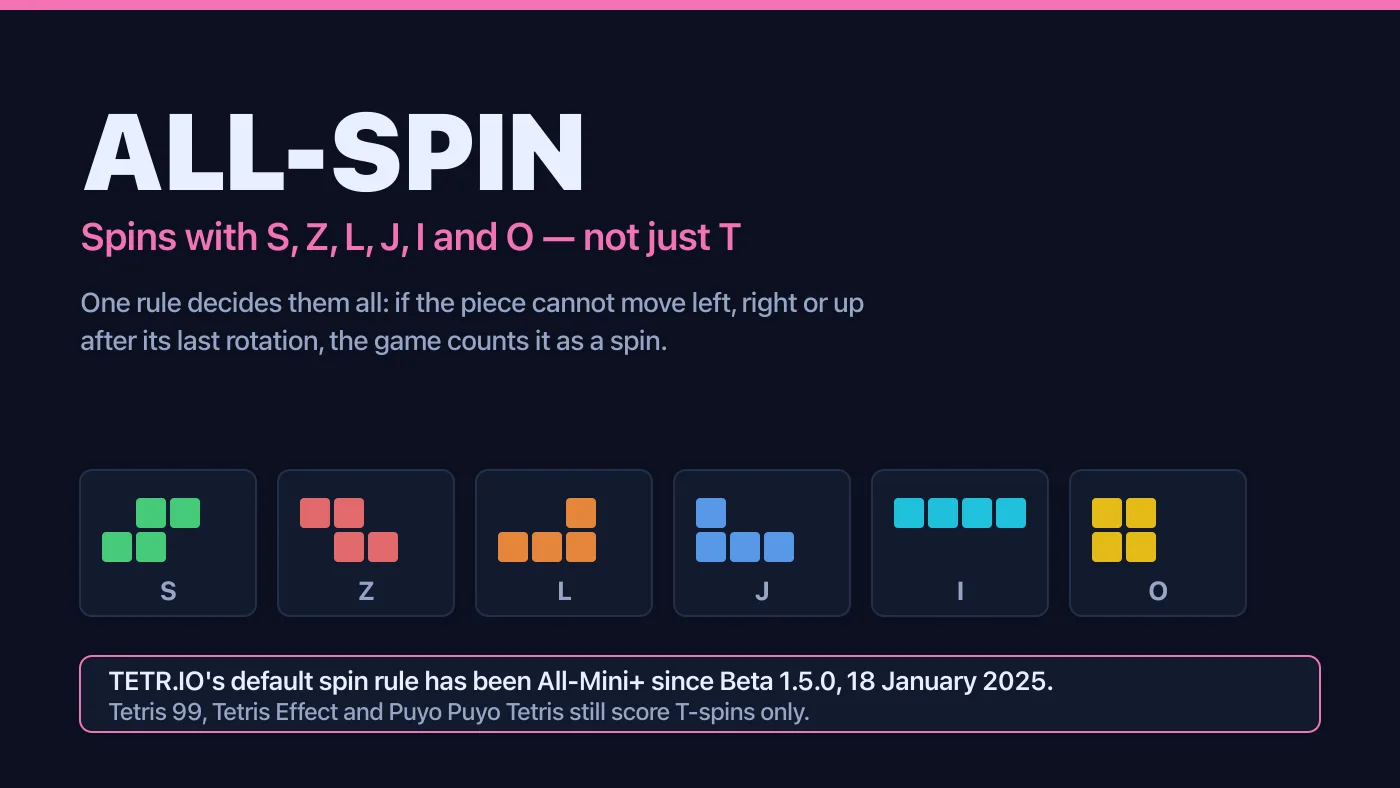
A Z piece rotated into a slot nothing else reaches is either a scored spin or an ordinary Double, and which one it is has nothing to do with you. It is a setting, and most Tetris games have it switched off.