Tetris T-Spin Triple Setups: Triple Double to Infinite TST
A T-spin triple sends 6 lines from one T where a double sends 4, but it costs a three-deep hole and leaves an overhang behind. How to spot one mid-game, pay off the overhang, and turn it into a Triple Double, a second triple or the Infinite TST loop.
A T-spin double clears two rows and sends 4 lines. A T-spin triple clears three and sends 6. Per row, that is the same 2 lines either way, so the triple is not the more efficient clear per row. It is more efficient per T, and the T is the piece every T-spin is rationed by: a 7-bag deals exactly one per bag, and the triple gets 6 lines out of it where the double gets 4. That is the case for the TST. The price is a three-deep hole you have to bend the board around, and the overhang it leaves behind once it fires.
This is the triple half of the mid-game. Our mid-game T-spin setups guide covers the T-spin double families: donations, Kaidan, the STSD, Fractal and Imperial Cross. The T-spin guide has the three-corner rule and the basic tower, and the openers guide has the first-bag builds that include a triple, DT Cannon, C-Spin and Albatross among them. This post covers what comes after those: spotting a triple on a board you did not plan, paying off its overhang, the Triple Double, two triples in a row, and the Infinite TST loop. The sources are Hard Drop's wiki and FOUR (four.lol), a community setup guide, with tetris.wiki for which games count what.
Scope: Guideline games with SRS wall kicks and three-corner T-spin detection. tetris.wiki's comparison of Guideline games lists Tetris 99, Tetris Effect and Puyo Puyo Tetris with standard detection that recognises triples. The games that do not are near the end.
The triple family at a glance
| Setup | What it is | T pieces | Lines sent, new chain | Lines sent, chain already running |
|---|---|---|---|---|
| TST | One T kicked into a slot three rows deep | 1 | 6 | 7 |
| Triple Double (TD) | A TST whose slot leaves a T-spin double slot behind | 2 | 11 | 12 |
| Back-to-back TST | Two TST slots stacked on top of each other | 2 | 13 | 14 |
| Special Triple Triple | A Triple Double shape with its floor hole two columns over, so the second spin is a triple too | 2 | 13 | 14 |
| Infinite TST | A loop of four triples in two towers, built in four columns | 4 per loop | 27 per loop | 28 per loop |
The line counts use Hard Drop's general Guideline garbage table: 6 for a T-spin triple, 4 for a T-spin double, and +1 back-to-back on each difficult clear while the chain is alive. "New chain" means the first spin starts the chain and gets no bonus. Both sources' own totals match that arithmetic: FOUR puts a Triple Double at 12 lines when you have been maintaining back-to-back, and Hard Drop says a back-to-back TST sends 13 in Tetris DS. Clients tune their own tables, which the scoring and attack guide covers.
A triple pays more per T, not per row
| T-spin double | T-spin triple | |
|---|---|---|
| Rows cleared | 2 | 3 |
| Garbage sent, Guideline table | 4 | 6 |
| Garbage per row | 2 | 2 |
| Garbage with back-to-back | 5 | 7 |
| Back-to-back garbage per row | 2.5 | 2.33 |
| Points (x level) | 1,200 | 1,600 |
| Back-to-back points per row (x level) | 900 | 800 |
The garbage comes from Hard Drop's table and the points from tetris.wiki's scoring page, where back-to-back multiplies a difficult clear by 1.5. The per-row lines are our division. Row for row, the double is as good or better on both counts. T for T, the triple sends 50% more, 6 lines against 4; with back-to-back it is 7 against 5, or 40% more.
The board is the other half of the argument, and Hard Drop's Infinite TST page makes it for score. A bag of seven pieces adds 28 cells. A T-spin double removes 20, so a game of nothing but doubles runs out of room. Even spending every T, Hard Drop counts one Tetris needed per five doubles, which caps a T-spin double strategy at 729 points per cleared line. ST Stacking, the popular double loop, uses one Tetris per four doubles and comes to 700. Back-to-back triples score 800 per line. Hard Drop's conclusion is that Tetrises have to join the mix in the long run unless you use triples. By our subtraction, a triple removes 30 cells, two more than the bag added.
How the T gets in: two rotations and one deep kick
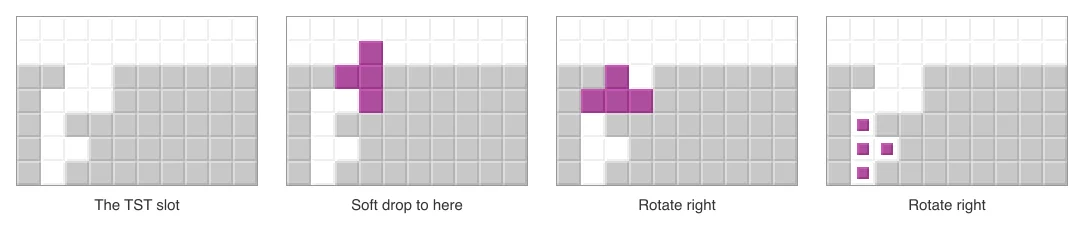
The diagram at the top of this page is Hard Drop's walkthrough. Hard Drop says a T only gets under a TST overhang by sliding or by using the T-spin single twist, and that the twist needs the wall opposite the overhang to be at least two rows high.
Hard Drop's Infinite TST page spells out the inputs, written for an overhang on the left:
- Rotate the T upright at the top, counterclockwise, so it faces the overhang.
- Soft drop it to the bottom of the open side.
- Rotate the other way, clockwise. Hard Drop calls this the T-spin Mini kick: the T's centre moves one column sideways and one row down. In the diagram, this is the step where the T twists flat into the mouth of the slot.
- Rotate clockwise again. The T-spin triple kick moves the centre one column sideways and two rows down, into the slot.
Mirror the directions for an overhang on the right. The two-row drop is the whole trick; Hard Drop notes that a T needs it to clear three lines at once. It is also why a TST is never scored as a Mini: tetris.wiki's T-spin page says a rotation whose kick moves the centre 1 by 2, the last offset SRS tries, counts as a proper T-spin even when its corners alone would make it a Mini, and its scoring table lists a Mini triple as impossible. Our wall kicks guide has the kick tables behind both moves.
Four shapes that fit a triple
FOUR counts four main ways to build a TST mid-game, with most of its examples credited to the player kazu:
- Notch. FOUR calls it probably the most straightforward shape to recognise. It notes that an L and J overhang is not the only way to finish one, and that other piece combinations may leave a cleaner stack. It also observes that people often build a TST on reflex when they see a notch, and points out that an STMB Cave can be built there too.
- Two-step stair. Whenever you see one, FOUR says to consider a TST. An S or Z can build the stair, which FOUR flags as useful for TST donations.
- One-step stair. With only one step, FOUR says an S or Z is the easiest way in. Leave one particular cell unfilled while you build it and the same shape offers another TST or a TSD afterwards.
- TSD conversion. FOUR says T-spin doubles and incomplete TSDs can be converted into triples, Neo-TSDs included, and that the conversions are especially useful for fixing bad overhangs when building Triple Doubles and for turning a TSD donation into a TST donation.
Two rules from Hard Drop decide whether to commit. If the triple sits on top of an empty garbage column, that column will be open again after the triple, as long as it lies under the notch or under the filled column beside the notch. And if the triple would mean stacking high over an empty column, Hard Drop's bailout is to take a T-spin double out of the same slot instead. FOUR makes the general point in its TST vs. TSD tips: sometimes the double is the better clear.
The overhang is the bill

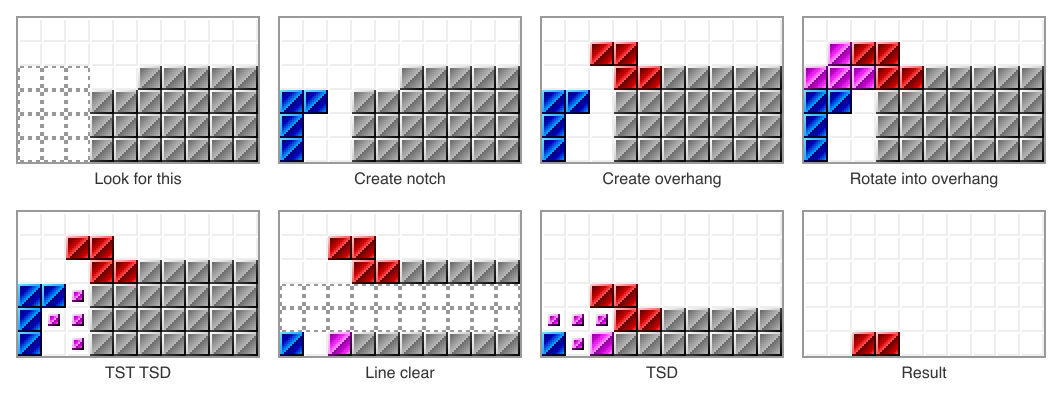
FOUR puts it plainly: after a TST you are always left with an overhang, and it needs cleaning up. Hard Drop adds the cost of waiting. Delaying it can lead to overstacking and an awkward stack, and it is time taken away from the garbage under the setup. Hard Drop's four examples, from the diagram above:
| Cleanup | Rows it clears in Hard Drop's diagram | Back-to-back |
|---|---|---|
| T-spin single | 1 | Kept: a line-clearing T-spin is a difficult clear |
| L-spin | 2 | Kept only if your game scores it as a spin |
| J slide | 0 | Kept: a placement that clears nothing does not break the chain |
| O line clear | 1 | Broken: a plain Single |
The chain rules come from tetris.wiki's scoring page, which says only a Single, Double or Triple breaks back-to-back, and Hard Drop's Back-to-Back page, which shows a placement that clears no lines leaving the chain intact. The L-spin row is the one to check. tetris.wiki lists Tetris 99, Tetris Effect and Puyo Puyo Tetris as recognising twists with the T only, so there the L clears a plain Double and ends the chain. TETR.IO's Beta 1.2.0 patch notes count immobile spins with other pieces as Minis that add and keep back-to-back, so in TETR.IO it depends on whether the L ends up immobile. Our all-spin guide covers that test.
FOUR's habits for paying the bill:
- J or L, if you are protecting back-to-back. FOUR says TST overhangs are generally cleaned up that way when you are trying to keep the chain. T-spin Minis get used too, but FOUR says that in many cases the T is better spent in the stack, on a Tetris or a TSD.
- Plan the next overhang now. Because you already know a J or L is going under the leftover, FOUR suggests matching the column parity on the other side so you create a TSD overhang in anticipation.
- Donate it away. If the triple's overhang was made with an S or Z, FOUR shows it cleaned up with what is essentially a Kaidan, or with a Shachiku Train when the S or Z lay flat. Both are donations, and the mid-game guide covers how donating works.
Triple Double: the triple that sets up its own double
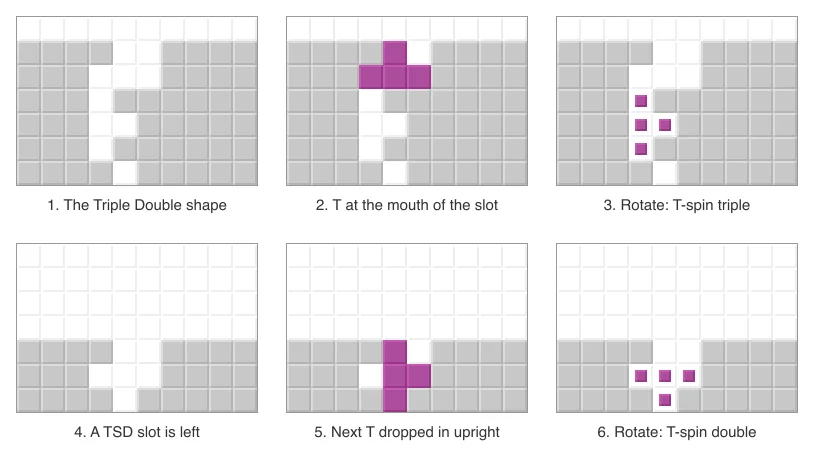
Hard Drop defines the Triple Double attack, also called Triple-Double, C-Spin or TD, as a T-spin triple followed by a T-spin double. FOUR calls it a powerful setup to use mid-game, worth 12 lines when back-to-back is already running, the same as a DT Cannon. A DT Cannon fires the double first and the triple second; the TD reverses the order, and what makes it work mid-game is the slot the triple leaves behind.
FOUR says a TD is built the same way as a TST, with one difference: an empty column underneath, at a specific position. Hard Drop's version of the same advice is to build the notch above an empty column or cell, which sets up the double in advance. The diagram shows why. The notch block goes out with the three cleared rows, and the empty cell that was under it becomes the bottom of a ready-made T-spin double slot.
Where to look for one:
- A block over a hole. FOUR says TDs are most easily recognised when a block sits above an empty column, and Hard Drop's notch section uses that shape to deal with a single mino on top of a line of garbage.
- A C made of J and L. A TD built with a J and an L is what both sources call a C-Spin, after the C the two pieces form. The C-Spin opener is in our openers guide; FOUR says you can build a TD this way whenever you spot a notch of the matching shape.
- After a T-spin single donation. FOUR builds TDs after a particular TSS donation that leaves a notch, used when you cannot fill the block a TSD donation would need.
- A bad overhang. FOUR says TDs are useful for fixing one. An Imperial Cross can do the same job, but FOUR says the TD is often preferred when you can build either.
One naming trap: Hard Drop and FOUR both note that in Japanese usage "TKI" often means the Triple Double or the C-Spin, while English-speaking players usually mean the TKI-3 opener.
Two triples in a row
Stack two TST slots and you get a back-to-back T-spin triple, which FOUR calls a Double TST. The two sources disagree on when to build one, and the disagreement is the useful part:
- Hard Drop says the technique is frequently used in mid-game and barely ever seen as an opener.
- FOUR calls it a spiking technique for limited situations, risky to build mid-game, and says it is usually made early in the game, with no garbage lines on the board, because it is very easy to get spiked while you build it.
Our read, and it is opinion: build it on a clean board, and treat it as a luxury once garbage starts arriving.
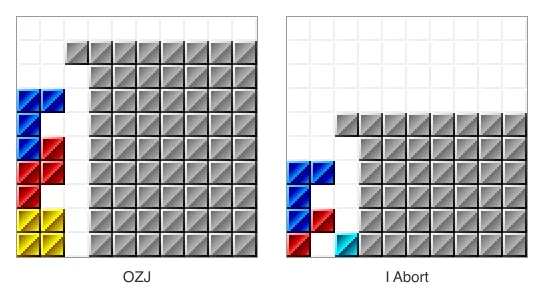
Hard Drop's pick is OZJ, which it calls arguably the safest and most efficient back-to-back TST setup. It takes the fewest pieces to set up the notch, leaves seven columns free to stack, and has an escape hatch: before the final lid piece goes on, an I placed into the empty column turns one of the triples into a double. Hard Drop calls that a scapegoat for ill-fated garbage. Its ZZJ variation is for S and Z starts.
FOUR's routes in: a JZ or LS platform beside a right side that is already built, a particular TSD shape with room for an S or Z, or an STSD turned into a double TST, which FOUR calls another safe way to build one.
Two relatives:
- Special Triple Triple. Credited by Hard Drop to the player Chopin of Tetris, it sends the same as a back-to-back TST but sits lower, so it is less easily topped out. The shape is a Triple Double with the floor hole moved two columns over, and after the first triple an S or Z makes the second notch. Hard Drop calls it one of the more advanced setups.
- Incomplete TST. A TST with at least one of its rows left unfilled; Hard Drop names the STSD as a common case. When the missing mino is three cells from the T slot, the incomplete triple can be followed by another TST. A Ventilator leaves the missing mino on the second row beside the slot. Hard Drop says the Japanese community calls it the CC Cannon, because the bot Cold Clear sometimes uses it, and that it often leaves unclean residue.
Infinite TST: triples on a loop
Hard Drop credits the Infinite TST to the player Massi4h, and FOUR agrees. Each loop is two TST towers and four triples. Hard Drop calls it one of the most efficient methods to score points in single-player modes such as Ultra or Marathon, and adds that it can be strong in multiplayer modes where back-to-back triples send a lot, naming Tetris Battle. FOUR describes it as a looping technique often used in Ultra, commonly after a DT Cannon opener, and more efficient than ST Stacking, the other Ultra technique it names. That matches the scoring maths above: 800 points per line against ST Stacking's 700.
What it costs:
- A piece budget. Hard Drop's standard version uses the four leftmost columns, with the excess pieces stacked on the right. That pattern needs 3 L pieces, 2 I pieces and one each of S, Z and J. Mirrored onto the right side it needs 3 J instead, and Hard Drop says the mirror may work better under high gravity.
- Your T pieces. Hard Drop's TST page says 14 out of 15 T pieces must be used for triples so the loop side of the stack does not grow, unless you skim.
- Risk. The same page calls the loop pretty risky.
- 20G. Hard Drop's "reversed" versions, which mirror only the four loop columns, include a J or L overhang placement that cannot be done under 20G.
To start it, Hard Drop lists several routes. On an empty board, a flat Z placed two columns from the left wall works, at the cost of two T pieces spent on the right before the first triple. A DT Cannon, which Hard Drop calls by far the most common start, the first TSD of a TKI and an Albatross can all lead into the loop. FOUR names the DT Cannon and the Albatross too, and our openers guide covers all three openers. FOUR also links Jstris replays of the loop in Ultra if you want to watch one run.
Check your game before you build
| Rule in your game | What it means for triples | Source |
|---|---|---|
| Standard three-corner detection | Triples recognised, as in Tetris 99, Tetris Effect and Puyo Puyo Tetris | tetris.wiki comparison table |
| Kick-nerfed detection that skips triples | Tetris Zone does not recognise T-spin triples | tetris.wiki |
| No-kick detection | Tetris Evolution, Tetris: New Century and iPod Tetris only count spins without a kick; a TST needs the kick, so by our reading it cannot count there | tetris.wiki, Hard Drop |
| 180 rotation with a sideways kick from north to south | Makes the Iso T-spin Triple (TrIso) possible, in TETR.IO but not Jstris | Hard Drop |
| Back-to-Back Charging, TETR.IO Beta 1.2.0 | +1 per attack while the chain lives, and from B2Bx4 a Surge that is sent, split into three attacks, when the chain breaks | TETR.IO patch notes |
| Garbage bonus, TETR.IO Beta 1.3.0 | Quads and spins that clear garbage send a flat +1, outside the multipliers | TETR.IO patch notes |
TrIso is a curiosity: Hard Drop says it is rarely used, credits it to YackTenebreux, and calls the Yackspin opener one of the only openers built on it, if not the only one. The TETR.IO rows matter more. A Triple Double or a back-to-back TST is the kind of setup that keeps a chain climbing between Quads, and the Tetra League ranks guide covers the rest of the Season 2 rules.
Which triple to learn first
This part is opinion. Learn the plain TST from a notch first, with a J or L cleanup, because the Triple Double, the back-to-back TST and the Infinite TST are all built from it. Then the Triple Double, because its cleanup is a second spin instead of a chore. Back-to-back TSTs come next, on a clean board, with OZJ's I escape in your pocket. The Infinite TST is a score-mode skill first: learn it if you play Ultra or Marathon.
For practice, rebuild the diagrams. FOUR publishes its setups as fumen diagrams, and our fumen guide covers stepping through and editing them; building each shape by hand in an editor is a quick check that you know which pieces it needs. On a board full of garbage, dig before you build: the downstacking guide covers that. More on the Tetris coverage hub.
Quick Action Checklist
- Count a triple by T pieces, not rows: 6 lines per T against 4 for a double, the same 2 lines per row.
- Drop the T upright facing the overhang, then rotate the other way twice: one kick to the mouth of the slot, one deep kick into it.
- Check that the wall opposite the overhang is at least two rows high before you rely on the twist.
- Look for FOUR's four shapes: a notch, a two-step stair, a one-step stair with S or Z, and a TSD you can convert.
- If the triple means stacking high over an empty column, take Hard Drop's TSD bailout instead.
- Clean the leftover overhang soon, with a J or L slide if back-to-back matters; an O that clears a Single ends the chain.
- Build the notch above an empty cell and the triple leaves you a TSD slot: that is the Triple Double.
- Save back-to-back TSTs for a clean board, and use OZJ's I escape before the lid goes on.
- Learn the Infinite TST for Ultra and Marathon, and expect it to want 14 of every 15 T pieces.
- Check your game first: Tetris Zone does not recognise triples, and TrIso needs a 180 kick like TETR.IO's.
Frequently Asked Questions
What is a T-spin triple in Tetris?
Is a T-spin triple better than a T-spin double?
How do you do a T-spin triple in Tetris?
What is a Triple Double in Tetris?
How do you clean up the overhang after a T-spin triple?
What is Infinite TST in Tetris?
Keep Reading
- Hard Drop Tetris Wiki — T-Spin Triple Setups: the slide or T-spin single twist, the two-row wall, garbage columns, overhang cleanup, the TSD bailout, Infinite TST piece demands and TrIso
- Hard Drop Tetris Wiki — Infinite TST: Massi4h, execution steps and kicks, piece needs, points per cleared line, starting methods
- Hard Drop Tetris Wiki — Triple Double Attack Setups: names, the TKI naming note, notch over garbage, C-Spin cores
- Hard Drop Tetris Wiki — Back-to-Back T-Spin Triple: 13 rows in Tetris DS, the OZJ setup and I abort, ZZJ
- Hard Drop Tetris Wiki — Special Triple Triple: Chopin of Tetris, the shifted floor hole, S or Z second notch
- Hard Drop Tetris Wiki — Incomplete TST: STSD as a case, TST chaining, the Ventilator (CC Cannon)
- Hard Drop Tetris Wiki — C-Spin: the J and L C shape, opener cores and continuations
- Hard Drop Tetris Wiki — Garbage: the general Guideline garbage table
- Hard Drop Tetris Wiki — Back-to-Back: difficult clears and a non-clearing placement that keeps the chain
- FOUR — T-Spin Triple (TST): four ways to build one mid-game, cleaning up the overhang, incomplete TSTs, Double TST, Infinite TST
- FOUR — Triple Double (TD): 12 lines with back-to-back, notch over an empty column, C-Spin, donations, fixing bad overhangs
- TetrisWiki — T-Spin: the 1-by-2 kick rule, Mini triple impossible, games without triple or kick recognition
- TetrisWiki — Scoring: Guideline points, the 1.5x back-to-back multiplier, what breaks a chain
- TetrisWiki — Guideline compliant game differences: T-spin and twist recognition by game
- TETR.IO patch notes — Beta 1.2.0 (Back-to-Back Charging, Surge, All-Mini) and Beta 1.3.0 (+1 for Quads and spins that clear garbage)
Related Guides
Tetris Mid-Game T-Spins: STSD, Imperial Cross, Kaidan
Once the opener is spent, the board decides your T-spins. Hard Drop files 63 pages of mid-game T-spin setups; this guide covers three families: lend your well to a T-spin, stack two TSD slots, or kick a T two rows deeper to save a bad board.
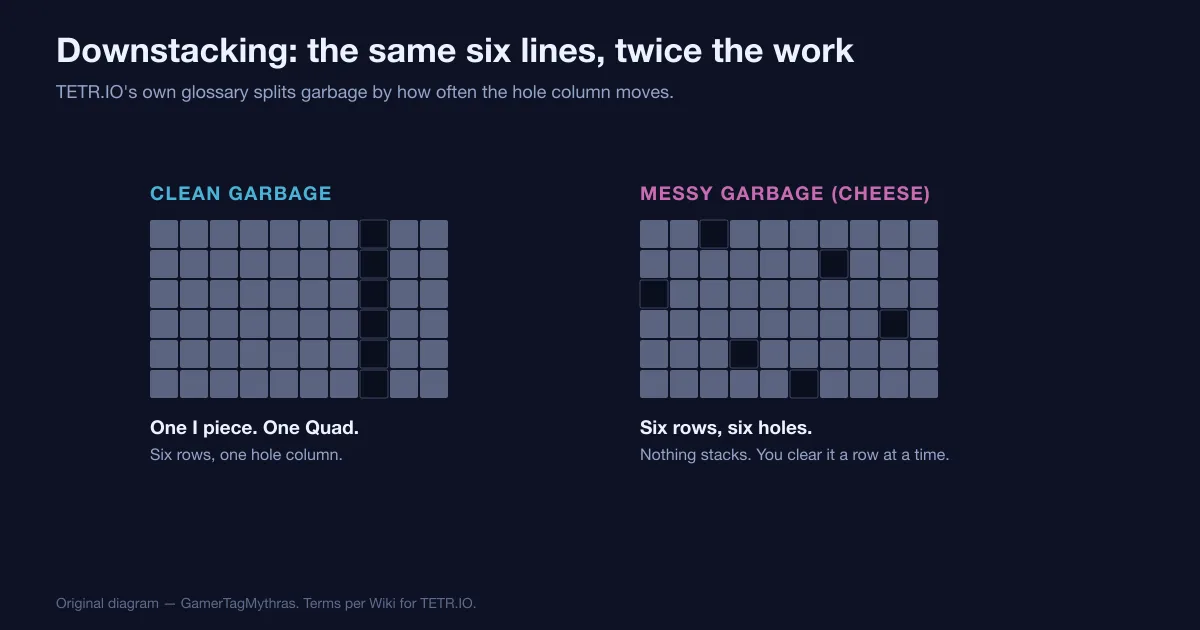
Tetris Downstacking: How to Dig Out of Garbage
Garbage is not one obstacle, it is two. Where the hole column sits from row to row decides whether six lines cost you one piece or six, and TETR.IO scores the lines you dig out at exactly the same rate as the lines you send.
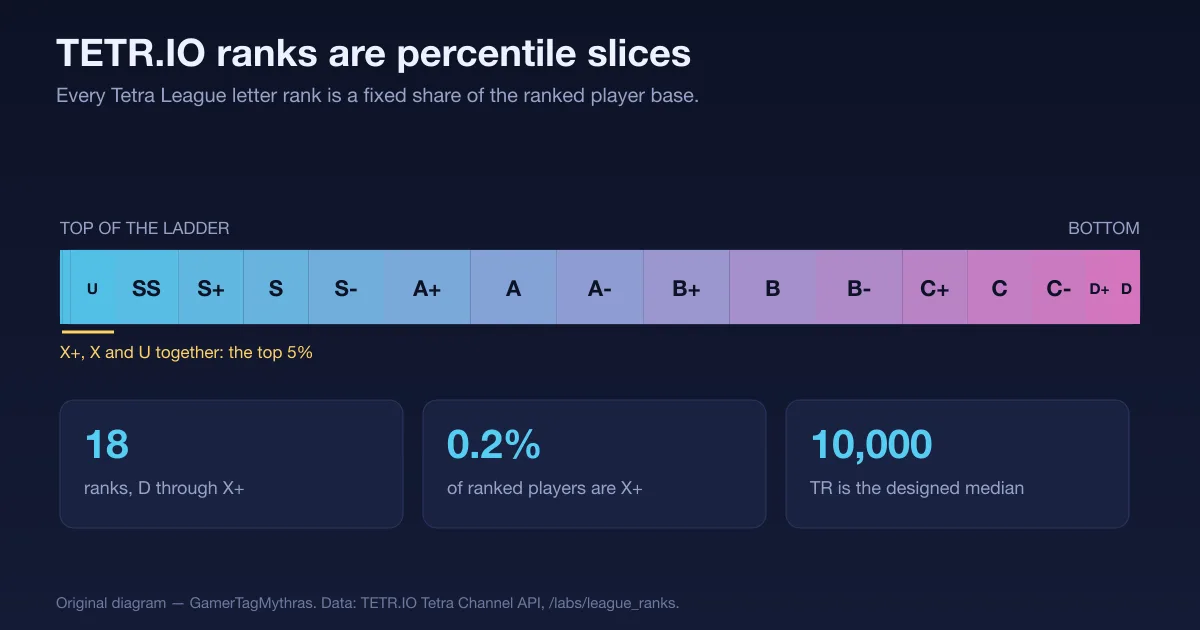
TETR.IO Ranks Explained: TR, Percentiles and Cutoffs
A Tetra League letter is not a skill score, it is a slice of the leaderboard — and TETR.IO publishes exactly how big each slice is, what TR it currently costs, and how fast the people inside it play.
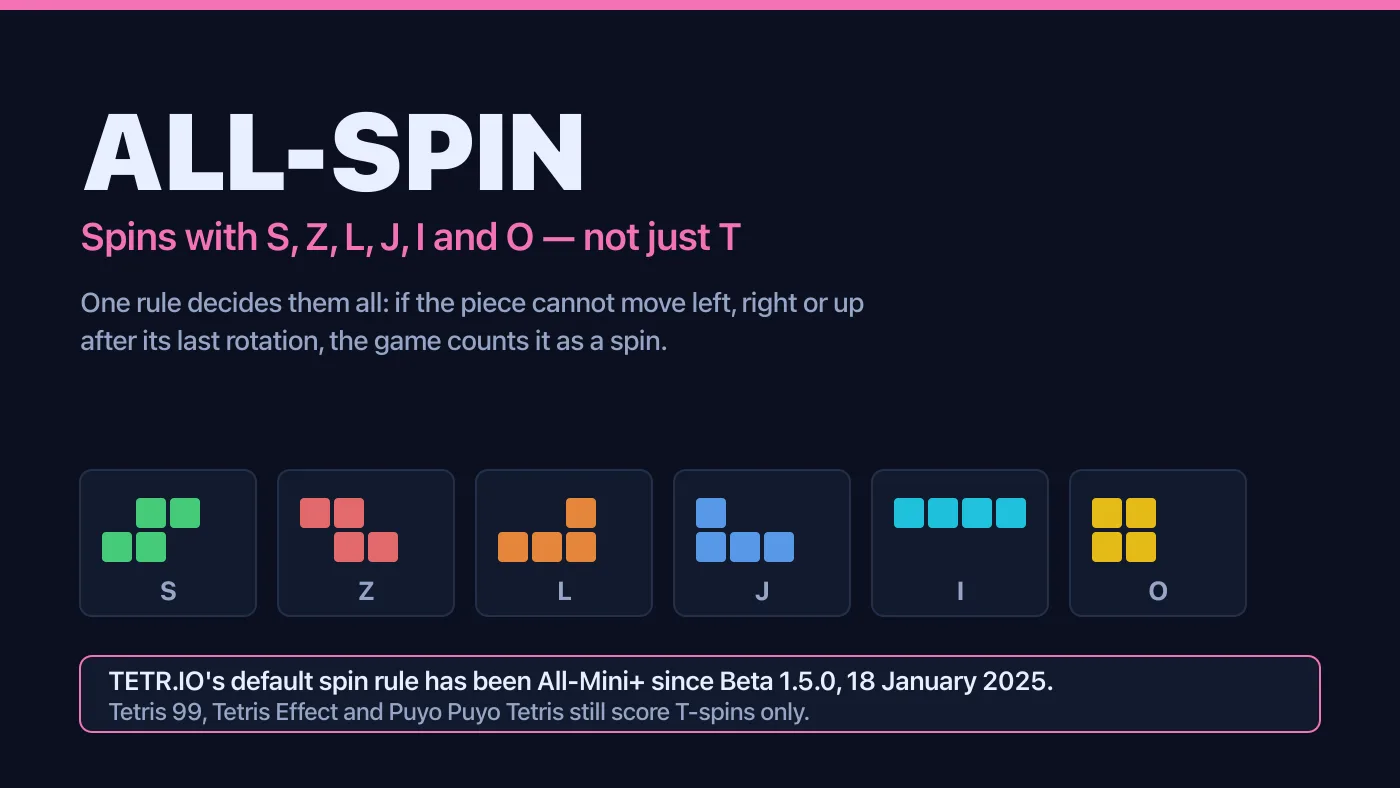
Tetris All-Spin Explained: S, Z, L, J and I Spins
A Z piece rotated into a slot nothing else reaches is either a scored spin or an ordinary Double, and which one it is has nothing to do with you. It is a setting, and most Tetris games have it switched off.

Tetris Stacking Fundamentals: Build a Board That Wins
Most players do not lose to speed. They lose to a board they built themselves three minutes earlier. Here is how stacking actually works in modern Guideline Tetris, and the habits that stop you from burying your own well.
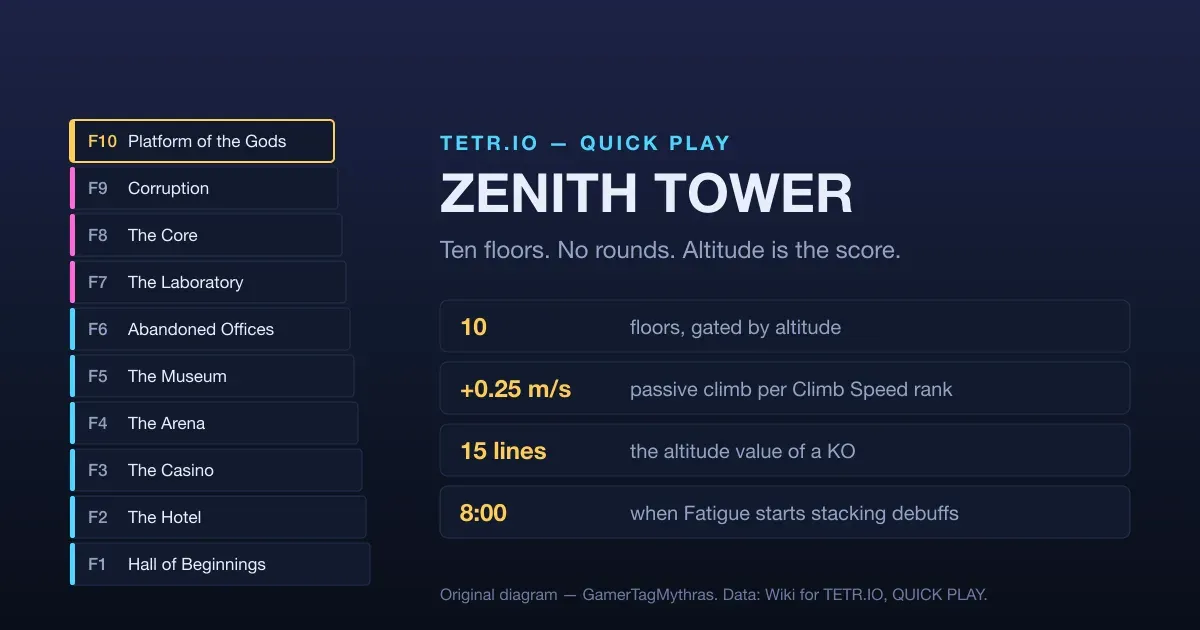
TETR.IO Quick Play Explained: The Zenith Tower, Climb Speed, and HYPERSPEED
Quick Play looks like a battle royale and scores like a speedrun. There is no round to win and nobody to outlast — only altitude, and altitude is bought mostly with the lines you send at other people.