TETR.IO Ranks Explained: TR, Percentiles and Cutoffs
A Tetra League letter is not a skill score, it is a slice of the leaderboard — and TETR.IO publishes exactly how big each slice is, what TR it currently costs, and how fast the people inside it play.
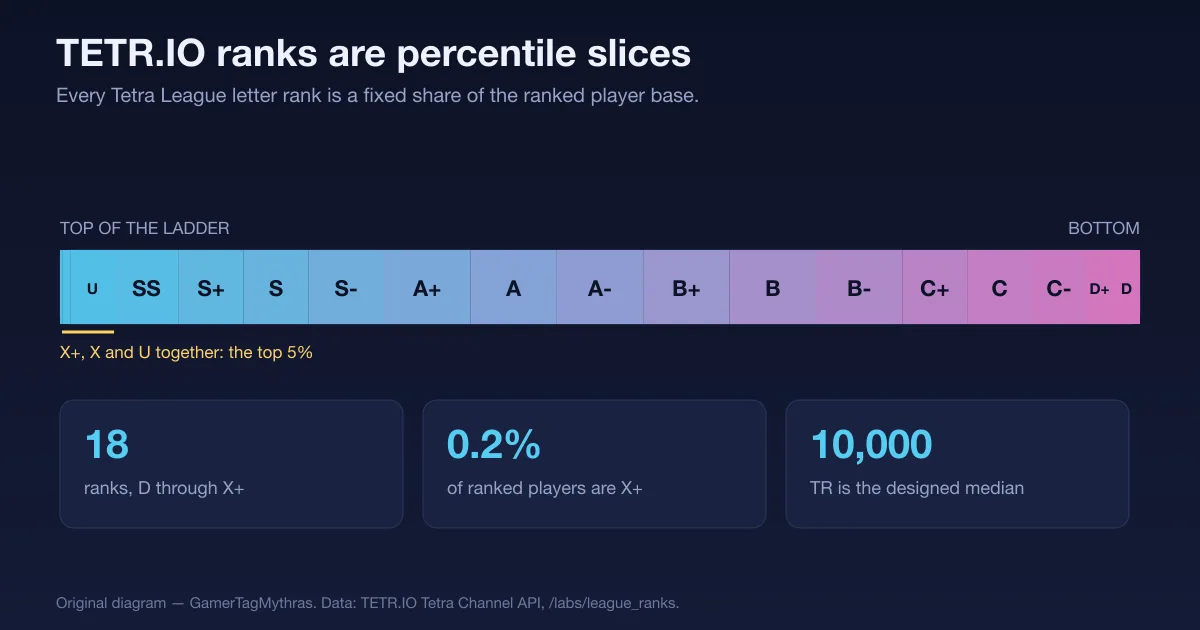
Grinding from C to B in TETR.IO does not mean you crossed a skill threshold. It means you crossed a line drawn on a leaderboard — a line that moves, deliberately, while you are playing under it. You do not have to take anyone's word for how that works, either: TETR.IO ships the entire ladder through its own public API, refreshed every half hour, with the cutoffs, the population of each rank and the average speed and attack of the players inside it.
Here is what is actually in there.
A rank is a percentile, not a score
TETR.IO has said this since the mode existed. The ALPHA 2.0.0 notes that opened Tetra League pretesting on 4 April 2020 put it in one line: the matchmaker is based on Glicko-2, TR was based on GLIXARE, and ranks are based on percentile of userbase. Six years and one season reset later, the percentile part has not changed.
So a letter is a position, not a score. There are 18 of them, D through X+, and each owns a fixed slice of the ranked leaderboard. X+ is the top 0.2%. X takes you down to the top 1%. U covers the top 5%. D is the bottom 2.5%. The TR figure attached to a rank is the consequence rather than the cause — it is whatever rating happens to be sitting at that leaderboard position at that moment.
Two things follow immediately.
Improving does not guarantee a promotion. If the players in your band improve at the same rate you do, the band stays where it is, and so do you. Your TR can rise while your letter does not move.
Ranks are not comparable across seasons. Beta 1.2.0 rebuilt the TR formula from the ground up when Season 2 opened on 16 August 2024, and the patch note said so directly: the range is still 0 to 25,000, the median now sits at 10,000 TR, the formula gives far more headroom to pro players, and your Season 2 TR will likely read lower than your Season 1 TR. A screenshot from 2023 is not evidence about the current ladder.
The full Tetra League ladder
The Tetra Channel API exposes the whole ladder at /labs/league_ranks, where the underlying Labs record is regenerated every 30 minutes. The table below is a single read of it, taken 23 August 2026. The percentile column is structural and does not move. The TR cutoff column is live and does.
| Rank | Percentile band | TR cutoff | Target TR | Gap | Players |
|---|---|---|---|---|---|
| X+ | top 0.2% | 24,115 | 24,000 | +115 | 72 |
| X | 0.2% – 1% | 22,802 | 22,500 | +302 | 280 |
| U | 1% – 5% | 20,525 | 20,000 | +525 | 1,363 |
| SS | 5% – 11% | 18,422 | 18,000 | +422 | 2,051 |
| S+ | 11% – 17% | 16,723 | 16,500 | +223 | 2,026 |
| S | 17% – 23% | 15,311 | 15,200 | +111 | 2,048 |
| S- | 23% – 30% | 13,854 | 13,800 | +54 | 2,378 |
| A+ | 30% – 38% | 12,042 | 12,000 | +42 | 2,705 |
| A | 38% – 46% | 10,406 | 10,500 | -94 | 2,709 |
| A- | 46% – 54% | 8,802 | 9,000 | -198 | 2,708 |
| B+ | 54% – 62% | 7,087 | 7,400 | -313 | 2,714 |
| B | 62% – 70% | 5,462 | 5,700 | -238 | 2,784 |
| B- | 70% – 78% | 3,982 | 4,200 | -218 | 2,724 |
| C+ | 78% – 84% | 2,915 | 3,000 | -85 | 2,042 |
| C | 84% – 90% | 1,929 | 2,000 | -71 | 2,024 |
| C- | 90% – 95% | 1,053 | 1,300 | -247 | 1,701 |
| D+ | 95% – 97.5% | 442 | 800 | -358 | 869 |
| D | 97.5% – 100% | 2 | 0 | +2 | 819 |
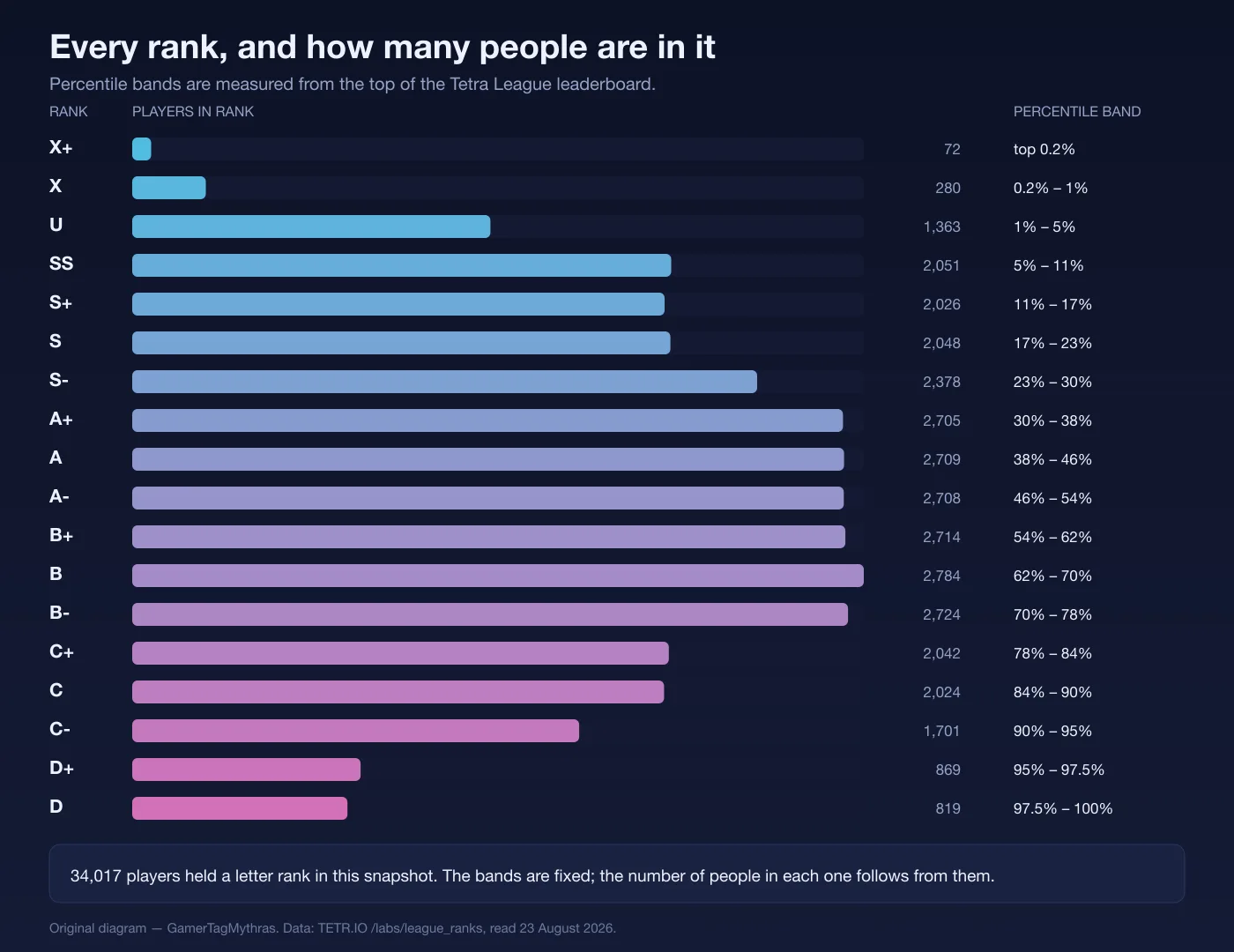
Percentiles are measured from the top down, so "54% – 62%" means B+ starts once you are better than the bottom 38% of the ranked field. The bands are also visibly uneven by design: the seven bands from S- to B- are all 7 or 8 points wide, while X+ gets 0.2 of a point. The top of the ladder is deliberately thin.
Two population numbers are worth putting next to each other. In that same read, 34,017 players held a letter rank. TETR.IO's server statistics endpoint reported 9,574,125 accounts on the server at the same time, 6,182,425 of them anonymous — and anonymous accounts cannot enter Tetra League at all. A letter rank of any colour is not a mass-participation object.
What each rank actually plays like
The same endpoint publishes the average APM, PPS and Versus Score of the players inside each rank. These are TETR.IO's own aggregates, not community estimates, and they are the closest thing the game has to an answer for "what do I need to play like to hold this rank".
The final column is derived rather than published: attack per piece, calculated as APM ÷ (PPS × 60). The wiki's own statistics page treats APP as the efficiency metric that ignores speed entirely, which is why it is worth putting next to the two the game shows you.
| Rank | Avg APM | Avg PPS | Avg VS | Attack per piece |
|---|---|---|---|---|
| X+ | 171.6 | 3.32 | 343.4 | 0.86 |
| X | 132.2 | 2.83 | 269.0 | 0.78 |
| U | 96.9 | 2.33 | 199.5 | 0.69 |
| SS | 72.0 | 1.97 | 150.0 | 0.61 |
| S+ | 56.4 | 1.75 | 119.1 | 0.54 |
| S | 46.5 | 1.60 | 99.0 | 0.49 |
| S- | 39.2 | 1.47 | 84.0 | 0.45 |
| A+ | 33.2 | 1.35 | 71.3 | 0.41 |
| A | 28.4 | 1.27 | 61.2 | 0.37 |
| A- | 24.8 | 1.20 | 53.4 | 0.35 |
| B+ | 21.7 | 1.12 | 46.6 | 0.32 |
| B | 19.1 | 1.06 | 41.0 | 0.30 |
| B- | 16.7 | 1.00 | 35.7 | 0.28 |
| C+ | 14.9 | 0.94 | 31.3 | 0.26 |
| C | 12.9 | 0.88 | 26.9 | 0.24 |
| C- | 10.8 | 0.83 | 22.4 | 0.22 |
| D+ | 9.5 | 0.78 | 19.8 | 0.20 |
| D | 6.8 | 0.71 | 13.9 | 0.16 |
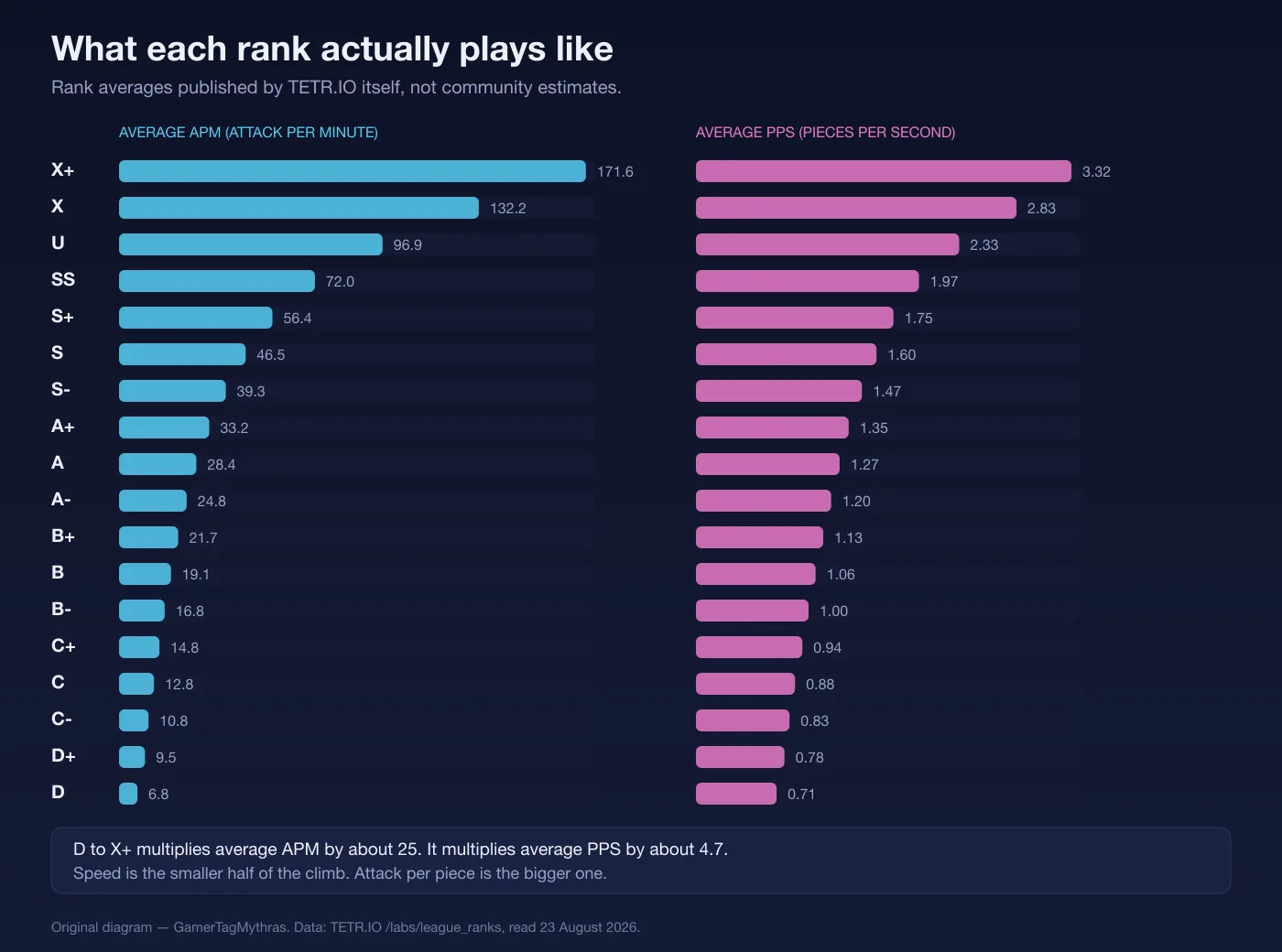
Run the ends against each other. From D to X+, average APM multiplies by about 25. Average PPS multiplies by about 4.7, and attack per piece multiplies by about 5.4 — 0.16 to 0.86. Those two factors are what produce the 25, and they are nearly the same size.
That is the useful part. Neither half dominates, so a plan built only on raising PPS is aimed at less than half the gap. Climbing from B to A in this snapshot — three promotions, through B+ and A- — moves the band averages from 1.06 to 1.27 PPS and from 0.30 to 0.37 attack per piece: about a 20% rise in speed and about a 24% rise in what each piece is worth, at the same time.
The two things that raise attack per piece directly are spins and openers. Our T-spin guide covers the detection rules and the standard setups, and the openers guide covers the first-bag structures that convert a clean board into damage before anyone has stacked anything.
How you get a letter in the first place
There are three gates before a rank appears on your card at all, and they are separate from each other.
- Access. You need a registered account at Level 10 or higher. Anonymous accounts cannot play Tetra League.
- Placements. Your TR is not displayed until you have played at least 10 matches, which the wiki calls rating games.
- Confidence. A letter rank is only assigned to players whose RD is below 100. TR alone does not earn you a letter.
The third gate has nothing to do with skill, and it is the one that quietly removes a letter you already earned.
RD is the gate that hides your letter
RD is rating deviation — Glicko-2's measure of how confident the system is in your rating. Low RD means the system thinks it knows what you are. High RD means it does not.
- Playing Tetra League regularly drives RD down to a soft floor of 58.
- The hard ceiling is 350, which is where a long-dormant account sits.
- Stop playing and it climbs back. Per the wiki, the climb starts after about a week of inactivity, and since Beta 1.7.5 on 30 October 2025 the game bumps it hourly rather than daily — still adding up to 1 RD per day.
- The same patch added a guard worth knowing: RD may no longer rise into 100 as a result of a match. A game you played cannot, by itself, push you over the line that hides your letter.
The practical read: a rank is not a possession, it is a claim the system keeps re-evaluating. Do the arithmetic on those numbers and an account sitting at the 58 floor crosses 100 RD roughly seven weeks after its last match — a week of grace plus 42 days at 1 RD a day. At that point the letter is gone until you have played enough to bring RD back down, not because you got worse but because the game no longer knows.
Target TR, and why the ladder moves under you
Every rank carries a second number in the API alongside its cutoff. TETR.IO's documentation defines targettr as the TR the rank will gravitate toward, using its de- and inflation zones. In other words the ladder has an intended shape, and the system nudges the live cutoffs back toward it.
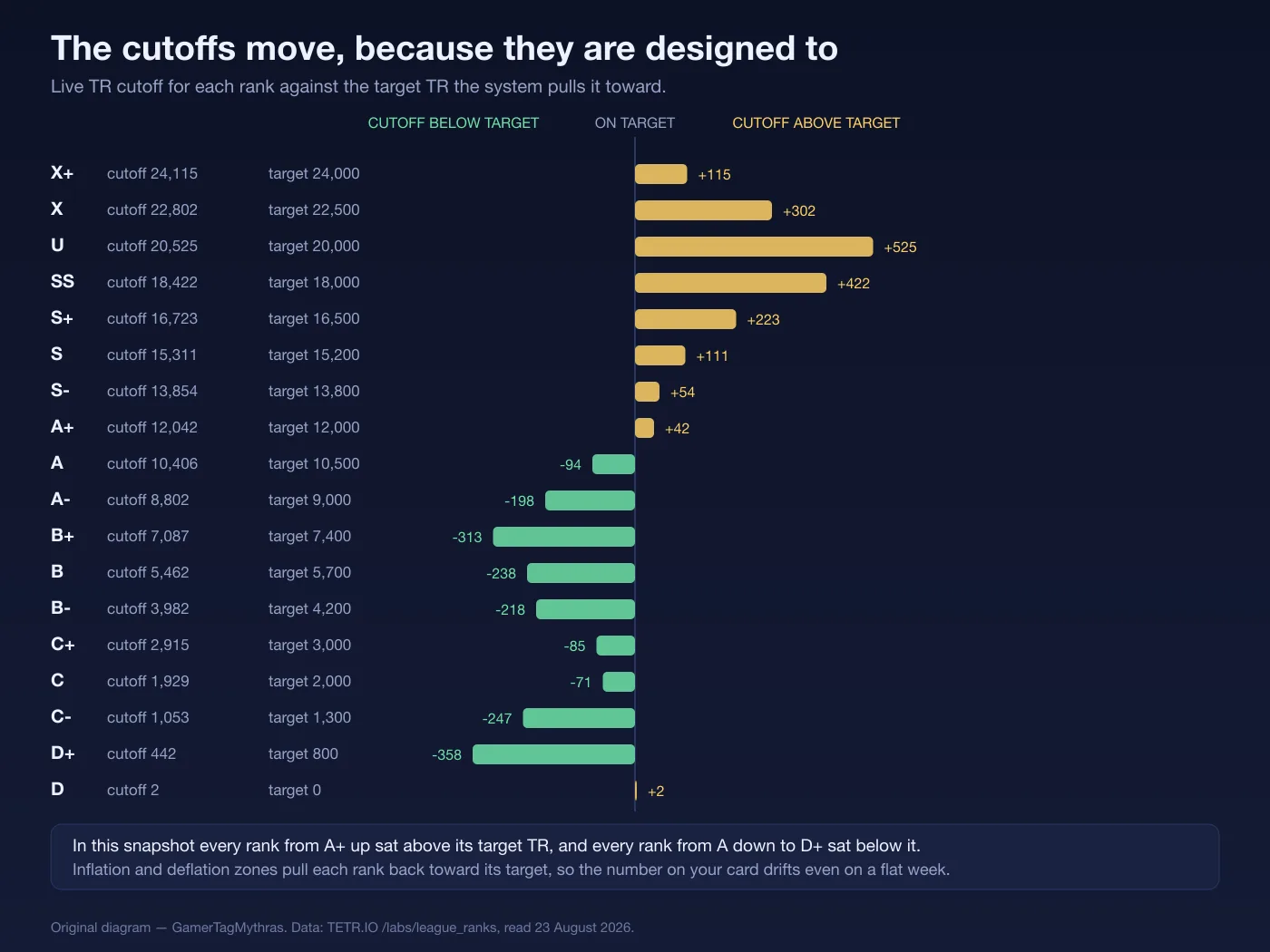
The Gap column in the ladder table above is that comparison. In this snapshot every rank from A+ upward sat above its target and every rank from A down to D+ sat below it, with the largest single deviations at U (+525) and D+ (-358).
This is a tuned system, not a static one. Beta 1.3.0 on 22 September 2024 increased the power of deflation zones slightly to help TR settle faster after the Season 2 launch, and Beta 1.3.1 on 3 November 2024 returned that power to normal once it had done its job. The consequence for you is that identical performance across two months can still produce a drifting TR, and that a cutoff you screenshot today is not a fixed target to aim at.
Match length is set by the higher-ranked player
Tetra League is a first-to format, and how long a match runs is decided by the higher-ranked of the two players. Unranked players are slotted by raw TR instead, using thresholds Beta 1.5.0 updated on 18 January 2025.
| Format | Rounds | Higher-ranked player is | If unranked |
|---|---|---|---|
| FT3 | best of 5 | D through A+ | under 13,800 TR |
| FT5 | best of 9 | S- through SS | 13,800 – 20,000 TR |
| FT7 | best of 13 | U, X or X+ | above 20,000 TR |
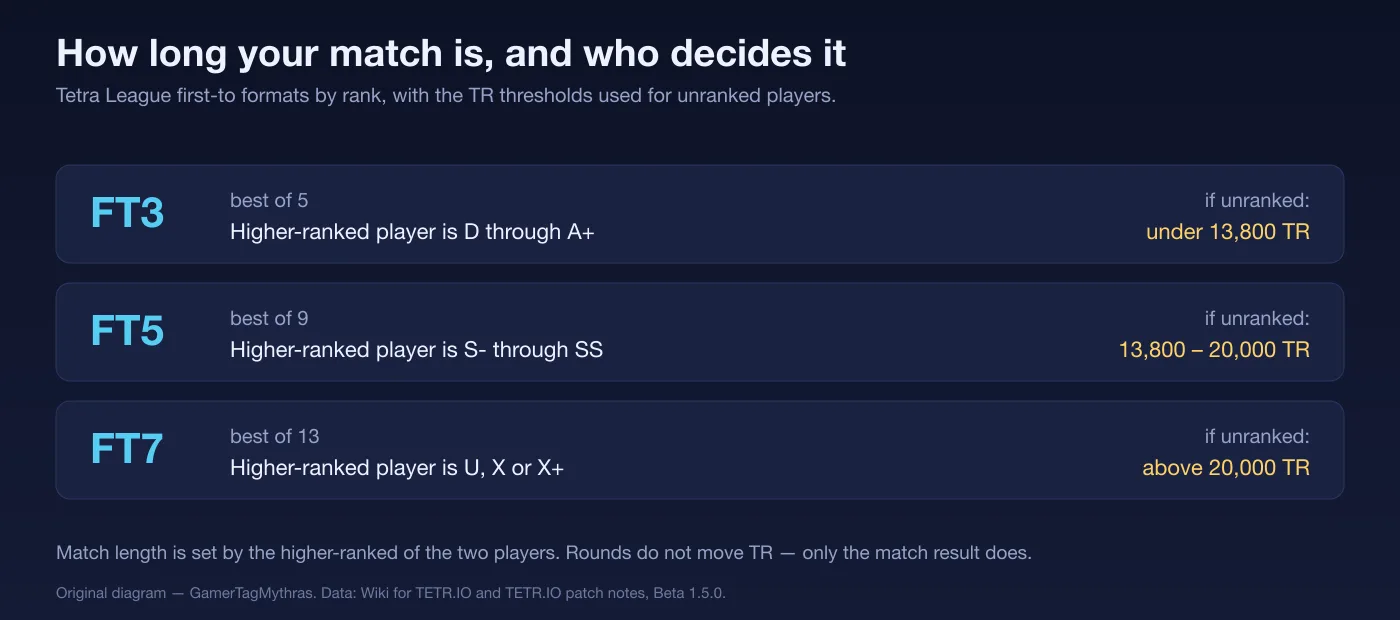
Two rules attach to this that change how a match should be played:
- Rounds do not move TR. Matches do. Losing 2-3 in an FT3 costs exactly what losing 0-3 costs. There is no partial credit and no reason to protect a scoreline.
- A disconnect is not automatically a loss. You get a window to reconnect that scales with how far ahead you were, with a minimum of 45 seconds, and the remaining player accrues score while you are gone. You may reconnect once per match. If both players drop, the match is cancelled and no TR changes hands.
Season 2 is what those averages measure
The APM and APP figures above are not measurements of Tetris in the abstract. They are measurements of players under the Season 2 ruleset that has been live since 16 August 2024, and that ruleset is specific:
- Back-to-Back Charging replaced Season 1's Chaining. B2B sends 1 per attack like Guideline, but from B2Bx4 it charges a Surge that fires in three separate attacks when the chain finally breaks.
- All-Mini spins. Immobile spins with pieces other than T register as Minis: they send nothing, but they add and keep back-to-back. Beta 1.5.0 extended that to immobile T-spins that fail the three-corner rule.
- Opener phase double-cancel. For the first 14 pieces, if your pending garbage exceeds what you have sent, you cancel double.
- All Clears send 5 and count toward back-to-back, down from Season 1's 10.
- Beta 1.3.0 added a flat +1 garbage to Quads and Spins that clear garbage, unaffected by multipliers.
If you want that ruleset in depth rather than in summary, the all-spin guide covers the spin rules and the scoring and attack guide covers how TETR.IO's attack maths diverges from the Guideline table. And if you have never touched the client, the which Tetris to play guide puts it next to the alternatives.
How to read your own numbers
Pull your own APM, PPS and VS from your Tetra Channel profile and put them beside the table. APP is not one of the three the profile shows, so work it out the same way the column above was built: APM divided by PPS times 60.
- If your APP is above your rank average but your PPS is below it, you are playing an efficient, slow game. The ceiling you are hitting is speed, and sprint work is the lever: our 40-line sprint guide is built for exactly that.
- If your PPS is above your rank average but your APP is below it, you are fast and cheap. You are placing pieces that do not pay, and openers and spins are the fix.
- If both sit near your rank average, you are a representative member of your band, and the promotion is a matter of raising both together rather than finding a trick.
One caution on all of this: these are averages of a whole band, and the wiki's statistics page notes that outlier cases are present, especially at the edges of ranks. Treat the row as a benchmark, not a requirement.
Quick Action Checklist
- Read your rank as a percentile band, not a score — the letter is a leaderboard position.
- Do not compare your TR to any figure published before 16 August 2024. Season 2 rebuilt the formula.
- Check your RD before you panic about a missing letter; below 100 is the requirement, and it climbs while you are away.
- Compare your attack per piece, not just your PPS, to your rank's average — APP spans a factor of 5.4 across the ladder against 4.7 for PPS.
- Play the whole match. Rounds do not move TR, so a 0-3 and a 2-3 cost the same.
- Expect your TR to drift on a flat week. The cutoffs are pulled toward target values on purpose.
Frequently Asked Questions
How many ranks are there in TETR.IO Tetra League?
What is TR in TETR.IO?
What APM and PPS do you need for each TETR.IO rank?
Why does my TETR.IO rank not show up?
Why does my TETR.IO TR change when my results have not?
Keep Reading
- TETR.IO Tetra Channel API — league ranks: percentile, TR cutoff, target TR, player count and average APM/PPS/VS per rank
- TETR.IO — official API documentation (Labs League Ranks field definitions, server statistics)
- Wiki for TETR.IO — TETRA LEAGUE: FT formats, TR and RD rules, Season 1 and Season 2 changes
- TETR.IO — official patch notes (Alpha 2.0.0, Beta 1.2.0, Beta 1.3.0, Beta 1.3.1, Beta 1.5.0, Beta 1.7.5)
- Wiki for TETR.IO — Statistics: APM, PPS, APP and Versus Score definitions
Related Guides
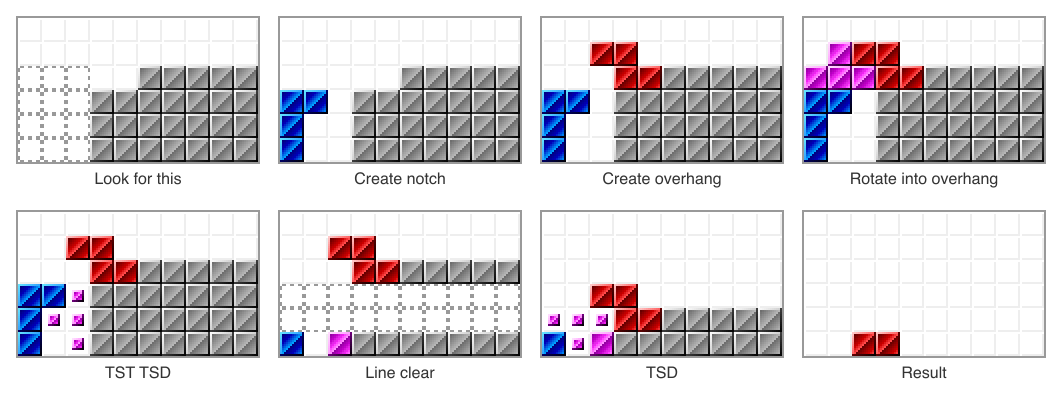
Tetris Mid-Game T-Spins: STSD, Imperial Cross, Kaidan
Once the opener is spent, the board decides your T-spins. Hard Drop files 63 pages of mid-game T-spin setups; this guide covers three families: lend your well to a T-spin, stack two TSD slots, or kick a T two rows deeper to save a bad board.
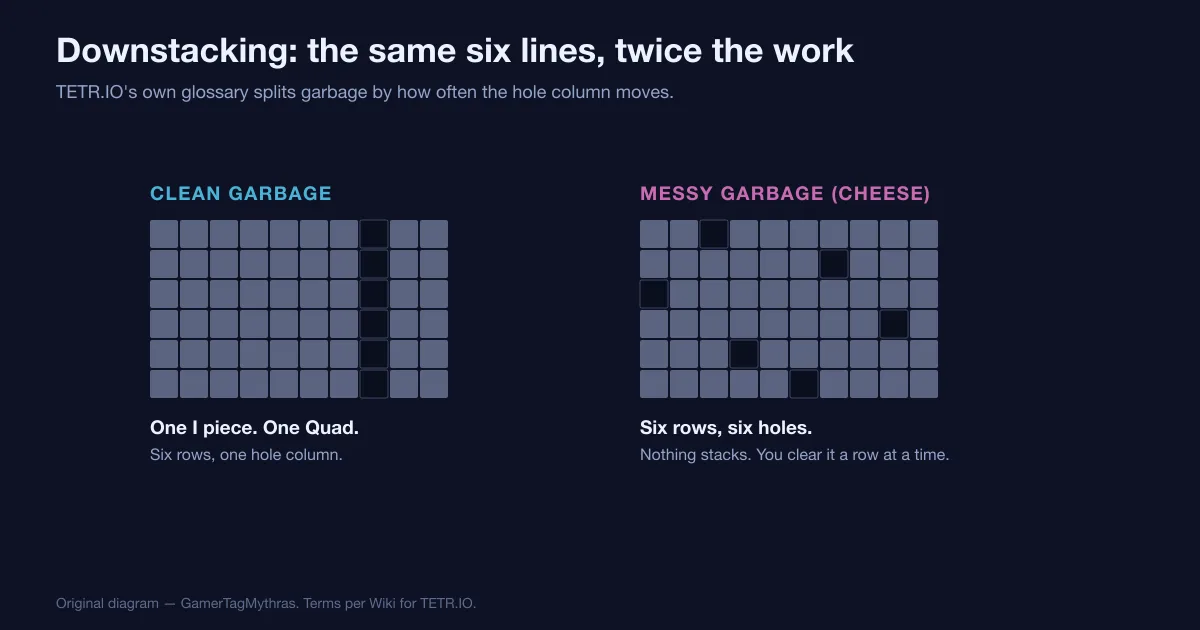
Tetris Downstacking: How to Dig Out of Garbage
Garbage is not one obstacle, it is two. Where the hole column sits from row to row decides whether six lines cost you one piece or six, and TETR.IO scores the lines you dig out at exactly the same rate as the lines you send.
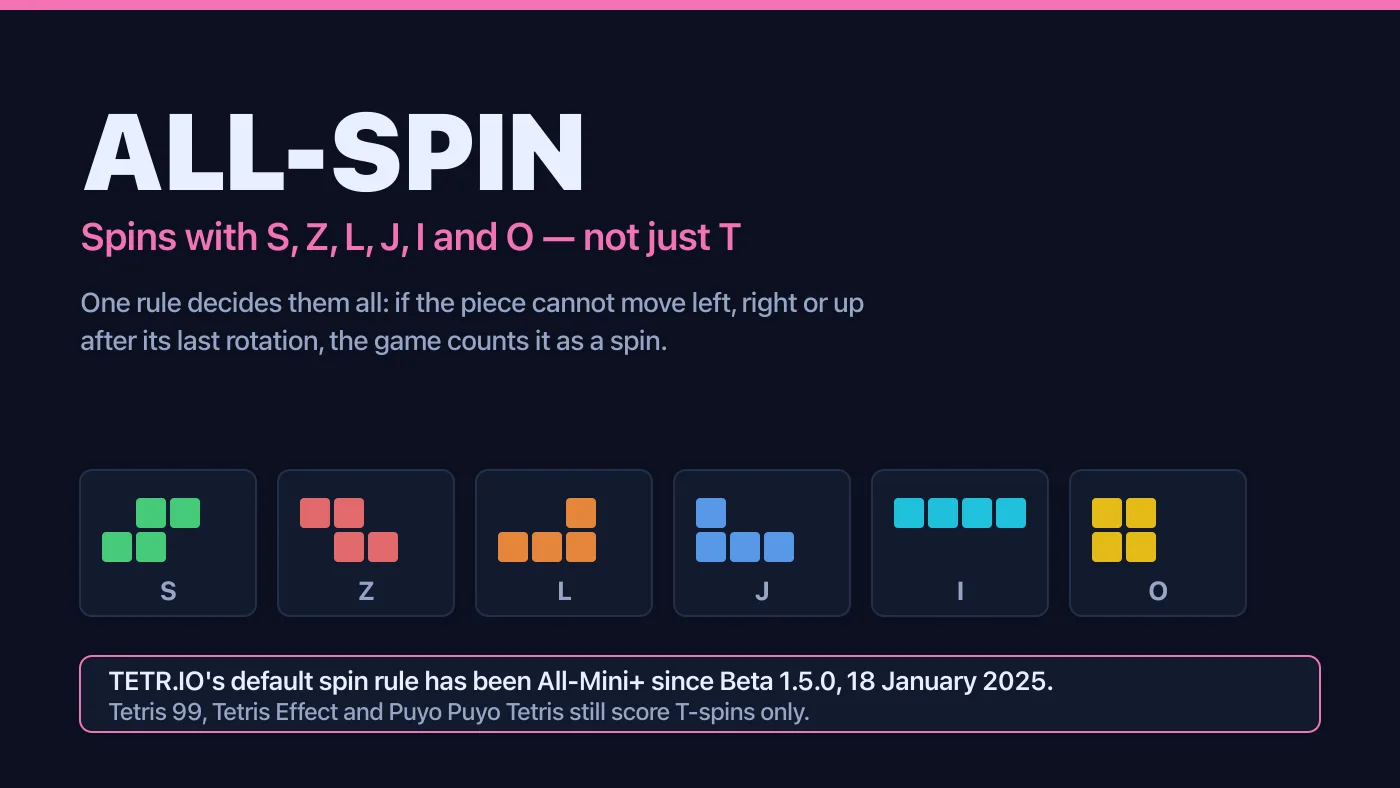
Tetris All-Spin Explained: S, Z, L, J and I Spins
A Z piece rotated into a slot nothing else reaches is either a scored spin or an ordinary Double, and which one it is has nothing to do with you. It is a setting, and most Tetris games have it switched off.
TETR.IO Quick Play Explained: The Zenith Tower, Climb Speed, and HYPERSPEED
Quick Play looks like a battle royale and scores like a speedrun. There is no round to win and nobody to outlast — only altitude, and altitude is bought mostly with the lines you send at other people.

Tetris Stacking Fundamentals: Build a Board That Wins
Most players do not lose to speed. They lose to a board they built themselves three minutes earlier. Here is how stacking actually works in modern Guideline Tetris, and the habits that stop you from burying your own well.
The Tetris Effect Zone Guide: Ultimatris, the Attack Table, and When to Press It
Zone is sold as a get-out-of-jail button, and used as one it pays a fraction of what it could. The published Zone Bonus Attack table says the same lines can be worth 40 garbage rows or 80, depending only on when you pressed it.