Tetris Mid-Game T-Spins: STSD, Imperial Cross, Kaidan
Once the opener is spent, the board decides your T-spins. Hard Drop files 63 pages of mid-game T-spin setups; this guide covers three families: lend your well to a T-spin, stack two TSD slots, or kick a T two rows deeper to save a bad board.
Somewhere around the third bag, your opener is spent. The TKI fired, or the DT Cannon did, and now there is a Tetris well on one side, garbage underneath with its hole in a column you did not pick, and none of the empty-board shapes you memorised. From here until someone tops out, your T-spins get built out of whatever the board already looks like.
Hard Drop's wiki files 63 pages under its Mid-game T-Spin setups category, counted on 10 October 2026. You need far fewer. This guide covers three families from that list: lend your well to a T-spin and take it back (donation, Kaidan), stack two T-spin double slots so the first T sets up the second (STSD, Fractal, Imperial Cross), or kick a T two rows deeper than usual to save a board that went wrong (Fin, Neo, Iso). For each one: what it needs, what breaks it, and what it sends.
Scope: Guideline games running SRS with three-corner T-spin detection, such as TETR.IO, Jstris, Tetris Effect: Connected, Puyo Puyo Tetris and Tetris 99. The detection rule and the basic TSD and TST shapes are in our T-spin guide, and the first-bag builds are in the openers guide. This post starts where both of them stop.
The setups at a glance
| Setup | What it is | T pieces | Lines sent before back-to-back |
|---|---|---|---|
| Donation | A piece covers the well so a T-spin can clear above it; the well reopens afterwards | 1 | 4 for a TSD |
| Kaidan | A donation on a staircase edge, with an S or Z as the base | 1 | 4 |
| STSD | Two TSDs out of one three-wide, three-deep hole | 2 | 8 |
| Fractal | Two TSD slots stacked directly on top of each other | 2 | 8 |
| Imperial Cross | A split TSD out of a cross-shaped hole, then a normal TSD | 2 | 8 |
| Fin, Neo or Iso TSD | One TSD with the T kicked two rows down | 1 | 4, or 1 if your client scores a Neo as a Mini |
| Trinity | An STSD stacked on top of a TSD | 3 | 12 |
| King Crimson | A TST stacked on top of an STSD | 3 | 14 |
The line counts use Hard Drop's general Guideline garbage table: 4 for a T-spin double, 6 for a T-spin triple, and a +1 back-to-back bonus on each one you land while the chain is alive. So an STSD fired into a running chain sends 10, not 8. Clients tune their own tables, and the scoring and attack guide covers where TETR.IO and Tetris 99 depart from this one.
Donation: lend the well, take it back
Hard Drop defines donating as plugging up the Tetris hole to send a T-spin, after which the hole opens up again so you can keep taking Tetrises or keep downstacking. FOUR (four.lol), a community setup guide, describes the same idea as temporarily covering your open column, then uncovering it with a clear that keeps back-to-back, such as a TSD. It also names the hidden benefit: because you deliberately leave cells unfilled under the spin, the T-spin shape takes fewer pieces to build.
The rule that decides whether a donation works is in FOUR's walkthrough. Before placing anything, picture the T-spin's base and overhang and work out which lines it will clear. The donated piece may only put minos into the well column on those lines, which for a TSD means two cells at most. Put a third mino in the column and the hole stays covered after the spin.
Hard Drop's donation page sorts its examples into natural donations, which preserve back-to-back, and other examples that break it. The natural ones it diagrams use an S, Z, J, O or T on its own, or the pairs ZS, LS, LZ, IJ and JZ, and a separate section covers T-spin single donations with S, Z, J, L and I. FOUR adds the warning that matters in practice: misused, donations make the stack worse, and its own worked example ends on a queue where plain stacking leaves the cleaner board.
FOUR lists four donation methods that have their own names: Kaidan, STMB Cave, Parapet and Shachiku Train. Kaidan is the one to learn first.
Kaidan: the donation the stairs hand you
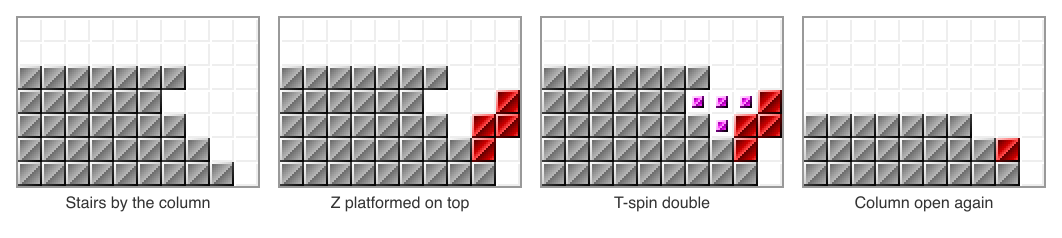
Kaidan is Japanese for stairs, and the setup is named after the edge it needs: a stack that steps down toward an empty column. Hard Drop credits it to Tetris DS player TCM-WC. An overhang goes on the stairs, a Z is platformed over the empty column as the base, and the T drops in between for a TSD. After the double, the empty column is open again. Hard Drop calls Kaidan especially effective in games that reward back-to-back, and all five clients named above do.
Two rules from Hard Drop's Kaidan page:
- The overhang and the base can go down in either order.
- A J base is an alternative it does not recommend, because the empty column stays covered after the TSD, which defeats the point of donating.
FOUR describes Kaidan as a TSD donation whose overhang can vary but whose T-spin shape is always made with an S or a Z. If your stack slopes down toward the well and an S or Z is in the queue, look for a Kaidan before you place anything else.
STSD: two doubles from one three-wide hole
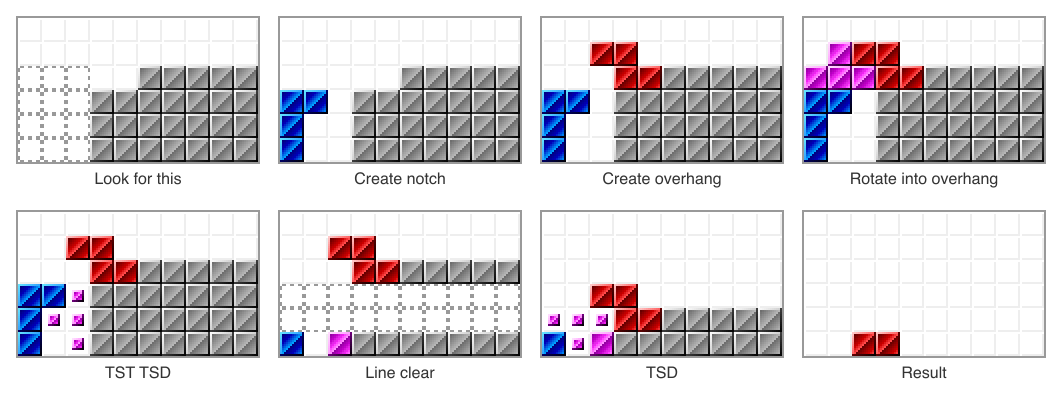
The Super T-Spin Double is the setup Hard Drop describes as often used in mid-game, and it delivers what the name promises: two T-spin doubles from one structure. The hero diagram at the top of this page is rendered from Hard Drop's own mid-game walkthrough of it, eight of its twelve steps.
The build, per FOUR and Hard Drop:
- Find a three-wide hole. FOUR's recognition rule is that most STSDs start from a three-column, three-row empty space.
- Notch it with a J or L. FOUR says the J and L pair is the most common way to build one, because all you have to check is whether both are in your queue.
- Put an overhang over the side opposite the notch.
- First T. Soft drop it and rotate it in against the overhang, then rotate once more: that second rotation kicks it down into the lower slot with the same deep kick a T-spin triple uses, and Hard Drop's walkthrough labels this step TST TSD. The bottom row of that slot is one cell short, so the clear takes two lines, not three.
- Second T. What the first T leaves behind is an ordinary TSD slot under the same overhang.
Two T pieces, two doubles. Hard Drop's advice for its empty-field versions is to hold the T pieces until you are ready to clear both doubles, and the versions with a T in the base cannot fire before the third bag, because each bag deals one T.
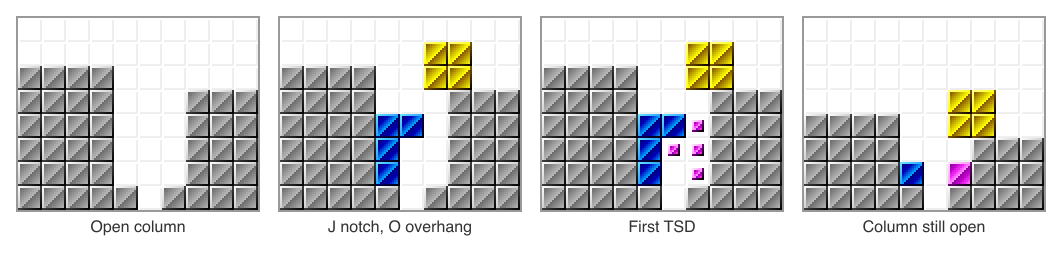
The diagram above is the version built over a well. Hard Drop's tips say an STSD can sit over an empty column, which helps when the rows are getting too high to set up a TSD or when you want to sneak in a second one, and that combined with Tetrises it is very deadly. The same page adds a sequencing rule: over a Tetris column you can still take the Tetris as long as the notch has not gone in. The overhang alone does not block the column; the notch does.
FOUR also lists the STSD as a recovery technique for a misdropped J or L.
When garbage breaks the STSD
Hard Drop's STSD page names the failure up front: the setup also works as an opener, but garbage arriving with its hole in the wrong column breaks the T-spin. In most of its diagrams the wrong column is the third one from the wall. The Boomerang page spells out what goes wrong: the T falls one block too far and clears only a single, leaving a bad board.
The fix is the Boomerang itself: spin a J or L into the hole instead, which in Hard Drop's example clears a J-spin double, then finish with the TSD on top. Two things to know before you lean on it:
- It moves your well. Hard Drop says the Boomerang shifts the well over one column. Hard Drop and FOUR both point to a Triple Double to clean up afterwards, and Hard Drop also suggests an Imperial Cross.
- It costs your chain. Tetris 99, Tetris Effect and Puyo Puyo Tetris recognise twists with the T only, per tetris.wiki's table of Guideline game differences, so the J or L clear scores as a plain Double, and a Double ends a back-to-back chain. TETR.IO's default rule does count immobile non-T spins as Minis that keep back-to-back, but the TETR.IO wiki's Spins page uses the Boomerang as its counterexample: the L "is not immobile as it can move upward".
Treat the Boomerang as a board save, not an attack.
Imperial Cross or Fractal: one column apart
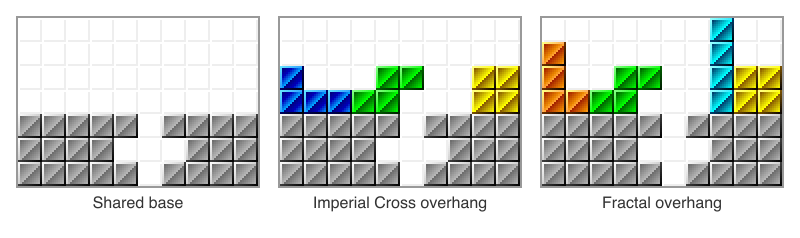
Both are two-TSD setups over the same cross-shaped base, and FOUR states the difference in one line: the only difference in the shape is the shifted overhang. Move the S one column and you have switched setups. What changes is which lines each T clears, and that decides when you can fire.
Fractal stacks one TSD slot directly on top of another. Hard Drop also calls it Spider or TSD stacking, notes that the Japanese community says Double Dagger, and calls it one of the most common T-spin methods used in multiplayer. Its warnings: Fractals are hard to build without putting T pieces into the stack, which is a real risk if the Ts do not arrive in time, and although the pattern can be stacked indefinitely, setups three or more high are rare. FOUR says Fractals are usually built when you do not expect a T soon, most often on top of a TSD you already have, and that you need the complete setup before attempting either double.
Imperial Cross fires differently. Per tetris.wiki and Hard Drop, the first T is rotated into the cross as if for a T-spin triple, then rotated twice more, a 180, so it ends up facing the other way. The clear takes the rows above and below the cross's middle row: a split double. The second T is an ordinary TSD. Because the first double takes the lower lines, FOUR points out that the second double's row can still be filled after the first one fires, which is why the Imperial Cross gets built when piece constraints rule out a Fractal.
The trade-offs:
- It is slower. FOUR says it is not uncommon to rotate five times for the first TSD.
- It moves your open column. FOUR notes that this can fix a bad TSD overhang, and can also make the Imperial Cross the wrong choice for a field you wanted to keep.
- It survives stricter T-spin rules. Because of the 180 after the triple twist, Hard Drop and tetris.wiki say it works even in games from mid-2006 onward that do not recognise a kick twist as a T-spin, and both document a Cross Opening for Tetris Evolution, which rewards only no-kick T-spin singles and doubles.
- It extends. Both wikis show the second TSD swapped for a T-spin triple, and Hard Drop shows Imperial Crosses chained three or more times, though not indefinitely, because the pieces those builds need do not balance out across bags.
Hard Drop's Imperial Cross page gives the reason to switch to the Fractal: it is useful when the garbage column is directly below the cross. If you are coming out of a TKI-3, Hard Drop's TKI page lists an Imperial Cross continuation for both Castle Top and Flat Top, and the openers guide has the perfect clear rates for those branches.
Fin, Neo and Iso: TSDs for boards that went wrong
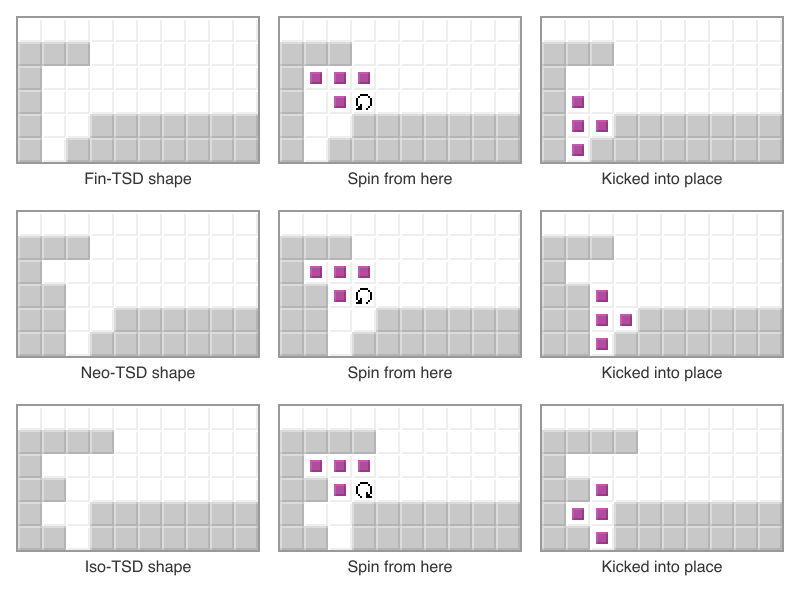
Hard Drop groups these three as Polymer T-Spins: TSD setups that use a kick other than the normal TSD and TST kicks, dropping the T two rows down. FOUR files them as NTSDs. Neither source oversells them. Hard Drop says they are considered ineffective in most cases but still used to fix misdrops or complicated terrain, and FOUR calls them bulky and trickier to clean up than regular TSDs.
| Variant | Where the overhang sits | Hard Drop's minimum sizes | Hard Drop's cleanup |
|---|---|---|---|
| Fin-TSD | Directly above the TSD | Overhang 2+ columns long, 2-row gap 3+ columns long | Spin a Z into the leftover |
| Neo-TSD | Shifted one column from the TSD | Overhang 2+ columns, gap 2+ columns | Spin a J into the leftover |
| Iso-TSD | A T-spin triple shape, but with the overhang on the other side | Overhang 3+ columns, gap 3+ columns | Spin a J into the leftover |
Hard Drop's cleanup pieces assume its diagrams' orientation. FOUR's Fin example is built with a J overhang and cleans up with an S instead, so check which way your setup faces before you plan the cleanup piece.
Learn the Fin first. Hard Drop calls it the most effective and efficient of the three, because the opportunity is easier to spot and it has the most reliable continuations, a Cut copy among them. FOUR calls it perhaps the most practical once you count setup and cleanup.
Check your client before you build a Neo. FOUR says a Neo-TSD counts as a T-Spin Mini Double rather than a full TSD, sending 1 line instead of 4, or 2 with back-to-back. Hard Drop hedges that this happens on some games, and tetris.wiki documents one exception: Jstris counts Mini T-spin Doubles as full T-spin Doubles, 4 lines and 1,200 points. Before back-to-back, the same placement sends 4 lines in Jstris against the 1 FOUR describes.
Kick it, do not drop it. FOUR's tip for the Fin and the Neo: it is easy to soft drop the T into its final cells instead of kicking it there, which scores a plain Double. Its fix is to get the T into position, rotate it the opposite way first, and then do the kick.
Back-to-back is what you are protecting
The T-spins these setups produce count as difficult clears, and back-to-back survives only as long as no Single, Double or Triple lands in between. Hard Drop's donation page sorts its examples by whether they keep back-to-back, and its Kaidan page rates the setup by how well it suits games that reward it.
TETR.IO raises the stakes. Its Season 2 patch notes (Beta 1.2.0, 16 August 2024) say back-to-back sends 1 extra line per attack, like the Guideline, but at B2Bx4 it starts charging a Surge Attack that begins at 4 lines and grows with the chain, and that is sent out, split into three attacks, when back-to-back breaks. tetris.wiki notes Quick Play starts the Surge at 1 line instead. A Kaidan, an STSD or a Fractal between Quads is how that counter keeps climbing. Our all-spin guide covers how non-T spins feed the same chain, and the Tetra League ranks guide the rest of the Season 2 ruleset.
How to drill them
- Jstris 20TSD. tetris.wiki describes the mode: perform as many T-spin doubles as possible, keep going past 20 if you can, and the run ends on any line clear that is not a TSD or on a block out. Fractals, STSDs and Kaidans are all T-spin doubles, so the mode rewards exactly these setups and ends the run on a stray Tetris.
- Read the source diagrams. FOUR publishes its setups as fumen diagrams, and Hard Drop's STSD page embeds them too. Our fumen guide covers opening, stepping through and editing them, and rebuilding a setup page by page in an editor is a quick check that you know its piece order.
- Fix the board first. On a stack full of holes, dig before you build. The downstacking guide covers digging, and stacking fundamentals covers the well these setups borrow.
The order to learn them in is opinion, and this is ours. Donation and Kaidan first, because they need one T and a board you already build when you stack for Tetrises. Then the STSD over a well. Then Fractal against Imperial Cross on the same base. The Fin last, as a repair tool, and the Neo only if your client pays it as a full TSD. Trinity and King Crimson can wait until the rest is automatic; Hard Drop itself says a King Crimson after a TKI-3 is usually not suggested, given its height and the three T pieces it needs. More on the Tetris coverage hub.
Quick Action Checklist
- After the opener, look for three shapes first: stairs down toward your well (Kaidan), a three-wide, three-deep hole (STSD), and a cross in the garbage (Imperial Cross or Fractal).
- Donate only into the rows the T-spin will clear: no more than two cells of the well column for a TSD.
- Build a Kaidan with an S or Z base; a J base leaves the column covered.
- Keep the STSD notch out until you have given up on the Tetris; the overhang alone does not block the well.
- If garbage puts a hole in the STSD's third column, Boomerang a J or L in and expect the chain to break.
- Choose the Fractal when the garbage column is directly below the cross, and the Imperial Cross when you cannot finish the upper row yet.
- Learn the Fin-TSD as a misdrop fix, and check how your client scores a Neo before building one.
- Kick Fin and Neo T pieces into place; a soft-dropped T scores a plain Double.
- Drill in Jstris 20TSD, where any clear except a TSD ends the run.
Frequently Asked Questions
What is an STSD in Tetris?
What is the difference between an Imperial Cross and a Fractal in Tetris?
What is a donation in Tetris?
What is a Kaidan setup in Tetris?
Does a Neo-TSD count as a T-spin double?
What do you do when garbage breaks an STSD in Tetris?
Keep Reading
- Hard Drop Tetris Wiki — Category: Mid-game T-Spin setups (63 pages, read 10 October 2026)
- Hard Drop Tetris Wiki — Super T-Spin Double: mid-game step-by-step, building over an empty column, wrong-column garbage, Trinity and King Crimson
- Hard Drop Tetris Wiki — Boomerang: spinning a J or L into a broken STSD, and the well shift it causes
- Hard Drop Tetris Wiki — Donation: natural donations that keep back-to-back, and T-spin single donations
- Hard Drop Tetris Wiki — Kaidan Setups: TCM-WC, the Z base, and placement rules
- Hard Drop Tetris Wiki — Imperial Cross: triple twist plus 180, Cross Opening, Fractal alternative, chaining
- Hard Drop Tetris Wiki — Fractal (Spider, TSD stacking, Double Dagger)
- Hard Drop Tetris Wiki — Polymer T-Spins: Fin-TSD, Neo-TSD and Iso-TSD minimum sizes and cleanup
- Hard Drop Tetris Wiki — King Crimson: a TST on top of an STSD
- Hard Drop Tetris Wiki — Garbage: the general Guideline garbage table
- Hard Drop Tetris Wiki — TKI 3 Opening: Imperial Cross continuations from Castle Top and Flat Top
- FOUR — STSD: the three-by-three recognition rule, J and L notches, Boomerang, Trinity
- FOUR — Imperial Cross: shifted overhang vs Fractal, lines cleared, five rotations
- FOUR — Fractal: when to build one and LST stacking
- FOUR — Kaidan: a TSD donation made with an S or Z
- FOUR — Polymer T-Spins: NTSD, Neo-TSD as a T-Spin Mini Double, the soft-drop mistake
- FOUR — Donation: basics, the two-cell rule, and named donation methods
- TetrisWiki — Imperial Cross: basic setup and Cross Opening
- TetrisWiki — Jstris: 20TSD mode, attack table, Mini T-spin Doubles counted as T-spin Doubles
- TetrisWiki — Guideline compliant game differences: twist recognition by game
- TETR.IO Wiki — Spins: immobile detection and the Boomerang L
- TetrisWiki — TETR.IO: Back-to-Back Charging, Surge starting at 1 line in Quick Play and 4 elsewhere
- TETR.IO patch notes — Beta 1.1.0 (All-Mini) and Beta 1.2.0 (Back-to-Back Charging and Surge)
Related Guides
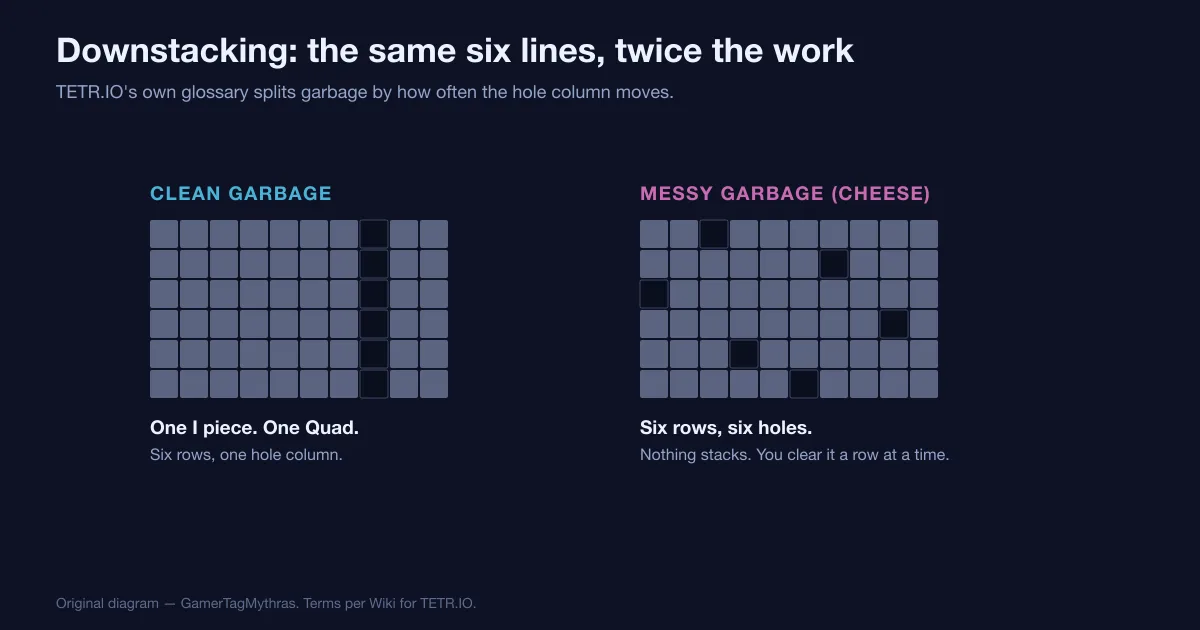
Tetris Downstacking: How to Dig Out of Garbage
Garbage is not one obstacle, it is two. Where the hole column sits from row to row decides whether six lines cost you one piece or six, and TETR.IO scores the lines you dig out at exactly the same rate as the lines you send.
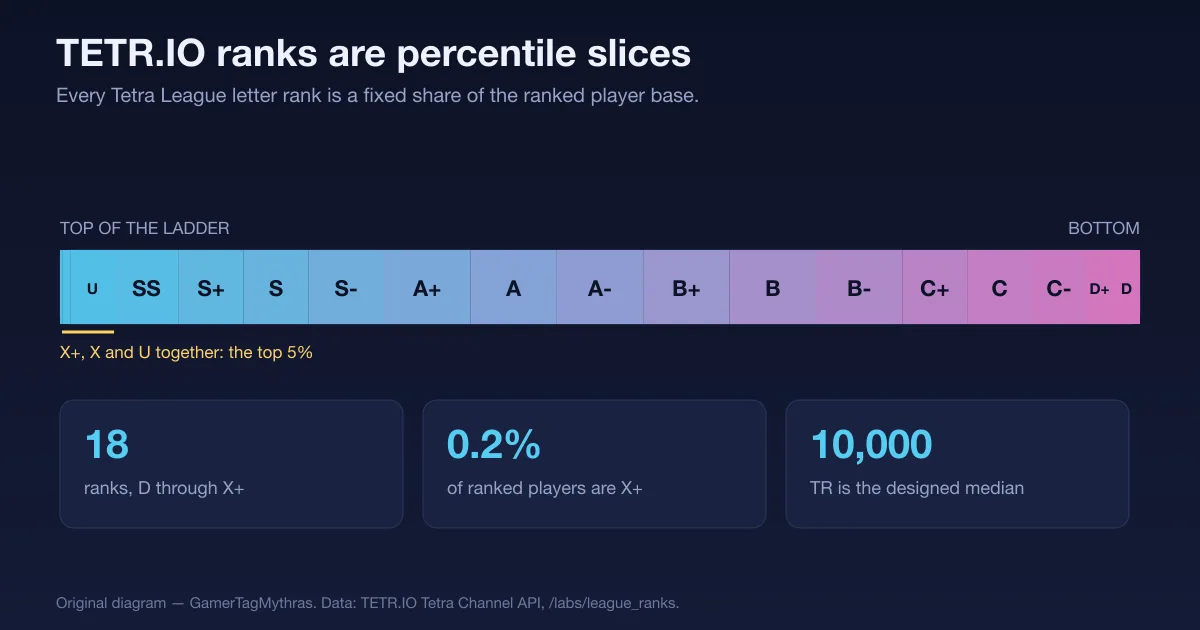
TETR.IO Ranks Explained: TR, Percentiles and Cutoffs
A Tetra League letter is not a skill score, it is a slice of the leaderboard — and TETR.IO publishes exactly how big each slice is, what TR it currently costs, and how fast the people inside it play.
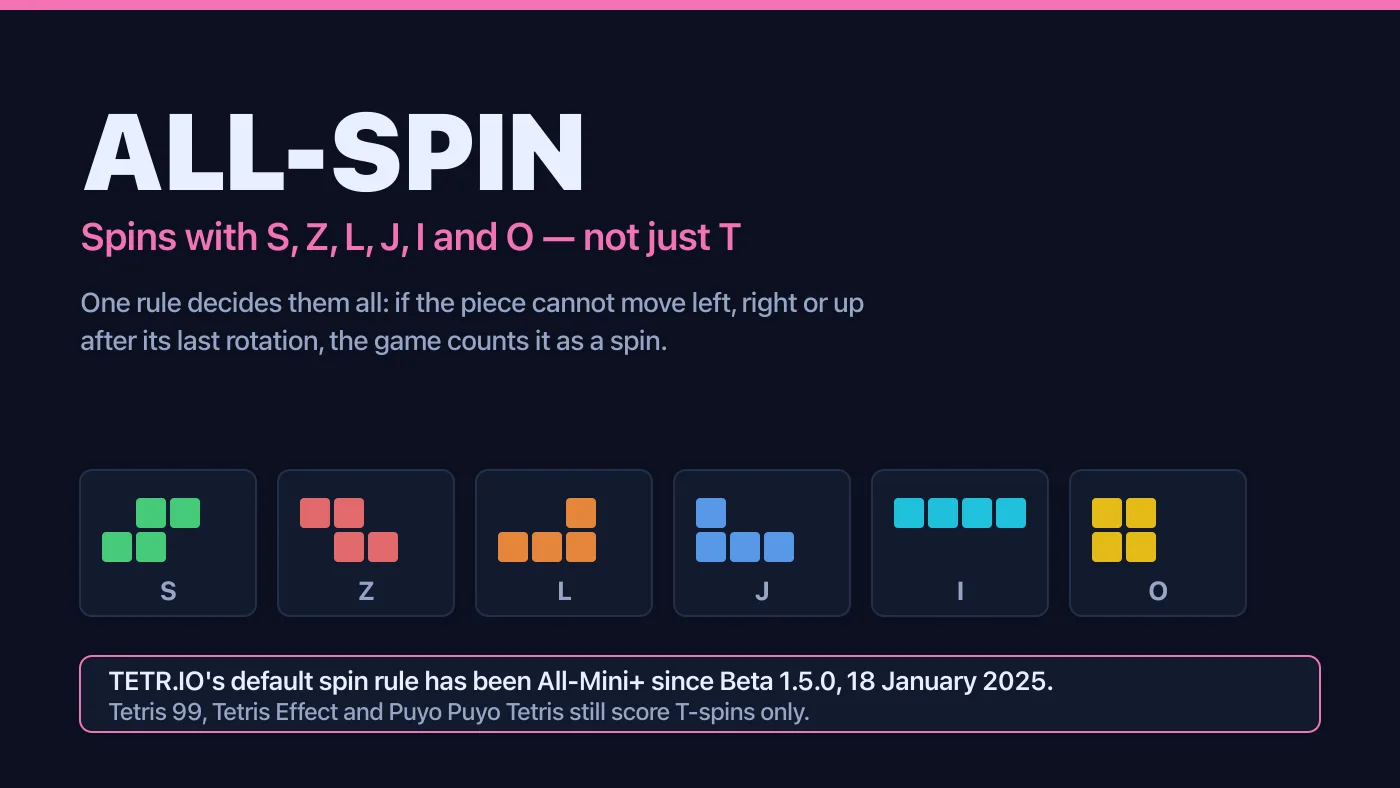
Tetris All-Spin Explained: S, Z, L, J and I Spins
A Z piece rotated into a slot nothing else reaches is either a scored spin or an ordinary Double, and which one it is has nothing to do with you. It is a setting, and most Tetris games have it switched off.
TETR.IO Quick Play Explained: The Zenith Tower, Climb Speed, and HYPERSPEED
Quick Play looks like a battle royale and scores like a speedrun. There is no round to win and nobody to outlast — only altitude, and altitude is bought mostly with the lines you send at other people.
Tetris Stacking Fundamentals: Build a Board That Wins
Most players do not lose to speed. They lose to a board they built themselves three minutes earlier. Here is how stacking actually works in modern Guideline Tetris, and the habits that stop you from burying your own well.
The Tetris Effect Zone Guide: Ultimatris, the Attack Table, and When to Press It
Zone is sold as a get-out-of-jail button, and used as one it pays a fraction of what it could. The published Zone Bonus Attack table says the same lines can be worth 40 garbage rows or 80, depending only on when you pressed it.