Puyo Puyo Tetris 2 Skill Battle Explained
Puyo Puyo Tetris looks like a novelty crossover until you open Skill Battle: a team of three sharing one HP bar and one MP gauge, where topping out costs you a slice of that HP instead of the match. Here's what actually happens under the hood.
A TETR.IO player who has never touched Puyo Puyo Tetris will not believe this exists: a mode where your Tetris side and two teammates share one health bar and one mana gauge. That mode is called Skill Battle, it shipped in Puyo Puyo Tetris 2 only — it does not exist in the 2014 original — and it is not the tacked-on crossover gimmick the name implies. It is a genuine second combat system layered on top of the exact Guideline mechanics this site already covers in depth.
This guide is about what Puyo Puyo Tetris actually does with its versus modes once you get past "half the roster plays Puyo, half plays Tetris." That includes Skill Battle's HP and MP economy, the four other rulesets sitting between plain Versus and Skill Battle, and the mechanic that decides what your Tetris clears are actually worth once they cross over to a Puyo opponent's board.
Not classic Fever, and not plain Guideline either
If you know Puyo Puyo from anywhere else, you know Fever mode: a gauge that fills as you offset garbage, then dumps a run of preset chains onto your own board to clear for a burst of damage. Puyo Puyo Tetris's standalone Versus mode does not run that system at all. A Puyo player in ordinary Versus is playing standard Tsu-rule chains — no Fever gauge, no preset drops — against a Tetris opponent running the Guideline rules covered across this site: Super Rotation System, hold, a 7-bag randomizer, and a 5-piece next queue that drops to 3 in Swap mode and in three- or four-player games, a detail our which Tetris should you play guide already flags. One extra wrinkle specific to this crossover: the Puyo side does not rotate the way mainline Puyo games do either. Hard Drop's own reference lists its rotation as a "Two-mino Rotation with wallkicks," distinct from the Tetris side's SRS.
Fever shows up in exactly two places, and neither one is the default Versus fight. It is a genuine single-player mode on its own (Endless Fever, alongside Endless Puyo, Marathon, Sprint and Ultra), and it is deliberately, asymmetrically baked into one specific versus ruleset covered below. Knowing where Fever actually lives — and where it does not — is the first correction most players coming in from a mainline Puyo game need.
How a mixed Puyo-vs-Tetris match actually works
When a Tetris player faces a Puyo opponent, your line clears do not become nuisance the instant they clear. Per tetris.wiki, "if a Tetris player has at least one Puyo opponent, the Tetris players' attacks will be queued in the meter on the left of their field and only sent when a non-line clearing piece locks." That is the same underlying rule our downstacking guide documents for incoming garbage in ordinary Tetris versus — pending garbage waits for a placement that does not clear — just running here on the outgoing side of a cross-game matchup instead.
What actually lands on a Puyo board is denominated differently than a Tetris player expects. Puyo Nexus's own reference on the nuisance queue lists the visual units a Puyo player reads pending garbage in: a lone chip is 1, a full row-covering "Large" is 6, a "Rock" is 30 and takes up to five rows to fall, and Star, Moon, Crown and Comet each jump by roughly an order of magnitude past that, into the hundreds and then above a thousand. A Tetris player's Quad does not show up on a Puyo screen as "4" — it shows up as however many of those units the conversion produces, and Hard Drop's own reference notes plainly that "the Tetris part got nerfed in newer versions," with specific clears like the Perfect Clear and T-Spin Triple sending less than they originally did. The exact current conversion table is not something this guide is going to assert a false precision on — what is worth knowing is that it exists, that it has been rebalanced at least once, and that it is a genuinely different economy from the same clears fought Tetris-versus-Tetris, which our openers guide already documents with Puyo Puyo Tetris's own attack numbers for that specific matchup.
Four rulesets before you even reach Skill Battle
Skill Battle gets the attention, but it sits alongside four other rulesets that each change the fight in a completely different way.
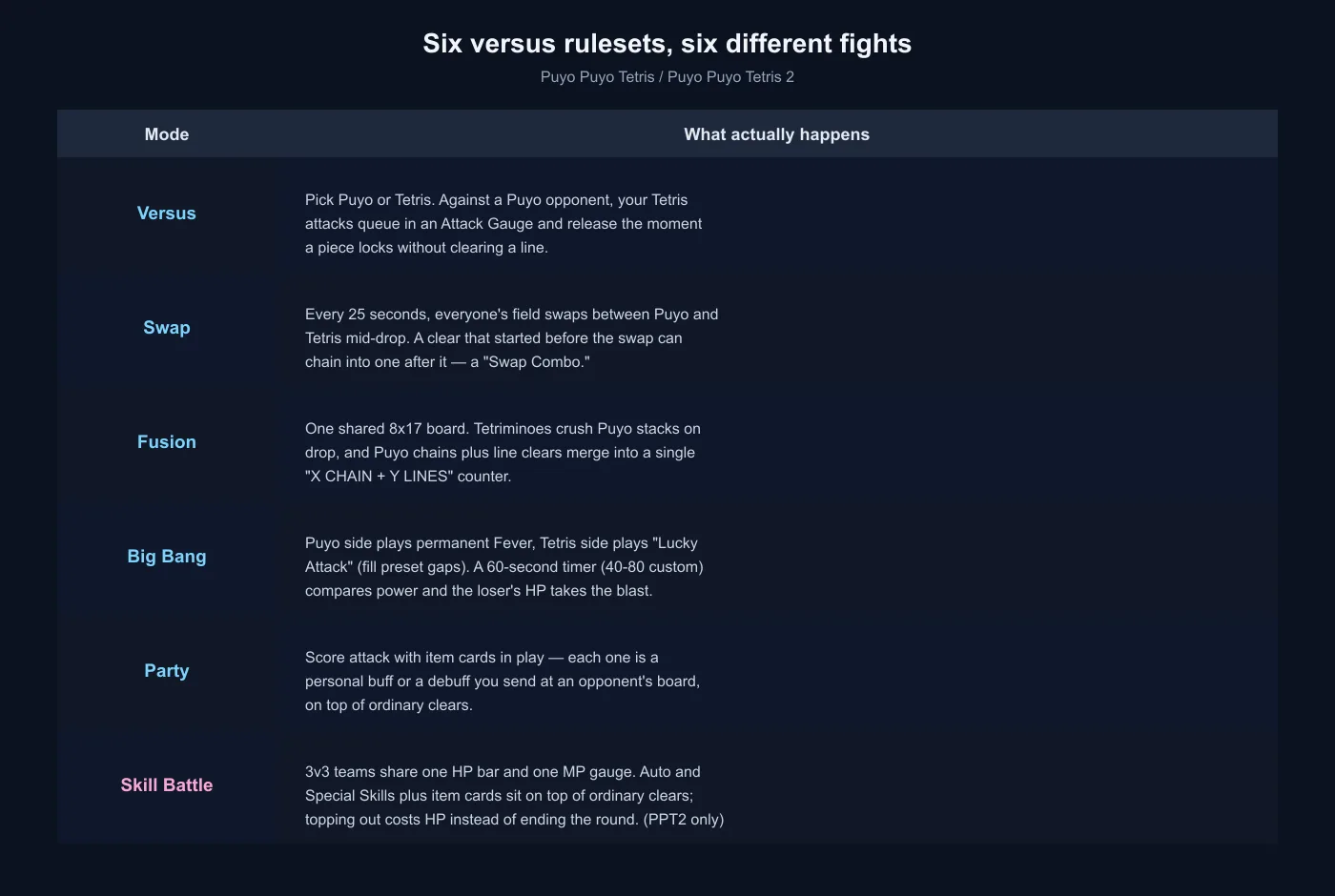
- Swap. Every 25 seconds, everyone's field flips between Puyo and Tetris mid-drop — the game does not wait for the current piece to finish, it keeps falling without your input through the swap. A clear that started on one side before the swap can chain into a clear on the other side afterward, which the community calls a Swap Combo, and it is worth real extra damage.
- Fusion. Both game types share one 8x17 board — wider and shorter than either game's own field. Tetriminoes do not stack around Puyos on that board, they crush them: soft-drop or hard-drop a piece onto a stack and the crushed Puyos disappear on lock, then fall back in from the top afterward. Puyo chains and Tetris line clears merge into a single running counter the game displays as "X CHAIN + Y LINES." You lose when a piece fills any of four marked cells at the top of the field.
- Big Bang. This is the one place standalone Fever actually lives in versus play — the Puyo player is placed in permanent Fever for the whole round, while the Tetris player instead gets Lucky Attack: a pre-made stack with gaps, cleared using whichever pieces that stack calls for. A timer counts down from 60 seconds by default (40 to 80 in custom rules), and when it hits zero every player's accumulated power is compared in a single explosion; whoever comes up short takes HP damage, shown as cracks spreading across their field. The round then repeats until one player is left.
- Party. A score-attack ruleset built around item cards — personal buffs or debuffs you can fire at an opponent's board — stacked on top of ordinary clears from either game.
Every one of those is a genuinely different fight, and none of them is the one this guide spends the rest of its time on.
Skill Battle: three characters, one HP bar, one MP gauge
Skill Battle drops the Puyo-versus-Tetris framing and replaces it with something closer to a turn-based RPG's action economy wrapped around the same falling-block engine. Per Puyo Nexus's wiki, each player "selects a team of 3 characters," and the goal is to bring the opposing team's shared HP bar to zero.
The part that catches people used to any other Puyo Puyo Tetris ruleset: MP is pooled across the whole team, not tracked per character. The official PlayStation Blog deep dive for the mode's reveal describes it directly — skills are "activated in battle by expending MP, which is pooled together and shared as a team." Whichever of your three characters is active, they are all drawing from and contributing to the same green gauge.
This is also where the game's roster actually mattered. Puyo Puyo Tetris 2 launched with 28 playable characters — 14 from the Puyo side, 14 from the Tetris side — and three free content updates between January and March 2021 added twelve more (four characters per update), giving Skill Battle teams real depth to build around by the time the game's support wound down.
Auto Skills vs. Special Skills, with real numbers
Every character brings two kinds of skill into a Skill Battle match, and the difference between them is when you get a say in using it.
An Auto Skill fires the instant the match starts and stays passive from there — it typically boosts one of your team's stats for the whole fight with no input required. A Special Skill costs MP, is triggered manually whenever you choose, and then sits on a cooldown before it can fire again. Puyo Nexus's own compiled skill list gives concrete numbers for both, and the shape of a few of them is worth knowing before you build a team:
| Character | Skill | Type | MP cost / cooldown | What it does |
|---|---|---|---|---|
| Ringo | Attack Up | Auto | — | Passive team attack boost that scales from 10% up to 30% as the skill levels |
| Carbuncle | Steel Guard | Special | 30–70 MP | Team defense rises from 20% to 40% as it levels, while the buff's own duration shrinks from 30 seconds down to 15 |
| Amitie | Recycle | Special | 30–70 MP | Converts 10 to 24 blocks already sitting in your nuisance queue into placeable red Puyos instead of letting them land as garbage |
| Tee | Sharpshooter | Special | 60–50 MP, 10s cooldown | Clears the bottom two rows of your own board outright |
| Klug | Change All | Special | 60–50 MP, 15s cooldown | Turns the bottom three rows of your board into a single color |
| Marle | Assemble! | Special | 180–160 MP | Right-aligns the bottom 14 rows of your board — pure reorganization, no direct damage |
Read the MP and duration columns as ranges tied to how far a skill has been leveled, not as a fixed number every player sees — Puyo Nexus records both ends of that range for each skill, and which end sits at level one versus max level is specific to the individual skill rather than a single site-wide rule. Carbuncle's Steel Guard is the cleanest illustration of the actual design intent: as it levels, the buff gets stronger (20% to 40% defense) at the direct cost of lasting less time (30 seconds down to 15) — a real risk-and-reward tradeoff baked into a single skill, not two separate numbers moving for no reason.
Topping out costs HP, not the match, until the sixth time
Every other ruleset on this page ends the instant your stack tops out or your Puyo field fills. Skill Battle does not — a top-out costs your team a slice of its HP and the match keeps going. How large that slice is has actually changed once, and the change is worth knowing because it decides how forgiving a bad board actually is.
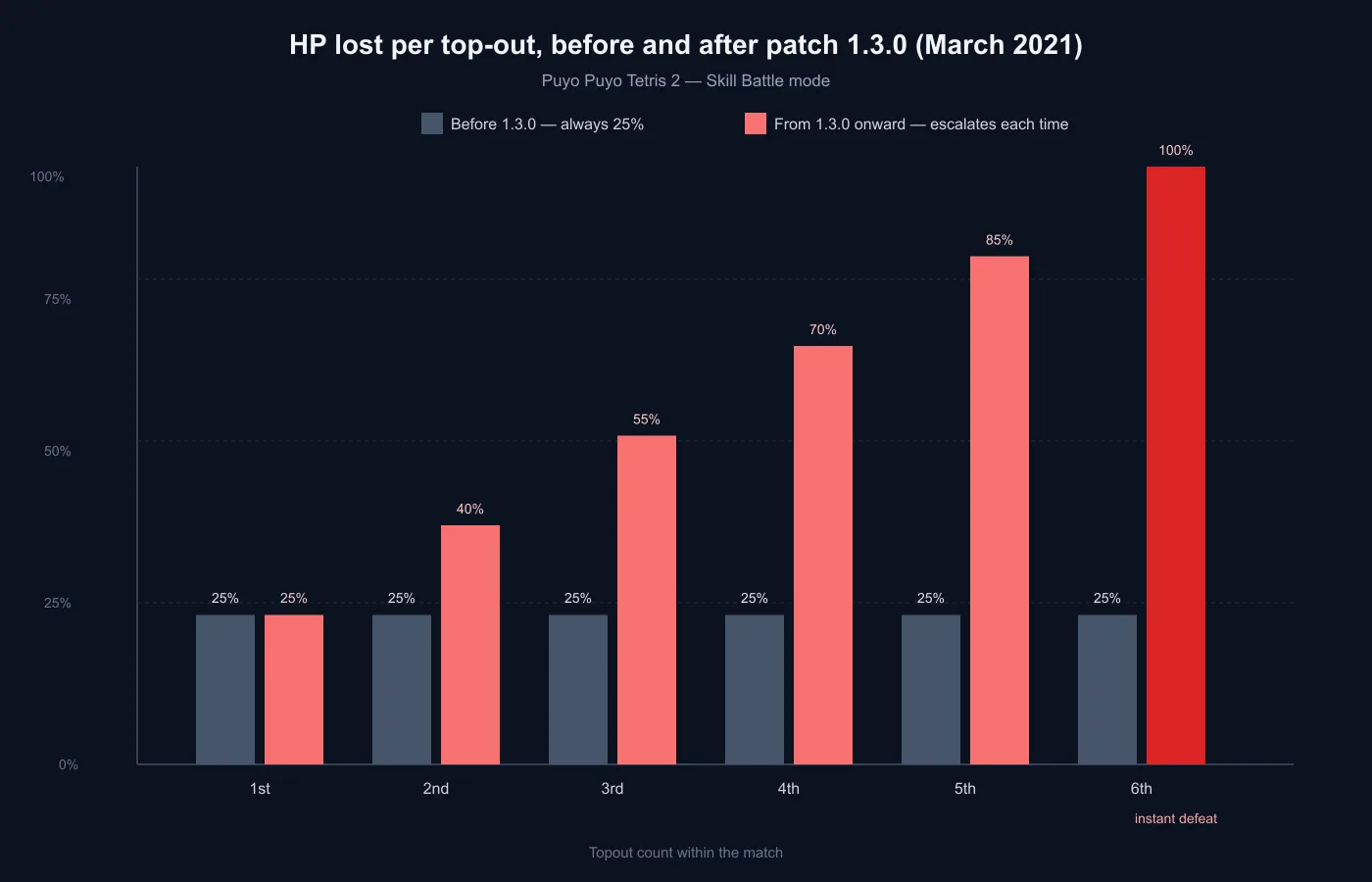
At launch, topping out always cost a flat 25% of your team's maximum HP, no matter how many times it happened in a match. That changed in version 1.3.0, the game's final free content update, released in early March 2021 alongside four new characters, a Spectator Mode, and a new "Super Spicy" boss-fight difficulty. From that patch onward, the penalty escalates with every top-out in the same match:
| Top-out count | HP lost |
|---|---|
| 1st | 25% |
| 2nd | 40% |
| 3rd | 55% |
| 4th | 70% |
| 5th | 85% |
| 6th | 100% — instant defeat |
The design read is straightforward once you see the table: a single mistake still costs the same quarter of your bar it always did, but a team that keeps toppling now runs out of match far faster than it would have at launch. Building a board you can consistently avoid dying on matters more today than it did in 2020.
Margin time still exists, it just moved
Mainline Puyo Puyo games have their own margin-time concept tied to a points target, and it does not carry over into Skill Battle in that form. Instead, Skill Battle runs its own version, and Puyo Nexus's wiki states the trigger exactly: "after two and a half minutes have passed, a chime will sound, and a Skill Battle-exclusive form of margin time will take effect. The amount of HP depleted by incoming garbage will increase greatly over time, which can cause even small attacks to completely deplete the victim's HP."
The practical read is straightforward: once that chime sounds at 2:30, a match stops rewarding a slow, defensive lead. A player sitting comfortably ahead on HP has every incentive to keep attacking rather than turtle, because from that point on the size of the attack matters far less than the fact that one is landing at all.
Item cards, and where they actually come from
On top of Auto Skills and Special Skills, each Skill Battle team can equip up to four item cards, which come in five stat types — HP, MP, Attack, Defense and Recovery — plus a separate category of "special effect" cards that boost something more specific, like a Puyo chain's attack power or a Tetris line-clear's attack power, instead of a flat stat.
Item cards are not bought or unlocked directly. The official PlayStation Blog deep dive says they "are randomly dropped in Adventure mode," and the game's higher Boss Raid difficulties are a second source: "Super Spicy" difficulty, added in the same 1.3.0 update that reworked the top-out penalty, was framed the way it was in the patch's own announcement because its bosses are "even more difficult than the already difficult 'Spicy' bosses, but defeating them has a high chance of earning you a high level item card." Between the two, the RPG-style Adventure campaign and the toughest Boss Raid encounters are where a Skill Battle team's actual equipment comes from.
What this means if you are coming from TETR.IO
None of this replaces the fundamentals. Line clears are still the engine underneath every skill and every item card, so stacking cleanly and landing T-spins still decide how much raw material you have to work with before any of the RPG layer gets applied on top of it. What changes is the ceiling on what a mechanically average Tetris player can do to a stronger one: a well-built three-character team with skills timed around the MP gauge and the right item cards equipped is a real equalizer in a way that no ordinary Guideline versus match has room for.
One practical note if you are deciding where to actually play this: the console versions — Switch, PS4, PS5, Xbox One and Xbox Series X/S — launched together on 8 December 2020, but the Windows version did not arrive on Steam until 23 March 2021, roughly three and a half months later. If you were shopping for it on PC in its launch week, it genuinely was not there yet; today it is, alongside the enhanced Switch 2 port, Puyo Puyo Tetris 2S, our version comparison guide already covers.
Quick Action Checklist
- Remember Fever is not the default Versus ruleset — it only runs in the single-player Endless Fever mode and, asymmetrically, inside Big Bang.
- In a mixed Puyo-vs-Tetris match, your attacks queue and release on your next non-clearing placement, the same rule that governs incoming garbage elsewhere on this site.
- Do not assume a Tetris clear converts to a fixed Puyo nuisance number — the conversion has been rebalanced at least once and is denominated in escalating visual units, not a flat count.
- Learn Swap Combo, Fusion's crush mechanic, and Big Bang's Lucky Attack before you assume every non-Skill-Battle ruleset plays like plain Versus.
- Build a Skill Battle team of three around one shared MP gauge, not three independent resource bars.
- Check whether a skill is Auto (fires at the start, passive) or Special (costs MP, manually triggered, then cools down) before planning around it.
- Play carefully around your fourth and fifth top-out — since patch 1.3.0, the penalty climbs to 70% and 85% of team HP before the sixth ends the match outright.
- Treat the 2:30 chime as a hard turning point — margin time makes small attacks lethal, so stop playing for a slow lead once it sounds.
- Grind Boss Raid's Super Spicy difficulty specifically for item cards; it was built for that.
- If you are shopping for the PC version, know it followed the console launch by about three and a half months, not same-day.
Frequently Asked Questions
What is Skill Battle in Puyo Puyo Tetris?
Does topping out end a Puyo Puyo Tetris 2 Skill Battle match?
What is the difference between an Auto Skill and a Special Skill?
How does Puyo Puyo Tetris convert Tetris garbage into Puyo damage?
What is Big Bang mode in Puyo Puyo Tetris?
Where do you get item cards in Puyo Puyo Tetris 2?
Is Puyo Puyo Tetris 2 available on PC?
Keep Reading
- Puyo Nexus Wiki — Skill Battle: team size, HP top-out table, shared MP, margin time
- Puyo Nexus Wiki — List of Skill Battle Skills in Puyo Puyo Tetris 2
- PlayStation Blog — official deep dive on Puyo Puyo Tetris 2 Skill Battle mode
- tetris.wiki — Puyo Puyo Tetris: Versus, Swap, Fusion, Big Bang and Party modes, Attack Gauge mechanic
- tetris.wiki — Puyo Puyo Tetris 2: release dates, rotation system, roster and mode list
- Puyo Nexus Wiki — Nuisance queue: garbage denominations and Fever-mode queue behavior
- Puyo Nexus Wiki — Big Bang mode: timer, Lucky Attack, Fever and HP damage
- Nintendo Everything — Puyo Puyo Tetris 2 version 1.3.0 patch notes (March 2021)
Related Guides
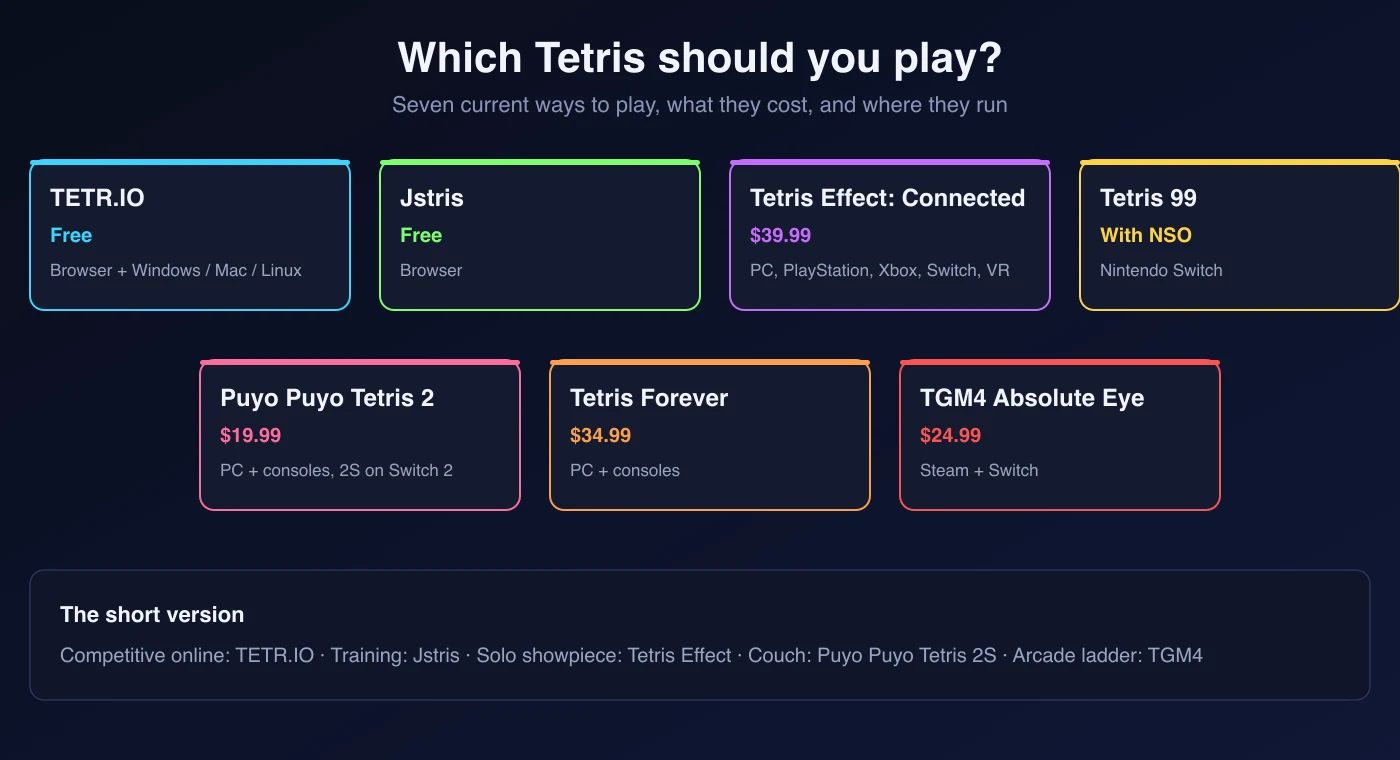
Which Tetris Should You Play? TETR.IO to Tetris Effect
There are at least seven current, maintained ways to play Tetris, and they are not interchangeable — two are free in a browser, one costs $39.99 and works in VR, and one is an arcade grading ladder that came back after twenty years. Here is which one to actually install.
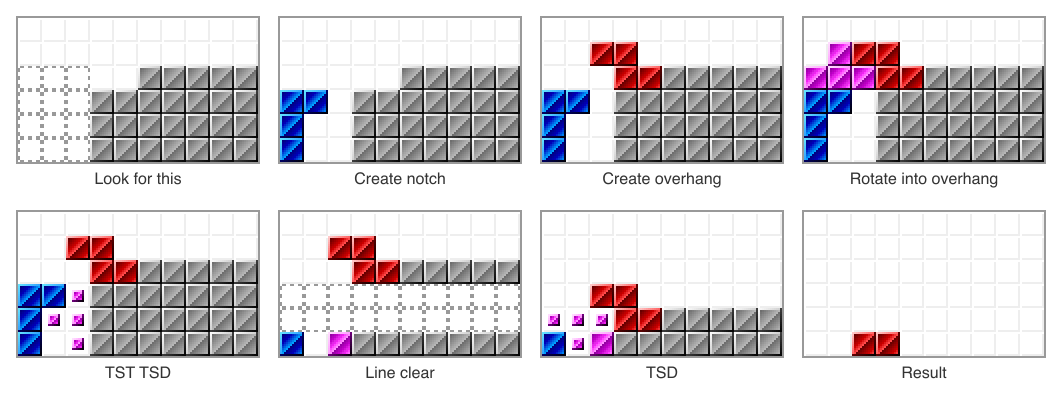
Tetris Mid-Game T-Spins: STSD, Imperial Cross, Kaidan
Once the opener is spent, the board decides your T-spins. Hard Drop files 63 pages of mid-game T-spin setups; this guide covers three families: lend your well to a T-spin, stack two TSD slots, or kick a T two rows deeper to save a bad board.
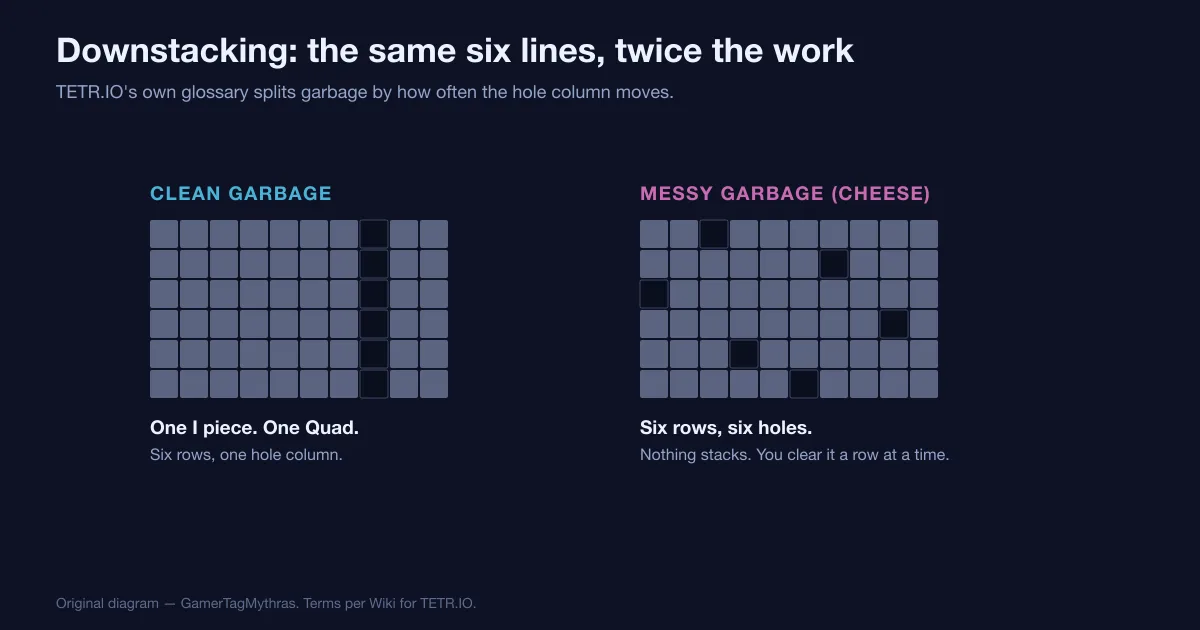
Tetris Downstacking: How to Dig Out of Garbage
Garbage is not one obstacle, it is two. Where the hole column sits from row to row decides whether six lines cost you one piece or six, and TETR.IO scores the lines you dig out at exactly the same rate as the lines you send.
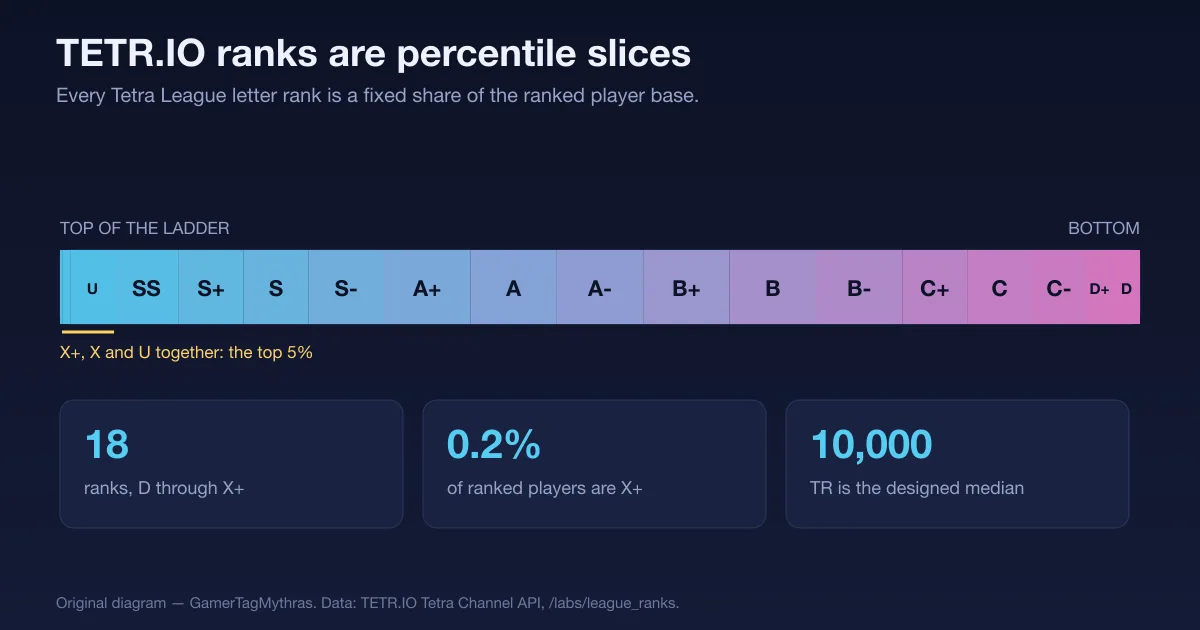
TETR.IO Ranks Explained: TR, Percentiles and Cutoffs
A Tetra League letter is not a skill score, it is a slice of the leaderboard — and TETR.IO publishes exactly how big each slice is, what TR it currently costs, and how fast the people inside it play.
Tetris Stacking Fundamentals: Build a Board That Wins
Most players do not lose to speed. They lose to a board they built themselves three minutes earlier. Here is how stacking actually works in modern Guideline Tetris, and the habits that stop you from burying your own well.
Tetris All-Spin Explained: S, Z, L, J and I Spins
A Z piece rotated into a slot nothing else reaches is either a scored spin or an ordinary Double, and which one it is has nothing to do with you. It is a setting, and most Tetris games have it switched off.