TETR.IO Quick Play Explained: The Zenith Tower, Climb Speed, and HYPERSPEED
Quick Play looks like a battle royale and scores like a speedrun. There is no round to win and nobody to outlast — only altitude, and altitude is bought mostly with the lines you send at other people.
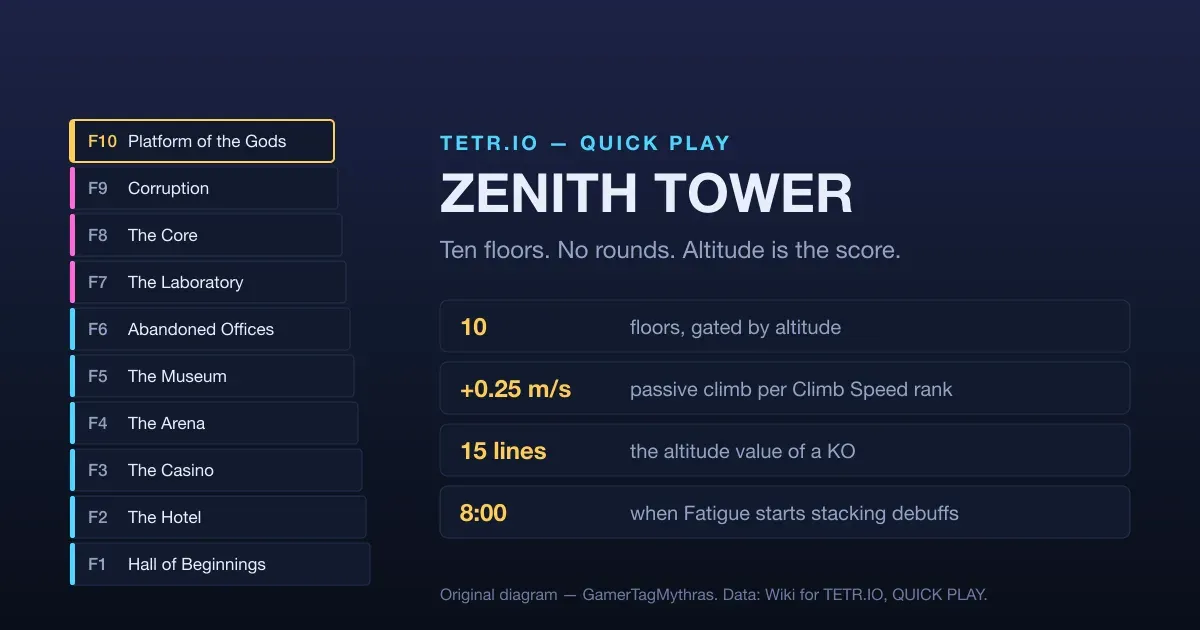
TETR.IO's Quick Play looks like a battle royale and scores like a speedrun. There is no round to survive and nobody to outlast — just a number in metres above your board and a tower you are trying to get further up before you top out. Then you press a button and immediately go again.
The mode shipped in this form with Beta 1.0.0 on 26 July 2024, and the studio has been tuning it every few months since; the newest build at the time of writing is Beta 1.7.8, dated 1 April 2026. That matters, because several of the rules below were rewritten after launch. This is what the tower actually pays out, taken from TETR.IO's own patch notes and the wiki that tracks them.
Zenith is a sending game, not a surviving game
The most useful thing to understand about Quick Play is that surviving is not the scoring mechanism. Altitude comes from Climb Speed, and Climb Speed ranks up by sending and cancelling lines. Sit on a clean board doing nothing and you drift upward at the passive rate for your current rank — and that rank decays while you idle.
TETR.IO's design lead on the rework, credited as garbo, wrote up the mode's development afterwards, and the clearest signal in that write-up is a balance change that sounds trivial and is not: in normal Quick Play, a 0-combo, non-Spin Single sends 1 line. Under TETR.IO's standard rules it sends nothing at all. The stated reason is that players who never attack are, in garbo's phrasing, "wasting targeting space" — they occupy a slot in the garbage economy without feeding it, which throws off every other difficulty knob the mode has.
So the floor of the mode was deliberately raised so that even a player who only clears Singles is participating. Expert Mode takes that back out: with Expert on, 0-combo Singles send nothing again.
What Quick Play 2 replaced
The old Quick Play was a conventional elimination free-for-all, and the numbers garbo published on it explain why it got torn down rather than patched:
- The average round ran 4 to 5 minutes.
- Half of all players died inside the first 2 minutes.
- There was a 30-second gap between one round ending and the next starting.
Add those up and a new player could wait five minutes, die in one, then spectate for another five. The rework's brief was to cut the wait to zero, sort players by skill without a matchmaker, and give every skill bracket something to chase. The persistent tower does all three at once: you drop in whenever, the floors sort players by how much damage they can actually produce, and the leaderboard resets weekly — every Monday at 12am GMT — so nobody is chasing a two-year-old score.
There are two of those leaderboards, incidentally: QUICK PLAY and EXPERT QUICK PLAY, the second gated behind the Expert mod.
Climb Speed is the entire scoreboard
Climb Speed starts at rank 1 and has no upper limit. Each rank adds 0.25 m/s of passive climbing, so rank 1 is +0.25 m/s and rank 8 is +2.00 m/s.
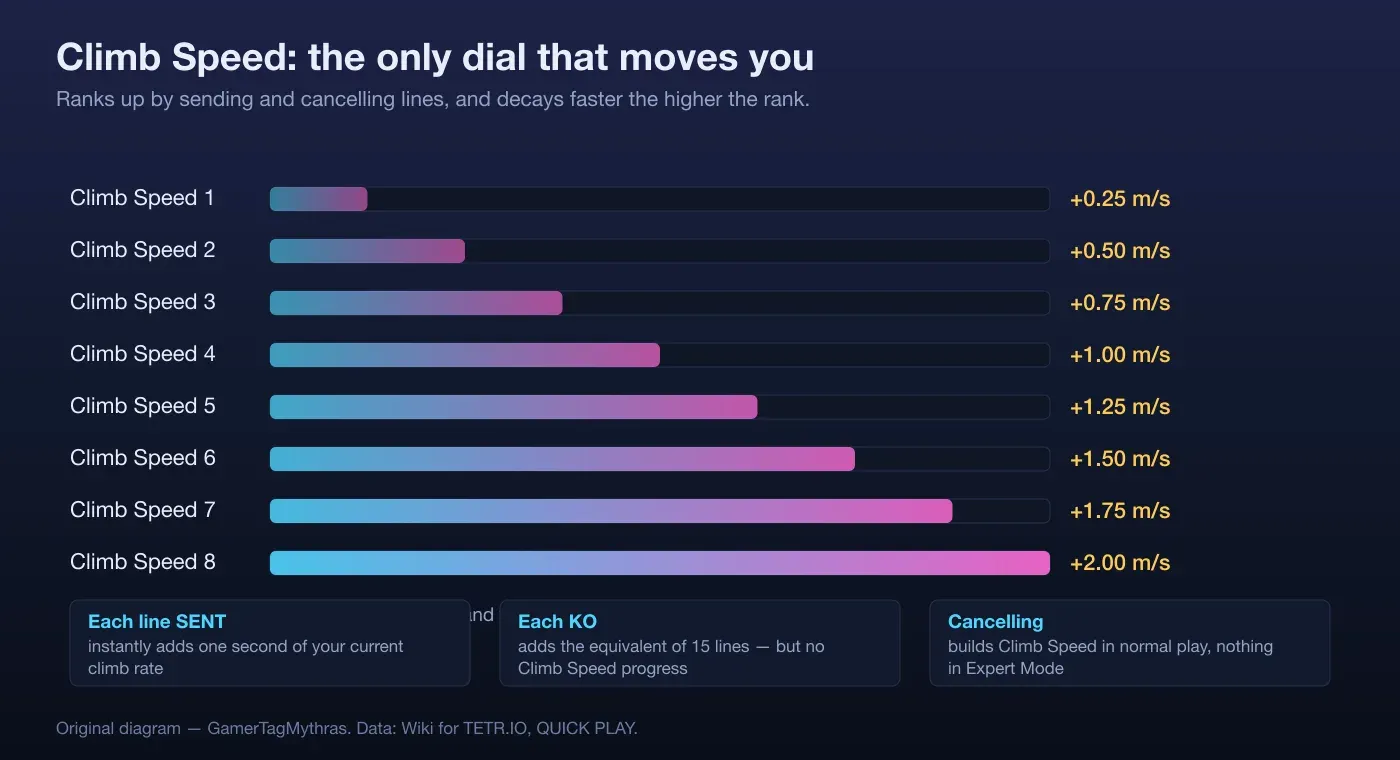
The passive rate is the boring half. The half that decides runs:
- Every line you send instantly boosts you by one second of your current climb rate. This is why the rank matters twice — it raises your passive speed and the value of every subsequent line you send.
- A KO is worth the equivalent of 15 lines of that instant boost, but KOs contribute nothing to Climb Speed progress. A KO is a payout, not an investment.
- Cancelling counts toward Climb Speed in normal play. Under Expert Mode it does not, which is why Expert players are told to tank garbage rather than cancel it.
Climb Speed also decays, faster at higher ranks. Ranking up pauses that decay for five seconds — but the game notices if you are yo-yoing. Each time you lose and re-gain the same rank, that pause shortens by one second, down to a floor of one second. You reset it back to the full five by pushing 50% of the way to the next rank after a promotion. Bouncing between rank 6 and rank 7 for two minutes therefore leaves you with a worse grace window than a player who just arrived at rank 6.
The ten floors and what each one hands you
Zenith Tower is split into ten floors by altitude. Reaching a new floor for the first time unlocks a mod — every floor except the first and the tenth.
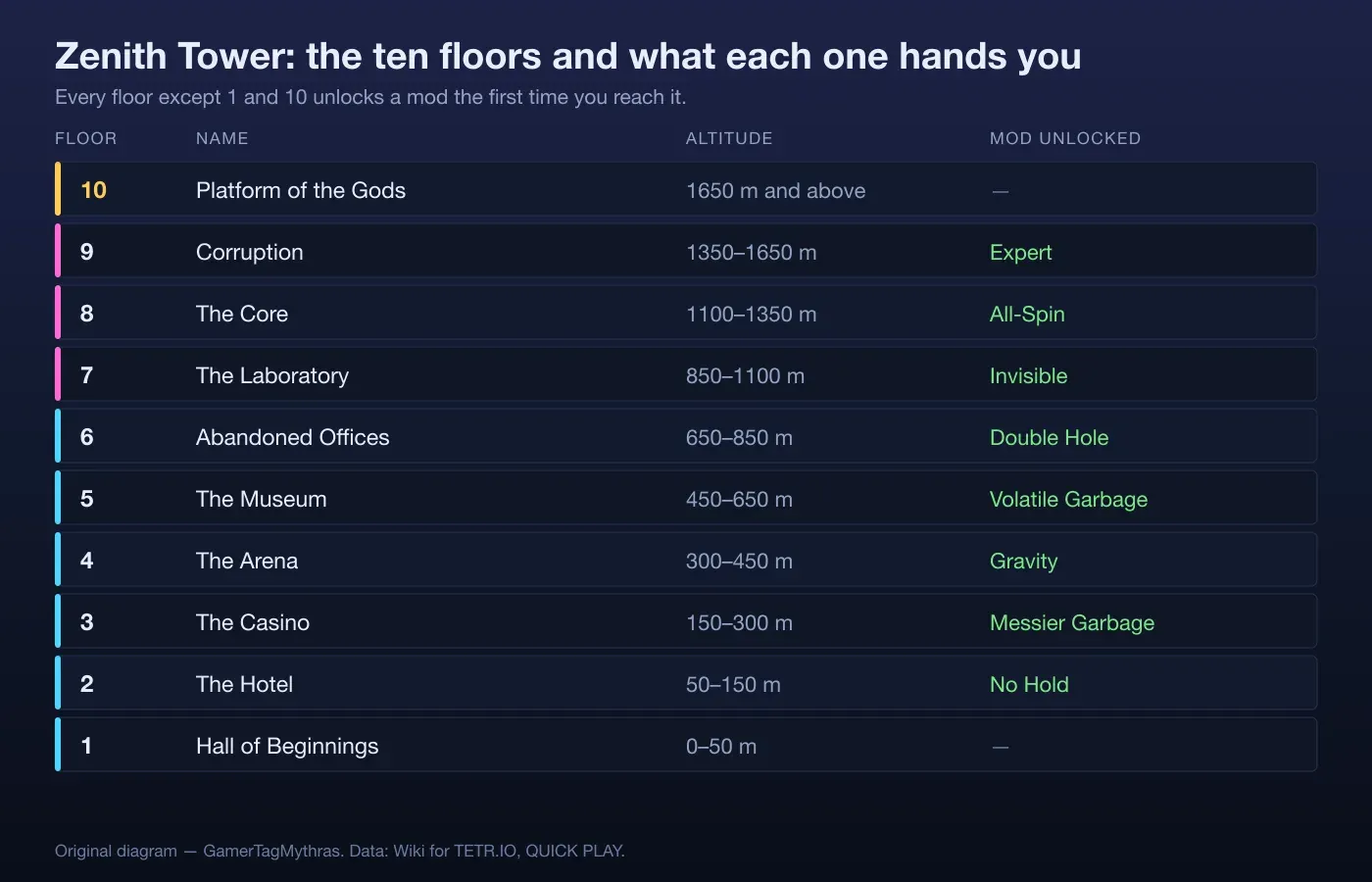
Floors are not purely cosmetic milestones. Several difficulty values are tied to them: garbage becomes active on your board faster per floor, garbage gets messier higher up, and since Beta 1.7.0 (21 March 2025) clean garbage wells on floor 5 and below only spawn in columns 3 through 8 — a deliberate concession to lower-floor players, since edge wells are the awkward ones to dig.
One rule change worth knowing if you last played this in 2024: Beta 1.5.0 (18 January 2025) made floor cutoffs much easier to pass. Previously you had to send lines to break through a cutoff. Now any line clear bumps you past it. If you have ever been told you need a big attack to crack a floor boundary, that advice predates Beta 1.5.0.
Garbage here is not Tetra League garbage
Quick Play runs a modified version of TETR.IO's normal attack rules, and the differences are big enough to change how you play:
- All Clears send 3 lines and add +2 to your back-to-back. In Tetra League's Season 2 rules an All Clear sends 5. In Season 1 it sent 10.
- B2B Surge starts at 1 line in Quick Play, against 4 in other multiplayer modes. Each level of back-to-back beyond a streak of 4 adds another line to the stored Surge, with no cap, and the whole thing fires in three segments when the streak breaks.
- Combo rounding is different. TETR.IO's Multiplier combo system computes attack as
base × (1 + 0.25x), and the fractional result has to be rounded to whole lines. Quick Play uses RNG rounding — a 1-combo Double worth 1.25 lines has a 25% chance of actually sending 2. Other multiplayer modes and ZEN round down, so that same clear always sends 1. - Garbage columns move. Each garbage line has a chance to change column, and between separate attacks that chance is multiplied by 2.5x. Garbage is not tied to a predictable queue the way it is in a 1v1.
Garbage also does not slam in. It queues up as transparent yellow, then transparent red, then goes opaque red once it is live, and placing a piece before it goes live keeps it out. Higher floors shorten that timer; Expert shortens it further and dumps all lines at once instead of rolling them in.
Targeting is out of your hands entirely — there is no targeting mode to pick. Every player carries a hidden Targeting Factor that rises the longer they survive, and a Targeting Grace that temporarily lowers it when they get hit. Players also tend to attack others on their own floor. The practical read: the longer you sit on a floor without taking damage, the more of the lobby is pointed at you.
Windup buys you a second
Windup triggers when a single incoming attack contains 8 or more lines. The attack gets split into portions of up to 4, and it can only split four times — the last portion carries whatever is left. An attack of 9 arrives as 4 + 4 + 1; an attack of 21 arrives as 4 + 4 + 4 + 9.
You get one second before the first portion lands and half a second between portions, and only one Windup can be running at a time — anything else queues behind it. That is your entire defensive window against a spike, and it is why keeping a downstacking clear ready matters more here than keeping a Quad ready.
Two details that trip people up. With the Volatile Garbage mod, Windup is checked before the doubling, so a 15 comes in normally and a 16 triggers it. And since Beta 1.7.0, large attacks from an opponent breaking a big Surge are combined into a Windup rather than arriving as separate hits.
Cancelling has a hidden cost
This is the mechanic most likely to be missing from any guide written before spring 2025. Cancelling Sickness was reworked in Beta 1.7.0 specifically to punish loop setups without punishing ordinary play.
The rule: every time you cancel lines, your Cancelling Sickness goes up. Accrue enough and your bags start getting modified away from standard 7-bag. You do not get a warning table, you just stop getting the pieces you were counting on.
It is reset to zero by clearing garbage. Short of that, it is reduced by tanking garbage, clearing Quads, and clearing Spins in different columns. In other words, the game will let you cancel your way up the tower for a while and then quietly take the randomizer away. If your piece sequences feel wrong halfway up a run where you have been cancelling everything, that is not variance.
Fatigue is the clock you cannot outplay
Runs get a stacking debuff every minute from 8:00 to 12:00, and each one lasts for the rest of the run.
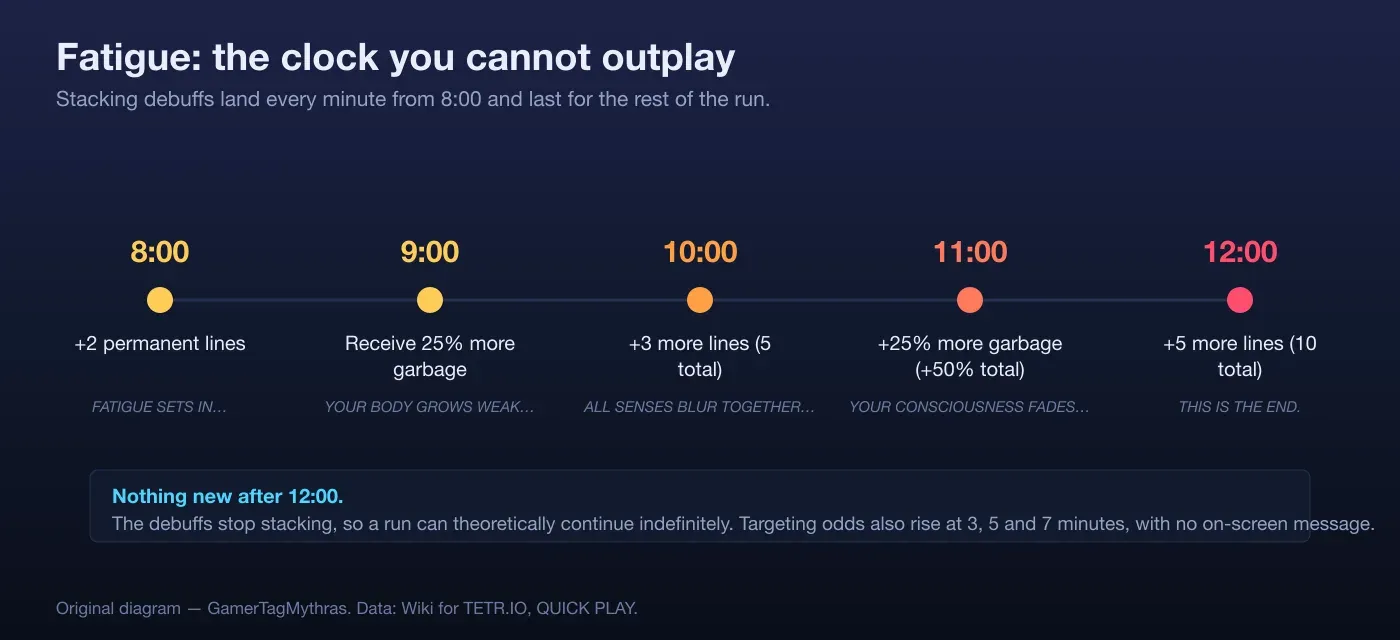
Fatigue exists because early testing produced runs nobody could end: garbo records survival times of 25 to 35 minutes in extreme cases. The stated design brief was to make it feel unintrusive rather than fatal, and it shows in the numbers: at maximum Fatigue you are carrying 10 permanent garbage lines and taking 50% extra incoming, which is brutal but still playable.
Nothing new lands after 12:00. The debuffs stop stacking there, so a run can in principle continue indefinitely. Separately and less visibly, your chance of being targeted rises at 3, 5 and 7 minutes, with no on-screen message at all.
Your board also darkens just before each Fatigue tick. That is your cue, and it is worth treating as one — if the tick coming up is one of the +25% garbage steps at 9:00 or 11:00, that is the moment to spend a stored Surge rather than keep charging it.
HYPERSPEED and the shortcut that got closed
HYPERSPEED is the mode's speedrun state, and the thresholds are specific: Climb Speed rank 8 on floors 1 or 2, rank 9 on floors 3 or 4, or rank 10 on floor 5. It ends if your Climb Speed drops below rank 7 or you top out, and it cannot be started once you enter floor 6.
While it is running you get a speedrun overlay with per-floor splits and personal bests. Reaching floor 10 with HYPERSPEED intact earns the Zenith Speedrun achievement; beyond that it is cosmetic and does not make you climb faster.
The rule that changed: HYPERSPEED can no longer be triggered with any mod enabled, a restriction added in Beta 1.6.1 on 16 February 2025. Before that patch it was possible to run mods alongside it, and the wiki suggests the change followed a player setting Quick Play records with unintended methods. If you find a HYPERSPEED strategy that involves a mod, it does not work any more.
It also exists for a genuinely funny reason. Per the wiki, HYPERSPEED was originally added because the developers were worried the mode's dynamic music would break if you climbed too quickly, and it grew into a mechanic with its own visuals and soundtrack afterwards.
Mods buy difficulty, not score
There are nine base mods, eight unlocked by floor and Duo requiring one player to hold Supporter. Each one generally makes the run harder. None of them multiply your altitude.
That was a deliberate call. garbo's write-up lays out the reasoning: a height multiplier would break the mapping between where a player sits in the tower and how hard they are actually playing, it would push people toward whichever mods were cheapest to score with, and it would need permanent rebalancing as players got better at each one. The reward for mods was routed into achievements instead, which is why each mod has its own achievement niche rather than a shared leaderboard.
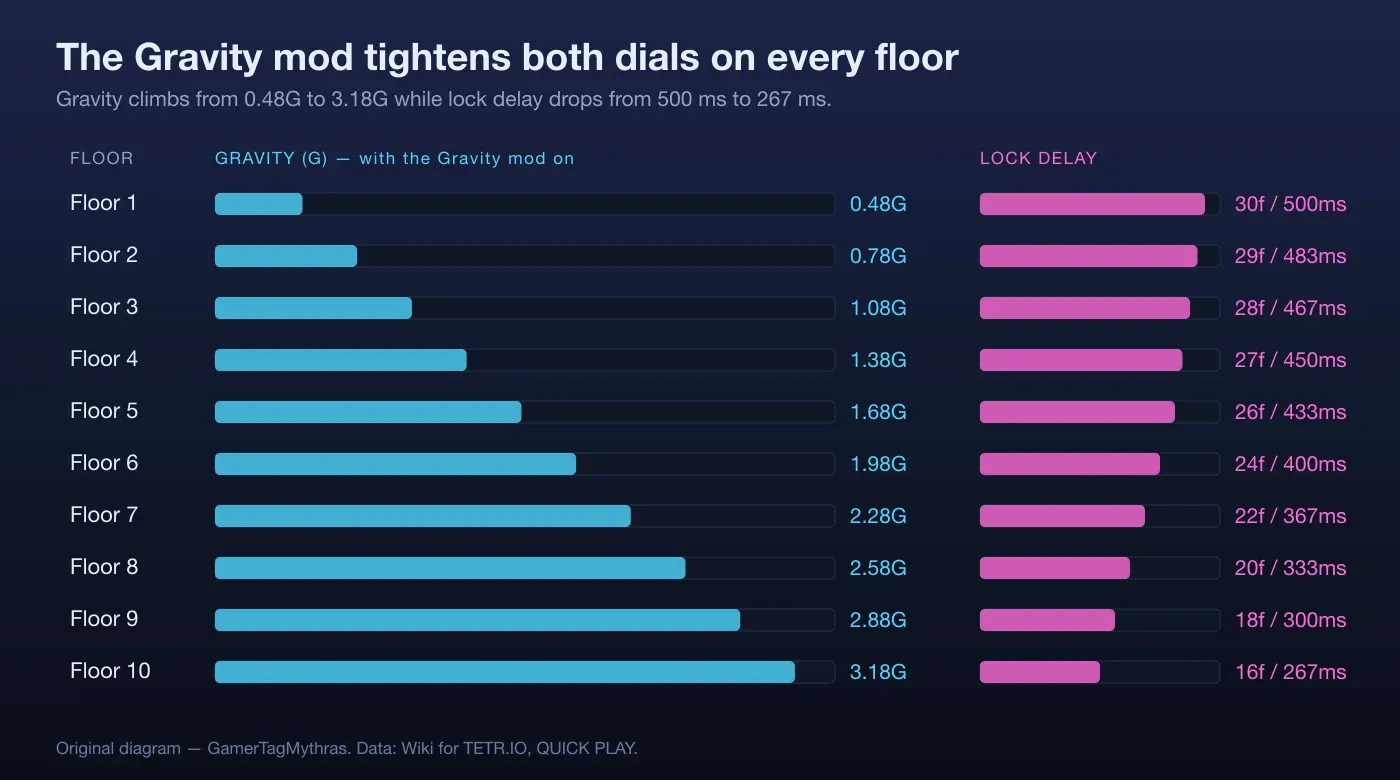
The Gravity mod is the clearest illustration of what "harder" means here, because it is the one with a published table: gravity rises from 0.48G on floor 1 to 3.18G on floor 10, while lock delay falls from 30 frames (500 ms) to 16 frames (267 ms) over the same climb.
Two more things worth knowing before you go mod hunting. Reversed mods arrived in Beta 1.5.0 — significantly harder variants that cannot be combined with anything else, and the reversal of each floor-unlocked mod is earned by climbing a cumulative 30,000 m with the base version. And since that same patch, mods can no longer be unlocked while playing Duo, so the co-op route to unlocking the tower is closed.
If you want the underlying attack maths that Quick Play is bending, our Tetris scoring and attack guide covers the Guideline baseline and where TETR.IO departs from it, and stacking fundamentals covers the downstacking that decides whether a Windup kills you. The rest of our coverage lives on the Tetris coverage hub.
Quick Action Checklist
- Treat lines sent as the score, because Climb Speed is what moves you and idling lets it decay.
- Remember a KO pays like 15 lines of altitude but gives zero Climb Speed progress.
- Stop yo-yoing a rank boundary — each re-gain of the same rank shortens your decay pause by a second.
- Clear Singles freely in normal Quick Play, where they send 1 line; stop doing it under Expert, where they send nothing.
- Tank garbage instead of cancelling it when Expert is on, since cancelling gives no Climb Speed there.
- Watch your Cancelling Sickness: clear actual garbage to reset it before your bags start drifting.
- Place a piece before incoming garbage turns opaque red and it stays off your board.
- Keep a downstack answer ready for an 8-line Windup, not just a Quad.
- Spend a stored Surge when the board darkens before a Fatigue tick rather than charging through it.
- Chase HYPERSPEED with no mods enabled, and start before you reach floor 6.
- Pick mods for the challenge and the achievements — they do not multiply your altitude.
Frequently Asked Questions
How does scoring work in TETR.IO Quick Play?
How many floors does the Zenith Tower have?
How do you trigger HYPERSPEED in TETR.IO?
What is Windup in TETR.IO Quick Play?
Do Quick Play mods give you a higher score?
Keep Reading
- Wiki for TETR.IO — QUICK PLAY: floors, Climb Speed, HYPERSPEED, Windup, Fatigue and mods
- Wiki for TETR.IO — Mechanics: Combo Multiplier, B2B Charging, Opener Phase
- Wiki for TETR.IO — TETRA LEAGUE: Season 1 and Season 2 rule changes
- TETR.IO — official patch notes (Beta 1.0.0 through Beta 1.7.8)
- osk blog — The Design of Quickplay 2.0, by design lead garbo
Related Guides
Tetris Mid-Game T-Spins: STSD, Imperial Cross, Kaidan
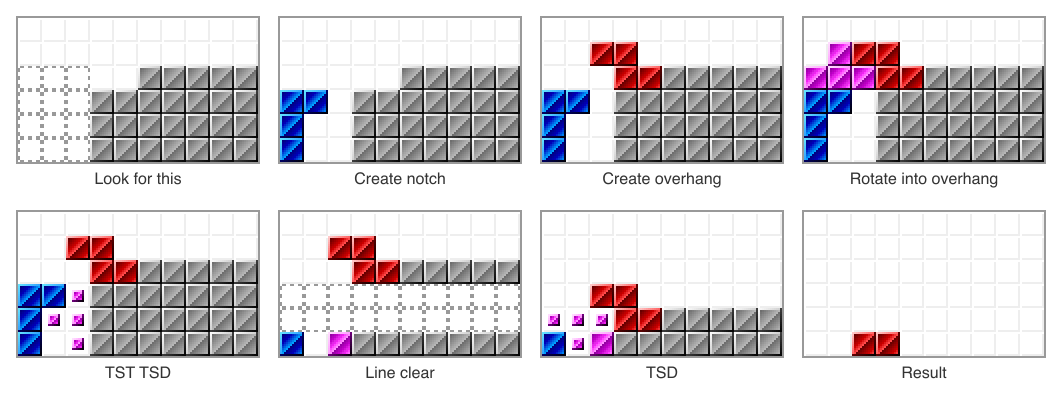
Once the opener is spent, the board decides your T-spins. Hard Drop files 63 pages of mid-game T-spin setups; this guide covers three families: lend your well to a T-spin, stack two TSD slots, or kick a T two rows deeper to save a bad board.
Tetris Downstacking: How to Dig Out of Garbage
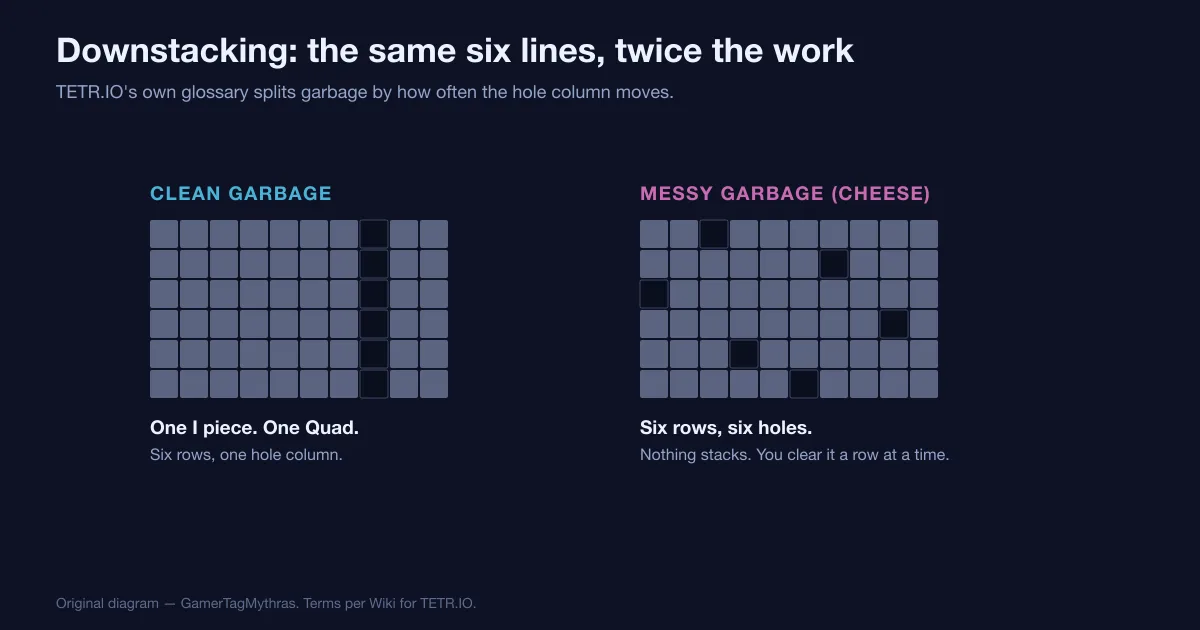
Garbage is not one obstacle, it is two. Where the hole column sits from row to row decides whether six lines cost you one piece or six, and TETR.IO scores the lines you dig out at exactly the same rate as the lines you send.
TETR.IO Ranks Explained: TR, Percentiles and Cutoffs
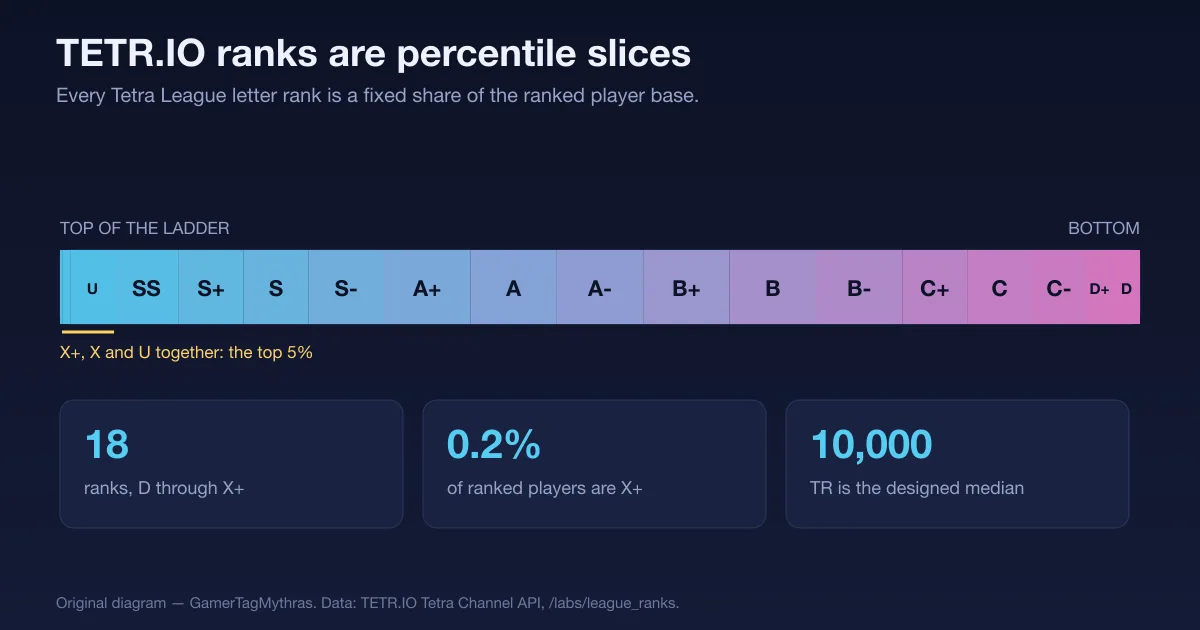
A Tetra League letter is not a skill score, it is a slice of the leaderboard — and TETR.IO publishes exactly how big each slice is, what TR it currently costs, and how fast the people inside it play.
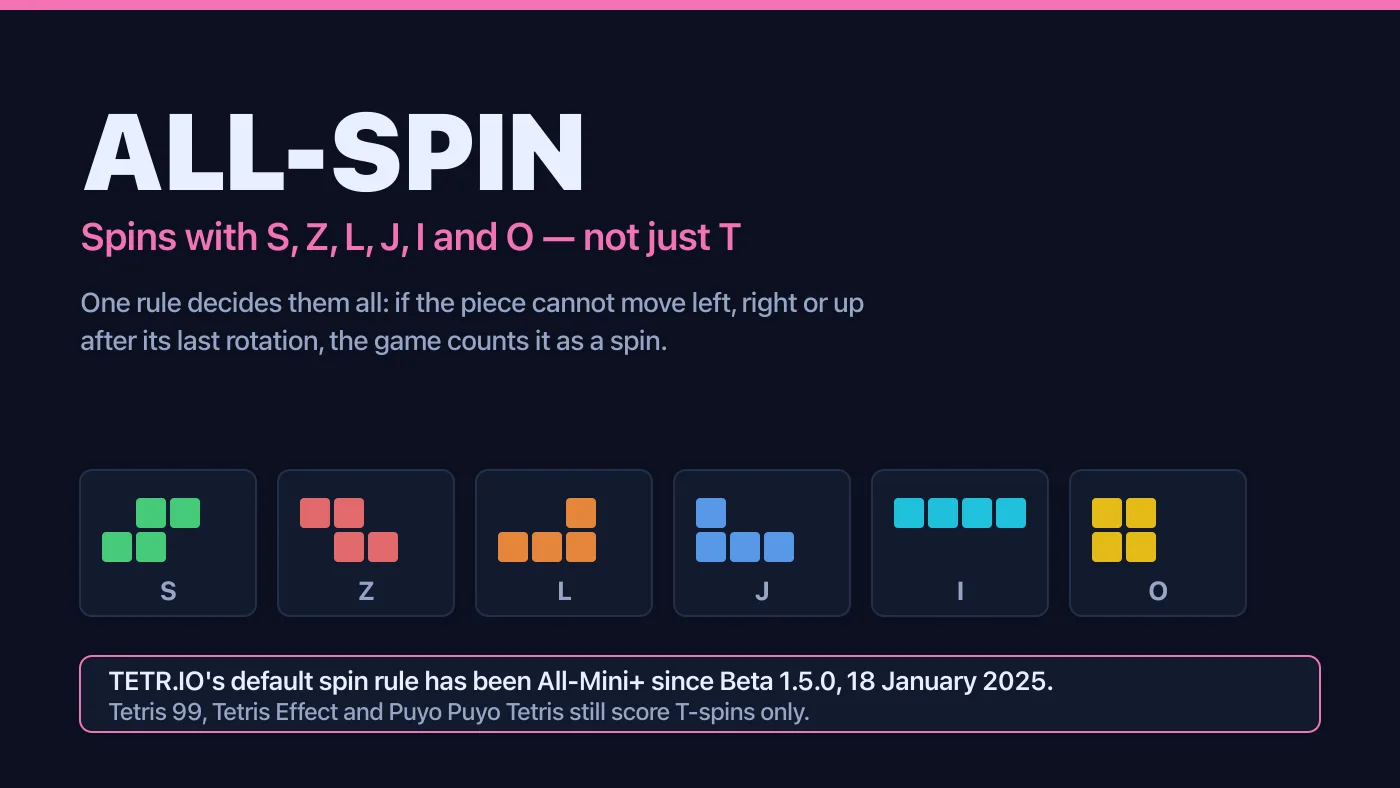
Tetris All-Spin Explained: S, Z, L, J and I Spins
A Z piece rotated into a slot nothing else reaches is either a scored spin or an ordinary Double, and which one it is has nothing to do with you. It is a setting, and most Tetris games have it switched off.
Tetris Stacking Fundamentals: Build a Board That Wins
Most players do not lose to speed. They lose to a board they built themselves three minutes earlier. Here is how stacking actually works in modern Guideline Tetris, and the habits that stop you from burying your own well.
The Tetris Effect Zone Guide: Ultimatris, the Attack Table, and When to Press It
Zone is sold as a get-out-of-jail button, and used as one it pays a fraction of what it could. The published Zone Bonus Attack table says the same lines can be worth 40 garbage rows or 80, depending only on when you pressed it.