The Last of Us Part 2 Difficulty Modes and Custom Sliders
The Last of Us Part 2 has seven challenge levels, and the interesting one is at the bottom of the list. Custom is not a difficulty - it is five separate dials with six settings each, which is 7,776 ways to configure a run before you open the accessibility menu.
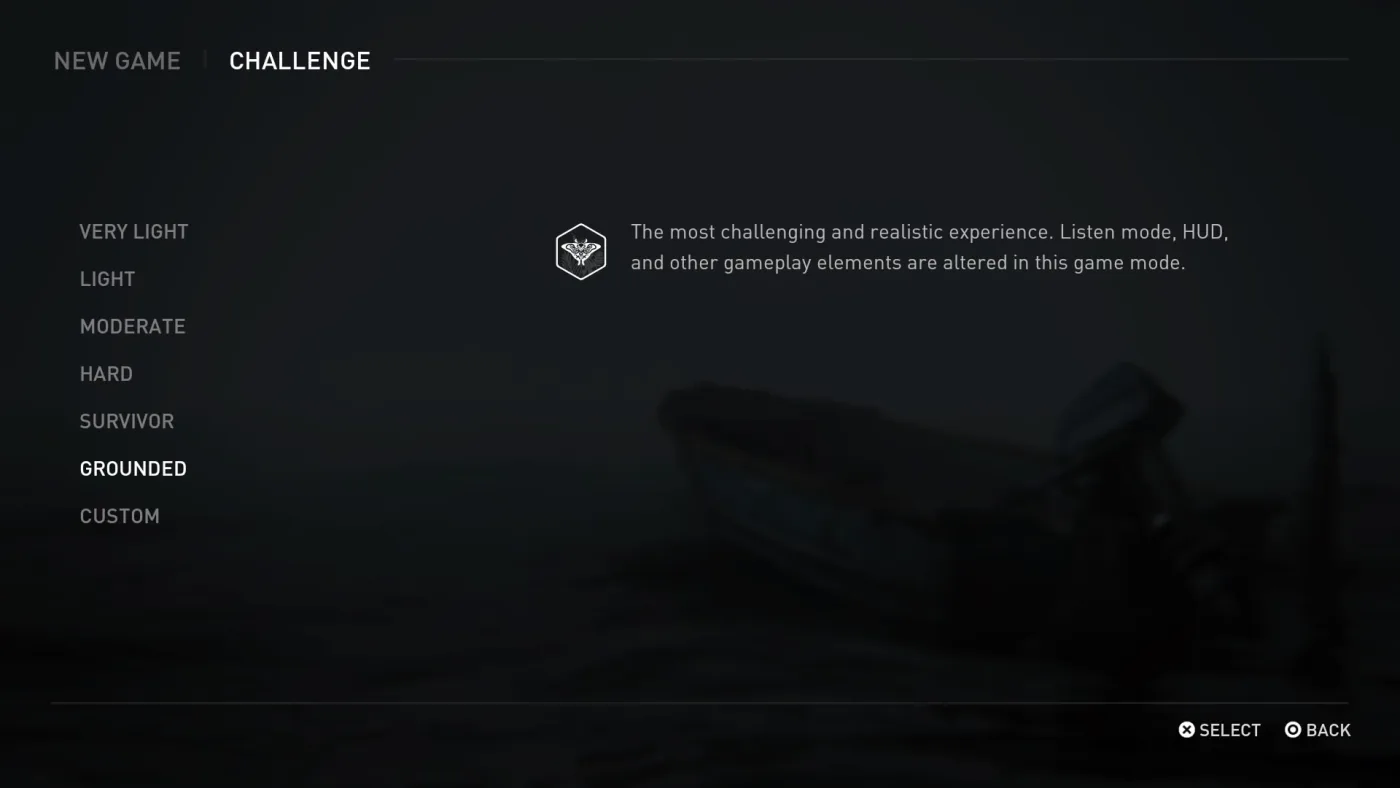
Naughty Dog put seven challenge levels in The Last of Us Part II and then buried the interesting one at the bottom of the list. Custom is not a difficulty. It is five separate difficulty dials, each offering the same six settings, which works out to 7,776 distinct configurations before you have touched the accessibility menu at all.
Everything below is Part II specifically — the 2020 PS4 release and The Last of Us Part II Remastered on PS5 and PC. The first game runs a different set of rules, and our difficulty modes guide covers that one. Mixing the two up is easy, because the presets share names but the systems around them do not.
Seven challenge levels, all unlocked from the start
The original The Last of Us locked Survivor behind a completed playthrough. Part II does not lock anything. Per the wiki's difficulty page, all seven of Part II's challenge levels — Very Light, Light, Moderate, Hard, Survivor, Grounded and Custom — are selectable on a fresh save, and at launch not a single trophy in the list was tied to a difficulty setting.
Grounded was not there on day one. It arrived with patch 1.05 on 13 August 2020, alongside Permadeath mode, a set of new gameplay modifiers and close to 30 graphics rendering modes, per Naughty Dog's own update post. Anything you can buy today ships with all of it: the PS4 original, Part II Remastered on PS5 (19 January 2024) and the PC release (3 April 2025).
What each preset actually does
The menu descriptions are terse. Here is what each one is telling you, in order:
| Level | What it changes | Worth knowing |
|---|---|---|
| Very Light | Lightest combat challenge | The only preset that switches camera and aim assistance on by default |
| Light | More resources, less dangerous enemies than Moderate | The step below the balanced setting |
| Moderate | The balanced experience; resources limited | The setting Part II's pacing is written around |
| Hard | Resources very limited, enemies more dangerous | Where scavenging starts to be a real activity |
| Survivor | Resources extremely scarce, enemies deadly | Unlocked from the start, unlike the first game's Survivor |
| Grounded | Listen Mode off, HUD elements deactivated, materials scarce | Added in patch 1.05, August 2020 |
| Custom | Five independent sliders, six settings each | Not a difficulty so much as a builder |
Read the middle of that table and the steps look even. They are not. The jump that actually changes your behaviour is Hard to Survivor, where supply scarcity stops being a nuisance and starts dictating which encounters you fight at all. The jump from Survivor to Grounded is a different kind again, because it takes information away rather than resources.
One trap worth flagging before you go reading elsewhere: the 2022 Part I remake uses this same six-name ladder and a Custom option with the same five categories. Very Light through Grounded is not a Part II-only naming scheme. If a guide talks about Easy, Normal and Hard, it is describing the 2013 original or Remastered, which used a different five-rung ladder entirely.
The five custom sliders
Custom splits difficulty into five independently adjustable categories. What each one governs, per PlayStation's accessibility rundown for Part II and the wiki's difficulty page:
| Slider | What it governs |
|---|---|
| Player | Damage you take from enemies; how often mid-encounter dynamic checkpoints fire |
| Enemies | Gunfire accuracy and projectile frequency, aggression when advancing and flanking, melee combo complexity, movement speed of certain high-threat enemies, tuning of specific encounters |
| Allies | How aggressive your companions are in combat, and how often they kill enemies for you |
| Stealth | Enemy perception through vision, hearing and smell; the grace period before a spotted enemy alerts the others; the conditions for grabbing an enemy from stealth |
| Resources | Quantity of ammunition and supplies in the world, durability of melee weapons enemies drop, yield of certain crafting recipes |
Each slider takes the same six values — Very Light, Light, Moderate, Hard, Survivor, Grounded. Five sliders at six values each is 7,776 possible configurations, which is why treating this menu as a formality is leaving most of the game's tuning on the table.
Two of those five deserve attention because of what they quietly control.
Player is the checkpoint dial. It is not just an incoming-damage multiplier — mid-encounter dynamic checkpoint frequency sits inside the same category. That is the setting deciding whether a bad death costs you thirty seconds or the whole fight, and it is the reason a high Player setting feels disproportionately punishing compared with a high Enemies setting.
Resources is the upgrade economy. This is the biggest single difference from the first game. In the original The Last of Us, supplements, parts and collectibles spawn identically on every difficulty — the 2013 strategy guide says so and the wiki records it. Part II does not work that way. Naughty Dog's own description of Grounded names ammo, upgrade and crafting materials together as the things that become scarce, and the Resources slider explicitly covers what the world gives you. A harder Part II run is a genuinely poorer run, not merely a more dangerous one, which is why the weapon upgrade guide treats that slider as a parts-income setting.
What Grounded takes away
Naughty Dog's summary of Grounded, from the patch 1.05 announcement, is short: enemies get deadlier, ammo and upgrade and crafting materials get incredibly scarce, Listen Mode is disabled, and elements of the HUD are deactivated. Screen Rant's write-up of the same patch adds that player damage output goes up as well as enemy damage, alongside the reduced ammo and crafting spawn rate.
Losing Listen Mode is the change that reshapes how you play. In Part II it works as it did in the first game — hold the button, see silhouettes through walls, crouch-walk while you do it — and taking it away means reading footsteps, shadows and enemy chatter instead of a wall-hack overlay. If you have leaned on it to count a patrol before committing, that habit does not survive here. The Part 2 enemies guide is the prerequisite reading, because on Grounded you are identifying a Shambler by sound before you see it.
Grounded also squeezes the skill tree from the supply side rather than the menu side. Supplements are spent the same way at any setting; what changes is how many the world hands you, because Naughty Dog's Grounded description puts upgrade materials in the same scarcity bracket as ammunition. Committing to one branch early matters more here than on any other setting.
Permadeath: three scopes, one rule
Permadeath arrived in the same 1.05 patch and is a separate toggle from difficulty. It has three scopes, and the in-game menu gives its own estimate of what each one costs you:
| Setting | What a death does | Time at risk |
|---|---|---|
| Off | Reload the last checkpoint | Nothing |
| Per Chapter | Progress resets to the start of the current chapter | Roughly 30 to 60 minutes |
| Per Act | Progress resets to the start of the current act | Roughly 2 to 5 hours |
| Whole Game | The saved game is completely reset | The run |
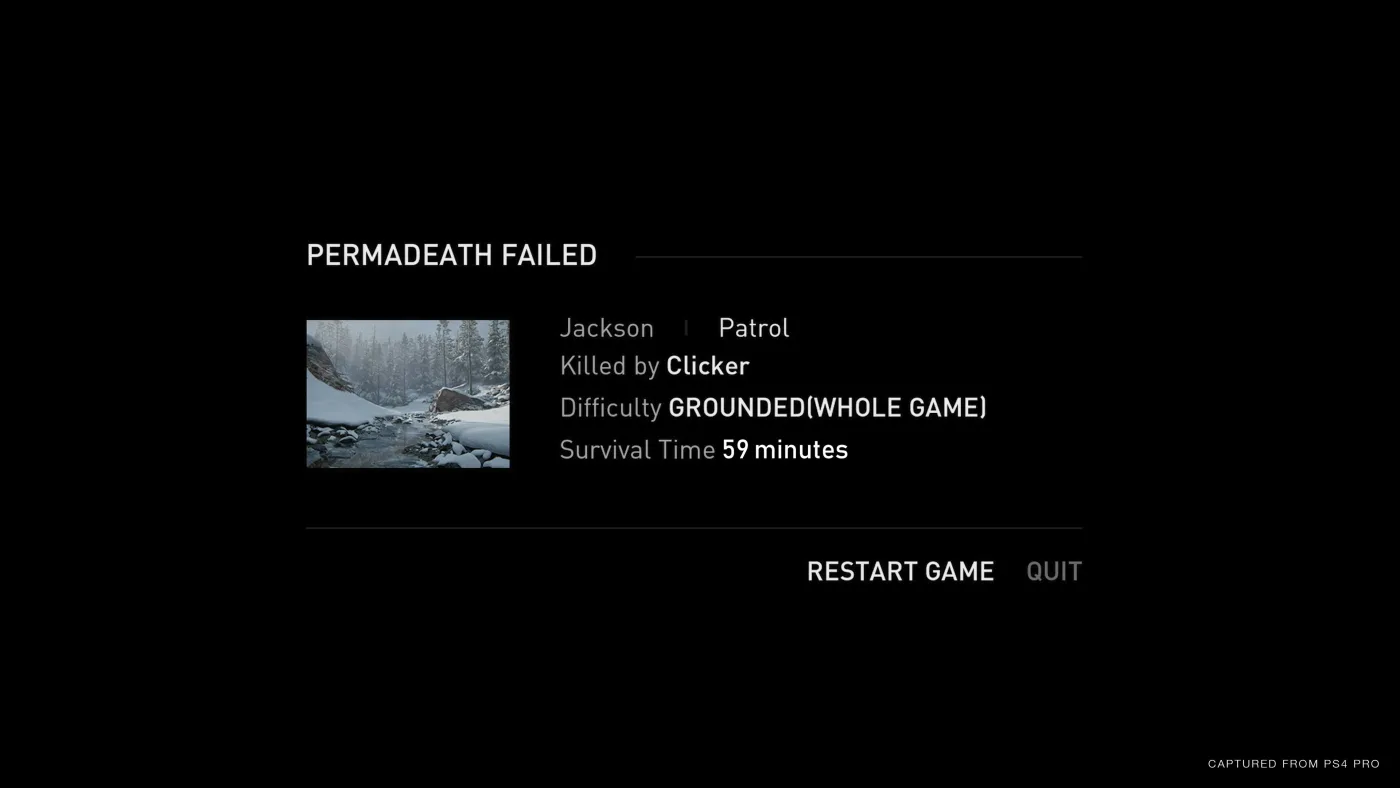
Three rules worth knowing before you commit, all recorded on the wiki from the in-game Permadeath settings text:
- It can only be enabled when you start a new game. You cannot bolt it onto a run in progress, and the reverse is the point of the mode.
- Manual saves are unavailable on a Permadeath run.
- Quitting the game or closing the application while in a dangerous position is treated as a death. Alt-tabbing out of a firefight is not an escape hatch.
Permadeath stacks with any level from Very Light to Grounded, so Permadeath on Very Light is a completely legitimate configuration — and, as the next section covers, the trophy does not ask which difficulty you were on.
The two trophies that don't count
Patch 1.05 added exactly two trophies:
| Trophy | Requirement | Grade | Needed for the platinum |
|---|---|---|---|
| Dig Two Graves | Complete the story on Grounded | Silver | No |
| You Can't Stop This | Complete the story with any Permadeath setting | Bronze | No |
The original Part II list runs to 28 trophies. Twenty-five of them are required for Every Last One of Them, the platinum; the platinum itself is the twenty-sixth; and these two are the leftovers. PlayStation's announcement post said so directly at the time — neither would be required to earn the platinum — and PowerPyx's trophy guide repeats it for both.
That has not changed since. Part II Remastered added 13 No Return trophies in January 2024 and three more in April 2025, and the wiki notes those sit outside the platinum too, with the original list untouched. All 44 appear as Steam achievements on the PC release. So Part II's platinum has carried no difficulty condition at any point — not at launch, not after the Grounded update, and not in Remastered. If the roguelike side is what you are chasing, that is the No Return guide.
The practical read: You Can't Stop This is the cheap one. It accepts any Permadeath setting, and Per Chapter on a low difficulty puts about half an hour at risk at a time. Dig Two Graves is the expensive one, because it wants the whole story on Grounded.
Modifiers are off on Grounded, accessibility is not
The same patch that added Grounded added the gameplay modifiers — Infinite Ammo, Infinite Crafting, Infinite Melee Durability, One Shot, Touch of Death, Mirror World, Slow Motion and bullet-speed adjustments among them. They do not coexist with the hardest setting: PowerPyx's guide is blunt that cheats are disabled on Grounded.
Accessibility options are a separate menu, and they stay available. PowerPyx's Grounded advice leans on them directly and singles out Invisible While Prone, noting that using it does not void the trophy. Read Naughty Dog's own description of the setting before you plan a run around it, because it carries two qualifiers: you are invisible to enemies while prone and not aiming, and the setting is disabled during certain encounters where stealth is not an option. It also has three states — Off, Limited and Unlimited — and on Limited the time you get is tied to the Stealth difficulty setting. If a specific stealth encounter is the thing standing between you and Dig Two Graves, that menu is the sanctioned tool rather than a workaround. It will not carry you through the encounters where Naughty Dog has switched it off.
Part II shipped with more than 60 accessibility settings and three presets tuned for vision, hearing and motor needs, per PlayStation's pre-launch rundown. Enhanced Listen Mode lives in there as well. It does not replace the standard version — you still enter listen mode by holding R1 — it adds to it: while listening, press Square to scan for enemies or Circle to scan for items, and the game answers with an audio cue at the target's location whose pitch changes with the target's height relative to you. Scan range is a slider from 10 to 30 metres and scan time from 1 to 5 seconds. The hold-versus-toggle choice for listen mode itself is a different setting — Listen Mode, under Holds and Presses — and it defaults to Hold.
New Game Plus and changing your mind
Two questions the difficulty menu will not answer for you.
Can you change difficulty mid-run? Yes. The difficulty settings, including the Custom sliders, are reachable from the Options menu at any point after a run has started. Permadeath is the exception — that one is start-of-run only, in both directions.
Does New Game Plus cap your difficulty? Not in Part II. Every difficulty is selectable on an NG+ save, Custom included. The first game did cap it: on the original and Remastered, NG+ was limited to the highest difficulty you had finished, or lower.
What carries into a Part II NG+ run is worth knowing before you plan a Grounded attempt around it. Skill-tree progress and crafting recipes are live from the opening. Weapon upgrades persist. But your arsenal itself does not come back until Ellie reaches Seattle, with each gun's upgrades reattaching as you reacquire it — so the Jackson stretch of an NG+ run is not the armoury walk you might be picturing.
Which setting to actually run
Straight calls, no hedging.
First playthrough, here for the story: Moderate. It is the balanced setting and the one Part II's encounter pacing is built around. Combat stays tense, scavenging still matters, and you will not lose a scene's momentum to a reload loop.
You want it to bite: Hard. Resources thin out enough that the crafting decisions become real without the game turning into a stealth-or-die proposition.
The recommendation I would actually make: build a Custom. Set Enemies and Stealth to Survivor and leave Player at Moderate or Hard. You get the version of Part II where enemies flank properly, sightlines are dangerous and grabs are conditional, without the version where two rifle rounds end a twenty-minute sequence. This is the single strongest argument for the Custom menu existing.
Do not open on Grounded. Same argument as the first game: the mode is a rebalance of an experience you have not had yet, and you cannot appreciate what it removes until you have played the version it removes it from.
If you want a challenge run with a survivable failure state: Permadeath on Per Chapter. Roughly 30 to 60 minutes at risk is enough to make you play carefully and short enough that a bad clicker does not end your week. It also earns You Can't Stop This on any difficulty you like.
Quick Action Checklist
- Part II has seven challenge levels — Very Light, Light, Moderate, Hard, Survivor, Grounded and Custom — and all of them are available on a fresh save.
- Custom is five sliders (Player, Enemies, Allies, Stealth, Resources) at six values each: 7,776 combinations.
- Remember Player controls checkpoint frequency, not just incoming damage — that is why it feels the harshest to raise.
- Resources moves your upgrade income in Part II. That is a change from the first game, where parts and supplements were fixed across every difficulty.
- Grounded disables Listen Mode and deactivates HUD elements on top of the scarcity — read the enemies guide before you try it.
- Permadeath is start-of-run only, blocks manual saves, and counts quitting in a dangerous position as a death.
- Neither Dig Two Graves (Grounded) nor You Can't Stop This (Permadeath) is required for the platinum, and neither are the No Return trophies in Remastered.
- Gameplay modifiers are disabled on Grounded; accessibility options are not, and Invisible While Prone does not void the trophy — but it only hides you while you are prone and not aiming, and Naughty Dog switches it off in certain encounters where stealth is not an option.
- Difficulty is adjustable mid-run from the Options menu, and Part II's New Game Plus does not cap which difficulty you can pick.
Frequently Asked Questions
How many difficulty settings does The Last of Us Part 2 have?
What does Grounded difficulty change in The Last of Us Part 2?
Can you change the difficulty in The Last of Us Part 2 after starting?
Do you need to beat The Last of Us Part 2 on Grounded for the platinum?
How does Permadeath work in The Last of Us Part 2?
What do the custom difficulty sliders control in The Last of Us Part 2?
Does difficulty affect weapon upgrade parts in The Last of Us Part 2?
Can you use gameplay modifiers on Grounded in The Last of Us Part 2?
Keep Reading
- The Last of Us Part II Update Adds Grounded Difficulty, Permadeath Mode, and More — Naughty Dog
- The Last of Us Part II update adds Grounded difficulty, Permadeath mode, and more — PlayStation.Blog
- The Last of Us Part II Accessibility Features Detailed — Naughty Dog
- The Last of Us Part II: Accessibility features detailed — PlayStation.Blog
- Difficulty — The Last of Us Wiki
- The Last of Us Part II trophies — The Last of Us Wiki
- Listen mode — The Last of Us Wiki
- The Last of Us 2 Trophy Guide & Roadmap — PowerPyx
- Last Of Us 2's Grounded DLC Update: Everything Included — Screen Rant
- New Game Plus Guide: Difficulty and What Carries Over — Game8
- Last of Us Part 2 — How to Change Difficulty — Attack of the Fanboy
- The Last of Us 1: Best Difficulty to Select — Push Square
Related Guides

The Last of Us Photo Mode Guide: Every Version Compared
Photo Mode has shipped in four Last of Us releases and the toolkit is different in each. How to open it, what each Part II tab does, what Part I and Part II Remastered added, and the slider settings Naughty Dog's own staff use.
The Last of Us Part 2 Crafting Guide: All 12 Recipes
Part II has twelve crafting recipes and neither character gets all of them. Here is every ingredient list, which recipes are locked behind a skill, what one craft yields, and where the ingredients collide.

The Last of Us Part 2 Remastered Skins: How to Unlock Them
The 2020 release of Part II had no outfits you could wear. Remastered added dozens, split between a points shop and No Return challenges. Here is what each one costs or asks of you, and where the lists disagree.
The Last of Us Part 2 Ending Explained
Ellie has Abby underwater, both hands locked around her throat, and every reason in the world to finish it. She lets go anyway. Here is the complete chain of events from the golf club in Jackson to the guitar Ellie can no longer play — verified chapter by chapter.
The Last of Us Infected Guide: How to Beat Every Type
A clicker cannot see you and cannot be strangled. Those two facts decide more encounters than any gun you own. Here is how all four infected stages actually work, and what to spend on each.
The Last of Us Part 2 Accessibility Settings: Every Option
Naughty Dog published its own option-by-option accessibility list for The Last of Us Part II. Here is the whole thing: 82 options across eleven menus, the exact settings each of the three presets switches on, and the menu paths for the ones that are not where you would look.