Cyberpunk TCG Comprehensive Rules: 10 Rulings That Bite
WeirdCo published the Cyberpunk TCG Comprehensive Rules on 28 August 2026 — 11 numbered sections and 660 numbered rules, thirteen days before the first Beta Events. It is the first public document that answers rules arguments rather than teaching the game, and ten of its rulings change decisions you would otherwise make from the Gameplay Guide alone. It also contradicts itself in three places.
Every card game reaches the point where the teaching document stops being enough. Cyberpunk TCG reached it on 28 August 2026, when WeirdCo published the Comprehensive Rules — the first Cyberpunk TCG document written to settle arguments rather than to explain the game.
The timing is not an accident. The first Beta Events run 10-20 September, retail Pre-Releases follow at the end of October, and Welcome to Night City hits shelves on 6 November. Thirteen days before the first sanctioned play, the game got a rulebook a judge can point at.
WeirdCo is blunt about who it is for. Rule 1.2 reads: "This is a reference material, not a teaching one! To learn how to play the game, check out the Gameplay Guide." That is the correct framing, and it is also why this post exists — the how-to-play primer was written from the Gameplay Guide, and there is a whole layer underneath it that only appeared this week.
What WeirdCo actually published
The document runs to 11 numbered top-level sections plus a credits block, containing 660 individually numbered rules across 41 subsections. It nests six levels deep in places: rule 3.18.1.2.1.1 is a real citation.
| # | Section | What lives there |
|---|---|---|
| 1 | Game Overview | Ownership vs control, win conditions, Overtime, lose conditions, conceding |
| 2 | Golden Rules | The six priority rules that decide every other conflict |
| 3 | Card Information | Every printed field, name by name, with a diagram |
| 4 | Card Types | Legends, Units, Gears, Programs, and what each does on entry |
| 5 | Game Areas | Ten named areas, public vs hidden, and what you may look at |
| 6 | Gigs | Rolling, adjusting, value-pairs, swapping, stealing |
| 7 | Game Setup | Deck legality, the pre-game sequence, the mulligan |
| 8 | Turn Order | Start Phase, Main Phase, End of Turn |
| 9 | Attack, Fight, and Steal | Declare, React, Fight or Steal, and how an attack ends early |
| 10 | Effects | The four effect types and the pending-resolution system |
| 11 | Terms | Costs, game actions, activation shorthand, trigger and effect keywords |
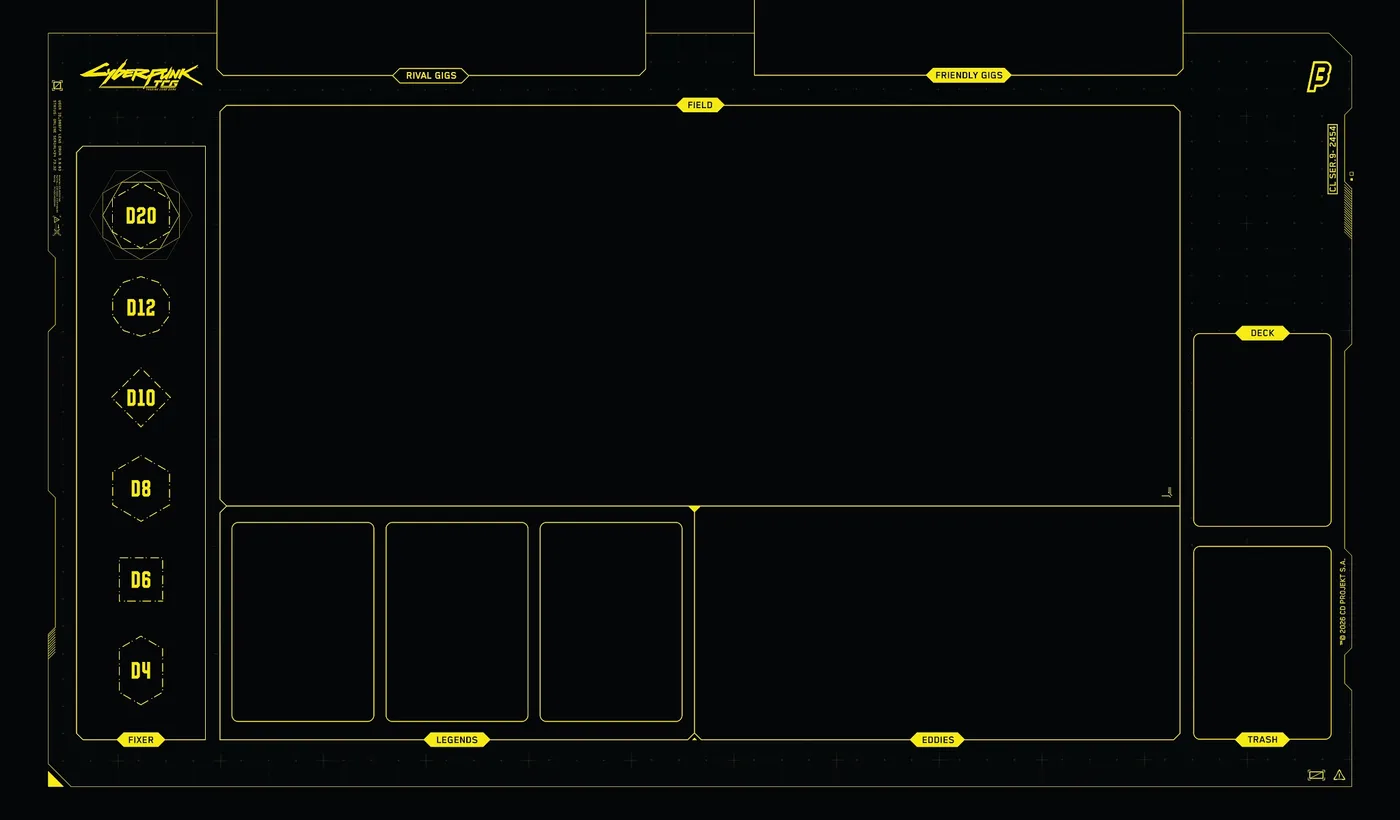
Section 5 is worth a note on its own. It defines ten game areas — hand, deck, field, Legends, Eddies, trash, fixer, friendly Gig, rival Gig, and removed-from-game — but the playmat in Figure 4 prints only eight of them. Your hand does not get a zone, and rule 5.13.2 says removed cards "do not have a designated game area, because they are no longer part of the game." You are told to make a visible pile off to one side.
The document carries no version number. The credits block is stamped only "(UPDATED AUG. 2026)". That matters for anyone who intends to cite it in six months: there is currently no way to say which Comprehensive Rules you are quoting.
The ten rulings that bite
These are the ten I would hand to someone who has read the Gameplay Guide and thinks they are done. Each one changes a decision, and each one is new to this document.
| # | Rule | The ruling |
|---|---|---|
| 1 | 1.11.1 | Overtime's trigger is two consecutive turns in which both players begin with an empty fixer area — the seventh turn is the usual case, not the rule |
| 2 | 2.5 | If card text contradicts the rules, the card wins |
| 3 | 2.6 | If one effect permits and another prevents, prevention wins, always |
| 4 | 2.10.1 | A negative value is treated as 0 for every reference and comparison, and the order the modifiers landed in does not change the answer |
| 5 | 2.10.2 | Null is not 0. It is not a number, it is neither even nor odd, and against 0 it is the smaller value |
| 6 | 4.5.3 | A Legend with a Null cost cannot be played to the field at all |
| 7 | 5.7.2.2 | A face-up Legend with no Sell Tag cannot be spent for 1 eurodollar |
| 8 | 6.4.5 | Adjusting a Gig to the value it already has fails; so does setting a d6 to 8 (6.4.4) |
| 9 | 6.6.2 | A swap is not a steal and triggers nothing that keys off stealing |
| 10 | 9.19.2 | A Unit with 0 power cannot defeat anything as the result of a fight |
Number 1 is the one most likely to be quoted wrongly. The seven-turn version of Overtime has been the standard phrasing everywhere, including on this site. It is right in the ordinary case — you roll in one die per turn from a six-die fixer — but 1.11.1 makes the fixer area the actual condition and hedges the turn count with "usually." If anything ever moves a die into a fixer area or takes one out early, the turn count and the rule come apart, and the rule is what a judge reads.
Number 1 also changes what winning looks like. Outside Overtime, the seven-Gig check happens before the first step of your Start Phase (1.10.1). Inside Overtime, rule 1.11 fires "at any point," mid-effect included. Same threshold, completely different clock.
Card text beats the rulebook, and can't beats can
The Golden Rules are six short subsections and they are the most useful thing in the document, because everything else defers to them.
Rule 2.5 is the standard TCG hierarchy, stated plainly: card text supersedes the Official Rules. WeirdCo's own worked example is a Unit reading "This Unit can attack ready Units," which overrides the closed list of valid attack targets in 9.3.2 — a spent rival Unit (9.3.2.1) or a rival Gig area holding at least one Gig (9.3.2.2), and nothing else (9.3.2.4).
Rule 2.6 is the counterweight. If one effect allows something and another forbids it, the forbidding effect wins. WeirdCo's example pits [ADRENALINE] against a Unit reading "Rival Units can't attack the turn they're played" — the rival Unit does not attack, keyword or no keyword.
The other four are quieter but land in real games:
- 2.4 — if you cannot resolve all of an effect, resolve as much as you can. Partial resolution is the default, not a failure.
- 2.7 / 2.8 — you may decline to pay a cost, and "up to X" always includes zero unless a minimum is printed.
- 2.9 — when both players do something simultaneously, the turn player goes first.
- 2.11 to 2.13 — conduct. WeirdCo put civility, personal space, asking before touching a Rival's cards, and personal hygiene inside the Comprehensive Rules rather than in a separate tournament policy. Rule 2.13.1 asks you to "neutralize any distracting smells on your person." It is in the rulebook, numbered, alongside the effect timing.
The two number rules: negative is zero, Null is nothing
These two get their own section because they look similar and behave nothing alike.
Negative numbers exist but read as 0. Rule 2.10.1: a game value can go negative, and while negative it is treated as 0 for all references and comparisons. The worked example is a 2-power Unit hit for -3, then given +2: it is at -1, reads as 0, then reads as 1. The document adds explicitly that "the order of these effects being applied does not alter this outcome" — so the game tracks the real arithmetic underneath and only clamps at the point of comparison. If it clamped on the way through, that Unit would end at 2.
Null is not a number at all. Rule 2.10.2 and 11.2.3 cover Null Street Cred, which is what you have when your Gig area is empty. It does not count as 0, it is not even, it is not odd, and rule 5.11.4.2 settles the comparison: "When compared to 0, Null is the smaller number." Any card keyed to odd or even Street Cred simply does not see a player with an empty Gig area. That is a live interaction rather than a curiosity, because WeirdCo's own Color Tree article says Green "wants to form pairs of Gigs with the same value number, match Gig values with unit power, and maintain either odd or even Street Cred" — and three Green cards in the database do exactly that: Field Operator, Pacifica Netrunner and Memory Relapse each check whether your Street Cred is an even number.
Null costs work the same way. Rule 3.11.2 gives Legends a Null cost, written in the rules as a parenthesised dash; you cannot pay it (3.11.2.1), you cannot increase, decrease or modify it (3.11.2.2), and 3.11.2.3 says effects that reference a Legend's cost treat Null as 0. Referenced as 0, unpayable as a cost.
Nineteen Legends can never touch the field
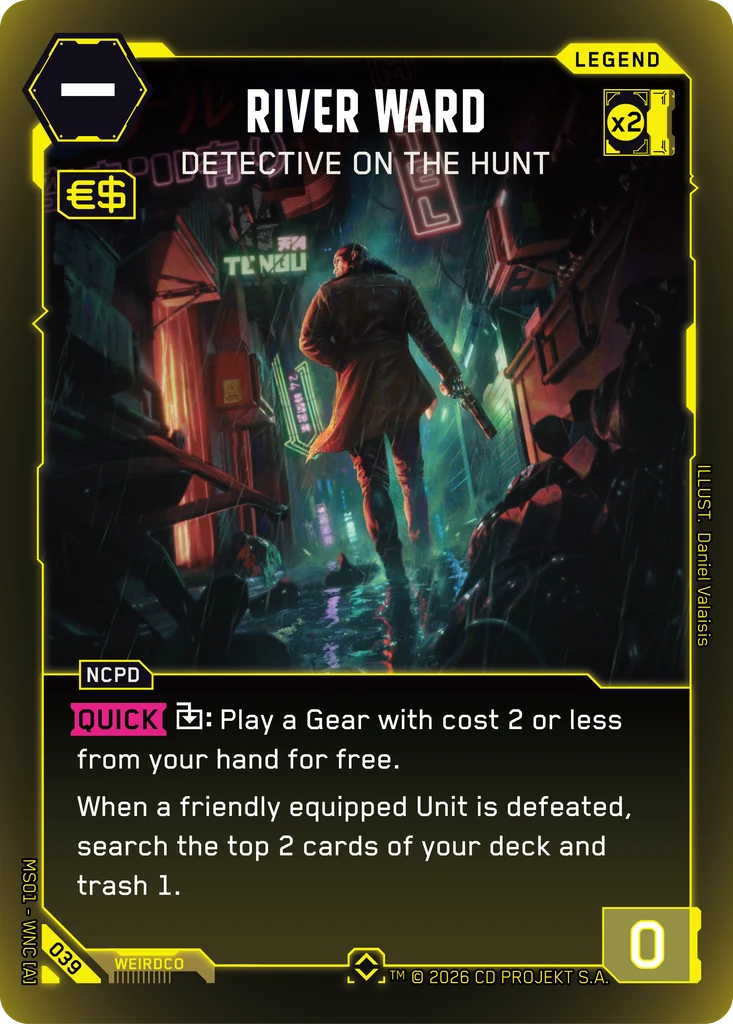
Rule 4.5 says you may play a Legend from the Legends area to the field as a Unit by paying its cost. Rule 4.5.2 says it arrives with Lag. Rule 4.5.3 then removes most of the candidates: "Legends with cost Null ( - ) do not have a cost, and cannot be played to the field."
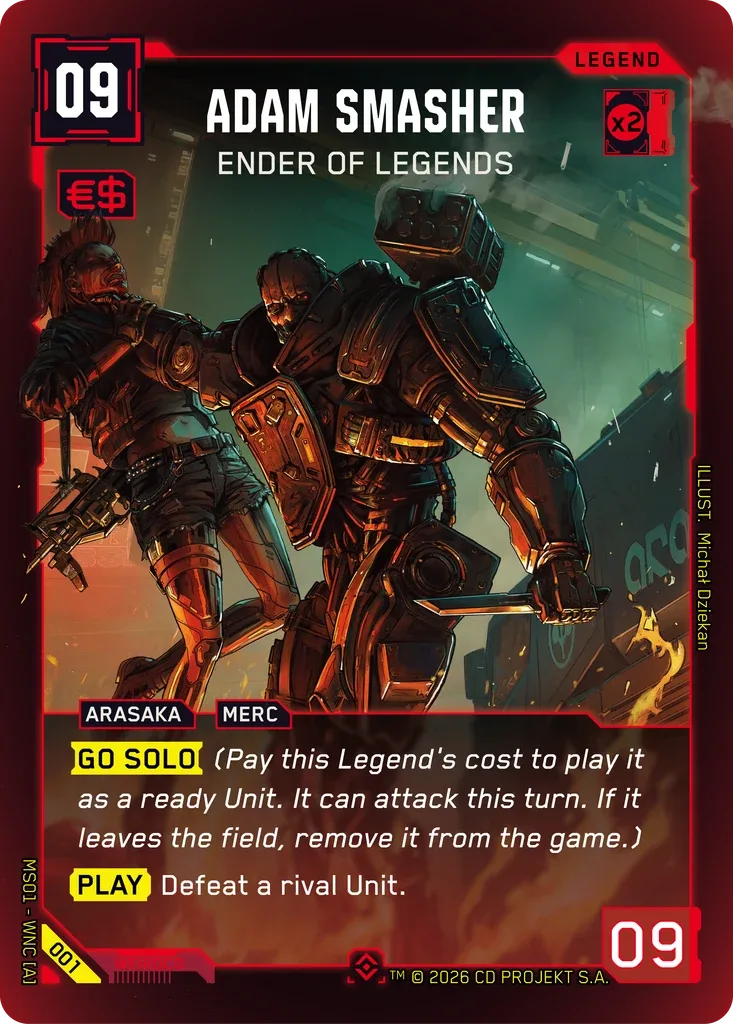
Run that against the card database and the split is exact. Of the 27 Legends listed, 19 print a Null cost and can never leave the Legends area under their own power. The eight that print a real cost are V: Streetkid (5), V: Corporate Exile (5), Goro Takemura: Hands Unclean (5), Sasha Yakovleva: Won't Let You Down (5), Royce: Psycho on the Edge (6), Jackie Welles: Mama's Favorite (6), Rogue Amendiares: Preem Solo (7) and Adam Smasher: Ender of Legends (9).
All eight of those carry [GO SOLO]. Every one of the 19 Null-cost Legends does not. There is not a single exception in either direction in the current database, which reframes what the keyword is doing. Rule 11.25.1 defines [GO SOLO] as "Pay this Legend's cost to play it as a ready Unit. It can attack this turn. If it leaves the field, remove it from the game" — but rule 4.5 already grants the paying-to-play part, and rule 4.4.1 already removes a Legend that moves to an invalid area, the field and the Legends area being the only valid ones (4.4). Two clauses do work the base rules do not: "as a ready Unit" overrides 4.5.1, which would otherwise bring the Legend in wearing whatever orientation it had in the Legends area (Legends can be spent there — 5.7.6 — and only ready again at 8.6.3), and "It can attack this turn" overrides one half of Lag.
Only one half, and that is the part worth reading twice. Lag carries two restrictions, not one: 11.3.1.1 says lagging Units cannot attack, and 11.3.1.2 says they cannot activate [Spend Icon] effects (restated at 8.14.1). [GO SOLO] speaks to attacking and says nothing about [Spend Icon], so under rule 2.5 it beats 11.3.1.1 and leaves 11.3.1.2 standing. A Legend played to the field is still lagging until the end of the turn (11.3.2).
On today's card pool that restriction has nothing to bite. Seventeen cards in the database print a [Spend Icon] effect, and the split is almost comically tidy: 13 of them are Legends, all 13 of those are Null-cost Legends that can never reach the field under 4.5.3, and the other four are three Units and a Gear. Not one of the eight costed Legends prints one. So 4.5.2 applies to every Legend that can reach the field and costs those eight nothing today — which is not the same thing as the rule being dormant, and the difference is the kind a judge is paid to notice. It bites Units already: a Unit with a [Spend Icon] effect enters with Lag under 4.7, so 11.3.1.2 locks that effect off for the turn it is played, and Lag does not fall away until the end of that turn (11.3.2).
The Sell Tag has a matching wrinkle. Rule 5.7.2 lets you spend Legends as 1 eurodollar each "whether face-up or face-down," and 5.7.2.2 then adds that a face-up Legend without a Sell Tag may not be spent. Currently that bites exactly one card: 26 of the 27 Legends in the database print a Sell Tag, and the one that does not is Rebecca: Having a Moment, the promo with no rules text at all. Face-down Legends are unaffected either way, since 3.4.1 says a face-down card's information is ignored.
Zero power defeats nothing
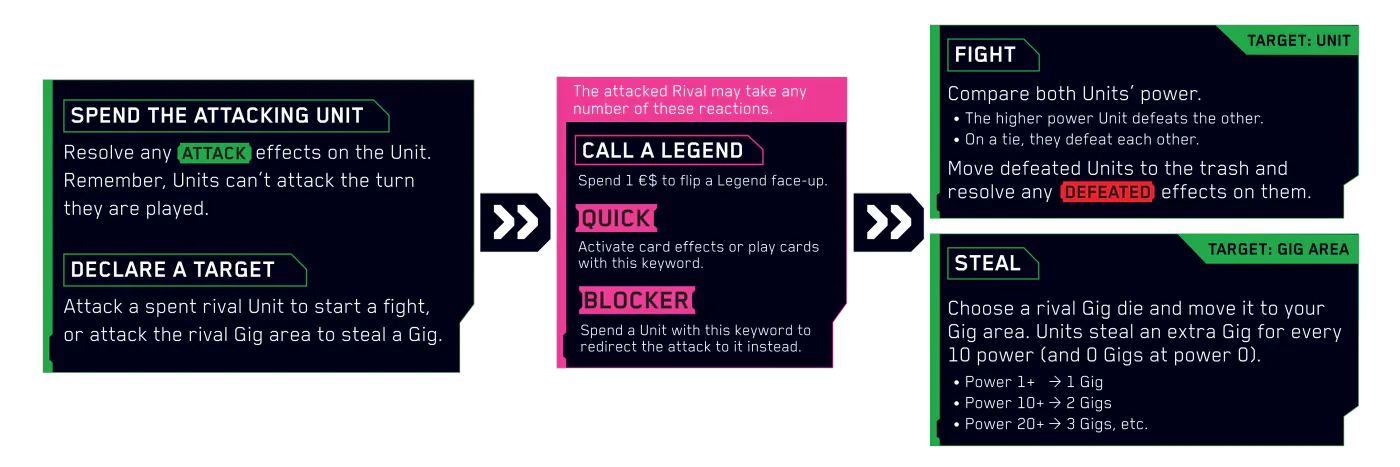
Section 9 splits a fight into a loser check and a defeat step, and the gap between them is where the 0-power rules live.
Rule 9.17.2: a Unit loses a fight when it has equal or lower power. Rule 9.17.3: on equal power neither wins and both lose. Then rule 9.19.1 turns losing into defeat — except 9.19.2 stops it dead: "A Unit with 0 power cannot defeat a Unit as the result of a fight."
Put a 0-power Unit into a fight with another 0-power Unit and both lose the fight, and neither is defeated. The loss is real — 9.19.3 is explicit that a Unit prevented from being defeated "is still a loser that has lost the fight" — so anything keyed to losing a fight still fires. Nothing goes to the trash.
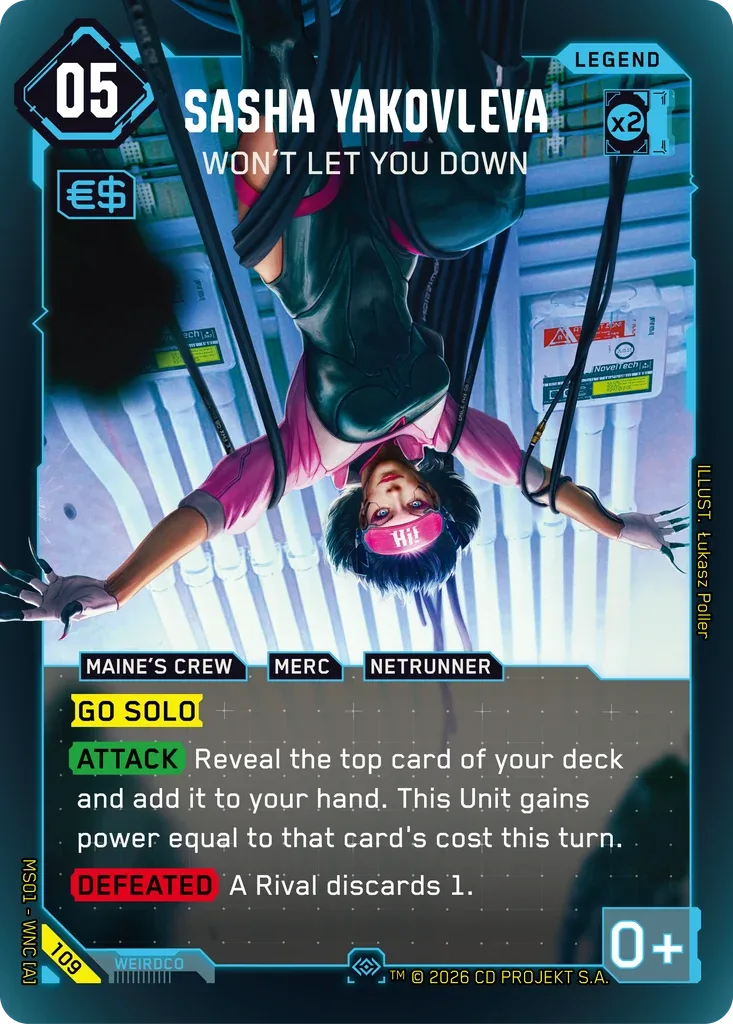
Sasha Yakovleva: Won't Let You Down makes this concrete rather than hypothetical. She is a Blue Legend, cost 5, RAM 2, with [GO SOLO] and a printed power of 0. Her [ATTACK] trigger reveals the top card of your deck, adds it to your hand and gives her power equal to that card's cost for the turn — and the sequencing means it lands in time. Rule 9.5 puts all effects triggered by attacking into pending the moment the attack is declared, and rule 11.21.2.2 requires them resolved "before your Rival's react step." The Steal Step reads her power afterwards, at 9.23.1.
Which matters, because the steal formula punishes 0 exactly as hard. Rule 9.23.2.1: a 0-power attacker steals 0 Gigs. Rule 9.23.2.2 gives the formula for everything else, rounded down, where P is the attacker's power:
X = (P / 10) + 1
So 1 to 9 power steals one Gig, 10 to 19 steals two, 20 to 29 steals three, and it keeps going. Declare an attack on the Gig area with Sasha before her trigger resolves and you would steal nothing; the rules resolve it in the order that saves you.
Pending effects are the timing system
Cyberpunk TCG has no stack and no priority passing. Section 10 gives it something smaller instead, and this is the part of the document with no equivalent anywhere in the Gameplay Guide.
An effect that triggers while something else is resolving becomes pending (10.2.4). Pending effects wait; you cannot take a game action while any are outstanding (10.11.1). The ordering rules are short enough to memorise:
| Situation | Rule | Who decides |
|---|---|---|
| You control several pending effects | 10.12 | You resolve them in any order you like |
| Both players have pending effects | 10.13 | Turn player clears all of theirs first |
| New effects trigger mid-resolution | 10.14 | Finish the current one, then take the new ones |
| Two mandatory replacement effects collide | 10.28.1 | The affected player chooses which applies |
| A mandatory and an optional replacement collide | 10.28 | Mandatory applies first |
| A game mechanic and a mandatory replacement collide | 10.30 | The game mechanic wins |
Two consequences worth carrying to a table. First, rule 10.15: once an effect is pending, later changes to the game state do not stop it resolving unless the effect itself carries a condition that must hold at resolution. You cannot fizzle a pending effect by removing its source. Second, rule 10.21 says the same thing about activated effects specifically — activate it, and it resolves even if the card that produced it leaves.
Compared with Riftbound's chain and HOT FEPR ordering, this is a deliberately smaller system: no shared stack, no windows to hold priority in, and a single React Step as the non-turn player's only reaction window — rule 9.7.1 says you may take reactions "only during the React Step of an attack, and only if you are the defending player." They still act outside it, just not by reacting: they clear their own pending effects after the turn player clears theirs (10.13), and they choose between colliding mandatory replacement effects aimed at them (10.28.1). The trade is that almost everything resolves immediately and in the order the turn player prefers.
Three places the document argues with itself
It is a first edition of a 660-rule document, so this is not a scandal. It is, however, worth knowing before you cite it at an event.
1. Whether an effect-driven Sell burns your once-per-turn action. Rule 5.8.4 says a player is "allowed to Sell as many cards they want through effect but only allowed to Sell once per turn from their hand through game action." Rule 11.9.2.2 says the opposite: "An effect that says to 'Sell' does count as a player's 'Sell A Card' Main phase action." One of those permits unlimited effect-driven selling and the other spends your action on the first one. Rule 8.11.1 caps only the game action and does not break the tie.
2. The four effect types are named as five. Rule 10.4 lists them as "triggered effects, activated effects, permanent effects, and replacement effects." Rule 10.4.3, immediately below, defines a "persistent effect" — and persistent is the term used by the section heading and by all six rules from 10.22 to 10.23.1 (10.22, 10.22.1, 10.22.2, 10.22.3, 10.23, 10.23.1). The type is named once and then never called that again.
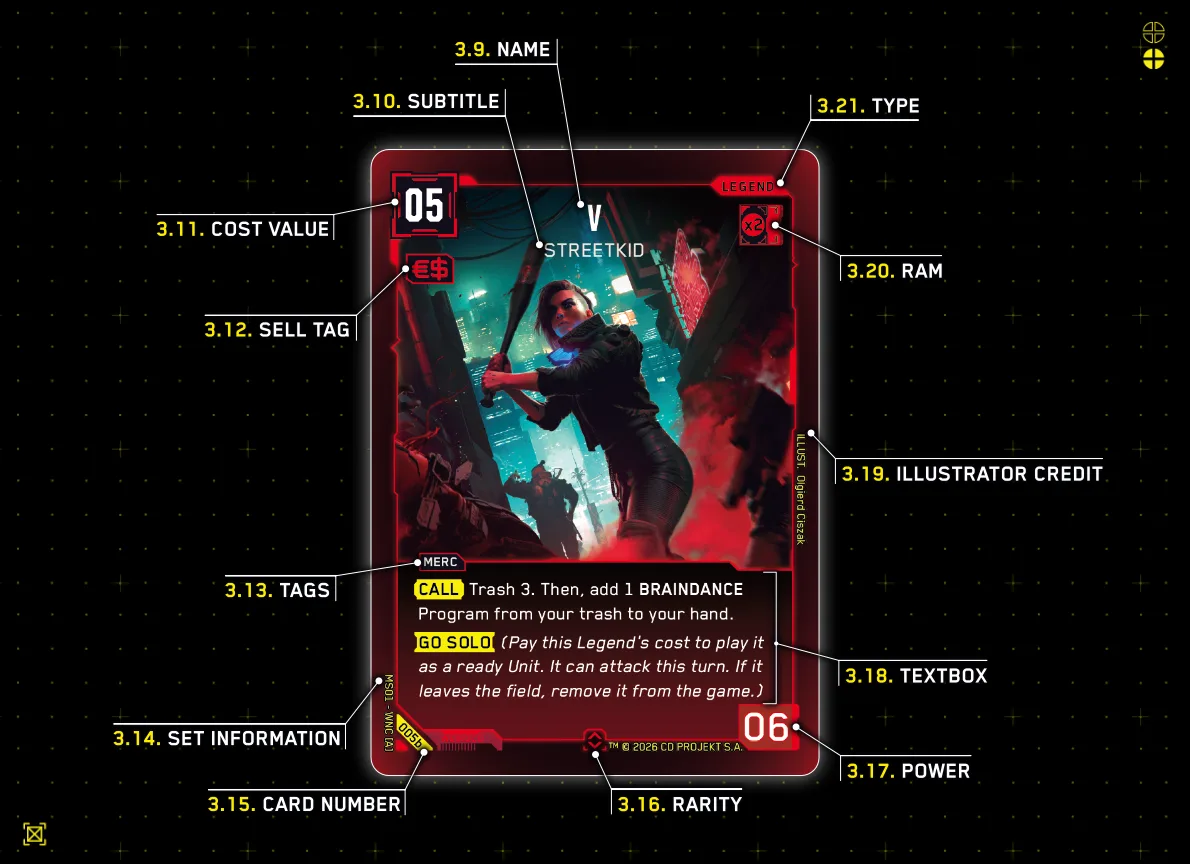
3. Reminder text is missing a "not." Rule 3.18.1.2.2.1 reads: "Reminder text is not effect text, and does influence gameplay." Read literally, that says the parenthetical italic text on a card both is not effect text and does affect the game. Figure 1 shows why it matters: on V: Streetkid, [GO SOLO]'s entire definition is printed as reminder text.
Two cross-references have drifted too. Rule 1.14.1 points at "10.2.1 TERMS > Game Actions > Draw," but Draw is rule 11.5 and 10.2.1 is an effects rule. Rule 10.2.1 cites a Golden Rule called "Do as Much as You Can"; the section is titled "Resolve as Much as Possible." Both resolve fine by name and neither by number.
None of this is fatal. All of it is the sort of thing that gets fixed in a second revision, which is exactly why a version number would help.
What is still unknown
- Which Sell ruling stands. 5.8.4 and 11.9.2.2 cannot both be right and WeirdCo has not published an errata channel.
- Whether there will be numbered revisions. The document is stamped "UPDATED AUG. 2026" and nothing else.
- Whether a judge FAQ is coming. The Comprehensive Rules answer rules questions; nothing published answers policy questions like slow play, deck checks or penalties.
- How the rules interact with sealed. Rule 7.3 defines a legal deck as 3 Legends plus 40 to 50 cards, which is the constructed rule. Sealed runs on a 30-card floor with no RAM ceiling, and the Comprehensive Rules defer to "current regulations for the game format" (7.3.6) without naming them.
- Whether [GO SOLO] is meant to cancel Lag outright. As written it cancels only the attack half (11.3.1.1); the [Spend Icon] half (11.3.1.2) survives on a Legend played to the field. No costed Legend prints a [Spend Icon] effect today, so nothing tests it.
Quick reference
- Published: 28 August 2026, at cyberpunktcg.com/comprehensive-rules. No version number.
- Size: 11 numbered sections plus CREDITS, 41 subsections, 660 numbered rules.
- Purpose: reference, not teaching (rule 1.2). The Gameplay Guide remains the beginner document.
- Priority order: card text beats rules (2.5), prevention beats permission (2.6), turn player acts first on simultaneity (2.9 and 10.13).
- Overtime: two consecutive turns with both fixer areas empty (1.11.1), usually after seven turns each; seven Gigs then wins the instant you hold them.
- Steal count: X = (P / 10) + 1, rounded down; 0 power steals 0 (9.23.2).
- Legends: 19 of 27 print a Null cost and can never be played to the field (4.5.3).
- Known internal conflicts: the Sell action (5.8.4 vs 11.9.2.2), permanent vs persistent effects (10.4 vs 10.22), and the reminder-text line (3.18.1.2.2.1).
Frequently Asked Questions
Where are the Cyberpunk TCG Comprehensive Rules?
What are the Cyberpunk TCG golden rules?
When does Overtime start in Cyberpunk TCG?
Can a Cyberpunk TCG Legend be played as a Unit?
What happens when a 0-power Unit fights in Cyberpunk TCG?
How many Gigs does a Cyberpunk TCG attack steal?
Do the Cyberpunk TCG Comprehensive Rules contradict themselves?
Keep Reading
- Cyberpunk TCG Comprehensive Rules (WeirdCo, official), updated August 2026 - 11 sections and 660 numbered rules; source for every rule number cited in this post, including the Golden Rules (2.1-2.13), Overtime (1.11.1), Null-cost Legends (4.5.3), the Sell Tag restriction (5.7.2.2), the steal formula (9.23.2.2), 0-power fights (9.19.2) and the pending-effect ordering (10.12-10.30)
- Cyberpunk TCG Comprehensive Rules are now available!, 28 August 2026 (WeirdCo) - the publication date, the judge-and-experienced-player framing, and the redirect of new players to the Gameplay Guide
- Cyberpunk TCG Gameplay Guide (WeirdCo, official) - the teaching document the Comprehensive Rules defers to in rule 1.2, and the source of the attack-step diagram reused here
- Cyberpunk TCG card database (WeirdCo, official, powered by Netdeck.gg) - 148 cards listed on 30 August 2026, including the 27 Legends, the 19 with a Null cost, the 8 with a printed cost and GO SOLO, and the 26 that print a Sell Tag
- Sasha Yakovleva: Won't Let You Down card entry (WeirdCo, official) - Blue Legend, cost 5, RAM 2, printed power 0, with GO SOLO, an ATTACK trigger and a DEFEATED trigger
- V: Streetkid card entry (WeirdCo, official) - the Legend used in Figure 1 of the Comprehensive Rules, showing GO SOLO printed as parenthetical reminder text
- Cyberpunk TCG Dev Blog (WeirdCo, official) - the post index confirming the Comprehensive Rules announcement of 28 August 2026 as the newest entry
- Developer Insights: The Color Tree Part 1 (Red and Green) (WeirdCo, official) - the source for Green's stated design brief, "Align, Gather, Execute," including that it wants to "maintain either odd or even Street Cred"
Related Guides
Cyberpunk TCG Rules FAQ: What 269 Official Rulings Settle
Besides the Comprehensive Rules and the Tournament Rules, WeirdCo publishes a third rules document written as the questions a player asks mid-game: a Rules FAQ with 269 official rulings, 244 of them on specific cards. It settles the GO SOLO question the rulebook left open, half-settles the Sell contradiction, and makes clear which card effects you cannot decline.
Cyberpunk TCG Sealed Deck Rules: RAM Does Not Apply
Until this week the sealed half of Cyberpunk TCG was a card count and nothing else. WeirdCo published the rest of it on 19 August 2026, and the headline is that the constructed format's defining constraint — the per-colour RAM ceiling your three Legends set — is switched off entirely. Your Legends stop being a deckbuilding licence and become three cards you flip.
Cyberpunk TCG Starter Decks: Embracing Power vs The Heist
WeirdCo's two Welcome to Night City starter decks share no cards and are built on mirror-image Legend lines. Here are both full lists with every card's cost, RAM and power, the five cards each second Legend exists to pay for, the rulings that change how they play, and which box is the better first buy.
Cyberpunk TCG's Deck Builder Is Live: 716 Decks So Far
WeirdCo's official Deck Builder went live on 2 September 2026, and by 16 September the community had published 716 public decks through it. Pull every one through the tool's own API and a pattern falls out that the RAM-ceiling math alone could not show: which colours people actually pair, which Legend is in more than a quarter of all decks, and which one of the 27 Legends in the database has never been picked once.
How to Play the Cyberpunk TCG — Gig Dice, Eddies and Street Cred, Explained
WeirdCo raised $28.3 million to build a trading card game where the win condition is a pile of dice. Here is how the Cyberpunk TCG actually works under the beta rules, what the four colors do, and why the release date most sites are printing is out of date.
Cyberpunk TCG Keywords Explained: All 9, 86 Cards Use One
Cyberpunk TCG's official card database has a Keyword filter with zero options in it, so nothing tells you the game has keywords at all unless you read every card. It does: nine bracketed tokens, split by the Comprehensive Rules into four trigger keywords, four effect keywords and one activation shorthand it does not call a keyword. Eighty-six of the 151 cards print at least one, four cards print three, and three keywords turn out to be things one card gives another rather than something every printed instance owns.