Cyberpunk TCG's Deck Builder Is Live: 716 Decks So Far
WeirdCo's official Deck Builder went live on 2 September 2026, and by 16 September the community had published 716 public decks through it. Pull every one through the tool's own API and a pattern falls out that the RAM-ceiling math alone could not show: which colours people actually pair, which Legend is in more than a quarter of all decks, and which one of the 27 Legends in the database has never been picked once.
WeirdCo's card database can tell you what a Cyberpunk TCG deck is allowed to look like. Until two weeks ago, nothing on cyberpunktcg.com could tell you what a deck actually does look like when a real person builds one.
That changed on 2 September 2026, when WeirdCo's blog post announced the Deck Builder was live: "create lists and share your crew with the world." The RAM-limits piece on this site worked out the theoretical shape of deckbuilding from the 151-card database alone, two weeks before this tool existed. This is the follow-up that question couldn't answer yet: with the tool live and hundreds of public decks built through it, what colours, Legends and card types is the community actually choosing?
I pulled every public deck through the Deck Builder's own API on 16 September 2026. There are 716 of them.
What launched on 2 September
The Deck Builder lives at cyberpunktcg.com/decks, running on the same Netdeck.gg backend as the card database. It does three things: build a deck against the full card pool with live legality checking, browse and duplicate other players' public decks, and export or share a finished list. WeirdCo's own framing, from the launch post: useful whether you're "a passionate creator that wants to brew decks from scratch, or an aspiring ripperdoc that can't wait to augment and improve on other peoples' designs."
The oldest public deck still live carries a last-edit timestamp of 3 September 2026, the day after launch. The newest was edited minutes before I pulled this data. In the 13 days between, players published 716 decks publicly enough to appear in the tool's own community browser - not everyone's decks, since the tool also supports private lists, but every one that was set to share.
Every public deck reads as legal
Before anything else: does the tool actually enforce WeirdCo's own deckbuilding rules, or is it just a list of card names?
It enforces them. Open any deck and the status panel reads a live legality check against two conditions: 3 of 3 Legends, and a main deck between 40 and 50 cards. Query the API across all 716 public decks and every single card_count value - the 3 Legends plus the main deck - falls between 43 and 53, with zero exceptions. Every deck also carries the tool's own is_valid: true flag. Neither of those is a coincidence; together they say the community's public decks are, without exception, built inside WeirdCo's stated 40-to-50-card constructed range.
That is a check on card count and Legend count. It is not proof the tool separately validates the per-colour RAM ceiling that piece worked out from the card pool - the API does not expose that as its own field, and I have not forced an over-RAM deck through the builder to test it directly. Treat "every deck is valid" as a card-count and Legend-count fact, not a RAM-legality guarantee.
The colour pairs people actually build
Every public deck carries a colour identity in the API - which of the four colours (Red, Green, Blue, Yellow) its cards touch. Tally all 716 and a clear shape appears:
| Colour combination | Decks | Share |
|---|---|---|
| Red / Yellow | 147 | 20.5% |
| Blue / Green | 95 | 13.3% |
| Green / Red | 85 | 11.9% |
| Blue / Red | 79 | 11.0% |
| Mono Yellow | 68 | 9.5% |
| Mono Blue | 66 | 9.2% |
| Green / Yellow | 61 | 8.5% |
| Blue / Yellow | 44 | 6.1% |
| Green / Red / Yellow | 23 | 3.2% |
| Blue / Green / Yellow | 14 | 2.0% |
| Blue / Red / Yellow | 10 | 1.4% |
| Blue / Green / Red | 9 | 1.3% |
| Mono Red | 8 | 1.1% |
| Mono Green | 7 | 1.0% |
Group those rows and the pattern sharpens: 511 decks (71.4%) run exactly two colours, 149 (20.8%) run one, and only 56 (7.8%) run three. Two-colour is the default shape of a real Cyberpunk TCG deck, by a wide margin.
Red/Yellow alone accounts for one in five of every public deck - more than double its nearest rival. And mono-colour decks are lopsided in a way the raw colour totals don't show on their own: 68 players built mono Yellow and 66 built mono Blue, but only 8 built mono Red and 7 built mono Green, despite Red (361 total appearances) and Yellow (367) being the two most-picked colours overall. Yellow and Blue support a one-Legend, single-colour build; Red and Green, on this data, effectively don't.
River Ward is in more than a quarter of all decks
Every deck's three Legends are identifiable in the API, so I tallied Legend picks across all 716 decks - 2,148 Legend slots in total.
| Rank | Legend | Colour | Decks | Share |
|---|---|---|---|---|
| 1 | River Ward: Detective on the Hunt | Yellow | 199 | 27.8% |
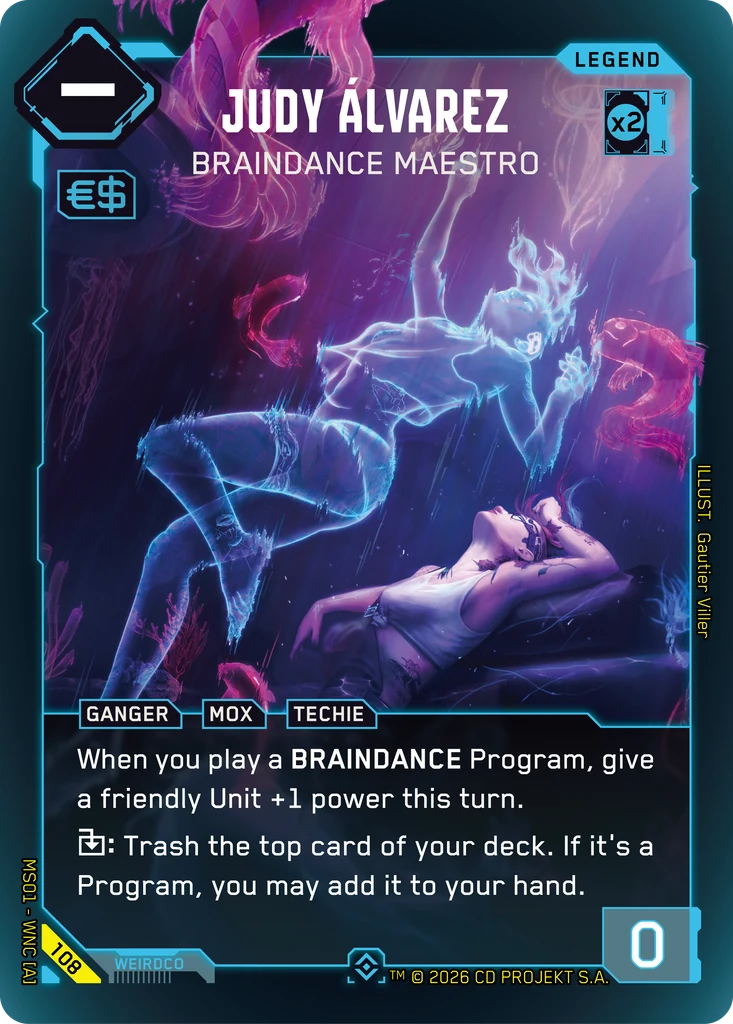
| 2 | Judy Alvarez: Braindance Maestro | Blue | 168 | 23.5% |
| 3 | Alt Cunningham: Soulkiller Architect | Blue | 145 | 20.3% |
| 4 | Hanako Arasaka: Daughter of the Emperor | Green | 142 | 19.8% |
| 5 | V: Streetkid | Red | 108 | 15.1% |
| 5 | Dum Dum: Maelstrom Triggerman | Yellow | 108 | 15.1% |
| 7 | Jackie Welles: Pour One Out For Me | Blue | 105 | 14.7% |
| 8 | Royce: Psycho on the Edge | Red | 100 | 14.0% |
| 9 | Adam Smasher: Ender of Legends | Red | 96 | 13.4% |
| 10 | Johnny Silverhand: Rocking Renegade | Red | 93 | 13.0% |
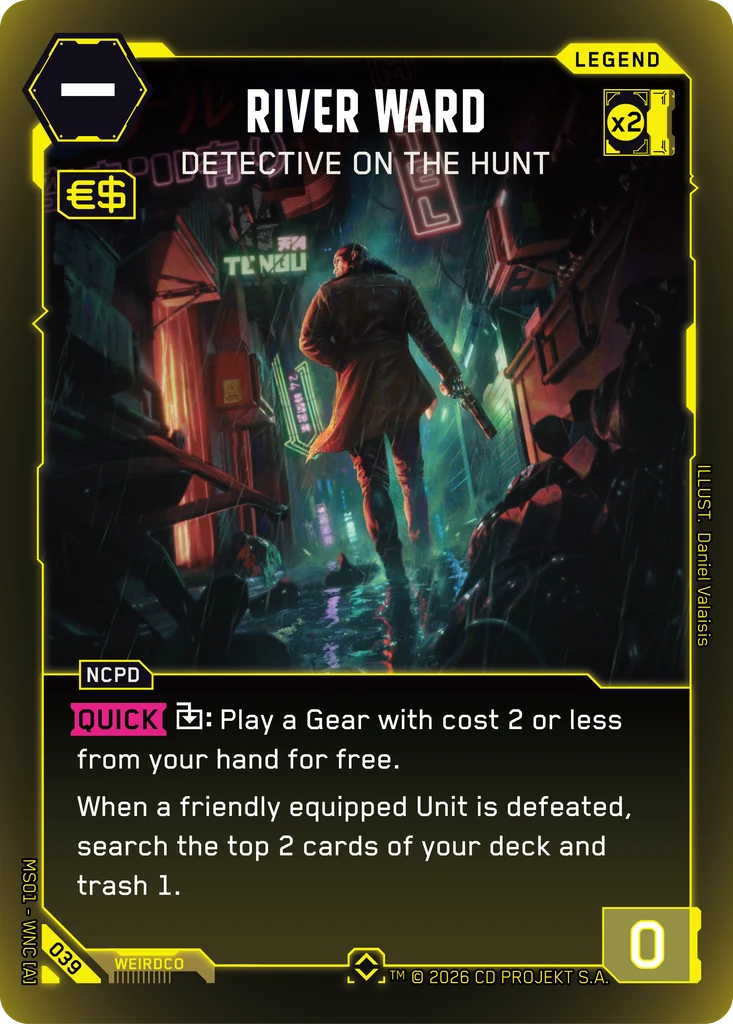
River Ward - a Yellow Legend whose ability plays a cheap Gear for free and refills your deck when an equipped Unit dies - is in more than one of every four public decks, comfortably clear of anything else in the database.
Look at the colours in that top four, and the mono-colour numbers above make more sense from the other direction. Judy Alvarez and Alt Cunningham are both Blue, and both sit inside the top three. Splitting three Legends 2-and-1 across colours, instead of one-each, is exactly the move that raises a single colour's RAM ceiling to 4 instead of capping every colour at 2. Two of the three most-picked Legends in the database sharing a colour is what that concentration strategy looks like when real players choose it, not just when the math allows it.
The one Legend that has never been picked
Twenty-six distinct Legends appear across those 2,148 slots. The database held 27 Legends as of 4 September. That leaves exactly one unaccounted for, and it is not a surprise once you know which one: Rebecca: Having a Moment, the Nova Rare promo, appears in zero of the 716 public decks.
The reasons stack. Rebecca prints no cost, no power and - critically for a deck that needs its Legends to set a RAM ceiling - no RAM value at all; I checked her card page directly and it carries no RAM field, where every other Legend page states one. WeirdCo has said her full rules text arrives with Cyberpunk TCG's second set. And she is in no purchasable product whatsoever - not a booster, not a starter deck, not a Box Topper - so most players building in the Deck Builder today would need to already own a convention or Kickstarter-exclusive promo to even try her. A textless, RAM-less, unbuyable Legend showing up zero times in 716 real decks isn't a surprising result. It is the cleanest confirmation available that the mechanical reasoning in the RAM-limits piece holds up against actual play.
The lowest-picked Legend that does function is Yorinobu Arasaka: Embracing Destruction, a real, statted, RAM 2 Red Legend that appears in 28 of the 716 decks (3.9%).
Decks run fewer Units than the card pool would predict
Every deck's non-Legend cards break down by type in the API: Unit, Program, Gear. Summed across all 716 decks, that's 30,077 card slots.
| Card type | Slots across all decks | Share of decks | Share of the printed pool |
|---|---|---|---|
| Unit | 12,732 | 42.3% | 58.9% |
| Program | 10,673 | 35.5% | 27.4% |
| Gear | 6,672 | 22.2% | 13.7% |
The "share of the printed pool" column comes from the RAM-limits piece's count of the 151-card database: 73 Units, 34 Programs and 17 Gear among non-Legend cards. Units are the plurality of everything printed - 58.9% of the non-Legend pool - but they make up only 42.3% of what actually goes in a deck. Programs and Gear both run the other way: Programs are 27.4% of the pool and 35.5% of real decks; Gear is 13.7% of the pool and 22.2% of real decks.
Put plainly: community deckbuilders are reaching for Programs and Gear well out of proportion to how many of each WeirdCo has printed, and passing on Units at a similar rate. That's a real signal about where the community sees value in this card pool, not a card-count artifact - the pool itself leans the opposite way.

How big are real decks
WeirdCo's rule is 40 to 50 main-deck cards. Real decks cluster hard at one end of that range and spike at the other:
| Total cards (3 Legends + main deck) | Decks | Share |
|---|---|---|
| 43 (the 40-card floor) | 483 | 67.5% |
| 44-52 | 145 | 20.3% |
| 53 (the 50-card ceiling) | 88 | 12.3% |
Two out of every three public decks sit at the exact minimum. That's the expected shape for a card pool this size early in a game's life - fewer playables you actually want means less reason to pad past 40 - but the second-biggest single number on the table is the maximum, not something in between. 88 decks (12.3%) run the full 50, more than run any single count from 44 through 49 individually. Deckbuilding here is trending toward two camps: as lean as the rules allow, or as full as they allow, with comparatively few decks parked in the middle.
What this does not tell you
- This is deckbuilding, not a meta. Sanctioned constructed events don't start until after retail launches 6 November. Nobody has won a tournament with any of these decks yet. This is what players are building in theory, with the full 151-card database in front of them, not what's winning games.
- "Public" is not "everyone." The Deck Builder supports private decks, and the API only returns the 716 that are shared. The real number of decks built is higher and unknowable from outside.
- The RAM ceiling itself isn't in this data. The API exposes colour identity and card counts, not each deck's computed RAM ceiling per colour. I did not verify that a deck combining two Legends of different RAM totals would get flagged - only that card-count and Legend-count legality holds for all 716.
- This is a snapshot, not a trend line. 716 decks as of 16 September is one point. Whether Red/Yellow's lead holds once Set 2 or the Edgerunner Open prize cards change the incentives is a question for a later pull of the same API, not this one.
- None of the 716 are confirmed to be WeirdCo's own examples. A handful of public decks are attributed to a generic "Community member" account rather than a named user; nothing in the tool or its announcement post confirms whether those are staff-seeded examples or simply decks saved without a linked profile. I have not treated any deck in this data as official.
Quick Action Checklist
- If you're building your first deck, Red/Yellow is where the crowd already is - 147 of 716 public decks, and the only combination running well clear of the rest. That's a signal about what feels good to build with the current card pool, not a claim about competitive strength.
- If you want to try a single-colour build, go Yellow or Blue. 68 and 66 public decks respectively did; mono Red and mono Green combined don't reach 16.
- Don't burn a copy of Rebecca: Having a Moment chasing a deck slot. She has no RAM value to set a ceiling with, no purchasable printing, and appears in zero of 716 public decks for exactly those reasons.
- Expect to want more Programs and Gear than the card pool's own ratio suggests. Real decks run proportionally more of both than WeirdCo has printed of either, relative to Units.
- Treat "is_valid: true" as a card-count and Legend-count guarantee, not a RAM-legality one, until the RAM ceiling is directly tested against the tool.
Frequently Asked Questions
What is the Cyberpunk TCG Deck Builder and when did it launch?
How many decks have been built in the Cyberpunk TCG Deck Builder?
What is the most popular colour combination in Cyberpunk TCG decks?
What is the most-picked Legend in Cyberpunk TCG?
Which Cyberpunk TCG Legend has never been used in a public deck?
Does the Cyberpunk TCG Deck Builder enforce the official deckbuilding rules?
Keep Reading
- The Cyberpunk TCG Deck Builder is now live! (WeirdCo, official) - the 2 September 2026 launch post
- Cyberpunk TCG Deck Builder, Community Decks tab (WeirdCo, official, powered by Netdeck.gg)
- River Ward: Detective on the Hunt card entry (WeirdCo, official) - the most-picked Legend in the data
- Rebecca: Having a Moment card entry (WeirdCo, official) - a Red Legend with no RAM field printed on the page
- Cyberpunk TCG card database, powered by Netdeck.gg (WeirdCo, official)
- Organized Play Structure (WeirdCo, official) - confirms sanctioned constructed play starts after retail
Related Guides
Cyberpunk TCG Starter Decks: Embracing Power vs The Heist
WeirdCo's two Welcome to Night City starter decks share no cards and are built on mirror-image Legend lines. Here are both full lists with every card's cost, RAM and power, the five cards each second Legend exists to pay for, the rulings that change how they play, and which box is the better first buy.

Every Cyberpunk TCG Legend Is RAM 2. That Turns Deckbuilding Into One Decision
WeirdCo tells you your Legends set your deck's RAM ceiling and leaves it there. Run the rule against the 151 cards in the official database and it collapses into something much harder: every Legend that prints a RAM value carries RAM 2, so you have exactly six RAM to spend, and how you split it decides which of the 36 gated non-Legend cards you can reach at all.
Cyberpunk TCG Rules FAQ: What 269 Official Rulings Settle
Besides the Comprehensive Rules and the Tournament Rules, WeirdCo publishes a third rules document written as the questions a player asks mid-game: a Rules FAQ with 269 official rulings, 244 of them on specific cards. It settles the GO SOLO question the rulebook left open, half-settles the Sell contradiction, and makes clear which card effects you cannot decline.
Cyberpunk TCG Keywords Explained: All 9, 86 Cards Use One
Cyberpunk TCG's official card database has a Keyword filter with zero options in it, so nothing tells you the game has keywords at all unless you read every card. It does: nine bracketed tokens, split by the Comprehensive Rules into four trigger keywords, four effect keywords and one activation shorthand it does not call a keyword. Eighty-six of the 151 cards print at least one, four cards print three, and three keywords turn out to be things one card gives another rather than something every printed instance owns.

How to Play the Cyberpunk TCG — Gig Dice, Eddies and Street Cred, Explained
WeirdCo raised $28.3 million to build a trading card game where the win condition is a pile of dice. Here is how the Cyberpunk TCG actually works under the beta rules, what the four colors do, and why the release date most sites are printing is out of date.
Cyberpunk TCG Tags: 39 Printed, 10 With Payoff Cards
Cyberpunk TCG prints 39 tags across the 151 cards in its official database, and the Comprehensive Rules give them a real definition — an effect naming a tag references every card carrying it. Then only 13 cards in the whole pool name a tag at all, covering 10 of the 39. Arasaka is the deepest supported one with four; Netrunner has 13 cards and nothing that cares.