Cyberpunk TCG Rules FAQ: What 269 Official Rulings Settle
Besides the Comprehensive Rules and the Tournament Rules, WeirdCo publishes a third rules document written as the questions a player asks mid-game: a Rules FAQ with 269 official rulings, 244 of them on specific cards. It settles the GO SOLO question the rulebook left open, half-settles the Sell contradiction, and makes clear which card effects you cannot decline.
Besides the teaching Gameplay Guide, WeirdCo keeps four rules references on cyberpunktcg.com: the Comprehensive Rules, the Tournament Rules, a card errata page, and a Rules FAQ. The first two have had posts on this site. The FAQ has not, and it is the one written as the questions a player asks mid-game: can I BLOCKER twice, can I GO SOLO a spent Legend, do I have to defeat my own Unit.
It holds 269 official rulings. Every entry in its data feed carries the same publication stamp, 4 September 2026, and the page's own last-updated stamp is 15 September 2026. Our Comprehensive Rules breakdown ended with questions that document could not answer, and the Tournament Rules deal with event policy rather than card interactions. The FAQ is one question and one short answer per entry, most of them pinned to a named card.
Pre-release weekend starts on 30 October, and the first weekly constructed events follow the week after. Here is what the FAQ settles, sorted by what changes a decision, with every card text checked against the official database on 30 September 2026.
What is in the Rules FAQ
| Count | |
|---|---|
| Total rulings | 269 |
| General rulings on keywords and timing | 25 |
| Card-specific rulings | 244 |
| Cards with at least one ruling | 140 of 151 |
| Legends covered | 26 of 27 |
| Programs covered | 34 of 34 |
| Units covered | 65 of 73 |
| Gear covered | 15 of 17 |
The answers are terse: 153 of the 269 begin with "Yes" and 91 with "No." The most-ruled card is Chrome Fang, with five entries. The one Legend with no ruling is Rebecca: Having a Moment, which has no rules text to rule on.
Keyword rulings the rulebook never spelled out
Read the 25 general entries first, because they apply across the game rather than to one card. These are the ones that change play:
| Question | FAQ ruling | What it means |
|---|---|---|
| Can a Unit with ADRENALINE use its Spend ability the turn it is played? | No | ADRENALINE lifts Lag's attack ban (11.3.1.1), not its Spend ban (11.3.1.2) |
| Does QUICK let a Unit use its Spend ability the turn it is played? | No | Same Lag rule |
| Can a Unit use BLOCKER the turn it is played? | Yes | BLOCKER spends the Unit, but it is a keyword, not a Spend-icon ability |
| Once one BLOCKER redirects an attack, can another BLOCKER redirect it again? | Yes | A card ruling adds there is "no limit" to BLOCKER uses per turn |
| Can BLOCKER redirect an attack on another Unit, not just the Gig area? | Yes | Either target |
| Can a Legend use BLOCKER from the Legends area? | No | It must be on the field |
| Can you use more than one QUICK during a single Rival attack? | Yes | |
| Can you answer a Rival's QUICK with a QUICK of your own? | No | Only the defending player reacts (9.7.1) |
| Can you use a QUICK on your own turn? | Yes | As a Main Phase action (11.26.2) |
| If a defeat is prevented, does the DEFEATED effect still happen? | No | |
| Can you choose the order of several triggers that go pending together? | Yes | Matches rule 10.12 |
| Can a Legend use its Spend ability the turn it is Called? | Yes | Lag is a condition on Units entering the field (11.3.1) |
| Can you adjust a Gig "by up to X" by 0? | Yes, but it does not count as adjusting | Effects that trigger "when you adjust a Gig" do not fire |
Three of those are worth a second read.
The ADRENALINE ruling has a live example. Valentino Street Racer's PLAY effect gives another friendly Unit with cost 5 or less ADRENALINE. Hand it to Kerry Eurodyne: The Last Rockerboy, a cost-4 Unit whose only ability is a Spend (draw 2 if you control an 8+ Gig), and Kerry can attack the turn he lands but cannot use that ability until your next turn. Kerry's own card ruling says the same thing.
BLOCKER on arrival only matters on your Rival's turn. Lag wears off at the end of every turn (11.3.2), so a BLOCKER Unit you play in your own Main Phase is ready to block by then anyway. The ruling bites when a Unit enters during your Rival's attack: Goro Takemura: Vengeful Bodyguard's ruling confirms that a Unit you manage to play in your React step, then hand BLOCKER to with Goro, can block that same attack.
The Legends-area BLOCKER ruling hits exactly one card. In the current 151-card database, Goro Takemura: Hands Unclean is the only Legend that prints BLOCKER as its own keyword (Vengeful Bodyguard grants it to Units), and his card ruling repeats the general one. His BLOCKER does nothing until he is on the field.
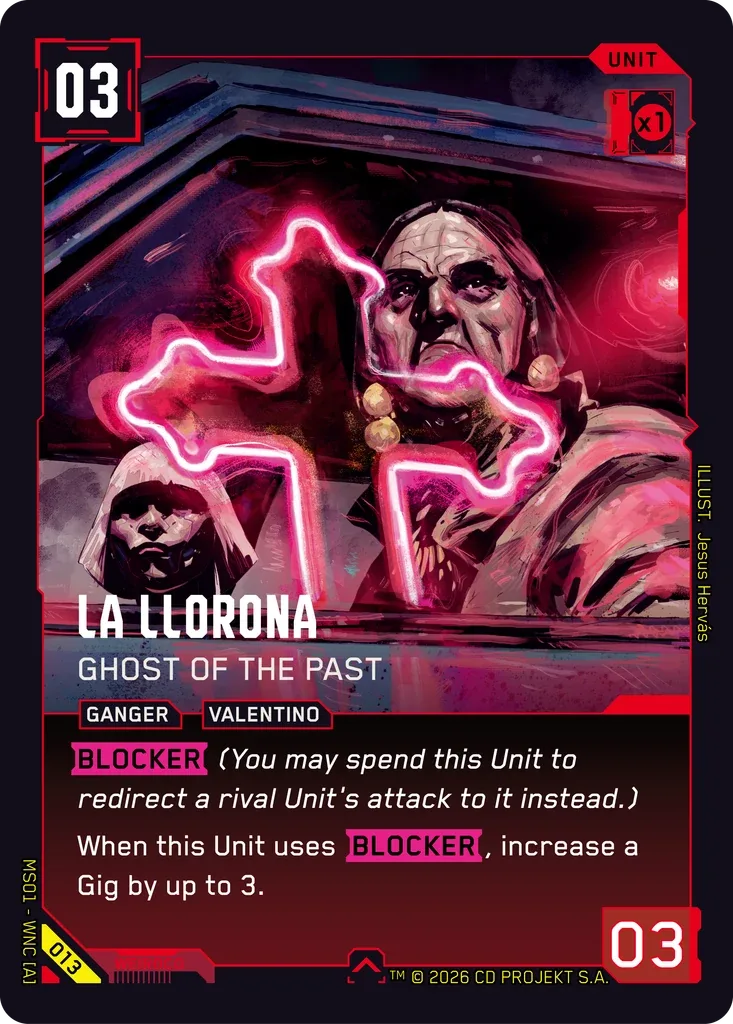
La Llorona is where the chain ruling lives. Her rulings say the Gig increase happens before the fight she just blocked into, that "up to 3" means 0, 1, 2 or 3, and that another Unit's BLOCKER can take the attack off her afterwards: "There is no limit of how many times you can use [BLOCKER] in one turn."
GO SOLO, answered
The Comprehensive Rules breakdown left one GO SOLO question open. The keyword lets a Legend attack the turn it reaches the field, but does it also switch off Lag's ban on Spend abilities? The FAQ answers it directly: a Legend on the field cannot use its Spend ability the turn it was played there. GO SOLO beats half of Lag, which is how that post read the rules.
The rest of the GO SOLO rulings:
- You can GO SOLO the turn you Call the Legend.
- You can GO SOLO a spent Legend. It still arrives ready, because GO SOLO plays it "as a ready Unit."
- A Legend can chip in toward its own GO SOLO. You may spend it for 1 €$ as part of paying its own cost.
- You can skip GO SOLO entirely. Any Legend with a numeric cost can be paid onto the field under rule 4.5. It then enters with Lag, in whatever orientation it had in the Legends area.
- A Legend that has gone solo is still a Legend. Synapse Burnout's ruling treats a Legend on the field as both a Legend and a Unit, matching rule 4.2.1.
- "Can't attack" still wins. MaxTac Suppression Team reads "Rival Units can't attack the turn they're played," and its ruling says a Legend that went solo that turn cannot attack through it. That is Golden Rule 2.6, prevention over permission.
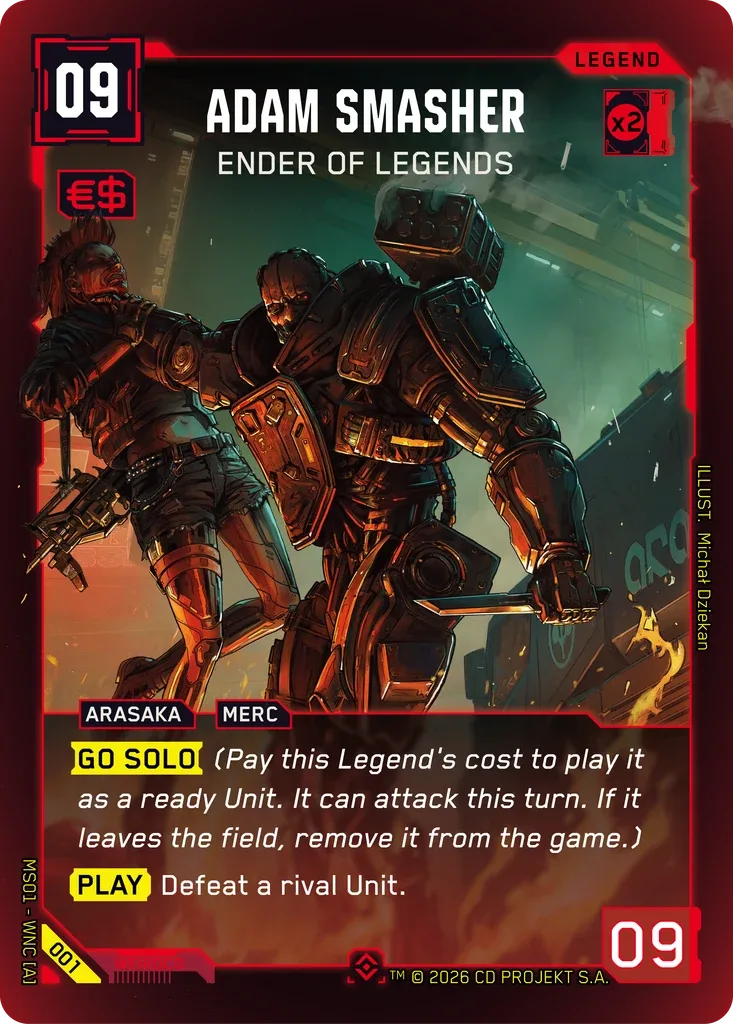
Adam Smasher: Ender of Legends, pictured at the top, gets four rulings of his own. His PLAY effect, "Defeat a rival Unit," fires when he Goes Solo but not when he is Called or flipped face-up. If his cost is reduced, GO SOLO gets cheaper with it. If he leaves the field, he is removed from the game. Put the general rulings on top and the full line reads: Call him, spend him for the first 1 €$ of his own cost of 9, pay the other 8, and he arrives ready to attack after defeating a rival Unit on the way in.
One consequence the FAQ does not spell out, but two of its answers imply. Riot Shield reads "Rivals must pay +2 €$ to use GO SOLO," and its ruling confirms it forces nothing. Because GO SOLO is not the only way onto the field, a Legend with a numeric cost facing Riot Shield can be played under rule 4.5 instead and skip the tax, giving up readiness and a same-turn attack to save 2 €$. That is my reading of the rulings, not a ruling in itself.
The Sell conflict, half settled
The Comprehensive Rules contradict themselves on selling. Rule 5.8.4 says you may Sell "as many cards you want through card effects" and take the Main Phase Sell action once per turn. Rule 11.9.2.2 says "An effect that says to 'Sell' does count as a player's 'Sell A Card' Main phase action." Those cannot both hold, and the rules breakdown flagged it in August.
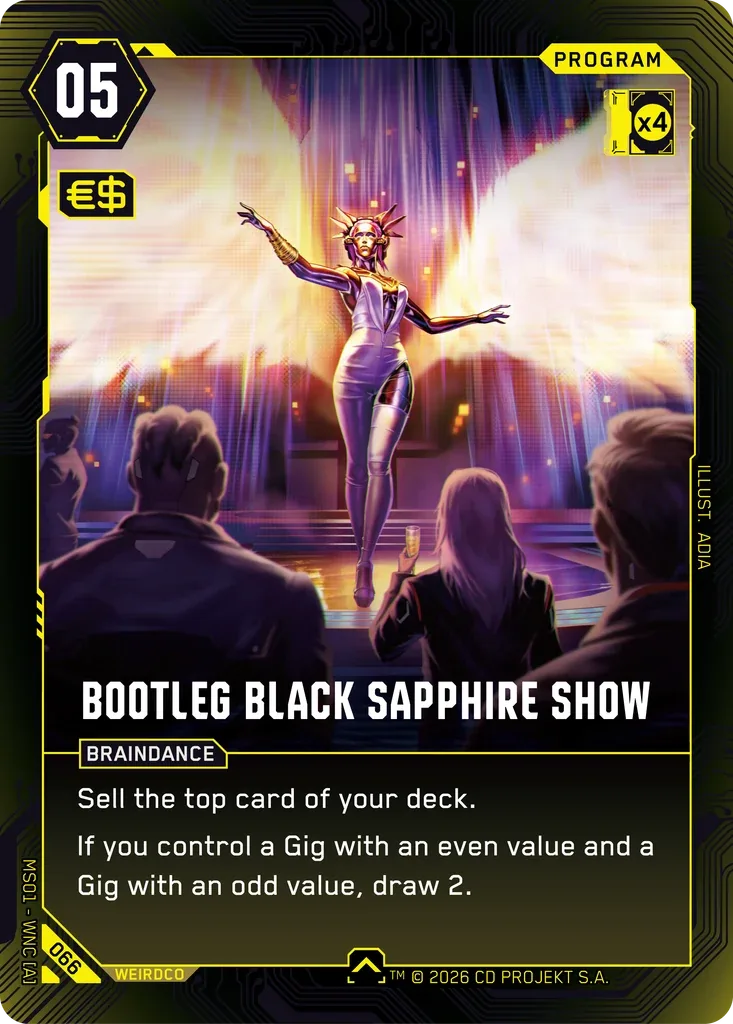
Bootleg Black Sapphire Show is the only card in the 151-card database whose text says "Sell," so its rulings are the only test of the conflict so far. There are three:
- You do not reveal the card you sell, or even look at it. The Main Phase Sell action reveals the card to your Rival (11.9.1). This one does not.
- The top card is sold even if it has no sell tag. That matches rule 11.9.2.1, which exempts any effect that moves a card into the Eddies area from needing one.
- "If I already sold a card during my main phase, can I still sell a card from Bootleg Sapphire's effect?" Yes.
So in that order, the FAQ sides with 5.8.4: selling from your hand first does not stop the effect from selling. The reverse order, casting Bootleg first and then trying to sell from hand, has no ruling. Read literally, 11.9.2.2 would say Bootleg already used your Sell action. Until WeirdCo rules on it, sequence it the way the FAQ has blessed: sell from hand first, then cast Bootleg.
One deckbuilding note: Bootleg is RAM 4, so in constructed it needs two Yellow Legends, as the RAM guide lays out.
Choose one can mean choose nothing
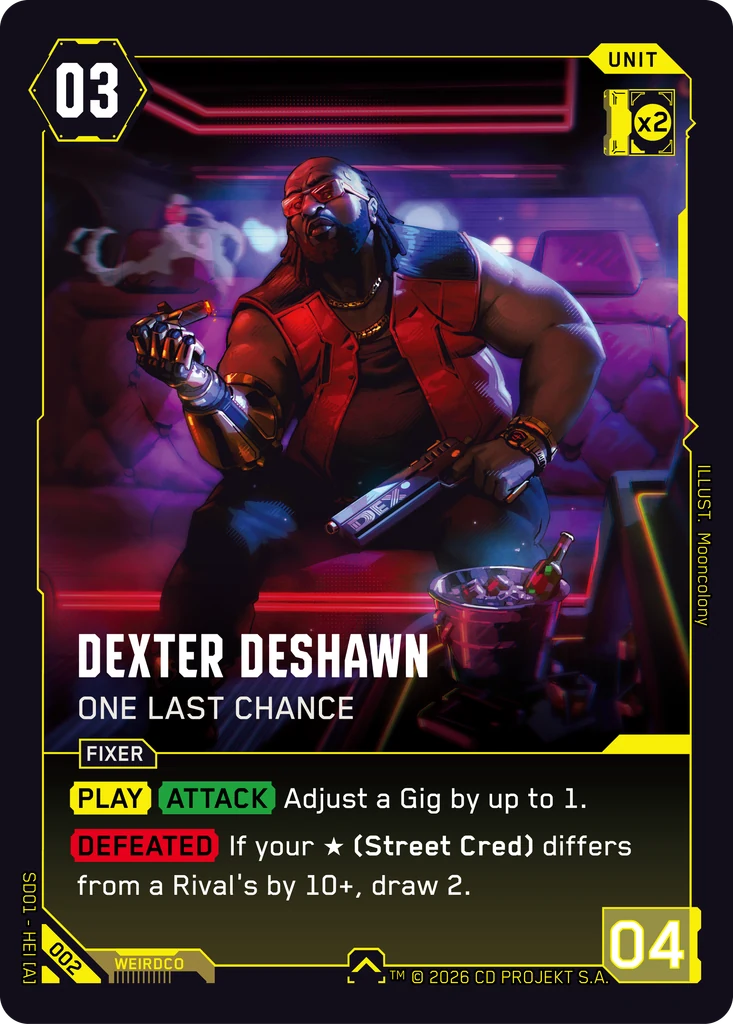
Four Legends share a Call that opens "Choose one effect" with Draw 1 as one of the two options: Dexter DeShawn: Off the Grid, Muamar Reyes: El Capitán, Padre: Man of the Cross and Wakako Okada: Peace and Harmony. The FAQ asks the same question for all four: with no valid target for the other effect, do I have to choose Draw 1? The answer each time is no: "You can still 'choose' the other effect, it just fails." Nocturne OP55 N1 gets the same answer for its three options.
The reason it matters is deck-out. Rule 1.14 ends the game the moment you must draw from an empty deck, and your face-down Legends are shuffled and hidden even from you (5.7.1, 5.7.4.1), so the Legend you Call can turn out to be a Fixer when your deck is empty. Choosing the effect that fails is a legal way to not draw. These four are also a large share of the Pre-release pool: WeirdCo's kit preview lists all four among the ten Legends a kit can contain, and a sealed deck can be as small as 30 cards. The Night City Brawl and Showdown breakdown covers that pool.
The "choose both" cards have the opposite ruling: you get no choice about order. Pyramid Song and Towerfall each let you take both of their effects when a condition is met, and the FAQ says both resolve top to bottom. That is the order the cards need. Towerfall's top effect gives all rival Units -5 power, and its bottom effect bottom-decks all rival Units with power 0, so the power cut always lands first. Towerfall's condition is having less Street Cred than a Rival. The FAQ confirms that a tie gets you one effect, not both.
Two kit rulings for the Pre-release
Every Welcome to Night City Pre-release Kit contains a Gorilla Arms promo, per WeirdCo's 23 September preview: a Yellow Gear reading "The first time this Unit steals 1 or more Gigs each turn, steal a rival Gig with a value not shared by a friendly Gig." Its rulings, spread across three cards:
- The Unit steals the extra Gig, not you. The whole ruling reads "The Unit," so the extra Gig counts as that Unit stealing.
- Take Control stops it cold. Play Take Control on a rival Unit that would steal 1 Gig while wearing Gorilla Arms, and the ruling is that it steals 0. The first steal never happens, so Gorilla Arms never triggers.
- Chrome Fang applies to the extra steal too. Its "can't steal friendly Gigs with value higher than their power" limit covers effect steals like Gorilla Arms.
The second kit ruling is in the Tournament Rules rather than the FAQ, and it matters because of the name rule further down. Sealed decks are exempt: Appendix D.2.1 says "Legends do not need to have unique names." Open a second copy of one of your kit Legends in a booster, and you may play both. The sealed deck rules cover the rest of the format.
The effects you cannot decline
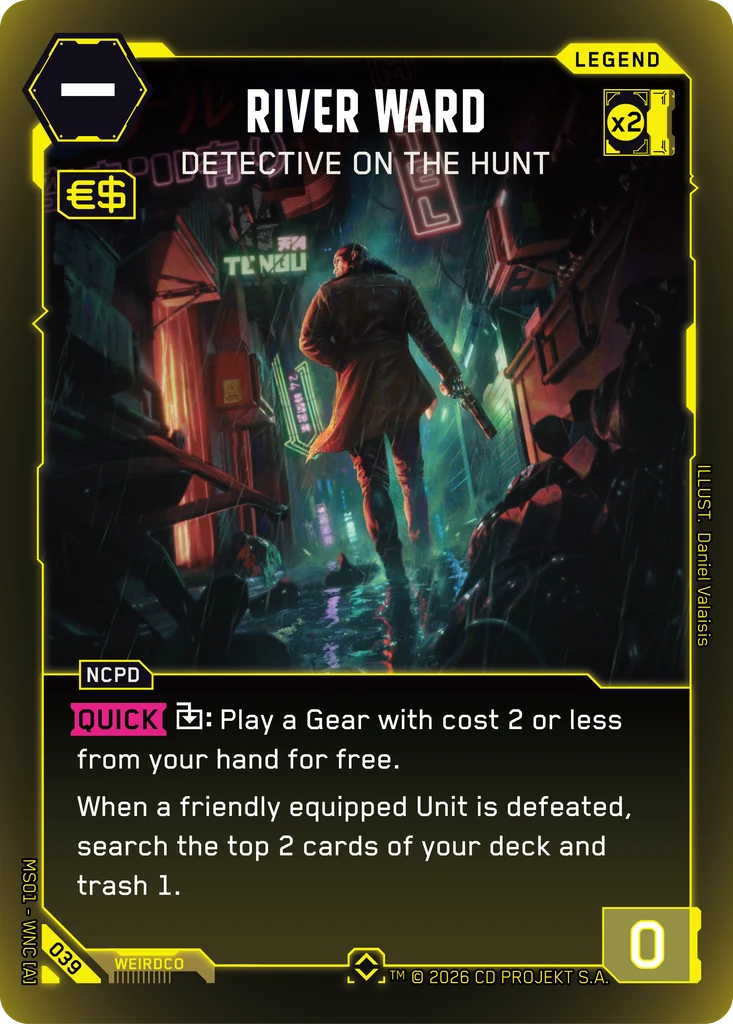
Comprehensive Rules 2.1 says that when an effect tells you to do something, you must resolve it. Rule 2.1.1 carves out "you may," and 2.8 makes anything "up to X" optional down to zero. The FAQ applies that hard: I count 24 card rulings that answer some version of "do I have to?" with yes. One exception is a search that asks you to reveal a card. Sketchy Ripper's "Reveal a Gear and add it to your hand" has no "may" in it, but the FAQ lets you reveal nothing and bottom-deck all three cards. That is not a pass for every search: River Ward: Detective on the Hunt must still trash 1 of the 2 cards it searches, per its own ruling.
Most of the 24 are pure upside, such as being made to defeat a rival Unit. These are the rulings that can hurt:
| Card | What the FAQ says you must do | When it hurts |
|---|---|---|
| Unlikely Bond | Bottom-deck a ready friendly Unit, even with no rival Unit to hit | You lose a Unit for nothing |
| Wild in the Streets | Defeat a spent Unit, your own if it is the only one | The only spent Unit on the field is yours |
| Offduty Malfini | Spend itself when played, even with no rival Unit | A spent Unit is a legal attack target (9.3.2.1) |
| Delamain: Rideshare AI | Draw 2 when played | One card left in your deck loses you the game (1.14.1) |
| Rita Wheeler: No Stupid Questions | Draw 1 then discard 1 the first time she is spent each turn | Spending her to attack or BLOCKER with an empty deck loses |
| Goro Takemura: Vengeful Bodyguard | The discard is optional, but taking it forces the draw | With an empty deck, "you will lose the game," in the FAQ's words |
Three discounts are compulsory as well. Viktor Vektor: Drop Your Illusions and We Gotta Live Together both make you pay the reduced price even if you would rather pay full, and Nocturne OP55 N1 must be played for 1 €$ when your fixer area is empty.
A discount is not a cost change
Six rulings make the same point: Carnage at the Colosseum, MaxTac Heavy, Octant, Trauma Team Operatives, We Gotta Live Together and Zetatech Berserk. A "play this for less" effect changes "only the amount you pay," never the card's cost.
That matters because plenty of cards check cost. Caliber: Totentanz's Top Dog defeats a rival Unit "with cost 2 or less." Goro Takemura: Vengeful Bodyguard hands BLOCKER only to a Unit "with cost 4 or less." Overwatch: Panam's Gift compares against a discarded card's cost. A MaxTac Heavy you played for 1 €$ is still a cost-7 Unit to all three: out of Caliber's reach, and not eligible for Goro's BLOCKER.
GO SOLO works the other way. The Adam Smasher ruling above says reducing his cost reduces what his GO SOLO costs, because GO SOLO pays "this Legend's cost."
Named V means any V
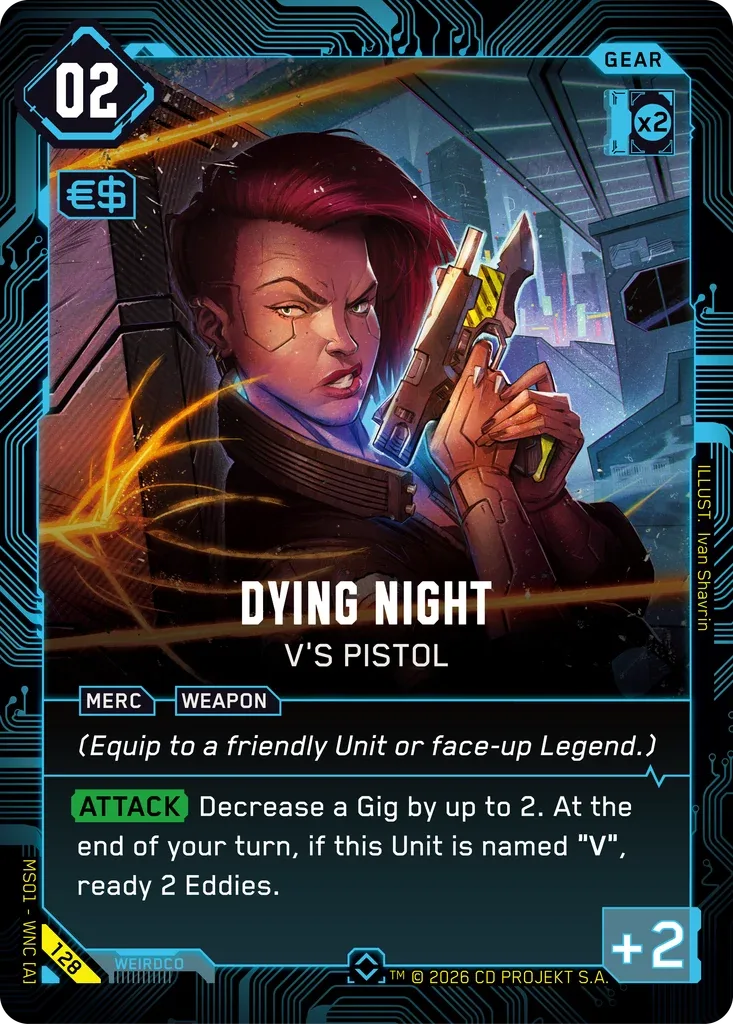
Dying Night: V's Pistol pays out "if this Unit is named 'V'." Its rulings talk about a Unit "named 'V'" with no subtitle attached, and the Comprehensive Rules explain why no subtitle is needed. Rule 3.9.2: "A card's subtitle is not part of its name." Three cards in the database are named V: V: Streetkid (Red Legend), V: Corporate Exile (Blue Legend) and V: Roamer of the Badlands (Red Unit). Both V Legends have GO SOLO, so either one counts once it is on the field. The rulings add that you still ready the 2 Eddies if you skip the Gig decrease, and still ready them if your V is defeated before the end of the turn.
If you own The Heist starter deck, you already have the pair. The database lists a printing of Dying Night in that deck, and V: Corporate Exile is one of the five Heist cards with no booster printing, as the starter-deck breakdown covers.
The same rule changes deckbuilding. Rule 7.3.1: "You cannot use multiple Legends with the same name." WeirdCo's own worked example under it says V: Corporate Exile and V: Streetkid "are both named 'V,' so you can't use both of them in the same deck." Three pairs of Legends in the current database share a name, and each pair is one-per-deck in constructed:
| Name | Legends that share it |
|---|---|
| V | V: Streetkid (Red), V: Corporate Exile (Blue) |
| Goro Takemura | Goro Takemura: Hands Unclean (Green), Goro Takemura: Vengeful Bodyguard (Green) |
| Jackie Welles | Jackie Welles: Mama's Favorite (Green), Jackie Welles: Pour One Out For Me (Blue) |
The rule restricts Legends only, so a V Unit in the main deck alongside a V Legend is fine, and sealed waives it entirely (Tournament Rules Appendix D.2.1). The RAM guide and the Tournament Rules breakdown on this site both treated the constructed Legend name question as open. Rule 7.3.1's example settles it.
Where the FAQ and the rulebook still disagree
- Activating a Spend ability whose condition you do not meet. Kerry Eurodyne: The Last Rockerboy reads "Spend: If you control a Gig with 8+ value, draw 2." The FAQ says you may activate it without an 8+ Gig and simply not draw. Comprehensive Rules 11.15.3.1 says "If a [Spend Icon] effect also has a condition, the condition must be met at the time of activation and resolution," which read literally forbids exactly that activation. It is not academic. NetWatch Netdriver ("When this Unit or Legend is spent, draw 1") triggers off any spend, and its own ruling says it resolves after the Spend ability. WeirdCo has not said which document wins, so ask the judge before you rely on it.
- The other half of the Sell question. Covered above: hand-then-effect is ruled, effect-then-hand is not.
- The copy cap's wording. Tournament Rules Appendix D.1 caps constructed decks at "No more than 3 copies of any unique card name." Comprehensive Rules 7.3.3 caps them at three copies "of a card with an identical name and subtitle combination." With subtitles outside the name (3.9.2), the two readings split on one pair of main-deck cards: Viktor Vektor: Drop Your Illusions and Viktor Vektor: You Might Feel a Little Pinch, both Yellow Units named Viktor Vektor. Rule 7.3.3 allows three of each. The Tournament Rules' shorthand reads as three in total.
- Zero versus Null. Field Operator's ruling answers "Does 0 count as an even number?" with no. A Gig can never be 0: rule 6.3.3 says the lowest value on any die "is always 1," and a d10's 0 face counts as 10. So the only case the question can describe is an empty Gig area. The Comprehensive Rules call that Street Cred Null, say it "does not count as having 0" (11.2.3), and say it counts as neither even nor odd (5.11.4.1). Different words, same result: no draw.
What the FAQ does not cover
- Where it ranks. The FAQ never says whether it overrides the Comprehensive Rules. The errata page does say where it stands: its updated text "supersedes all printed text at all levels of play." Riot's Riftbound FAQ, covered here, states outright that it takes precedence over the Core Rules where they differ. WeirdCo's FAQ has no equivalent line.
- Anything in the Tournament Rules. The FAQ was last updated on 15 September, ten days before the Tournament Rules' 25 September update, and there is nothing in it on sideboards, dice checks or the round clock.
- Eleven cards. No ruling exists for Animals Wrecker, Emergency Atlus, Hanako Arasaka: In a Gilded Cage, Lizzy Wizzy: Delicate Weapon, Mandibular Upgrade, Mantis Blades, Psycho Squad, Rebecca: Having a Moment, Riding Nomad, Rockn' Rockerboy or Secondhand Bombus.
- The Legend name rule. It lives in the Comprehensive Rules (3.9.2 and 7.3.1) and the Tournament Rules' Appendix D. The FAQ touches it only through Dying Night.
Quick reference
- Where: cyberpunktcg.com/rules-faq. 269 rulings: 25 general, 244 card-specific across 140 of 151 cards. Stamped 4 September 2026, last updated 15 September 2026.
- ADRENALINE and QUICK: neither lets a Unit use its Spend ability the turn it is played.
- BLOCKER: usable the turn a Unit is played, chainable with no per-turn limit, works against attacks on Units or the Gig area, and dead in the Legends area.
- QUICK: usable on your own turn, several per Rival attack, but not in response to a Rival's QUICK.
- GO SOLO: allowed the turn you Call, allowed from spent, and the Legend can pay 1 €$ of its own cost. It still cannot use a Spend ability that turn, and "can't attack" effects still stop it.
- Sell: an effect Sell after your hand Sell is allowed. The reverse order has no ruling.
- "Choose one": you may pick the effect that fails. "Choose both" resolves top to bottom.
- Compulsory: effects without "may" or "up to" must resolve (rule 2.1), and the FAQ lets Sketchy Ripper's search come up empty. Watch Unlikely Bond, Wild in the Streets and anything that draws when your deck is low.
- Discounts: change what you pay, not the card's cost. Viktor Vektor: Drop Your Illusions, We Gotta Live Together and Nocturne OP55 N1 cannot be declined.
- Names: subtitles are not part of a name. A constructed deck can hold at most one V, one Goro Takemura and one Jackie Welles Legend. Sealed has no name rule.
Frequently Asked Questions
Where is the official Cyberpunk TCG Rules FAQ?
Can you play two Legends with the same name in Cyberpunk TCG?
Can a Cyberpunk TCG Legend use GO SOLO the turn it is Called?
Can you use BLOCKER more than once on the same attack in Cyberpunk TCG?
Does a card effect that sells count as your Sell action in Cyberpunk TCG?
Do you have to resolve Cyberpunk TCG card effects you do not want?
Does a cost reduction change a Cyberpunk TCG card's cost?
Keep Reading
- Rules FAQ (WeirdCo, official) - 269 rulings (25 general, 244 card-specific across 140 cards), every entry stamped 4 September 2026, last updated 15 September 2026; read 30 September 2026
- Comprehensive Rules (WeirdCo, official), updated 1 September 2026 - rules 1.14, 1.14.1, 2.1, 2.1.1, 2.6, 2.8, 3.9.2, 4.2.1, 4.5, 5.7.1, 5.7.4.1, 5.8.4, 5.11.4.1, 6.3.3, 7.3.1, 7.3.3, 9.3.2.1, 9.7.1, 10.12, 11.2.3, 11.3.1, 11.3.2, 11.9.1, 11.9.2.1, 11.9.2.2, 11.15.3.1 and 11.26.2
- Tournament Rules (WeirdCo, official), last updated 25 September 2026 - Appendix D.1 (constructed copy limit wording) and D.2.1 (sealed Legends need not have unique names)
- Card Errata and Text Clarifications (WeirdCo, official) - errata text "supersedes all printed text at all levels of play"
- Welcome to Night City Pre-release Preview: What's in the kit?, 23 September 2026 (WeirdCo, official) - the Gorilla Arms promo and the ten-Legend kit pool, including the four Fixer Legends
- Adam Smasher: Ender of Legends card entry (WeirdCo, official) - Red Legend, cost 9, GO SOLO and "PLAY Defeat a rival Unit"
- Bootleg Black Sapphire Show card entry (WeirdCo, official) - Yellow Program, cost 5, RAM 4, "Sell the top card of your deck"
- Dying Night: V's Pistol card entry (WeirdCo, official) - Blue Gear, cost 2, RAM 2, readies 2 Eddies if the equipped Unit is named "V"; printed in The Heist starter deck
- La Llorona: Ghost of the Past card entry (WeirdCo, official) - Red Unit with BLOCKER and a Gig increase when she blocks
- Kerry Eurodyne: The Last Rockerboy card entry (WeirdCo, official) - Red Unit, cost 4, "Spend: If you control a Gig with 8+ value, draw 2"
- Cyberpunk TCG card database, powered by Netdeck.gg (WeirdCo, official) - 151 cards read 30 September 2026, including the three pairs of same-name Legends and the three cards named V
- Vendetta Rules FAQ and Clarifications, 14 August 2026 (Riot Games, official) - "In places where the FAQ differs from the Core Rules Document, the FAQ takes precedence"
Related Guides
Cyberpunk TCG Comprehensive Rules: 10 Rulings That Bite
WeirdCo published the Cyberpunk TCG Comprehensive Rules on 28 August 2026 — 11 numbered sections and 660 numbered rules, thirteen days before the first Beta Events. It is the first public document that answers rules arguments rather than teaching the game, and ten of its rulings change decisions you would otherwise make from the Gameplay Guide alone. It also contradicts itself in three places.
Cyberpunk TCG Sealed Deck Rules: RAM Does Not Apply
Until this week the sealed half of Cyberpunk TCG was a card count and nothing else. WeirdCo published the rest of it on 19 August 2026, and the headline is that the constructed format's defining constraint — the per-colour RAM ceiling your three Legends set — is switched off entirely. Your Legends stop being a deckbuilding licence and become three cards you flip.
Cyberpunk TCG Starter Decks: Embracing Power vs The Heist
WeirdCo's two Welcome to Night City starter decks share no cards and are built on mirror-image Legend lines. Here are both full lists with every card's cost, RAM and power, the five cards each second Legend exists to pay for, the rulings that change how they play, and which box is the better first buy.
Cyberpunk TCG's Deck Builder Is Live: 716 Decks So Far
WeirdCo's official Deck Builder went live on 2 September 2026, and by 16 September the community had published 716 public decks through it. Pull every one through the tool's own API and a pattern falls out that the RAM-ceiling math alone could not show: which colours people actually pair, which Legend is in more than a quarter of all decks, and which one of the 27 Legends in the database has never been picked once.
How to Play the Cyberpunk TCG — Gig Dice, Eddies and Street Cred, Explained
WeirdCo raised $28.3 million to build a trading card game where the win condition is a pile of dice. Here is how the Cyberpunk TCG actually works under the beta rules, what the four colors do, and why the release date most sites are printing is out of date.
Cyberpunk TCG Keywords Explained: All 9, 86 Cards Use One
Cyberpunk TCG's official card database has a Keyword filter with zero options in it, so nothing tells you the game has keywords at all unless you read every card. It does: nine bracketed tokens, split by the Comprehensive Rules into four trigger keywords, four effect keywords and one activation shorthand it does not call a keyword. Eighty-six of the 151 cards print at least one, four cards print three, and three keywords turn out to be things one card gives another rather than something every printed instance owns.