Cyberpunk TCG Rules Update: Fights, Steals, Penalty Guide
WeirdCo shipped a rules update on 28 and 29 October 2026 to coincide with the Welcome to Night City retail release. The Comprehensive Rules flag 73 changed entries, 45 of them in four brand-new sections that define fight, steal, defeat and top-deck. The Tournament Rules flag 41, and the penalty appendix that was a placeholder in September is now a working guide. Here is what moved and what it changes at the table.
WeirdCo has put a changelog on the Cyberpunk TCG rules documents. Both rules documents now carry a "last updated" stamp and a count of changed entries: the Comprehensive Rules read "LAST UPDATED OCT 29, 2026" with "73 CHANGES IN THE LATEST UPDATE", and the Tournament Rules read "OCT 28, 2026" with 41. Each changed entry is tagged in the page's data as added or updated. This post walks through both lists, because 45 of the 73 Comprehensive Rules entries are four new sections that rewrite how you should read a fight, a steal, a defeat and a top-deck, and the Tournament Rules penalty appendix is no longer the placeholder it was in September.
One caveat on method. The documents show you what changed in the latest update but not what the old text said, so where I describe a before, it comes from this site's earlier reads of the documents (the Comprehensive Rules breakdown from 30 August and the Tournament Rules breakdown from 25 September), and I say so. Everything below was read from the live documents on 1 November 2026.
What WeirdCo published
WeirdCo's 28 October dev blog post, "Welcome to Night City Patch Notes: Errata and Rules Updates", says it was written "to coincide with the Retail release of Welcome to Night City". It lists exactly two new errata, both artist-credit fixes, and then says the Game Design and Rules teams "have made several revisions" to the Comprehensive Rules and the Organized Play team "several revisions" to the Tournament Rules. It does not list those revisions. Instead it says all changes are highlighted in yellow in the documents, and it announces a policy: as new sets approach, WeirdCo will "consolidate any rules or card-based updates into short updates like this one wherever possible and suitable."
So the patch note is a pointer, and the documents are the substance. Here is what is in them.
| Document | Stamp as read 1 Nov | Changed entries | Added | Updated |
|---|---|---|---|---|
| Comprehensive Rules | Last updated 29 Oct 2026 | 73 | 56 | 17 |
| Tournament Rules | Last updated 28 Oct 2026 | 41 | 0 | 41 |
| Card errata page | No dates listed | 7 entries in total, 2 new | n/a | n/a |
The Tournament Rules figure of 41 updated and none added matters. It means those entries were edited in place, which fits a document that was reorganised and filled in rather than extended with new rule numbers. Several of the Tournament Rules changes can only be described against what this site read on 25 September, and I flag each one.
The Comprehensive Rules at a glance
Of the 73 changed entries, here is where they sit. Counts are by rule number prefix.
| Rules | Topic | Changed entries |
|---|---|---|
| 11.4 | Fight (new section) | 18 |
| 11.5 | Steal (new section) | 15 |
| 11.6 | Defeat (new section) | 5 |
| 11.16 | Top-deck (new section) | 7 |
| 3.9, 5.7, 5.8, 6.4, 6.5, 6.8 | Names, Legend spending, Sell, Gig adjust and set | 9 |
| 7.6, 7.7, 8.11, 9.16, 9.17 | Shuffling and presenting decks, Sell for Turn, the fight step | 6 |
| 10.1, 10.3, 10.16, 10.17 | Effects: conditions, triggers, targets | 5 |
| 11.9, 11.11, 11.12, 11.15, 11.23, 11.28 | Gear location, play costs, Sell, Programs, DEFEATED, redirects | 8 |
The four big ones are all Terms entries in section 11, and they are all marked added. Our August read found the fight and defeat rules inside the Attack section (it cites them at 9.17 and 9.19). The new text gives fight, steal and defeat each a definition and a step order in section 11, and section 9 now carries short pointers. Rule 9.16 now says the attacking and defending Unit fight and points to Fight; 9.17 says that after the fight you resolve all pending effects, and then the Fight Step and the attack end.
Fight, steal and defeat get their own sections
Fight (rule 11.4). The headline is that a fight is now a defined game process in which "two opposing Units compare power to determine at least one loser and potentially one winner." The rules that follow are set out together in one section:
- A Unit wins when its power is higher. The opposing Unit then always loses, "regardless of power" (11.4.1.1.1).
- A Unit loses with equal or lower power, and on equal power "neither Unit wins and both Units lose the fight" (11.4.1.2 and 11.4.1.3).
- A card effect that says a Unit wins or loses a fight supersedes the power comparison (11.4.1.4).
- The order is fixed: apply "while fighting" effects, compare power and declare losers and winners, then defeat the losers, then end the fight and remove the "while fighting" effects, then resolve pending effects (11.4.2.1 through 11.4.3). Effects triggered by the fight become pending when you determine winners and losers, and resolve after the fight ends (11.4.2.2.1).
- Even if the opposing Unit has left the field, "it still defeats the loser" (11.4.2.3.1).
- "Units with power 0 cannot defeat a Unit in a fight" (11.4.2.3.2), and a Unit that is prevented from being defeated "still loses the fight, it only ignores the resulting defeat" (11.4.2.3.4).
That last pair is the same ruling this site flagged in August as number ten of the ten rulings that bite. It is not new, but its address changed: the August post cited it as rule 9.19.2, and in the 29 October text it lives at 11.4.2.3.2. Rule 9.19.2 no longer exists in the live document. If you cite rule numbers at an event, cite the 11.4 numbers and say which update you are reading.
Steal (rule 11.5). This is the longest of the new sections after Fight, and the one with the most procedural detail.
- Every steal has an "actor". When a Unit or Legend attacks to steal, it is the actor, and if an effect names a different actor, that actor steals (11.5.1.1).
- "A Gig's value can't change during stealing." An effect that adjusts the Gig must resolve either before you choose the Gigs or after they change control (11.5.1.2).
- You apply "while stealing" effects and anything that modifies or restricts the attacker's power or ability to steal before selecting Gigs (11.5.1.3).
- You select all the Gigs first, one at a time if there are several, and "may choose to steal any Gig in the defending Gig area, regardless of its value" (11.5.1.4 to 11.5.1.4.2).
- Prevention effects, and triggers that read "would be stolen", resolve after selection but before the Gig changes control (11.5.1.5). WeirdCo's example: a Unit that lets you discard a card with cost equal to the Gig's value to stop the steal. A rival attacks to steal two Gigs, picks values 3 and 10, you discard a cost-3 card, and only the 10 is stolen.
- The chosen Gigs move at the same time, each counts as a separate stolen Gig, and "stolen" triggers become pending after the move (11.5.1.6 to 11.5.1.7).
The number of Gigs a steal takes has not moved: rule 9.20.1 gives 0 power as 0 Gigs and otherwise X = (P / 10) + 1, rounded down, so power 1 to 9 steals one Gig and power 10 to 19 steals two. What the new section adds is the sequence around that number, which is also the frame the per-card Rules FAQ rulings on steal effects hang from.
Defeat (rule 11.6). Defeating moves a Unit, Legend or Gear from the field or Legends area to the trash (11.6.1). Two rules matter at a table. A defeated Unit "is considered to be in the trash while resolving [DEFEATED] effects" (11.6.2), and its equipped Gear goes to the trash with it and is no longer equipped there (11.6.3 and 11.6.3.1). A companion change to 11.23.3 says that while resolving a DEFEATED effect you use "the information from when the piece was last on the field", including its equipped state and power adjustments. The example in the rule is a Gear that gives its Unit a DEFEATED effect to play another Unit for free and then bottom-deck "this Unit": the Gear is already in the trash by then, but the effect still resolves using the Unit as it stood on the field.
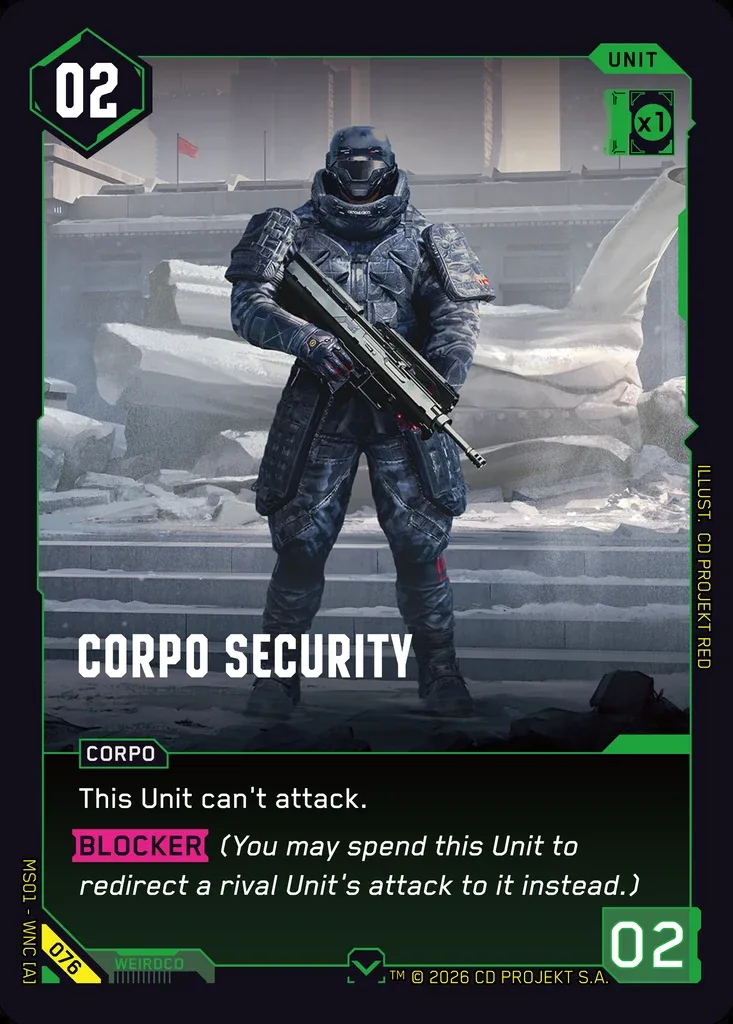
Corpo Security, pictured above, is the card behind one more entry in this batch. New rule 11.28.3.1 says "A Unit can't redirect an attack to itself if it's already the target of that attack." That is the kind of corner a Blocker like Corpo Security ("You may spend this Unit to redirect a rival Unit's attack to it instead") can reach, and now it has an answer.
Sell, costs and free plays
Six entries touch the economy, and the Sell ones are the first rewrite of the rule this site called out as self-contradictory in August.
- Sell from hand (5.8.2.2). "Once per turn during your Main phase, you may reveal and sell a card with a Sell Tag from your hand." Rule 8.11 names this action "Sell for Turn", and 8.11.1 limits it to once per turn.
- Selling through effects (5.8.2.3). "There is no limit to the number of cards you may Sell through card effects in a turn. (Only the Main phase Sell action is limited to once per turn.)" This is new text.
- Definition (11.12.1). Sell is the action of turning a card into an Eddie by placing it face-down in the Eddies area.
- Cost floor (11.11.3). "Effects that reduce the amount you pay to play a card cannot reduce the amount below 1 €$." If you were assuming a discount could take a card to free, it cannot.
- Free plays (11.11.4.2). "When you play a card for free, ignore effects that increase or reduce the amount you pay to play it."
- Legends (5.7.6). "While a Legend is face-up in the Legends area, you may activate its [Spend Icon] effect during your main phase."
The August breakdown listed the Sell conflict first among three places the document argued with itself: 5.8.4 said a player could sell as many cards as they like through effects, and 11.9.2.2 said an effect-driven Sell counts as the Main-phase action. Rule 5.8.4 is gone from the live text, and 5.8.2.3 now says the effect route is unlimited. But the matching rule at 11.12.2.2 is not among the changed entries, and still reads: "An effect that says to 'Sell' does count as a player's 'Sell A Card' Main phase action." Read next to 5.8.2.3, that sentence is ambiguous at best. If an effect-driven Sell counts as the Main-phase Sell action, it is unclear how it can be exempt from that action's once-per-turn limit. The likeliest reading is that the effect still counts as a sell for anything keyed to selling, while the cap only applies to the hand action, but that is my inference, not WeirdCo's text. I would not rule on it at a competitive table without a Head Judge.
The other two internal conflicts from August, the missing "not" in the reminder-text rule and the permanent-versus-persistent effect type, both read correctly in the live document: 3.18.1.2.2.1 now says reminder text "does not influence gameplay", and 10.4 lists "persistent effects". Neither is in the 73 flagged entries, so they were corrected at some point I cannot date.
Triggers, targets, names and top-decking
Section 10, the names rules and a few Gig and deck-handling rules got a handful of clarifications.
- Conditions are checked at resolution (10.16.1.1). If a trigger has conditions beyond the trigger itself, "those conditions do not need to be true when it triggers, only when you resolve it." The example: a power 3 Unit with "[ATTACK] If this Unit has power 5+, draw 1" and a Gear that gives it +2 power when spent. You declare the attack at power 3, the Gear's +2 lands, the Unit is at power 5 when the attack trigger resolves, and you draw.
- Stacked trigger keywords are "or" (10.17.1). "[PLAY] [ATTACK] Adjust a Gig by up to 1" fires when you play the Unit and each time it attacks.
- Restrictions apply to every listed target (10.1.5). The example is Gear reminder text, "Equip to a friendly Unit or face-up Legend": "friendly" covers both the Unit and the Legend.
- Where to look when text is unclear (10.1.1). "Refer to the FAQ on its official card database page." That makes the per-card rulings on cyberpunktcg.com/cards an official fallback inside the Comprehensive Rules.
- Names (3.9.2 and 3.9.3). A card that names itself means itself, not another card with the same name. A name with an ampersand has three names: both halves plus the combined name. WeirdCo's example is "Pilar & Rebecca: Runs in the Family", which is named "Rebecca", "Pilar" and "Pilar & Rebecca".
- Gigs (6.4, 6.5, 6.5.1). Adjusting a Gig is incrementing or decrementing it; "setting" a Gig changes its face to a specific value; and you cannot set a die to a value not on its face, such as a d6 to 8.
- Shuffling (7.6.2 and 7.7.2). After both players finish shuffling, you present your deck to your Rival, who may cut or shuffle it. The same applies to your face-down Legends.
Top-deck (rule 11.16) is the fourth new section. To top-deck is to place cards on top of your deck "in a random order" and face-down, indistinguishable from the rest (11.16.1 and 11.16.1.1). You cannot top-deck a card you do not own; its owner top-decks it instead (11.16.1.2). If several cards are top-decked at once you randomise them together, including Units or Legends with Gear attached (11.16.1.3), unless the effect says "in any order", in which case you choose the order (11.16.2). A Program that top-decks or bottom-decks itself after being played does that instead of going to the trash (11.16.3 and 11.15.3).
The Tournament Rules now have a penalty guide
The Tournament Rules page flags 41 entries, all updated, and the biggest single change visible against this site's 25 September read is Appendix A. That read described Appendix A, Penalties and Infractions, as a placeholder whose only text was a note that it would be added later. The 1 November text is a working penalty guide.
Its scope is stated up front: "The contents of this guide should be applied for tournaments in the Competition-Level and above." It does not say store-level events must use it, so it reads as the standard for District Opens and up rather than a mandate for a Night City Brawl. It sets four penalties:
| Penalty | When it applies |
|---|---|
| Warning (W) | First instances of a rules violation; "a gentle reminder." |
| Minor, Game Loss (GL) | Moderate impact or high abuse risk. "Typically, a third Warning given to a player should be upgraded to a Minor Penalty automatically." |
| Major, Match Loss (ML) | Tournament integrity significantly impacted, or the match compromised beyond recovery. |
| Disqualification (DQ) | Severe damage to integrity, such as intentional cheating or an illegal deck. Reported to WeirdCo, which may ban the player. |
Infractions come in two groups, seven game errors (A.2.1) and sixteen tournament issues (A.2.2). The ones most likely to matter in a first tournament:
| Infraction | Suggested penalty | The part to know |
|---|---|---|
| Missed Trigger | None (asterisked) | Only when the trigger would "visibly affect the game"; upgrades to a Warning if the missed trigger was detrimental to its controller |
| Game Rules Violation | Warning | The fallback category; simple rewinds, with a full rewind needing Head Judge authorisation |
| Failure to Maintain Game State | Warning | Both players are responsible for calling errors; the warning cannot be upgraded to a Game Loss |
| Hidden Zone Error | Warning | Drawing an extra card or a seven-card opening hand; the Rival chooses which cards stay |
| Dice Dexterity Error | Warning | Knocking a Gig die; if players disagree on the value, notes are the first reference, then a reroll |
| Slow Play | Warning | A 2-minute time extension is added; intentional slow play upgrades to Stalling, a DQ |
| Tardiness | Game Loss (asterisked) | Not ready within 5 minutes of the round timer; over 10 minutes is a Match Loss |
| Randomizing Match Result | Match Loss | Rolling a D20 for the win, or flipping top cards to compare costs; both players if both engage in it |
| Decklist Error | Game Loss (asterisked) | A submitted list that does not match the deck |
| Illegal Deck | Disqualification | In Round 1 only, it can instead be a Match Loss and a fix from the sideboard |
| Outside Assistance | Game Loss | Both the asker and the helper; a spectator pointing out a missed optional trigger counts |
| Collusion, Bribery and Wagering | Disqualification | Includes bets on any part of the tournament |
Three details are easy to miss. The Tardiness entry says "If a player's tardiness is as little as 3 minutes, the penalty is downgraded to a Warning", which sits oddly beside the 5-minute threshold in the same paragraph, so ask the Head Judge how it is applied. The Illegal Deck examples include "A player has more than 7 cards in their sideboard" and "less than 40 or more than 50 cards in their deck", which confirms the 7-card sideboard from the September breakdown is enforced with a disqualification, not a shrug. And the Major Unsporting Conduct entry lists "A player doesn't maintain proper hygiene" among its examples, which echoes the civility and hygiene wording already inside the Comprehensive Rules at 2.13.1.
Also in the flagged list: 2.2.1 on judge roles, which points readers to the Judge Program appendix for qualifications; Section 3.3 on the number of rounds; 3.2.2 on top cuts (a Night City District Open of 64 to 256 players cuts to a Top 8, an Edgerunner Open Regional of 512 to 2,048 players to a Top 16, and the final single-elimination rounds of Regionals are untimed); and 3.4.5, which adds that the Round-End procedure is "distinct from the Overtime rules described in the Comprehensive Rules."
Appendix B and the sealed formats
Two other Tournament Rules passages read differently from this site's September copy.
Appendix B, Current Card Bans and Restrictions. The 25 September read quoted a list of three textless promos that are not yet tournament-legal: Lucyna Kushinada: Fresh Beginnings, David Martinez: Built Different and Rebecca: Having a Moment. It also quoted a named banned card, "Jackie & V: Chooms to the End", and described the Alpha Kit exclusion as "except the Nova Rare alpha cards". The 1 November Appendix B is shorter:
- All cards printed in official expansion sets from Welcome to Night City Beta and Retail onward are legal, except Alpha Kit cards (marked with an [ALPHA] symbol in the card number), test prints with outdated mechanics, and NOT LEGAL cards such as staff cards marked with an "N" in the card number.
- Three Alpha cards are named as legal: Saburo Arasaka: Stubborn Patriarch (a029), Goro Takemura: Hands Unclean (a030) and Yorinobu Arasaka: Embracing Destruction (a031).
- The textless-promo clause now names one card, "Rebecca: Having a Moment".
I searched the whole 1 November document for Lucyna, David Martinez and Jackie and found none of them. What that means for the Chicago Top 8 prize is not something WeirdCo has said. The Edgerunner Open prizing breakdown and the cards-not-in-boosters post still talk about Lucyna and David as promos, and the Tournament Rules no longer list either as a textless promo.
Appendix D.2, Sealed Format. The September read described two sealed formats, Sealed Kit and 6-Pack. The 1 November text defines four, all with the same core build rules (up to three colours, RAM limits ignored, at least 30 cards, any number of copies of non-Legend cards, unused cards as a sideboard):
- Pre-Release (D.2.1). A kit of six boosters, three additional random Legends, one Nova Rare promo and a full set of polyhedral dice. You choose exactly 3 Legends from anything you opened.
- 6-Pack (D.2.2). Six bare boosters, up to 3 Legends, and each missing Legend becomes a blank Eddie.
- Chroming Up (D.2.3). Eight boosters: six to build with and one more after each of Rounds 1 and 2 to improve your deck.
- Chooms (D.2.4). A team format for sides of three under one captain, run mainly as an Edgerunner Open Regional side event: three individual best-of-1 games that report as one best-of-3, and in the sealed variant an 18-pack team pool.
Chroming Up and Chooms matter because our 23 October side events breakdown found both on the Regional side-event list and noted two gaps: that the Tournament Rules had "no clause for a deck that grows mid-event", and that WeirdCo did not say whether a Chooms team's 18 packs were split or pooled. The 1 November text answers both. D.2.3 lets Chroming Up players "use the cards from their additional packs to modify their decks even further after Rounds 1 and 2", and D.2.4 calls the 18 packs a "collective pool" the team builds from. D.2.3 is among the flagged entries and D.2.4 is not, so I cannot say when each first appeared. The sealed deck rules post covers the Beta Event kit and the 30-card floor, and the four formats above are a superset of it.
Appendix E, the Judge Program, is now part of the Tournament Rules too, with the Level 1/2/3 structure and a Level 1 qualification list that matches our Judge Program breakdown: Pre-Release, Night City Brawl and Night City Showdown in any position and a Night City District Open as a floor judge. It adds that Head Judge is a title rather than a fourth level and that "there will typically only be 10-20 Head Judges maximum" across all regions.
The two errata
The card errata page, which says its updated text "supersedes all printed text at all levels of play", now lists seven entries. The two from 28 October are both artist credits:
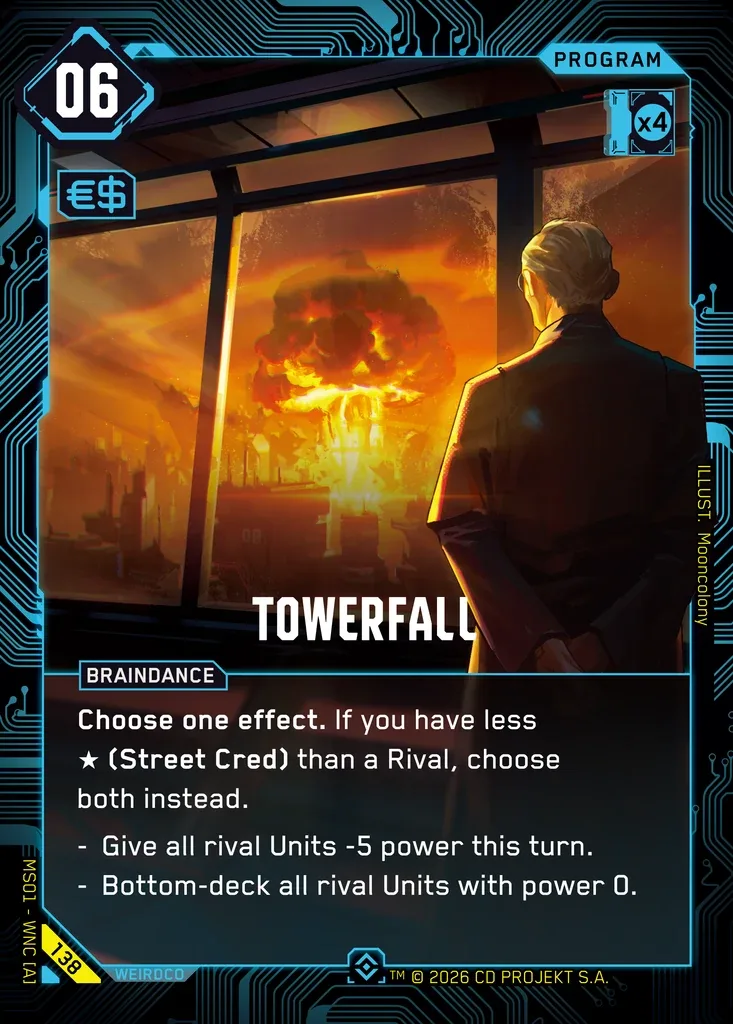
- Towerfall, base Retail version: the credit changes from Mooncolony to Dardo Studios.
- Corpo Security, Night City Brawl Promo version: the credit changes from Daniel Valaisis to CD PROJEKT RED.
The other five on the page, none dated, are the Beta Iconic Rare Johnny Silverhand: Never Stop Fighting (printed with a Sell tag it should not have; it cannot be sold, matching the other versions), Kiroshi Optics (reminder text changed to "Equip to a friendly Unit or face-up Legend" to match other Gear), and artist-credit corrections on Nocturne OP55N1, Judy Álvarez: Nothing to Doubt and Yorinobu Arasaka: Embracing Destruction (Beta Box Topper).
Neither new erratum changes how a card plays. The card database has not caught up with them yet. As read on 1 November, the Towerfall Retail entry (138) and its second Retail printing (167) still list Mooncolony, and the render at the top of this post still says "ILLUST. Mooncolony", while the Beta printing already lists Dardo Studios, the credit the erratum names. The two Corpo Security Brawl promo printings (009 and 027) still list Daniel Valaisis. The Retail Corpo Security at the middle of this post already credits CD PROJEKT RED, which is the credit the erratum gives the Brawl promo.
What is still unclear
- Whether the Tournament Rules list of changed entries is the whole diff. All 41 are marked updated and none added, but a document that fills a placeholder appendix and adds sealed formats arguably has additions. I am reporting the marker, not a verified diff.
- What changed in the 17 updated Comprehensive Rules entries. The page shows that an entry changed, not the previous wording. Where I describe a before, it comes from this site's earlier reads and I could be wrong about intermediate revisions.
- Whether 11.12.2.2 will be corrected to match 5.8.2.3. See above.
- Whether the credits stamp will move. The Comprehensive Rules credits block still reads "(UPDATED AUG. 2026)" while the page header says 29 October. The header is the one to cite.
- Whether the Appendix A guide will extend to store-level events. It says Competition-Level and above, and WeirdCo has not published a store-level equivalent.
- Set 2 timing. WeirdCo says it will fold rules updates into short consolidated posts as new sets approach, and Set 2, Edgerunners: Burn Bright, was announced on 20 October for Spring 2027. Expect the next one then; no date has been given.
Quick reference
- Patch notes: WeirdCo dev blog, 28 October 2026, "to coincide with the Retail release of Welcome to Night City."
- Comprehensive Rules: last updated 29 October 2026, 73 changed entries (56 added, 17 updated), 45 of them in the new Fight (11.4), Steal (11.5), Defeat (11.6) and Top-deck (11.16) sections.
- Tournament Rules: last updated 28 October 2026, 41 changed entries, Appendix A penalty guide for Competition-Level and above.
- Moved citation: 0-power Units cannot defeat in a fight is now rule 11.4.2.3.2 (August post cited 9.19.2).
- New Sell text: once per turn from hand (5.8.2.2), unlimited through effects (5.8.2.3), but 11.12.2.2 still says an effect Sell counts as the Main-phase action.
- Play cost floor: cannot be reduced below 1 eurodollar (11.11.3).
- Errata: Towerfall (Retail) credit now Dardo Studios; Corpo Security (Brawl promo) credit now CD PROJEKT RED.
- Sealed formats in Appendix D.2: Pre-Release, 6-Pack, Chroming Up, Chooms.
Frequently Asked Questions
What changed in the Cyberpunk TCG rules update in October 2026?
What are the new Cyberpunk TCG errata?
Can you sell unlimited cards with effects in Cyberpunk TCG?
Can a discount make a Cyberpunk TCG card cost 0?
What penalties does the Cyberpunk TCG Tournament Rules penalty guide use?
How many sealed formats does Cyberpunk TCG have?
Keep Reading
- Welcome to Night City Patch Notes: Errata and Rules Updates, 28 October 2026 (WeirdCo, official) - two new errata, revisions to both rules documents highlighted in yellow, and the plan to consolidate future updates
- Official Comprehensive Rules (WeirdCo, official), read 1 November 2026 - last updated 29 October 2026, 73 changed entries; rules 11.4 Fight, 11.5 Steal, 11.6 Defeat, 11.16 Top-deck, 5.8.2.2, 5.8.2.3, 11.11.3 and 11.12.2.2
- Official Tournament Rules (WeirdCo, official), read 1 November 2026 - last updated 28 October 2026, 41 changed entries; Appendix A penalties and infractions, Appendix B bans and restrictions, Appendix D.2 sealed formats, Appendix E Judge Program
- Card Errata and Text Clarifications (WeirdCo, official), read 1 November 2026 - seven entries including the Towerfall and Corpo Security artist-credit corrections
- Towerfall card entry (WeirdCo, official card database), read 1 November 2026 - Retail 138 and 167 list Mooncolony, Beta printings list Dardo Studios and ADIA
- Corpo Security card entry (WeirdCo, official card database), read 1 November 2026 - Retail 076 credits CD PROJEKT RED; Night City Brawl S1 printings 009 and 027 list Daniel Valaisis
- Announcing Cyberpunk TCG Set Two - Edgerunners: Burn Bright, 20 October 2026 (WeirdCo, official) - Set 2 arrives in Spring 2027
Related Guides

I Played the Cyberpunk TCG at Gen Con: What an Hour at WeirdCo HQ Actually Covers
The Cyberpunk TCG Learn to Play at Gen Con 2026 was free, one hour, 18+, capped at 60 players and sold out, with an alt-art foil Rebecca promo for anyone who finished. Here is what a one-hour teach can realistically land in a game with no life total, why the dice make it a harder teaching job than any other card game on that floor, and the three cards WeirdCo revealed mid-show that prove it.
Cyberpunk TCG Starter Decks: Embracing Power vs The Heist
WeirdCo's two Welcome to Night City starter decks share no cards and are built on mirror-image Legend lines. Here are both full lists with every card's cost, RAM and power, the five cards each second Legend exists to pay for, the rulings that change how they play, and which box is the better first buy.
Cyberpunk TCG Rules FAQ: What 269 Official Rulings Settle
Besides the Comprehensive Rules and the Tournament Rules, WeirdCo publishes a third rules document written as the questions a player asks mid-game: a Rules FAQ with 269 official rulings, 244 of them on specific cards. It settles the GO SOLO question the rulebook left open, half-settles the Sell contradiction, and makes clear which card effects you cannot decline.
Cyberpunk TCG's Deck Builder Is Live: 716 Decks So Far
WeirdCo's official Deck Builder went live on 2 September 2026, and by 16 September the community had published 716 public decks through it. Pull every one through the tool's own API and a pattern falls out that the RAM-ceiling math alone could not show: which colours people actually pair, which Legend is in more than a quarter of all decks, and which one of the 27 Legends in the database has never been picked once.
How to Play the Cyberpunk TCG — Gig Dice, Eddies and Street Cred, Explained
WeirdCo raised $28.3 million to build a trading card game where the win condition is a pile of dice. Here is how the Cyberpunk TCG actually works under the beta rules, what the four colors do, and why the release date most sites are printing is out of date.
Cyberpunk TCG Keywords Explained: All 9, 86 Cards Use One
Cyberpunk TCG's official card database has a Keyword filter with zero options in it, so nothing tells you the game has keywords at all unless you read every card. It does: nine bracketed tokens, split by the Comprehensive Rules into four trigger keywords, four effect keywords and one activation shorthand it does not call a keyword. Eighty-six of the 151 cards print at least one, four cards print three, and three keywords turn out to be things one card gives another rather than something every printed instance owns.