Every Cyberpunk TCG Legend Is RAM 2. That Turns Deckbuilding Into One Decision
WeirdCo tells you your Legends set your deck's RAM ceiling and leaves it there. Run the rule against the 151 cards in the official database and it collapses into something much harder: every Legend that prints a RAM value carries RAM 2, so you have exactly six RAM to spend, and how you split it decides which of the 36 gated non-Legend cards you can reach at all.
The Cyberpunk TCG gameplay guide files RAM last in its deckbuilding section — four short paragraphs and two worked examples, then straight into the glossary — which makes it read like a formality. It is not. Of the four deckbuilding requirements WeirdCo lists, it is the one that decides what your deck can actually contain — and it is easy to underrate until you run it against a real card pool.
The official database sat at 151 cards when this post was last re-run against it on 4 September 2026, and it exposes the fields you need: colour, type, cost, power, RAM, tags, and whether a card can be sold for an Eddie. Pull all 151 and the RAM rule stops being a guideline and turns into a fixed budget with three legal ways to spend it. Every number below is from that pull. The pool has grown by 24 cards since this post first ran on 15 August and not one of its conclusions changed, which is itself worth knowing.
The rule, and the number under it
WeirdCo's wording, verbatim from the deckbuilding section of the gameplay guide: "The cumulative RAM of your three Legends cards sets the maximum RAM value for color cards permitted in your deck. If you want to use more powerful cards of a specific color, you need to use more Legends of the same color to increase your limit."
Each Legend's RAM counts only toward its own colour. That is the whole system, and it sounds open-ended — until you look at what the Legends actually print.
There are 27 Legends in the database. Twenty-six of them carry RAM 2. Not most. Not typically. All twenty-six that print a RAM value at all. The twenty-seventh is Rebecca: Having a Moment, the Nova Rare promo, and it is a borderless full-art card that prints no cost, no RAM, no power and no rules text, so the database has nothing to record for it. Three new Legends were added between 15 and 31 August 2026 and all three came in at RAM 2; the two cards added since are Programs, so the Legend count has not moved.
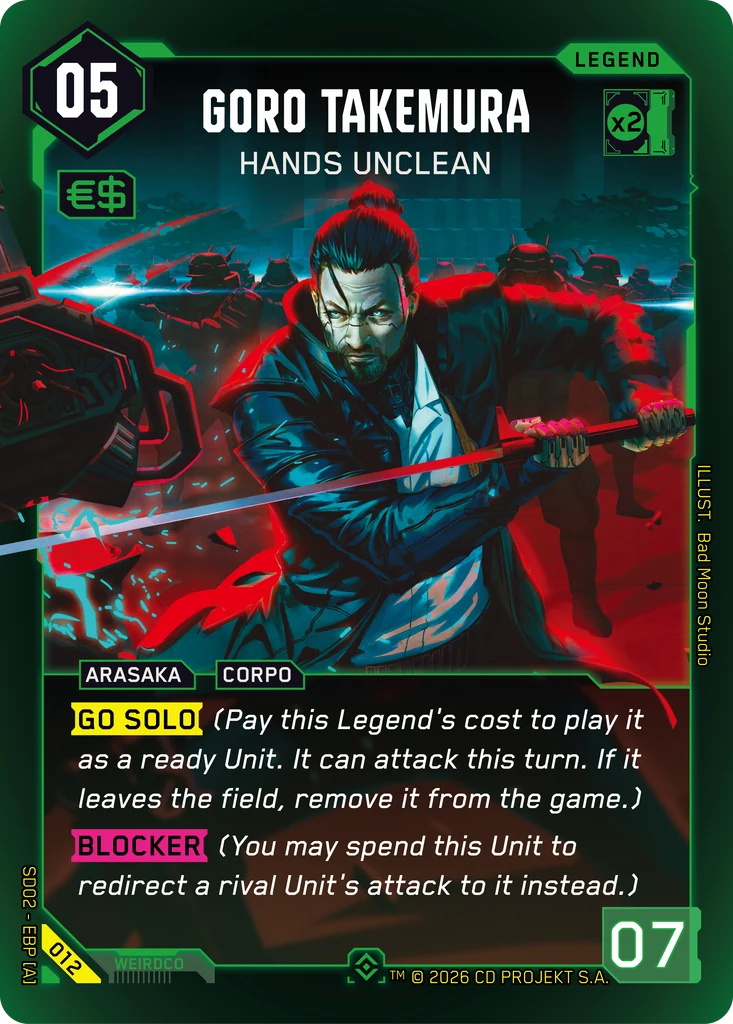
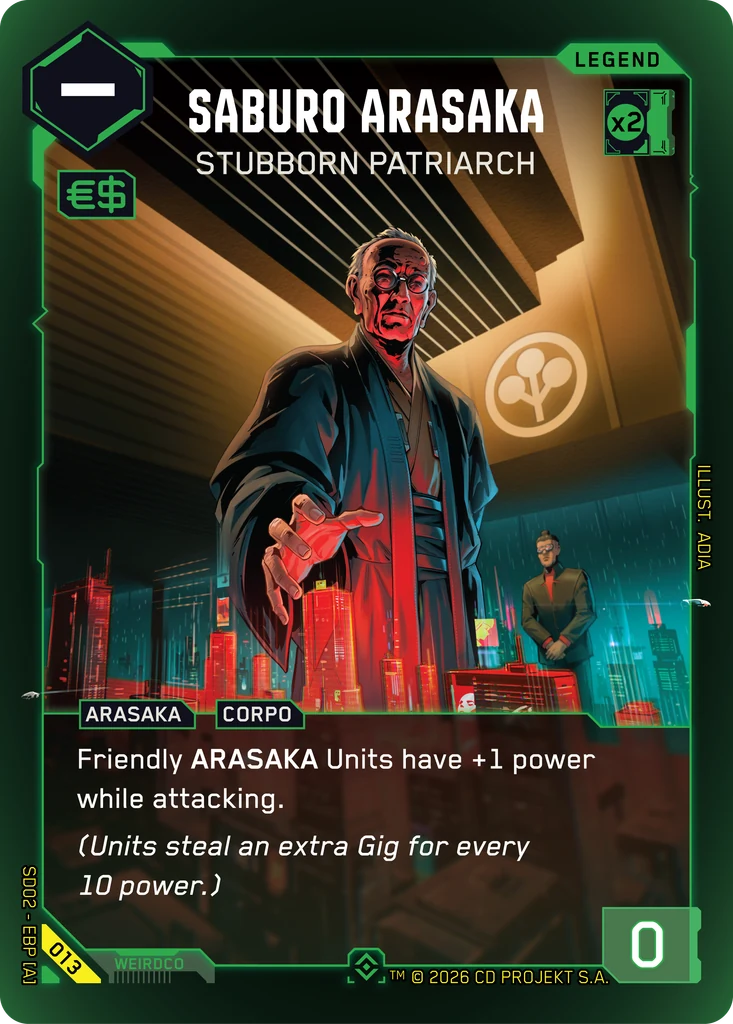
That is Goro Takemura: Hands Unclean, the Legend WeirdCo uses in its own worked example. The x2 in the top-right corner is the number, and it is the same number on Adam Smasher: Ender of Legends, on Alt Cunningham, on Rogue, on Saburo Arasaka, on every other Legend that prints one.
So the arithmetic is settled before you start. Three Legends, two RAM each, six RAM total, and the only RAM decision left is how you distribute it across colours.
Six RAM, split three ways
There are exactly three ways to split three Legends across colours, and each one produces a fixed set of ceilings:
| Legend line-up | RAM ceilings you get |
|---|---|
| 3 Legends, one colour | 6 RAM in that colour |
| 2 + 1 across two colours | 4 RAM in the main colour, 2 in the splash |
| 1 + 1 + 1 across three colours | 2 RAM in each of three colours |
Read the middle row again, because it is the one that bites. A splash colour in Cyberpunk TCG is capped at RAM 2, permanently. There is no second Legend to add without becoming a two-Legend colour, and nothing in the game raises the ceiling afterwards — the word RAM does not appear in the rules text of a single card in the database. Whatever sits above RAM 2 in your splash colour is not a "later." It is a no.
Here is the full picture. Every non-Legend card in the database, by colour and RAM:
| RAM | Red | Green | Blue | Yellow |
|---|---|---|---|---|
| 1 | 9 | 7 | 5 | 6 |
| 2 | 13 | 14 | 17 | 17 |
| 3 | 6 | 6 | 5 | 4 |
| 4 | 3 | 4 | 3 | 3 |
| 5 | 0 | 0 | 1 | 0 |
| 6 | 0 | 0 | 0 | 1 |
| Total | 31 | 31 | 31 | 31 |
The colours are almost perfectly balanced overall — 38 cards each in Red, Green and Blue, and 37 in Yellow, once you fold the Legends back in — but they are not balanced in where the cards sit on the RAM curve. Blue and Yellow each stack 17 of their non-Legend cards at RAM 2 exactly, giving them the largest pools that fit under a single Legend. Green has the most cards behind the gate: 10 of its 31 sit at RAM 3 or higher.
What a splash actually costs you
Turn the table into the number you care about: how many cards a single Legend of a colour buys you.
| Colour | Playable off 1 Legend (RAM 2 or less) | Locked behind 2+ Legends (RAM 3+) |
|---|---|---|
| Red | 22 of 31 | 9 |
| Green | 21 of 31 | 10 |
| Blue | 22 of 31 | 9 |
| Yellow | 23 of 31 | 8 |
Across the whole pool, 88 of the 124 non-Legend cards sit at RAM 2 or below. Thirty-six do not.
That reframes the three-colour deck. Going 1+1+1 does not leave you short of playables — 88 legal cards at up to three copies each is far more than a 40-to-50-card deck needs. It leaves you short of ceiling. Every card above RAM 2, in all four colours, is off the table simultaneously. RAM is a quality constraint dressed up as a quantity one, which is exactly why it is easy to misread on a first pass through the rules.
The two cards that demand all three Legends
Two cards in the revealed pool sit above RAM 4, and both of them require a mono-colour Legend line. Two Legends of a colour give you 4 RAM; only three give you 6.
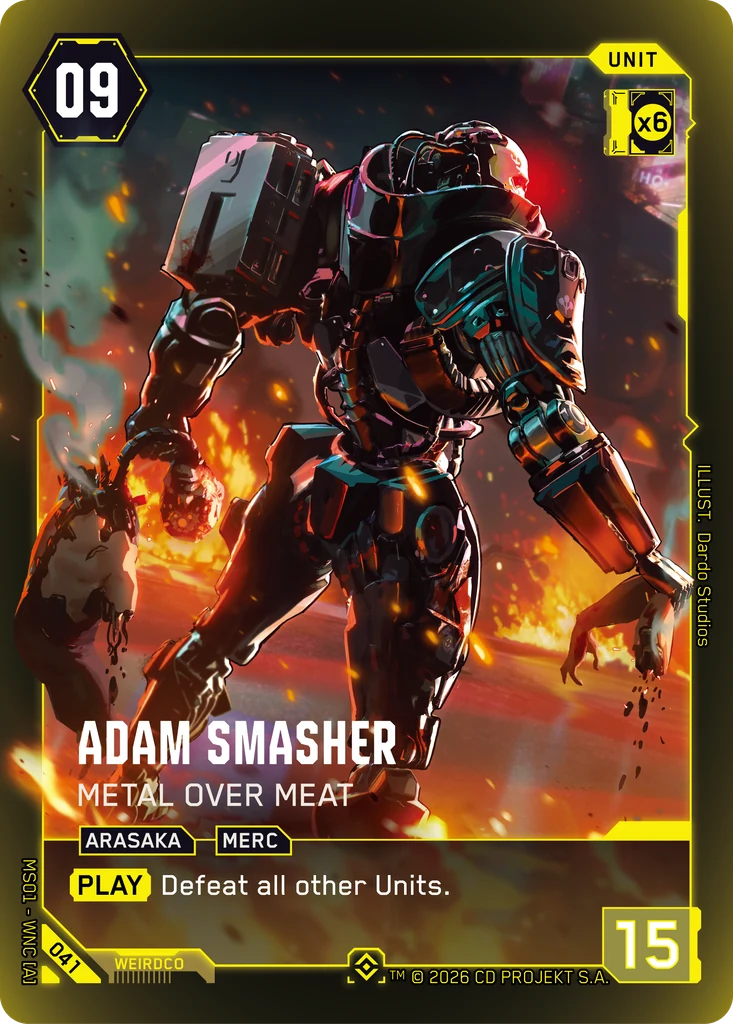
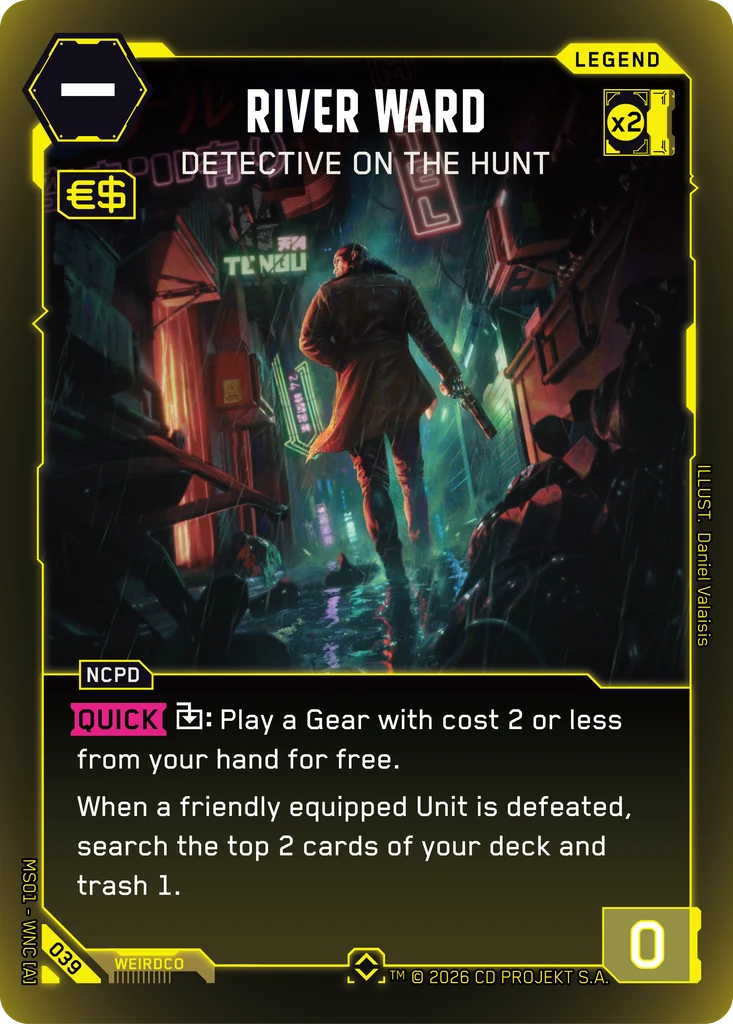
Adam Smasher: Metal Over Meat is Yellow, RAM 6, cost 9, power 15, and its entire text is "PLAY Defeat all other Units." Every other Unit on the table, yours included. To legally include one copy you need three Yellow Legends, and the database offers exactly six to choose from — Dum Dum, Kerry Eurodyne, Muamar Reyes, River Ward, Rogue Amendiares and Viktor Vektor — so your Legend line is close to written for you.
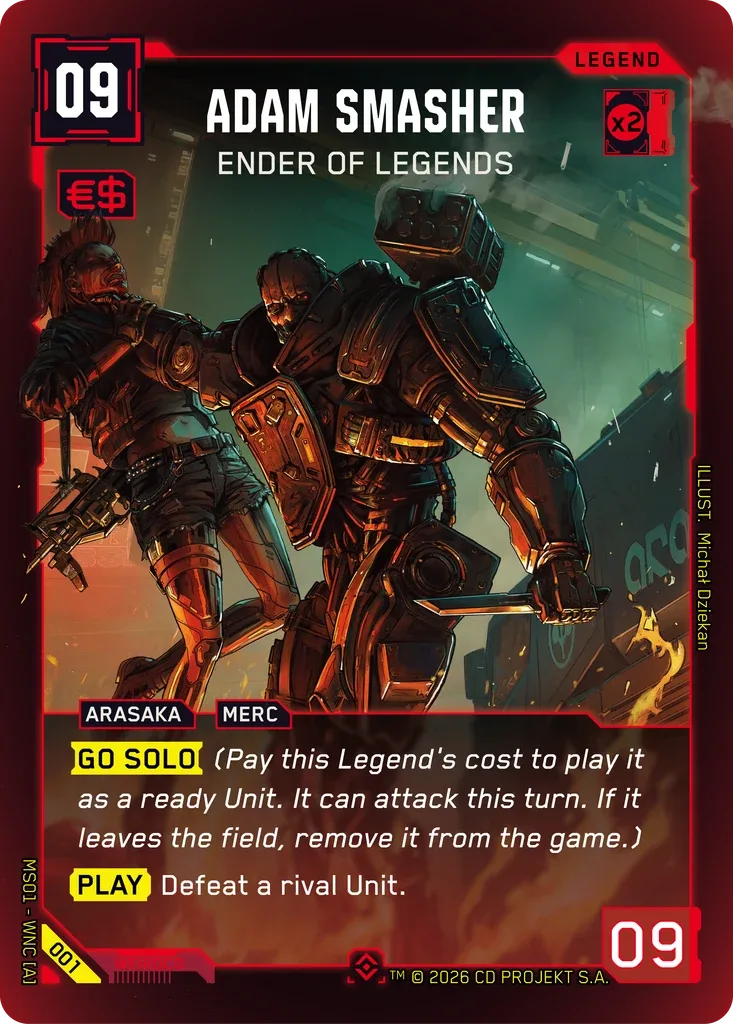
Judy Álvarez: Nothing to Doubt is Blue, RAM 5, cost 6, power 6, and for 1 €$ plus spending the Unit it reveals the top card of your deck, which you may either play for free or put in your hand. Same requirement — three Blue Legends, from a pool of seven.
Then there is the second bill. Eddies arrive at one per turn from selling, and you may additionally spend any number of your three Legends as 1 €$ each, every turn, since spent cards ready at the start of your turn. So on turn N your absolute ceiling is N + 3 Eddies of value. A cost-9 card is unpayable before turn six, and that is with a perfect sale every single turn and all three Legends thrown into the till — which means not Calling a Legend that turn, because that costs 1 €$ too. Adam Smasher is a real card. He is also a turn-six-at-the-earliest card in a game that reaches Overtime after the last player's seventh turn.
RAM is not a power rating
The obvious inference from the rule — higher RAM means stronger card — does not survive contact with the data. Averaged across all 73 revealed Units:
| RAM | Units | Average cost | Average power | Highest power |
|---|---|---|---|---|
| 1 | 16 | 3.8 | 4.3 | 8 |
| 2 | 41 | 4.4 | 4.6 | 14 |
| 3 | 9 | 4.9 | 5.6 | 10 |
| 4 | 5 | 5.6 | 5.0 | 8 |
| 5 | 1 | 6.0 | 6.0 | 6 |
| 6 | 1 | 9.0 | 15.0 | 15 |
RAM 4 Units average less power than RAM 3 Units. The highest-power RAM 4 Unit, Octant, is power 8 at cost 7. Meanwhile:
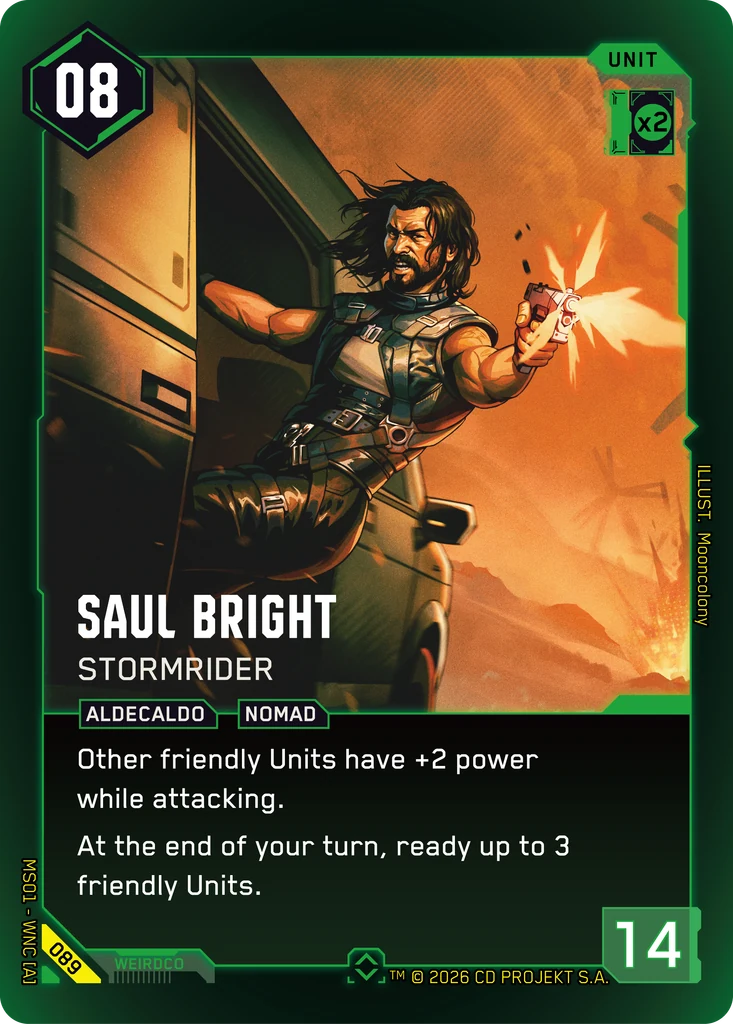
Saul Bright: Stormrider is power 14 — the second-highest in the set — at RAM 2. One Green Legend legalises him. He also gives other friendly Units +2 power while attacking and readies up to three friendly Units at the end of your turn — and the guide is explicit that ready Units cannot be attacked, so that is three bodies walled off across your Rival's turn.
Only four revealed Units reach power 10 or higher, the threshold at which a single attack on the Gig area steals two dice instead of one: Adam Smasher at 15, Saul Bright at 14, Animals Wrecker and Placide: Voodoo Sentinel at 10 each. Two of those four are RAM 2. Nothing revealed so far reaches the power 20 tier that steals three Gigs.
The practical read: RAM tracks effect complexity and colour commitment, not raw stats. If you want a big body, you can have one at RAM 2. If you want a card that rewrites the board, you pay in Legend slots.
Both official demo decks are built to these exact lines
WeirdCo publishes both demo decks as free print-and-play PDFs, and the database carries their contents as separate product codes — Merc Demo Deck, 15 distinct cards, and Arasaka Demo Deck, 14. Check the Legend lines against the table above and they are textbook 2+1 builds.
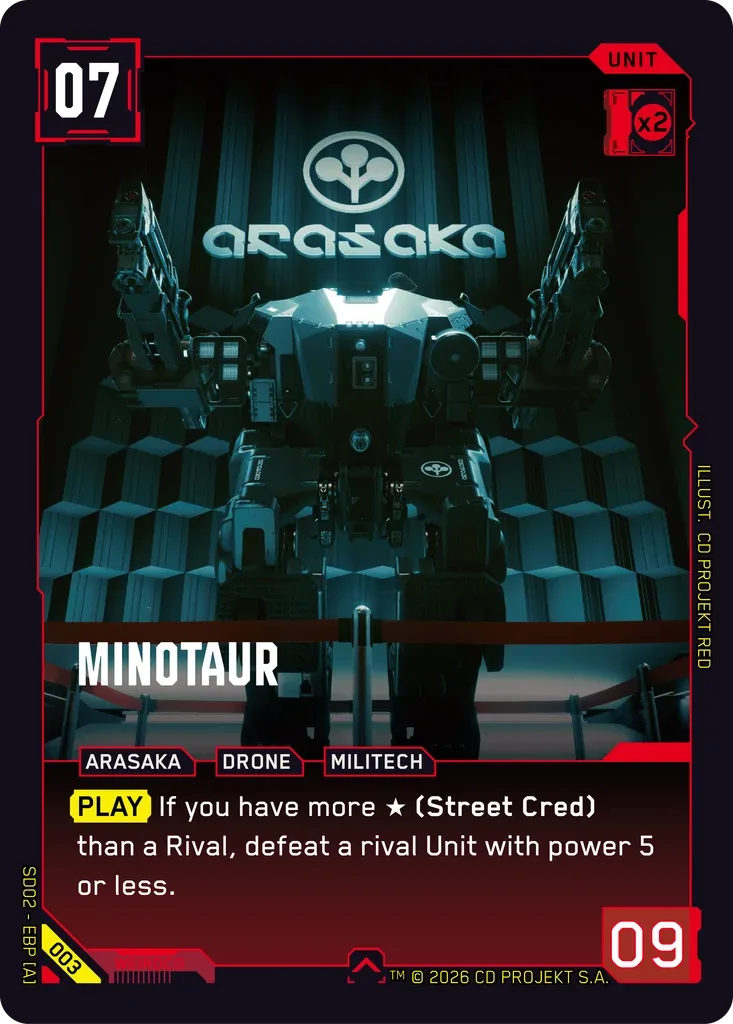
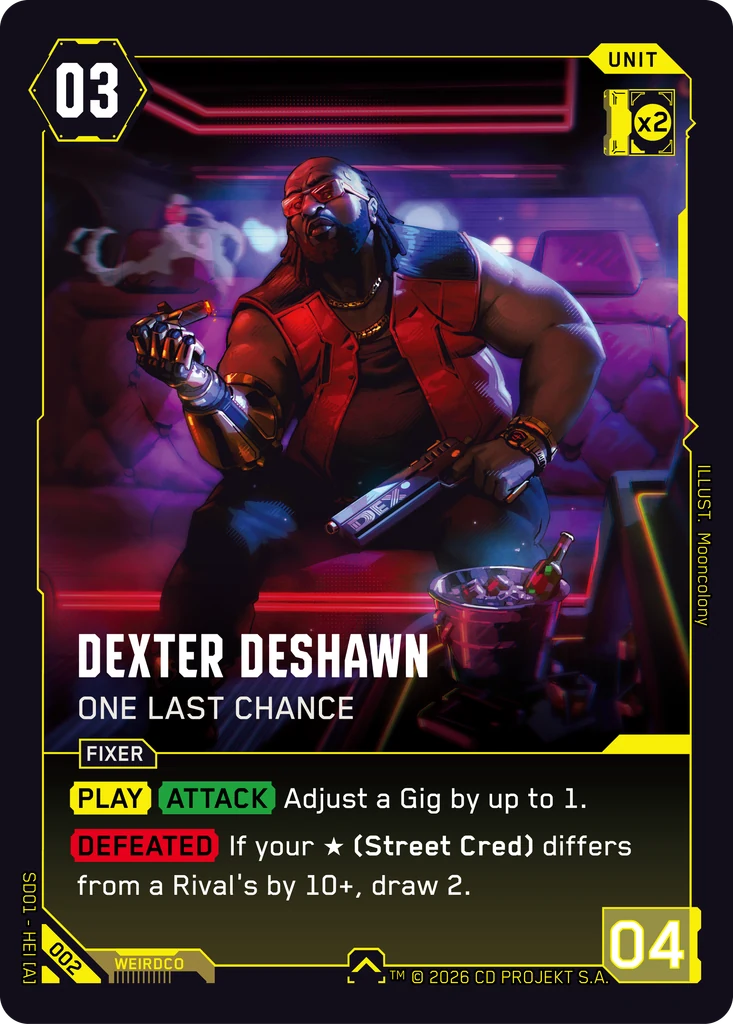
The Heist / Merc demo deck. Legends: Viktor Vektor: Sit Down and Relax (Yellow), V: Corporate Exile (Blue), Jackie Welles: Pour One Out For Me (Blue). That buys 4 Blue and 2 Yellow. The deck's highest Blue cards are Evelyn Parker: Scheming Siren and MT0D12 Flathead at RAM 3, comfortably under the Blue ceiling. Its five Yellow cards — Secondhand Bombus, Dexter DeShawn, Kiroshi Optics, Mandibular Upgrade and Afterparty at Lizzie's — top out at exactly RAM 2.
Embracing Power / Arasaka demo deck. Legends: Yorinobu Arasaka (Red), Goro Takemura: Hands Unclean (Green), Saburo Arasaka: Stubborn Patriarch (Green). That buys 4 Green and 2 Red. Highest Green card is Goro Takemura: Losing His Way at RAM 3. Every Red card in it — Swordwise Huscle, Minotaur, Mantis Blades, Satori, Industrial Assembly, Over the Edge — is RAM 2 or 1.
Both decks put their two-Legend colour at RAM 3 and pin their splash at RAM 2. That is not a coincidence, it is the constraint being demonstrated, and it is the clearest template on offer for a first build. Print them, play them, then swap cards inside the same ceilings.
The second constraint: 72 of 73 Units cannot be sold
RAM decides what you may play. A different field decides whether you can afford it, and it splits along card type rather than colour.
Your Eddies area starts empty and grows one card per turn, by selling from hand, and only cards printed with a sell tag can be sold. (Five revealed cards can ready a spent Eddie — Evelyn Parker: Beautiful Enigma, Misty Olszewski, Delamain Cab, Rogue Amendiares: Queen of the Afterlife and Dying Night: V's Pistol — but readying an Eddie you already own is not the same as making a new one.) Across the 151-card database:
- All 34 Programs carry a sell tag.
- All 17 Gear carry a sell tag.
- 26 of 27 Legends carry one (the exception being the frameless Rebecca promo).
- 1 of 73 Units carries one.
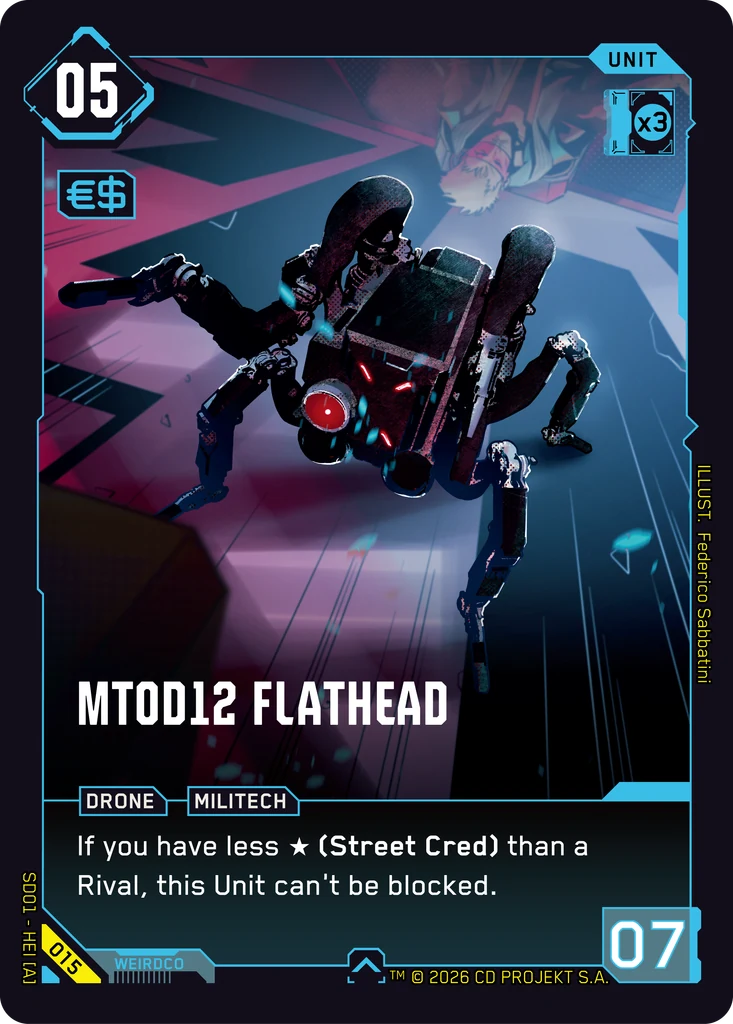
That single sellable Unit is MT0D12 Flathead, a Blue drone from The Heist starter deck, and you can see the €$ tag sitting under its cost. Every other revealed Unit is unsellable, so a turn where Units are all you are holding is a turn you make no Eddie.
The whole pool comes out at 78 sellable cards against 73 unsellable ones, and the sellable share is remarkably even by colour: Red 13 of 31 non-Legend cards, Green 13 of 31, Blue 14 of 31, Yellow 12 of 31. So no colour is a natural ramp colour. What varies is your Unit count — and the non-Legend cost curve peaks at cost 3 (25 cards) with costs 4 and 5 at 22 apiece, so a Unit-heavy list can build a hand it cannot pay for.
How to actually pick your three
Four things to do before you shuffle:
- Decide your splash first, not last. It is capped at RAM 2 forever. Filter the database to that colour at RAM 2 or below and look at what you get: 22 cards in Red, 20 in Green, 22 in Blue, 23 in Yellow. If the reason you wanted the splash is above RAM 2, the splash is wrong.
- Two Legends in a colour is the normal setting. Four RAM opens Red and Green completely — every revealed card in those colours is RAM 4 or lower — and leaves exactly one card unreachable in Blue and one in Yellow.
- Only go mono-colour for a specific card. Three Legends in one colour is a 6 RAM budget in a pool where exactly two cards need more than 4.
- Count your sell tags. Every revealed Program and Gear can be sold, as can every Legend but the frameless promo; Units, with one exception, cannot. If your list is mostly Units you have built a deck that cannot pay for itself.
One scope note, because it changed after this post first ran. Everything above is the constructed format. WeirdCo's sealed primer of 19 August 2026 switched the RAM ceiling off entirely for Beta Events and Pre-Releases — "you don't need to worry about the RAM numbers on any of your cards at all" — and lets a sealed deck play up to three colours regardless of which Legends you opened. So none of the arithmetic on this page applies at a September Beta Event; the sealed deck rules cover that format on its own terms.
For the rules those decisions sit on top of — Gig dice, Street Cred, combat, the four colours' identities — start with the full rules breakdown. For where you can bring the deck once you have one, Organized Play, every tier explained covers the ladder from Beta Events through Night City Brawl.
What is still unknown
Five things this analysis cannot tell you, and it matters that they are open:
- The database can still move. 151 cards is the database count on 4 September 2026. The Welcome to Night City retail numbering, 001 to 140, is now complete with no gaps, and the other 11 cards are the starter-deck exclusives and the Rebecca promo; the Beta numbering runs to 171 once the alternate arts are counted. A single Legend at RAM 1 or RAM 3 in a later product would rewrite every table above — the 24 cards added since 15 August did not, and neither did the three Legends among them.
- What counts as a "unique name." The rule is exactly 3 Legends with unique names, and the 27 Legends in the database use only 24 distinct base names. V: Streetkid and V: Corporate Exile are separate cards in separate colours; so are Goro Takemura: Hands Unclean and Goro Takemura: Vengeful Bodyguard, and Jackie Welles: Mama's Favorite and Jackie Welles: Pour One Out For Me. Whether the shared first half blocks the pairing is not spelled out in the guide, and for a Red/Blue deck built around two Vs it is the difference between legal and not.
- Rebecca: Having a Moment's actual stats. The Nova Rare promo prints no cost, RAM, power or text. WeirdCo said on 4 July that the card "will feature in Cyberpunk TCG set two, and you'll discover her rules text during that set's reveal season," and that the textless promo will function identically to the full-text version. So the statted card exists; it just has not been shown.
- Card stats have moved before, and are still moving. WeirdCo said when it published the beta rules on 29 May that changes were coming to individual card stats, effects, keywords and templating as the game crossed from Alpha to Beta. It has happened at least once since: Pyramid Song was revealed at Gen Con on 31 July reducing a rival Unit's power by 4, and the database now prints -5. Every card in the database except the Rebecca promo carries a Retail printing, and retail lands 6 November.
Quick reference
- Legends: 27 revealed, 26 at RAM 2, 1 (the Rebecca promo) with no printed values.
- Your budget: exactly 6 RAM, split as 6 mono-colour, 4+2 across two colours, or 2+2+2 across three.
- Splash cap: a one-Legend colour is stuck at RAM 2 for the life of the deck.
- Pool: 151 cards on 4 September 2026 — 73 Units, 34 Programs, 27 Legends, 17 Gear. Red 38, Green 38, Blue 38, Yellow 37.
- 88 of 124 non-Legend cards are RAM 2 or lower; 36 need at least two Legends of their colour.
- Above RAM 4: Adam Smasher: Metal Over Meat (Yellow, RAM 6) and Judy Álvarez: Nothing to Doubt (Blue, RAM 5). Both need three Legends of that colour.
- RAM is not power: RAM 4 Units average 5.0 power, RAM 3 Units average 5.6, and the power-14 Saul Bright: Stormrider is RAM 2.
- Sell tags: all Programs, all Gear, 26 of 27 Legends, and exactly one Unit (MT0D12 Flathead).
- Sealed does not use any of this: the RAM ceiling is switched off at Beta Events and Pre-Releases.
- Deck rules unchanged: exactly 3 uniquely named Legends, 40-50 other cards, max 3 copies each.
If you want the same problem solved a different way, Riftbound deckbuilding basics covers a system where every card has to fit your Legend's two-domain Domain Identity — a membership test, with no numeric ceiling on top of it — and the Gundam Card Game deckbuilding guide covers one that simply caps a deck at one or two colours and leaves it there. Cyberpunk asks the same question twice: which colours, and then how deep into each one.
Frequently Asked Questions
How does RAM work in Cyberpunk TCG deckbuilding?
What RAM value do Cyberpunk TCG Legends have?
How many colours should a Cyberpunk TCG deck run?
Which Cyberpunk TCG cards have the highest RAM?
Does a higher RAM value mean a stronger card in Cyberpunk TCG?
Which Cyberpunk TCG cards can be sold for Eddies?
How many Cyberpunk TCG cards have been revealed?
Where can I get the Cyberpunk TCG demo decklists?
Keep Reading
- Cyberpunk TCG Gameplay Guide (WeirdCo, official) - the deckbuilding and RAM section, the Goro Takemura worked example, and the glossary
- Cyberpunk TCG card database, powered by Netdeck.gg (WeirdCo, official) - 151 cards on 4 September 2026, with colour, type, cost, power, RAM, tags and sell-tag data
- Adam Smasher - Metal Over Meat card entry (WeirdCo, official) - the only revealed RAM 6 card
- Judy Alvarez - Nothing to Doubt card entry (WeirdCo, official) - the only revealed RAM 5 card
- MT0D12 Flathead card entry (WeirdCo, official) - the only revealed Unit with a sell tag
- The Heist (Merc) Print & Play demo deck PDF (WeirdCo, official) - linked from the site nav alongside the Arasaka deck at /docs/print-and-play-araska.pdf
- Rule and Game System Updates from Alpha to Beta, 29 May 2026 (WeirdCo) - the Alpha-to-Beta changes to card stats, keywords and templating, and the 1 Eddie Call a Legend cost
- An Update on Rebecca: Having a Moment Promo Card Availability, 4 July 2026 (WeirdCo) - promos are only ever variants of widely available cards
Related Guides
Cyberpunk TCG Starter Decks: Embracing Power vs The Heist
WeirdCo's two Welcome to Night City starter decks share no cards and are built on mirror-image Legend lines. Here are both full lists with every card's cost, RAM and power, the five cards each second Legend exists to pay for, the rulings that change how they play, and which box is the better first buy.
Cyberpunk TCG's Deck Builder Is Live: 716 Decks So Far
WeirdCo's official Deck Builder went live on 2 September 2026, and by 16 September the community had published 716 public decks through it. Pull every one through the tool's own API and a pattern falls out that the RAM-ceiling math alone could not show: which colours people actually pair, which Legend is in more than a quarter of all decks, and which one of the 27 Legends in the database has never been picked once.
Cyberpunk TCG Rules FAQ: What 269 Official Rulings Settle
Besides the Comprehensive Rules and the Tournament Rules, WeirdCo publishes a third rules document written as the questions a player asks mid-game: a Rules FAQ with 269 official rulings, 244 of them on specific cards. It settles the GO SOLO question the rulebook left open, half-settles the Sell contradiction, and makes clear which card effects you cannot decline.
Cyberpunk TCG Keywords Explained: All 9, 86 Cards Use One
Cyberpunk TCG's official card database has a Keyword filter with zero options in it, so nothing tells you the game has keywords at all unless you read every card. It does: nine bracketed tokens, split by the Comprehensive Rules into four trigger keywords, four effect keywords and one activation shorthand it does not call a keyword. Eighty-six of the 151 cards print at least one, four cards print three, and three keywords turn out to be things one card gives another rather than something every printed instance owns.

How to Play the Cyberpunk TCG — Gig Dice, Eddies and Street Cred, Explained
WeirdCo raised $28.3 million to build a trading card game where the win condition is a pile of dice. Here is how the Cyberpunk TCG actually works under the beta rules, what the four colors do, and why the release date most sites are printing is out of date.
Cyberpunk TCG Tags: 39 Printed, 10 With Payoff Cards
Cyberpunk TCG prints 39 tags across the 151 cards in its official database, and the Comprehensive Rules give them a real definition — an effect naming a tag references every card carrying it. Then only 13 cards in the whole pool name a tag at all, covering 10 of the 39. Arasaka is the deepest supported one with four; Netrunner has 13 cards and nothing that cares.