Cyberpunk TCG Tournament Rules: The 7-Card Sideboard
Every deckbuilding breakdown on this site — the RAM ceiling, the 30-card sealed floor, the 40-to-50-card main deck — has been describing half a decklist. WeirdCo published the other half today: a mandatory 7-card sideboard nobody outside the company knew existed, alongside dice-check statistics, a card that is already banned before most of the set has hit shelves, and the real names behind two Nova Rare promos this site has been calling mysteries for a month.
Every deckbuilding breakdown on this site — the RAM ceiling, the 30-card sealed floor, the 40-to-50-card constructed main deck — has been describing half a decklist. WeirdCo published the other half today, 25 September 2026, when it posted the complete Cyberpunk TCG Tournament Rules: a standing reference document for judges, tournament organizers and players, distinct from the Comprehensive Rules that govern the game itself. It answers questions this vertical has been flagging as unpublished since August, and it does it with a document that is, structurally, nothing like what came before it.
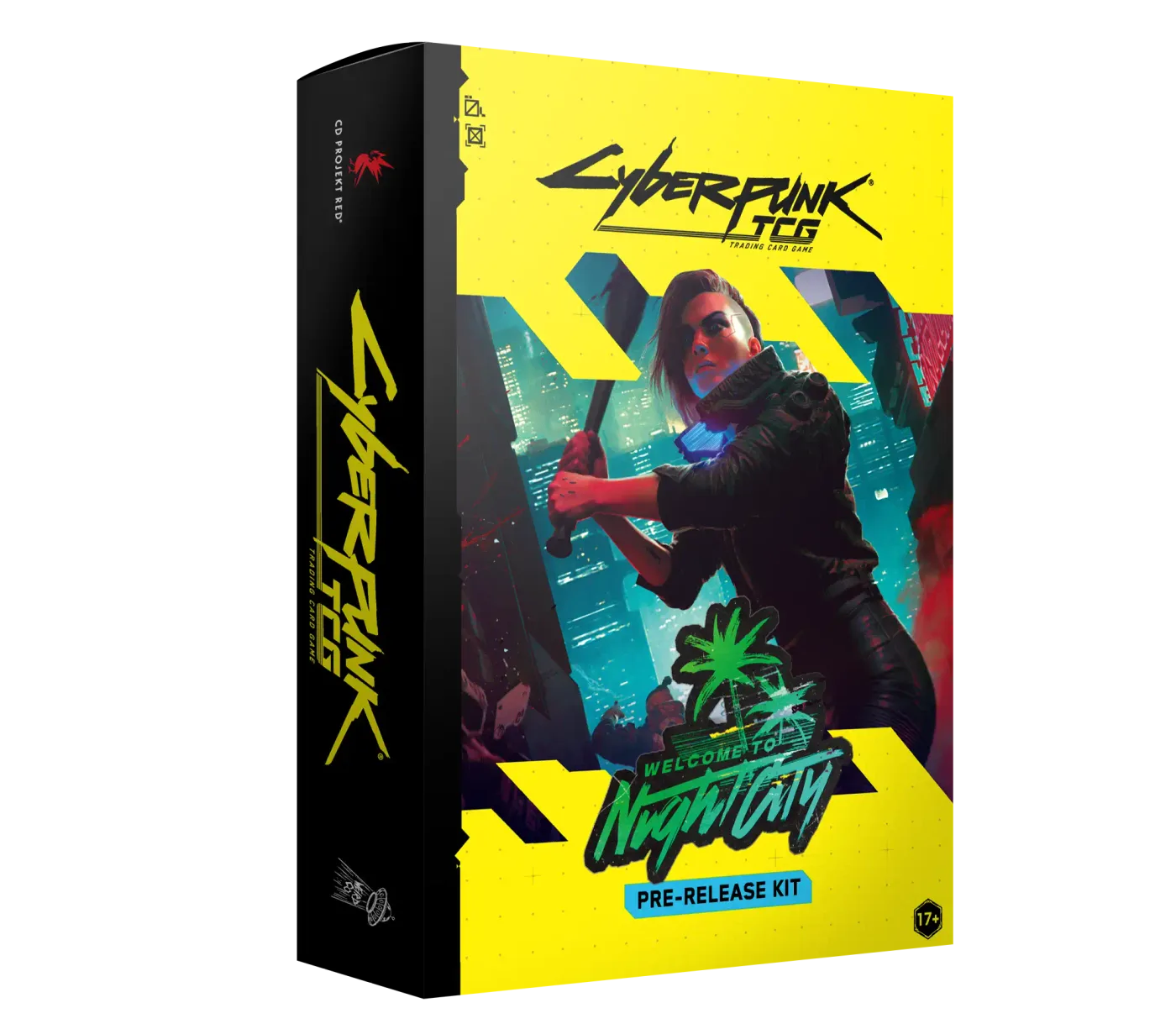
Two days earlier, on 23 September, WeirdCo also detailed the Welcome to Night City Pre-release Kit — six Retail Booster Packs, three random Legend cards from a ten-card pool, a Gorilla Arms promo, and a full polyhedral dice set, all carrying a foil "WTNC 2026" stamp exclusive to the kit. Beta Events wrapped up on 20 September; Pre-releases run the weekend of 30 October. That kit is what a Pre-release deck is built from. What the Tournament Rules document supplies, for the first time, is the actual legal framework a Pre-release deck gets built and played under — and a great deal more besides.
What WeirdCo actually published today
The Tournament Rules page is stamped "LAST UPDATED SEP 25, 2026" and runs four numbered sections plus four lettered appendices: Overview, Tournament Responsibilities, Tournament Play, and Judge Policies & Procedures, followed by Penalties & Infractions (currently a placeholder), Current Card Bans & Restrictions, Match Rules, and Format Rules. WeirdCo's own announcement post frames the timing plainly: "Now that we've announced full details about our Edgerunner Open Regional events, we're ready to share the complete Cyberpunk TCG Tournament Rules with you all," and adds that a Judge program and testing process are coming in October.
This is the document the Comprehensive Rules breakdown predicted would have to exist. That post's rule 7.3.6 note flagged a legal deck as deferring to "current regulations for the game format" without naming them. Today's document is that regulation, and it turns out to say more than anyone expected.
The sideboard nobody saw coming
Here is the sentence that rewrites every constructed decklist on this site. Section 2.1.3 defines a legal tournament decklist as: first and last name, Melee.gg/CyberpunkTCG ID, exactly 3 Legend cards, and "Composition of Deck + Sideboard (40-50 Card Main Deck + 7 Card Sideboard)."
Appendix D.1 confirms it as a constructed deckbuilding requirement in its own right: a 40-to-50 card main deck, exactly 3 uniquely named Legends, a maximum of 3 copies of any card — and "a sideboard of exactly 7 cards." Section 3.4.4 spells out how it works: sideboard cards may only be main-deck cards (no Legends), you swap cards in and out between games of a match rather than adding to your deck's total size, and you get two minutes to do it between games of a best-of-3 round, or three minutes before a best-of-1 round starts. After the match, you are responsible for returning your deck to its original decklist configuration — the rules put the burden of noticing a mis-sideboarded, therefore illegal, deck on the player who has it, not just the judge.
None of the site's constructed guides have accounted for this, because nothing published before today mentioned a sideboard existed. The RAM deckbuilding guide worked out that a constructed deck buys exactly 6 RAM across three Legends and needs enough legal cards to fill 40 to 50 slots inside that ceiling. A tournament-legal deck now needs enough legal cards, at that same RAM ceiling, to fill 47 to 57 slots — the main deck plus a 7-card sideboard drawn from the same colour and RAM restrictions, since Appendix D.1 states plainly that "cards in a constructed format deck must follow any and all deckbuilding guidelines and restrictions... including but not limited to RAM values." A splash colour capped at RAM 2 was already a tight fit; it now has to supply sideboard cards too.
One exception is written in on purpose. Appendix C.2.2 defines a "Quick" best-of-1 match type for LGS-level Pre-release or Night City Brawl events: "a constructed format legal best-of-1 deck with no sideboard, however all other deckbuilding and material requirements must be met." So the sideboard is the default for constructed play, not a universal law — a store running casual Quick matches can opt out of it entirely, while anything run as best-of-3, or as a "Competitive" best-of-1 premier side event, carries it.
Two mystery promos get named, not released

Appendix B lists three cards under a single heading: "The following cards currently have textless versions printed that are not currently legal for tournament play, however will become legal when a card with an identical name and subtitle are printed in an official Cyberpunk TCG expansion set": Lucyna Kushinada — Fresh Beginnings, David Martinez — Built Different, and Rebecca — Having a Moment.
That closes two gaps this site has been carrying for weeks. Cards you cannot pull from a booster flagged a bare mention of a third Nova Rare named "David" in WeirdCo's fulfilment FAQ, with "no reveal post, no stated eligibility and no announced acquisition route." The Edgerunner Open tickets and prizing post went further and named the Top 8 Regional prize as "Lucyna Kushinada," then reported checking all 151 cards in the database and finding "no entry under that name in any form." Both names now have subtitles, and both are officially confirmed to work exactly like Rebecca does: textless, unplayable, and legal only once a full-text version ships in a numbered expansion set.
I re-checked the card database directly today. Neither David Martinez nor Lucyna Kushinada returns a result — searching either name gives zero cards, the same result Rebecca gave before her card entry existed. So this is a name reveal, not a release: Appendix B tells you what the cards will eventually be called and confirms the mechanism, but the cards themselves remain exactly as uncatalogued as they were yesterday. Whoever wins Top 8 at Chicago in December is winning a promise, not a functioning card, unless Set 2 lands first.
The card that's already banned
Appendix B's second list is shorter and stranger: two categories of product are flatly not legal for tournament play — "Cyberpunk TCG Alpha Kit, except the Nova Rare alpha cards" and "Test prints which feature outdated and inaccurate mechanics and card descriptions" — plus one specific card, named on its own line: "Jackie & V — Chooms to the End."
I searched the card database for it. Zero results, the same as David and Lucyna. Unlike them, there is no textless-promo clause attached — this card is not "not yet legal," it is banned outright, with no path to legality stated anywhere in the document. WeirdCo's marketing-materials library lists an Alpha Kit product entry, confirming Alpha Kit is a real, physical thing that predates Welcome to Night City's Beta and Retail print runs — a detail nothing on this site had previously mentioned. Read together, the ban makes sense as pure hygiene: Alpha-era cards were, by WeirdCo's own account in the how-to-play primer, still changing shape as recently as 29 May, so banning that whole print run except its Nova Rares (presumably reprinted since with current text) keeps a judge from ever having to adjudicate a card that predates the beta rules it is supposed to be legal under.
Two open questions this document just closed
Two "what is still unknown" bullets, from two different posts, now have real answers.
The sealed copy limit. Both the Organized Play breakdown and the sealed deck rules post flagged this as unpublished in either direction. Appendix D.2 settles it for both sealed formats it defines: "Main deck may contain any number of copies of any non-Legend unique card." Sealed decks carry no 3-copy cap at all — a real difference from constructed, where copies are capped at 3.
Unique Legend names in sealed. The RAM deckbuilding guide raised this for constructed, where the database's 27 Legends share only 24 distinct first names — do V: Streetkid and V: Corporate Exile block each other? Appendix D.1 answers constructed with the phrase "exactly 3 Legend cards that do not share the same name," which is honestly no less ambiguous than before; it still is not clear whether "name" means the full "V: Streetkid" or just "V." For sealed, though, Appendix D.2.1 is unambiguous: "Legends do not need to have unique names." Open a kit with two copies of the same Legend and both are legal to run.
The second sealed format nobody has covered
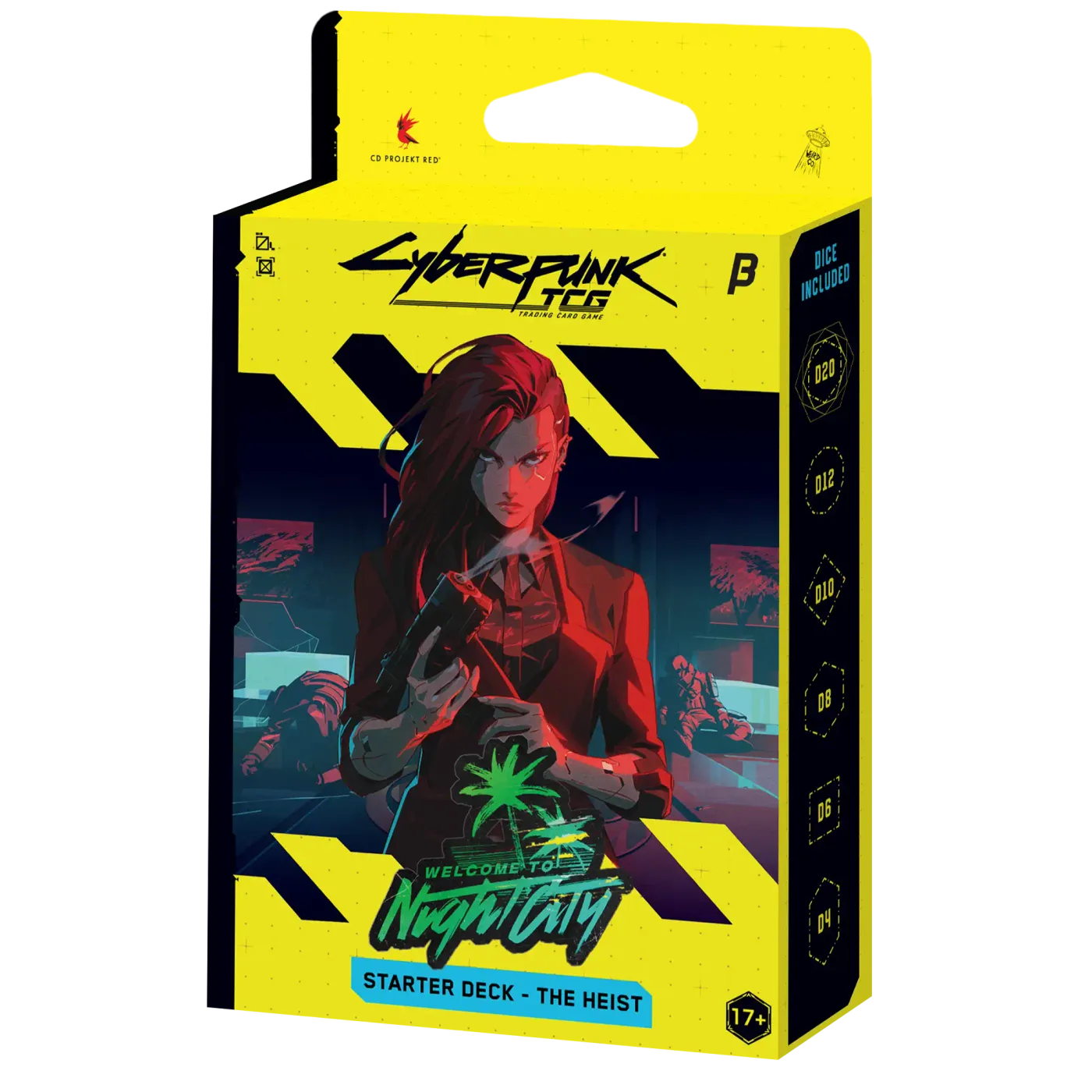
Appendix D.2 defines two sealed formats, not one. "Sealed Kit" rules (D.2.1) are what this site already covered in detail for Beta Events and Pre-releases: a kit with six boosters, three guaranteed Legend promos, one Nova Rare promo and dice, building to a 30-card floor. "6-Pack" rules (D.2.2) are new: an LGS or side-event format using six bare booster packs with no guaranteed Legend pack at all.
That changes the one assumption every deckbuilding post on this site has made without stating it: that a player always has exactly 3 Legends to work with. In a 6-Pack event, you "choose up to 3 Legends" from whatever your six packs happen to contain — you might open zero, one, two or three. WeirdCo's fix for the shortfall is mechanical rather than restrictive: "For every missing Legend in a player's Legend area at the start of the game, they add the top card of their deck face down as a blank Eddie" — before drawing opening hands. Whiff on Legends entirely and you start the game with three blank Eddies already banked, rather than three Legends you could otherwise Call or spend for value. Everything else about the format matches the Sealed Kit rules: up to three colours regardless of Legend colours, no RAM ceiling, a 30-card floor, unlimited copies of any non-Legend card.
The dice-check math
Section 4.1.2 is the most rigorous thing WeirdCo has published about this game, and it is worth working through because the numbers are more careful than they look at a glance. To flag a die as a possible cheat, a judge rolls it 10 times, then — only if something looks off — 24 more, then, if it's still suspicious, 46 more, for 80 rolls total. A die is flagged if any single face comes up this many times across all 80 rolls:
| Die | Flag threshold | Expected count (fair die) | Deviation |
|---|---|---|---|
| d4 | 28 | 20.0 | ~2.1 standard deviations |
| d6 | 23 | 13.3 | ~2.9 standard deviations |
| d8 | 20 | 10.0 | ~3.4 standard deviations |
| d10 | 17 | 8.0 | ~3.4 standard deviations |
| d12 | 16 | 6.7 | ~3.8 standard deviations |
| d20 | 11 | 4.0 | ~3.6 standard deviations |
Run the standard-deviation math yourself (n = 80, p = 1/faces, a fair die's roll counts follow a binomial distribution) and five of the six thresholds land in a tight band, roughly 2.9 to 3.8 standard deviations above what chance alone would produce — a real, deliberate margin against false-flagging an honest die on a bad run. The d4 is the outlier: WeirdCo flags it at only about 2.1 standard deviations, a noticeably more trigger-happy bar than every other die in the set gets. Whether that is intentional — a d4 has fewer faces to hide a shave on, so a smaller deviation is easier to attribute to tampering rather than variance — or simply an oversight in a first-edition document, the rules do not say.
Separately, Section 2.1.4 sets hard manufacturing standards for legal dice: no shaving, filing, weighting or "spindown" numerically-ascending d20s, and any non-numerical symbol face must consistently represent either the minimum or maximum value across the whole six-die set. Day-2 competitors and players on stream may be required to switch to WeirdCo-provided dice regardless of check results.
'Time called' is not Overtime
The Comprehensive Rules breakdown covers Overtime — the sudden-death state that begins after two consecutive turns where both players start with an empty fixer area, usually around turn seven. Today's document adds a separate, tournament-only clock that sits on top of it: what happens when the round timer, not the game state, runs out.
Round lengths are fixed by match type:
| Round type | Time |
|---|---|
| Swiss best-of-3 | 50 minutes |
| Swiss "Competitive" best-of-1 | 30 minutes + 3 minutes pre-sideboard |
| "Quick" best-of-1 | 30 minutes |
| Single elimination best-of-3 | 50 minutes (75 in top cut) |
| Single elimination best-of-1 | 30 minutes |
When time is called mid-game, per Section 3.4.5: finish the current turn, then both players get one full additional turn each, with a combined 5-minute cap on those final turns starting the moment time elapsed. If either player controls 7 or more Gig dice at the end of that second post-time turn, they win; otherwise the game is a draw, and the match result is whichever player has won more games. If time is called while a game is already inside Overtime, the 5-minute clock still applies, but play continues under Overtime's own sudden-death rule rather than the round-end procedure — and if nobody has a majority of the Gig dice when those 5 minutes run out, that game is a draw. Two different endings, two different triggers, easy to conflate if you have only read the Comprehensive Rules.
How a District Open actually gets approved
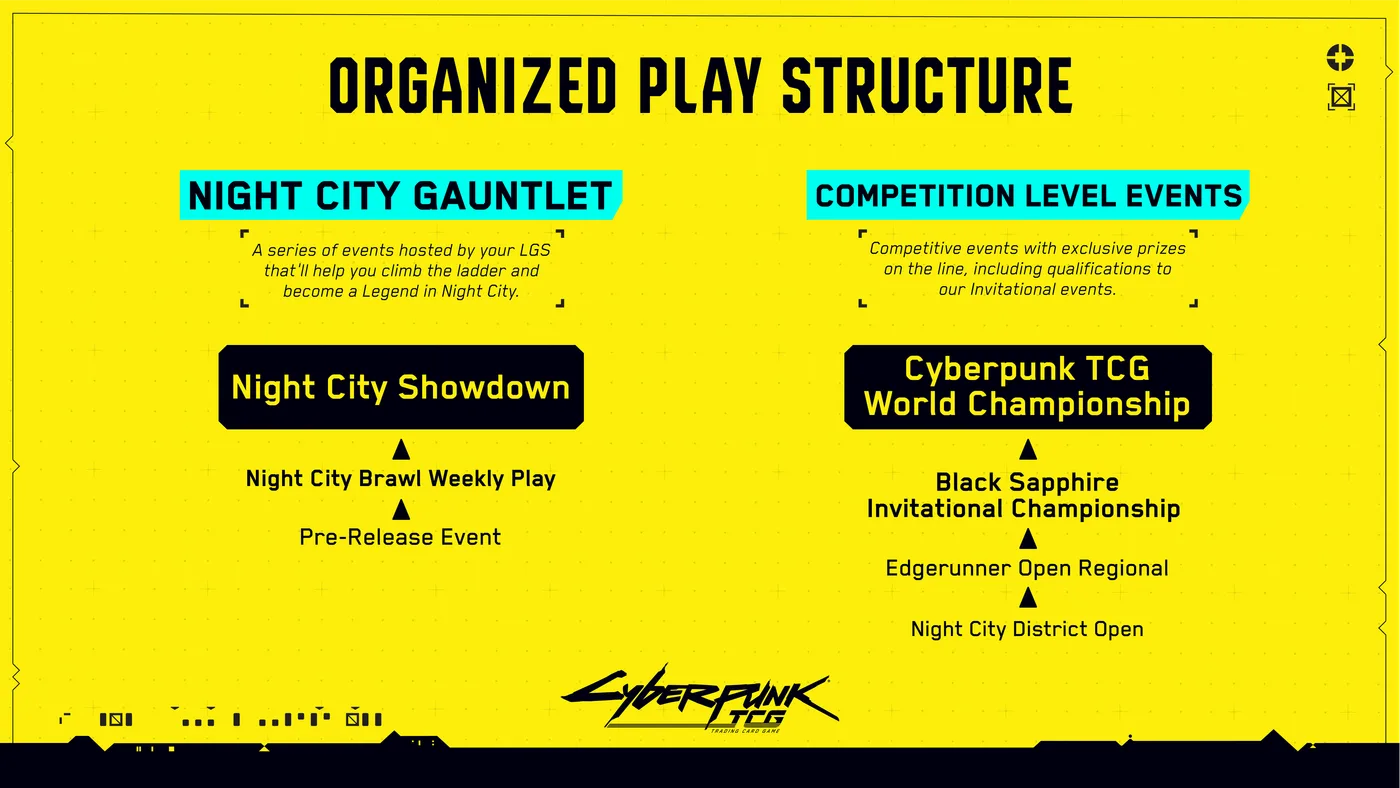
The Organized Play breakdown named Night City District Opens as running "from Set 2" at stores that "supported Cyberpunk TCG the most," with the host-selection mechanism unpublished. Section 2.3.2 fills it in: "LGS-level TOs may apply to run Night City District Open events during the application period for each Cyberpunk TCG main set, which is typically 1-2 weeks following the release. Certain LGS-level TOs may be given priority based on metrics defined and communicated by WeirdCo prior to the opening of this application period." So it is a defined, recurring application window tied to every set release, not a one-time Set 2 launch decision — and the metrics that decide priority are a promise WeirdCo has made to publish before each window opens, not a permanent secret.
The single-elimination table also resolves a size question. Night City District Open never runs a top cut larger than 8, regardless of attendance up to its 256-player cap — but an Edgerunner Open Regional at the identical 129-to-256 headcount runs a top cut of 16. Same player count, different event, different bracket. And the generic Swiss-round table checks out exactly against what this site already reported for Chicago's 2,048-cap Main Event: the 1,025-to-2,048 bracket calls for 11 Swiss rounds and a 16-player, 4-round single elimination — precisely the 8-Swiss-plus-3-more-for-18-match-points structure the tickets and prizing post described from WeirdCo's own event page three days ago. The two documents agree down to the round count.
One publisher-side inconsistency
Not ours to fix, but worth knowing before you plan around it: the Organized Play FAQ still reads, as of today, "It is recommended that Beta Events are three rounds, Best-of-3, 60 minutes each." The Tournament Rules document published today sets the general Swiss best-of-3 round at 50 minutes, with no Beta Event exception carved out anywhere in its round-type table — Beta Events aren't a category in this newer document at all, because they concluded on 20 September, five days before it went up. WeirdCo has not reconciled the two pages — this is the second time this vertical has caught the OPFAQ and a newer official document disagreeing with each other rather than with one of our own posts.
Separately, and already flagged in this vertical: the Organized Play structure page still reads "We'll share our full Edgerunner Open Regional schedule with you in due course," unchanged since at least 12 September, despite real venues, ticket waves and a full prizing ladder having existed on a different WeirdCo page for weeks. That specific staleness is already known and reported; this post is not re-reporting it.
What is still missing
- Appendix A: Penalties & Infractions is a placeholder. Its only text is "IMPORTANT! Appendix A: Penalties & Infractions will be added at a later date." Every reference in the main document to a "penalty" or "game loss" currently points at a section that does not exist yet.
- A Judge program and certification process, which WeirdCo says explicitly is coming in October.
- Which specific printing ships as a stamped tournament promo, where more than one art variant of a card exists — a gap the tickets and prizing post already raised and this document does not touch.
- A numbered revision system. Like the Comprehensive Rules, this document carries only a last-updated date, not a version number — the same citation problem flagged in that breakdown.
- Whether "do not share the same name" for constructed Legends means the full name or just the first word. Sealed answered its version of this question today; constructed did not.
Quick reference
- Published: 25 September 2026, at cyberpunktcg.com/tournament-rules. No version number, only a last-updated date.
- Constructed decklist: 3 uniquely named Legends, 40-50 main deck, max 3 copies per card, plus a 7-card sideboard — waived only for "Quick" best-of-1 LGS matches.
- Sideboarding window: 2 minutes between games of a best-of-3 match, 3 minutes before a best-of-1 round.
- Sealed decks (both Sealed Kit and 6-Pack): up to 3 colours freely chosen, no RAM ceiling, 30-card floor, unlimited copies of any non-Legend card, Legends do not need unique names.
- 6-Pack format: no guaranteed Legend pack; a missing Legend slot becomes a face-down blank Eddie instead.
- Banned outright: "Jackie & V — Chooms to the End," Alpha Kit product (except Nova Rare alpha cards), and outdated test prints.
- Not yet legal, but named: Lucyna Kushinada — Fresh Beginnings, David Martinez — Built Different, Rebecca — Having a Moment. None of the three has a card-database entry yet.
- Dice checks: up to 80 rolls per die; flag thresholds run 28 (d4), 23 (d6), 20 (d8), 17 (d10), 16 (d12), 11 (d20).
- Round-end (time called): one more full turn each, 5 minutes combined; 7+ Gig dice at the end wins, otherwise a draw.
- District Open approval: an LGS application window opens 1-2 weeks after every main set's release.
Frequently Asked Questions
Does Cyberpunk TCG have a sideboard?
Is there a copy limit in Cyberpunk TCG sealed events?
What happens if you have fewer than 3 Legends in a Cyberpunk TCG 6-Pack sealed event?
Who are Lucyna Kushinada and David Martinez in Cyberpunk TCG?
Is any Cyberpunk TCG card banned from tournament play?
How do Cyberpunk TCG judges check for loaded dice?
What happens if time is called in a Cyberpunk TCG tournament round?
How does a local game store get approved to run a Cyberpunk TCG Night City District Open?
Keep Reading
- Tournament Rules (WeirdCo, official) - last updated 25 September 2026; source for the sideboard requirement, dice-check thresholds, round-end procedure, card bans, and the Sealed Kit and 6-Pack format rules
- Cyberpunk TCG Tournament Rules are now live!, 25 September 2026 (WeirdCo, official)
- Welcome to Night City Pre-release Preview: What's in the kit?, 23 September 2026 (WeirdCo, official) - Pre-release Kit contents and the WTNC 2026 foil stamp
- Melee Integration and Organized Play FAQ (WeirdCo, official) - still recommends 60-minute Beta Event rounds as of 25 September 2026, against the Tournament Rules' 50-minute Swiss best-of-3 standard
- Organized Play Structure (WeirdCo, official) - still reads "in due course" for the Edgerunner Open Regional schedule as of 25 September 2026
- Cyberpunk TCG card database, powered by Netdeck.gg (WeirdCo, official) - searched directly on 25 September 2026 and returns zero results for "David Martinez," "Lucyna Kushinada" and "Chooms"
- Marketing Materials asset library (WeirdCo, official) - source of the Pre-release Kit product render used in this post, and confirmation that a separate Alpha Kit product exists
Related Guides

Cyberpunk TCG Conventions: Rebecca, Misty and Where to Play
WeirdCo's events calendar now lists eight convention stops from SPIEL Essen to February 2027. Only two still list the Rebecca promo. From Lucca on it is Misty Olszewski, a full-text card from the first set. Here is each stop, the three dates that disagree with the organisers, and where you can play or buy rather than just demo.

Cyberpunk TCG Holophone: Factions, Jobs and Launch Date
WeirdCo announced Holophone on 7 October: a text-message story app that connects your Night City Brawl results to jobs for one of three factions. Here is what it is, how you get in, how it lines up with the Organized Play calendar, and the naming clash worth knowing about before it goes live on 30 October.
Cyberpunk TCG Night City Brawl and Showdown Prizes
Before Chicago crowns a Regional champion, local stores crown their own: the Night City Showdown window opens one week after retail. WeirdCo has now published every prize for it and for the weekly Brawls, and the card database already carries all of the promo cards - including a headline Showdown prize that only a mono-Yellow deck can legally play.
Cyberpunk TCG Edgerunner Open: $75 Tickets, 10 Prize Tiers
As of 12 September, WeirdCo's own Edgerunner Open post said venues, ticket prices, prizing and format were all still unpublished. Nine days later they are all live on cyberpunktcg.com/eor - McCormick Place, Warsaw EXPO XXI, a $75 Major Leagues badge, an 8-round-then-playoffs format, a ten-step prize ladder, and a serialized Encrypted Legends mechanic explained in full for the first time. The four alt-art promos WeirdCo teased on stream in September have also turned up in the card database - not as one printing each, but four art variants apiece.
How to Play the Cyberpunk TCG — Gig Dice, Eddies and Street Cred, Explained
WeirdCo raised $28.3 million to build a trading card game where the win condition is a pile of dice. Here is how the Cyberpunk TCG actually works under the beta rules, what the four colors do, and why the release date most sites are printing is out of date.
Cyberpunk TCG Edgerunner Open: Dates, Tickets, 12 Promos
WeirdCo's Organized Play page still says the Edgerunner Open Regional schedule is coming 'in due course'. On 4 September it named two cities and five ticket-sale dates, and the official card database has quietly gone further than the announcement did: twelve cards now carry an Edgerunner Open Season 1 printing, eight of them Legends stamped with a serial box.