Elden Ring Multiplayer Guide: The Matchmaking Math Behind Every Summon Sign
Your summon sign is invisible to most of the players who would happily help you, and the reason is two formulas the game never prints. Here is the co-op level band, the weapon-upgrade table that remembers every weapon you have ever touched, and what bringing a phantom really costs.
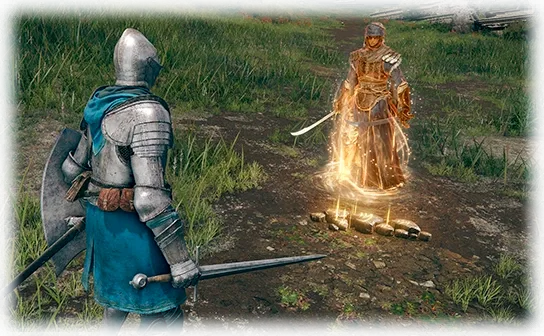
Two players want to fight Rennala together. The host is level 60, the helper is level 44, and it works. Drop the helper to 43 and the sign vanishes — nothing about either character changed except one number, and 60 × 0.9 − 10 happens to be 44.
Elden Ring gates who can see your summon sign with two formulas and a lookup table, and prints none of them. Here is all three, plus what a phantom actually costs the person who summoned it.
Five roles, and the item that puts you in each
Everything downstream makes more sense once the roles are straight.
| Role | What you are | Item |
|---|---|---|
| Host of Fingers | The anchor of the session. Objective: kill the area boss without dying. | Furlcalling Finger Remedy |
| Furled Finger | A summoned ally, also called a cooperator. Same objective as the host. | Tarnished's Furled Finger |
| Hunter | Summoned automatically into an invaded world to kill the invader. | Blue Cipher Ring |
| Invader | Forces entry into a host's world. Objective: kill the host. | Bloody Finger, Recusant Finger, Festering Bloody Finger |
| Duelist | Invited in by the host to fight them. | Duelist's Furled Finger |
The session ends when the host defeats a boss, dies, or uses the Finger Severer. That last one only works on gold phantoms — the Finger Severer cannot dismiss a red player. Once an invader is in, the session runs until the invader dies, the host dies, or the host clears the boss.
Two host-side details that catch people:
- You cannot rest at a Site of Grace while the Furlcalling Finger Remedy or Taunter's Tongue is active. No topping up flasks between summon attempts.
- Gold ally summon signs are hidden once that area's boss is already dead. If you cleared Stormveil and want company for the run back through, the signs are gone.
The three items you actually need

Tarnished's Furled Finger writes your gold sign. It is reusable, it holds one, and it is lying near the lift out of the Stranded Graveyard — the tutorial cave. The Finger Severer is on the same stretch of that cave. Both are easy to walk straight past on the way to the surface.
Furlcalling Finger Remedy is the host's half. It is a consumable that reveals gold and red signs, and it is craftable from two Erdleaf Flowers once you have the Crafting Kit — 300 runes from Merchant Kalé, camped at the Church of Elleh in Limgrave. Patches also carries three of them in Murkwater Cave.
The fourth item is optional and changes how you play.
Summoning pools change the geography
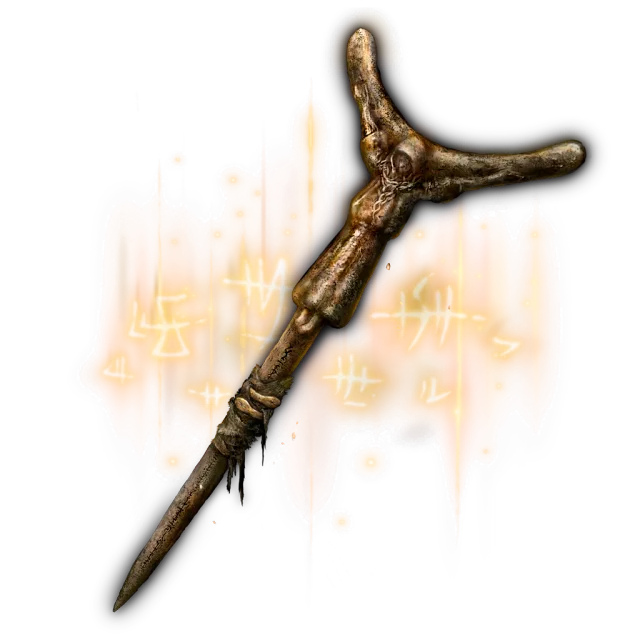
Summoning Pools are the crucified statues — Effigies of the Martyr — and the wiki puts one in nearly every location across the Lands Between and the Realm of Shadow. Activate one and it becomes a broadcast target. The Small Golden Effigy, looted once from any pool, sends your cooperation sign to several activated pools at once instead of leaving it on the ground where you happen to be standing.
That is the difference between waiting at one fog gate and being visible at several at once. Version 1.06 added the "Near" / "Far" option to sign placement and invasion, and version 1.12 layered two more controls on top: active pools now carry over into New Game Plus, and individual pools can be switched on and off in the Map Functions Menu.
1.12 also fenced off one specific abuse, and the patch note is worth quoting because it is oddly specific:
If "Include Distant Areas" is selected when using the Small Golden Effigy, summoning pools within the Mohgwyn Palace will not be selected for summoning, even if you have activated them.
You can still be summoned into Mohgwyn Palace — you just have to be standing there and pick "Nearby Only". Broadcasting a sign into it from across the map is over.
The level formula
Here is the one that decides everything. From the host's side:
Guests you can match with = level × 0.9 − 10 (minimum) to level × 1.1 + 10 (maximum).
Fractions round inward at both edges, never outward. Run it out:
| Host level | Can summon (and be summoned by) |
|---|---|
| 15 | 4 – 26 |
| 30 | 17 – 43 |
| 60 | 44 – 76 |
| 100 | 80 – 120 |
| 125 | 103 – 147 |
| 150 | 125 – 175 |
| 200 | 170 – 230 |
The band widens as you climb, because one term is proportional and one is flat. At level 30 you reach 13 levels down and 13 up. At level 150 you reach 25 down and 25 up. Practically, that means a 150 and a 160 match in both directions without either of them thinking about it, while a 30 and a 45 do not.
The other thing that falls out of the table: the flat ±10 is doing most of the work early. At level 15 the lower bound is 4, so a level 15 host can pull in someone who has barely spent a rune.
Invasions run on a different formula
Invaders are measured from their own level outward, not the host's:
Hosts an invader can reach = their level × 0.9 to their level × 1.1 + 20.
An invader at 125 reaches hosts from 113 to 157. The asymmetry runs upward: an invader can climb 30-odd levels above themselves but only drop about 12 below. That lines up with the entry condition below — invasion normally requires the host to already have a cooperator, so the invader is usually the one outnumbered.
Read from the other side, a level 30 host is invadable by anyone from level 10 to 33. And a level 1 character is invadable only by other level 1 characters.
Weapon upgrade level is the second filter, and it never forgets
Level is only half the check. The game also files you by the highest weapon upgrade level you have ever obtained — and this is the part that ruins plans, because storing the weapon does not help, and neither does dropping it. Once you have held a +12 sword, you are a +12 player forever on that character.
| Host weapon | Guests it matches (standard) | Somber equivalent | Guests it matches (somber) |
|---|---|---|---|
| +0 | +0 to +3 | +0 | +0 to +1 |
| +3 | +0 to +6 | +1 | +0 to +2 |
| +6 | +3 to +10 | +2 | +1 to +3 |
| +10 | +6 to +14 | +4 | +2 to +5 |
| +12 | +8 to +17 | +5 | +3 to +7 |
| +16 | +12 to +21 | +6 | +5 to +8 |
| +20 | +15 to +25 | +8 | +6 to +10 |
| +25 | +20 to +25 | +10 | +8 to +10 |
Two things to pull out of that.
The somber column is the same ladder at a different scale. A +10 somber weapon sits in the same band as a +25 standard one, and a +4 somber sits with a +10 standard — the same equivalence that the upgrade curves imply, now enforced by matchmaking.
The bottom of the table is tight. A host at +0 reaches guests up to +3 and no further. If your friend starts a fresh character and you have already taken anything to +7 on yours, normal matchmaking will not connect you no matter how close your character levels are. Two people who are "basically the same level" can be completely invisible to each other on this filter alone.
Passwords override the math in one direction only
Set a multiplayer password and two things happen at once. Only signs carrying the same password become visible to you, and both the level check and the weapon-upgrade check stop applying. A level 20 and a level 200 can play together.
What the password does not do is make that fair. Over-levelled guests get scaled down; under-levelled guests are not scaled up. The wiki is blunt that the effectiveness of the downscaling "varies greatly based on the Host's level compared to the guest and what kind of build the guest is using."
The scaling itself works from both ends: an over-levelled cooperator has their HP, stamina and FP reduced, and separately, everything else in the world gets a defence bonus against them so their damage lands softer. It is a blunt instrument, and it has been buggy before — prior to version 1.09 there was a consistent bug that stripped the invader's share of that defence bonus after a Phantom Finger was used, handing the over-levelled cooperator their full damage back against the invader specifically.
What bringing help actually costs
Summoning is not free, and the price is paid in three separate currencies.
Boss health. Datamining published by Illusory Wall put the co-op buff at 60% more boss HP with one summon and 130% more with two, plus 50% more resistances whether there are one or two. Two phantoms means the boss has more than twice the health bar and takes noticeably longer to status-proc.
Stance damage. A summoned player or NPC costs you 40% of your stance damage against bosses, which is enough to turn a four-charged-heavy break into a seven. Spirit Ashes carry no such penalty — the full breakdown is in the stance break guide, and it is the strongest argument for a good Spirit Ash over a summon sign when the plan is a critical hit.
Bodies on the field. The cap is two allied phantoms at a time. Adding the second is where the HP multiplier jumps from 60% to 130%, so the second phantom needs to be worth more than the first was.
Your flasks get halved, and the rounding is per flask
The host keeps every charge they own, up to the maximum of 14. A guest arrives with half, rounded down.
Here is the trap: the halving is applied to each flask separately, so an odd split costs you a charge. Seven crimson and seven cerulean gives you three and three — six total. Eight crimson and six cerulean gives you four and three — seven total. Same 14 charges at home, one extra sip in someone else's world. If you spend real time being summoned, allocate in even numbers.
Guests are not stuck with what they arrive with. Allies refill charges by wiping out enemy groups, killing Crimson Tear Scarabs, and defeating invaders. Invaders refill from the death of any other player in the session — a cooperator, a hunter, even a fellow invader. Killing the host does not refill anything, because the session ends there anyway.
Summoning is what opens the door to invaders

The entry condition is narrower than it looks: a solo player cannot be invaded. Invasion becomes possible once the host has summoned a cooperator, or once the host deliberately opens the door.
That door is the Taunter's Tongue, and its item description spells out three separate effects: it allows your world to be invaded with no cooperators present, it shortens the interval between invasion windows, and it enables a second invader. The catch is in the parentheses — with two invaders present, you are capped at one cooperator. Two-on-two, not two-on-three.
Every role has a Rune Arc attached to doing its job, and the rules are pleasingly symmetrical:
- Every summoned cooperator gets a Rune Arc when the area boss dies — regardless of contribution. You can be summoned, contribute a single arrow, and still bank the arc.
- Every invader present gets one when the host dies.
- Every hunter present gets one whenever an invader dies.
Given that the Twin Maiden Husks charge 4,000 runes apiece for them, being summoned is a genuinely competitive way to keep a Great Rune lit without touching your own rune balance.
The invader's toolkit has one item worth knowing about even if you never invade. Successfully invading grants a Phantom Finger, a single-use retry that re-enters the same world. Its real job is fixing bad spawns: the game places multiplayer arrivals using the host's X and Z coordinates and ignores the Y axis entirely, which is how an invader ends up at the bottom of the cliff the host is standing on top of.
Hunters, and which ring does what

Both rings cost 1,000 runes from the Twin Maiden Husks at the Roundtable Hold, and the names invert easily, so:
- White Cipher Ring is the call. Keep it active and your world automatically requests a hunter when you are invaded. The description hedges: "Summoning is not always possible."
- Blue Cipher Ring is the answer. Keep it active and you get pulled into other people's worlds as a hunter, with one objective — kill the invader.
Two thousand runes for the pair, which is a rounding error by the time you are summoning regularly.
The Colosseums: three venues, three rule sets
The Colosseums were not in the launch game. Version 1.08 opened them for free, and the patch note is one line: "The Colosseums of Limgrave, Caelid and Leyndell are now open." Register at each one's altar and you can then travel to all three from Marika's Effigy in the Roundtable Hold, in the same room as the Table of Lost Grace.
| Venue | Modes |
|---|---|
| Limgrave Colosseum | United Combat, Combat Ordeal |
| Royal Colosseum (Leyndell) | Duels |
| Caelid Colosseum | All three, with Spirit Ashes enabled |
The rules differ per mode, and the differences are sharper than they look:
| Mode | Players | Flasks | Ends |
|---|---|---|---|
| Duel | 2 | Crimson disabled, cerulean restricted | One elimination, or 180 seconds |
| United Combat | Up to 6, two teams | Both allowed but limited | 300 seconds |
| Combat Ordeal | Up to 6, free-for-all | Both allowed but limited | 300 seconds |
Duels are the one mode of the three that disables the Flask of Crimson Tears outright. You cannot out-sustain a bad trade; you have the health you walked in with, and 180 seconds to use it. Each mode tracks five ranks, displayed beside your character name — and they unlock nothing, which is either a disappointment or a relief depending on your relationship with grinding.
Group passwords do not touch matchmaking
The second password field is a different system, and it is easy to skip past. You can hold five group passwords at once, and they have no effect on who you can summon.
What they do is tag content. Player phantoms, messages, bloodstains and summon signs left by someone carrying the same group password are visually marked as coming from your group. And there is a real mechanical payout attached: when anyone sharing your group password defeats a Shardbearer or reaches the credits, everyone carrying that password gets 5% more runes from enemies for five minutes.
It is small, it is free, and it costs you nothing to have five of them set.
What the patches changed
Elden Ring's multiplayer has been rewritten in public more than once, which makes old advice risky.
| Version | Date | What it did to multiplayer |
|---|---|---|
| 1.06 | 9 August 2022 | Added the "Near" / "Far" option for summon signs and invasions |
| 1.07 | 13 October 2022 | Split PvE and PvP damage scaling; player damage in PvP cut across the board |
| 1.08 | 7 December 2022 | Opened the three Colosseums |
| 1.09 | 23 March 2023 | Fixed the Phantom Finger bug that removed the invader's defence bonus against downscaled cooperators |
| 1.10 | 26 July 2023 | Poise rework — filed under PvP-exclusive, explicitly not affecting single-player or co-op |
| 1.12 | 20 June 2024 | Summoning pools carry to NG+, per-pool toggles, Mohgwyn distant-summon restriction |
| 1.16.1 | 21 August 2025 | Closed a method for bypassing another player's platform block |
The 1.07 split is the one that changes how you read patch notes. Since October 2022 FromSoftware can nerf a weapon in PvP without touching it in PvE, and 1.08, 1.10 and 1.12 all carry a section headed "PvP-exclusive balance adjustments" that says so in as many words. A "nerfed" weapon in a PvP tier list may be completely untouched in your solo run. Version 1.10's poise rework is the clearest case — its poise numbers were filed as PvP-only, with the patch note stating outright that they do not affect single-player or cooperative play.
Version 1.16.1, released 21 August 2025, is the most recent base-game patch, and its two entries were a weapon affinity bug and a fix for players bypassing another player's platform block. The versions between 1.12 and it — 1.13 through 1.16 — were bug fixes, DLC tuning and PvP balance; none of them touched the matchmaking bands, the flask rule or the Colosseum formats above.
Quick Action Checklist
- Do the level math before you both make characters. A host at level L reaches guests from L × 0.9 − 10 to L × 1.1 + 10. Pick a target level and both stop there.
- Watch the weapon upgrade level harder than the character level. It counts the highest weapon you have ever upgraded, and a +0 host cannot reach a +7 guest.
- Use a password with friends. It removes both checks. Just know the under-levelled player is not scaled up, only the over-levelled one is scaled down.
- Grab the Small Golden Effigy from the first summoning pool you activate. Sign visibility across several pools beats standing at one fog gate.
- Set five group passwords. Free 5% rune buff for five minutes every time someone in the group kills a Shardbearer.
- Allocate flasks in even numbers if you get summoned often. 8/6 gives a guest seven charges; 7/7 gives six.
- Buy the White Cipher Ring for 1,000 runes before you start summoning. Summoning is what makes you invadable.
- Farm Rune Arcs by being summoned. Every cooperator present when the boss dies gets one regardless of contribution, and the Twin Maiden Husks sell them for 4,000 runes each.
- Use Spirit Ashes, not phantoms, when you plan to stance break. Phantoms cost 40% of your stance damage and add 60% to the boss health bar.
- Do not bring a second phantom casually. The boss HP buff goes from 60% to 130% when the second one lands.
Frequently Asked Questions
What is the co-op level range in Elden Ring?
Why can I not summon my friend in Elden Ring even though we are the same level?
Do bosses get more health when you summon in Elden Ring?
Can you be invaded playing solo in Elden Ring?
How many flasks do you get as a summoned phantom in Elden Ring?
What do the White and Blue Cipher Rings do in Elden Ring?
What are the Elden Ring Colosseum modes?
Keep Reading
- Online — Elden Ring Wiki (Fandom)
- Host of Fingers — Elden Ring Wiki (Fandom)
- Phantom Finger — Elden Ring Wiki (Fandom)
- Arena Combat — Elden Ring Wiki (Fandom)
- Rune Arc — Elden Ring Wiki (Fandom)
- White Cipher Ring — Elden Ring Wiki (Fandom)
- Summon Range Calculator — Elden Ring Wiki (Fextralife)
- Illusory Wall — co-op boss buff measurements (@illusorywall)
- Elden Ring — Patch Notes Version 1.08 (Bandai Namco)
- Elden Ring — Patch Notes Version 1.12 (Bandai Namco)
- Elden Ring — Patch Notes Version 1.16.1 (Bandai Namco)
Related Guides
Elden Ring Tarnished Pack: Every Weapon and Armor Location
Patch 1.17's notes never name the Tarnished Pack's weapons. Here are all eight armaments, the four armor sets and the three Torrent attires, where each one sits, what stands in front of it, the two invaders who carry two of the sets, and the one set you can lock yourself out of.
How to Beat Maliketh, the Black Blade in Elden Ring
Maliketh's death turns Leyndell to ash and takes the Bolt of Gransax, two armor sets and a Tarnished Pack invasion with it. Here is what to finish first, what he resists, both movesets with counters, how Destined Death eats your max HP, and where the Blasphemous Claw comes from.

How to Beat Radagon and the Elden Beast in Elden Ring
Elden Ring's final boss is two resistance charts behind one fog gate, with no Site of Grace between them. Radagon has no fire negation at all; the Elden Beast blocks 40% of it and every status buildup. Here is what each half resists, the one damage type that works on both, the holy-defense stack they both punish you for skipping, and what the patches actually changed.
Elden Ring Dragon Communion: Every Spell and Heart Cost
The base game has 23 Dragon Hearts and its 13 Dragon Communion spells cost 20, but six of those hearts sit behind Ranni's questline. Here are all three altars, all 16 spells, every base-game heart, and the arithmetic for spending them.
Best Elden Ring Starting Class: All 10 Origins Ranked
Every Elden Ring origin has exactly the same number of attribute points for its level — the only thing you are really choosing is where those points sit and what gear you get for free. Here is what that actually means for your first twenty hours.

Elden Ring Memory Stones: All 8 Locations and Max Slots
Every character starts with two memory slots, and Comet Azur alone needs three. Here are all eight Memory Stones, the tortoise puzzles and missable gesture that guard them, the talisman that takes you to twelve, and the spells that cost more than one slot.