LEGO Fortnite Odyssey Guide: The Survival Game, Explained
Odyssey is a 95-square-kilometre survival-crafting game sitting three tiles over from Battle Royale, and it has changed more since launch than any other part of Fortnite. Hunger is gone. Bench upgrades are gone. Here's the version that's actually live.
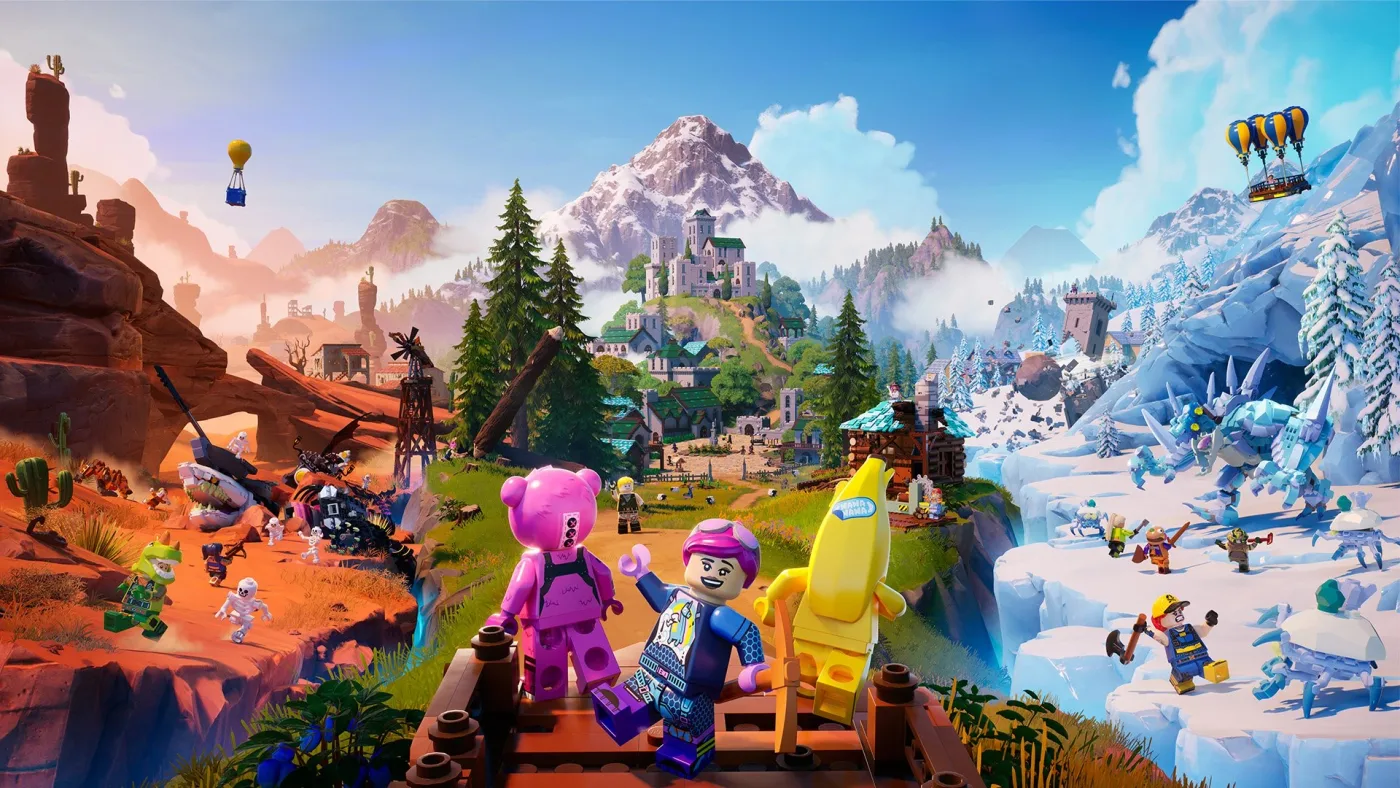
Open Fortnite, skip the Battle Royale tile, and there is a full survival-crafting game a few tiles over that has been running since December 7, 2023. LEGO Fortnite Odyssey is not a minigame bolted onto a shooter. Epic put its playable space at 95 square kilometres, streamed using Unreal Engine 5's World Partition and populated by the Procedural Content Generation framework — the Fortnite Wiki works that figure out at roughly 19 Battle Royale islands.
It has also been rebuilt repeatedly since launch, which is why so much of what is written about it no longer matches the game. Hunger is gone. Crafting Bench upgrades are gone. The Juicer is called the Mixer now. If your mental model of Odyssey still includes a food meter ticking down while you chop trees, it went out of date in October 2025.
So this is the current-build version: what Odyssey actually is, which of the four world types to pick before you touch anything, what Epic has quietly removed, and where the real progression lives. Our Fortnite modes overview maps the rest of the launcher; this is the deep dive on the LEGO tile.
The survival game hiding behind the Fortnite login
The core loop is genre-standard, rendered in bricks: harvest wood and stone, craft tools at a Crafting Bench, build shelter before nightfall, then push into hostile biomes for better materials. The bench costs 3 Wood and 5 Granite and its recipe is unlocked by default the moment a world is created, so there is no gating ritual before you can make your first axe.
Where Odyssey diverges from Minecraft or Valheim is the village layer. You are not only building a base — you are recruiting NPCs to run it while you are elsewhere, which turns the mid-game into a light management sim.
Three structural rules are worth knowing before you press create:
- Up to eight players can be in one world: you plus seven others.
- Up to eight worlds can exist on your account at once.
- Key holders are the part people get wrong. You can grant a key to as many as seven players, and a key holder can enter and edit your world at any time — including while you are offline. Party members without a key are removed from the world as soon as you leave it.
That last rule cuts both ways, and it is worth reading twice: a key is what lets a friend return to your world on their own, and it is also what lets them redecorate it while you are not there. Hand them out deliberately.
Pick your world type before anything else
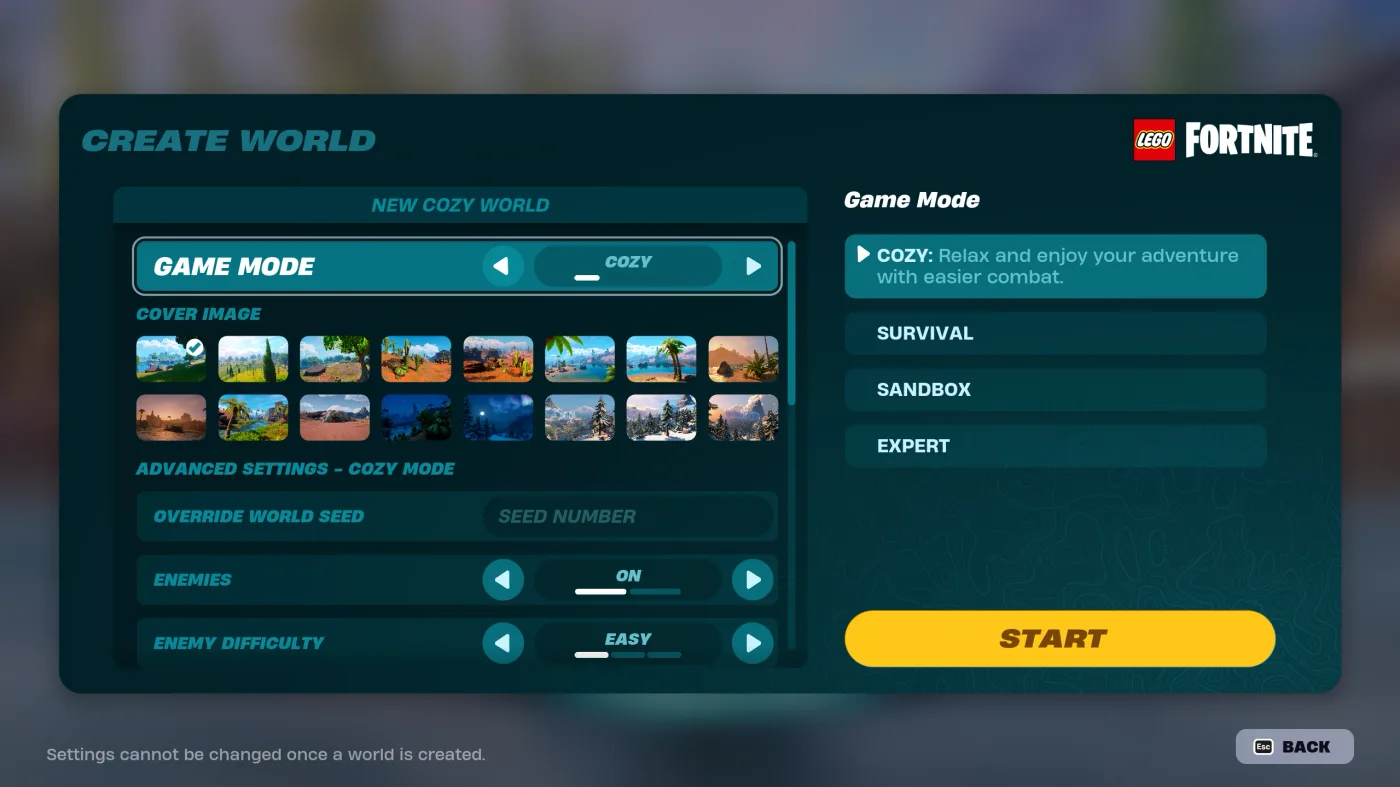
Odyssey asks you to choose a world type at creation, and the mode itself cannot be changed afterwards. Everything else can be, since Update v30.40 on August 6, 2024 — everything except the mode and Player Elimination, plus the settings Expert keeps locked.
| World type | The pitch | What it means in practice |
|---|---|---|
| Cozy | Easier combat, relaxed adventure | Enemies on but Easy, no temperature, no stamina, keep your inventory on death |
| Survival | The intended experience | Enemies on at Normal, temperature and stamina live, you drop your inventory when eliminated |
| Sandbox | Spawn what you want, build without cost | Enemies off by default, no resource requirements — creative mode with LEGO bricks |
| Expert | Higher difficulty, no second chances | Hard combat, Storm-Wild creatures roaming, and Player Elimination set to Permanent |
Expert deserves the bold text. Player Elimination has three states — Respawn, Off, and Permanent — and Expert is the one that ships on Permanent. Following villagers still respawn at their village when they go down; you do not. That is the setting the mode locks, so an Expert world is a commitment, not a difficulty slider you can walk back at hour forty.
The advanced settings underneath are where the four types actually differ:
| Setting | Cozy | Survival | Sandbox | Expert |
|---|---|---|---|---|
| Enemies | On | On | Off | On |
| Enemy Difficulty | Easy | Normal | Normal | Hard |
| Storm-Wild Enemies | Off | Off | Off | On |
| Temperature | Off | On | Off | On |
| Stamina | Off | On | Off | On |
| Player Elimination | Respawn | Respawn | Respawn | Permanent |
| Drop Inventory on Elimination | Off | On | Off | On |
| Power System | Off | On | Off | On |
Friendly Creatures and Villagers default to On across all four. Turning either off is allowed, but the settings carry an explicit warning that doing so may block elements of progression — read that as "you can lock yourself out of the village system". You can also override the world seed with any number from 1 to 2147483647 to regenerate a world with the same starting point as someone else's — useful if a friend found a good spawn.
My read: start on Survival. Cozy strips out temperature and stamina, which are two of the three systems that make the biome structure mean anything, and Sandbox skips the game entirely. If Survival grinds you down, you can now switch those toggles off mid-world rather than restarting.
What Epic has deleted since launch
This is the part where older write-ups go wrong, so treat it as a correction list rather than trivia.
| Mechanic | Status | When |
|---|---|---|
| Hunger | Removed outright | Update v37.50, October 9, 2025 |
| Crafting Bench upgrades | Removed | Update v30.20 |
| The Juicer | Renamed to the Mixer | Update v37.50 |
| Food as your main healing | Reworked into buffs | Update v37.50 |
| LEGO Fortnite Expeditions | Removed from Fortnite | November 1, 2025 (v38.00) |
Epic's own note on the hunger cut was blunt: hunger was removed so your character can focus on adventure rather than their next snack. Nothing replaced it. There is no food meter in Odyssey.
The Crafting Bench change is subtler. The bench used to be upgradeable through Uncommon, Rare, and Epic tiers, with each upgrade unlocking better recipes. Update v30.20 deleted that system: recipes now unlock from finding the resources out in the world, not from feeding your bench. If a guide tells you to farm Sand Claws and Brute Scales to upgrade your bench, it is describing a version of the game from 2024.
The v37.50 food rework is the third trap. Health Potions became the primary source of healing, brewed at a new station called the Cauldron, while food items had their healing reduced and were converted into long-lasting buffs instead. Food is still worth carrying — it just is not your heal button anymore.
And for anyone who remembers the squad-based LEGO spin-off: Expeditions is gone. It launched on June 18, 2025 and was removed on November 1, 2025, roughly four and a half months later. The full removal ledger lives in our Fortnite removed modes guide.
Hearts, temperature, and the charm cap
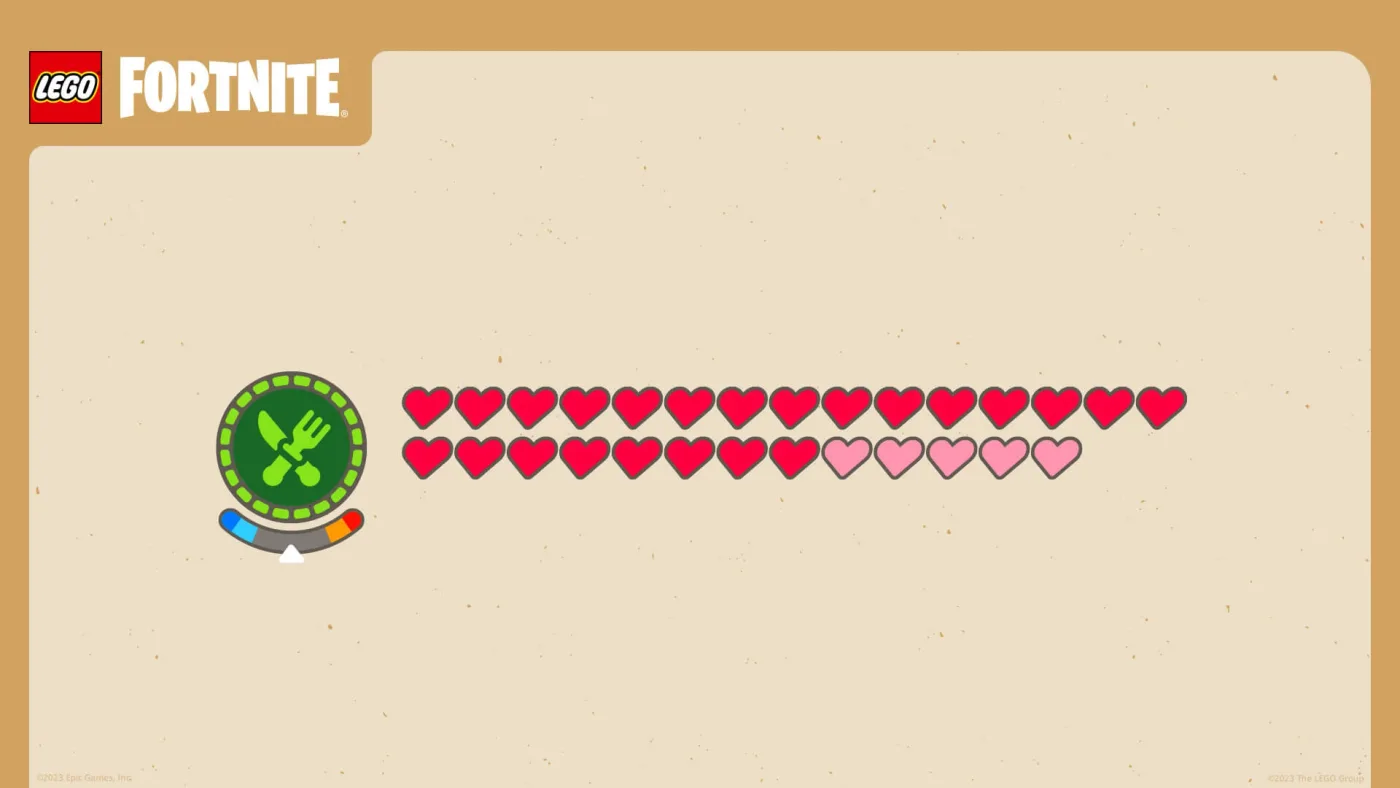
Odyssey does not use the health-and-shield bars from Battle Royale. It uses hearts, and each heart is four points of health.
- You start a new world with a maximum of three hearts, regardless of world type.
- On your very first spawn, only one heart is filled. Every respawn after that gives you three.
- Damage comes from creatures, fall damage, and letting the temperature meter run to either extreme — the wiki is explicit that both excessive heat and excessive cold deal damage, which is why the desert and the snow are each hostile to an unprepared character.
The interesting part is the ceiling. The only permanent way to raise maximum health is Charms, and the documented cap is 18 hearts, reached with at least three Epic-tier charms — with the Reflection Charm as the outlier that grants four hearts on its own rather than three. Newly added hearts start empty, so equipping a charm does not heal you; it gives you room to heal into.
The charm list is where the mode's build variety actually lives:
| Charm or totem | Effect | Rarity range |
|---|---|---|
| Health Charm | Adds health and armor | Common to Epic |
| Cool-Headed Charm | Heat resistance | Common to Rare |
| Inner Fire Charm | Cold resistance | Rare to Epic |
| Charm of Resilience | Bonus armor for a few seconds after taking damage | Rare to Epic |
| Regeneration Charm | Regenerates health over time | Rare to Epic |
| Reflection Charm | Reflects some damage back at the attacker | Rare to Epic |
| Good Luck Charm | Raises the chance of rare loot when digging | Rare |
| Wavebreak Charm | Faster swimming | Uncommon to Rare |
| Totem of Return | Revive in your bed keeping your inventory, then self-destructs | Uncommon to Epic |
| Totem of the Immortal | Revive mid-fight to avoid elimination, then self-destructs | Rare |
The two temperature charms are the practical gate on exploration. Cool-Headed gets you into Dry Valley; Inner Fire gets you into the Frostlands. Your gear list is what decides where you can stand, which is worth internalising before you go shopping for a bigger sword.
Villages are the real progression system

Build a Village Square and NPCs start wandering in. Talk to one, and if you have met the requirements — chiefly a Bed for them to sleep in — they will move in and take a job.
Villager capacity is tied strictly to Village Square level. You unlock your first villager slot at level 1, then more at levels 3, 5, 8, and 10, topping out at six villagers including Cuddle Team Leader. Biome village squares upgrade to level 10; Haven's Village caps at six levels.
Each level does something specific, and a few are genuinely worth rushing:
| Village level | What it unlocks |
|---|---|
| 1 | Villagers equip a health charm, enemies stop spawning near the village, friendly explorers start visiting |
| 2 | Villagers can be asked to forage nearby resources |
| 3 | Villagers start giving you gifts |
| 4 | Villagers can cook, extract seeds, and tend dirt plots; woodcutters produce more wood types |
| 5 | Rarer explorers visit; villagers gain bonus health and defense |
| 6 | Villagers can smelt metal, refine textiles, and collect gems; stonecutters produce more stone types |
| 7 | Villagers can gift unique new recipes |
| 9 | Villagers can forage other biomes for resources |
Level 1 alone changes how the game feels, because a village enemies do not spawn near is a base you can leave things in. Level 6 is the one that turns your village into an economy — smelting, textiles, and gem collection are chores you would otherwise be doing yourself. Level 9, foraging other biomes, means a mature village pulls in materials you would need resistance charms and travel time to gather in person.
Getting between all of it is handled by the Battle Bus fast travel network, added in v30.40. Bus Stations already exist scattered across your world, and you can build your own using Rift Shards, which you get by destroying an existing station.
Biomes gate your gear, not your level
Progress in Odyssey is measured less by a number than by which biome you can currently survive in, and each biome holds the next rung of the material ladder.
| Biome | Character | Signature materials |
|---|---|---|
| Grasslands | The starting plains | Wood, Granite, Knotroot, Marble |
| Dry Valley | Hot desert — needs heat resistance | Flexwood, Obsidian, Ruby |
| Frostlands | Cold and snow — needs cold resistance | Frostpine, Malachite |
| Shore and Water | Coastline, lakes, rivers, ocean | Fishing and sand resources |
| Caves | Grasslands, Lava, and Ice variants | Copper, Amber, deeper ore |
You can read the whole progression straight off the village upgrade costs, which is the most legible version of it anywhere in the game. A Grasslands village walks you from Wood to Plank to Knotroot to Granite to Marble to Copper Bar and finally Amber. A Dry Valley village asks for Flexwood, then Obsidian, then Cut Ruby. A Frostlands village wants Frostpine and Malachite. Same shape, different biome, escalating requirements — the tech tree is drawn on the map rather than in a menu.
Then there is Lost Isles, added in Update v31.20 on September 17, 2024 and reachable from any Battle Bus Station. It is a separate landmass with five environments layered on top of the base world:
- Beach — Pirates and Pirate Towns.
- Plains — home of the friendly Peely Tribe.
- Jungle — Hop Flowers that bounce you, Slurp Plants that heal, and Bomb and Stink Flowers you can weaponise, plus Storm-Wild Tomatoes that would like a word.
- Mountains and Floating Islands round out the set.
Heroes, hover bricks, and the current build

Two updates define how Odyssey plays right now.
Update v37.50 brought Heroes into Odyssey. You unlock Hero Weapon and Hero Equipment recipes from the Mastery Tab in the Player menu, then craft them at a new Hero Station. Rare or higher Hero Weapons carry an Ultimate Ability — a heavier secondary attack or buff that you charge by landing hits with the weapon's primary attack. Hero Equipment also added movement options that did not exist before, including dropping traps mid-dodge and a double jump. The same update moved the health bar to the bottom-left corner on PC and console, added a small stamina cost to dodging, and increased stamina recovery to compensate.
Update v40.40, on May 14, 2026, was Star Wars: Galactic Builds — the most recent update with dedicated LEGO Fortnite patch notes as of August 2026. Two additions matter mechanically:
- The Hover Brick. A toy that counteracts gravity so your builds glide above the ground. Epic's own guidance: it lifts to a set distance from the ground and will not work if placed too high in a build, it has a weight limit, four bricks at opposite corners give the most stable ride, and pairing them with Thrusters adds steering and propulsion. It runs on Durasteel and Plastoid, both farmed from the Star Wars enemies on the Main Island.
- The lightsaber overhaul. Lightsabers stopped being one-off legendary finds and became craftable at the Rebel Workbench in Tier 4, 6, and 8 rarities. There are now six blade colours, and colour determines combat style: Defense (Blue and White) counterattacks, Aggression (Red and Purple) runs offensive combos at a stamina cost, and Fluidity (Green and Yellow) leans on aerial mobility.
One catch worth flagging from that event: Epic stated outright that Din Djarin and Grogu would only appear in worlds with a player-built village, and that they would leave for good when the next LEGO Fortnite update dropped if you had not recruited them. A world with no village was a world that could not access the content at all — another argument for planting a Village Square early even if you would rather be wandering.
The LEGO Pass and what it costs
Odyssey has its own seasonal reward track, separate from the Battle Pass. The LEGO Pass costs 1,200 V-Bucks — down from 1,400 — or comes included with Fortnite Crew. It is a single track carrying both free and premium rewards, climbed with Season XP, which replaced the old Studs currency. Individual pass items can resurface in the Item Shop later, but an expired pass itself cannot be played.
The current one is Soaring Skies, which started on April 16, 2026 and is scheduled to end on September 2, 2026 — a 139-day season, long by this track's standards next to the 36-day First Order pass in 2025.
Odyssey vs Brick Life vs Expeditions
Three things have carried the LEGO Fortnite name, and only two of them still exist:
- LEGO Fortnite Odyssey — the survival-crafting game this guide covers, live since December 7, 2023.
- LEGO Fortnite Brick Life — a social roleplay game released December 12, 2024, set in the city of Brick Bay. You buy a lot with a For Sale sign, place a home, take one of a rotating list of jobs to earn money, and work a task board. Cash is capped at 200,000. It is a life sim rather than a survival game — the overlap with Odyssey is the art style and your account, not the gameplay.
- LEGO Fortnite Expeditions — the squad-based action-adventure spin-off, live June 18, 2025 to November 1, 2025. Removed.
If someone recommends "LEGO Fortnite" without specifying, ask which one. They are as different from each other as Battle Royale and Festival.
Quick Action Checklist
- Pick Survival for your first world — it is the intended tuning, and since v30.40 you can soften individual settings later
- Do not start on Expert casually — Player Elimination is locked to Permanent and cannot be changed
- Ignore any guide mentioning hunger or bench upgrades — both were removed, in v37.50 and v30.20
- Build a Village Square early — level 1 stops enemies spawning nearby, and event NPCs have required a player-built village
- Craft a Bed per villager — beds are the recruitment requirement, not a nice-to-have
- Chase Cool-Headed and Inner Fire charms — they are the real gate on Dry Valley and the Frostlands
- Carry a Totem of Return — it revives you in your bed with your inventory intact
- Push Village Square to level 6 — smelting, textiles, and gem collection is the point where villagers start paying for themselves
- Destroy a Bus Station for Rift Shards if you want to place fast travel where you actually live
- Check the LEGO Pass end date — Soaring Skies is scheduled to close September 2, 2026
If your objection to Fortnite has always been that it is a building contest against people with faster hands, Odyssey is the part of the app that answers it. It is a genuinely deep survival-crafter with a village economy, a charm-driven build system, and 95 square kilometres to get lost in, and it costs nothing extra. Just make sure whatever you read about it is newer than October 2025.
Frequently Asked Questions
Does LEGO Fortnite still have hunger?
What is the difference between Cozy, Survival, Sandbox, and Expert in LEGO Fortnite?
How many villagers can you have in LEGO Fortnite Odyssey?
How many players can play LEGO Fortnite Odyssey together?
How much health can you get in LEGO Fortnite?
Is LEGO Fortnite Odyssey the same as Brick Life?
Do you still upgrade the Crafting Bench in LEGO Fortnite?
Keep Reading
- Fortnite Wiki — LEGO Fortnite: Odyssey (release date, world settings, scale)
- Fortnite Wiki — Update v37.50 patch notes (Heroes, Cauldron, hunger removal)
- Fortnite Wiki — Update v40.40 patch notes (STAR WARS Galactic Builds, Hover Brick, lightsabers)
- Fortnite Wiki — Update v30.40 patch notes (Battle Bus fast travel, editable world settings)
- Fortnite Wiki — LEGO Fortnite Villagers (recruitment and capacity)
- Fortnite Wiki — LEGO Fortnite Village Square (upgrade rewards and costs)
- Fortnite Wiki — LEGO Fortnite Health (hearts, charm cap)
- Fortnite Wiki — LEGO Pass (pricing and season dates)
Related Guides
Can You Play Fortnite on Steam Deck?
Our mobile guide covers where Fortnite installs on a phone. It says nothing about the handheld a lot of those same readers also own, because a Steam Deck isn't a phone and Epic doesn't treat it like one. The short version: it's Epic's call, not a hardware limit, and the fix depends on which handheld is actually in your hands.

Fortnite Mobile: How to Install on iPhone and Android
Fortnite is back on both phone stores — the App Store worldwide since 19 May 2026, Google Play since 19 March 2026 — and Australia is the one country still locked out. Here is the install route for your device, the exact hardware floor, and the two things the mobile build does not have.
Fortnite Crew Guide: What You Get and Is It Worth It
Fortnite Crew got quietly worse in June 2026 — the monthly V-Bucks dropped from 1,000 to 800 at the same $11.99 — and the math still leans in its favor, because it bundles five passes and a skin you cannot buy any other way. Here's the full contents list and the honest math.

Fortnite Save the World Guide: The PvE Mode Is Finally Free
Save the World spent nearly nine years behind a paywall while the battle royale it spawned ate the world. As of April 16, 2026, the original Fortnite is free. Here's what the PvE mode actually is, how its progression works, and whether it deserves a slot in your rotation.
Fortnite Weapon Tier List: How to Rank Any Loot Pool
Any Fortnite tier list is stale the second a patch drops. So instead of memorizing this season's gun names, learn how to rank weapons by class and role — the framework that's S-tier in every season.

Best Fortnite Settings for PC & Console
Half your settings menu is noise; a handful of options decide whether you can see, aim, and build. Here's what to change on PC and console, why, and the one number nobody else can pick for you.