Genshin Genius Invokation TCG Guide — Rules That Win
Melt does +2 damage in the card game. Not double. Not scaled off Elemental Mastery. Two. Every classic reaction you memorized for the open world is now a flat +1 or +2 with a rider — except Lunar-Charged, which adds no bonus damage at all. Unlearn that before you sit down at The Cat's Tail.
Melt does +2 damage. Not double. Not 1.5 times a base value scaled off Elemental Mastery and character level. Two.
That is the whole of Melt in Genius Invokation TCG, and it is the first thing to unlearn. Every classic reaction you have spent years optimising has been flattened into a +1 or a +2 with a rider attached, which makes the card game a test of whether you can spend eight dice better than the person across the table — not a test of your account. Lunar-Charged, bolted on years later, breaks that pattern outright: it adds no bonus damage at all.
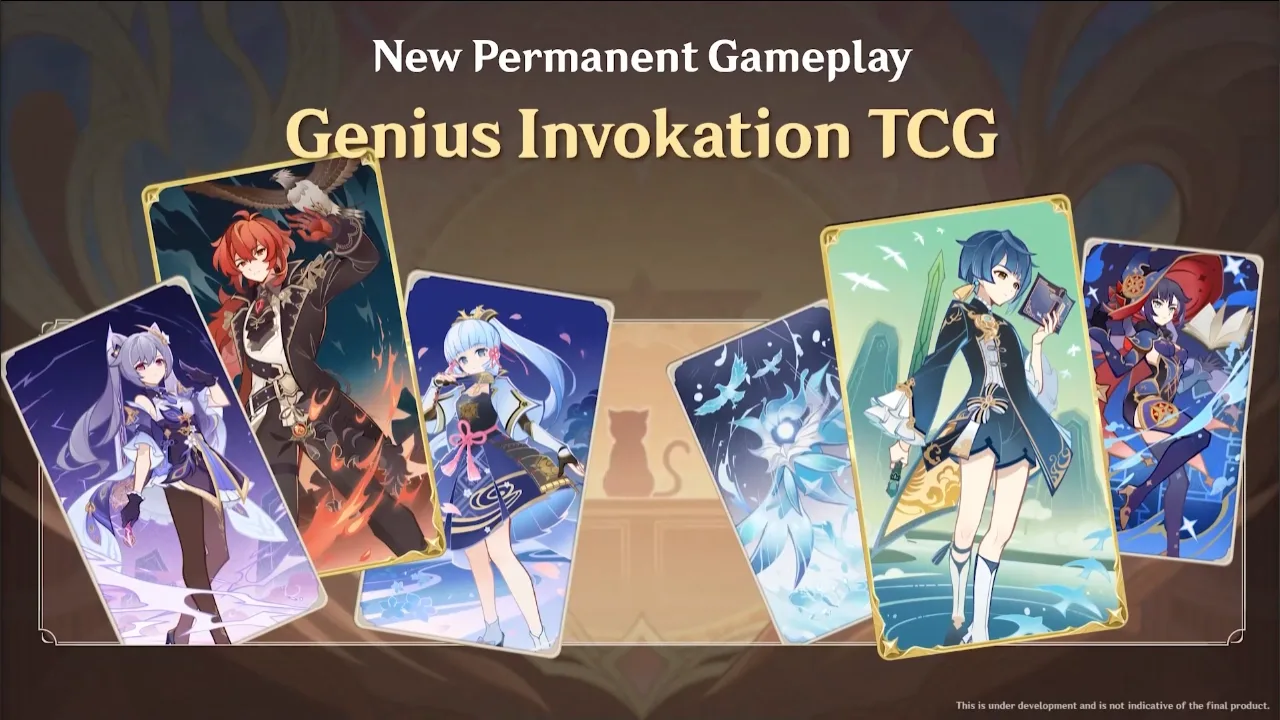
Genius Invokation TCG has been a permanent mode since Version 3.3, it costs no Original Resin, and it pays 600 Primogems just for climbing its own progression track. Most players open it once, fail to parse the dice, and never come back.
The Reaction Table You Memorized Does Not Apply Here
Here is how the card game resolves each reaction, straight off the in-game rules panel.
| Reaction | Elements | Card-game effect |
|---|---|---|
| Melt | Cryo + Pyro | +2 DMG for this instance |
| Vaporize | Hydro + Pyro | +2 DMG for this instance |
| Overloaded | Electro + Pyro | +2 DMG, and the target is forcibly switched to the next character |
| Superconduct | Cryo + Electro | +1 DMG, plus 1 Piercing DMG to all opposing characters except the target |
| Electro-Charged | Electro + Hydro | +1 DMG, plus 1 Piercing DMG to all opposing characters except the target |
| Lunar-Charged | Electro + Hydro, conditional | No bonus DMG at all. Creates a Thundercloud Summon (End Phase: 2 Electro DMG, stacking, no stack limit) and attaches Electric Shock to a random card in your opponent's hand |
| Frozen | Cryo + Hydro | +1 DMG, and the target cannot use Skills until the end of the Round |
| Swirl | Anemo + Cryo/Hydro/Pyro/Electro | 1 DMG of the swirled element to all opposing characters except the target |
| Crystallize | Geo + Cryo/Hydro/Pyro/Electro | +1 DMG, and your active character gains 1 Shield point (max 2) |
| Burning | Pyro + Dendro | +1 DMG and creates a Burning Flame that deals 1 Pyro DMG at the End Phase |
| Bloom | Hydro + Dendro | +1 DMG and creates a Dendro Core: your next Pyro or Electro DMG is +2 |
| Quicken | Electro + Dendro | +1 DMG and creates a Catalyzing Field: your next 2 Electro or Dendro hits are +1 |
Read that as a control chart, not a damage chart. Overloaded is not the biggest number on the board — Melt and Vaporize match it at +2 — but it is the one that moves your opponent's active character for them. Yanking a healthy tank off the field and stranding a half-dead support in front of you wins games raw damage does not.
Lunar-Charged is the row that breaks the pattern, so read it twice. It arrived with Version "Luna V" on 25 February 2026 and it is conditional: it does not fire off Electro plus Hydro on its own. You need an enabler in your lineup — the Moonsign Benediction passives on the Ineffa and Flins Character Cards each convert your opponent's Electro-Charged reactions into Lunar-Charged for the rest of the game. When it does fire, it adds no bonus damage to that instance. Instead it creates a Thundercloud Summon that deals 2 Electro DMG at the End Phase and stacks with no limit, and every time the Thundercloud appears or gains a usage it attaches Electric Shock to a random card in your opponent's hand. That card then chews on them: at each End Phase, while Electric Shock sits in their hand, their highest-HP character takes Piercing DMG equal to its stack count. It is a slow-burn attrition reaction, not a burst one, and it is why the flat +1/+2 shorthand needs an asterisk now.
Frozen is the other one worth building around. A Frozen character cannot use Skills for the rest of the Round, which effectively deletes an opposing turn. The counterplay is baked in: Pyro or Physical DMG strips Frozen early and deals +2 in the process.
Anemo and Geo do not apply their element to a target. They can only react with an element already sitting there, which is why an all-Anemo opener does nothing at all.
One priority rule catches people out. If a character is carrying both Cryo and Dendro at the same time and you hit them with Electro, Hydro or Pyro, the Cryo reaction resolves and the Dendro application survives untouched. If you want the full picture of how these same reactions behave in the open world, where multipliers and Elemental Mastery genuinely matter, our Genshin elemental reactions guide covers the version you actually fight bosses with.
Unlocking It and the Gadget That Runs Everything
Two requirements, both easy to miss because neither is advertised.
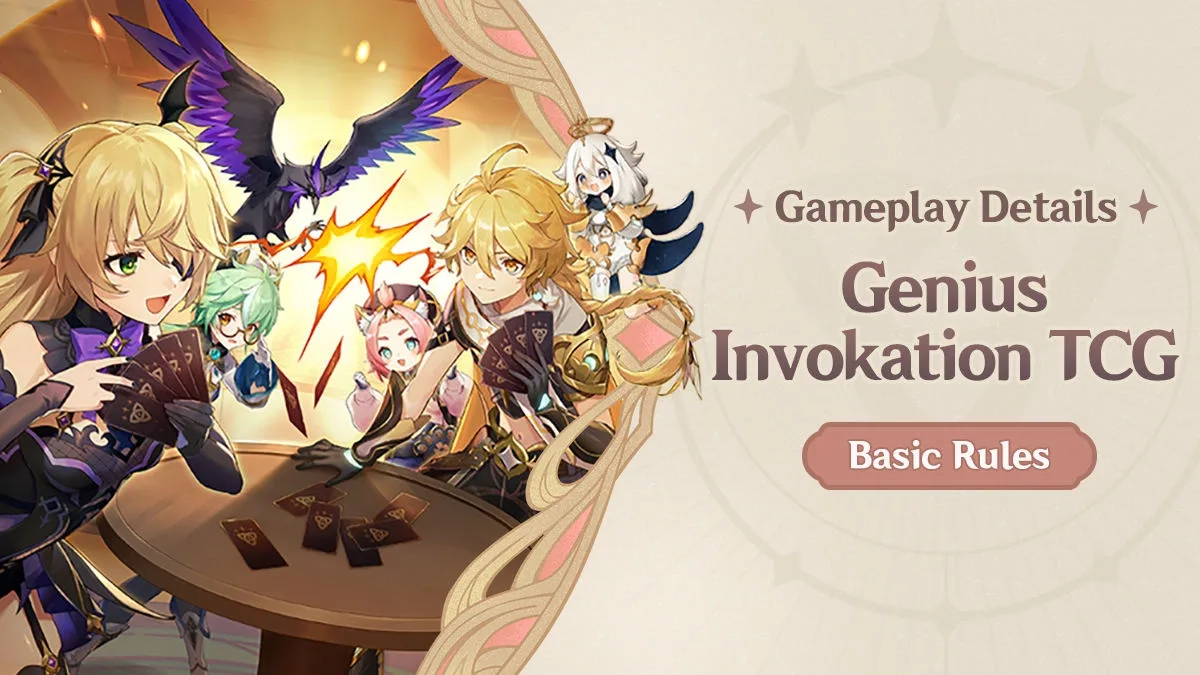
You need Adventure Rank 32, and you need Archon Quest Prologue Act III, Song of the Dragon and Freedom, completed. Hit both and the tutorial quest Come Try Genius Invokation TCG! becomes available. Finishing it hands you the Casket of Tomes, a gadget that does two jobs: it opens the Deck Menu anywhere in the world, and it pings nearby NPCs who are also carrying one so you can challenge them on the spot.
The mode lives at The Cat's Tail, the tavern in Springvale south of Mondstadt. A cat named Prince runs the Card Shop there, the Invitation Board hangs by the bar, and the TCG Player's Manual is bound to F6 on PC. The tutorial also hands over your first four playable Character Cards — Diluc, Kaeya, Sucrose and Fischl — which is enough to build something legal on day one.
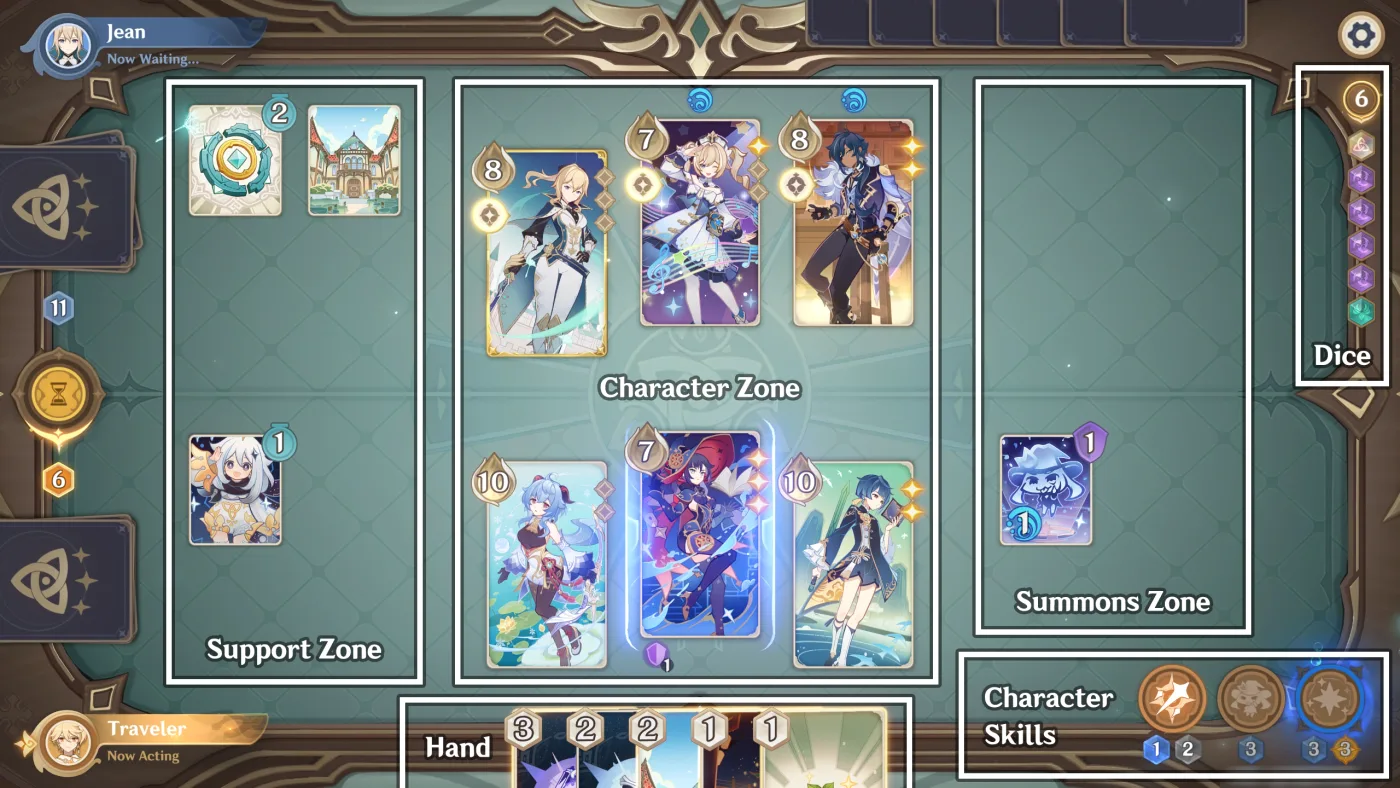
One Round, Three Phases, Eight Dice
Before the first Round, both sides draw 5 cards and get exactly one chance to mulligan any number of them, then each picks a starting active character.
After that, every Round is the same three beats:
- Roll Phase. Both players roll 8 Elemental Dice and get one chance to reroll any number of them.
- Action Phase. Players alternate turns until both declare their Round over.
- End Phase. Card effects resolve, then both players draw 2 cards.
The hard numbers around that loop matter more than they look. You can never hold more than 16 Elemental Dice. Your hand caps at 10 cards and anything drawn beyond that is discarded immediately. An empty draw pile does not deck you out — you simply draw nothing. And a match hard-stops at 15 Rounds, at which point the game concedes for both players.
Unused dice do not carry over. Whatever you did not spend this Round is gone at the End Phase, which is why banking dice through Support Cards is one of the strongest things a cheap deck can do.
Combat Actions Versus Fast Actions
This is the rule that decides more matches than any card in the game, and the tutorial mentions it once and moves on.
Every action is either a Combat Action or a Fast Action. Combat Actions pass your turn to the opponent. Using a Skill, switching characters, declaring your Round over, and playing most Talent Cards all count. Fast Actions do not. Playing most cards and using Elemental Tuning leave the turn with you, so you can chain as many of them as your dice allow before you commit.
Now look at switching again. Changing your active character costs 1 Elemental Die and your entire turn — the most expensive thing you can do in a Round that gives you eight dice and maybe four meaningful actions. It is also exactly what a Bloom or Vaporize deck needs to do constantly.
That is why two zero-cost Event Cards from the starter set are permanent staples:
- Changing Shifts — your next Switch Character costs 1 fewer Elemental Die.
- Leave It to Me! — your next Switch Character is treated as a Fast Action instead of a Combat Action.
Leave It to Me! is the stronger of the two and it costs nothing. Switching for free without surrendering the turn lets you set up a reaction and detonate it in the same window, which is the core combo of every mid-tier deck.
One more piece of turn economy: the first player to declare their Round over goes first in the next Round, and their Summons resolve first in the End Phase. Passing early when you have nothing productive left is a real play, not a concession.
Dice Are the Real Resource
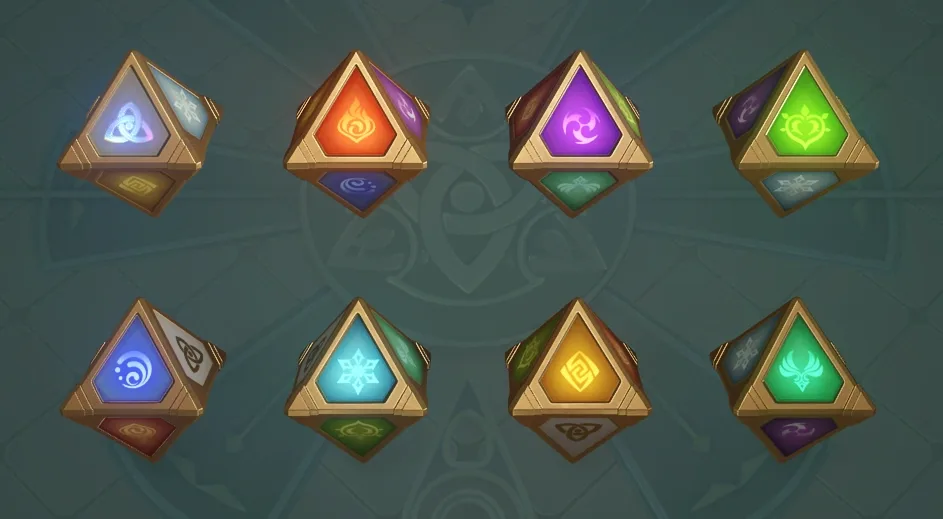
Eight dice faces exist: the seven elements plus Omni, which counts as any element you need.
Card and skill costs come in two flavours. A Matching cost demands that many dice of one specific element. An Unaligned cost takes any dice at all. Omni satisfies both. That distinction is the entire reason a three-element rainbow deck feels miserable to pilot — you roll eight dice, three of them are the colour you needed, and your Elemental Burst wanted four.
Elemental Tuning and the Omni Die
Elemental Tuning is the pressure valve. Discard any card from your hand and one Elemental Die converts to your active character's element. It is a Fast Action, so it costs you nothing but the card.
That trade — a card for a die — is why decks run cheap, low-impact filler on purpose. Dead cards are not dead if they are tuning fuel.
Several Support Cards attack the same problem from the other side, and most of them cost zero dice to play:
- Vanarana collects up to 2 unused Elemental Dice at the End Phase and hands them back when the next Action Phase begins.
- Liben banks your leftover dice, at most one of each element, and once it has collected 3 it draws you 2 cards, creates 2 Omni dice and discards itself.
- Knights of Favonius Library rerolls dice of your choice the moment you play it, then grants an extra reroll every Roll Phase for the rest of the match.
Elemental Resonance cards are the other lever. Run two Character Cards of the same element and you unlock that element's Resonance card — Elemental Resonance: Woven Flames, for example, creates a Pyro die for zero cost. A two-Pyro-one-flex deck is not just thematically tidy, it is literally cheaper to run.
The Charged Attack Rule Nobody Notices
Before your Action Phase, if the total number of Elemental Dice you hold is even, your next Normal Attack counts as a Charged Attack. Odd, and it does not.
Plenty of cards key off Charged Attacks, so this quietly means the number of dice you are sitting on can be worth deliberately manipulating — spend one extra die, or tune one away, to land on an even count before you swing.
The matching rule for plunges carries a qualifier that costs people damage: after a character is switched in, the plunge only lands if their next Combat Action that Round is a Normal Attack. Open with an Elemental Skill instead and the window is gone.
Skill Costs and the Energy Clock
Character Cards carry a fixed, published cost structure, and it is tight enough to memorise:
| Skill | Typical cost | Notes |
|---|---|---|
| Normal Attack | 0-1 Matching + 2 Unaligned | Every character has exactly 1 |
| Elemental Skill | 3 or 5 Matching | Characters have 0-2 of these, 1 is standard |
| Elemental Burst | 3-4 Matching + 2-3 Energy | Every character has exactly 1 |
| Passive Skill | None | Only on specific cards |
Energy is the slow clock. Every Normal Attack and Elemental Skill gives that character 1 Energy, and only that character, so a Burst is realistically a Round-three play unless you accelerate it. Starsigns costs 2 Unaligned dice and hands your active character 1 Energy outright. Northern Smoked Chicken is a zero-cost Food card that makes the target's next Normal Attack cost 1 fewer Unaligned die that Round — a cheap way to squeeze an extra attack, and an extra Energy, out of a bad roll.
When a character is defeated, their Energy is cleared and every piece of equipment attached to them is discarded. Dumping a Weapon and an Artifact onto a character at 3 HP is how you lose two cards for nothing.
Piercing DMG is the exception to everything. It has no element, it cannot be increased by any effect, and no Shield or damage immunity stops it. Superconduct and Electro-Charged both spray 1 Piercing DMG onto the opponent's whole back line, which is how you finish characters hiding behind a Crystallize shield.
Building a Legal Deck
A deck needs exactly 3 Character Cards and 30 Action Cards to be set as active. There is no more or less.
Action Cards split three ways:
- Equipment Cards attach to a character. Each character can hold at most 1 Weapon and 1 Artifact, plus any number of other equipment types such as Talent and Technique cards. The Weapon Cards are named after real Genshin weapons and the Artifact Cards after real artifact sets, so the vocabulary transfers even though the numbers do not.
- Event Cards fire once and are gone.
- Support Cards sit in the Support Zone and keep working.
Two zone caps govern the board, and they do not behave the same way. The Support Zone holds 4 Support Cards, and when it is full you can discard one already sitting there to make room for a new one. The Summons Zone also holds 4, but it gives you no such out — once it is full, new Summons are simply not created at all. Effects inside each zone resolve in the order they were placed, so the sequencing of your Supports is a real decision, not flavour.
Two special-case rules round it out. Arcane Legend cards start in your opening hand, but the limit is one Arcane Legend card per player per match — not one use of each card you happen to own. Run one, not three; the spares just clog your opener. And Food cards apply the Satiated state: a character who has eaten cannot be targeted by another Food card that Round, and once any revival Food card has been played, no other revival Food can be used that Round.
Budget Staples That Belong in Almost Every Deck
None of these require a good pull. Most cost zero dice.
| Card | Type | Cost | Effect |
|---|---|---|---|
| The Bestest Travel Companion! | Event | 2 Unaligned | Create 2 Omni Element |
| Changing Shifts | Event | 0 | Next Switch Character costs 1 fewer die |
| Leave It to Me! | Event | 0 | Next Switch Character becomes a Fast Action |
| Starsigns | Event | 2 Unaligned | Active character gains 1 Energy |
| Sweet Madame | Food Event | 0 | Heal target character 1 HP |
| Mondstadt Hash Brown | Food Event | 1 Matching | Heal target character 2 HP |
| Northern Smoked Chicken | Food Event | 0 | Target's next Normal Attack costs 1 fewer Unaligned die |
| Liben | Support | 0 | Banks unused dice; at 3, draw 2 and create 2 Omni |
| Vanarana | Support | 0 | Stores up to 2 unused dice into the next Round |
| Knights of Favonius Library | Support | 0 | Reroll on play, plus an extra reroll every Roll Phase |
| Chang the Ninth | Support | 0 | Gains Inspiration from Physical, Piercing or reactions; draws 2 at 3 |
| Liyue Harbor Wharf | Support | 2 Matching | Draw 2 cards at the End Phase, twice |
| Chef Mao | Support | 1 Matching | Food cards generate dice and refill themselves |
| Paimon | Support | 3 Matching | Create 2 Omni Element when the Action Phase begins, twice |
Chang the Ninth deserves a specific note. It triggers when either side deals Physical or Piercing DMG or triggers a reaction, which means your opponent charges it for you. In a reaction-heavy match it draws two cards for free within about two Rounds.
Where the Cards and Primogems Actually Come From
Player Level is the mode's own progression track, separate from Adventure Rank, and it runs 1 to 10. Every single level pays 60 Primogems — 600 across the track, none of it costing Original Resin. Levels 3, 5, 7 and 10 also sit behind Ascension Challenges, so EXP alone will not carry you.
| Player Level | Total Player EXP | Notable unlocks |
|---|---|---|
| 1 | 0 | Invitationals, Co-Op Match, Card Shop |
| 2 | 300 | Weekly Guest Challenges |
| 3 | 1,050 | Extra deck slot, Liyue opponents |
| 4 | 2,000 | Invitation Board matchmaking, Arena of Champions, Heated Battle Mode |
| 5 | 3,300 | Extra deck slot, Inazuma opponents |
| 7 | 6,350 | Extra deck slot, Sumeru opponents |
| 10 | 12,450 | Final deck slot |
Cards come from four places. The Card Shop at The Cat's Tail sells Action Cards for Lucky Coins, priced at 500 for entry-level weapons like Magic Guide and Raven Bow, 700 for the mid tier, and 1,000 for the top end such as Wolf's Gravestone, Amos' Bow and Engulfing Lightning. The TCG Player's Manual hands out 23,600 Lucky Coins across its match chapters, plus 60 Primogems for each chapter you complete. Tavern Challenges at Friendly Fracas difficulty award Character and Talent Cards, and Invitationals on Friendly Fracas are how you unlock Character Cards based on playable characters. Watch the cap while you grind: you can only hold 20,000 Lucky Coins at once, and hitting the ceiling blocks challenge objectives from paying out at all.
Weekly Guest Challenges are the recurring EXP faucet. Up to four guests visit The Cat's Tail each week, one arriving per day — but from Player Level 4 onward all four show up on Monday, so the whole week can be cleared in one sitting. Some guests also adjust their decks based on your Player Level, which is worth knowing before you assume a loss was bad luck.
You do not need a whale account for any of this. Character Cards are unlocked by beating opponents, not by pulling, so the same four-star roster that powers the best free-to-play teams is more than enough — and unlike the Imaginarium Theater, nothing here checks your character levels.
Arena of Champions
The competitive mode. It unlocks at Player Level 4 from the Invitation Board and opens on the 1st and the 16th of every month, with records cleared at the start of each new season.
An attempt runs until you reach 5 victories or 3 defeats, and you cannot alter your deck mid-run. Clear it and the Character Cards you used are logged in that season's Character Honors, which tracks opponents defeated, strongest single strike, damage dealt, damage taken and Crowns of Victory forged. Character Honors is its own per-season tab, and it is not what the save caps apply to. The caps sit on your records: up to 9 Arena of Champions records, culled oldest-first once you hit 9, and up to 10 challenge-deck records, culled by fewest victories first and then by age.
Heated Battle Mode
Also gated at Player Level 4 and also run from the Invitation Board, Heated Battle Mode appears for a limited window each Version with a special rule set that can change the game substantially. It pays Lucky Coins, so check it whenever a new Version lands even if the ruleset looks silly.
More Genshin coverage lives on the Genshin Impact coverage hub, and the rest of our game guides sit on the Mythras blog.
Quick Action Checklist
- Unlock it at Adventure Rank 32 with Prologue Act III cleared, then finish Come Try Genius Invokation TCG! for the Casket of Tomes.
- Learn the flat reaction table first: Melt, Vaporize and Overloaded are +2 and every other classic reaction is +1 with a rider — except Lunar-Charged, which deals no bonus damage at all.
- Build to exactly 3 Character Cards and 30 Action Cards, and pair two characters of one element to unlock that Elemental Resonance card.
- Run Leave It to Me! and Changing Shifts in every deck, tune away cards you will never play, and bank leftovers with Vanarana or Liben before the End Phase eats them.
- Never stack a Weapon and an Artifact on a character who is about to die — defeat discards all attached equipment and clears their Energy.
- Climb Player Level 1 to 10 for 60 Primogems each, and spend Lucky Coins before the 20,000 cap stops objectives paying out.
- From Player Level 4, all four Weekly Guest Challenge opponents arrive on Monday, and Arena of Champions opens on the 1st and the 16th.
Frequently Asked Questions
How do you unlock Genius Invokation TCG in Genshin Impact?
How many cards are in a Genius Invokation TCG deck?
How do elemental reactions work in the Genshin card game?
How many Elemental Dice do you get each round?
What is the difference between a Combat Action and a Fast Action?
How many Primogems does Genius Invokation TCG give?
When does Arena of Champions open and how does it work?
Keep Reading
- HoYoverse — Version "Luna V" Update Details (25 February 2026), including the Lunar-Charged reaction and Thundercloud Summon in Genius Invokation TCG
- Genshin Impact Wiki — Genius Invokation TCG full rules, round flow, reaction effects and deck composition
- Genshin Impact Wiki — Genius Invokation TCG unlock requirements, Player Level rewards and game modes
- Genshin Impact Wiki — Card Shop Lucky Coin prices for every purchasable Action Card
- Genshin Impact Wiki — TCG Player's Manual task list and Primogem/Lucky Coin rewards
- Genshin Impact Wiki — Arena of Champions season schedule, win/loss rules and Character Honors
Related Guides
Genshin Miliastra Wonderland Guide — What It Actually Pays
Miliastra Wonderland runs on its own currencies, so you can ignore most of it. Three things leak back into Teyvat: a free 5-star you can't take into the endgame, about 200 Primogems this update, and a Battle Pass deal that makes one of its passes free.
Genshin Wish Guide — Pity, Rates and Real Primogem Costs
The base five-star rate is 0.6 percent, which sounds brutal until you learn that almost nobody actually pulls at 0.6 percent. The rate ramps hard starting at wish 74, and that single fact should change how you save.
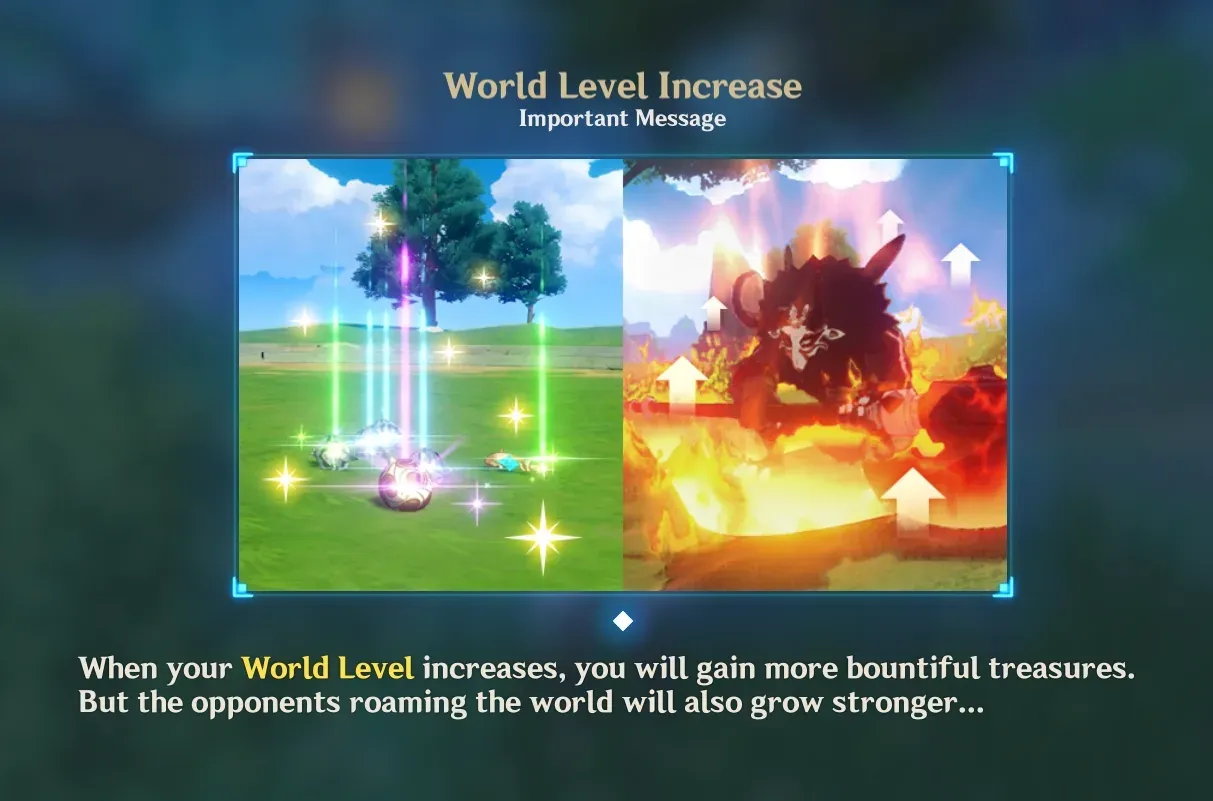
Genshin World Level Guide — What Each Level Pays
World Level is the number on your profile that quietly rewrites your drop table: which artifact rarities and ascension gem tiers bosses can drop, and what a Ley Line Blossom pays. Here is what each of the ten levels changes, which three thresholds actually move money, and exactly what you give up if you lower it.
Genshin Fishing Guide — Bait, Fish and Free Weapons
Fishing hands you three four-star weapons, all refinable to R5, for zero Primogems and zero Original Resin. It also hides the cost behind eight separate shops, twelve bait recipes and a 72-hour respawn timer. Here are the actual numbers: what each reward costs in fish, which bait catches what, and which of those fish only exist after dark.
Genshin Artifact Guide — Stats, Rolls and Resin Math
A five-star artifact can roll the exact same substat four times and give you anywhere from 10.88 percent to 15.54 percent CRIT DMG. Understanding that spread is the difference between a functional account and a museum of half-built characters.
Genshin Snezhnaya Farming Guide — Domains, Days, Drops
Version 7.0 dropped three permanent domains, two normal bosses, four enemy drop families and two local specialties into Snezhnaya — and locked the whole nation behind a single Archon Quest. Here is what each source pays, which day it pays it, and who on your account is actually waiting for it.