Genshin Imaginarium Theater Guide — The Endgame That Out-Pays the Abyss
The Spiral Abyss pays 800 Primogems a month. A full Imaginarium Theater season pays 1,000. One of them asks for eight built characters and one asks for twenty-eight, and most accounts are still only collecting the smaller cheque.
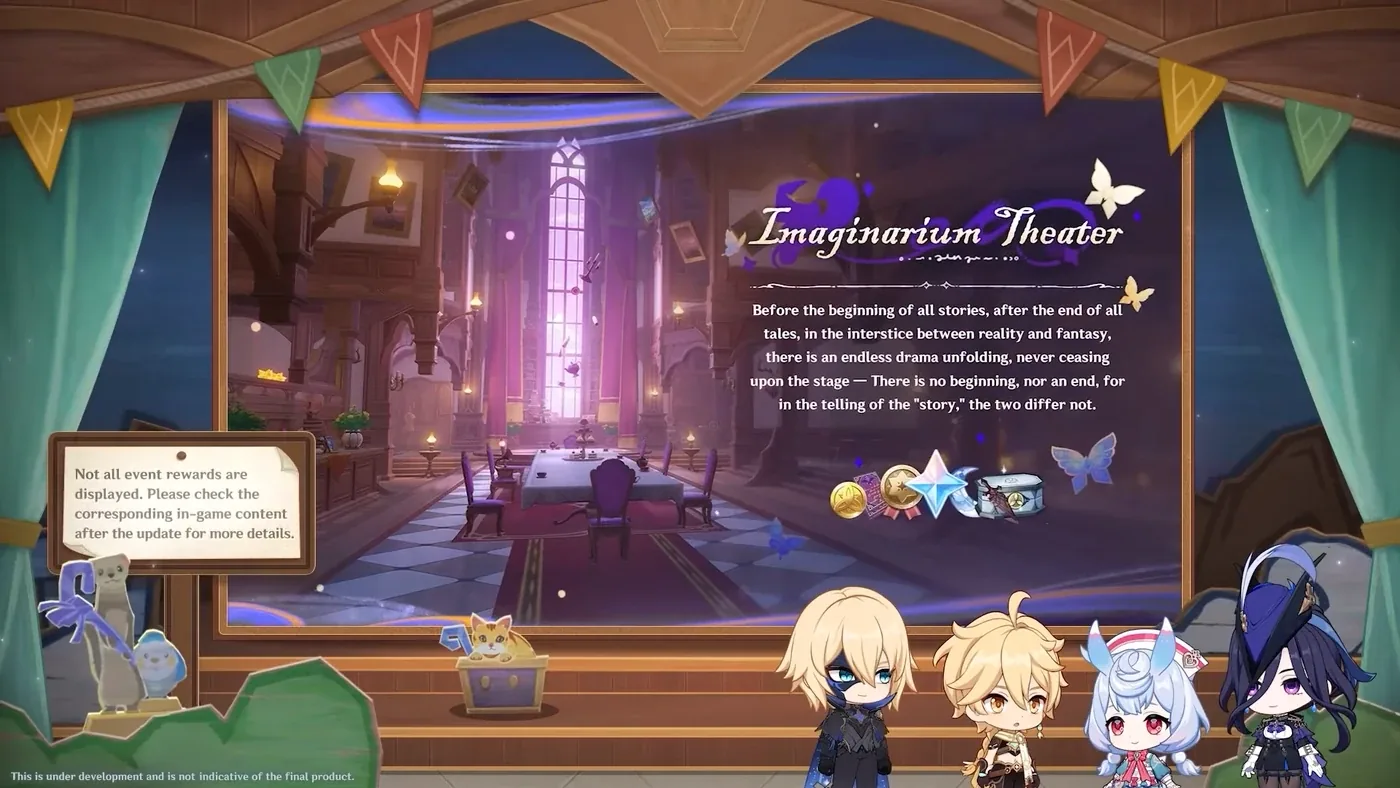
The Theater Now Matches the Abyss and Then Beats It
Two numbers almost nobody puts side by side.
The Abyssal Moon Spire — Floors 9 through 12 of the Spiral Abyss — pays 800 Primogems. Not per reset. Per month. Since 16 June 2024 the Moon Spire stopped refreshing twice a month and now resets once, on the 16th, during the Moment of Syzygy. The old 1,200-a-month figure that still floats around community guides is two years stale.
A full Imaginarium Theater season pays 1,000.
Clear all ten Acts on Visionary Mode and you bank exactly 800 Primogems — dead level with a 36-star Abyss run. Push into Lunar Mode and clear both Arcanum Challenges and the Theater pulls ahead at 1,000. It resets on the 1st, the Abyss resets on the 16th, so the two endgames sit two weeks apart on the calendar and pay a combined 1,800 Primogems every month for zero Original Resin.
The catch is the reason most accounts collect only one of them. The Abyss asks for eight built characters. Lunar Mode asks you to hand over twenty-eight before the curtain goes up.
That is not a difficulty wall. It is an account-shape wall, and it is the only piece of Genshin content that punishes exactly the habit the rest of the game rewards.
Unlocking It and the Monthly Season Clock
The Theater unlocks at Adventure Rank 35, after you complete the quest Unbegun, Unending Story. It lives in the Theater Lobby — previously called the Mysterious Room — inside the Mondstadt Library at the Knights of Favonius Headquarters, where a concierge named Wolfy runs the door.
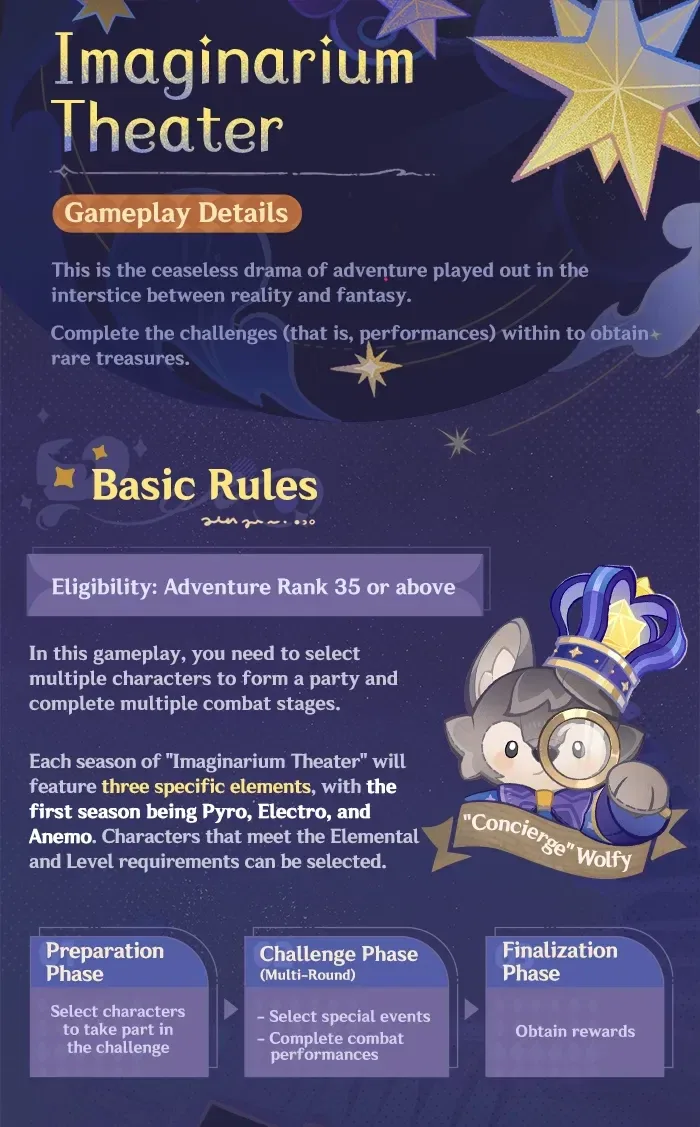
Everything about it runs on a monthly season. The Theater resets on the first day of every month, and each season runs from the 1st to the 1st of the following month. Season 26, for example, covers 1 August 2026 to 1 September 2026, with Hydro, Electro and Cryo as its required elements.
That element rotation is the part that catches people. Every season picks three random elements, and your bench characters have to match them. A roster that is four Pyro units deep and nothing else will run into a month where Pyro simply is not on the menu. Over a year, the Theater quietly demands coverage across all seven elements — and it occasionally rolls three elements that do not even react with each other, such as Dendro and Cryo.
The Five Difficulties and What Each One Demands
Five modes, each with a hard roster requirement and a hard minimum character level. These are gates, not suggestions — you cannot start the show without meeting them.
| Mode | Challenges | Characters required | Characters allowed | Min. level |
|---|---|---|---|---|
| Easy | 3 | 8 | 10 | 60 |
| Normal | 6 | 12 | 14 | 60 |
| Hard | 8 | 16 | 20 | 70 |
| Visionary | 10 | 22 | 26 | 70 |
| Lunar | 12 | 28 | 32 | 70 |
Visionary unlocks only after you clear Hard. Lunar unlocks only after you clear Visionary. Every mode lets you invite exactly one Supporting Cast character from a friend.
Note what the level column is really saying. Everything from Hard upward wants level 70, not 90. Getting a four-star from 70 to 90 is an enormous investment for a marginal stat bump; getting one from 1 to 70 is cheap. The Theater is priced for wide, shallow investment, which is the opposite of how most players spend their talent books and ascension materials.
Why Visionary Is the Real Target
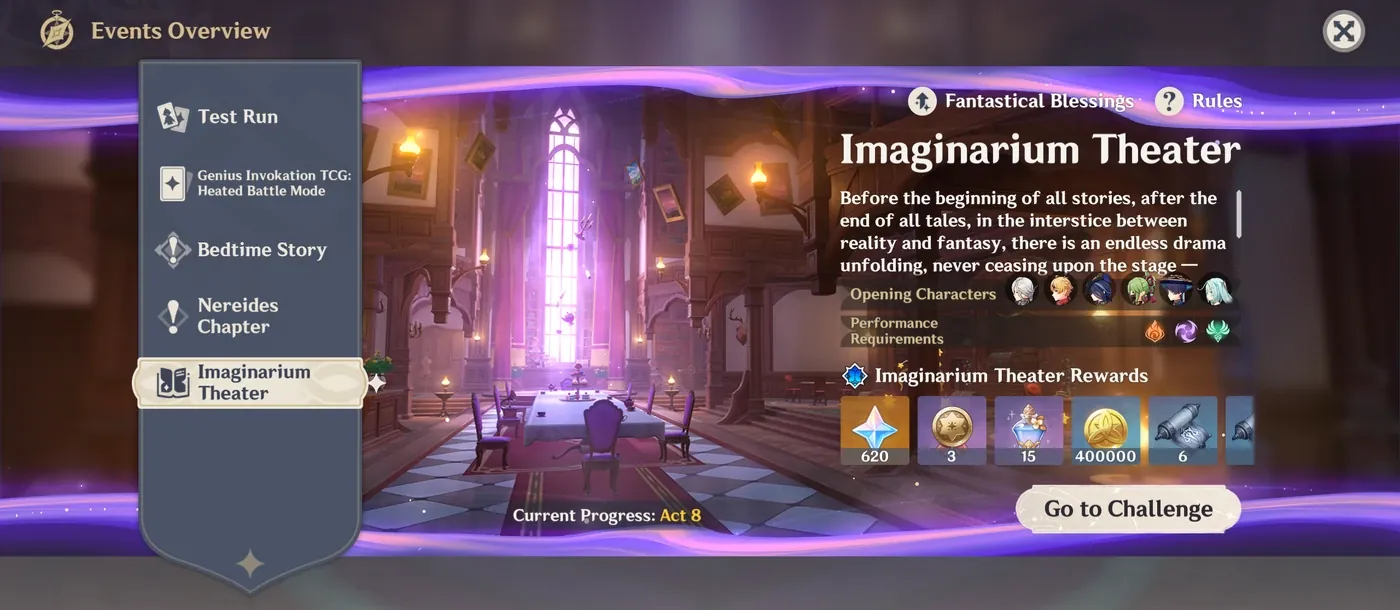
Here is the per-Act Primogem breakdown for the recurring Performance Tour Rewards: Acts 1, 2, 4, 5, 7 and 9 pay 60 each, Acts 3 and 6 pay 100 each, and Acts 8 and 10 pay 120 each. That totals 800 across ten Acts.
So Visionary Mode — not Lunar — is where the Theater stops being a side dish. Hard Mode caps at eight Acts and 620 Primogems. The jump from Hard to Visionary is worth 180 Primogems a month for six extra characters on the bench, and those six do not have to be good. They have to exist, be the right element, and be level 70.
What Lunar Mode Adds
Lunar Mode is not twelve harder Acts. It is the same ten Acts as Visionary plus two optional Arcanum Challenges, which unlock after you complete Acts 3 and 6 and can be attempted any time before you enter the Act 10 challenge. Their difficulty is on par with the final Act.
Each Arcanum Challenge is worth 100 Primogems, which is what takes the season total from 800 to 1,000. Clearing both also lets you draw a Lunar Arcanum after finishing Act 10 — one per season, so the draw is a real decision rather than a formality.
The Four Cast Types Explained
The vocabulary is the main barrier to entry here, and the in-game tutorial is not great at it. Four terms matter.
Principal Cast are the characters you can actually field right now. Alternate Cast is the bench — they cannot be used directly and must be pulled into the Principal Cast through Combat Events or Companion Events. Those are the two you will hear constantly.
Opening Characters and the Free 20 Percent
Each season designates six Opening Characters who form your starting Principal Cast. The Theater offers trial versions of all six, so you can run the season even if you own none of them. Opening Characters are not available as Supporting Cast picks.
But if you actually own one, you get a Fantastical Blessing: that character's Max HP, ATK and DEF go up by 20 percent for the whole season, and — this is the part people miss — the buff applies outside the Theater too. It is a free open-world and Abyss buff for owning the right six characters that month, and it costs you nothing but checking the season page.
Special Guest Stars
Alongside the three mandatory elements, each season names four Special Guest Stars who are exempt from the element requirement. The trade-off is ownership: unlike Opening Characters, there is no trial version. You must actually own a Special Guest Star, or borrow one through the Supporting Cast, for it to appear.
Two practical notes. First, Guest Stars do not benefit from the season's reaction blessings the way the featured elements do, so it is usually right to burn them early while the run is easy rather than saving them for a boss. Second, per the wiki's Blessing Level entry, the buff effects Special Guest Stars receive are increased by 100 percent — so when you do field one deep into a run with a stacked Blessing Level, they get double the attribute payout.
Supporting Cast Is Your Friends List
You can set up to seven of your own characters as Supporting Cast for friends to borrow, and they can be used to assist up to 15 times per season. Going the other way, you can invite one Supporting Cast character per run, and only one from any given friend per season.
Two rules that trip people up: a character you have set as Supporting Cast cannot simultaneously sit on your own Alternate Cast — the game will make you choose — and the Traveler cannot be assigned as a Supporting Cast member at all.
If you are a floor or two short of the roster gate, a borrowed character is a legitimate way to cross it. Set your own supports thoughtfully too; a well-built off-field applier is what friends actually want to borrow.
Vigor Is the Resource That Actually Runs Out
Every character enters with 2 Vigor. Completing a Combat Event costs 1. At zero Vigor, that character is finished for the entire run.
Vigor cannot be restored normally. The only route back is a handful of Mystery Cache options, every one of which carries a downside — Companion: Overtime Performance restores 1 Vigor to a random Principal Cast member but you earn 30 fewer Fantasia Flowers after that Act, and Companion: Congenial Comeback restores 1 Vigor but the active character loses 5 percent of their Max HP on every CRIT hit, up to once per second.
Now the arithmetic that reframes the whole mode. Every stage requires four stage members, even if you could win with fewer. Visionary Mode is ten Acts. Four members per Act, one Vigor each, is forty deployments — and at two Vigor per character, that is twenty characters' worth of Vigor burned in a single full run.
This is why the Theater cannot be solved by one immaculate team. Your best four are used up by Act 2. Everything after that is your bench, and the run ends when the bench does.
Two more rules borrowed straight from the Spiral Abyss: once you finalise your selection, character stats and levels are locked, so swapping artifacts or levelling a talent means restarting the run. And characters in the Theater start with full HP and Energy, which quietly removes one of the Abyss's harshest taxes — you are not opening every fight from an empty burst bar, so the Energy Recharge thresholds you sweat over in the Abyss matter less here.
The Fantasia Flower Economy
Fantasia Flowers are the in-run currency, earned from battles and spent on everything else. The exact numbers are the most useful thing in this guide, because they explain why you always feel broke.
Income:
| Event | Flowers |
|---|---|
| Battle: Normal | +90 |
| Battle: Defense Sequence | +90 |
| Battle: Elite Assault | +110 |
| Battle: High-Pressure Defense | +110 |
| Battle: Climactic Showdown | +125 |
| Arcana Challenge | +90 |
Spending:
| Event | Flowers |
|---|---|
| Companion: Select or Random | -80 |
| Companion: Invite | -100 |
| Brilliant Blessing (any tier) | -60 |
| Mystery Cache | Free |
| Mystery Cache: Rare | -40 |
Read those two tables together and the design snaps into focus. A standard battle pays 90. Recruiting one bench character at the good tier costs 100. Buying a single Blessing costs 60. You cannot both recruit and buff off an ordinary stage — you are structurally about 50 flowers short of doing everything every Act, and that gap is the entire strategy layer.
Which is why Elite Assault and High-Pressure Defense matter more than their reputation suggests. They are slightly harder versions of the standard battles and pay 110 instead of 90. Twenty flowers does not sound like much, but taken three or four times across a run it is a free Blessing you would not otherwise have afforded. If your team can comfortably beat the normal version, take the hard one.
One free bit of value people skip: after each Battle Event you get to pick one of two Alternate Cast members to join the Principal Cast at no flower cost, and recruits from Companion Events always arrive with both units of Vigor intact. Standard Mystery Cache events are free as well. Take them.
Blessing Level — Why You Should Never Bring the Minimum
This is the single most actionable mechanic in the Theater and it is buried three menus deep.
Blessing Level rises two ways. Every character you add to the Alternate Cast above the required number gives +2 Blessing Level. Every Brilliant Blessing you obtain or upgrade gives +1.
Each point of Blessing Level grants every participating character:
- Max HP + (Blessing Level x 800)
- ATK + (Blessing Level x 50)
- DEF + (Blessing Level x 50)
- Elemental Mastery + (Blessing Level x 20)
Now apply it. Visionary Mode requires 22 characters and allows up to 26. Bringing the full 26 instead of the bare 22 is four extra characters, which is +8 Blessing Level, which is +6,400 Max HP, +400 ATK, +400 DEF and +160 Elemental Mastery on everybody in the run.
Four hundred flat ATK is a bigger number than most artifact main stats will give you, and 160 Elemental Mastery is roughly a full sands slot. You get it for adding four characters you may never even field, who only have to be the right element and level 70.
If you take one thing from this guide: never enter at the minimum roster. The maximum is free stats.
Brilliant Blessings and the Three-Element Season
Version 5.0 replaced the old Wondrous Boon events with Brilliant Blessings, which are built around elemental reactions rather than generic stat buffs. The season's three elements determine which reaction blessings are on offer, which is why the element rotation is a bigger deal than it first appears.
Blessings upgrade through tiers — Origin, then Divergence, then Evolution, then a final branch — and each purchase or upgrade costs 60 flowers and adds +1 Blessing Level. Two concrete examples of what they actually do:
- Vaporize: Origin drops the target's Pyro and Hydro RES by 25 percent for 6 seconds after every Vaporize. The tier-four branch The Origin Refined adds a flat 50 percent increase to Vaporize damage.
- Frozen: Origin creates a Stinging Chill effect for 6 seconds that gives every Cryo and Hydro party member 40 percent CRIT DMG.
Those are not small percentages. A stacked Vaporize blessing tree turns a mediocre bench team into something that deletes an Act 8 boss, and it is available to anyone who understands which reaction the season is nudging them toward. If you are unsure which pairings produce what, our Genshin elemental reactions guide maps every combination and the trigger order that decides your multiplier — reading the season's three elements and picking the reaction to build around is most of the skill in this mode.
Stella and the Rewards Nobody Claims
Each Act carries a Star Challenge, and clearing it awards a Stella. The condition is one of three types: defeat enemies within a time limit, defeat a specific number of enemies, or keep the Ley Line Monolith above a health threshold. You are allowed to reattempt a stage during or after clearing it purely to pick up the Stella you missed.
Before the June 2025 season, Stella were a vanity score and nothing else. They now pay:
- 3 Stella — 8 Sanctifying Unction
- 6 Stella — 1 Transient Resin
- 9 Stella — 1 Sanctifying Elixir
- 12 Stella — 1 Sanctifying Elixir
Sanctifying Elixir is the material the Artifact Transmuter consumes to define an artifact's set, and it is genuinely scarce. Two per season, resin-free, is a meaningful drip.
The artifact economy is the sleeper reward here. A full Lunar season hands over 26 Sanctifying Essence and 28 Sanctifying Unction. At 10,000 and 2,500 Artifact EXP apiece, that is 330,000 Artifact EXP — and taking a five-star artifact from level 0 to +20 costs 270,475. One Theater season pays for a maxed five-star piece and change, with no domain runs and no Original Resin spent. Enhancement also charges 1 Mora per point of EXP, and the season hands you 600,000 Mora, so the Mora bill is covered by the same payout.
Then there is the one-time Debut Performance layer, paid the first time you clear each Act. That is worth 1,800 Primogems, 960,000 Mora, 60 Hero's Wit, 6 Fragile Resin, a Midlander Billet Trove, a Borderland Billet Trove and — for first-clearing Act 10 — a Crown of Insight. Crowns are one of the hardest-capped resources in the game, so that alone justifies pushing to Act 10 once even if you never repeat it.
You also collect 3 Toy Medals a season, which Wolfy trades for Thespian Tricks — extra photo poses. Purely cosmetic, but free.

How to Build an Account That Clears It
The Theater rewards a completely different account than the Abyss does, and the adjustment is mostly about where you stop investing rather than what you pull.
Level breadth, not depth. Everything from Hard upward gates at level 70. Twenty-two characters at 70 clears Visionary; four characters at 90 clears nothing here. If you are choosing between crowning a talent and levelling two benched four-stars to 70, take the four-stars.
Cover all seven elements. Three elements rotate in every month. If your Electro roster is one character deep, an Electro season will simply lock you out of Visionary. Fill the thin elements first — the best free-to-play teams are built almost entirely from characters you already own or can get from the standard banner, and every one of them counts toward the roster gate.
Cheap shielders and healers are load-bearing. A four-star like Layla works fine at modest investment, counts toward the roster requirement, and actually contributes when fielded. Survivability units age well here because the late Acts throw serious enemies at whatever bench scraps you have left — Season 26 alone lined up a Level 90 Knuckle Duckle, a Level 92 Battle-Hardened Elite Treasure Hoarder, a Level 95 Battle-Hardened Precursor's Secret Source Matrix of Overseer Network and a Level 100 Perpetual Mechanical Array as its Primary Antagonists.
Always bring the maximum roster. Repeating it because it is worth repeating: the gap between minimum and maximum is +8 Blessing Level on Hard, Visionary and Lunar. That is free stats for characters who might never take the stage.
Set artifacts before you finalise. Stats lock on entry exactly like the Abyss. If you know you want a particular bench unit contributing, sort their artifacts first, because you cannot touch them mid-run.
Do it in the same week as the Abyss. The Theater resets on the 1st, the Moon Spire on the 16th. Two dates a month, 1,800 Primogems between them, zero resin. Set a reminder and stop leaving one of them on the table — and if the Spiral Abyss side of that pair is where you are stuck, that guide covers the two-team problem in detail.
More Genshin coverage lives on the Genshin Impact coverage hub, and the rest of our game guides are on the Mythras blog.
Quick Action Checklist
- Unlock at Adventure Rank 35 by completing Unbegun, Unending Story, in the Theater Lobby at the Mondstadt Library.
- Seasons run from the 1st of a month to the 1st of the next, with three required elements rerolled each season.
- Roster gates: Easy 8, Normal 12, Hard 16, Visionary 22, Lunar 28 characters. Level 60 for Easy and Normal, level 70 from Hard up.
- Visionary Mode pays 800 Primogems a season, matching the entire Spiral Abyss monthly payout. Lunar adds two Arcanum Challenges worth 100 each for 1,000 total.
- Always enter with the maximum roster, not the minimum — each extra character is +2 Blessing Level, and the cap is worth +8.
- Blessing Level gives every character +800 Max HP, +50 ATK, +50 DEF and +20 Elemental Mastery per point.
- Every character has 2 Vigor and loses 1 per Combat Event. A ten-Act Visionary run burns roughly twenty characters' worth.
- Battles pay 90 to 125 Fantasia Flowers; Companion Events cost 80 to 100 and Blessings cost 60. Take Elite Assault and High-Pressure Defense for the extra 20 when you can win them.
- Own an Opening Character and you get +20 percent Max HP, ATK and DEF for the season — including outside the Theater.
- Reattempt Acts to pick up missed Stella. Twelve Stella pays 8 Sanctifying Unction, 1 Transient Resin and 2 Sanctifying Elixir.
- Clear Act 10 at least once for the Debut rewards: 1,800 Primogems total across all Acts, plus a Crown of Insight.
Frequently Asked Questions
How do you unlock the Imaginarium Theater in Genshin Impact?
How many characters do you need for the Imaginarium Theater?
How many Primogems does the Imaginarium Theater give per season?
Is the Imaginarium Theater better than the Spiral Abyss for Primogems?
What is Blessing Level in the Imaginarium Theater?
What is Vigor and can you restore it?
How do Fantasia Flowers work?
Do you need to own the Opening Characters?
Keep Reading
- Genshin Impact Wiki — Imaginarium Theater difficulty requirements, Vigor, Blessing Level and reward tables
- Genshin Impact Wiki — Fantasia Flower costs and Brilliant Blessing effects by tier
- Genshin Impact Wiki — Abyssal Moon Spire monthly reset and Star Bounty rewards
- Genshin Impact Wiki — Artifact EXP per level and enhancement material values
- HoYoverse — official Imaginarium Theater gameplay details
Related Guides
Genshin Stygian Onslaught Guide — The Primogems Stop at Difficulty Three
Genshin has three permanent endgames. The third one hands you its entire Primogem payout at difficulty three of six, then spends the top half of the ladder paying you in artifact currency and weapon skins instead. The reward table is the whole strategy.

Genshin Spiral Abyss Guide — 800 Primogems a Month
A full 36-star Spiral Abyss clear pays 800 Primogems, once a month, for the cost of zero resin. What stands between you and that payout usually is not skill — it is the two-team tax.
Genshin 7.1 Phase 2 Events: Rewards and Deadlines
Phase II of Genshin 7.1 adds three events, but most of the confirmed Primogems still on the table come from two holdovers, and the first deadline that costs you a reward milestone lands on October 15, not November 3. Here is the calendar in deadline order and what each event pays.

Genshin Miliastra Wonderland Guide — What It Actually Pays
Miliastra Wonderland runs on its own currencies, so you can ignore most of it. Three things leak back into Teyvat: a free 5-star you can't take into the endgame, about 200 Primogems this update, and a Battle Pass deal that makes one of its passes free.

Genshin Artifact Guide — Stats, Rolls and Resin Math
A five-star artifact can roll the exact same substat four times and give you anywhere from 10.88 percent to 15.54 percent CRIT DMG. Understanding that spread is the difference between a functional account and a museum of half-built characters.

Genshin Anniversary Selector — Which Free 5-Star to Pick
Version 7.1 hands every eligible account two free 5-star invitations from two lists that do not overlap. Five of the fourteen names work in both Imaginarium Theater seasons that open before the deadline, two are wired into Stellar Swirl, and one is missing from the current free-constellation event roster.