Gundam Card Game Rarities Explained - C, U, R, LR and Link Rare, and Why SP Is Not a Rarity
The rarest treatment in the Gundam Card Game is printed on four cards, and every one of them is a Resource - a card with no level, no cost, no colour and no game text. That is not a quirk, it is the whole rarity system telling you how it works. Bandai runs rarity and alternate art as two independent fields, and almost every rarity guide online mashes them into a single ladder. I filtered all 1,816 entries in the official English card database to work out what the codes actually mean.
The rarest print treatment in the Gundam Card Game appears on exactly four cards. All four of them are Resource cards.
R-002, R-015, R-025 and R-038, each in its double-plus printing - full-art, gold-bordered, an RX-78-2 head staring out of a card that has no level, no cost, no colour and no game text beyond a parenthetical reminder that you rest a Resource to pay a cost. That is the top-shelf pull. A blank.
That is not a joke at Bandai's expense. It is the rarity system explaining itself, if you read it the way the database is actually built rather than the way every rarity guide online writes it up. I pulled all 1,816 entries from the official English card database on 2 August 2026 and filtered by every rarity value and every alternate-art value the search offers. The result contradicts the ladder you have probably seen.
The chase card in this game is a Resource
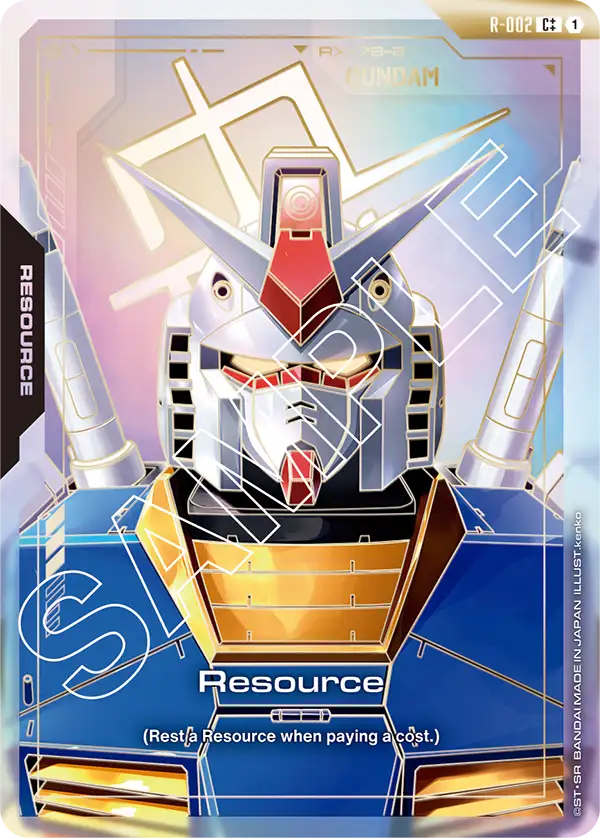
Look at the top-right corner of that card. It reads R-002, then a C with a double mark after it.
C. Common.
The double-plus treatment exists on 18 entries in the entire database. Fourteen of them sit on Legend Rare cards - the marquee suits, Gundam and Zeong and Sazabi and Strike Freedom. The other four are these Resources, and they are Common. There is not a single double-plus card at Uncommon or at Rare. Not one.
So a card stamped Common is, by print treatment, in the same 18-card club as the Legend Rares, and scarcer than the vast majority of cards stamped Rare. If your mental model is a single line running Common up to Legend Rare, that sentence is nonsense. Once you see that Bandai is tracking two things at once, it is obvious.
Two fields, not one ladder
Open the filter panel on Bandai's card search and you get two separate blocks.
The first is labelled Rarity, and it offers eight values: C, U, R, LR, LKC, LKU, LKR and P.
The second is labelled Alternate Art, and it offers three: SP, + and ++.
They are independent checkboxes. A card has a rarity, and then it separately either has an alternate-art treatment or it does not. Nearly every rarity explainer I could find flattens these into one ranked list that runs something like C, U, R, LR, then C+, U+, R+, LR+, then SP, then the double-plus cards. That list is not wrong about which cards are hard to find. It is wrong about what the game is actually tracking, and that is why those guides cannot explain a Common that is scarcer than a Legend Rare.
Here is the whole database by rarity, counted on 2 August 2026. These are printings, not distinct cards - a card that exists in a normal version and an alternate-art version is two entries.
| Rarity code | Entries | Share |
|---|---|---|
| C | 850 | 46.8% |
| U | 278 | 15.3% |
| R | 348 | 19.2% |
| LR | 226 | 12.4% |
| LKC | 4 | 0.2% |
| LKU | 3 | 0.2% |
| LKR | 5 | 0.3% |
| P | 102 | 5.6% |
| Total | 1,816 |
And here is the same 1,816 entries by alternate art:
| Alternate art | Entries |
|---|---|
| (none) | 1,303 |
| + | 467 |
| SP | 28 |
| ++ | 18 |
Just over 28% of everything printed carries some alternate-art treatment. The two tables describe the same pile of cards from two different angles, which is exactly the point.
The four base rarities
C, U, R and LR are the ordinary ladder, and Bandai names them on its product pages: Common, Uncommon, Rare and Legend Rare.
The database totals above are printings, so they overstate how the ladder feels when you rip a pack. For that, Bandai's own GD01 product page is the cleaner source, because it lists the set by card type rather than by printing. Under the heading "130+6 Card Types" it gives:
- x50 Common
- x36 Common
- x32 Rare
- x12 Legend Rare
- x6 Token/Resource
Yes, "Common" twice. The second line is Uncommon, and you do not have to infer that from the arithmetic alone - the GD02 and GD03 product pages print the identical block with "x36 Uncommon" sitting in that slot. GD01's version is a typo that has been live on Bandai's English site since July 2025, and it is a fair illustration of how much of this game's rarity information you end up reconstructing rather than reading.
Taking that at face value, a booster set is roughly 38% Common, 28% Uncommon, 25% Rare and 9% Legend Rare by card type.
One thing that looks strange in the printings table and is worth explaining: Uncommon (278) has fewer entries than Rare (348), which inverts the order you would expect. That is entirely an alternate-art effect. Rare cards picked up 116 plus-printings across the game so far; Uncommon cards picked up 30. Bandai gives the alternate-art budget to Rares and Legend Rares, so the Uncommon slot stays lean.
Plus and double-plus are the alternate art marks
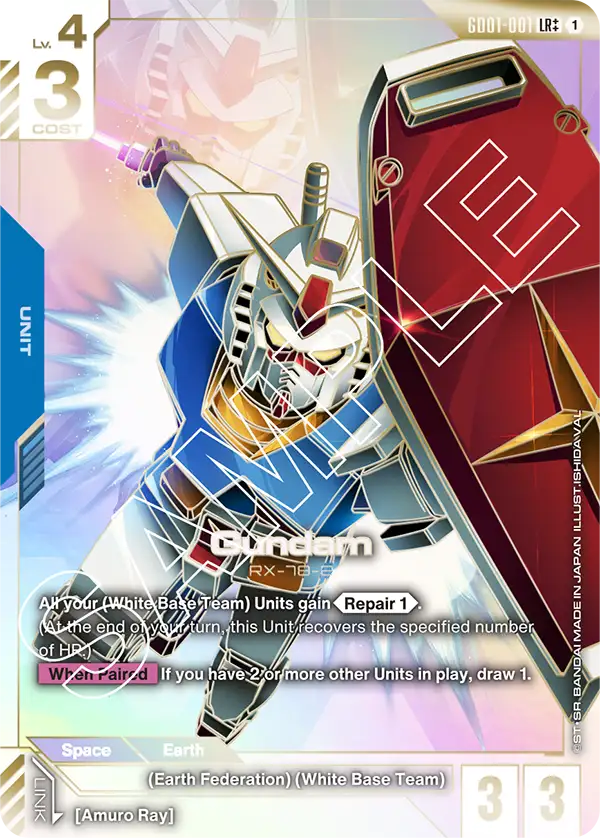
The plus marks print immediately after the rarity letter in the card's top-right corner. One mark is the standard alternate art, 467 entries. Two marks is the premium version, 18 entries.
The double-plus distribution is the sharpest number in this whole piece:
| Rarity | Double-plus entries |
|---|---|
| LR | 14 |
| C | 4 |
| U | 0 |
| R | 0 |
| Link rarities | 0 |
| P | 0 |
Fourteen and four, and nothing anywhere else.
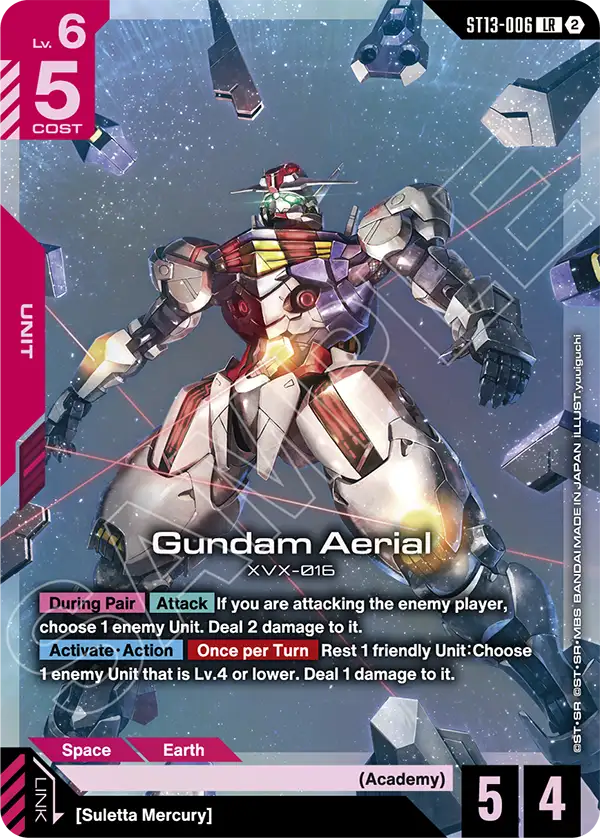
The per-set pattern is just as tight. GD01 through GD04 each shipped exactly three double-plus cards: two Legend Rares and one Resource. GD01 gave you Gundam and Gundam Aerial Rebuild plus R-002. GD02 gave you GQuuuuuuX (Omega Psycommu) and Gundam Barbatos 1st Form plus R-015. GD03: Kämpfer, GFreD, R-025. GD04: Zeong, Destiny Gundam, R-038. The fourteenth Legend Rare double-plus, Phoenix Gundam (Power Unleashed), comes from the Eternal Nexus extra booster rather than a main set.
Then GD05 broke the pattern, and Bandai said so out loud on the product page: "Don't miss the luxurious LR++ cards, now included in a record-high 5 types!" The database backs it exactly - five double-plus cards in Freedom Ascension, all Legend Rare, being Strike Freedom Gundam, Nu Gundam, Master Gundam, Sazabi and Wing Gundam Zero (EW). GD05 is also the first main set with no Resource double-plus at all. It traded the blank for three more mobile suits.
SP is a badge, not a rarity
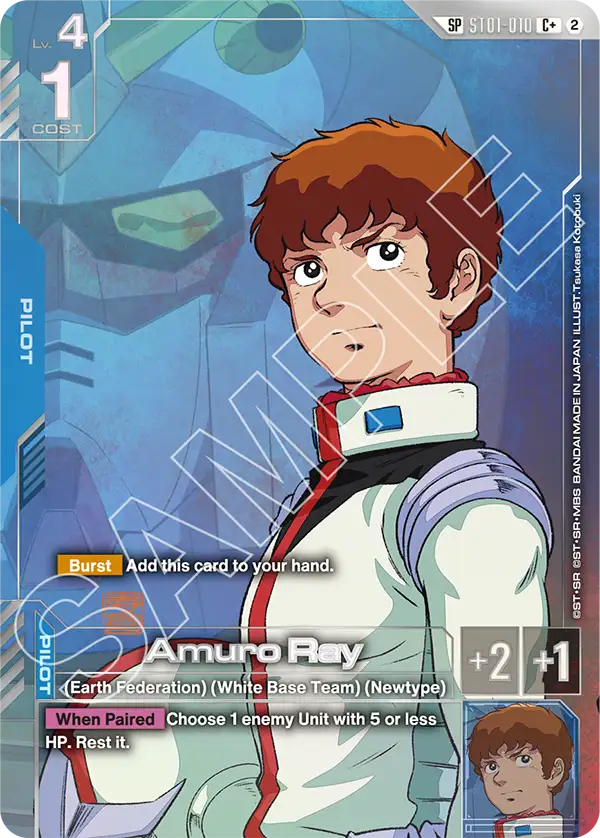
This is the one that will cost people money, so look at the corner carefully. Left to right: an SP badge in its own box, then the card number ST01-010, then the rarity - C+.
The SP Amuro Ray is a Common. Bandai's own card detail page renders the SP badge in a completely separate field from the rarity, and the rarity field still reads C with one plus mark. SP is a treatment applied on top of whatever the card already was.
Bandai's product pages agree. The Steel Requiem [GD03] page lists the set as "x50 Common, x36 Uncommon, x34 Rare, x12 Legend Rare" and then puts "x7 Special" on its own separate line - and filtering the database for SP cards in GD03 returns exactly 7. Special is counted alongside the rarities, not inside them.
All 28 SP entries, by the rarity of the card underneath:
| Underlying rarity | SP entries |
|---|---|
| C | 18 |
| U | 4 |
| R | 4 |
| LR | 2 |
Sixteen of those 28 arrived in GD05 at once, and Bandai's copy describes them precisely: "A total of 8 popular Pilot Cards are included as SP Card versions!" and, separately, "SP Card EX Resources make their first appearance!" The database shows those exact 16 - eight Pilots (Amuro Ray, Suletta Mercury, Heero Yuy, Full Frontal, Char Aznable, Kira Yamato, Setsuna F. Seiei and Marida Cruz) and eight EX Resources, EXR-004 through EXR-011.
Note what that Pilot list does to the rarity question. Seven of those eight Pilots are starter-deck cards, which means Common. Marida Cruz is a GD01 booster card, which means Rare. Same SP treatment, same pack, two different rarities underneath. None of this is visible if you have flattened SP into a rung on a ladder.
Price an SP card however the market prices it - I am not telling you a foil Char is worth less than a Legend Rare. I am telling you that when you type its rarity into a spreadsheet, the answer is Common.
Link Rare is a rarity that encodes another rarity
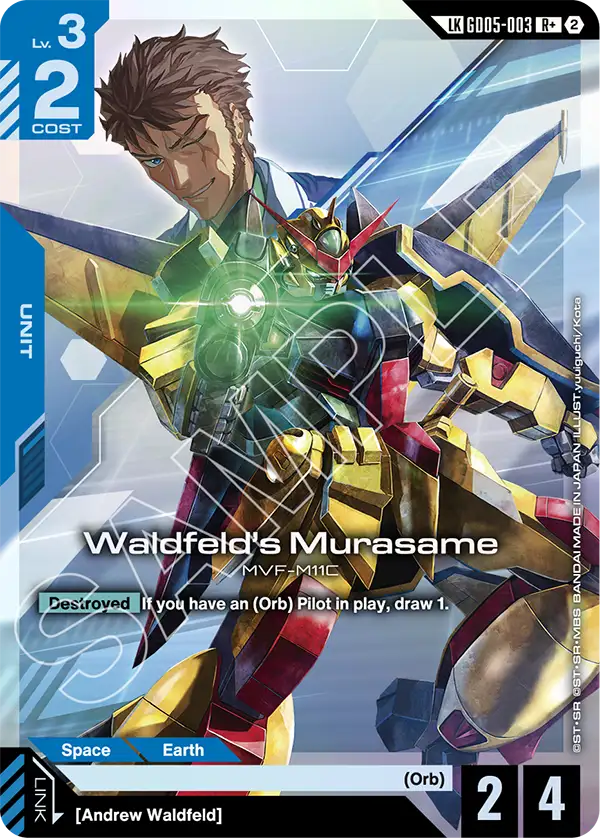
LKC, LKU and LKR are the newest codes in the database, and there are twelve of them in total: four LKC, three LKU, five LKR. Every single one is a GD05 card, and every single one carries the plus mark.
Bandai introduced them on the Freedom Ascension page: "The new 'Link Rare' rarity, featuring linked Units and Pilots, makes its debut! These cards will be included as parallel cards of cards featured in this set, with special designs showcasing memorable pairings."
Read that second sentence again, because it is the whole mechanic. Link Rares are not new cards. They are alternate-art printings of cards already in the set, redrawn so the Pilot appears alongside the mobile suit they link with.
Which raises the obvious question: if a Link Rare is a parallel of an existing card, what happens to that card's rarity? I checked all twelve against their base printings. The answer is completely consistent:
| Link code | Base card rarity | Cards |
|---|---|---|
| LKC | Common | Kayra's Re-GZ, Gundam Kyrios (Flight Mode), Force Impulse Gundam, Gundam Heavyarms Custom (EW) |
| LKU | Uncommon | Demi Barding, Gaia Gundam (MA Mode), Gundam Barbatos Lupus |
| LKR | Rare | Waldfeld's Murasame, Strike Rouge (Ootori), Haow Gundam, Quess's Jagd Doga, Gundam Sandrock Custom (EW) |
Twelve for twelve. LKC is the Link treatment on a Common, LKU on an Uncommon, LKR on a Rare. The code is the letters LK glued to the base rarity letter.
The printed card makes this even plainer than the database does. Look at the corner of Waldfeld's Murasame above: an LK badge in its own box, then GD05-003, then R+. The card says Rare. The database says LKR. Same information, written two ways - which, frankly, is a small inconsistency in Bandai's own tooling, since SP gets its own field but LK gets folded into the rarity string.
There is no Link treatment on a Legend Rare, and none on anything outside GD05. Whether GD06 changes that is worth watching.
The P bucket is 101 cards that do nothing
P is the promotional rarity, and at 102 entries it is the second-largest bucket after Common. That sounds like a serious chunk of the game. It is not.
I classified all 102 by card number prefix:
- RP-001 to RP-066 - 66 Resource cards
- EXBP - 21 EX Base cards
- EXRP - 14 EX Resource cards
- ST05-010_p2 - one promotional Mikazuki Augus
That is 101 Resources, EX Bases and EX Resources, and exactly one card you can actually put in a 50-card deck. The promo rarity in this game is, almost entirely, table flair - alternate art for the resource deck and for the two tokens you bring to every game.
None of the 102 carries an SP badge or a plus mark either. Promos sit outside the alternate-art system entirely, which makes sense once you realise they are the alternate art.
Where the alternate art actually lives
The card search has an "Included In" filter that maps every entry to the one product it comes from. Those product totals add to 1,816 exactly, so nothing is double-counted. Here are the main ones:
| Product | Entries | + | ++ | SP |
|---|---|---|---|---|
| Newtype Rising [GD01] | 179 | 37 | 3 | 0 |
| Dual Impact [GD02] | 187 | 43 | 3 | 0 |
| Steel Requiem [GD03] | 202 | 49 | 3 | 7 |
| Phantom Aria [GD04] | 194 | 47 | 3 | 5 |
| Freedom Ascension [GD05] | 197 | 60 | 5 | 16 |
| Eternal Nexus [EB01] | 108 | 16 | 1 | 0 |
| Edition Beta | 83 | 13 | 0 | 0 |
| Promotion card | 208 | 41 | 0 | 0 |
| Deck Build Box [SC01] | 51 | 0 | 0 | 0 |
The ten starter decks are deliberately left off that table because they are all the same shape: 32 to 39 entries each, 13 to 16 of them plus-printings, and zero double-plus, zero SP. If you want the starter deck breakdown, it is a separate piece.
Two things stand out. First, alternate art is climbing set over set - 37 plus-printings in GD01, 60 in GD05, a 62% increase across five sets. Second, the Deck Build Box has 51 entries and not a single alternate-art card among them. It is a pure gameplay product.
Edition Beta printings are not parallels
Here is the trap that will wreck your counting if you scrape this database yourself.
Alternate-art cards get a suffix on their card number - GD05-003 becomes GD05-003_p1, GD01-001 becomes GD01-001_p2. Natural conclusion: count the suffixed entries and you have counted the parallels.
You have not. Search the database for GD01 and you get 264 entries under 130 distinct card numbers, so 134 suffixed printings. But the GD01 booster product itself only accounts for 179 entries, and the plus, double-plus and SP filters together tag only 51 GD01-numbered cards.
The gap is Edition Beta. Pull up GD01-004_p1 and the detail page shows rarity R with no alternate-art mark at all, and under "Where to get it" it says Edition Beta. Its block indicator is the Greek letter beta instead of a number. It is an ordinary Rare Guncannon that happens to have been printed in a different box.
Edition Beta is a real Bandai product, not a fan nickname: an official limited box released 7 December 2024 at a $69.99 MSRP, containing 16 booster packs of 9 cards, a 56-card fixed set, one Legend Rare, two rule and playsheets, and six dice damage counters. It shipped ahead of the game's proper 2025 launch. It accounts for 83 database entries, every one of them a reprint of a GD01 card number.
So the suffix means "not the first printing of this card number." It does not mean alternate art, and it certainly does not mean rare.
How to read a card corner in three seconds
Everything above collapses into one habit. The strip along the top-right of every card reads left to right in four parts:
- A badge, if there is one. SP or LK, in its own box. Most cards have nothing here.
- The card number. GD05-003, ST01-010, R-002.
- The rarity, followed by zero, one or two plus marks.
- A block number.
Run it on the four cards in this article:
- SP | ST01-010 | C+ - an SP-treated alternate art of a Common.
- LK | GD05-003 | R+ - a Link parallel of a Rare.
- GD01-001 | LR++ - the premium printing of a Legend Rare.
- R-002 | C++ - the premium printing of a Common Resource.
Two of those four are Commons. That is the sentence to remember.
What Bandai does not publish
Pull rates. I could not find per-pack odds for the English release on any Bandai product page, news post or rules document. Every "one in X packs" or "one per case" figure circulating for this game comes from people opening product and counting, not from the publisher. Some of that community data may well be accurate; none of it is official, and I am not going to launder it into a number here.
Two more honest limits. Everything above counts database entries, which tells you how many distinct printings exist - not how many were physically made. A rarity with four entries is not necessarily four times scarcer than one with sixteen.
And these numbers have a shelf life. 1,816 entries, 18 double-plus cards, 12 Link Rares, all measured on 2 August 2026, when GD05 was the newest set. GD06 will move every row in every table here. The structure - two fields, a badge, a plus mark - is the part worth keeping.
Re-checked 31 August 2026: the database now returns 1,846 entries, all 30 of the additions landing in the Promotion card bucket. Nothing structural moved - still 18 double-plus, still 14 on Legend Rares and four on Common Resources, still 28 SP entries split 18 C / 4 U / 4 R / 2 LR, still 12 Link Rares and all of them GD05. Only the totals drift: the P rarity is now 109 entries and the single-plus mark 470.
If you are working out what to actually buy, the product and starter deck guide covers what is in each box, and the deckbuilding guide covers why none of this rarity structure affects deck legality - a Common plays exactly as well as its LR++ twin. If you have not played yet, start with the rules walkthrough.
Worth comparing, too, with how other modern TCGs have solved the same problem: Lorcana's rarity ladder keeps enchanted cards as a genuine top rung, and the Pokemon TCG's rarity system has spent years bolting extra tiers onto the top. Bandai went the other way and made the second axis explicit. It is a better design. It is just badly explained.
Frequently Asked Questions
What are the rarities in the Gundam Card Game?
Is SP a rarity in the Gundam Card Game?
What does LKR mean in the Gundam Card Game?
What is the rarest card in the Gundam Card Game?
What do the + and ++ marks mean on a Gundam card?
Are promo cards valuable in the Gundam Card Game?
Why do some Gundam cards have _p1 or _p2 in their card number?
How many alternate-art cards are in the Gundam Card Game?
Keep Reading
- GUNDAM CARD GAME Official Card Database (rarity and Alternate Art filters)
- Freedom Ascension [GD05] product page, including the Link Rare and LR++ announcements
- Newtype Rising [GD01] product page, with the per-rarity card-type breakdown
- GUNDAM CARD GAME Edition Beta product page (released 7 December 2024)
Related Guides
![Official key visual for the Gundam Card Game starter deck Aquatic Assault [ST11], showing Char's Z'gok with its claw arms extended against smoke and blue water.](/images/blog/gundam-tcg/gundam-card-game-starter-decks-guide/gundam-st11-aquatic-assault-key-visual-hero.webp)
Gundam Card Game Starter Decks and Products - Every ST Deck, What Is Actually in the Box, and What Ships Next
A Gundam Card Game starter deck is 50 cards but only 16 distinct card types - Bandai says so on the box. This is the full confirmed product slate as of August 2026: what is physically inside an ST deck versus a booster pack, which of the fourteen starters plays which colour pair, what the Ultimate Deck and Deck Build Box actually are, and which entry point is right for you. Every product name, date and MSRP checked against gundam-gcg.com, with the gaps in Bandai's own published info called out rather than filled in.
How to Play the Gundam Card Game - Resources, Shields, Pilots, and the Six-Card Life Total
Your entire life total in the Gundam Card Game is six face-down cards with 1 HP each, plus a token base with 3 HP. This is the complete rules walkthrough - the separate resource deck, the Level and Cost split, setup, the five card types, pairing Pilots into Link Units, the five phases, and combat - checked line by line against Bandai's Comprehensive Rules Ver. 1.8.0.
Can You Play the Gundam Card Game Online?
Bandai's free Gundam Card Game Teaching App has been on the App Store since June 2025, and nothing in its description or its eight updates describes playing another person. Here is what its two modes do, what it has and has not been updated with, and the webcam rules Bandai wrote into its Tournament Rules Manual for playing a real opponent online.
Gundam Card Game Timing Keywords: All 13 and When They Fire
Section 13-2 of the Gundam Card Game Comprehensive Rules defines 13 timing keywords, and 715 of the 956 main-deck cards open an effect with at least one. Here is what each one is, when it fires, how many cards print it, the colour it wears on the printed card, and the rulings that separate When Paired, During Pair, When Linked and During Link.
![The official Gundam Card Game Unit token T-029 Bit / Funnel from Silent Barrage [ST13]: a beige-framed token card showing purple, red-capped bit pods and magenta funnels firing white beams through a blue starfield, with the line This Unit can't be paired with a Pilot or attack, the Long-Range Weapon trait, and 2 AP and 2 HP along the bottom, under a SAMPLE watermark.](/images/blog/gundam-tcg/gundam-card-game-tokens-guide/gundam-t-029-bit-funnel-token-card.webp)
Gundam Card Game Tokens - All 29, and What to Bring
The English card database holds 29 Unit tokens and 32 deck cards that make them, and Bandai's own Aquatic Assault build needs three token cards from a different starter deck. Here is every token, every card that makes one, the six-copy rule, what three Bandai documents say about substitutes, and where the database gets its own tokens wrong.
How to Qualify for the Gundam Card Game World Championships
Eleven of the 22 Season 2 Regionals on Bandai's World Championships 26-27 calendar have been played, and the rest run from 3 October to 20 December 2026. Here is every route to an Area Finals seat - the Top 16 invite, the Store Championship lottery and its attendance cliffs, the Last Chance Qualifiers in Orlando and London, the open finals in Latin America and Oceania - plus the one Regional that falls inside Stardust Trails' first week, and a Season 2 prize ladder that turns out to be one Zeong board handed out in pieces.