Half-Life 2 RTX Update #4: DLSS 5, 6x Frame Gen and ARM
On October 23, 2026, after 533 days with nothing new on its Steam feed, the Half-Life 2 RTX demo moved onto NVIDIA's RTX Remix 1.6 runtime. No new levels, seven listed changes, and three of them split by GPU generation. Here is what each one does, which cards Orbifold and NVIDIA name for it, and why shipping the headline feature switched off makes sense.
The Half-Life 2 RTX demo's Steam feed sat silent for 533 days after its May 8, 2025 update. Then Orbifold Studios posted Update #4 at 15:32 UTC on October 23, 2026, twenty minutes after NVIDIA published RTX Remix 1.6 on GitHub. Orbifold's post says up front what it isn't: "a technical update to the existing demo, with no additional levels or content."
So it is still the same Ravenholm and Nova Prospekt slice. What changed is the renderer underneath. The update "brings the demo onto the latest RTX Remix runtime," and that runtime brought seven listed changes with it. Three of them are gated by GPU generation, and the headline feature is switched off when you load in.
If you need the basics first, meaning what the demo covers, what it costs and what it asks of your PC, the Half-Life 2 RTX demo guide has them. For Valve's own video options in the base game, see the graphics settings guide. This page covers what Update #4 changed and which of it your card can use.
The short answer
| Change | What it does | Hardware named |
|---|---|---|
| Windows on ARM | The demo runs on "compatible Windows on ARM systems" | NVIDIA's runtime notes name RTX Spark as an ARM64 platform |
| DLSS 3D-Guided Neural Rendering | An optional AI rendering pass that adjusts lighting and material detail. Disabled by default | "Supported hardware". NVIDIA ships the feature as DLSS 5 |
| Frame Generation Preset C | A faster "Performance Mode" for frame generation | GeForce RTX 40 and RTX 50 Series, RTX Spark laptops |
| Multi Frame Generation 5x and 6x | Up to five generated frames for each rendered one | Supported GeForce RTX 50 Series GPUs |
| Sparse Rendering | Calculates fewer lighting samples and has DLSS Ray Reconstruction rebuild the image | None named |
| SHaRC | A second indirect-lighting cache, alongside NVIDIA's Neural Radiance Cache | None named |
| Shadow terminator fixes | Less jagged self-shadowing on curved and low-polygon surfaces | None named |
The seven changes and the hardware each one names come from Orbifold's post. The RTX Spark note, the DLSS 5 name and the frame count for 6x come from NVIDIA.
Press Alt+X in game for the RTX Remix settings. Orbifold adds that "Available options depend on your hardware and driver," and NVIDIA's Remix 1.6 release notes raise the runtime's minimum NVIDIA driver to 616.92. Update the driver before you go looking for the new options.
What your card can actually use
Line the table up against the demo's own system requirements and the update splits by GPU generation. The Steam page still lists an RTX 3060 Ti as the minimum and an RTX 4070 as recommended, both with DLSS on.
- RTX 50 Series: every change except the ARM support, which is for ARM machines. It is the family Orbifold names for 5x and 6x Multi Frame Generation, and a family NVIDIA names for DLSS 5.
- RTX 40 Series, including the recommended RTX 4070: Preset C frame generation, plus the three changes with no hardware named: sparse rendering, SHaRC and the shadow fixes. Orbifold names RTX 50 Series for the 5x and 6x modes. NVIDIA's September 1, 2026 DLSS 5 launch article and its October 13 follow-up name RTX 50 Series GPUs for DLSS 5, and the October one adds RTX Spark laptops. Neither names the RTX 40 Series for DLSS 5.
- RTX 30 Series, including the minimum RTX 3060 Ti: sparse rendering, SHaRC and the shadow fixes. None of the three frame generation and neural rendering additions is named for it.
- RTX Spark laptops: NVIDIA's notes name RTX Spark as an ARM64 platform for Remix, Orbifold names the laptops for Preset C, and NVIDIA's October 13 article names them for DLSS 5.
That is the awkward line in this patch. Neither headline feature is named for the demo's own recommended GPU.
DLSS 4.5 or DLSS 5? Both, under one headline
Orbifold's headline says "DLSS 4.5". That label fits the 5x and 6x modes. NVIDIA introduced DLSS 4.5 at CES in January 2026 and released 6x Multi Frame Generation as part of it on March 31, 2026. NVIDIA describes it as "generating five additional frames for every natively rendered frame" on RTX 50 Series GPUs, and the Remix runtime's option for the frame multiplier is documented as being "For DLSS 4.5 frame generation".
The neural rendering mode is another matter, and NVIDIA doesn't call that 4.5. Its RTX Remix 1.6 release notes file it under "DLSS 5 Integration", alongside Preset C. Its October 13 article announced that "On October 23rd, we're adding DLSS 5 with the new, faster 3D-Guided Neural Rendering model" to RTX Remix, together with the faster frame generation Performance Mode. Orbifold's bullet is titled "DLSS 3D-Guided Neural Rendering", the same feature under its technical name.
If you searched for DLSS 5 in Half-Life 2 RTX: this is it, under a quieter label.
3D-Guided Neural Rendering ships switched off
NVIDIA's DLSS 5 launch article describes the feature as a final rendering stage. It takes the frame's colour and motion vectors and uses AI to generate lighting and material detail, such as subsurface scattering in skin, light through hair and foliage, and deeper contact shadows. Its job is not resolution or frame rate. It changes what the picture looks like.
The runtime's option reference, at the remix-1.6.1 tag, makes that concrete. The feature comes in three model variants, A, B and C, and the reference says their "appearance is content-dependent". Separate strength controls cover "details, shadows, and materials", "lightness, darkness, and color", and the structure of characters. The runtime's own defaults put structure at 0.7 and tone at 0.3 on a 0 to 1 scale, though a mod can ship its own values.
Orbifold ships it off, and for this project that is the right default. In May 2025 Orbifold relit the demo, "directly addressing community feedback regarding light levels and fog intensity," and wrote that the changes resulted in "Ravenholm being darker, with more intentional authorship of light and shadow." 3D-Guided Neural Rendering has a control whose whole job is adjusting "lightness, darkness, and color". Switching it on hands part of that hand-tuned lighting to an AI pass.
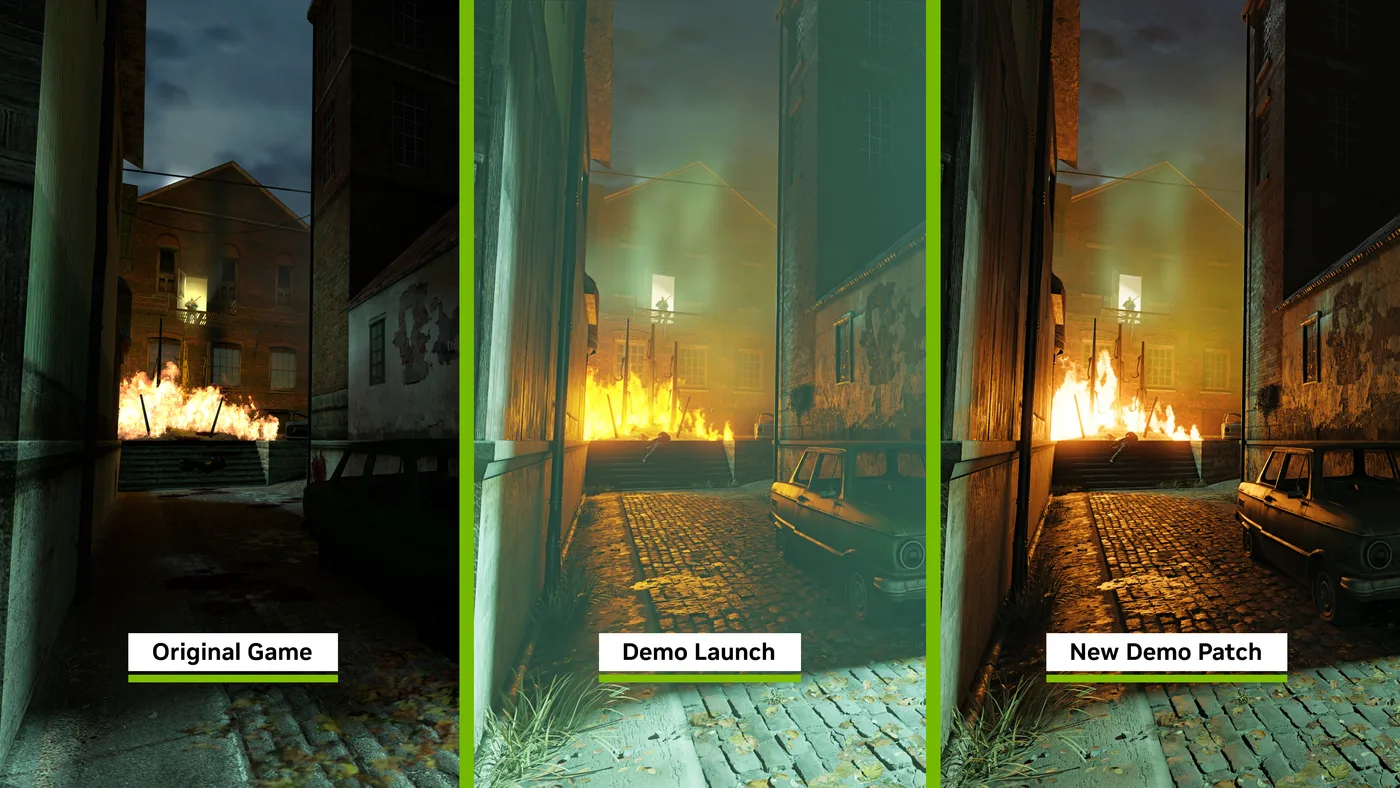
That is Orbifold's own before-and-after from the May 2025 relight. None of this makes neural rendering bad. It makes it a taste call. On an RTX 50 card, switch it on in a scene like that alley, switch it off again, and decide which version you would rather play through. NVIDIA's instructions for Remix put the switch in the Developer Settings menu, reached from the Alt+X overlay.
Frame generation: 6x for RTX 50, a lighter model for RTX 40
Two of the seven changes are frame generation, and they solve different problems.
5x and 6x Multi Frame Generation raise the ceiling on RTX 50 cards. In NVIDIA's terms, 6x generates five frames for each one the GPU actually renders. More generated frames push the frame counter up, not responsiveness: the runtime's own description of frame generation says it raises frame rate "at the cost of slightly more latency." Treat the higher multipliers as a way to fill a high-refresh display, not as a fix for a low base frame rate.
Preset C is the frame generation change RTX 40 owners get. NVIDIA's October 13 article says this Performance Mode "replaces the second AI model with a faster and lighter algorithm," trading a little image quality for frame rate, and puts it at "up to 35% faster" on an RTX 5060. That is NVIDIA's figure, and it isn't a measurement of this demo. The runtime calls it "Preset C (lightweight model)", against the standard Preset A, and its option reference has Preset A as the default.
Sparse rendering and SHaRC: fewer rays, more reuse
Both of these work on the expensive part of a path tracer, which is the lighting.
Sparse rendering takes lighting samples for only part of the screen and has DLSS Ray Reconstruction reconstruct the rest. The runtime's reference says it "applies a constant per-pixel sampling rate across the screen" and that "DLSS Ray Reconstruction is required." Its reference rate, set for the Ultra preset at 4K with DLSS Auto, is 0.357, which means fresh lighting samples for roughly a third of the pixels. By default the rate adapts to your resolution, and the runtime turns sparse rendering off once the rate climbs past 0.75, because above that "the performance gain is no longer worth the loss in image quality." In the runtime's defaults, sparse rendering itself is off.
SHaRC, the Spatially Hashed Radiance Cache, is the other one. The demo launched with NVIDIA's Neural Radiance Cache, which NVIDIA said in March 2025 ran "up to 15% faster in Half-Life 2 RTX." The runtime describes NRC as "an AI based world space radiance cache" that is "live trained by the path tracer." SHaRC does the same job with a hash table instead of a neural network: it "uses a spatial hash to store radiance and allows paths to terminate early by looking up cached values." NVIDIA merged SHaRC v1.8.3 into the Remix runtime's code on October 7, 2026.
One wrinkle. In the 1.6.1 option reference, SHaRC is the runtime's default indirect lighting mode. Orbifold's post calls it "an alternative indirect-lighting caching option alongside NVIDIA's Neural Radiance Cache (NRC)" and doesn't say which one the demo starts on. Check the Alt+X menu rather than assuming.
The shadow fix targets low-poly curves
Orbifold's last bullet reads: "Reduced jagged self-shadowing artifacts on curved and low-polygon surfaces." The runtime's option reference describes two fixes behind it. One offsets the shadow ray's starting point along the triangle's vertex normals so a surface stops shadowing itself, which "helps to remove the triangular shadow artifacts on a terminator region." The other softens "the harsh transition on a shadow terminator" where the geometry normal and the shading normal disagree.
The terminator is the line where a curved surface turns from lit to unlit. On a low-polygon model that line follows the triangles instead of the curve, which is where the jagged shadow comes from.
The reference is upfront about the trade-off: the offset "may introduce a noticeable light leaking if the geometry is low-poly." Both fixes are on by default in the runtime, and neither appears in the option reference for the previous release, remix-1.5.2.
Windows on ARM and RTX Spark
Orbifold's line is short: "Added support for compatible Windows on ARM systems." NVIDIA's Remix 1.6 notes say more. The runtime gained Windows on Arm support with public ARM64 and ARM64EC builds, and "Day 1 support for Portal RTX, Half-Life 2 RTX Demo and RTX Remix for Minecraft (Beta)." The same notes name the hardware they had in mind: "ARM64 platforms such as RTX Spark."
RTX Spark is NVIDIA's superchip for Windows PCs, and the first RTX Spark laptops went on sale on October 16, 2026, a week before this update. NVIDIA's availability release lists machines from ASUS, Dell, HP, Lenovo, Microsoft and MSI, built on "a single superchip combining an NVIDIA Blackwell RTX GPU and an NVIDIA Grace CPU." NVIDIA's gaming article puts the GPU at up to 6,144 CUDA cores and the CPU at up to 20 cores.
Two caveats. The Steam store's system requirements haven't changed: they still list Intel and AMD processors and desktop RTX cards, with no ARM entry. And neither Orbifold's post nor NVIDIA's release notes give a frame rate for the demo on RTX Spark. The platforms guide covers where Half-Life 2 itself runs.
What Update #4 does not change
- The levels. It is the same demo of the "We Don't Go To Ravenholm..." and Nova Prospekt chapters. Orbifold's words: "no additional levels or content."
- The full game's status. Orbifold's post says nothing about the full remaster or a release date, and the official Half-Life 2 RTX site gives no release date either.
- The listed requirements. RTX 3060 Ti minimum, RTX 4070 recommended, both with DLSS on, 50 GB of storage, and 64-bit Windows 10 or 11.
- What Orbifold says about AMD. Its post doesn't mention AMD. NVIDIA's runtime notes do: the runtime now defaults AMD cards on Windows to its TraceRay path, which community measurements put at roughly 20% faster, from 53 to 63 fps. The notes don't name the game behind that measurement, so read it as a runtime change rather than a Half-Life 2 RTX benchmark.
Quick Action Checklist
- Update your NVIDIA driver to 616.92 or newer. NVIDIA's Remix 1.6 notes set that as the minimum for the runtime this update moved to.
- Press Alt+X in the demo for the RTX Remix settings. What you see there depends on your GPU and driver.
- RTX 50: try 3D-Guided Neural Rendering, the feature NVIDIA brands DLSS 5. It is off by default. Compare it on and off in a dark Ravenholm scene before you keep it.
- RTX 50: 5x and 6x Multi Frame Generation are new. Use them to fill a high-refresh display, not to rescue a low base frame rate, since generated frames add slight latency.
- RTX 40: Preset C is your new frame generation option. NVIDIA says it is up to 35% faster on an RTX 5060, at a small image-quality cost.
- Any RTX card: sparse rendering needs DLSS Ray Reconstruction on, and SHaRC is an alternative to the Neural Radiance Cache. Orbifold doesn't say which cache the demo starts on.
- Don't expect new levels. Update #4 is "a technical update to the existing demo, with no additional levels or content."
- On an RTX Spark laptop, the demo is supported on Windows on ARM from this update, though the Steam requirements don't list it yet.
Frequently Asked Questions
What did Half-Life 2 RTX Update #4 change?
Does Half-Life 2 RTX have DLSS 5?
Does Half-Life 2 RTX Update 4 add new levels?
Does Half-Life 2 RTX run on Windows on ARM?
Which GPUs get 6x frame generation in Half-Life 2 RTX?
What is SHaRC in Half-Life 2 RTX?
Keep Reading
- Steam — Half-Life 2 RTX "Update #4: DLSS 4.5, ARM Support & Rendering Improvements" (Orbifold Studios, October 23, 2026): the seven listed changes, "no additional levels or content", and Alt+X for the RTX Remix settings
- NVIDIA — RTX Remix Release 1.6 notes (GitHub, October 23, 2026): "DLSS 5 Integration", 5x and 6x Multi Frame Generation, sparse rendering, Windows on Arm with day one support for the Half-Life 2 RTX Demo, minimum driver 616.92, and the AMD TraceRay default
- NVIDIA — RTX Remix runtime option reference at the remix-1.6.1 tag: DLSS 3D-Guided Neural Rendering models and strength controls, Frame Generation Preset C, sparse rendering rates, SHaRC and NRC descriptions, and the shadow terminator options
- NVIDIA — RTX Remix runtime option reference at the previous remix-1.5.2 tag, which has no shadow terminator, sparse rendering or SHaRC options
- NVIDIA — dxvk-remix commit "Integration of SHaRC v1.8.3 with support for Sparse Rendering, debug views and imgui controls" (October 7, 2026)
- NVIDIA — "DLSS 5 Comes To Hogwarts Legacy & RTX Spark, Powered By 2X Faster Model" (October 13, 2026): DLSS 5 and Frame Generation Performance Mode coming to RTX Remix on October 23, and Performance Mode for RTX 40 and 50 Series and RTX Spark laptops
- NVIDIA — "NVIDIA DLSS 5 Available Now: 3D-Guided Neural Rendering Debuts In NBA 2K27 For All GeForce RTX 50 Series GPUs, And On GeForce NOW" (September 1, 2026): what 3D-Guided Neural Rendering does and its RTX 50 Series support
- NVIDIA — "DLSS 4.5 Dynamic Multi Frame Generation & Multi Frame Generation 6X Available Now" (March 31, 2026): DLSS 4.5 introduced at CES in January 2026, and 6X mode generating five frames per rendered frame on RTX 50 Series GPUs
- NVIDIA — "NVIDIA RTX Spark PCs Available Today" press release (October 16, 2026): Blackwell RTX GPU and Grace CPU superchip, laptops from ASUS, Dell, HP, Lenovo, Microsoft and MSI
- NVIDIA — "RTX Spark Launches With Hundreds Of Top Games On October 16" (October 13, 2026): up to 6,144 CUDA cores and a Grace CPU with up to 20 cores
- NVIDIA — Half-Life 2 RTX demo launch article (March 18, 2025): Neural Radiance Cache running up to 15% faster in Half-Life 2 RTX
- Steam — Half-Life 2 RTX "Update #3: Lighting, Fog & Additional Fixes" (May 8, 2025): the relight leaving "Ravenholm being darker", and the three-panel comparison images
- Steam — Half-Life 2 RTX store page: free mod by Orbifold Studios, Windows-only, RTX 3060 Ti minimum and RTX 4070 recommended with DLSS on, 50 GB
- Official Half-Life 2 RTX site (Orbifold Studios): no release date for the full remaster
Related Guides
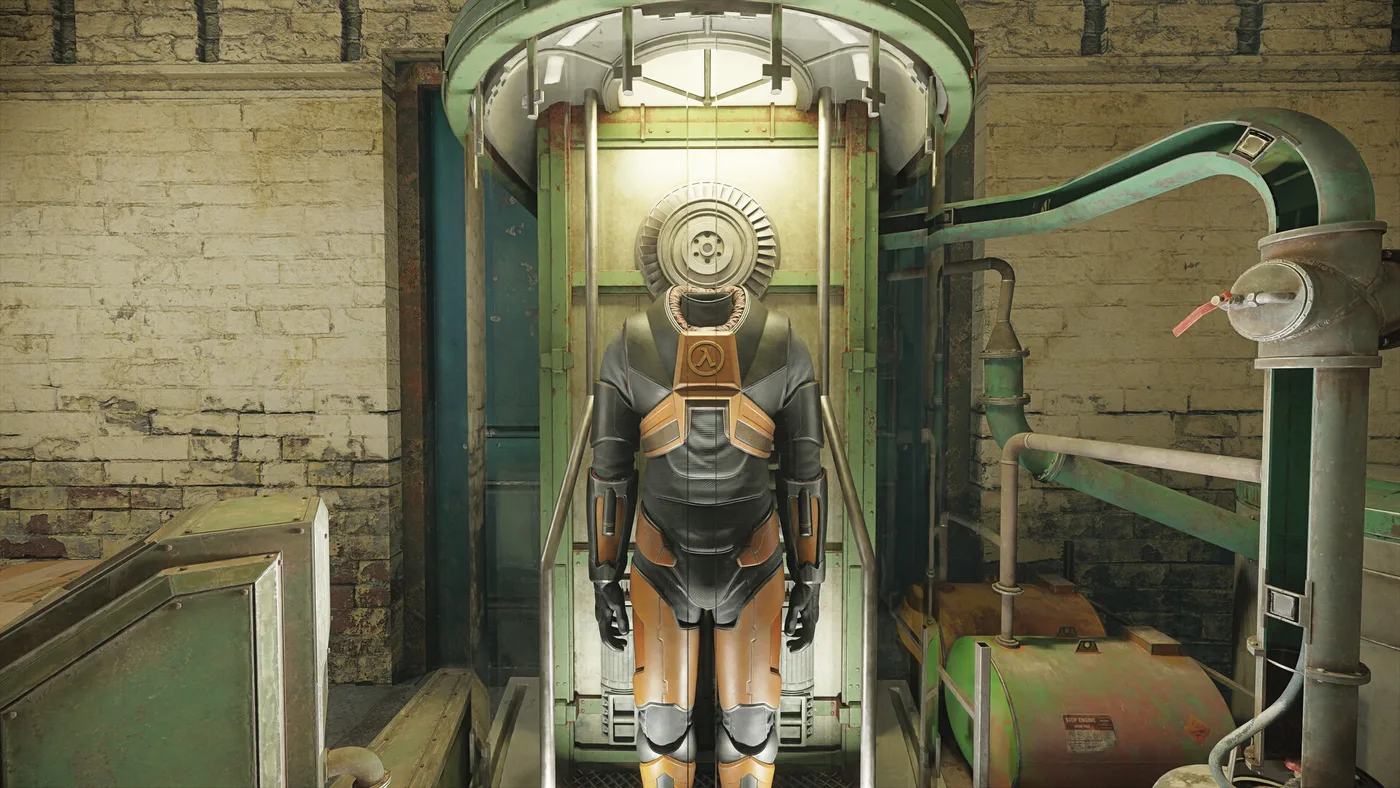
Half-Life 2 RTX: Is It Out? What the Demo Contains
Half-Life 2 RTX was announced at gamescom 2023. Three gamescoms later, with the 2026 show closing today, the only thing you can install is a two-chapter demo that has not been patched since May 2025. Here is exactly what exists, what it needs, and what has never been dated.
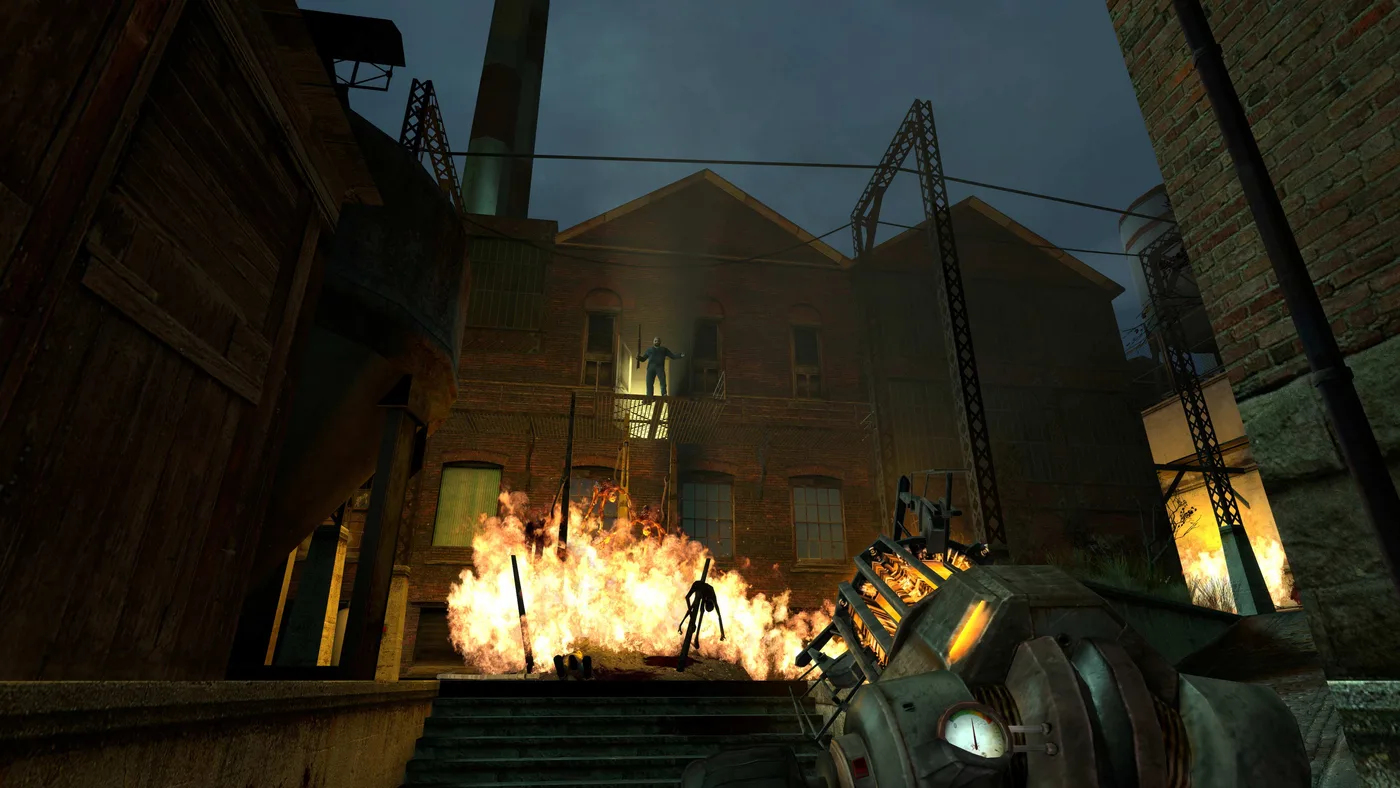
Half-Life 2 Graphics Settings: What the New Options Do
Valve's 20th Anniversary Update put bicubic lightmap filtering behind Shader Detail's Very High setting, added a Classic Effects toggle that only works in the base game, and moved HDR to the main Video tab. What each Half-Life 2 video option does now, what to set it to, the launch options worth knowing, and the graphics bugs still open on Valve's tracker.
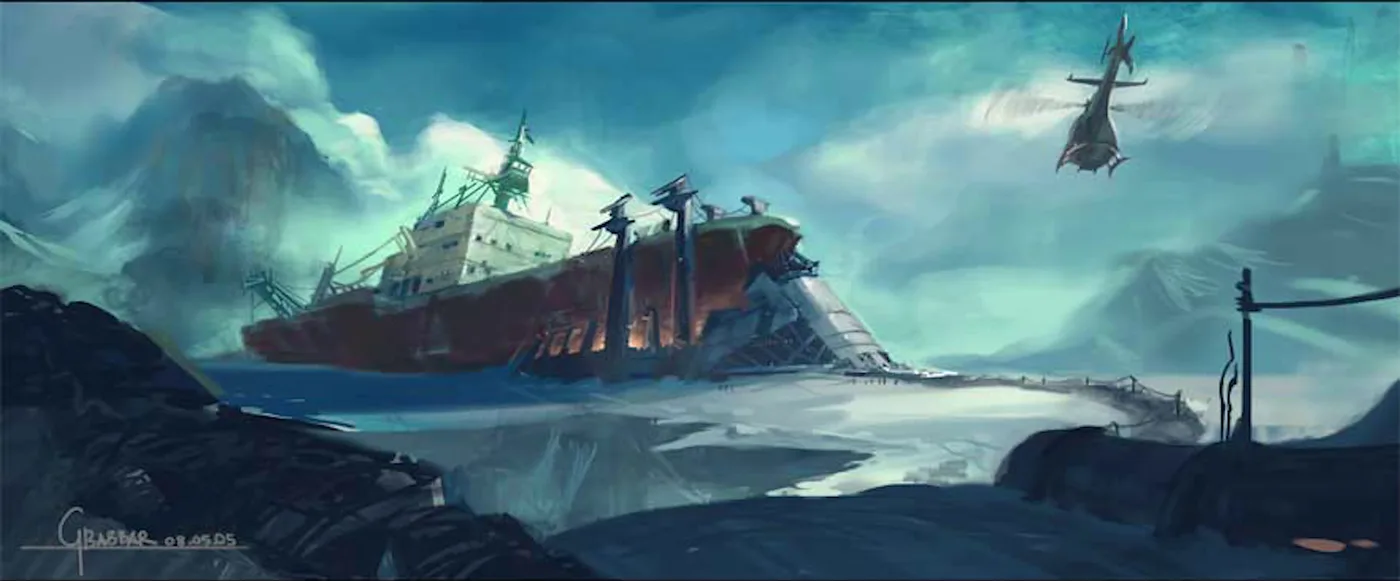
Half-Life 2 Episode Three: What Was Built and Why It Died
Valve promised the Half-Life 2 trilogy would end by Christmas 2007. Episode Three never shipped, and neither did the two Ravenholm projects Junction Point and Arkane built for Valve. Here is what each project contained, the code Valve still publishes, and the reasons the developers have given on the record, up to an August 2026 interview.
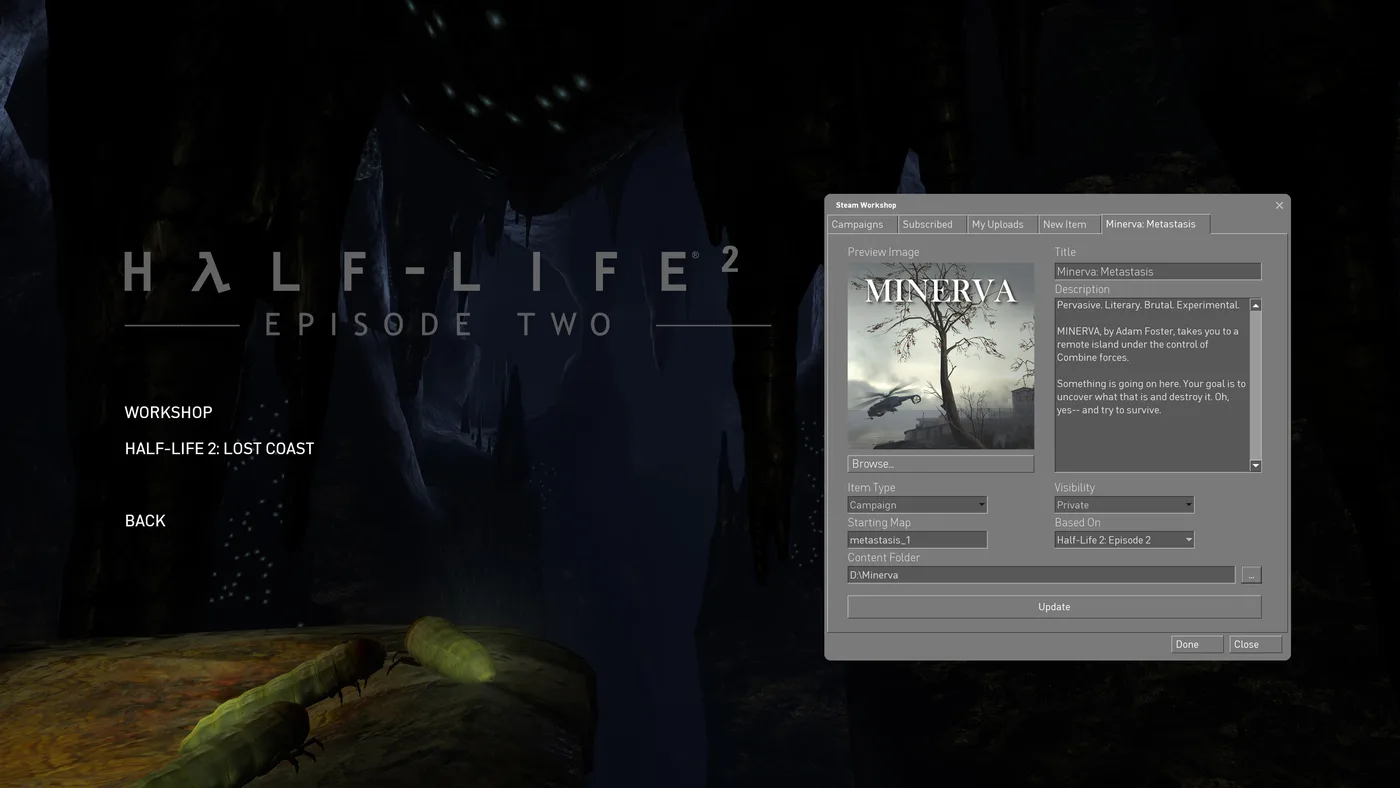
Half-Life 2 Steam Workshop: Campaigns, Addons, Known Bugs
Half-Life 2 has had a Steam Workshop in its Extras menu since November 2024, and it held 12,469 items on October 11, 2026. Here is how Campaign and Content items load differently, how to start a Workshop campaign, what people actually subscribe to, and the bugs still open on Valve's tracker.

Half-Life 2 Beginner's Guide: Start Strong in City 17
Half-Life 2 never stops to explain itself, which is why new players stall in Ravenholm with no shotgun ammo and no idea the gravity gun was the answer. Here is the chapter map, the systems the game hides, and the mistakes that waste your first playthrough.
Half-Life 2 Episode Achievements: All 36, and the Hard Ones
Half-Life 2's Steam page now lists 69 achievements, not 33. The 20th Anniversary Update brought in the Episodes' 36. Here is every one of them, which game each actually counts in, which ones a reload can rescue, and the runs that need planning.