Half-Life 2 Episode Three: What Was Built and Why It Died
Valve promised the Half-Life 2 trilogy would end by Christmas 2007. Episode Three never shipped, and neither did the two Ravenholm projects Junction Point and Arkane built for Valve. Here is what each project contained, the code Valve still publishes, and the reasons the developers have given on the record, up to an August 2026 interview.
On June 8, 2006, Valve put a deadline on the end of Half-Life 2. Episode One had just topped European retail charts, and Valve's press release called it the first in a trilogy of episodes that would "conclude by Christmas of 2007." Gabe Newell, quoted in the same release, pitched the episodic plan as a way to show players what happened after the Citadel blew up within 18 months, instead of making them wait six years.
Episode Two shipped on October 10, 2007, inside The Orange Box. Episode Three never shipped. It also wasn't the only Half-Life 2 follow-up that died. Two outside studios, Warren Spector's Junction Point and Arkane, each worked on a Ravenholm project for Valve, and Valve cancelled both.
This vertical's episodes guide covers the two episodes you can play, and gives Episode Three a single paragraph at the end. This page covers the rest: what Valve actually built, the Episode Three source code Valve still publishes, the reasons the people involved have given on the record, and what turned up in 2026.
The short answer
| Project | Built by | When | What it was | What happened |
|---|---|---|---|---|
| Half-Life 2: Episode Three | Valve | Announced 2006. Combine OverWiki dates the earliest concept art to 2005 | The trilogy's finale, set in the Arctic around the Borealis | Put down when the team moved to Left 4 Dead, never picked back up |
| Junction Point's episode | Junction Point Studios, Austin | Between late 2005 and mid-2007, per PC Gamer | Ravenholm before it fell, and Father Grigori's backstory | Cancelled by Valve. Disney bought the studio in July 2007 |
| Ravenholm | Arkane Studios | 2006 to 2007, per Combine OverWiki | Adrian Shephard and Father Grigori fighting through a zombie-infested city | Cancelled by Valve. Noclip released footage in 2020 and 2022 |
None of the three was ever released. What exists is concept art, prototype footage, a few source files and a lot of interviews, and that's what the rest of this page works through.
Episode Three: what Valve actually built
The best official look at Episode Three is the last section of the Half-Life 2: 20th Anniversary Documentary, which Valve posted to its YouTube channel on November 15, 2024. Secret Tape made it, and the chapter list in Valve's own description puts "Epilogue: The Episodes" at 1:46:23.
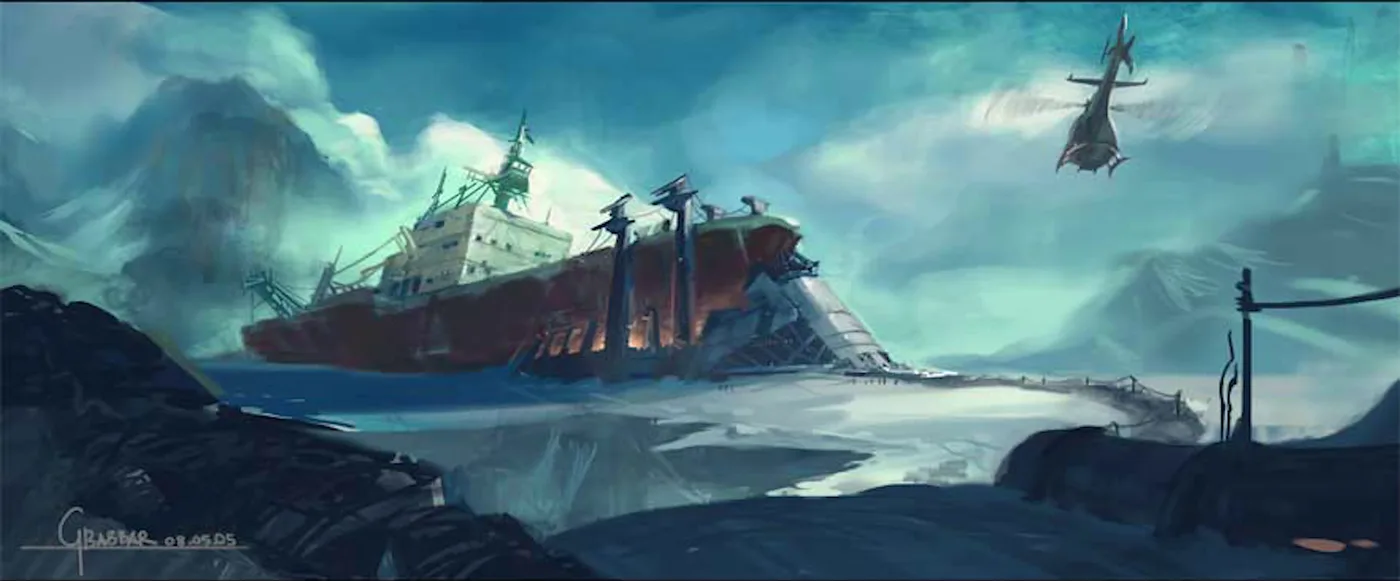
80 Level's write-up of that segment makes one thing clear before anything else. There was no narrative timeline, just a collection of playable levels in no particular order and a pile of story concepts, with the story set in the Arctic around the Borealis. The hero image above is one of those concepts. Combine OverWiki's file record transcribes the signature in its corner as "GBabbar 08.05.05" and credits it to Gautam Babbar.
Two prototypes carry the footage.
The Ice Gun. According to 80 Level, it built ice walls that could shield you from enemies. A second mode, called Silver Surfer, extruded a strip of ice you could run along to cross gaps. Combine OverWiki adds that the footage shows it working alongside the SMG and the pulse rifle rather than replacing them, and freezing Combine soldiers when fired straight at them.
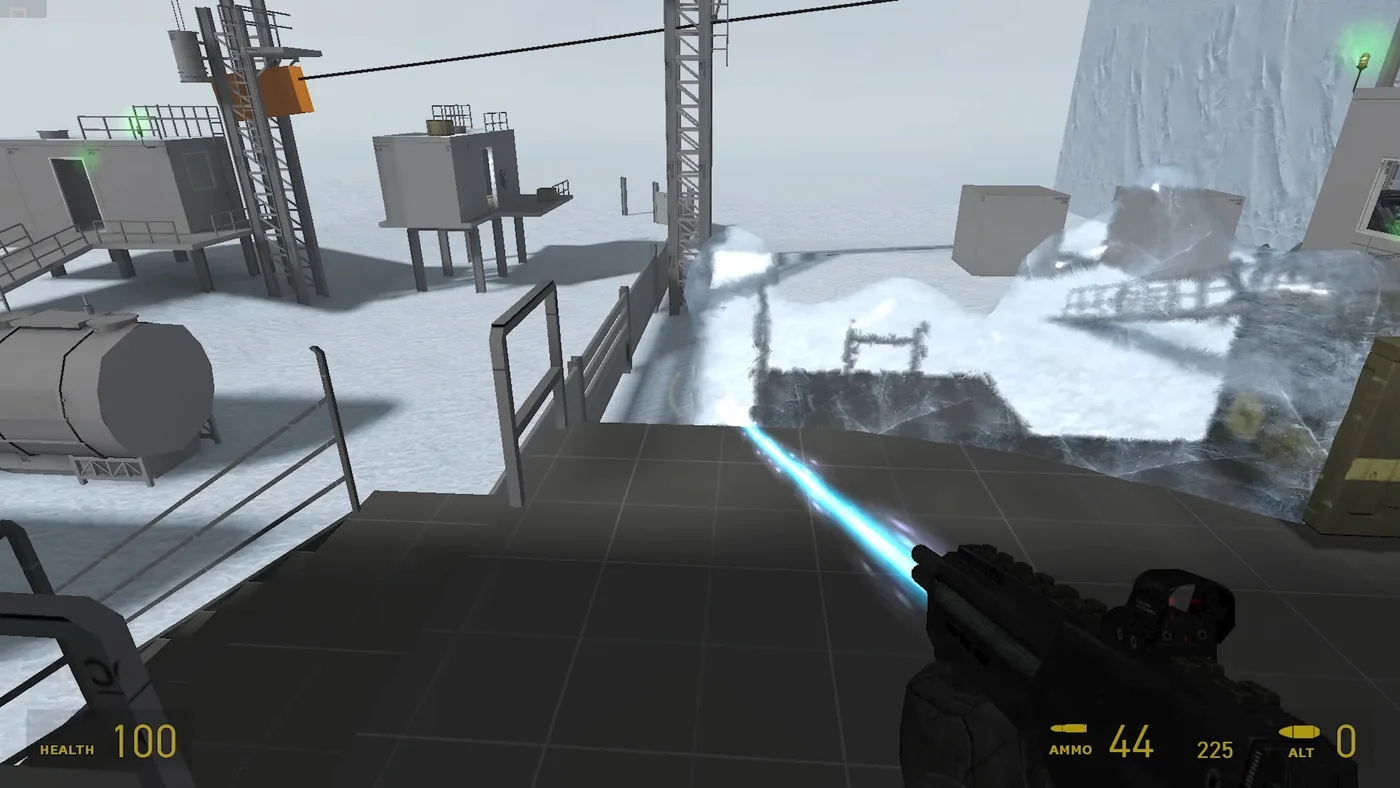
That shot shows the gun pushing a slab of ice out from a platform edge in a grey, barely textured test map. It's the most Half-Life idea in the whole project. Half-Life 2 handed you a gun that turned the room into ammo, and Episode Three's prototype handed you one that turned the room into terrain.
The Blob. 80 Level describes an enemy that could change shape, split into small hopping blobs, pass through grates, and absorb objects and creatures.
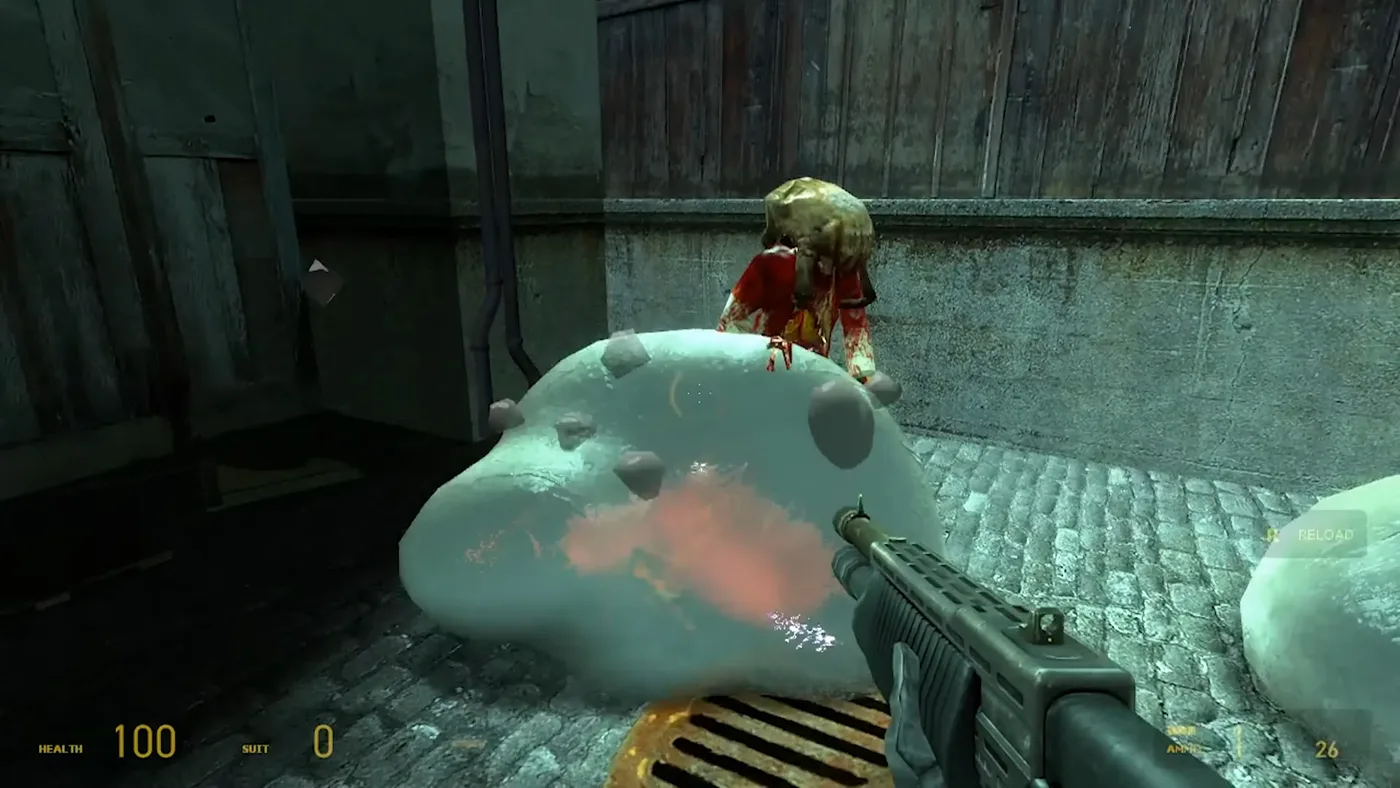
Combine OverWiki says this shot was taken in a modified Ravenholm map, which is why a Half-Life 2 zombie is the thing getting absorbed.
Beyond the footage, it gets murkier. Combine OverWiki's Episode Three page lists more planned weapons, including one called the Weaponizer, a flamethrower, a pipe bomb launcher and a flechette gun. That list is drawn from leaked code rather than anything Valve published. It also says Valve released pieces of Episode Three concept art in November 2007 and July 2008 to tease the game.
The Episode Three code Valve still publishes
You don't need a leak to read some of this. Valve's public Source SDK 2013 repository on GitHub has a folder at src/game/server/episodic/Episode3. It arrived on February 18, 2025, in the commit that added the Team Fortress 2 SDK, and it holds three files. Combine OverWiki points to a 2008 Steam forum thread about the same three files turning up in a beta, and says all three ideas were later cut from the project.
| File | Valve's own comment | What the code does |
|---|---|---|
weapon_proto1.cpp | The header still reads "357 - hand gun" | Primary fire is a hitscan bolt whose damage is set to whatever health the target NPC has left, so in the code's own terms a hit is a kill. It punches through world geometry up to 24 units thick to reach whatever is behind it. Secondary fire eats a physics prop of mass 250 or less and turns it into one round. With no physics object in front of it, secondary fire sends out a sonar ping instead, which marks hostile NPCs within 1,200 units |
npc_wpnscanner.cpp | "Scanner with a gun" | A City Scanner model with 30 health that fires bolts at 1,300 units per second for 5 damage each |
npc_combine_armored.cpp | "Heavily armored combine infantry" | A Combine soldier wearing five separate physics armour pieces: both thighs, both upper arms and the chest |
Proto1 is the one worth reading. You get 3 rounds when you pick it up and 1 per prop you feed it, and the code prints "GULP!" to the console every time it eats something. Read it next to the gravity gun guide and you can watch Valve circling the same idea again: the room is your ammo.
The Blob's code has been public for longer, and it sits elsewhere. src/game/server/hl2/npc_blob.cpp has been in the SDK since its first commit on June 26, 2013, and its header calls it an "experimental, cpu-intensive monster made of lots of smaller elements." The file itself never says Episode Three. Combine OverWiki identifies npc_blob as the Blob from the footage, and the code fits the description:
- It's a swarm. The blob is built from 20 separate elements by default, each drawn with a model from a list. The default pick is
w_squeak.mdl, the Snark from the first Half-Life. - Its health is maxed out. The code sets it to 2,147,483,647, the largest value a signed 32-bit integer can hold.
- It eats. When the centre of the swarm gets within 32 units of an enemy, a non-Combine target takes 5 slashing damage every think, and the blob thinks every 0.025 seconds by default. That works out to 200 damage a second.
- Combine targets get special treatment. Code flagged by a variable named
m_bEatCombineHackmakes a Combine target react as if hit by bugbait, then sets its health to zero three seconds later.
None of this is Episode Three as it would have shipped. It is prototype code: experiments from along the way, some of them cut before the project stopped, not the game Valve stopped making.
Why Episode Three stopped
Three people who were there have explained it on the record, a fourth account comes from a book, and the explanations fit together.
The Left 4 Dead detour. In the documentary, engineer David Speyrer says the team was about six months into Episode Three when it put the episode down to help on Left 4 Dead, which came out on November 17, 2008. VGC's write-up quotes the rest of his account. By the time anyone considered going back, the argument was that they had missed the window. Speyrer also said they could definitely have gone back and spent two years finishing it.
Newell was stumped. In the same documentary, Gabe Newell calls it his own failure: "My personal failure was being stumped." He says he couldn't figure out why doing Episode Three was pushing anything forward.
It had outgrown the format. Kotaku reported in March 2020 that when work on Episode Three began, nobody could come up with a unifying idea, and Robin Walker told it that at that point the team felt Episode Three's scope "couldn't just be an episode" and had to be much bigger. He also said there was never a document setting out what Episode Three would be, and that multiple teams tried without anything sticking.
The engine. Combine OverWiki, citing The Final Hours of Half-Life: Alyx, says the team was struggling in 2008 to find new gameplay ideas within the limits of the Source engine.
Put those together and the irony is hard to miss. The whole case for episodes was speed, and the June 2006 press release made it in Newell's own words. In Walker's telling, the finale had already outgrown the small format when work on it began. By the time the team came back from Left 4 Dead, an episode-sized ending no longer looked worth making, and, per Combine OverWiki's summary of the documentary, a sequel-sized one needed a new engine. Half-Life: Alyx, the next Half-Life game Valve shipped, arrived in 2020.
Epistle 3 is not Episode Three
Marc Laidlaw, the series writer, left Valve in 2016. In August 2017, per Combine OverWiki, he posted a short story called Epistle 3 on his website: a letter from a "Gertie Fremont" with its characters renamed and genderswapped. Swap the names back and it's a trip to the polar ice to find the Borealis, which turns out to be phasing in and out of existence inside a Combine installation. Breen's consciousness turns up in a slug-like host body, Mossman is a prisoner, and the ship itself becomes the plan.
It got read as the Episode Three plot. Two people who were there have said it wasn't:
- Robin Walker, in the same Kotaku interview, said he remembered thinking it wasn't what they had been planning at all. He described it as the kind of idea dump he had seen from Laidlaw before.
- Laidlaw himself told Rock Paper Shotgun in March 2023 that he regrets publishing it. He said it caused trouble for his former colleagues and gave the false impression that Episode Three would have looked like his outline, when the real story only gets developed while the game is being made.
Combine OverWiki says the story was taken down from Laidlaw's site around May 2022. The story and lore guide already treats it as non-canon, and the two accounts above back that up.
Junction Point's episode: Ravenholm before it fell
The earlier of the two outside projects came from Junction Point Studios, the Austin studio Warren Spector founded after leaving Ion Storm Austin. PC Gamer reported in November 2017 that it worked on an additional Half-Life 2 episode somewhere between the end of 2005 and mid-2007, and that Valve cancelled it.
Spector told PC Gamer the whole episode would have been about Ravenholm. The team wanted to tell how the town became what it is in Half-Life 2, and to show more of Father Grigori and how he became the man you meet there. He couldn't remember much else about the story. He wasn't even sure whether the player would have been Gordon Freeman.
He did remember the weapon. The magnet gun was, he said, team lead Matt Baer's idea. In the version he remembered best, you fired a sticky magnetic ball at a surface and anything metal was forcefully pulled toward it. That's the gravity gun turned inside out: instead of pulling objects to you, you choose where they go.
On July 13, 2007, the Los Angeles Times reported that Disney had bought Junction Point and that the studio would make games based on Disney characters. Combine OverWiki cites a 2017 Laidlaw email, published by ValveTime, saying the Ravenholm concept then passed to Arkane.
Arkane's Ravenholm: Adrian Shephard and a mutating Grigori
Marc Laidlaw confirmed Arkane's project to LambdaGeneration on January 13, 2012. Valve had wanted to work with Arkane, Arkane built some good material, and Valve then decided it didn't make sense to pursue. He gave two reasons: headcrabs and zombies, Ravenholm's staples, felt played out, and the story would have had to take place before the end of Episode Two, which he called a creative constraint. The same report says Laidlaw was fairly sure the "Episode Four" Newell had mentioned in 2006 and 2007 was this project.
What it actually was came out in Noclip's documentary on Arkane, published May 26, 2020. PC Gamer's report on it notes that Arkane considered it a standalone spin-off rather than a Half-Life 2 episode, and says:
- Adrian Shephard, the marine from Half-Life: Opposing Force, would have been the player character, not Gordon.
- Father Grigori returned as a mad scientist milking and experimenting with headcrabs. Arkane also added killer monkeys, zombies and drugs made from headcrab juice.
- Nine or ten missions were designed around Shephard and Grigori restoring power to the part of Ravenholm where the priest was living.
- Electricity was a prominent mechanic. Shephard could build a power network with a nail gun and a live outlet, and the same trick made traps for zombies. Arkane also built a leaf blower for double-jumping, and a chainsaw.
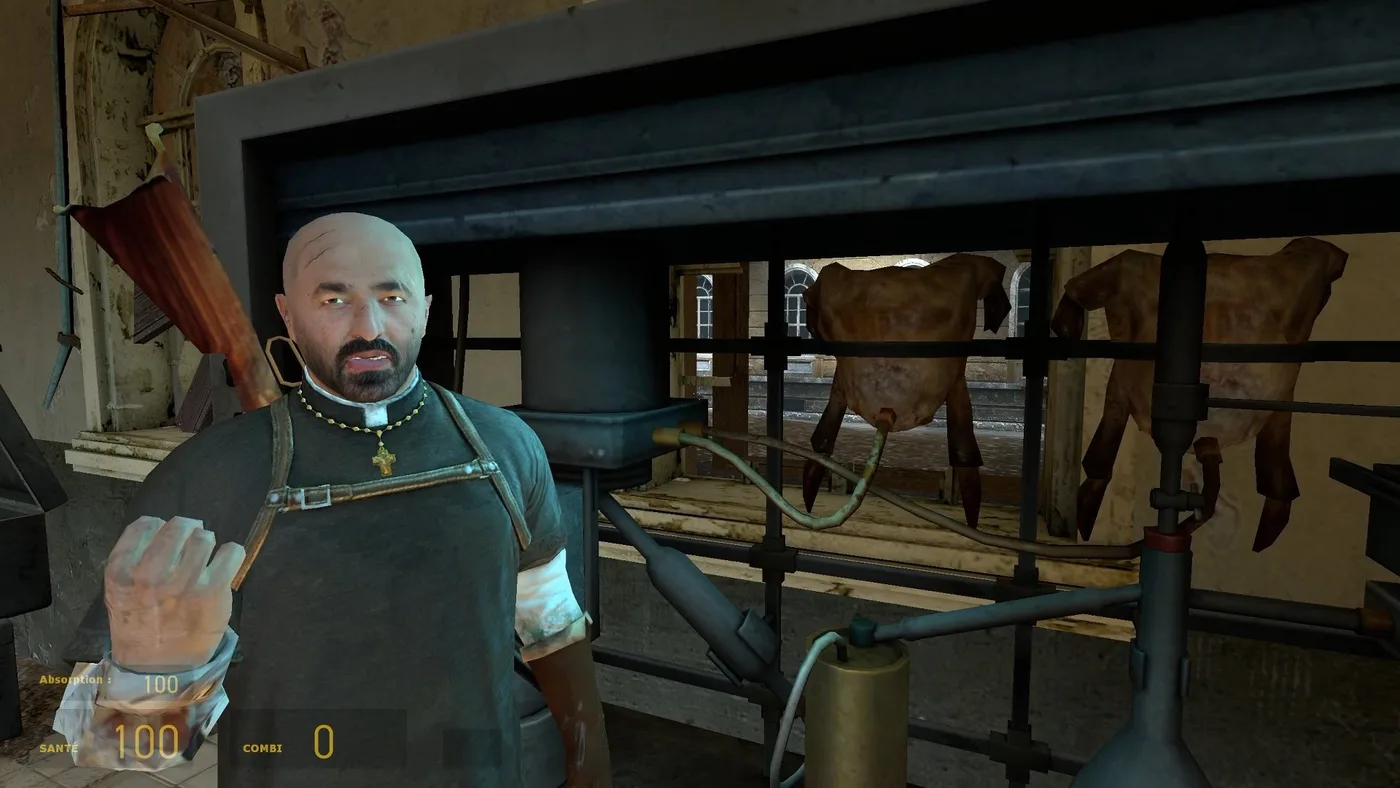
That's Grigori's headcrab-milking machine, in a screenshot Noclip posted. Note the HUD: it's in French, with an "Absorption" meter alongside health. On May 4, 2022, Noclip published about an hour of that prototype gameplay, split into chapters including Breakfast of Champions, Electrical Play, Swarming and Pitch Black.
What 2026 added
Arkane's founder spelled out the business reason. It wasn't the first time Raphaël Colantonio had called the cut financial: PC Gamer's 2020 report on the Noclip documentary says he believed Valve cancelled Ravenholm because it didn't make financial sense to keep going, with the game still a year out from completion. On August 21, 2026, Press Box PR published an interview in which he went further. He said it took the studio a decade to get over losing Ravenholm, and that at the time they didn't understand the decision. His explanation now: "It all came down to the economics." He tied the cut to how the Half-Life 2 episodes were selling and to the share of Valve's attention a project like this took.
Two more details from that answer line up with what was already known:
- Colantonio said Valve had tried making it internally first, and then with an external team in America that turned out to be too expensive, before coming to Arkane. That fits Junction Point, an Austin studio, and Laidlaw's email.
- He said what Arkane had was good but still needed too much time to finish. Working with Valve also brought Arkane together with Half-Life 2's art director Viktor Antonov, who later joined Arkane to work on Dishonored.
That's a different reason from the one Laidlaw gave in 2012, but they don't contradict each other. One is about creative fit, the other is about cost.
A leak turned up more Episode Three files. PC Gamer reported on August 30, 2026 that a cache of internal Valve data had begun circulating the previous day. It was around 12 terabytes, dated between 2003 and 2013, and linked to Valve's old Steam2 content servers. According to the YouTuber Gabe Follower, it includes the Weaponizer, an unfinished weapon previously linked to Episode Three, and PC Gamer notes that a gun resembling it appears in the documentary footage. Combine OverWiki also records a separate leak of the F-Stop source code on September 25, 2026, which it says carries further Episode Three references. This page doesn't link to leaked files.
Where to see it yourself
| What | Where | What it shows |
|---|---|---|
| Half-Life 2: 20th Anniversary Documentary | Valve's YouTube channel, November 15, 2024. The Episodes epilogue starts at 1:46:23 | Episode Three concept art, Ice Gun and Blob prototype footage, and the team on why it stopped |
| Source SDK 2013 | Valve's GitHub repository | The three Episode3 files and npc_blob.cpp |
| The Untold History of Arkane | Noclip on YouTube, May 26, 2020 | Arkane's own account of Ravenholm |
| This is "Ravenholm" | Noclip on YouTube, May 4, 2022, about 64 minutes | An hour of Arkane's prototype, chapter by chapter |
| Combine OverWiki | The Episode Three, Ravenholm and Junction Point pages | Concept art galleries and a development timeline |
If you want what Half-Life 2 itself cut before 2004 (the Arctic chapters, the Borealis level, the Ice Axe), that's a different set of cuts, and the cut content guide covers them. The Ravenholm guide covers the town as it actually shipped.
Quick Action Checklist
- Episode Three was never released. Valve's June 2006 press release promised the trilogy would conclude by Christmas 2007, and Episode Two, in October 2007, was the last episode to ship.
- Watch the documentary's epilogue from 1:46:23 for Valve's own Episode Three footage: the Ice Gun and the Blob.
- Read
weapon_proto1.cppandnpc_blob.cppon Valve's GitHub if you want Episode Three-era prototypes in Valve's own code. No leak needed. - The reasons given on the record: the team moved to Left 4 Dead about six months in (Speyrer), Newell was "stumped", and the finale had outgrown an episode (Walker).
- Don't treat Epistle 3 as the Episode Three plot. Walker said it wasn't the plan, and Laidlaw regrets publishing it.
- Two more Half-Life 2 projects died: Junction Point's Ravenholm-origin episode with a magnet gun, and Arkane's Ravenholm spin-off starring Adrian Shephard.
- For Arkane's version, watch Noclip's May 2022 hour of gameplay. Colantonio called the cut financial in 2020, and his August 2026 interview spells it out: the economics of how the episodes were selling.
Frequently Asked Questions
Was Half-Life 2: Episode Three ever released?
Why was Half-Life 2: Episode Three cancelled?
What was in Half-Life 2: Episode Three?
Is Epistle 3 the plot of Half-Life 2: Episode Three?
What was Return to Ravenholm, or Half-Life 2: Episode Four?
Did another studio make a Half-Life 2 episode before Arkane?
Keep Reading
- Valve press release, June 8, 2006: Episode One debuts at number one in Europe, first in a trilogy of episodes that will conclude by Christmas of 2007; Newell on 18 months rather than 6 years
- Valve — Half-Life 2: 20th Anniversary Documentary (YouTube, November 15, 2024; chapter list puts Epilogue: The Episodes at 1:46:23)
- VGC — Half-Life 2 documentary shows unseen Episode 3 footage (November 15, 2024): Speyrer on six months in, Left 4 Dead and two years; Newell on being stumped
- 80 Level — Valve revealed footage of Half-Life 2: Episode 3 (November 18, 2024): no narrative timeline, Arctic and Borealis, Ice Gun walls and Silver Surfer mode, the Blob
- Combine OverWiki — Half-Life 2: Episode Three: earliest concept art 2005, 2007 and 2008 teasers, planned weapons from leaked code, Final Hours of Half-Life: Alyx on the Source engine
- Combine OverWiki — Ice Gun: used alongside the SMG and pulse rifle, walls and ramps, freezing soldiers
- Combine OverWiki — Blob: npc_blob entity, footage taken in a modified Ravenholm map
- Valve — Source SDK 2013 repository, src/game/server/episodic/Episode3: weapon_proto1.cpp, npc_wpnscanner.cpp, npc_combine_armored.cpp
- Valve — Source SDK 2013 commit "Add Team Fortress 2 SDK", February 18, 2025 (the commit that added the Episode3 folder)
- Valve — weapon_proto1.cpp: damage set to target health, 24-unit penetration, prop_physics consumption up to mass 250, 1,200-unit sonar ping, 3 rounds on equip
- Valve — npc_blob.cpp: "experimental, cpu-intensive monster", 20 elements, w_squeak.mdl default model, INT_MAX health, 5 damage per 0.025-second think, m_bEatCombineHack
- Steam — Left 4 Dead store page: released November 17, 2008
- Kotaku — Why Valve gave up on 'multiple' Half-Life 3s (March 23, 2020): Robin Walker on Episode Three's scope and on Epistle 3
- Combine OverWiki — Epistle 3: posted August 2017, genderswapped aliases, removed from Laidlaw's site around May 2022
- Rock Paper Shotgun — Marc Laidlaw on writing Half-Life (March 1, 2023): regrets publishing Epistle 3
- PC Gamer — Warren Spector discusses his cancelled Half-Life 2 Ravenholm episode (November 8, 2017): Ravenholm origin, Father Grigori, the magnet gun
- Los Angeles Times — Disney buys game developer Junction Point (July 13, 2007)
- Combine OverWiki — Junction Point's Half-Life 2 Episode: the 2017 Laidlaw email on the concept passing to Arkane
- LambdaGeneration — Marc Laidlaw on the cancelled Half-Life spin-offs Return to Ravenholm and Episode Four (January 13, 2012)
- PC Gamer — Arkane's Half-Life spin-off featured Opposing Force's protagonist and a mutant priest (May 26, 2020)
- Noclip — The Untold History of Arkane: Dishonored / Prey / Ravenholm / LMNO / The Crossing (May 26, 2020)
- Noclip — This is "Ravenholm": The Cancelled Half-Life Game from Arkane Studios (May 4, 2022)
- Combine OverWiki — Ravenholm (cancelled game): Arkane, 2006 to 2007, screenshot and concept galleries
- Press Box PR — Raphaël Colantonio interview (August 21, 2026): Ravenholm cut on the economics of the Half-Life 2 episodes, the earlier internal and American attempts, Viktor Antonov
- PC Gamer — Valve data leak reported (August 30, 2026): around 12 TB dated 2003 to 2013, Steam2 content servers, the Weaponizer
- Combine OverWiki — Half-Life 2 leak: the August 29, 2026 Steam2 dump and the September 25, 2026 F-Stop source leak
Related Guides
Half-Life 2 Steam Workshop: Campaigns, Addons, Known Bugs
Half-Life 2 has had a Steam Workshop in its Extras menu since November 2024, and it held 12,469 items on October 11, 2026. Here is how Campaign and Content items load differently, how to start a Workshop campaign, what people actually subscribe to, and the bugs still open on Valve's tracker.
Half-Life 2 Episode Achievements: All 36, and the Hard Ones
Half-Life 2's Steam page now lists 69 achievements, not 33. The 20th Anniversary Update brought in the Episodes' 36. Here is every one of them, which game each actually counts in, which ones a reload can rescue, and the runs that need planning.
Half-Life 2 G-Man Sightings: Where to Spot Him, Map by Map
Between the opening monologue and the ending, the G-Man turns up twelve more times in Half-Life 2, mostly at a distance or on a screen. Here is where each one is, by chapter and map, plus the three in Episode Two and the ones Valve cut.
Half-Life 2 on Console, Mac and Steam Deck: Every Version
Half-Life 2 has shipped on seven platforms and one arcade cabinet, and only one of those versions still gets patches from Valve. Here is every official port, what each one is missing, and the right way to play it on whatever you own.
Half-Life 2 Beginner's Guide: Start Strong in City 17
Half-Life 2 never stops to explain itself, which is why new players stall in Ravenholm with no shotgun ammo and no idea the gravity gun was the answer. Here is the chapter map, the systems the game hides, and the mistakes that waste your first playthrough.
Half-Life 2 Citadel Guide: Our Benefactors and Dark Energy
Our Benefactors and Dark Energy get summarized as "you get the blue gravity gun and blow up a reactor," which skips the part where Breen steals that gun and runs off with it, the part where Gordon is a prisoner too, and the part where the game itself refuses to confirm whether Breen dies. Here is the full run, and the confirmed-versus-unresolved line at the end.