MTG Archenemy Rules: Schemes, Life Totals and Commander
One player starts at 40 life, goes first and flips a free scheme every turn. The rest share a turn and block for each other. Here is how Archenemy works, from the scheme deck and setting schemes in motion to ongoing schemes, hot-seat choices and the 60-against-60 Commander version, checked against the Comprehensive Rules effective September 25, 2026.
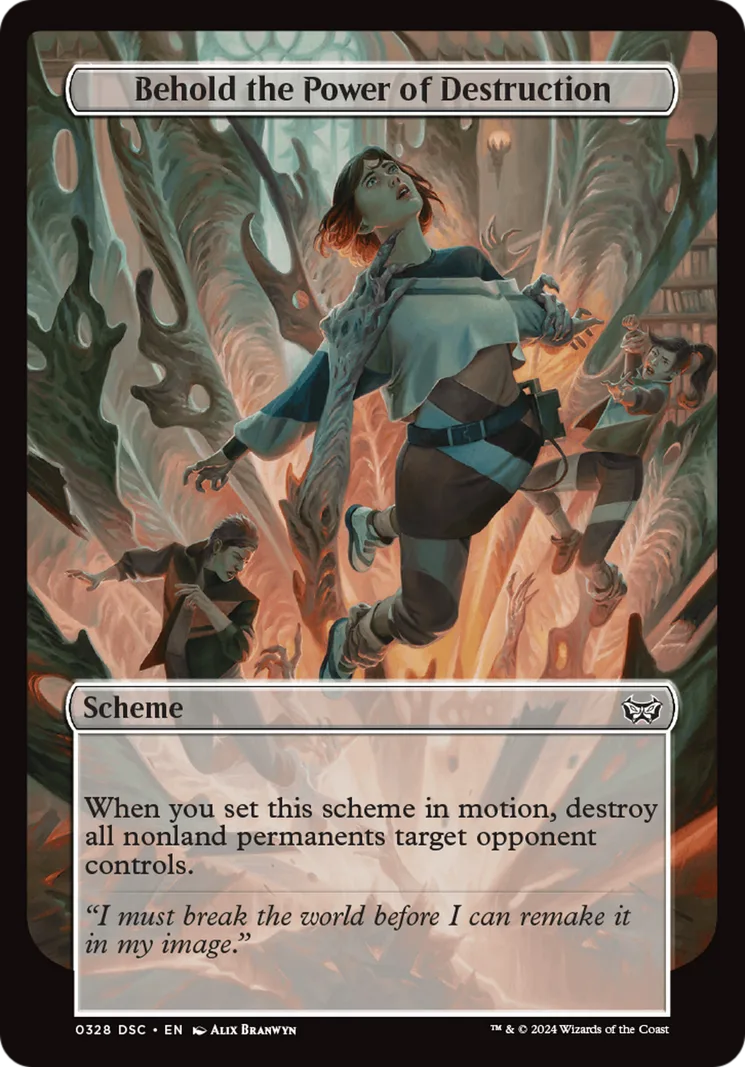
Behold the Power of Destruction destroys every nonland permanent one hero controls. The archenemy pays no mana for it and spends no card from hand. It is a scheme, and in Archenemy the villain turns one face up off a second deck as the first main phase of each of their turns begins, starting on turn one.
That is the deal the variant offers. One player gets 40 life, the first turn and a deck of free effects, and the rest of the table plays as a team that shares its turns. Since the 2024 Duskmourn Commander decks there is also a Commander version, where the archenemy has 60 life and the whole hero team has 60 between them, as one pool. Here is how all of it works, checked against the Comprehensive Rules effective September 25, 2026 (rule 904 and the rules it leans on), Wizards' Archenemy format page, the Duskmourn: House of Horror release notes that introduced Archenemy Commander, and Scryfall's card data. Rule numbers are given so you can settle a table argument yourself. If you have played Planechase, the command-zone setup will look familiar. The turn structure will not.
Three ways to play Archenemy
The Comprehensive Rules define one Archenemy variant and two options built on it:
| Archenemy (904.1–904.11) | Supervillain Rumble (904.12) | Archenemy Commander (904.13) | |
|---|---|---|---|
| Who plays | One archenemy against a team | Free-for-all: every player is an archenemy | One archenemy against a team |
| Main decks | Normal decks (60 or more, per Wizards' format page) | Normal decks | 100-card Commander decks |
| Archenemy's starting life | 40 | 40 each | 60 |
| Heroes' starting life | 20 each, tracked separately | No heroes | 60, shared by the whole team |
| Scheme deck | At least 20 cards, no more than two with the same name | One per player, same rules as Archenemy | At least 10 cards, every name different |
| First turn | The archenemy | Random | The archenemy |
| Turns | The heroes share one turn | Normal free-for-all turns | The heroes share one turn |
Rule 904.2b lets the team be "any number of players." Wizards' format page and the Duskmourn release notes both describe a team of three or more.
One combination the rules do not spell out is a Commander Supervillain Rumble. The Duskmourn release notes recommend it anyway: a normal Commander free-for-all at 40 life, where every player also brings a scheme deck of at least ten different schemes. Rule 904.12 on its own inherits the 20-card scheme deck from the classic rules.
Setting up the game
The archenemy shuffles the scheme deck as its own deck, separate from their library, and any opponent may shuffle or cut it (103.3a). From then on, scheme cards stay in the command zone, face down in the deck or face up once revealed (904.4). They are not permanents and cannot be cast, and if anything would move one out of the command zone, it stays where it is (314.2). That means a removal spell has nothing to aim at. A scheme is controlled by its owner, the archenemy (904.7).
The archenemy takes the first turn instead of a randomly chosen player (904.6). Three details matter before anyone has played a land:
- Mulligans go in team order. The archenemy decides first. Then the heroes decide, and they may consult each other while they do (805.3a). With three or more players this is a multiplayer game, so everyone's first mulligan is free (103.5c). Our mulligan guide covers how the London mulligan itself works.
- The archenemy draws on turn one. Only two-player games and Two-Headed Giant skip the starting player's first draw (103.8a–c), and Wizards' format page confirms the archenemy still draws in their first draw step.
- The first scheme comes on turn one, in that same turn's first main phase.
Setting a scheme in motion
Rule 904.9 fixes the moment: "immediately after the archenemy's precombat main phase begins," the archenemy turns the top card of the scheme deck face up. That is setting the scheme in motion. It is a turn-based action, so it does not use the stack, and nobody can respond to the flip itself (505.3). The scheme's "When you set this scheme in motion" ability then triggers and goes on the stack like any other triggered ability, so the heroes do get a window to respond before it resolves. Our stack and priority guide covers how that window works, and the turn structure guide shows where the main phase sits.
Two things about the order inside that moment change how cards play:
- Sagas come second. Rule 703.4f puts lore counters on the archenemy's Sagas after the scheme action, not before.
- This turn's land drop can't count toward a set-in-motion land check. Seven schemes count the archenemy's lands when their set-in-motion ability goes on the stack or resolves. Six of them want six or more lands, and Evil Comes to Fruition wants ten. A land can only be played with an empty stack, and the stack is not empty until that ability resolves. The Duskmourn release notes spell it out for Power Without Equal: you can't play a land during your turn before it resolves. For the six-land version of a scheme, the sixth land has to be there already, or arrive through an effect that puts a land onto the battlefield, not through your land play. (The ongoing My Tendrils Run Deep is different: it checks for six lands at your end step, after your land drop.)
When a normal scheme's ability has left the stack, the scheme turns face down and goes to the bottom of the scheme deck. That is a state-based action (904.10). No rule reshuffles the scheme deck after the opening shuffle, and none of the 102 scheme cards on Scryfall does either, so the deck runs as a loop. In a 10-card deck, the 11th card you turn up is the first one again, as long as that first one was not an ongoing scheme. In a 20-card deck it is the 21st. A hero who writes down each scheme as it goes to the bottom knows the order of the second lap, because an ongoing scheme only goes there once it is abandoned.
Schemes that set more schemes in motion speed the loop up. Plots That Span Centuries turns your next scheme into three, and rule 701.32c says they are set in motion one at a time.
Ongoing schemes, and how heroes switch them off
Most schemes fire once and go to the bottom. An ongoing scheme stays face up in the command zone and keeps working until it is abandoned (904.11), which means turned face down and put on the bottom of the scheme deck (701.33b). The Duskmourn release notes add two points: there is no limit on how many ongoing schemes can be face up at once, and having one out does not stop the archenemy setting a new scheme in motion each turn.
Scryfall lists 21 ongoing schemes, and 20 of them print the condition that abandons them. Since a scheme cannot be destroyed, meeting that condition is the heroes' way of switching one off. Several of those conditions are in the heroes' hands:
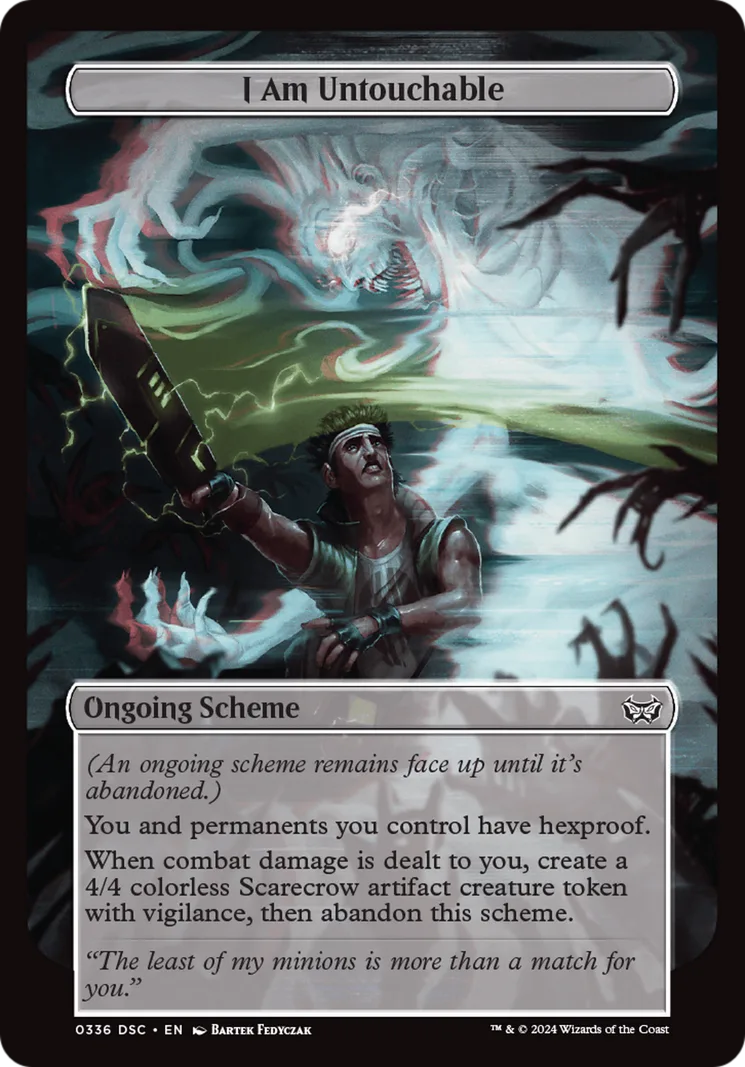
| Ongoing scheme | While it is face up | What abandons it |
|---|---|---|
| I Am Untouchable (2024) | The archenemy and permanents they control have hexproof | Combat damage dealt to the archenemy. The archenemy also gets a 4/4 Scarecrow token |
| I Bask in Your Silent Awe (2010) | Each opponent can't cast more than one spell each turn | At the archenemy's upkeep, if no opponent cast a spell since the archenemy's last turn ended |
| The Very Soil Shall Shake (2010) | The archenemy's creatures get +2/+2 and trample | A creature the archenemy controls dies |
| Bow to My Command (2017) | One chosen opponent's creatures can't attack the archenemy or their planeswalkers | At the heroes' end step, they tap untapped creatures with total power 8 or greater |
| My Forces Are Innumerable (2017) | A 3/3 Horror token for the archenemy at each of their end steps | At the heroes' end step, they sacrifice two creatures |
Two of those reward thinking a turn ahead. I Am Untouchable's abandon trigger fires once however many creatures connect, per the release notes, so one unblocked creature is enough to strip the hexproof. The price is a 4/4 Scarecrow for the archenemy. I Bask in Your Silent Awe goes away if no hero casts a spell between the end of one archenemy turn and the start of the next, which is sometimes cheaper than living under it.
The 21st ongoing scheme is the odd one. Your Inescapable Doom, a 2010 promo scheme, prints no abandon condition at all. At each of the archenemy's end steps it adds a doom counter, then deals damage equal to the number of counters to the opponent with the highest life total: 1, then 2, then 3. After five of the archenemy's end steps it has dealt 15 damage in total, and after six it has dealt 21.
The heroes' turn: one team, one combat
Archenemy always uses the shared team turns option (805.1), the same turn structure as Two-Headed Giant. The heroes take one turn together:
- Each hero untaps, draws in the team's draw step, and may play a land (805.4b–c).
- Priority belongs to the team, not to individual players (805.5). If no hero wants to act, the team passes.
- The heroes make one combined attack, and that set of attackers has to be legal as a whole (805.10b).
- Resources are not shared (808.5). Gavin Verhey's 2024 article on the format puts it plainly: you can't tap a teammate's lands for mana or cast spells from their hand.
On the archenemy's turn, each attacking creature attacks a specific hero, or a hero's planeswalker or battle (805.10b). The heroes then declare blockers as one team, and any hero's creatures can block a creature attacking any hero (805.10d). That has not always been the rule. Wizards' June 2017 preview of Archenemy: Nicol Bolas calls it "the only rules change" that product made. Before that, the variant used normal multiplayer blocking, where your creatures can block only creatures attacking you (802.4a).
In classic Archenemy each hero keeps a separate life total, so heroes can be knocked out one at a time. A hero who loses leaves the game, and everything they own leaves with them (800.4a). The team still wins if the archenemy loses, and rule 104.2c says each player on the winning team wins "even if one or more of those players had previously lost that game."
Hot-seat schemes: self or others
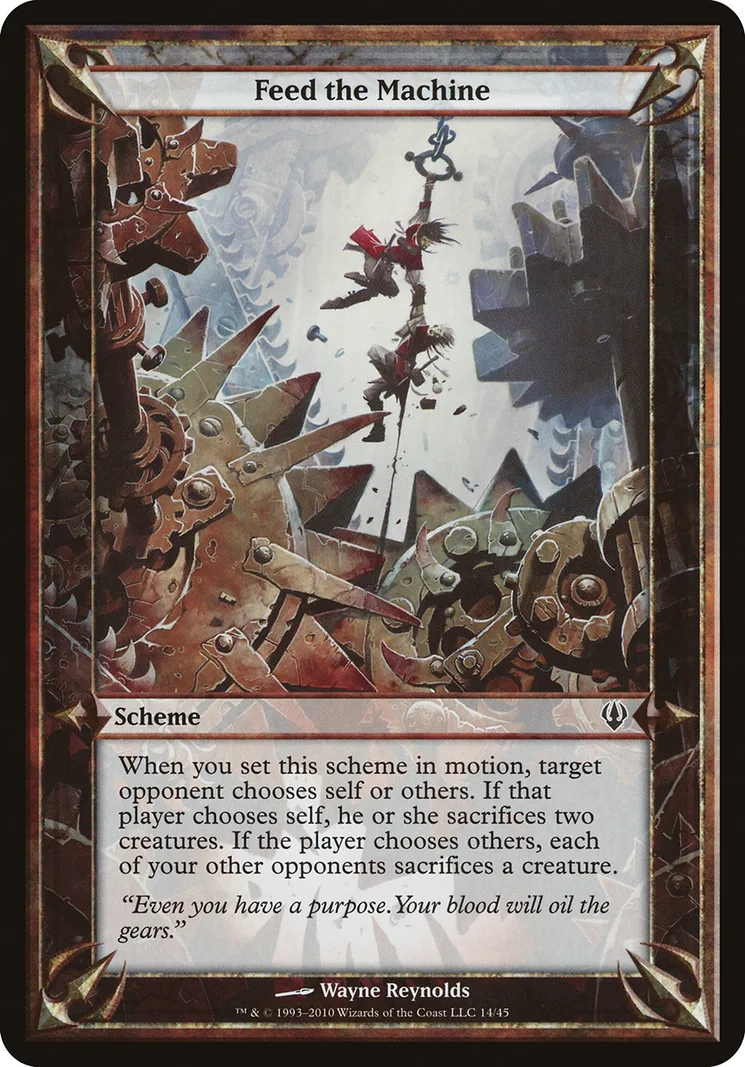
Four schemes from the 2010 Archenemy set target one hero and make that hero choose "self or others": take the hit alone, or hand a smaller hit to every other opponent. With three heroes, "others" means two players, and the team loses exactly the same total either way:
| Scheme | Self | Others (each other opponent) | Team total with three heroes | "Others" with four heroes |
|---|---|---|---|---|
| Surrender Your Thoughts | Discard four cards | Discard two cards | 4 cards either way | 6 cards |
| May Civilization Collapse | Sacrifice two lands | Sacrifice a land | 2 lands either way | 3 lands |
| Feed the Machine | Sacrifice two creatures | Sacrifice a creature | 2 creatures either way | 3 creatures |
| The Fate of the Flammable | 6 damage | 3 damage | 6 damage either way | 9 damage |
So at a four-player table, the minimum Wizards' format page lists, the choice is about who can best afford the loss: the hero with spare lands, the widest board or the most life. With a fourth hero, "others" costs the team half again as much. With only two heroes it costs half as much as "self." The archenemy chooses which hero to target, which is the archenemy's half of the decision.
Archenemy Commander: 60 against 60
Duskmourn: House of Horror Commander, which Scryfall dates to September 27, 2024, brought the variant back with a Commander option, now rule 904.13:
- The archenemy starts at 60 life. The heroes have one shared life total that also starts at 60, handled with the Two-Headed Giant rules for shared life (904.13b, which points to 810.8 and 810.9).
- The scheme deck needs only ten cards, each with a different name (904.13d). Each Duskmourn Commander deck comes with exactly ten.
- Everything else is normal Commander as modified by Archenemy (904.13a). The heroes still share a turn, and the archenemy still goes first.
Gavin Verhey's announcement, Evolving Archenemy (June 28, 2024), gives the reason. With separate life totals, the archenemy's best plan was to take one hero down fast, because beating two players is easier than beating three, and that left a player sitting out for the rest of the game. With one pool, the heroes "all win or lose together," and nobody is eliminated early. If you are new to the base format, start with how to play Commander.
Three consequences of putting the two formats together:
- Commander damage is still counted per player. Damage is dealt to each hero individually and then applied to the pool (810.9), and nothing in 904.13 switches off rule 903.10a, under which a player dealt 21 or more combat damage by the same commander loses. So the archenemy's commander can still focus one hero, and since the team loses together, 21 from one commander into one hero ends the game for the whole team. It cuts the other way too: 21 combat damage from one hero's commander beats an archenemy who started on 60.
- Poison is not pooled. Ten poison counters on the archenemy, or on any single hero, loses the game (904.13c). In Two-Headed Giant the team shares its counters and needs 15 (810.8d).
- Some schemes change meaning under shared life. The two below show it from opposite directions.
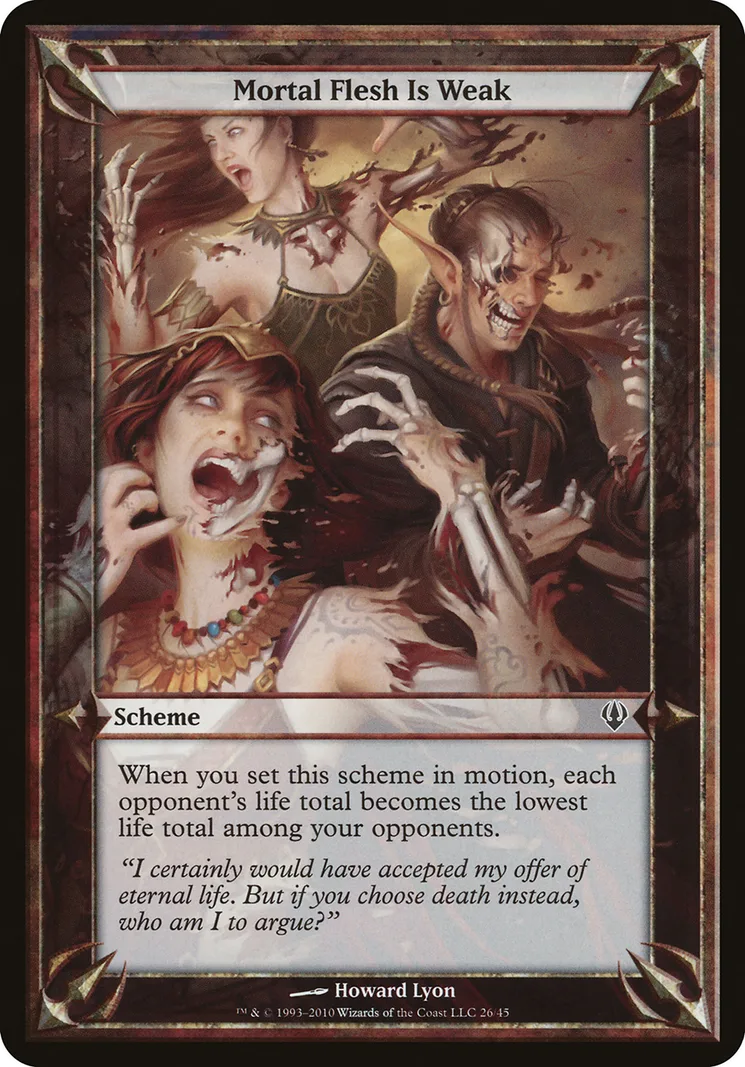
Mortal Flesh Is Weak sets each opponent's life total to the lowest one among them. In classic Archenemy it drags every hero down to the weakest hero's total. Against a shared pool there is only one total to compare, so the scheme does nothing (810.9a). Verhey names it as an older scheme that functions "weirdly" under the new rules, says such schemes were left out of the Duskmourn decks, and suggests leaving them out of yours.
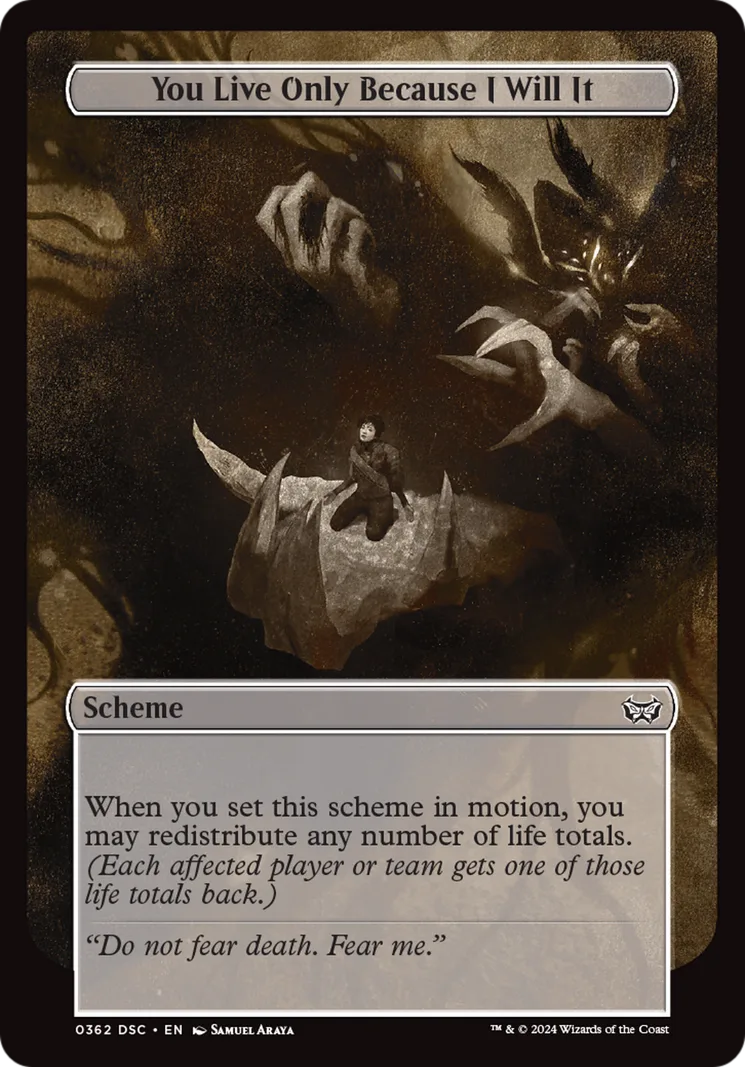
You Live Only Because I Will It, from the Death Toll deck, goes the other way. It redistributes any number of life totals, and the release notes say each team has a single life total in a shared-life game. An archenemy on 12 facing a hero pool of 50 can swap the two.
Three of the Duskmourn schemes need a commander to do anything. I Am Never Alone makes a token copy of your commander, You Will Know True Suffering deals damage equal to your commander's mana value, and My Champion Stands Supreme buffs your commander. Put them in the scheme deck for a classic 60-card game and they have nothing to work with.
Where the schemes come from
| Product | Released | Scheme cards | What came in it |
|---|---|---|---|
| Archenemy | June 18, 2010 | 45 different | Four game packs, each a 60-card deck plus 20 schemes: 15 different names, with five of them doubled |
| Archenemy promos | 2010 | 5 | Promo schemes, among them Plots That Span Centuries and Your Inescapable Doom |
| Archenemy: Nicol Bolas | June 16, 2017 | 20, all different | One box: a Nicol Bolas villain deck with the schemes, plus three 60-card hero decks for Gideon, Chandra and Nissa |
| Duskmourn: House of Horror Commander | September 27, 2024 | 40 different: 32 new, 8 reprints | Four Commander decks with ten different schemes each |
Release dates and the scheme counts are Scryfall's. The game pack contents come from the MTG Wiki's decklists for the 2010 set, and from Wizards' 2017 preview and the MTG Wiki's product page for Nicol Bolas. As of October 25, 2026, Scryfall lists 102 different scheme cards, 21 of them ongoing, and the newest printing is the Duskmourn Commander set.
What you can build from what you own:
- A 2010 game pack is a legal classic scheme deck straight out of the box: 20 cards, no name more than twice. For Archenemy Commander, drop the five duplicates and you have 15 different schemes, more than the ten the rule asks for.
- One Duskmourn deck's ten schemes are a legal Archenemy Commander scheme deck exactly. Verhey's article calls pooling all four decks "a blast." Their 40 schemes all have different names, so the pooled deck is still legal.
- Mixing products can create duplicates. The Duskmourn decks reprinted eight older schemes: Behold the Power of Destruction, Choose Your Champion and My Crushing Masterstroke from 2010, the 2010 promo Plots That Span Centuries, and Choose Your Demise, My Laughter Echoes, Power Without Equal and When Will You Learn? from 2017. A Commander scheme deck still needs every name to be different.
- Any Duskmourn deck can be the archenemy. Verhey points out the difference from Archenemy: Nicol Bolas, where only the Bolas deck came with schemes.
The four Duskmourn scheme decks
From Wizards' Duskmourn Commander decklists:
| Deck | Colors | Legendary commanders | Its ten schemes |
|---|---|---|---|
| Jump Scare! | Green-blue | Zimone, Mystery Unraveler; Kianne, Corrupted Memory | Chaos Is My Plaything, I Am Untouchable, Kneel Before My Legions, Mine Is the Only Truth, My Laughter Echoes, Power Without Equal, You Are Unworthy of Mercy, You Will Know True Suffering, Your Own Face Mocks You, Your Plans Mean Nothing |
| Miracle Worker | White-blue-black | Aminatou, Veil Piercer; The Master of Keys | A Premonition of Your Demise, Behold the Power of Destruction, Choose Your Demise, I Am Duskmourn, My Champion Stands Supreme, My Followers Ascend, My Wealth Will Bury You, Only I Know What Awaits, Time Bends to My Will, You Cannot Hide from Me |
| Death Toll | Black-green | Winter, Cynical Opportunist; Rendmaw, Creaking Nest | Choose Your Champion, Dark Wings Bring Your Downfall, I Am Never Alone, My Tendrils Run Deep, My Will Is Irresistible, My Wings Enfold All, Plots That Span Centuries, Rot Like the Scum You Are, You Live Only Because I Will It, Your Mistake Is My Triumph |
| Endless Punishment | Black-red | Valgavoth, Harrower of Souls; The Lord of Pain | Fear My Authority, I Call for Slaughter, I Will Savor Your Agony, My Crushing Masterstroke, No Secret Is Hidden from Me, Reality Is Mine to Control, Running Is Useless, When Will You Learn?, You Exist Only to Amuse, Your Nightmares Are Delicious |
If you own one of these decks and want to tune the 99 rather than the schemes, our precon upgrade guide covers what to change first.
Quick Action Checklist
- Classic Archenemy: the archenemy has 40 life and a scheme deck of at least 20, with no more than two of any name. Each hero has 20.
- Archenemy Commander: 60 life against a shared hero pool of 60, a scheme deck of at least ten different schemes, and poison counters that are not shared.
- Supervillain Rumble: everyone is an archenemy at 40 life in a free-for-all, with a random starting player.
- The archenemy goes first and still draws on turn one. The heroes decide on mulligans after the archenemy, and everyone's first mulligan is free.
- The scheme flips as the archenemy's first main phase begins, before Saga counters and before any land can be played. This turn's land drop can't count toward a set-in-motion "six or more lands" check.
- Nobody can respond to the flip, but everybody can respond to the scheme's ability.
- Schemes cannot be destroyed. An ongoing scheme stays until its own abandon condition is met, and Your Inescapable Doom has none.
- The heroes share one turn and block for each other (805.10d).
- In Archenemy Commander, track commander damage per hero. 21 from one commander into one player still ends the game, for either side.
- Leave Mortal Flesh Is Weak out of shared-life games. It does nothing there.
- One Duskmourn deck is a complete ten-scheme deck, and all four pooled make 40 different schemes.
Frequently Asked Questions
How do you play Archenemy in Magic: The Gathering?
How much life does the archenemy start with?
How many cards are in an Archenemy scheme deck?
What is an ongoing scheme in MTG Archenemy?
How does Archenemy Commander work?
Can heroes block for each other in Archenemy?
Which products include Archenemy scheme cards?
Keep Reading
- Wizards of the Coast — Magic: The Gathering Comprehensive Rules, effective September 25, 2026 (rule 904 Archenemy; 103.3a, 103.5c, 103.8, 104.2c, 314, 505.3, 701.32, 701.33, 703.4f, 800.4a, 802.4a, 805, 810.8–810.10, 903.10a)
- Wizards of the Coast — Comprehensive Rules download page
- Wizards of the Coast — Archenemy format page (team size, deck sizes, life totals, scheme deck limits, first-turn draw, Supervillain Rumble)
- Wizards of the Coast — Evolving Archenemy (Gavin Verhey, June 28, 2024): Archenemy Commander life totals, ten-scheme decks and Mortal Flesh Is Weak
- Wizards of the Coast — Duskmourn: House of Horror Release Notes (Archenemy Commander, Supervillain Rumble with Commander, and scheme card rulings)
- Wizards of the Coast — Duskmourn: House of Horror Commander Decklists (the ten schemes in each deck)
- Wizards of the Coast — Archenemy: Nicol Bolas Preview (June 5, 2017): 20 scheme cards and the blocking rules change
- Scryfall — every scheme card (102 different cards, 21 ongoing, checked October 25, 2026), with set and release-date data
- Scryfall — Your Inescapable Doom Oracle text (the ongoing scheme with no abandon condition)
- MTG Wiki — Archenemy theme decks: the 20 schemes in each 2010 game pack
- MTG Wiki — Archenemy: Nicol Bolas product contents (four 60-card decks and 20 schemes)
Related Guides
MTG Arena Competitive Brawl: Rules and Banned Commanders
On October 12, 2026, Wizards banned three more commanders in Competitive Brawl and moved nine cards, Oko and Ragavan among them, from fully banned to banned only as your commander. Here is what Competitive Brawl is, how it differs from the Brawl queue next to it, the full list, and the one card the official page has gone quiet on.
MTG Planechase Rules: Planar Die, Planes and Phenomena
Your first roll of the planar die each turn is free. The sixth costs five mana on its own, and the six together cost fifteen. Here is how Planechase actually works, from the planar deck and the starting plane to the die, chaos, phenomena and Commander pods, checked against the Comprehensive Rules effective September 25, 2026.
MTG Commander Banned List: Every Card and Why
Wizards' banned list page gives Commander 42 card names and four lines of small print. Scryfall says the real number is 83. The gap is 41 cards banned by category rather than by name — Conspiracies, ante cards, and the seven banned everywhere for offensive content. Here is the entire list, grouped by what each card actually does, plus the one change the Commander Format Panel made this year.
MTG Oathbreaker Format Guide: Where to Start
Oathbreaker is what you get when you take Commander, swap the legendary creature for a planeswalker, and bolt on a signature spell you can only cast while that planeswalker is alive. Here is how the format works, how to build your first deck, and which oathbreakers actually win.
MTG Commander Format Guide — How to Start Playing EDH (2026)
Commander is the most-played MTG format on the planet and the easiest one for new players to start in. The rules look intimidating on paper. They are not. Here is the full beginner guide.

Best Commander Staples Every Deck Wants, Ranked
There's a short list of cards that show up in basically every Commander deck regardless of theme — the silent 25 that make the splashy 75 work. Here are the staples worth a slot in almost any list, sorted by the job they do, with the legality double-checked.