MTG Planechase Rules: Planar Die, Planes and Phenomena
Your first roll of the planar die each turn is free. The sixth costs five mana on its own, and the six together cost fifteen. Here is how Planechase actually works, from the planar deck and the starting plane to the die, chaos, phenomena and Commander pods, checked against the Comprehensive Rules effective September 25, 2026.
Your first roll of the planar die each turn is free. The second costs one mana, the third costs two, and if you want six rolls in a single turn you will have spent fifteen mana on dice. That escalating price is the first rule worth getting straight, because the die is how a game moves to a new plane (sometimes onto a phenomenon that throws the table somewhere else) and how a plane's chaos ability goes off.
Planechase is also a variant Wizards keeps coming back to: five retail products since 2009, the last two of them Commander decks. Here is how it actually works, checked against the Comprehensive Rules effective September 25, 2026 (rule 901 and the rules around it), Wizards' own Planechase format page and Scryfall's card data. Rule numbers are given so you can settle an argument without taking my word for it.
What you need: two decks and one die
Planechase is played on top of a normal game of Magic. Nothing about your main deck changes. Wizards' format page lists 60 cards or more and two to four players, and a Commander deck works exactly as it is.
What you add is a planar deck. Under rule 901.3 it needs at least ten plane and/or phenomenon cards, no more than two of them phenomena, and every card must have a different English name. Planar decks live in the command zone for the whole game, both while they are part of a planar deck and once they are turned face up (901.4). A plane card is not a permanent, it cannot be cast, and if something would move it out of the command zone it stays put (311.2).
The table also needs one planar die: six sides, with the Planeswalker symbol on one face, the chaos symbol on another, and the other four blank (901.3a).
There are two official ways to build the planar side:
| Individual planar decks (rule 901.3) | One shared planar deck (rule 901.15) | |
|---|---|---|
| Size | At least 10 cards per player | At least 40 cards, or 10 per player, whichever is smaller |
| Phenomena allowed | No more than 2 per deck | No more than 2 per player in the game |
| Duplicate names | Not allowed within a deck | Not allowed in the deck |
| When someone planeswalks | They flip the top card of their own planar deck | The planar controller flips the top of the shared deck |
| Who owns the plane cards | Whoever brought them | The planar controller counts as owner of all of them (901.15b) |
The Comprehensive Rules treat individual decks as the default and the shared deck as an option. Wizards' format page lists the shared deck first. Both are official, and Gavin Verhey's 2023 primer for Wizards calls shuffling everyone's planes together an optional house rule, "up to you and your group."
Setting up: the starting plane
Nothing planar happens until every player has kept an opening hand and used any card that acts from an opening hand. Then the starting player turns over the top card of their planar deck (901.5, 103.7).
- If it is a plane, that is the starting plane. Its static abilities apply to everyone immediately.
- If it is a phenomenon, it goes to the bottom of that planar deck and the player flips again, until a plane turns up.
- Nothing triggers during this flip. A plane that says "when you planeswalk to" does not fire for being the starting plane.
Rolling the planar die: when, and what it costs
Rule 901.9 is tight about timing. Only the active player can roll, only during a main phase of their own turn, and only while they have priority with an empty stack. That is sorcery timing: you cannot roll on an opponent's turn, in combat, or in response to anything. If you are hazy on where the main phases sit, our turn structure guide walks the whole turn.
The roll is a special action, like playing a land (116.2i), so it does not use the stack and nobody can respond to the roll itself. The results are a different matter. A chaos result triggers the plane's chaos ability, and a Planeswalker result triggers the game's built-in "planeswalking ability" (901.8). Both go on the stack and the active player gets priority (901.9b–c), so every player gets a window to respond before either one resolves. Our guide to the stack and priority covers how those windows work.
The cost is the number of times you have already taken that action this turn (901.9). Here is what that adds up to, with the odds from a fair six-sided die:
| Rolls this turn | That roll costs | Total mana spent | Chance the Planeswalker symbol shows at least once | Chance of at least one non-blank face |
|---|---|---|---|---|
| 1 | 0 | 0 | 16.7% | 33.3% |
| 2 | 1 | 1 | 30.6% | 55.6% |
| 3 | 2 | 3 | 42.1% | 70.4% |
| 4 | 3 | 6 | 51.8% | 80.2% |
| 5 | 4 | 10 | 59.8% | 86.8% |
| 6 | 5 | 15 | 66.5% | 91.2% |
The chaos column would be identical to the Planeswalker column, since each is one face in six. One caveat the table cannot show: a Planeswalker result moves you to a new plane, so a chaos roll after it triggers the new plane's chaos ability.
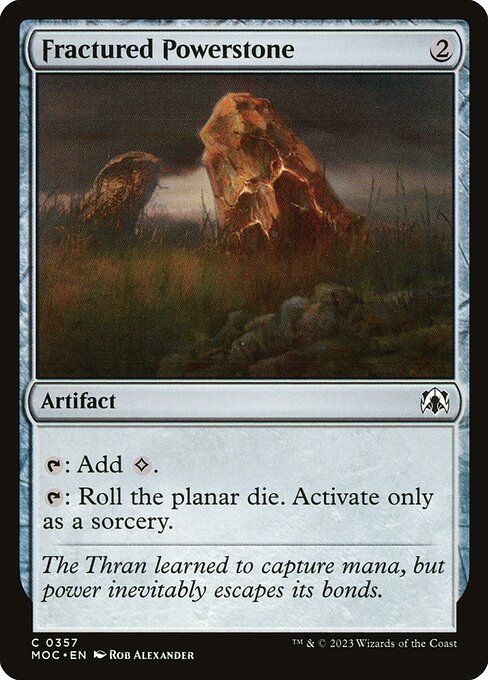
Rolls caused by an effect do not raise the price. Fractured Powerstone taps to roll the planar die, and its official ruling on Scryfall spells it out: roll twice, tap the Powerstone for a third roll, and your next roll that turn still costs {2}, not {3}. The rule text says the same thing, noting that the count "won't be equal to the number of times the player has rolled the planar die" once an effect is involved.
The planar die also counts as a die roll for other cards. Under 706.7 and 901.9d, abilities that trigger when a player rolls one or more dice do trigger. Brazen Dwarf, which deals 1 damage to each opponent whenever you roll one or more dice, fires on every planar roll you make. Effects that care about a number rolled ignore the planar die completely.
Planeswalking, chaos, and whose plane it is
The plane belongs to whoever's turn it is. The face-up plane is controlled by the planar controller, normally the active player (901.6). Control passes around the table every turn. The Scryfall rulings on plane cards spell out the practical consequence: when a plane says "you," it means whoever controls the plane right now, not the player who brought it.
Planeswalking is defined in 701.31b: every face-up plane and phenomenon goes to the bottom of its owner's planar deck, face down, and then you turn over the top card of your planar deck. With individual decks, that means the plane you leave goes home to whoever brought it, and the plane you arrive at comes from the roller's deck. Two more details from rule 901.11 and 311.6:
- Effects that last "until a player planeswalks" end the moment anyone does.
- A plane that goes face down becomes a new object, so any counters on it are lost. A plane that counts up counters and pays off later starts from zero if the table ever comes back to it.
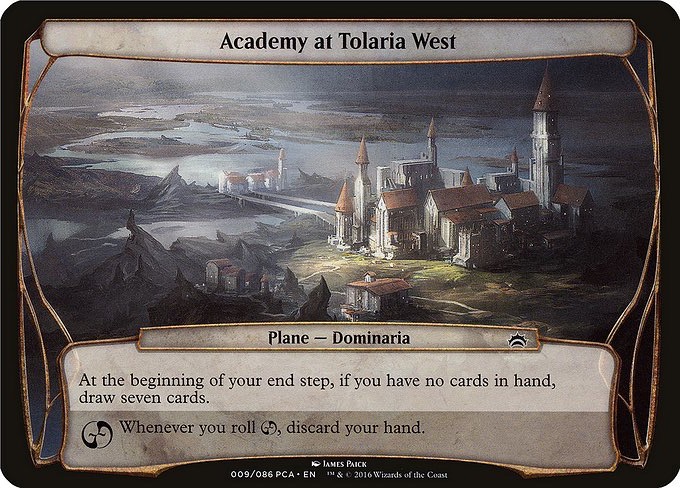
Chaos is the plane's second ability, marked with the chaos symbol. Rule 311.7 says it triggers "Whenever chaos ensues": when the die shows the chaos symbol, or when a spell or ability says chaos ensues. The chaos ability is controlled by the current planar controller, and since only the active player can roll, a chaos result you roll is yours to resolve. Older cards are printed differently. The Planechase Anthology printing of Academy at Tolaria West reads "Whenever you roll" followed by the chaos symbol, while its Oracle text on Scryfall now reads "Whenever chaos ensues." The MTG Wiki dates the "chaos ensues" wording to the March of the Machine Commander decks in 2023. Play the Oracle wording. The difference matters because some effects make chaos ensue without a roll.
Phenomena: the cards you never stay on
A phenomenon is a one-shot event shuffled into the planar deck. When you move one off the deck and turn it face up, you encounter it, and its triggered ability goes on the stack (312.5). As soon as that trigger has left the stack, a state-based action makes the planar controller planeswalk away (312.7, 704.6f). Nobody stays on a phenomenon, and one can never be the starting plane either (901.5).
Phenomena are scarce. The five retail Planechase products hold 12 different ones between them: 8 from Planechase 2012 and 4 new ones in the Doctor Who decks. The March of the Machine Commander decks reprinted five of the 2012 set. At a maximum of two per planar deck they stay rare events, and a few of them rewrite the game for a stretch:
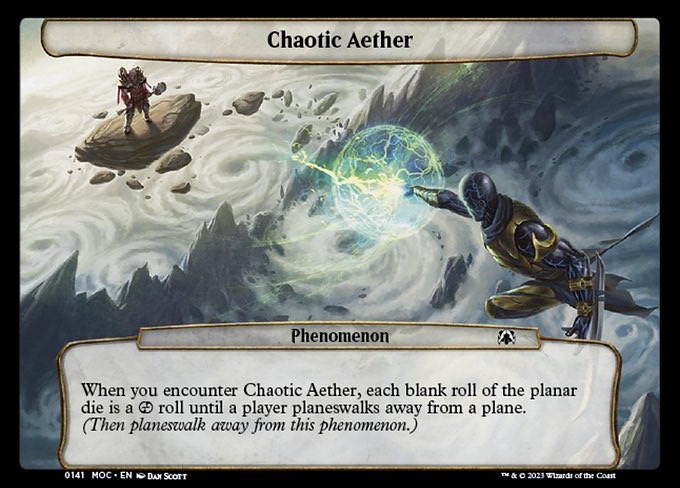
- Chaotic Aether makes every blank roll count as a chaos roll "until a player planeswalks away from a plane." For that stretch the die reads chaos five times in six and Planeswalker once in six, so every roll, free or paid, fires a chaos ability unless it moves you on.
- Time Distortion reverses the turn order, clockwise to counterclockwise or the other way round.
- Spatial Merging reveals cards until two planes turn up and planeswalks to both at once.
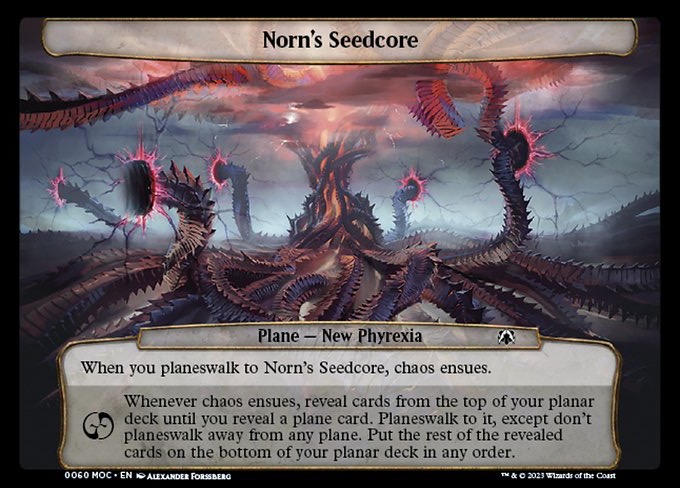
Two planes at once is not only a phenomenon trick. Norn's Seedcore, a new plane in March of the Machine Commander, makes chaos ensue as you arrive, and its chaos ability flips the next plane without leaving any. Once several planes are face up, rule 901.11c keeps the exit simple: the next planeswalk leaves all of them.
Planechase in a Commander pod
The last two retail Planechase products were Commander decks. Gavin Verhey's March 2023 primer says each March of the Machine Commander deck includes a planar die and a ten-card planar deck: five new planes, four reprinted planes and one phenomenon. Wizards' collecting article for Doctor Who lists ten oversized new-to-Magic planar cards and a planar die in each of its four decks. Rule 901.2 allows two-player or multiplayer Planechase, and the default multiplayer setup is the same Free-for-All Commander uses.
Three rules matter more in a pod than in a duel:
- Eliminations shrink the plane pool. When a player leaves the game, everything they own leaves with them, including their planar deck. If the face-up plane was theirs, the planar controller immediately flips the next one (901.10). With individual decks, each knocked-out player takes their whole planar deck out of the rotation.
- The pace comes from the free roll. If every player in a four-player pod takes only their free roll, the Planeswalker symbol comes up on about one turn in six, roughly once every round and a half. That is arithmetic on the die, not a promise. Anyone who pays for extra rolls speeds it up.
- A pod of four hits the shared-deck minimum exactly. Four players' ten-card decks make 40 cards, which is the single-deck floor for four players (the smaller of 40 and 10 × 4). Pooling the planes of four precons gives you a legal shared deck with nothing extra to buy, as long as no two cards share a name. Any mix of March of the Machine and Doctor Who decks passes: their 90 planar cards all have different names.
In a Two-Headed Giant game, rule 901.12 keeps individual planar decks, lets both members of the active team roll with separate cost counts, and applies any "you" on the plane to both teammates.
Where the planes come from
| Product | Released | Planar cards | What each box or deck included |
|---|---|---|---|
| Planechase | September 4, 2009 | 40 planes | Four game packs, each a 60-card deck, 10 planes and a planar die |
| Planechase 2012 | June 1, 2012 | 32 planes, 8 phenomena | Four game packs, each a 60-card deck, 10 planar cards and a planar die |
| Planechase Anthology | November 25, 2016 | 86 (all of the above, plus 6 promo planes) | The four 2012 decks, every planar card to date and a special-edition planar die |
| March of the Machine Commander | April 21, 2023 | 25 new planes, plus 20 reprinted planes and 5 reprinted phenomena | Five Commander decks, each with 10 planar cards and a planar die |
| Doctor Who | October 13, 2023 | 36 planes, 4 phenomena, all new | Four Commander decks, each with 10 planar cards and a planar die |
Release dates are Scryfall's. Contents come from Wizards' announcements for the two Commander products and the MTG Wiki's product pages for the older three.
On 30 September 2026, Scryfall lists 206 different plane and phenomenon cards. 151 of them (139 planes and 12 phenomena) appear in those five products. The other 55 are MagicCon event cards that Scryfall files under two sets: 45 in "Black Lotus Unknown Planechase" and 10 in "Secret Lair Showcase Planes." Wizards' MagicCon: Chicago 2025 announcement lists a "Black Lotus Commander Unknown Planechase Event" among the top VIP badge's perks. The newest planar printing Scryfall records is dated February 21, 2025, and the most recent store product with planes in it is still Doctor Who. The Comprehensive Rules list 82 planar types (205.3n).
Outside the planar decks themselves, a Scryfall search turns up eleven regular cards (not counting playtest and event cards) that refer to planeswalking, chaos or the planar die. They are Fractured Powerstone, Ichor Elixir (which makes you roll an extra planar die and ignore one), the five March of the Machine Commander "Path" sorceries, and four Doctor Who cards: Start the TARDIS, TARDIS, Susan Foreman and Missy. The Paths end with a Will of the Planeswalkers vote between planeswalking and chaos, a relative of the vote cards in our politics cards ranking. Outside a Planechase game those clauses do nothing. Rule 701.31a allows planeswalking only in Planechase, and Fractured Powerstone's own ruling says its die ability "will have no effect" in other games. So a Path you keep in an upgraded precon is worth only its first half at a table without planes.
Two planes that teach you when to roll
The strategic core of Planechase is simple: roll when the current plane is bad for you, and roll when its chaos ability is good for you. The Oracle text of two planes shows how precisely you can time it.
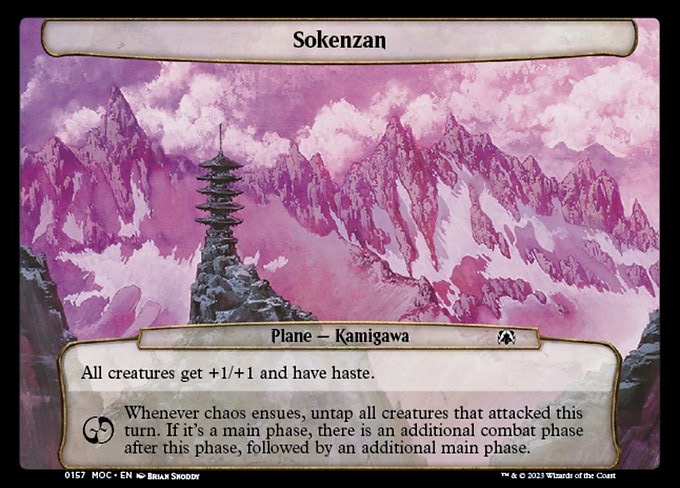
Sokenzan gives every creature +1/+1 and haste. Its chaos ability untaps all creatures that attacked this turn and, "if it's a main phase," adds an extra combat phase followed by an extra main phase. You can only roll in a main phase anyway, so the moment to fish for chaos is your second main phase, after you have attacked. A hit there untaps the whole team and swings again. Rolled before combat, the same chaos gives an extra combat but nothing to untap.
Academy at Tolaria West says: at the beginning of your end step, if you have no cards in hand, draw seven. Its chaos ability is "discard your hand." Those two lines work together. A chaos roll in your main phase empties your hand, you stay on the Academy because chaos does not planeswalk, and your end step refills you to seven. Because "your" means the planar controller, that end-step draw is live for every player on their own turn, so an opponent who empties their hand on the Academy gets seven cards too.
Quick Action Checklist
- Build a planar deck of at least 10 cards, no more than 2 phenomena, no duplicate names. A shared deck needs 40 cards or 10 per player, whichever is smaller.
- One planar die serves the whole table: one Planeswalker face, one chaos face, four blanks.
- Flip the starting plane after mulligans. Phenomena go to the bottom until a plane turns up.
- Roll only in your own main phase with an empty stack. The first roll each turn is free, then 1, 2, 3 and so on; six rolls cost 15 mana in total.
- Nobody can respond to the roll, but everybody can respond to the result. Chaos and planeswalking both use the stack.
- "You" on a plane means whoever's turn it is. Control of the plane rotates every turn.
- Play the Oracle text. "Whenever you roll" plus the chaos symbol on older planes now reads "Whenever chaos ensues."
- Phenomena resolve and leave. Chaotic Aether turns blanks into chaos until someone planeswalks away.
- In Commander pods, eliminations take planar decks with them. Four precons' planar decks pooled together make a legal 40-card shared deck if no names repeat.
- The Path sorceries, the four Doctor Who planeswalk and chaos cards, Fractured Powerstone and Ichor Elixir do nothing planar outside Planechase. Judge them on their other text if you run them without planes.
Frequently Asked Questions
How do you play Planechase in Magic: The Gathering?
How much does it cost to roll the planar die in Planechase?
What happens when you roll the chaos symbol in Planechase?
What is a phenomenon card in MTG Planechase?
Can you play Planechase with Commander decks?
How many cards are in a Planechase planar deck?
Where can I get Planechase cards?
Keep Reading
- Wizards of the Coast — Magic: The Gathering Comprehensive Rules, effective September 25, 2026 (rule 901 Planechase; 103.7, 116.2i, 205.3n, 311, 312, 701.31, 704.6f, 706.7)
- Wizards of the Coast — Comprehensive Rules download page
- Wizards of the Coast — Planechase format page (deck size, players, shared and individual planar deck rules, roll cost)
- Wizards of the Coast — What Is Planechase and Why Is It Awesome (Gavin Verhey, March 29, 2023): March of the Machine Commander planar deck contents and planar die
- Wizards of the Coast — Collecting Magic: The Gathering | Doctor Who (October 3, 2023): 10 planar cards and a planar die per Commander deck
- Scryfall — every plane and phenomenon card (206 cards, 30 September 2026; set and release-date data for the product table)
- Scryfall — Fractured Powerstone Oracle text and rulings (effect rolls do not raise the roll cost; no effect outside Planechase)
- Scryfall — Ichor Elixir Oracle text (roll an extra planar die and ignore one)
- Scryfall — Tazeem rulings (the planar controller, and what "you" means on a plane)
- MTG Wiki — Planechase (format): products and the origin of the "chaos ensues" wording
- MTG Wiki — Planechase Anthology, Planechase and Planechase 2012 product contents
- Magic.gg — MagicCon: Chicago 2025 (Black Lotus Commander Unknown Planechase Event in the Black Lotus VIP badge)
- MTG Wiki — Planechase Unknown (the Black Lotus VIP Planechase event run at MagicCons since Chicago 2024)
- MTG Wiki — Secret Lair Spectacular (MagicCon event from 2025 that adds a specially designed Planechase deck)
Related Guides
MTG Arena Competitive Brawl: Rules and Banned Commanders
On October 12, 2026, Wizards banned three more commanders in Competitive Brawl and moved nine cards, Oko and Ragavan among them, from fully banned to banned only as your commander. Here is what Competitive Brawl is, how it differs from the Brawl queue next to it, the full list, and the one card the official page has gone quiet on.
MTG Commander Banned List: Every Card and Why
Wizards' banned list page gives Commander 42 card names and four lines of small print. Scryfall says the real number is 83. The gap is 41 cards banned by category rather than by name — Conspiracies, ante cards, and the seven banned everywhere for offensive content. Here is the entire list, grouped by what each card actually does, plus the one change the Commander Format Panel made this year.
MTG Oathbreaker Format Guide: Where to Start
Oathbreaker is what you get when you take Commander, swap the legendary creature for a planeswalker, and bolt on a signature spell you can only cast while that planeswalker is alive. Here is how the format works, how to build your first deck, and which oathbreakers actually win.
MTG Brawl Format Guide: Standard Brawl vs Historic Brawl
Brawl is singleton Commander squeezed into a one-on-one Arena format that doesn't take forty minutes a game. Here's what Brawl is, how Standard Brawl and Historic Brawl differ, how to pick a commander, and how to build your first deck.
MTG Commander Format Guide — How to Start Playing EDH (2026)
Commander is the most-played MTG format on the planet and the easiest one for new players to start in. The rules look intimidating on paper. They are not. Here is the full beginner guide.

Best Commander Staples Every Deck Wants, Ranked
There's a short list of cards that show up in basically every Commander deck regardless of theme — the silent 25 that make the splashy 75 work. Here are the staples worth a slot in almost any list, sorted by the job they do, with the legality double-checked.