MTG The Hobbit Set Guide: Storied, Recruit, Hone Counters
The Hobbit is on shelves today with three new mechanics, no Commander decks, and a rules update that quietly turned ten older cards into slower versions of themselves. Here is the whole release, checked against Wizards' release notes and Scryfall.
The most consequential thing in today's release is not a card in it.
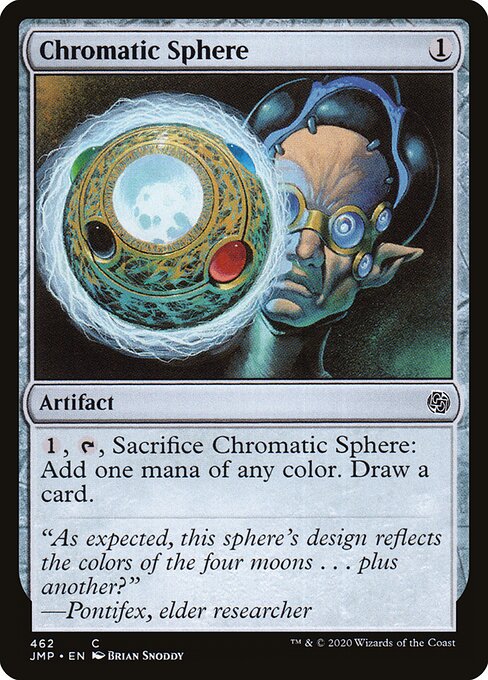
Buried in the Update Bulletin that ships alongside The Hobbit is a change to rule 605.1a, and it takes ten older cards — Chromatic Sphere, Selvala, Explorer Returned, Millikin and seven more — and makes their abilities stop being mana abilities. Scryfall has already pushed the new Oracle text, complete with a fresh line of reminder text telling you the ability is instant-speed only now.
That is a functional nerf by any reading — those abilities lose speed and gain a window for opponents to respond — and it arrived on the same day as a Middle-earth set. So let us do both: what actually shipped, the three new mechanics with the rulings that will settle arguments, and the rules update riding along behind them.
What actually shipped today
There are two set codes on the shelf, and the difference matters at deck registration.
HOB is the main set. Wizards' release notes put HOB cards in Standard, Pioneer and Modern, plus Commander and everything else. The official breakdown is 60 common, 55 uncommon, 53 rare and 15 mythic rare, on top of 5 common dual lands and 5 default-frame basics — 193 distinct cards, which is exactly what a Scryfall query for the set returns.
HOC is The Hobbit Eternal-legal set, 117 distinct cards. Those are legal in Commander, Legacy and Vintage only. The part people misread: a reprint carrying the HOC code stays legal anywhere a card of that name already was. So the HOC printing of The One Ring is still banned in Modern, because The One Ring is banned in Modern. It is the new HOC cards that are shut out of Standard, Pioneer and Modern entirely.
The other thing worth knowing before you spend money: there are no Commander decks for this set. Wizards' own product page lists Play Boosters, Draft Night, the Bundle, Collector Boosters, the Gift Bundle and two Scene Boxes, and the MSRP table in its collecting article lists the same six and nothing else — Play Booster $6.99, Collector Booster $37.99, Bundle $69.99, Gift Bundle $89.99, Draft Night $119.99, Scene Box $41.99. For a premier set with an Eternal-legal supplement attached, that is a genuinely unusual lineup. What you get instead is five 40-card mono-coloured Welcome Decks at WPN stores that mix HOB and HOC cards, and a Battle of Five Armies Co-Op Kit that Wizards has slotted for 2027.
A Play Booster is 14 cards plus a double-sided token: 7 commons, 3 uncommons, one wildcard of any rarity, one rare or mythic, one traditional foil and one land. The wildcard slot is a common 74.17% of the time, uncommon 3.9%, rare 17.3% and mythic 2.3% — so the wildcard is a second rare-or-better roughly one pack in five.
The calendar Wizards published around the launch:
| Date | Event |
|---|---|
| July 30 – August 2 | Early Prereleases at Gen Con |
| August 7–13 | Prerelease events |
| August 11 | MTG Arena release |
| August 14 | Global tabletop release |
| August 14 – September 24 | Standard Showdown |
| August 21–27 | Commander Party, round 1 |
| August 28–30 | Magic Spotlight in Brisbane |
| September 4 | Gift Bundle release |
| September 18–24 | Commander Party, round 2 |
One more number that says a lot about the set's design: of the 193 cards in HOB, only two non-land cards are reprints — Settle the Wreckage and Wood Elves. Nearly everything here is new.
Storied, and the designation you cannot lose
Storied is the headline keyword, and it is a static ability rather than a trigger. The reminder text: if you control three or more artifacts, legendaries, and/or Sagas, you have an enduring story for the rest of the game.
Read that last clause again, because it is doing the heavy lifting. An enduring story is not a permanent, not an ability, and not a counter. It is a designation on you, the player, and Wizards' release notes are explicit that once you have it, no effect can remove it. Blow up all three permanents, bounce the storied creature, wipe the board — the story is already written.
The rulings that will actually come up:
- A permanent only counts once. A legendary artifact is one permanent toward the three, not two. Control one legendary artifact and one Saga and you are at two, not three.
- You need a permanent with storied on the battlefield at the moment the count hits three. If you control three artifacts, lose two, then cast a storied creature, nothing happens. The condition is checked live, not retroactively.
- It is not a triggered ability and does not use the stack. Opponents can respond to the spell that would give you your third qualifying permanent. They cannot respond to you getting the designation.
- A permanent that enters and immediately dies still counts. If your third qualifying permanent enters and then leaves to the legend rule or to zero toughness, you get the enduring story before it goes.
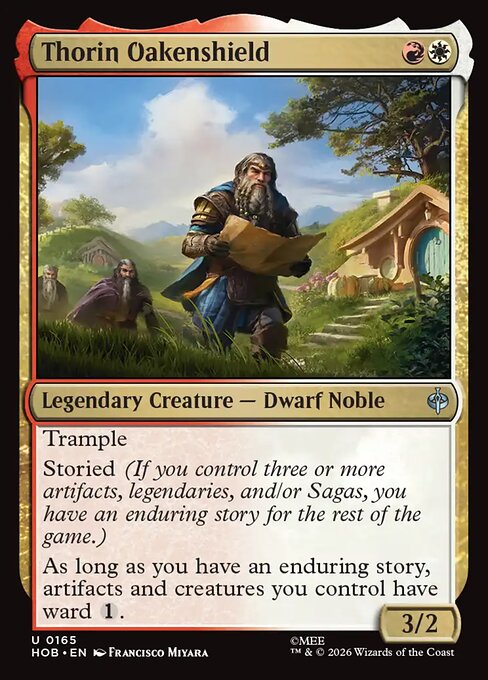
Nine cards in the set carry storied, and all nine are legendary Dwarves — two commons (Ori, Keeper of Songs and Óin the Brave), four uncommons, three rares, and not a single mythic. Thorin Oakenshield himself is a two-mana uncommon that hands your artifacts and creatures ward 1 once the story is running.
The set is built to feed it. 74 of the 193 cards in HOB are legendary permanents, artifacts or Sagas — 55 legendaries, 18 artifacts and 8 Sagas, with overlap. Turning storied on in Limited is not a puzzle; it is the default.
If you remember historic as a batch, this is the same three card types with a different name. Wizards notes that historic itself is not returning in this set.
Recruit is a rummage that sometimes leaves a body
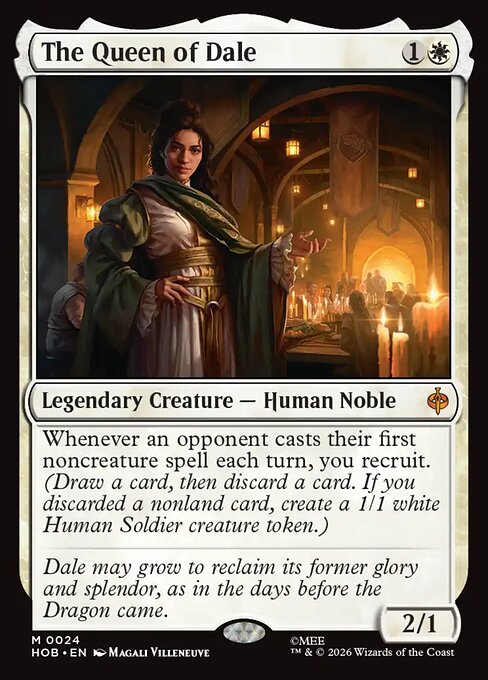
Recruit is a new keyword action and it is three steps: draw a card, discard a card, and if the discarded card was a nonland card, create a 1/1 white Human Soldier token.
That is a rummage with a rider, and the rider is the interesting part. Discarding a land gets you nothing, so recruit rewards a hand that is short on lands — which is precisely the hand you get when you have been recruiting. It fills the graveyard while it fills the board, which puts it squarely in token territory.
Ten cards in HOB tell you to recruit, from a one-mana common in Lake-town Lookout up to The Queen of Dale, a mythic that recruits every time an opponent casts their first noncreature spell in a turn. Every one of the ten is white, blue, or both — five mono-white, three mono-blue, and two in Azorius.
The one procedural ruling to know: once a spell or ability that recruits starts resolving, nobody gets priority until it is finished. You cannot respond in the gap between the draw and the discard, and neither can anyone else. Responses have to happen before the whole thing starts.
Hone counters live on the Equipment, not the creature
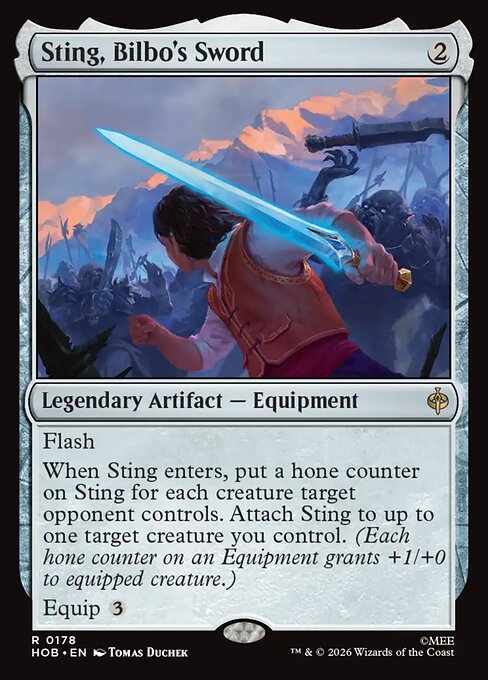
Hone counters are the third new thing, and they are the cleanest: each hone counter on an Equipment grants +1/+0 to the creature that Equipment is attached to.
The subtlety is where the bonus comes from. It is not an ability of the Equipment — it is a rules effect of the counter itself, defined in new subrule 122.1j. Three consequences fall straight out of that, and Wizards spells all three out in the release notes:
- Stripping the Equipment's abilities does not stop the boost. If the Equipment loses all abilities, each hone counter still grants +1/+0. This is the one that wins arguments — compare it to how the layer system treats ability-removal effects.
- The boost only applies while the Equipment is attached. Unattach it, remove the counters, or move the Equipment off the battlefield and the creature's power changes immediately.
- Hone counters work on any Equipment. The Equipment does not need to mention them. Land a hone counter on a Bonesplitter you have had in a binder since 2003 and the equipped creature gets the bonus all the same.
That third point is the one Voltron players should sit with. Dwalin, Weaponmaster puts a hone counter on each Equipment you control whenever he enters or attacks, and nothing about that ability cares which Equipment you are running.
There is a small piece of housekeeping attached: Uvilda, Dean of Perfection used to exile cards with "hone counters" on them. To avoid the collision, Wizards renamed those to refine counters. It is not a functional change, but if you own that card, the Oracle text moved under you.
Amass is back, and this time it makes Goblins
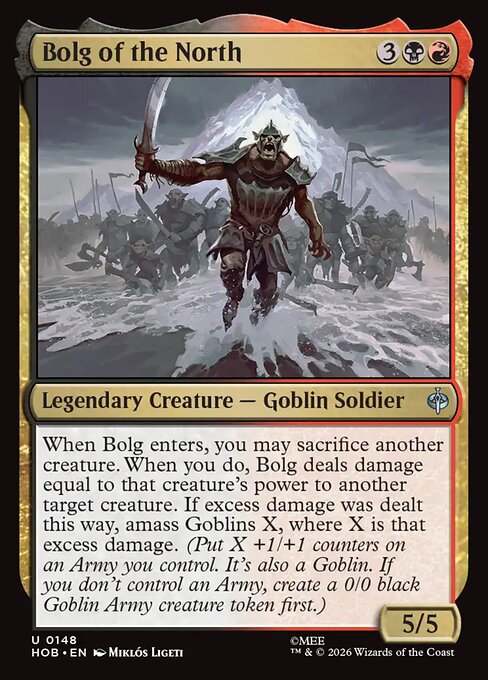
Amass returns from The Lord of the Rings: Tales of Middle-earth, unchanged in how it works and changed in what it names. Every one of the 14 amass cards in HOB says amass Goblins, not amass Orcs.
Mechanically the loop is unchanged from Tales of Middle-earth: if you do not control an Army creature, create a 0/0 black Army token of the named type; then put that many +1/+1 counters on an Army you control. The token is always black regardless of the creature type bolted onto it, and if you somehow control more than one Army — a changeling counts — you choose which one gets the counters.
Where this gets fun is that the set gives Goblins and Armies their own payoffs. The Great Goblin deals 2 damage to a target opponent whenever you put one or more counters on a Goblin, Orc or Army you control — so every amass that actually places counters is also two damage to the face.
The rules change that hits ten cards you may already own
Here is the part that will outlive the set.
Rule 605.1a now says an activated ability is not a mana ability if it moves cards to or from a library as part of its cost or its effect — even when it produces mana. Wizards' stated reason is that mana abilities resolve without using the stack, including in the middle of casting a spell, and having cards move in and out of hidden zones during that window produced answers that were technically defined and practically baffling. Their example is searching your library with Evolving Wilds, wanting to cast Panglacial Wurm out of it, and trying to pay with Chromatic Sphere — which would mean drawing a card while you are actively searching your own library.
Ten cards are functionally changed by this:
- Chromatic Sphere
- Selvala, Explorer Returned
- Millikin
- Deranged Assistant
- Charmed Pendant
- Darkwater Egg, Mossfire Egg, Shadowblood Egg, Skycloud Egg, Sungrass Egg
Their abilities now use the stack, can be responded to, and can only be activated at instant speed. You cannot fire them off mid-cast to help pay for the spell you are casting, and you cannot use them to pay a cost to attack or block. All ten have picked up new reminder text saying so — Chromatic Sphere's Oracle text on Scryfall now ends with a parenthetical telling you to activate only as an instant.
If you play Legacy, Vintage or Commander, check your lists. Deathrite Shaman also gained the same reminder text, though its first ability was never a mana ability to begin with — it requires a target — so nothing about it actually changed.
Two smaller items in the same bulletin. Battles got a rules pass: 310.8 is a new rule covering the state-based action that puts a non-Siege battle into its owner's graveyard at zero defence, with the surrounding rules renumbered around it. And keyword ordering shifted so that reach now prints earlier in a creature's keyword list — Sire of Seven Deaths leads with reach now instead of first strike. That one is cosmetic, and honestly overdue.
What Standard looks like from today
Wizards' release notes enumerate the Standard-legal sets at The Hobbit's release, and there are 19 paper sets on the list: Foundations, Wilds of Eldraine, The Lost Caverns of Ixalan, Murders at Karlov Manor, Outlaws of Thunder Junction, The Big Score, Bloomburrow, Duskmourn: House of Horror, Aetherdrift, Tarkir: Dragonstorm, Final Fantasy, Edge of Eternities, Marvel's Spider-Man, Avatar: The Last Airbender, Lorwyn Eclipsed, Teenage Mutant Ninja Turtles, Secrets of Strixhaven, Marvel Super Heroes and The Hobbit. The official Standard page adds Through the Omenpaths, which is digital-only.
Wilds of Eldraine shipped on September 8, 2023 and is still legal today, which tells you how long a set's Standard life now runs. The official Standard page describes rotation as an annual event that happens after the first premier set Prerelease of the year and removes the six oldest sets — so nothing on that list moves before then. If you are building into Standard around this set, that is a lot of runway.
Quick Action Checklist
- HOB is legal everywhere; HOC is Commander, Legacy and Vintage only. Reprints in HOC keep whatever legality that card name already had.
- Storied is a player designation and cannot be removed. Get to three artifacts, legendaries and/or Sagas while controlling a storied permanent, once, and you have it for the game.
- One permanent counts once toward storied. A legendary artifact is not two-thirds of the way there.
- Recruit is draw, discard, then a 1/1 only if the discard was a nonland. No priority passes inside it.
- Hone counters come from the counter, not the Equipment. Ability removal does not switch them off, and they work on Equipment that has never heard of them.
- Amass in this set always names Goblins. The Army token is black no matter what.
- Ten older cards stopped having mana abilities. Chromatic Sphere, Selvala, Millikin, Deranged Assistant, Charmed Pendant and the five Eggs are now instant-speed, stack-using, respondable.
- No Commander decks in this release. Welcome Decks, Scene Boxes and Collector Boosters are where the HOC cards live until the 2027 co-op kit.
- Only two non-land reprints in the main set — Settle the Wreckage and Wood Elves. The draft environment is almost entirely new cards.
Frequently Asked Questions
When does MTG The Hobbit release?
What is the difference between HOB and HOC in The Hobbit?
How does the storied mechanic work in MTG?
What does recruit do in Magic: The Gathering?
How do hone counters work?
Why did Chromatic Sphere change with The Hobbit?
Does The Hobbit have Commander decks?
Keep Reading
- Wizards of the Coast — The Hobbit Mechanics (Matt Tabak, July 18, 2026)
- Wizards of the Coast — The Hobbit Release Notes (card legality and rulings)
- Wizards of the Coast — The Hobbit Update Bulletin (rules 605.1a, 122.1j, 701.70, 702.195)
- Wizards of the Coast — Collecting The Hobbit (product contents, MSRPs, key dates)
- Wizards of the Coast — The Hobbit Welcome Decks
- Wizards of the Coast — Standard format legal sets and rotation
- Scryfall — The Hobbit (HOB) set data and card legality
- Scryfall — The Hobbit Eternal (HOC) set data
Related Guides
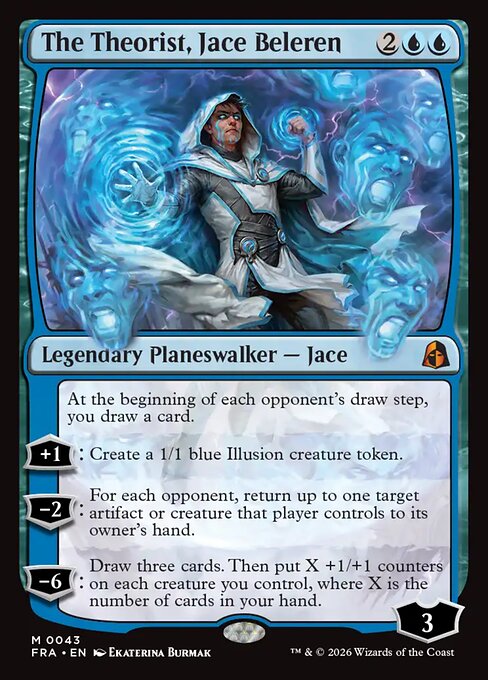
MTG Reality Fracture: Mechanics, Set Size, Prerelease
Prerelease weekend runs September 25 through October 1, and Wizards has already spoiled enough of Reality Fracture that you do not have to walk in blind. Jace becomes the villain, every deck gets a planeswalker token, and Tarmogoyf is quietly back in Standard packs. Here is the whole set, checked against Wizards' own preview articles and Scryfall.
Secrets of Strixhaven Tier List — 20 Cards That Matter
Secrets of Strixhaven shipped 270 cards. Most will never see Standard play. Here are the 20 that actually matter, the hype mythics that flopped, and what the May 18 bans changed.
MTG Universes Beyond: Which Sets Are Standard-Legal
The Hobbit printed four legendary Dragons named Smaug and one of them is illegal in Standard. That is Universes Beyond legality in one image: a simple rule with two exceptions the packaging never mentions. Here is the full set list, the Eternal sets that ship beside them, and what share of each format is now licensed crossover — all read off Scryfall.
Mystery Booster Commander Edition: Packs, Draft, Legality
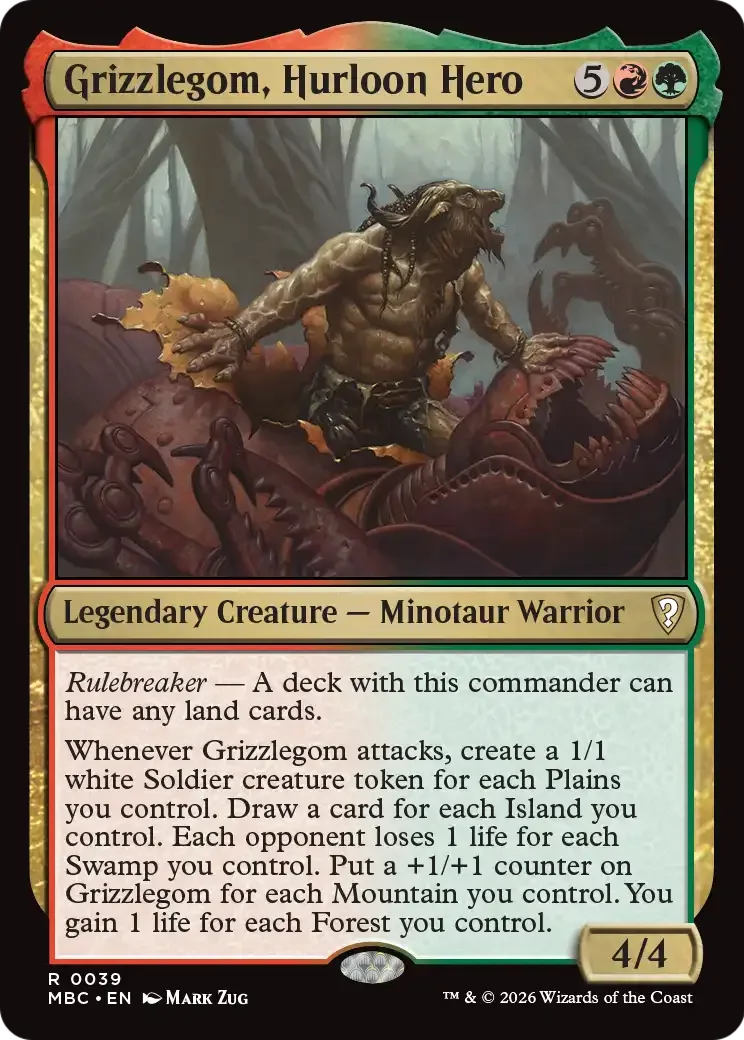
Festival in a Box: Atlanta 2026 goes on sale October 19 for $249.99 with a full box of Mystery Booster Commander Edition inside, and one box is exactly one eight-player Commander Draft. Here is the booster slot by slot, the draft rules, all 60 new commanders by color, the eight rulebreakers, and when the cards become legal.
MTG Commander Format Guide — How to Start Playing EDH (2026)
Commander is the most-played MTG format on the planet and the easiest one for new players to start in. The rules look intimidating on paper. They are not. Here is the full beginner guide.

Best Commander Staples Every Deck Wants, Ranked
There's a short list of cards that show up in basically every Commander deck regardless of theme — the silent 25 that make the splashy 75 work. Here are the staples worth a slot in almost any list, sorted by the job they do, with the legality double-checked.