Minecraft Amethyst Geodes: Find, Farm and Use Amethyst
Amethyst geodes are the only renewable source of amethyst shards, and the block that makes them renewable cannot be moved. Here is where geodes generate, how long a cluster takes to grow, what a pickaxe and Fortune do to the drop, and what the shards are actually for.
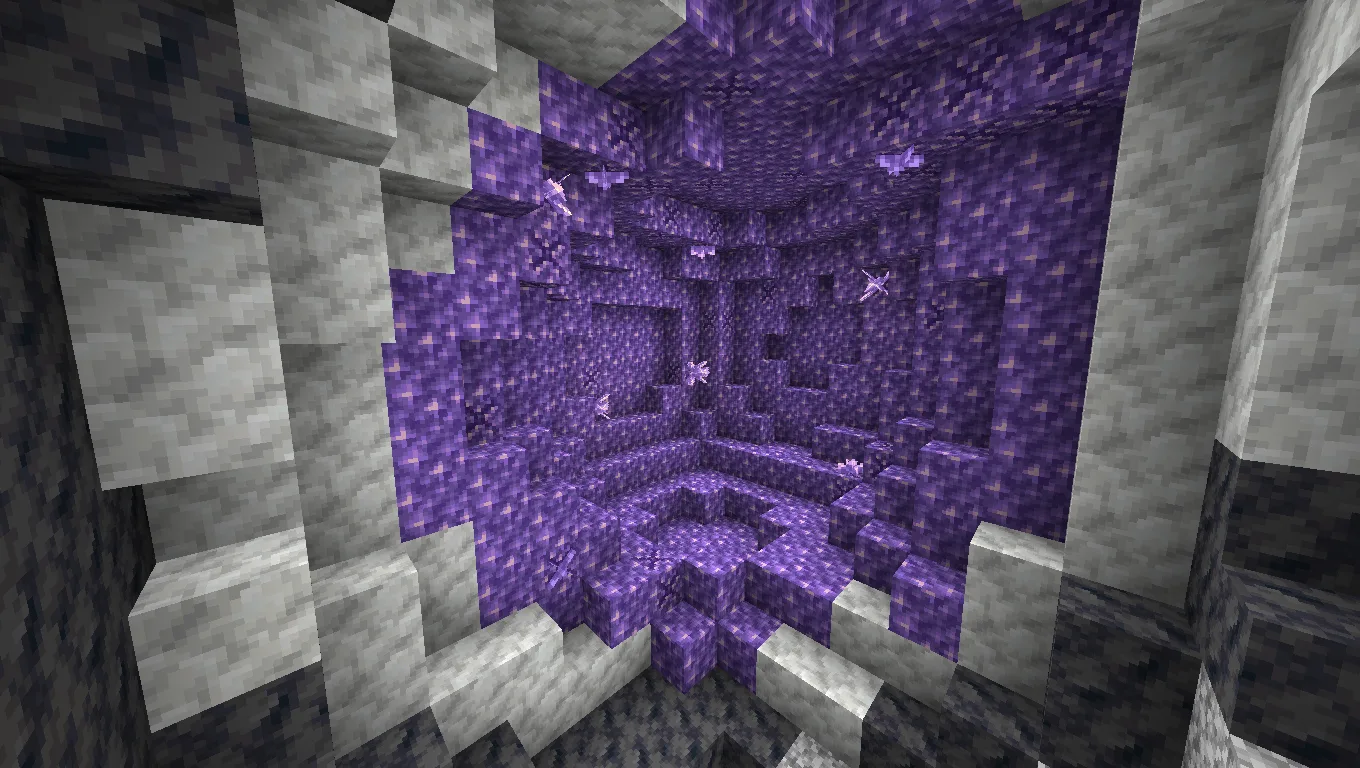
A geode shows up as a cave wall that turns dark grey, then white, then opens into a purple room full of crystals. Do not strip it for shards and move on, because the block that grows the crystals cannot be moved, cannot be crafted and cannot be Silk Touched. The geode you are standing in is the farm. This guide covers where geodes generate, how fast amethyst grows, what each tool drops, and what the shards are worth. Numbers are from the Minecraft Wiki and the Java Edition 26.3 vanilla data, the current release as of 2026-11-10.
Amethyst geodes at a glance
| Fact | Value (Java 26.3) |
|---|---|
| Height range | Y=-58 to Y=30 |
| Chance per chunk | 1 in 24 attempts to place a geode |
| Layers, outside in | Smooth basalt, calcite, amethyst blocks (with budding amethyst) |
| Share of inner layer that is budding amethyst | 8.3% |
| Chance of a crack | 95% |
| Average growth, empty face to full cluster | 8,192 seconds (about 2 h 16 min) of loaded time |
| Cluster drop, pickaxe | 4 shards |
| Cluster drop, anything else | 2 shards |
| Cluster drop, Fortune III pickaxe | 4, 8, 12 or 16 shards, average 8.8 |
| Budding amethyst drop | Nothing, with any tool |
Where geodes generate
In the Java world-gen data, the geode feature tries once per chunk with a 1-in-24 rarity filter, at a random height from 6 blocks above the world bottom (Y=-58) up to Y=30. The attempt is cancelled if it hits water, lava, bedrock, ice, packed ice or blue ice (the game's geode_invalid_blocks tag) or air, which the wiki notes is also treated as invalid. The wiki lists geodes as generating in any Overworld biome, and the 26.3 data includes the feature in biomes as different as plains, frozen peaks, lush caves, dripstone caves, mushroom fields and the deep dark, so there is no "geode biome" to hunt for.
Two practical consequences:
- Look for the outer shell, not the crystals. The outer layer is smooth basalt, a dark grey block that appears in few other places (the wiki lists ancient cities). If you see it in a cave wall, the white calcite and the purple core are a few blocks behind it.
- Caves, aquifers and canyons can be overwritten by them. The wiki notes geodes do not connect to caves cleanly, so one often sits half-buried in the wall of a cave you are already exploring. And 95% of geodes generate with a crack that exposes the interior, so the purple usually shows if you light the area.
If you want to skip searching, the wiki's geode page embeds a Chunkbase calculator that maps geode positions from your seed.
What a geode is made of
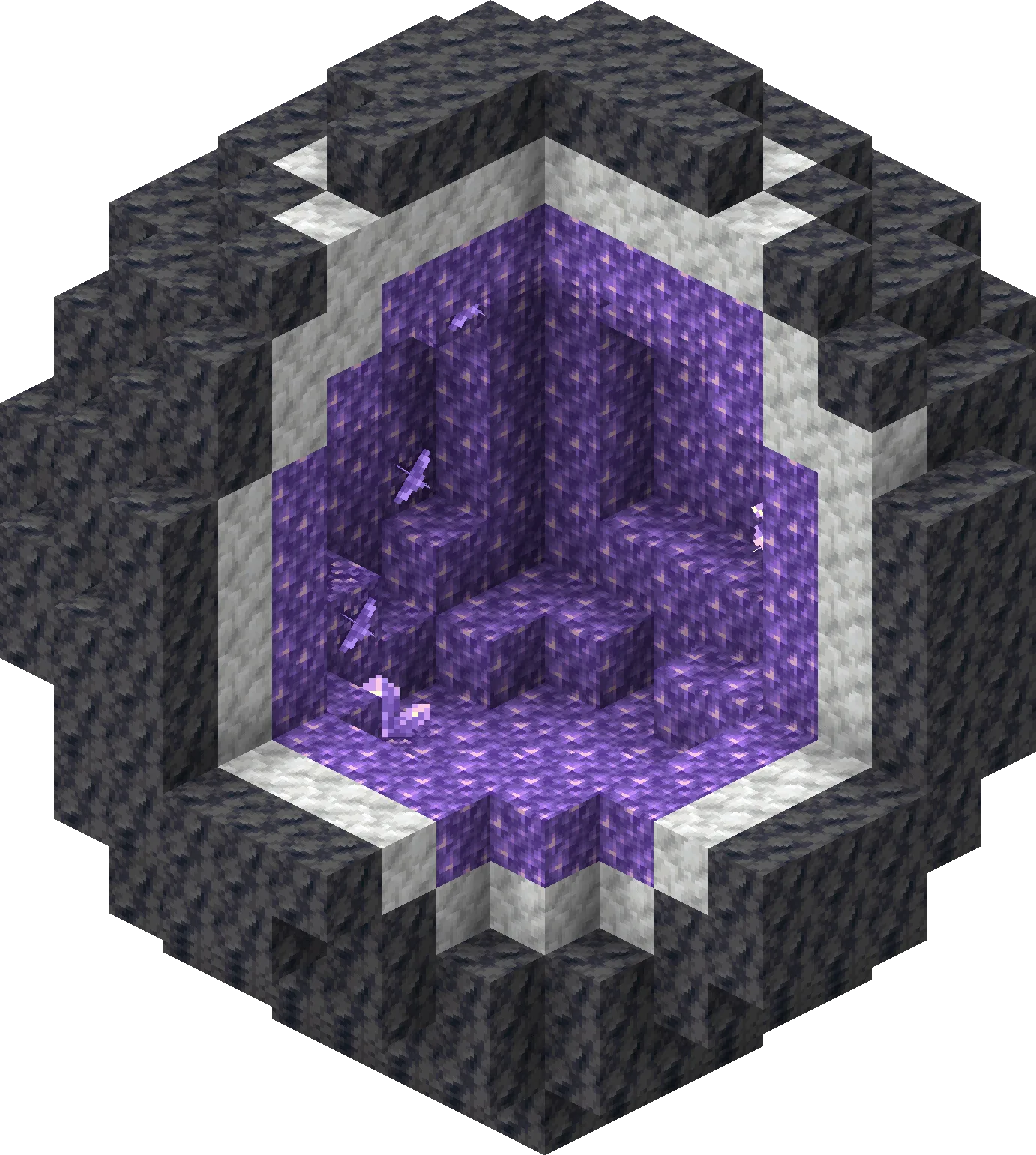
Three layers, outside to inside:
| Layer | Block | Worth mining? |
|---|---|---|
| Outer | Smooth basalt | Decoration only. It can also be smelted from basalt |
| Middle | Calcite | Decoration, and getting a full block family in the next drop (below) |
| Inner | Block of amethyst, with 8.3% budding amethyst | Amethyst blocks yes. Budding amethyst cannot be collected |
Blocks of amethyst, calcite and smooth basalt all need a pickaxe to drop. Mine blocks of amethyst freely if you want them for decoration or sculk relays; they are craftable from four shards anyway. Just do not break the budding amethyst.
Budding amethyst: the block you cannot take home
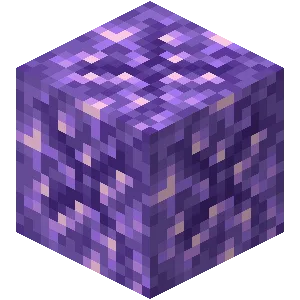
Budding amethyst looks almost like a block of amethyst, and it is the only block that grows crystals. Per the Minecraft Wiki:
- It drops nothing when broken, and Silk Touch does not change that. The Java loot table for it is empty.
- It is destroyed when a piston pushes it, and sticky pistons, slime blocks and honey blocks cannot pull it.
- It is unobtainable in Survival. Creative inventory and commands only.
So every budding block you break is gone from that world for good. Before you mine anything in the inner layer, look closely: budding amethyst has a slightly different texture from the plain block, and in a natural geode buds only ever grow from budding faces, so a block with crystals on it is the one to leave alone.
How amethyst grows
A bud only grows while it is attached to budding amethyst. A bud you place on any other block stays at whatever stage it was.
There are four stages, each with its own light level:
| Stage | Light level | Drops without Silk Touch |
|---|---|---|
| Small amethyst bud | 1 | Nothing |
| Medium amethyst bud | 2 | Nothing |
| Large amethyst bud | 4 | Nothing |
| Amethyst cluster | 5 | Shards |
The mechanic, per the wiki: when a budding amethyst gets a random tick, it picks one of its six faces at random and has a 20% chance to either start a small bud there (if the space is air or a water source block) or advance the bud already on that face by one stage. If the chosen face holds anything other than air, a water source block or that face's own bud, the tick does nothing.
With the default random tick speed, a given block gets a random tick about every 68.27 seconds. A specific face therefore advances once every 30 random ticks on average (one in six for the face, times one in five for the 20%), and needs four advances to become a cluster. That is 68.27 x 30 x 4 = 8,192 seconds, about 2 hours 16 minutes, for each exposed face. All six faces grow at the same time, so a fully exposed budding block averages up to six clusters in that window, and a block with three faces buried in calcite averages three.
Two rules that change your farm design:
- Expose every face. Any block against a face, solid or not, stops that face from ever growing.
- The chunk has to be loaded. Since Java 1.21.5, every fully loaded chunk receives random ticks whether or not a player is within 8 chunks, per the wiki's tick article. That means a chunk loader works, but in practice the geode only grows while you, or a loader, keep it loaded. Build your base close to it.
Mining clusters: pickaxe, Fortune and Silk Touch
The Java loot table for an amethyst cluster has three branches, checked in order:
- Silk Touch: the cluster drops itself. Buds at any stage also drop themselves with Silk Touch.
- Any pickaxe (wooden through netherite, including copper, per the cluster_max_harvestables tag): 4 shards, then Fortune applies.
- Anything else, including your hand, a piston push or an explosion: 2 shards (and explosions can destroy some of them).
Fortune uses the standard ore-drop formula on the base 4:
| Pickaxe | Possible shard counts | Average per cluster |
|---|---|---|
| No enchantment | 4 | 4 |
| Fortune I | 4 or 8 | 5.33 |
| Fortune II | 4, 8 or 12 | 7 |
| Fortune III | 4, 8, 12 or 16 | 8.8 |
That table is the whole case for harvesting by hand. A piston-based automatic farm gets 2 shards per cluster; a Fortune III pickaxe averages 8.8, more than four times as much. (The wiki's farming tutorial says Fortune III averages 10, which does not match the cluster page or the loot formula. 8.8 is the figure the data supports.) Do not mine buds early: a large bud with a normal pickaxe drops nothing and resets that face to empty.
Turning a geode into a farm
Because the budding blocks cannot move, a farm is built around the geode where it sits. The wiki's amethyst farming tutorial lays out the options. The common thread is to dig out every non-budding block around the budding ones (amethyst, calcite, basalt, stone) so each budding face is open air, light the area so mobs do not spawn, and give yourself a way to reach every face.
| Design | How it works | Trade-off |
|---|---|---|
| Scaffolding | Floors and ladders around the hollowed geode, scaffolding to reach each budding block | Simplest. Keep scaffolding off the budding faces, since it blocks growth |
| Float | Flood the cleared geode with water source blocks and conduits so you can swim and mine freely; buds grow in source water | Needs conduits and lots of water; drops float to the surface and can despawn |
| Hole | A floor above with a water-filled hole over each budding block, and a collection system below | No despawning; more building |
| Automatic | Pistons or a flying machine break clusters on a timer, hoppers collect | AFK-friendly, but only 2 shards per cluster and buds get broken too |
My recommendation: unless you need hands-off shards in bulk, build a manual farm and harvest with Fortune III. The automatic designs exist for players who want shards without visiting, and the wiki notes the best of them, flying machines that clear every face, are hard to design. The automatic farms guide covers the observer and piston basics, and the enchantments ranking covers getting Fortune III on a pickaxe.
What amethyst shards are for
In Java 26.3 a shard goes into four crafting recipes, one smithing use and one mob interaction:
| Use | Recipe | What you get |
|---|---|---|
| Block of amethyst | 4 shards in a 2x2 | 1 block (decoration, and relays vibrations next to a sculk sensor) |
| Tinted glass | 4 shards around 1 glass | 2 tinted glass |
| Spyglass | 1 shard on top of 2 copper ingots | 1 spyglass |
| Calibrated sculk sensor | 3 shards around 1 sculk sensor (top and both sides) | 1 calibrated sculk sensor |
| Armor trim | 1 shard as the trim material | Amethyst-coloured trim |
| Allay duplication | Give 1 shard to an allay dancing to a jukebox | A second allay (5-minute cooldown) |
A few notes on the ones that matter:
Tinted glass is see-through but blocks light completely, and beacon beams. It drops itself when broken by hand, unlike regular glass, and it cannot be made into panes. It is the clean way to build a dark mob-farm room you can still see into; the mob spawning guide covers why darkness matters.
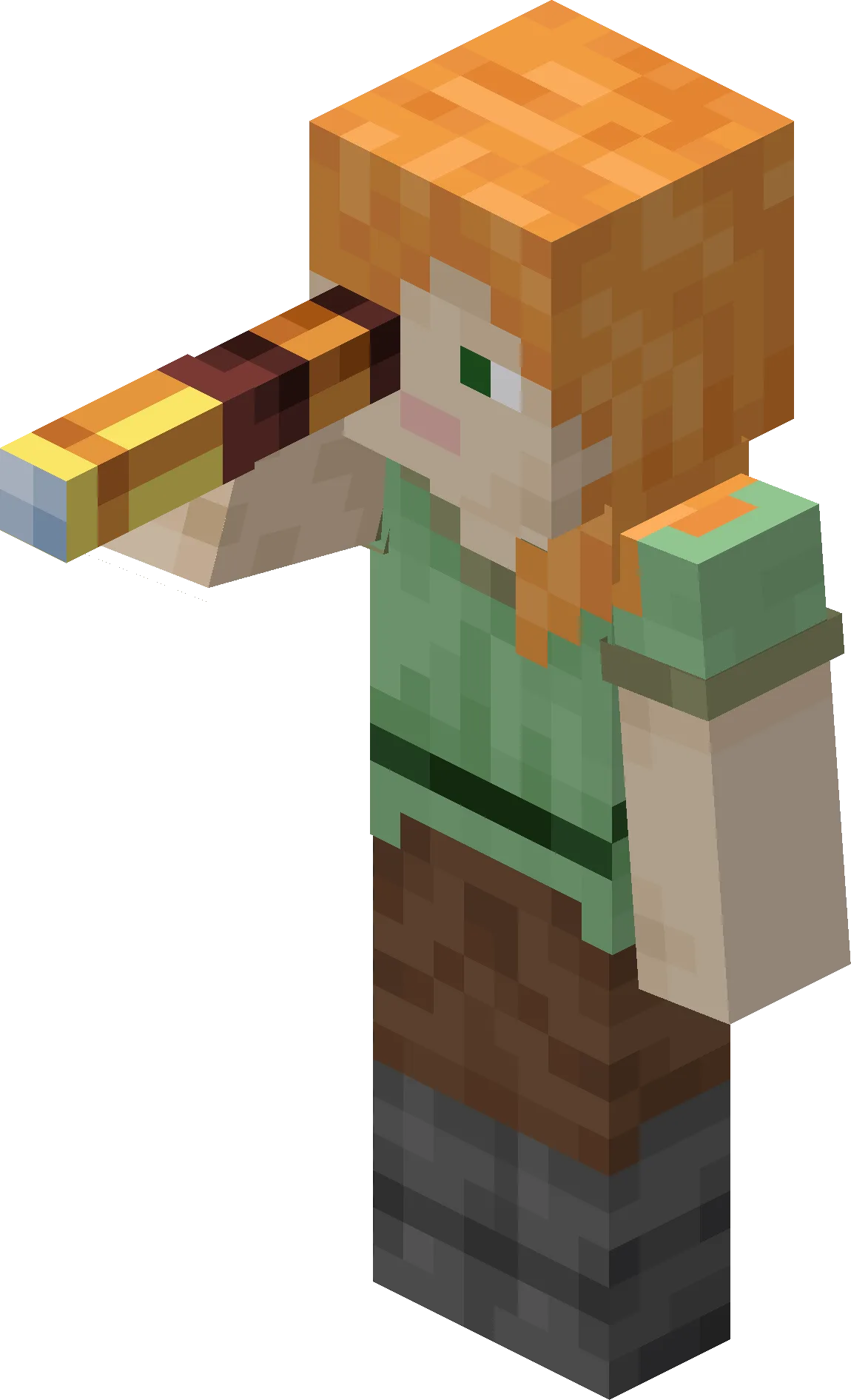
The spyglass narrows your field of view to one tenth of your setting: 7 degrees at Java's default 70. It is also tied to three advancements, Is It a Bird? (look at a parrot through it), Is It a Balloon? (a ghast) and Is It a Plane? (the ender dragon). See the advancements list for the rest.
The calibrated sculk sensor listens twice as far as a regular one (16 blocks against 8) and can be filtered to a single vibration frequency by powering its amethyst side. Put a block of amethyst next to a sensor and it re-emits the vibration, which is how wireless sculk lines are built. Keep both away from natural sculk shriekers; a calibrated sensor can trigger one within 8 blocks, and a natural shrieker can summon the Warden (see the Deep Dark and Warden guide).
Allays cost one shard per duplicate. The allay guide covers the jukebox duplication trick.
Chest loot: the backup source
If you have not found a geode, two structures carry shards in Java 26.3:
| Chest | Rolls per chest | Shard entry weight | Stack size |
|---|---|---|---|
| Trial chambers intersection chest | 1 to 3 | 20 of 86 | 8 to 20 |
| Ancient city chest | 5 to 10 | 3 of 84 | 1 to 15 |
Neither is renewable, and neither gives you budding amethyst, so treat chests as a way to get a spyglass early, not as a supply. The trial chambers guide covers the structure.
Calcite is about to matter
In the Java 26.3 data, calcite has no crafting recipes of its own; it is a decoration block and nothing else. That changes with the upcoming game drop: Java 26.4 Snapshot 7 (November 3, 2026) added a calcite pillar, slab, stairs and wall, plus polished calcite (2x2 calcite) and polished calcite bricks (2x2 polished calcite), each with its own slab, stairs and wall, all also craftable in a stonecutter. Those are snapshot additions and could change before release. Per the wiki, geodes and stony peaks are where calcite generates today (ice caves join them in the drop), so if you are hollowing one out for a farm, keep the calcite instead of tossing it.
One more snapshot detail: the wiki notes that because packed ice is on the invalid list, geodes will rarely generate inside the new ice caves (bug report MC-312663, marked Works As Intended). The ice caves guide covers that biome.
Quick Action Checklist
- Hunt the smooth basalt. Dark grey in a cave wall, between Y=-58 and Y=30, usually means a geode is behind it.
- Never break budding amethyst. It drops nothing, even with Silk Touch, and cannot be moved.
- Clear every face around each budding block; each blocked face never grows.
- Wait about 2 h 16 min of loaded time per face for a full cluster, and stay nearby so the chunk stays loaded.
- Harvest clusters only, with Fortune III: 8.8 shards on average against 4 with a plain pickaxe and 2 from pistons.
- Spend them on a spyglass (1 shard), tinted glass (4 for 2), calibrated sculk sensors (3) and allays.
- Keep the calcite for the 26.4 calcite blocks.
Frequently Asked Questions
Where do amethyst geodes spawn in Minecraft?
Can you get budding amethyst in Minecraft Survival?
How long does amethyst take to grow in Minecraft?
How many amethyst shards does a cluster drop in Minecraft?
What are amethyst shards used for in Minecraft?
Should you break budding amethyst in Minecraft?
Keep Reading
- Minecraft Wiki — Amethyst Geode: Y=-58 to 30, 1/24 per chunk, layers, 8.3% budding, 95% cracked
- Minecraft Wiki — Budding Amethyst: drops nothing, piston behaviour, growth mechanics
- Minecraft Wiki — Amethyst Cluster: growth stages, light levels, shard drops and Fortune averages
- Minecraft Wiki — Amethyst Shard: sources and uses
- Minecraft Wiki — Tutorial: Amethyst farming (manual and automatic designs)
- Minecraft Wiki — Tick: random ticks in fully loaded chunks since Java 1.21.5
- Minecraft Wiki — Tinted Glass: blocks light and beacon beams, drops when broken
- Minecraft Wiki — Spyglass: recipe and field of view
- Minecraft Wiki — Calibrated Sculk Sensor: 16-block range, frequency filtering, amethyst resonance
- Minecraft Wiki — Java Edition 26.4 Snapshot 7 (November 3, 2026): calcite block sets
- Minecraft.net — Minecraft 26.4 Snapshot 7
- Java Edition 26.3 vanilla data (misode/mcmeta): geode placement, rarity 24, height 6 above bottom to Y=30
- Java Edition 26.3 vanilla data (misode/mcmeta): geode feature, 0.95 crack chance, 0.083 budding chance
- Java Edition 26.3 vanilla data (misode/mcmeta): amethyst cluster loot table
- Java Edition 26.3 vanilla data (misode/mcmeta): trial chambers intersection chest, amethyst shards 8 to 20
- Java Edition 26.3 vanilla data (misode/mcmeta): ancient city chest, amethyst shards 1 to 15
Related Guides
Minecraft Spawn Point: Beds, Respawn Anchors and World Spawn
You died, clicked Respawn, and landed hundreds of blocks from your base. Here is how a bed, a respawn anchor and the spawnpoint command each set your respawn point, what quietly deletes it, and what to do in the five minutes your items last.

Minecraft Goat Horns: All 8 Sounds and How to Get Them
Eight goat horns exist, and four of them only come from screaming goats. Here is exactly which blocks knock a horn loose, how to breed screaming goats, the pillager outpost chest that can hold a horn, and why blowing one in the Deep Dark is a bad idea.
Minecraft Advancements List and How to Get the Hard Ones
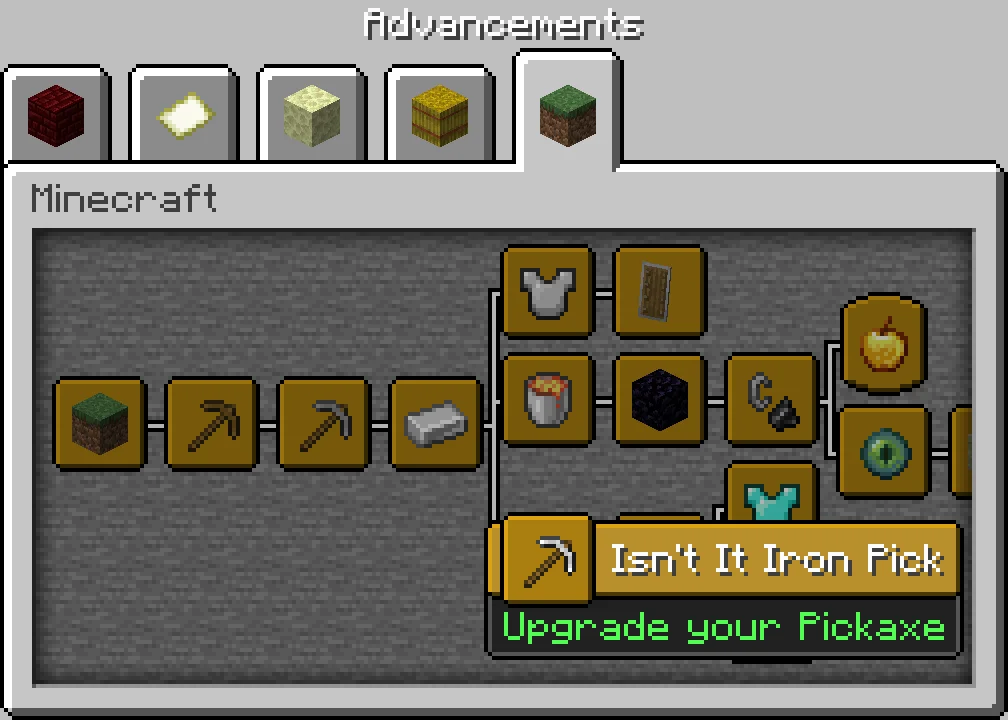
Minecraft Java has 126 advancements, but only 23 pay XP, and one of them pays 1,000. Here is every advancement by tab for Java 26.3, the challenges ranked by reward, the full Adventuring Time, Monsters Hunted, A Balanced Diet and Two by Two checklists, the descriptions that mislead you, and what the 26.4 snapshots change.
Minecraft Wandering Trader Guide: Trades, Spawns and Llamas
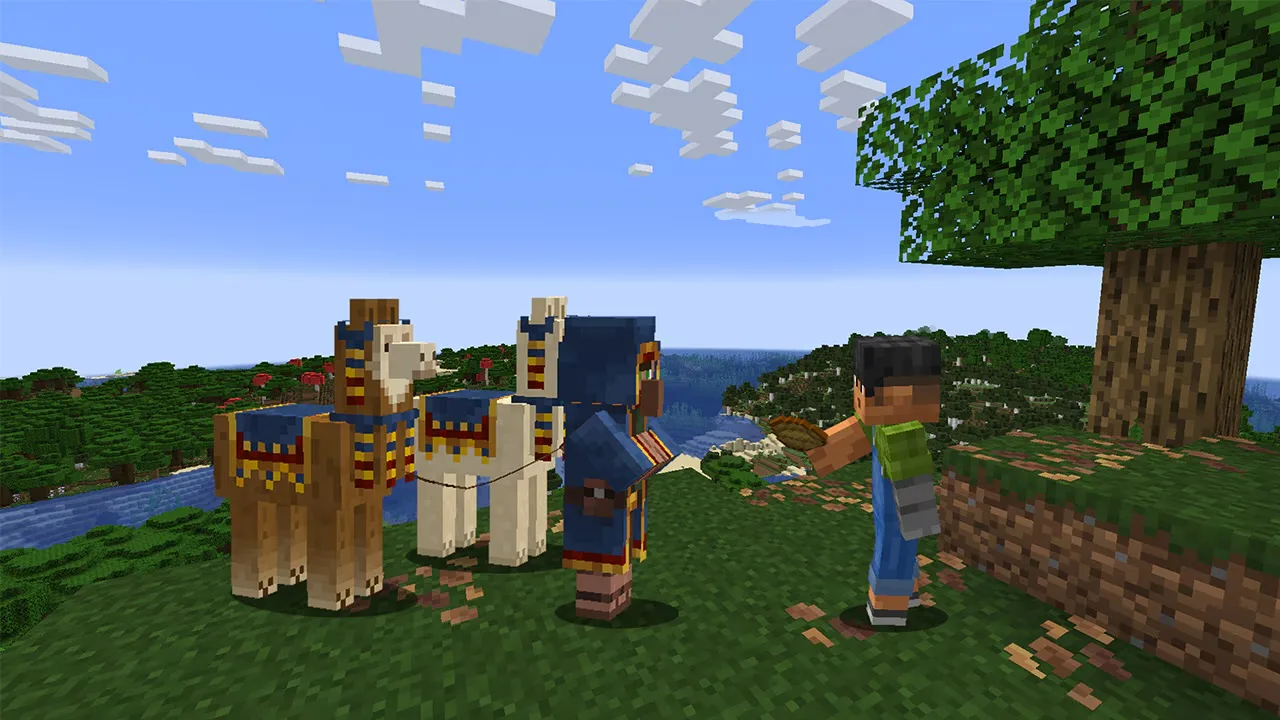
Every wandering trader shows 9 offers drawn from a pool of 100 that is the same on Java 26.3 and Bedrock 26.60. Here is the full price list from the game's own trade files, the odds of seeing the offer you want, what the trader buys from you, how long one takes to spawn, and why a name tag will not keep it.
Minecraft Survival Guide for Beginners: Your First Days
You have about ten minutes of daylight before the sun sets and the world tries to kill you. Here is exactly what to do with them — punch a tree, build a tool chain, and get a roof over your head before the zombies arrive.
Best Minecraft Enchantments, Ranked — The Ones Worth Your XP
Mending is the enchantment that ends the grind — gear that repairs itself forever. Everything else is a fight over your XP and anvil uses. Here is what actually earns a slot, ranked, with the real max levels.