Minecraft Mob Spawning: Light Levels, Caps, Spawn-Proofing
The "keep it above light level 7" rule everyone still repeats died in 1.18. Here is the ruleset the game actually runs: what it checks before a mob appears, how far one torch really reaches, why your farm is capped, and the Java-versus-Bedrock differences that quietly break cross-play builds.
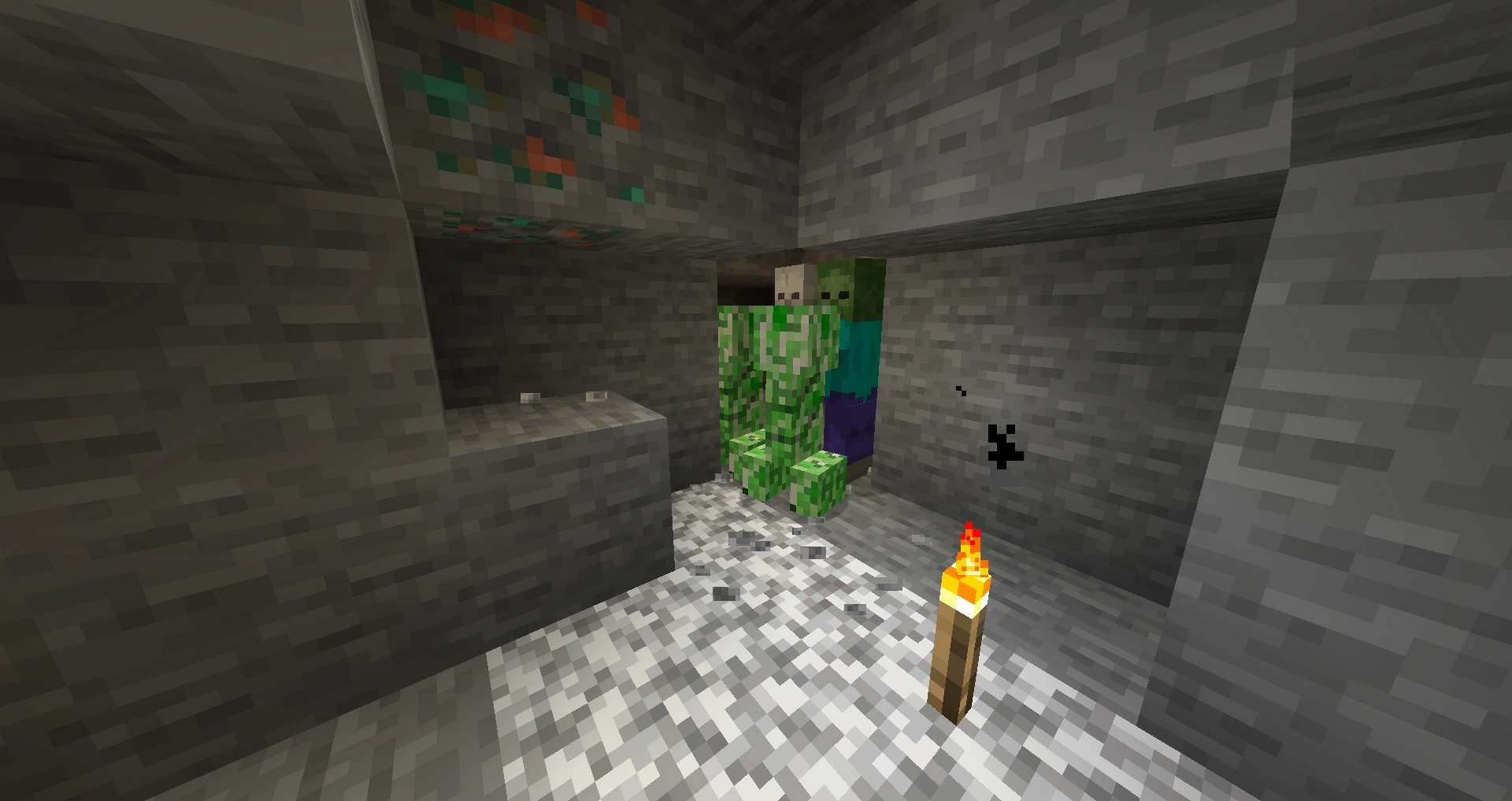
Ask ten players why a creeper just materialized in their hallway and you will get ten answers, and about half of them are quoting a rule Mojang deleted in 2021. The "keep it above light level 7" advice everyone still repeats was correct for eleven years — it went in on February 4, 2010, while the game was still in Indev, and it survived untouched until Caves and Cliffs Part II. Then 1.18 changed the number to zero, and nobody went back and updated their torch grids.
That one change is why your old mining tunnels are wildly over-lit and your new base still gets a spawn in the corner behind the crafting table. Below is the ruleset the game actually runs: the checks it performs before it places a mob, how far light really travels, why the mob cap throttles your farms, and the specific places where Java and Bedrock disagree badly enough to break a cross-play build.
The 1.18 change that made half your torches pointless
Before 1.18, an Overworld hostile mob could spawn at block light level 7 or below. To deny a spawn you needed block light 8 or higher on that tile — which is where the "torch every 6 blocks" habit came from.
Since 1.18, in Java Edition, block light has to be exactly 0. Any light at all — one single unit bleeding in from a torch thirteen blocks down the tunnel — blocks the spawn. Bedrock Edition sits in the same place: the rule there is that most Overworld monsters cannot spawn if sky light is 7 or greater, or if block light is greater than 0.
There is a second gate people forget about: sky light. In the Overworld the game also wants the internal sky light at that position to be 7 or less. Inside a cave that is automatic. On the surface it is the entire reason mobs do not spawn on your grass roof at noon but do at midnight — daylight keeps sky light above the threshold, dusk lets it fall below.
So the practical version:
- Underground or fully enclosed: block light 0 is the only thing standing between you and a spawn. Light is your whole defense.
- Surface at night: same situation, because sky light has already dropped out of the way.
- Surface at midday: sky light covers you regardless of how many torches you did or did not place.
One more caveat, because it catches people constantly: this is an Overworld rule. The Nether check allows spawns at light level 11 and below, which is why a bastion you have carpeted in glowstone still produces zombified piglins. The End requires block light 0, same as the Overworld.
What the game checks before a mob appears
A natural spawn has to clear every one of these. Fail a single condition and nothing appears:
- The position is inside the spawn shell. Mobs never spawn within 24 blocks of a player.
- The light check passes (block light 0 in the Overworld and the End, 11 or below in the Nether).
- The floor works. The block underneath needs a solid, full top surface.
- The space is legal. The spawn position and the block above cannot be a full 1x1x1 collision block, cannot be a fluid, cannot be a redstone power or transmission component — pressure plates, buttons, redstone dust, repeaters — and cannot be something that would immediately hurt the mob, like fire, a wither rose, sweet berry bushes, or powder snow.
- The category cap has room. More on that below.
- Mob-specific and biome-specific rules pass, which is why drowned appear in water and husks appear in deserts.
Spawn-proofing, stripped of mystique, is just picking whichever of those six conditions is cheapest to break at a given spot.
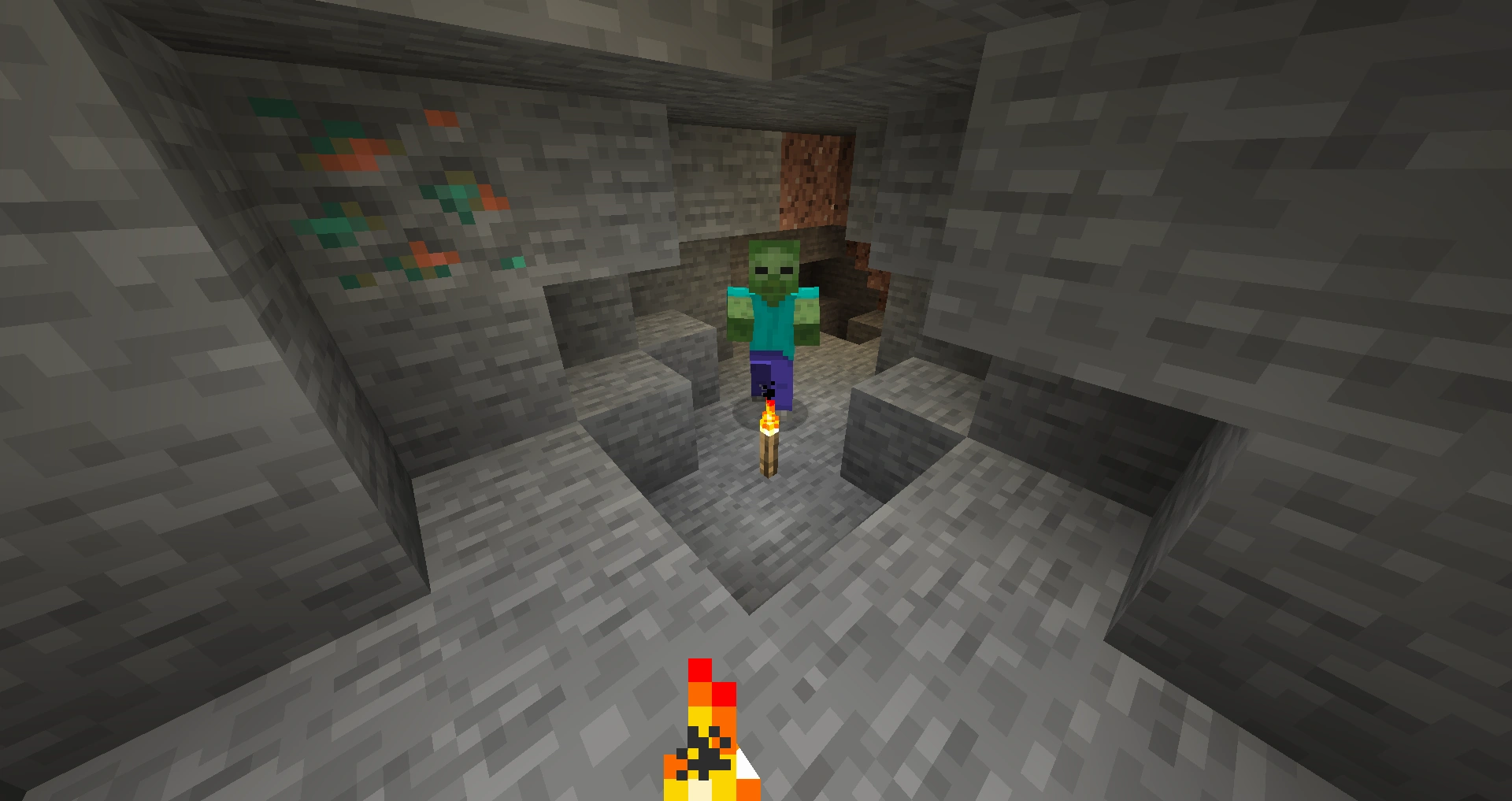
Java runs a hostile spawn attempt every game tick — 20 times a second; the passive-mob cycle only runs once every 400 ticks, or 20 seconds. Java also pack-spawns: it picks a point inside a chunk, then scatters up to four of a mob around it with a plus-or-minus 5 triangular offset, so roughly 85% land within 5 blocks of the pack center and 99% within 10. That is why caves come at you in clumps of three or four zombies instead of a steady trickle.
How far one torch actually reaches
Block light drops by exactly 1 per block of taxicab distance — X plus Y plus Z, not straight-line distance. A torch emits light level 14.
Run the arithmetic on a flat, open, unobstructed floor: at 13 blocks out the light value is 1, which is still above zero, which is still spawn-proof. At 14 blocks it hits 0 and mobs can spawn.
One torch covers 13 blocks in every direction. Before 1.18 that number was 6, because you needed light 8 or better. If you are still placing torches every 6 or 7 blocks down a straight tunnel, you are burning roughly double the coal you need to — space them about 26 apart and the floor between them never reaches 0.
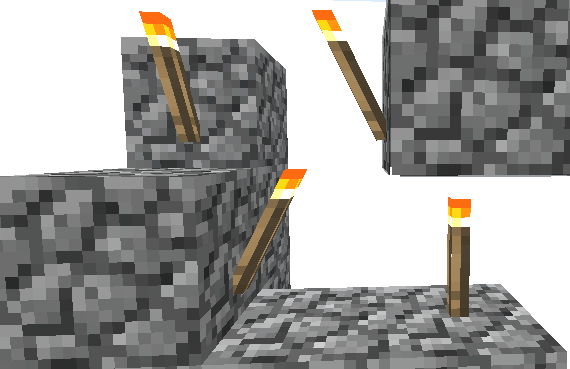
The caveats are the part that actually matters, though. Light does not pass through opaque blocks, so a corner, a wall, or a single one-block step kills that reach instantly. And because it is taxicab distance, climbing one level costs you exactly as much as walking one block sideways. Vertical drops, ore pockets you hollowed out, and side branches are where the spawns actually happen — not in the middle of the nice straight corridor you lit properly.
Light levels for every source worth using
Now that anything above 0 works, the question stopped being "is this bright enough" and became "how far does it reach, and does it look good in my build."
- 15: glowstone, sea lantern, lantern, shroomlight, campfire, jack o'lantern, froglight, lit redstone lamp, beacon, active conduit
- 14: torch, end rod
- 10: soul torch, soul lantern, soul campfire, crying obsidian
- 7: redstone torch, glow lichen
- 6: sculk catalyst
- 5: amethyst cluster
- 3: magma block
A level-15 source reaches 14 blocks against the torch's 13, so lanterns and sea lanterns buy you exactly one extra block of coverage — pick them for looks, not for math. Soul lights at 10 reach 9 blocks, which is plenty for a room and not enough for a corridor. Glow lichen is the trap: at level 7 it covers 6 blocks, and people spam it across cave walls assuming it is purely decorative.
The 24-block hole around you
Mobs cannot spawn within 24 blocks of a player in either edition, and it is a spherical shell, not a cylinder. Every mob farm design you have ever seen is downstream of this number: your AFK spot has to sit more than 24 blocks from the spawn platform or the platform produces nothing, while still being close enough that the platform is inside the spawn range at all.
Where the editions split:
- Java: mobs spawn within a 128-block-radius sphere centered on you, and a chunk is a spawning candidate when a player is horizontally within 128 blocks of the chunk's center.
- Bedrock: the shell is tied to simulation distance. At simulation distance 4, spawns happen between 24 and 44 blocks from you. At simulation distance 6 and above it widens to roughly 24 to 128 blocks, restricted to about 96 blocks horizontally.
That is why an identical farm at identical coordinates behaves completely differently across editions, and why Bedrock players get told to lower their simulation distance — it concentrates every spawn attempt into a much tighter shell around the farm.
Java vs Bedrock: the differences that change your build
The light rule converged, so ignore anyone telling you Bedrock lets mobs spawn at light 7. The differences that still matter:
- Spawn shell. Java: a 24-to-128-block sphere. Bedrock: keyed to simulation distance, 24 to 44 blocks at simulation distance 4.
- Hostile cap. Java's Monster category cap is 70, applied per player over mobs within 128 blocks, with the global figure scaled by how many chunks are loaded across a 17x17 chunk square around each player. Bedrock runs a global cap of 200 mobs plus separate population-control limits counted over 9x9 chunk squares.
- Spawnable surfaces. This is the one that ruins cross-play builds. In Java, top slabs, double slabs, and upside-down stairs all still spawn mobs, because each presents a full solid top face. Bedrock's list of blocks that cannot support a spawn explicitly includes right-side-up and upside-down stairs. So a stair-tiled roof is legitimate spawn-proofing on Bedrock and completely useless on Java.
- Bottom slabs and carpet block spawns in both, which is why they are the answer whenever you want one solution that works on either edition.
The mob cap is why your farm is slow
Java's Monster cap is 70. Once 70 hostile mobs exist in your counted area, the game stops spawning more — anywhere. Every zombie standing in an unlit cave under your base is a cap slot your farm is not getting.
This is the single biggest reason a correctly built farm produces at a fraction of its advertised rate, and the fix order is always the same:
- Clear the competition. Light, slab, or flood the caves within 128 blocks of the farm. This is tedious and it is also the entire fix in most cases.
- Build where there is nothing else to spawn on — over an ocean, or high in the sky above a properly darkened platform. There is a reason every high-rate design floats.
- Kill fast. Mobs waiting in your collection point still occupy cap slots. A slow drop chute is a throughput cap.
Bedrock's arithmetic differs — 200 global, plus per-area limits — but the principle is identical: any competing spawn space starves your farm. If you want the built designs rather than the theory, the best Minecraft farms roundup and the automatic farms guide cover the layouts.
Blocks that refuse to hold a spawn
Ranked roughly by how practical they are:
- Bottom slabs. Anything less than a full block high cannot hold a spawn. A bottom-slab floor is permanently spawn-proof at any light level. Note again that top slabs and double slabs are not — a slab in the upper position presents a full top face in Java.
- Carpet. Same logic, and mobs treat it as air. Cheap, thin, does not change your floor height, and it works on both editions.
- Redstone components. Buttons, pressure plates, rails, redstone dust, levers, repeaters — all of them block the spawn position.
- Glass, every variant. Including stained and tinted. Nothing hostile spawns on glass.
- Leaves, trapdoors, scaffolding, copper grate, chorus flower, bedrock, and barrier blocks are all non-spawnable surfaces.
- Water and lava. No non-aquatic mob spawns in water; nothing but striders spawns in lava.
- Snow layers 2 to 7 layers thick.
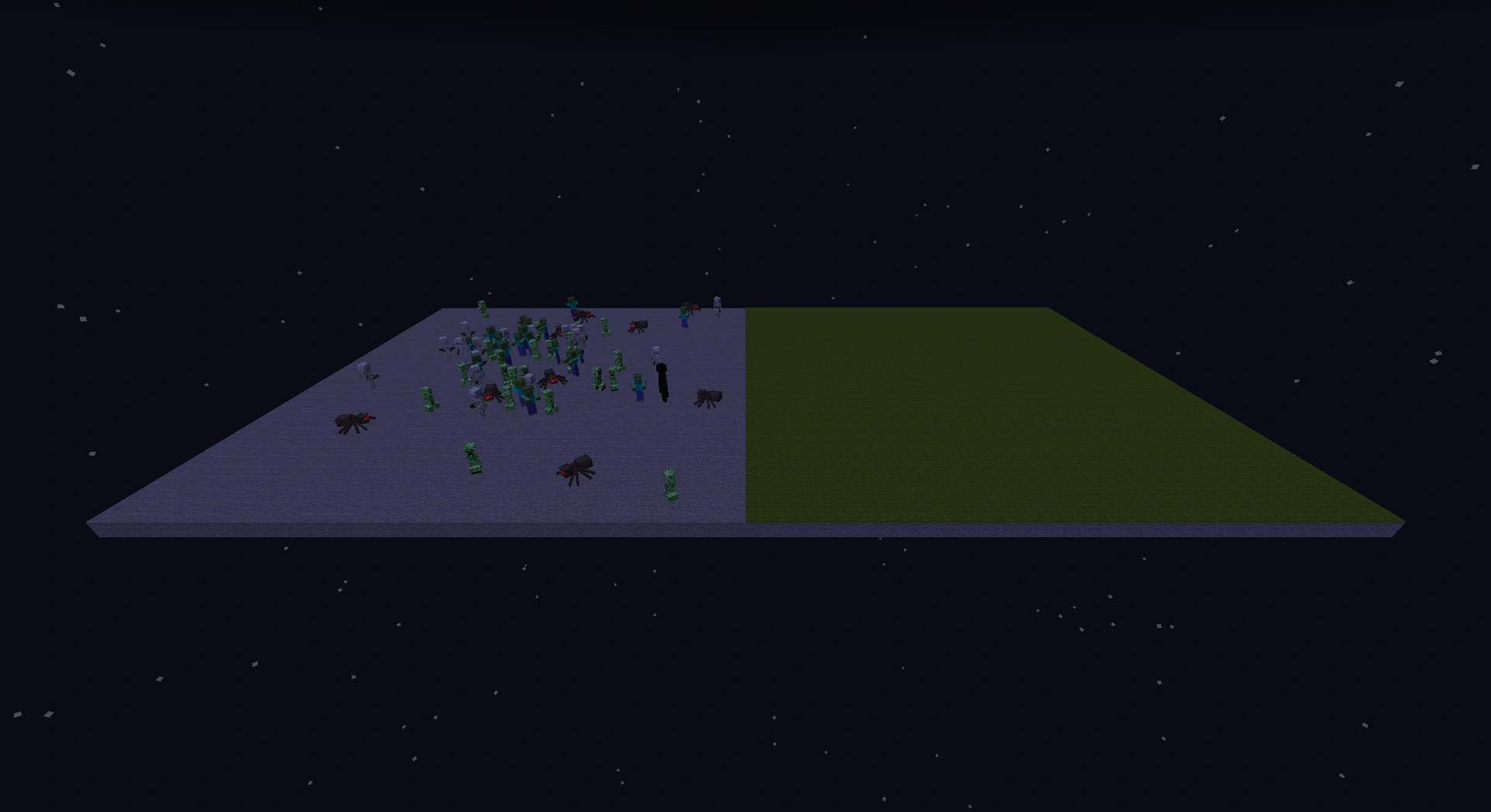
That screenshot is the whole argument for geometry over lighting: same platform, same night, same light level. The carpeted half has zero mobs on it.
What does not work is your intuition that "it feels bright in here." Brightness only helps if block light is above 0 on every single tile, and one shadowed block behind a door is a complete spawn slot. Slabs and carpet are absolutes; light is a measurement you have to actually take.
And two things ignore light entirely: slimes in slime chunks and magma cubes do not care about light level at all, which is why a slime farm does not need a dark room, and why your fully-lit basement below Y-40 still produces slimes.
Despawning: where your mobs went
The Java rules, precisely:
- A hostile mob more than 128 blocks from the nearest player despawns instantly.
- A mob with no player within 32 blocks for more than 30 seconds has a 1 in 800 chance of despawning per game tick. For monsters sitting in light above level 12, that timer is 10 seconds instead of 30.
1 in 800 sounds negligible until you remember there are 20 ticks per second — it averages out to roughly 40 seconds. That is exactly why your mob farm's holding cell is empty when you come back from making dinner, and why AFK-ing inside the 32-block bubble is what keeps your collection point populated.
Two exceptions worth knowing, and they run on one rule: a mob that has been named with a name tag or has picked up an item becomes persistent. In Java that switches off both despawn checks above, and it also takes the mob out of the mob-cap count, so a name-tagged zombie you forgot about in a corner is not costing your farm one of its 70 slots. Persistence has limits, though: a named wandering trader still despawns, and most hostile mobs, named or holding items, are removed the moment the difficulty is switched to Peaceful. Bedrock also makes a mob persistent when it is named with a name tag or picks up an item.
The five-minute base audit
Do this once and stop getting jumpscared in your own hallway.
- Check the actual numbers. In Java, F3 shows the client light value at your position, split into sky and block components. Anything reading 0 block light is a live spawn tile. Bedrock does not expose block light the same way, so either use a resource pack that highlights spawnable blocks or skip straight to slabbing the floor.
- Walk the perimeter at night. Sky light does nothing for you after dusk, so any flat surface you lit "well enough" during the day needs re-checking in the dark.
- Slab or carpet every flat outdoor surface you do not walk on. Roofs, ledges, wall tops, the flat bit above your door frame. This is where surface mobs stage before they find your entrance.
- Check underneath. A cave system connected to your basement is dozens of spawn slots of your own mob cap handed straight to zombies — and the single most common cause of "mobs keep appearing inside my walls."
- Corners, stair landings, and the space behind doors. Light does not turn corners. Those three spots account for most in-base spawns.
Do the slab-and-carpet pass before the lighting pass. Light is the fussier tool and it fails quietly; geometry cannot be wrong. Once your floors physically cannot hold a spawn, the only things left to worry about are the hostile mobs that walk in from outside — and those you can just fight.
Frequently Asked Questions
What light level stops mobs from spawning in Minecraft?
How far apart should I place torches in Minecraft?
Can mobs spawn on slabs and stairs?
Why is my Minecraft mob farm producing so slowly?
How far away do mobs have to be before they despawn?
How close can I AFK to a mob farm?
Keep Reading
Related Guides

Minecraft Redstone Contraptions Guide: Builds That Work
You learned what a repeater does. Now build something with it. This is the jump from 'I made a lamp blink' to piston doors, item sorters, auto-farms, and flying machines — the contraptions that change how you play.
Minecraft Bees & Honey Guide: Hives, Farms & Uses
Bees look like a cute side-feature and then quietly become one of the best renewable resources in the game. Here is how they actually work — pollination, hives, the campfire trick that stops the stinging, and what honey and honeycomb are really for.
How to Make a Saddle in Minecraft: Recipe and Loot Odds
Saddles have been craftable since June 2025: three leather and one iron ingot. Here is the recipe and what it really costs, every chest, trade and mob drop that still gives one with Java and Bedrock odds, the five chests that stopped, all eleven mobs it fits, and how shears take it back.
Minecraft Ice Caves Guide: Frostbite, Icicles and Freezing
Minecraft's fifth cave biome is mostly packed ice, its icicles drop when you light them, and its new zombie variant applies a brand-new Freezing effect with its melee hits. The ice caves drop is playable today in Bedrock Preview 26.60.29 and not yet in Java. Here is what is in it, with the numbers, and what could still change.

Minecraft Survival Guide for Beginners: Your First Days
You have about ten minutes of daylight before the sun sets and the world tries to kill you. Here is exactly what to do with them — punch a tree, build a tool chain, and get a roof over your head before the zombies arrive.

Best Minecraft Enchantments, Ranked — The Ones Worth Your XP
Mending is the enchantment that ends the grind — gear that repairs itself forever. Everything else is a fight over your XP and anvil uses. Here is what actually earns a slot, ranked, with the real max levels.