NARUTO Mythos TCG Penalties: Warnings to Disqualification
Cicaboom's NARUTO Mythos TCG Tournament Infraction Guidelines, in effect from 23 October 2026, decide what happens when you draw an extra card, register the wrong deck, arrive late or stall on the chess clock. Here is the five-level penalty ladder, how a judge repairs a game before penalising anyone, and the mistakes that cost a round or a whole tournament.
Sit down at your NARUTO Mythos TCG table five minutes after a Best-of-1 round has started and you have already lost it. That is not a store's house rule. It is the Tardiness Error: Major entry in Cicaboom's Tournament Infraction Guidelines, the 33-page document that tells judges what to do when something goes wrong at an official event. The current version took effect on 23 October 2026, a week before the new Store Championship season opens on 30 October and five weeks before the Münster Regional.
Our how-to-play guide covers the game and the deck rules, and the Münster post covers the Tournament Rules changes that matter on a chess clock. Neither covers what happens when somebody breaks one of those rules. This does: the penalty ladder, how a judge repairs a broken game before anyone is penalised, and the infractions a player can run into, from extra cards and decklists to lateness, the clock and the behaviour that gets you removed. Everything is read from the Infraction Guidelines and the Tournament Rules, both in effect from 23 October 2026 and linked from Cicaboom's Tournament Documents page, checked on 25 October 2026. Card details are read from the official card images served by Cicaboom's card gallery.
Two documents, and the one about mistakes
Cicaboom's Tournament Documents page links two files: the Tournament Rules, which explain how a tournament works, and the Tournament Infraction Guidelines, which explain "how judges handle errors when they happen". The Tournament Rules hand that job over in one line: penalties "are described in their own document". The guidelines then say that anyone attending an event "should get familiar with this document", players and spectators included, not just judges.
Three things set the tone before any penalty appears:
- It is a guideline, not a lookup table. The document says it cannot list every infraction, gives a description and examples for each, and expects judges to extrapolate, deviating from the recommended penalty after discussing it with the Head Judge.
- It applies at casual events too. Infractions there "should still be enforced", with the weight on teaching players so they know what to expect at a competitive event.
- Both players own the game state. The document says a player "is also responsible to ensure that their opponent doesn't make any mistake." That is why several of its examples give a Warning to a player whose only error was not noticing the other one's.
The contact address for NARUTO Mythos TCG Organized Play in both documents is at breakflip.com, the company whose name is also on the Münster Regional's event site.
Five levels, four penalties
Every infraction category is graded by how much damage it did. Each level maps to one penalty:
| Infraction level | Penalty | Who can give it |
|---|---|---|
| Minor | Warning | Any judge |
| Major | Game Loss | A judge, after the Head Judge approves it |
| Important | Tournament Round Loss | The Head Judge only |
| Strict | Disqualification | The Head Judge only |
| Cheating | Disqualification | The Head Judge only |
The Tournament Rules give an Assistant Head Judge the same powers as the Head Judge, including disqualification. Judges cannot invent penalties outside this ladder; the guidelines' example of what is off limits is adjusting the victory conditions.
Best-of-1 changes how heavy the middle rungs are. In a Best-of-1 round, a Game Loss and a Tournament Round Loss are the same penalty, so a Game Loss that gets escalated goes straight to Disqualification rather than a round loss. That rule was already in the 7 September version; the 23 October version only reworded it. It applies to every Swiss round at a Store Championship, because the Tournament Rules require those rounds to be Best-of-1, and to Münster's Saturday Swiss.
A table can also end with both players losing. Draws are not a valid result in NARUTO Mythos TCG, so if both players earn a Game Loss in a Best-of-1 round, or in Game 3 of a Best-of-3, both lose the round. In Game 1 or Game 2 of a Best-of-3, one Game Loss applies to the current game and the other to the next, and if a Game 3 is still needed a randomizer decides who starts it.
Warnings are written down, and only tournament staff can see that record. A repeat of the same infraction during the event can be escalated, though the guidelines generally advise against escalating at the first repeat. Different errors do not add up: their example is a player who forgot to draw, later forgot to take the Edge after passing first, and then underpaid a Chakra cost, and the Head Judge should not escalate, because those are three different errors. Unsporting Conduct is treated more strictly: it should escalate at the first repeat. When an infraction was an accident, the player's age and experience should not change what it is, but they count when deciding whether a repeat deserves escalation.
The judge repairs the game first
Before deciding on any penalty, the judge decides what to do with the game. The guidelines list four options in priority order:
| Fix | When it applies | The guidelines' own example |
|---|---|---|
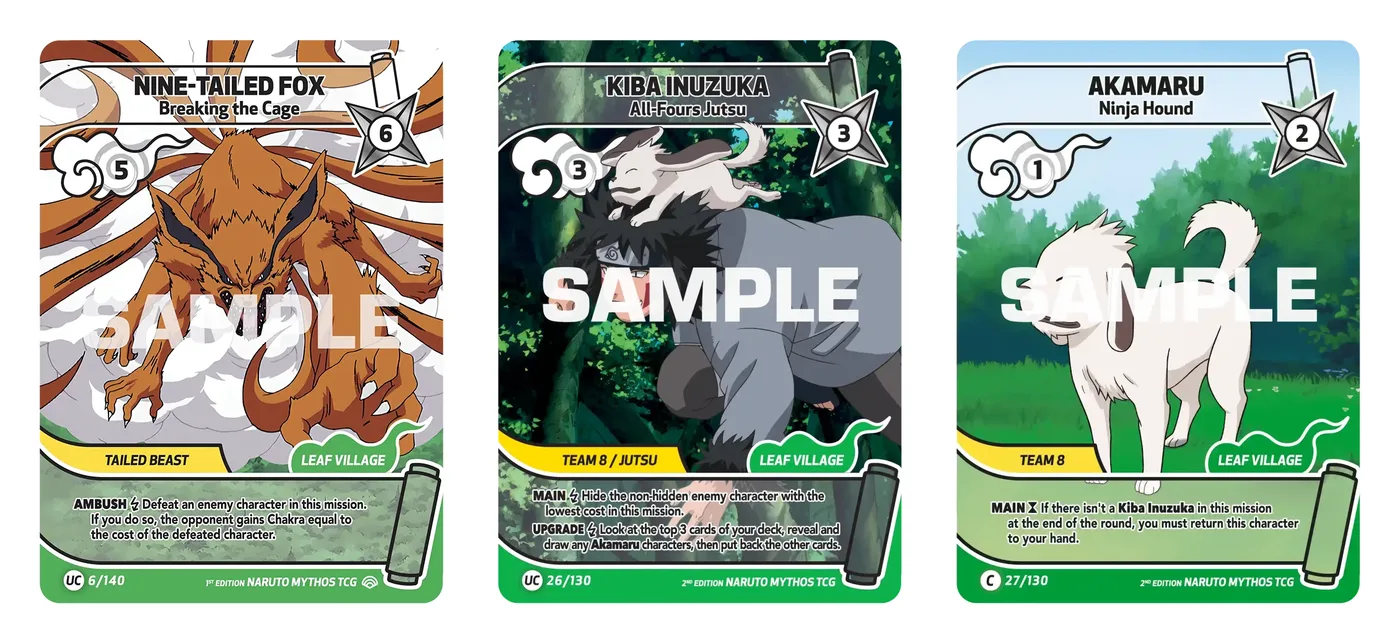
| Rewind | The error is recent enough to undo cleanly | A hidden Nine-Tailed Fox (Breaking the Cage) is revealed for 3 Chakra instead of its cost of 5, and its AMBUSH defeats the opponent's Naruto Uzumaki ("Believe it!"). The opponent then plays Ino Yamanaka (Genin of Team 10). The judge takes back Ino, the reveal and the AMBUSH, restores both players' Chakra, and it is the Nine-Tailed Fox player's turn again |
| Correct | Undoing it would replay random or hidden information | A player forgets to pay 1 Chakra for Akamaru (Ninja Hound), then upgrades into Kiba Inuzuka (All-Fours Jutsu) and looks at the top three cards. A rewind would change what Kiba's UPGRADE found, so the player simply pays the missing Chakra now |
| Accept | Nobody can reconstruct what happened, and nobody gained much from it | Both players misread a card and resolved it wrongly two rounds earlier. The game continues and both players get a Warning |
| Stop | The game cannot be repaired and the player at fault gained a decisive advantage | The player who more actively caused it gets a Game Loss, the other a Warning |
Two lines in that section limit how often a game gets stopped. Seeing extra private information does not count as "too much benefit"; stopping needs "an actual gameplay advantage that offers a decisive edge to win the current game". And failing to keep track of the game state is not "actively" damaging it, so plain inattention does not make you the player who takes the Game Loss.
Every infraction category on one table
The guidelines have eight infraction categories. This table puts the examples at each level side by side; a dash means the category has no entry at that level.
| Category | Warning | Game Loss | Round Loss | Disqualification |
|---|---|---|---|---|
| Gameplay Error | Playing a Character without enough Chakra, forgetting to draw, not tracking Mission points, accidentally revealing a Mission card, not catching your opponent's mistake | Shuffling your hand or discard pile into the deck beyond reconstruction; a missed mandatory effect, caught rounds later, that would have lost you the game | — | — |
| Drawing Extra Cards | Drawing 3 instead of 2, drawing off Shikamaru Nara (Genin of Team 10) without the Edge, drawing 6 at setup | An extra card from setup or round 1 found in round 4; 4 or more cards drawn and mixed in until half the hand belongs in the deck | — | — |
| Deck Error | A vague decklist entry that still identifies one card, the wrong version of a card listed, an unknowing counterfeit you can replace | Deck and decklist disagree, a deck under 30 cards, a third copy | — | Strict: the deck cannot be fixed, or is not fixed within two rounds |
| Marked Cards | Wear with no pattern: replace the sleeves or cards | Marks on a partial pattern of cards | Marks on a clear pattern | — |
| Pace of Play | Too slow without meaning to be | — | — | — |
| Tardiness | Under 5 minutes late | 5 to 9 minutes late | 10 minutes or more late; no decklist by the deadline | — |
| Tournament Error | Forgetting to report a result, no counters for Chakra and Mission points, a dead phone clock when the time left can be estimated | A dead phone clock with no estimate; damaging a card you cannot replace quickly | A result nobody reported, with players who cannot be found; a deck ruined by a spill; a deck lost between rounds | — |
| Unsporting Conduct | Telling an opponent to "read the card", eating at the table, demanding a specific penalty, asking for a different judge | Profanity aimed at someone, throwing a chair after a loss, refusing to confirm a result | Stalling; constant unpleasant remarks after being told to stop | Strict: slurs, insults or threats, being drunk or under the influence. Cheating: see below |
The spill example really does read "water or mayonnaise". The Marked Cards entries turn on the word pattern: random wear on three unrelated cards is a Warning and a resleeve, while 12 marked sleeves that all turn out to hold Naruto Uzumaki characters is Important, a round loss, even when the Head Judge believes it was an accident. Reporting marked cards before round 1 is paired can get them fixed with no penalty at all, because nobody has had a chance to use the marks yet.
Drew an extra card? Here is what goes back
Drawing an extra card gets its own category because, as the guidelines put it, it is "very common" and easy to fix, but valuable if nobody catches it. The fix runs in this order:
- If the opponent can confirm which cards are extra, or the judge can work it out, those exact cards go back.
- If not, the judge picks at random from the cards likely drawn during the wrong action.
- If even that is impossible, the judge picks at random from the whole hand. Any card picked at random is shown to both players.
- A card that was already known, for example one a card effect let you look at, returns to that known position. An unknown card is shuffled back into the random part of the deck, after the judge separates the known and unknown parts.
The examples are generous where they can be. A card that stuck behind another and never got seen can be chosen as the extra and put back on top without a shuffle. A card that went straight from the deck to the field face-down can go back on top too.

Shikamaru Nara (Genin of Team 10) is the guidelines' example of how the error happens through a card rather than a clumsy hand. Its MAIN draws a card only if you have the Edge. Draw off it without the Edge and you have drawn an extra card, a Warning. It becomes a Game Loss when the damage cannot be undone: the guidelines' example is an extra card from setup or round 1 discovered in round 4, when "there are no rounds left to draw more cards". Forgetting to draw, the opposite mistake, is a plain Gameplay Error, because it "very rarely" helps the player who makes it. A second extra-card infraction in the same event, where you cannot help the judge find the extra cards, is grounds for escalation.
Your deck box is part of the deck check
NARUTO Mythos TCG has no side deck, and the Tournament Rules say "only the Deck should be inside the Deckbox." If a judge checking your deck finds more cards in the box, the guidelines split them in two. Cards that have nothing to do with the deck, such as leftovers from an opened pack or the participation card, earn advice to store them elsewhere. Cards that could work as a reserve for the deck are treated as part of the infraction, anywhere from Deck Error: Major (a Game Loss) up to Cheating. Münster hands every player a participation card and six boosters; keep them out of the deck box.
Deck checks can happen at any time to randomly selected players, and the same player can be checked more than once. The Tournament Rules recommend checking at least 5% of active players during an event. Staff may offer a courtesy check before round 1 is paired, and the guidelines let the Head Judge waive the penalty for an error caught at registration.
When the deck and the decklist disagree, the Head Judge decides which one is right and corrects the other, partly by looking at what the deck interacts with. One example is a decklist with two "4/130" cards next to a deck holding two "4/140" cards. The deck interacts with Jiraiya characters and not with Tsunade ones, so the Head Judge concludes the decklist is the mistake and corrects it.
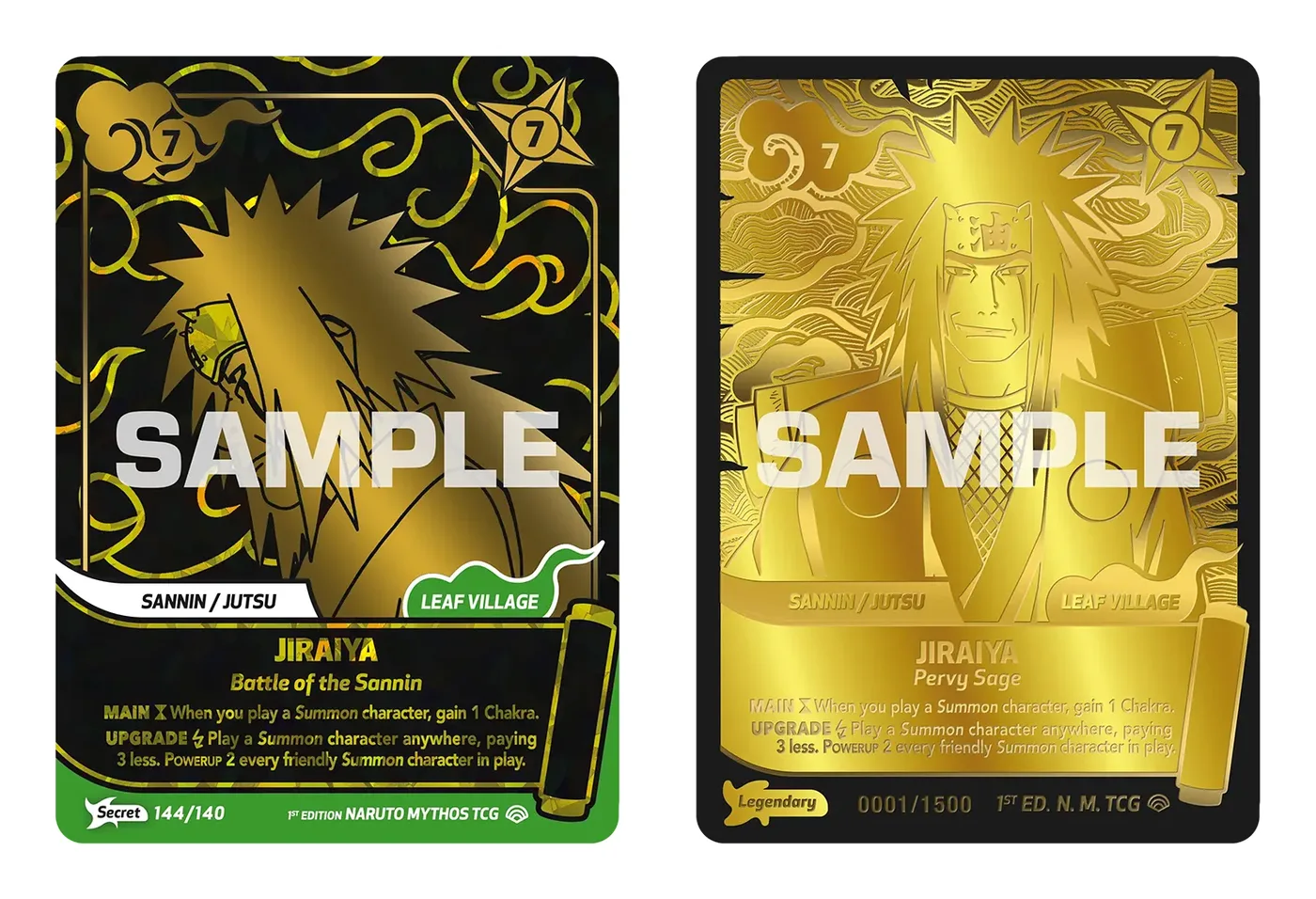
The copy limit is the trap these two Jiraiyas set. The Tournament Rules count copies by collection number and treat a Legendary numbered card as an alternate version of an existing card, so Jiraiya (Pervy Sage), printed only "XXXX/1500", is the same card as Jiraiya (Battle of the Sannin), 144/140. The guidelines' example deck runs two of each, four copies of one card, and even when the judge accepts it was an honest misunderstanding, it is a Deck Error: Major. The deck is cut back to two between them.
A Deck Error: Major is a Game Loss. In Best-of-1 you get the rest of the round to fix the deck. In Best-of-3 you still have a round to play, and taking more than 10 minutes to fix the deck can add a Tardiness Error: Important on top. If you have not fixed the deck and shown it to the Head Judge after two rounds, the penalty becomes Deck Error: Strict, and you are out of the event.
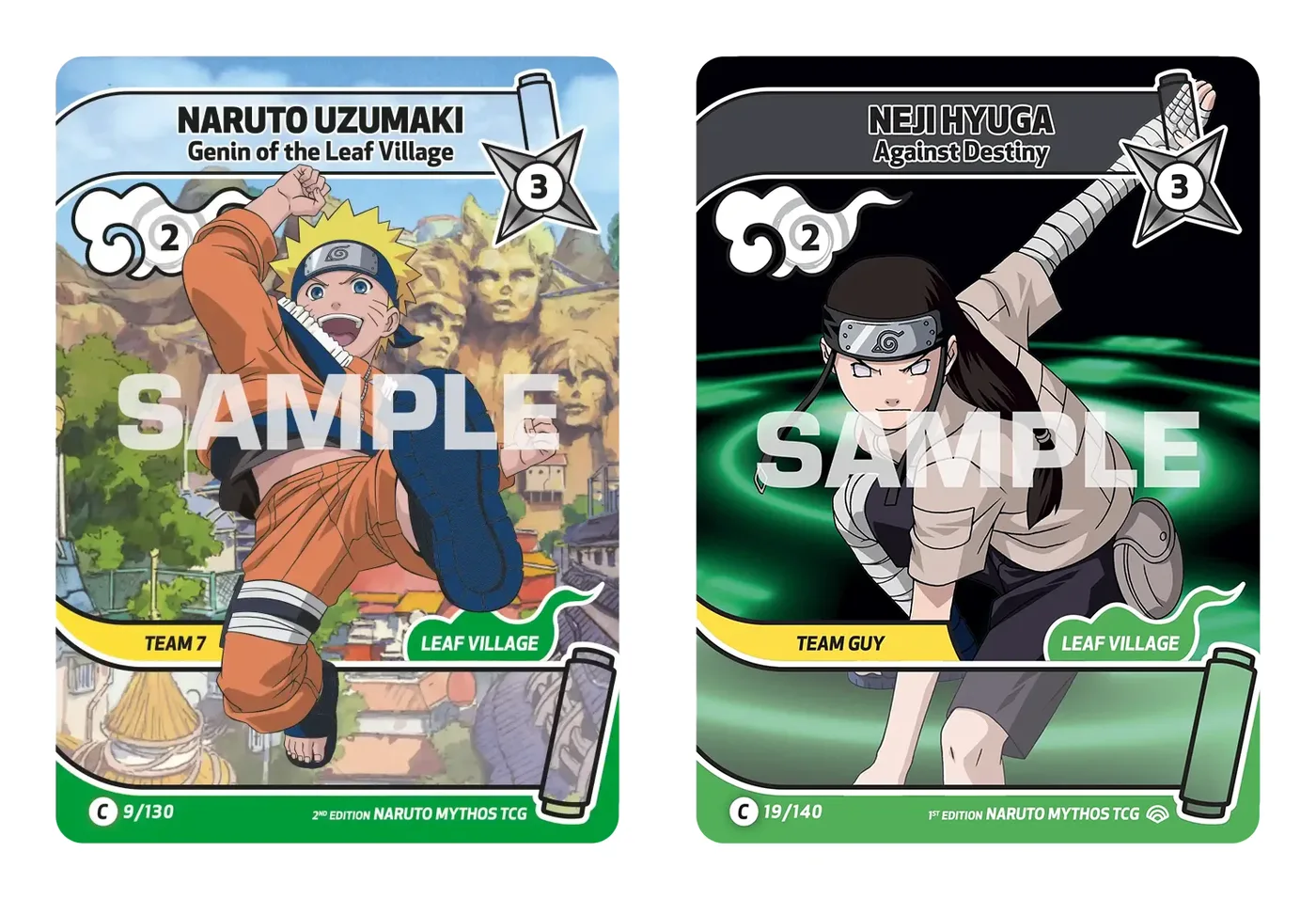
A deck that drops below 30 cards after a correction is not automatically dead. The Head Judge may let you fill it with strategically worse cards. The guidelines use exactly this pair: a player who could not get two Naruto Uzumaki (Genin of the Leaf Village) in time for registration offers two Neji Hyuga (Against Destiny) instead. Both cost 2 Chakra, have 3 Power and carry no effect text. If the deck barely interacts with Neji, the swap can be accepted. If the deck has several Neji interactions of its own, the replacement can be refused, and without a better substitute in time the deck is incomplete: Deck Error: Strict. The decklist format itself is in our how-to-play guide.
Five minutes late loses a Best-of-1 round
Tardiness is measured from the start of the Tournament Round, and sitting at the wrong table counts against the same clock:
| How late | Infraction | Best-of-1 | Best-of-3 |
|---|---|---|---|
| Under 5 minutes | Tardiness Error: Minor | Warning | Warning |
| 5 to 9 minutes | Tardiness Error: Major | Game Loss, which loses the round, and you are dropped at the end of it unless you ask the pairings staff to keep you in | You lose Game 1; the round continues |
| 10 minutes or more | Tardiness Error: Important | Tournament Round Loss, and you are dropped unless you ask to stay | Tournament Round Loss, and you are dropped unless you ask to stay |
| No decklist by the deadline | Tardiness Error: Important | You cannot play round 1, and must submit a proper list to stay in | Same |
The drop is the easy part to miss. A player 5 to 9 minutes late in Best-of-1, or 10 or more minutes late in any round, is removed at the end of that round by default; staying in the event means going to the staff running the pairings and asking. Lateness caused by dealing with tournament staff is not an infraction at all, and the judge should make sure that player gets the full game they are owed, with a time extension if needed.
The chess clock, and what counts as Stalling
Münster plays its Swiss rounds on a 13-minute-per-player chess clock and its Top 16 on 15 minutes, while the Tournament Rules recommend a flat 30 minutes for Store Championship Swiss rounds. The clock rules themselves are in the Münster post. In short, players may pause the clock only for the whole Mission Evaluation phase and for a judge call, the Edge holder restarts it after scoring, and on a clock there are no time extensions, because a judge call pauses the clock instead.
How the guidelines treat time on a clock:
- Pace of Play still applies. You only burn your own time, but the guidelines say the penalty "shall still be issued" because it still makes for a poor event for your opponent. Their example is a player who used 5 minutes in one game round to the opponent's 1, for a similar number of actions.
- Stalling is a round loss. It sits under Unsporting Conduct: Important. On a clock, the examples are pausing to call a judge repeatedly with irrelevant questions to think for free, and, new in the 23 October version, using the paused clock during Mission Evaluation to plan your next turn. Off the clock, the example is a player who leads on Mission points and slows down in the round's last 10 minutes.
- A dead phone is a Tournament Error. If the judge can estimate how much time each player had left and the opponent can set up their own phone, it is Minor. If not, it is Major, a Game Loss. Forgetting to start a clock at all is Minor, provided the time can be estimated.
The 23 October version also reshuffled the Pace of Play examples. The 7 September version listed "After the Mission Evaluation phase, a player forgets to resume Chess Clock" as slow play; the new one drops it, and the new Tournament Rules make restarting the clock the Edge holder's job. In its place are two new examples: being too slow to add up the Power on your side during Mission Evaluation, and, in rounds played to an overall time limit rather than a chess clock, spending an unreasonable time writing down every card on the opponent's board.
Cheating, lying and what you must answer
The Tournament Rules split game information in two:
| Must be answered truthfully if asked | Must not be answered |
|---|---|
| How many cards are in a hand or deck; the name and text of any card in play, revealed this round or in a discard pile; a card's current Power; what is attached to what; each player's Mission points | The name and text of unrevealed cards in hand; what is in the deck |
Refusing to answer about private information is correct. Lying about it is not bluffing: the Tournament Rules call it cheating. The guidelines' Cheating examples fall into a few groups:
- Deceiving the game state: placing a Character between two Missions so it looks like it is in the other one, laying your hand face-down on the field to look like an extra hidden Character, hiding cards on your lap, moving Power tokens.
- Lying: misdescribing a card's effect to bait a bad response, answering "No" when asked whether you hold a card you do hold, lying to a judge, or denying a previous penalty.
- Stacking: shuffling in a way meant to put the deck in a predictable order.
- Exploiting errors: keeping quiet about your own mistake because it helps you, or sitting on your opponent's mistake until they are about to win so the penalty hits harder.
- Gambling and bribery: offering anything for a result, deciding a game with a randomizer or a made-up victory condition, or betting on games.
Cheating can never be de-escalated. A player can be disqualified for it even without knowing the action broke a rule, as long as the Head Judge concludes they meant to do the action.
Conceding is allowed, with limits set by the Tournament Rules: you may not ask your opponent to concede, offer or accept anything for a concession, settle the result with a randomizer or another game, look at other tables' results to decide who wins, or split prizes or offer to. The Tournament Rules close that list with one line: "Any player doing so will be disqualified." The guidelines rate one item lower: two players who spend a long time watching nearby games to choose a winner instead of reporting their result commit Unsporting Conduct: Important, and both lose the round.
Appeals, disqualification and suspension
- Appeal after the ruling, not during it. A player may appeal to the Head Judge once the judge has finished explaining the decision. Asking for the Head Judge before that is itself Unsporting Conduct: Minor. The Head Judge's ruling on appeal is final, and a ruling the Head Judge made first-hand cannot be appealed.
- A penalty stays with its tournament. You can discuss it with the Head Judge later in the event, and contact Organized Play as a last resort. Judges are told not to discuss incidents players post online.
- Dropping does not dodge a disqualification. The guidelines say a player who drops still receives their penalties, and that staff must never suggest dropping to avoid one.
- A disqualified player is asked for a written statement. It covers their full name, email and tournament-platform ID, physical address and their version of events. The Head Judge sends the reports to Organized Play within 7 days.
- Disqualification is not suspension. A disqualified player can play other events. Only Organized Play can suspend someone, and a suspended person cannot attend any event as a player, staff member or spectator. Per the Tournament Rules, reinstatement is not automatic: you email Organized Play and wait for confirmation.
The Tournament Rules also bar some people from competitive events, meaning Store Championships, Regionals and above: the owner and employees of the store hosting the event, and any member or full-time contractor of Cicaboom, Zvezdar, Breakflip or any other company directly involved in making, distributing or running the game, including anyone who left one of those companies in the previous 60 days. Event staff cannot play in their own event at any level.
What the documents do not tell you
- A judge program page. The guidelines say passing the Judge Rulings Test is required to join the NARUTO Mythos TCG judge community, and the test's name in the guidelines PDF links to a Google Form titled "Naruto Mythos TCG - Judge Rulings Test". Cicaboom's sitemap, checked on 25 October 2026, lists no judge program page, so the link in the PDF is where to find the test.
- The section numbers in the changelogs. Both documents gained numbered headings on 23 October, and the numbering does not always line up. The Tournament Rules have two sections numbered 5.2 (Legendary Numbered cards and Card Legality), and their changelog cites "5.4 Side Deck" and "5.5 Alternative Formats" for sections numbered 5.9 and 5.13 in the body. The guidelines' changelog cites "3.3 Tournament Round Loss" for section 2.5.3. If you point a judge at a rule, name the section's title rather than its number.
- Which link is current. Older copies of both PDFs, at filenames without the code at the end, still served the 7 September versions on 25 October. The Tournament Documents page links the 23 October files.
- Anything about outcomes. Neither document provides for publishing penalties or disqualifications. They go to Organized Play in staff reports, and Warnings are visible to tournament staff only.
None of this needs memorising before a Store Championship. If you keep three lines in your head, make them these: be in your seat when the round starts, keep only the deck in the deck box, and let the paused clock stay paused while Missions are scored.
Frequently Asked Questions
What penalties can a judge give in NARUTO Mythos TCG?
What happens if you draw an extra card in NARUTO Mythos TCG?
What is the penalty for being late to a NARUTO Mythos TCG tournament round?
Can you pause the chess clock in NARUTO Mythos TCG?
What happens if my NARUTO Mythos TCG decklist does not match my deck?
Can players split prizes or roll for the win in NARUTO Mythos TCG?
Can I appeal a judge's ruling at a NARUTO Mythos TCG tournament?
Keep Reading
- Naruto Card Game Blog Hub
- How to play NARUTO Mythos TCG: decks, Missions and scoring
- NARUTO Mythos TCG Münster Regional: prizes, side events and the chess clock
- NARUTO Mythos TCG Store Championships
- NARUTO Mythos TCG Orlando Regional: results and decklists
- NARUTO Mythos TCG explained: publisher, sets, Gold Cards
- Breakflip and Zvezdar: who distributes NARUTO Mythos TCG
- Cicaboom — NARUTO Mythos TCG Tournament Documents page, linking the Tournament Rules and the Tournament Infraction Guidelines (checked 25 October 2026)
- NARUTO Mythos TCG Tournament Infraction Guidelines, in effect as of 23 October 2026 (33 pages): infraction levels and penalties, rewind/correct/accept/stop, every infraction category with examples, appeals, disqualification reports, changelog
- NARUTO Mythos TCG Tournament Rules, in effect as of 23 October 2026: participation limits, suspension, public and private information, chess clock, conceding, draws, deck construction, side deck, deck checks, changelog
- NARUTO Mythos TCG Tournament Infraction Guidelines, previous version in effect as of 7 September 2026, still served at this URL on 25 October 2026 (used for the comparison of Pace of Play and Stalling examples)
- NARUTO Mythos TCG official Card Gallery (the page showed an "under maintenance" notice on 25 October 2026; card details were read from its official card images on cards.narutotcgmythos.com): Nine-Tailed Fox (Breaking the Cage), Kiba Inuzuka (All-Fours Jutsu), Akamaru (Ninja Hound), Shikamaru Nara (Genin of Team 10), Jiraiya (Battle of the Sannin / Pervy Sage), Naruto Uzumaki (Genin of the Leaf Village), Neji Hyuga (Against Destiny)
- Cicaboom — Store Championship page: the new season runs 30 October to 15 November 2026, with registration through TopDeck
- NARUTO Germany Regional - Münster event page (Breakflip): Best-of-1 Swiss on a 13-minute chess clock, Best-of-3 Top 16 on 15 minutes (checked 25 October 2026)
- Cicaboom's NARUTO Mythos TCG sitemap, checked 25 October 2026: no judge program or Judge Rulings Test page listed
- Naruto Mythos TCG - Judge Rulings Test (Google Form linked from the Tournament Infraction Guidelines PDF, checked 25 October 2026)
Related Guides
How to Play NARUTO Mythos TCG: Rules, Decks and Scoring
Our NARUTO Mythos TCG explainer covers the rules in a handful of bullets. This is the full walkthrough, built only from Cicaboom's rulebook, Tournament Rules, FAQ and Game Mechanics pages: the 30-card, two-per-number deck rules, how the coin flip decides whose Missions land where, the four ways to put a card on a Mission, why a hidden card pays for itself, how Set 2's Attachments work, and why the first Mission revealed can be scored four times while the last is scored once.

NARUTO Mythos TCG Münster Regional: Prizes and Side Events
Cicaboom's third NARUTO Mythos TCG Regional runs 27 to 29 November 2026 in Münster, Germany. Paris listed three scheduled side events; Münster lists eleven, including four alternative formats. Here is what each ticket costs, what every Main Event placement wins, how Mini-Mythos, Evolving, Bad Deck and Highlander work, and the Tournament Rules update that takes effect today.
NARUTO Mythos TCG Shinobi Shiren: Set 2 Cards and Rarities
Set 2 of NARUTO Mythos TCG has been in European stores since 4 September, and Cicaboom's Products page still lists it as "Coming soon". The official Collection Guide says a great deal more: 150 numbered cards, a new Attachment card type, four rarities Set 1 never had, and serialized runs of 300, 400 and 1,500. Here is the whole set, rarity by rarity, checked against the official card gallery and events page.
NARUTO Mythos TCG Orlando Regional: Results and Decklists
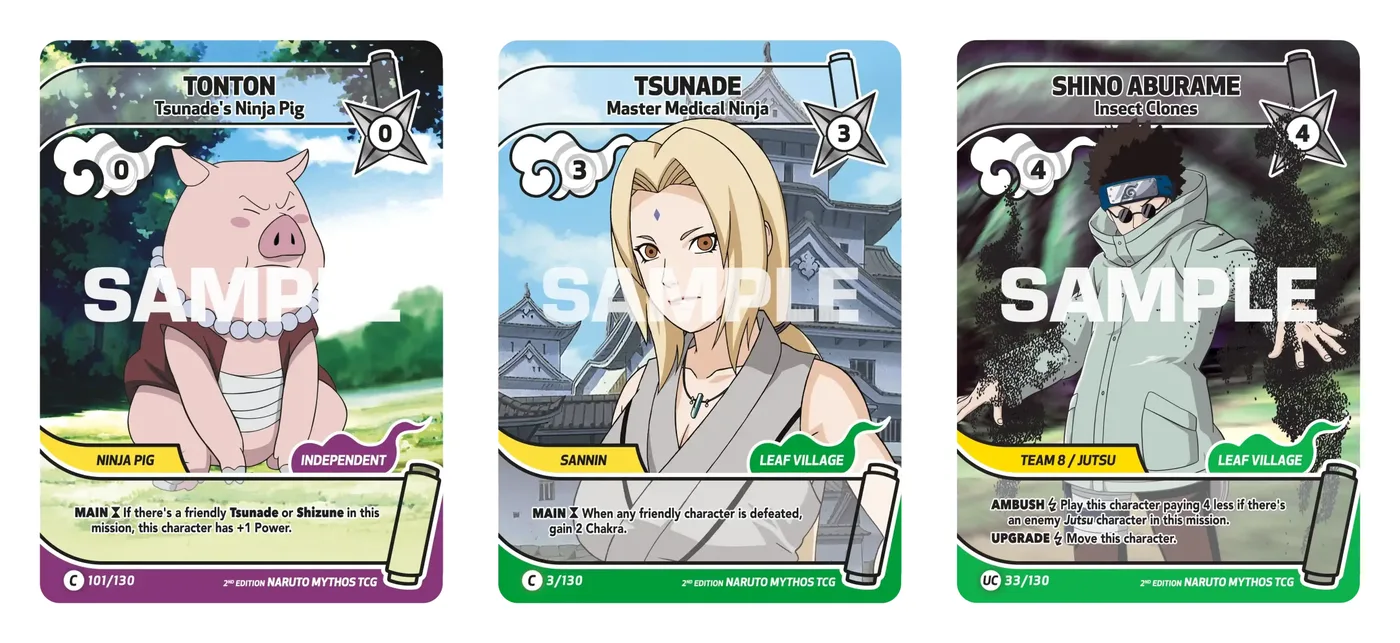
Cicaboom's website has not posted a result for either of its 2026 Regionals. The Orlando one is on TopDeck.gg anyway, the platform Cicaboom sent players to for registration, with final standings and 43 player-submitted decklists. The champion went 3-3 in the Swiss, took the last Top 16 seat on tiebreakers, and beat the only 6-0 player in the first round of the cut. Here is the bracket, the champion's 30 cards, and what the Top 16 had in common.
Naruto Card Game Explained: Bandai, Kayou or Mythos?
Search "Naruto cards" and you get three unrelated products stacked on top of each other: a competitive TCG from Bandai that nobody can buy until Summer 2027, a line of Chinese-made collectible cards from Kayou that has been in Walmart since 2025, and a third game — Cicaboom's NARUTO Mythos TCG — that has been on European shelves since March 2026 and is already running sanctioned tournaments. Here is exactly what each one is, what each publisher has actually confirmed, and which one the person asking the question actually wants.

NARUTO Mythos TCG Store Championships: Two Cards, No Results
Cicaboom has set a second NARUTO Mythos TCG Store Championship season for 30 October to 15 November 2026, with a stamped Naruto Uzumaki, Chunin Exams for every player and a Kiba Inuzuka, Chunin Exams for each event's Top 4. Season one ran across Europe from 27 June to 12 July with two promo cards of its own, and Cicaboom's news feed still has no results for it. The event pages don't state a format. The Tournament Rules do.