How to Play NARUTO Mythos TCG: Rules, Decks and Scoring
Our NARUTO Mythos TCG explainer covers the rules in a handful of bullets. This is the full walkthrough, built only from Cicaboom's rulebook, Tournament Rules, FAQ and Game Mechanics pages: the 30-card, two-per-number deck rules, how the coin flip decides whose Missions land where, the four ways to put a card on a Mission, why a hidden card pays for itself, how Set 2's Attachments work, and why the first Mission revealed can be scored four times while the last is scored once.
The first Mission revealed in a game of NARUTO Mythos TCG can be scored four times. The last one is scored once. That asymmetry drives a lot of the game's decisions, and it comes from one line in Cicaboom's rulebook: "You should be scoring a number of Missions equal to the number of the current Round." Our own NARUTO Mythos TCG explainer summarises the rules in a handful of bullets and moves on to sets, products and Gold Cards. It never gets to that line.
This guide is the part it skipped: how to build a deck a judge will accept, how a game is set up, what happens in each of the four rounds, the four ways to put a card on a Mission, how Set 2's Attachments work, and what changes when you sit down at a sanctioned event. It is built from Cicaboom's own documents only — the rulebook PDF linked from the official How to Play page (its file metadata dates it 27 August 2026, and unlike the March 2026 version still linked from the site's Collection Guide page, it covers Attachments), the Tournament Rules in effect from 7 September 2026, and the official FAQ and Game Mechanics pages. If you want to know what the game is, who makes it or where to buy it, start with the explainer. This piece assumes a Starter Pack is already open on the table.
What goes on the table
Three card types, three kinds of token, one deck.
- Character cards are the ninjas you assign to Missions, and most of your deck.
- Mission cards are the objectives. Each player brings exactly three, and they are never shuffled into the deck.
- Attachment cards arrived with Set 2, Shinobi Shiren, and modify a Character or a Mission already in play. They go in your deck alongside your Characters.
- Tokens: Chakra tokens, Mission-point tokens and a single Edge token. The rulebook says the Starter Pack includes a set and that dice or any small objects work if you do not have them. The Tournament Rules add two conditions for events: Chakra and Mission tokens must be easy to tell apart, and the Edge token can be any distinguishable object except a card.
A game lasts exactly four rounds. Whoever has more Mission points at the end of round four wins, and a tied score goes to whoever holds the Edge token.
Reading a Character card
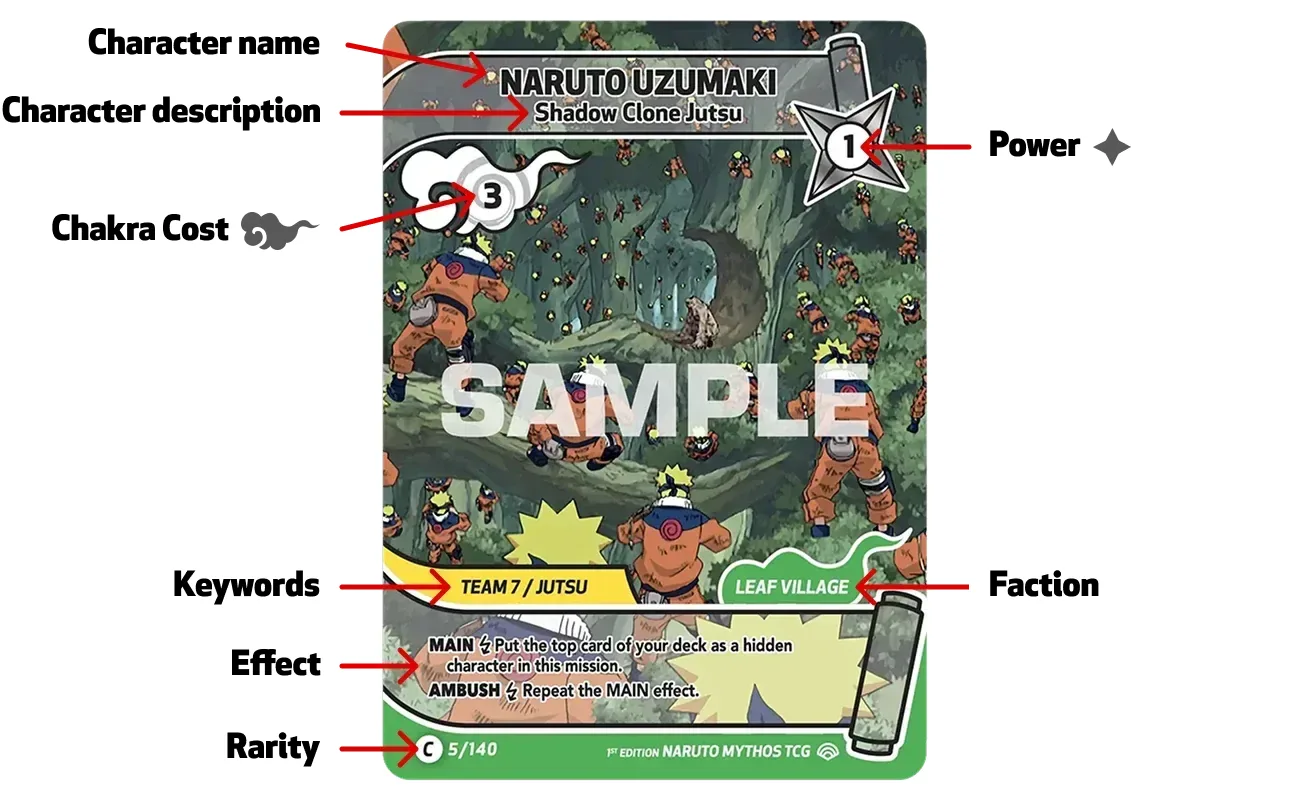
Cicaboom's own annotated sample shows every field. On a Character card the Chakra cost sits top left in a cloud icon, and Power, the number that wins Missions, sits top right. Under the name is the character description — "Shadow Clone Jutsu" on this card — which is what separates one Naruto Uzumaki from another. On this sample the yellow bar carries the keywords (TEAM 7 / JUTSU), the green tab the faction (LEAF VILLAGE), and the text box the effect, each line tagged with a timing: ↯ Instant fires once when the card is played, ⧗ Continuous stays on while the card is face-up. Bottom left is the rarity and the collection number, 5/140 here, which is what deck-building limits are counted against. The rulebook adds that a card with no set icon is from Set 1, Konoha Shidō.
The sample's own text previews half of this guide: "MAIN ↯ Put the top card of your deck as a hidden character in this mission. AMBUSH ↯ Repeat the MAIN effect."
Building a deck a judge will accept
The rulebook's deck-building section fits on a single page. The Tournament Rules fill in the edge cases. Together:
| Rule | What Cicaboom's documents say |
|---|---|
| Deck size | At least 30 Character and Attachment cards combined. No enforced maximum, as long as you can shuffle it yourself without delaying the match |
| Copies | Up to 2 cards sharing a collection number (bottom-left). A variant letter is ignored, so 108/130 and 108/130 A count as the same card |
| Same character name | Unlimited. You can run as many different versions of Naruto Uzumaki as exist, two of each |
| Legendary numbered cards | Treated as alternate versions of an existing card. The gold Naruto Uzumaki "I'll be the greatest Hokage!", numbered out of 2,000, plays as Naruto Uzumaki (Rasengan), 133/130 |
| Missions | Exactly 3, each with a different name, kept outside the deck |
| Side deck | None |
| Banned cards | None at present |
| Card language | Any language is legal. For a card in neither English nor the local language, you show your opponent a copy of its text in one of those on request |
Two consequences are worth spelling out. The limit is per number, not per name, which is why the Tournament Rules bother to flag lookalikes: Hinata Hyuga (Gentle Fist), 30/130, and Neji Hyuga (Gentle Fist), 36/130, share a subtitle, cost, Power and effect and are still two different cards. And the unlimited-name rule runs straight into a rule you will meet below — only one Character of a given name per Mission on your side — which is exactly what makes Upgrades matter.
Cards become tournament-legal on their set's official release date on your continent. Cicaboom's Set 2 announcement gives 4 September 2026 as Shinobi Shiren's official release date, but its Set 3 announcement says that date is for Europe and the UK and that Set 2 does not release simultaneously worldwide, so check your own region's date. The Set 2 page also says some Set 2 cards only become playable with Special Pack Design A, which moved to an October second wave with no confirmed date.
Setup: coin flip, Mission deck, one mulligan
- Pick a first player at random. At events, any method both players agree on; if they disagree, Heads or Tails. The first player takes the Edge token.
- Build the Mission deck. Each player shuffles their three Missions face-down and randomly picks two. The Tournament Rules fix the layout: the starting player's two go face-down into the D and B slots, the other player's into C and A, and nobody looks at them — or at the Mission each player set aside. For casual games the FAQ says you can simply shuffle whatever Missions you own and draw.
- Draw five. Each player may mulligan once: the whole hand goes back, reshuffle, draw five new cards. The Edge player decides first.
Then round one starts. Notice what step 2 quietly decides: whoever wins the coin flip supplies the Missions in the D and B slots, and as the scoring section below shows, those two are evaluated six times between them, against four for C and A.
One round, four phases
| Phase | What happens |
|---|---|
| Start | Reveal the next Mission (D in round 1, then C, B, A). Each player gains 5 Chakra plus 1 for every Character they have in play, hidden ones included, then draws 2 cards |
| Action | The Edge holder goes first. Players alternate, playing one card per turn. Passing ends your Action phase for the round. The first player to pass takes (or keeps) the Edge, and the other player then takes turns in a row until they pass too |
| Mission evaluation | Starting with D, compare total Power on each Mission. The higher total wins, ties go to the Edge holder, and you need at least 1 Power to win at all. The winner scores the Mission's printed points plus its rank bonus and triggers any SCORE effects |
| End | Both players discard unspent Chakra and every Power token on the board. After round 4, compare scores |
Three details in that table do most of the work. Characters stay on the board between rounds — only Chakra and Power tokens reset — so every body you commit keeps contesting its Mission and keeps producing Chakra. Chakra does not bank: whatever you leave unspent is discarded in the End phase. And the card flow is thin: five opening cards plus two per Start phase is 13 cards drawn across the whole game before any draw effect, from a deck of at least 30. Running out does not lose you the game; the FAQ says you simply stop drawing.
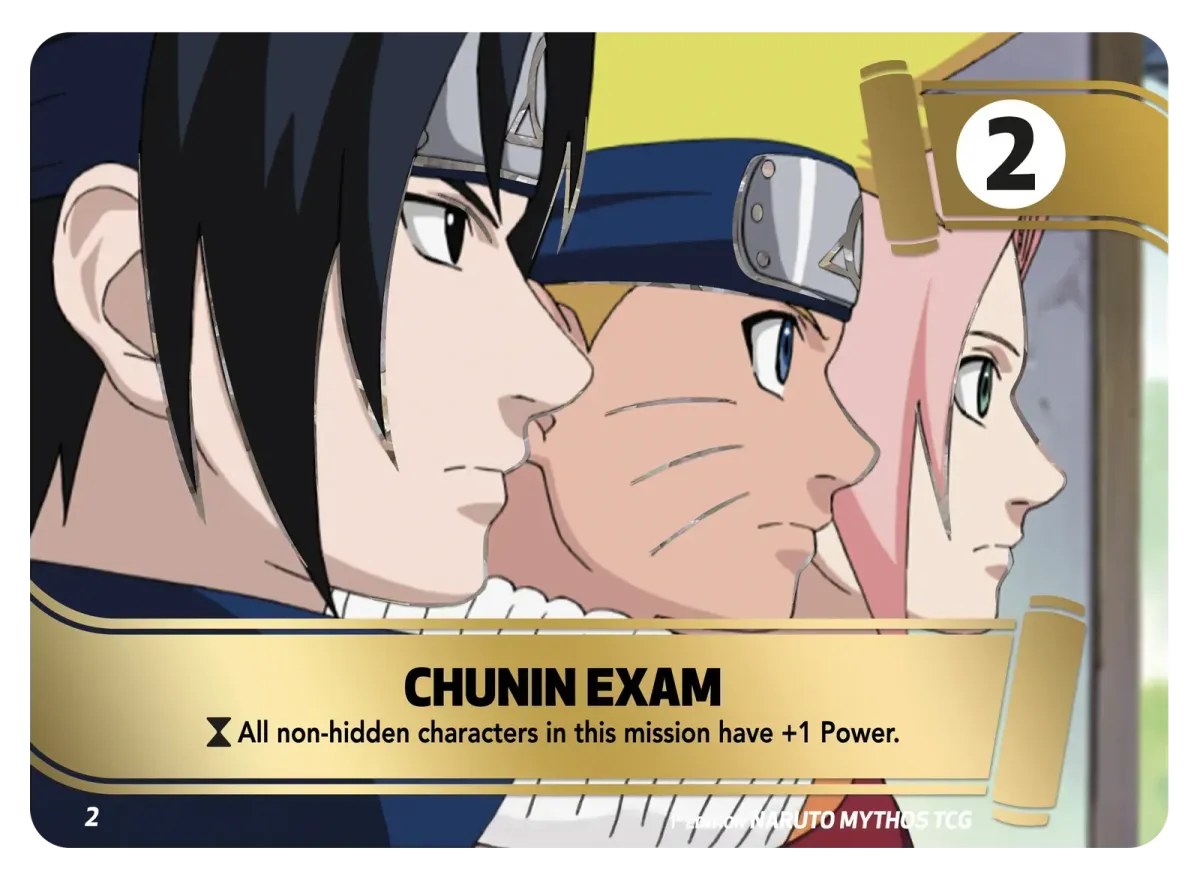
Four ways to put a card on a Mission
On your turn you play one card or you pass. Playing a Character means choosing one of these:
| Play | Chakra you pay | Effects that fire | Catch |
|---|---|---|---|
| Face-up from hand | Printed cost | MAIN | Only one Character per name per Mission on your side |
| Hidden (face-down) from hand | 1, whatever the printed cost | None | While hidden it has 0 Power, 0 cost, no faction and no keywords |
| Reveal a hidden card | Full printed cost | MAIN and AMBUSH | Only in the Mission it already sits in, unless a card says otherwise; counts as playing a Character |
| Upgrade | The cost difference | MAIN and UPGRADE (UPGRADE is optional) | Same name, strictly higher cost |
You pay by returning Chakra tokens to the shared pool, and you can check your own hidden cards whenever you like. AMBUSH is one reason to take the hidden route: an AMBUSH line only triggers when the card is revealed from hidden, not when it is played face-up from hand.
The one-name rule has two wrinkles the FAQ spells out. You can place a hidden card with the same name as a face-up Character already on that Mission, but you cannot reveal it there while the other one stays. And if an effect ever forces a duplicate onto a Mission, the newcomer is discarded without triggering anything and without counting as defeated.
A hidden card pays for itself
Here is the arithmetic the rulebook leaves you to do. A hidden card costs 1 Chakra. Once it is on the table it is a Character in play, and each Start phase pays you 1 Chakra per Character in play, hidden ones included. So a card hidden in round one has returned 3 Chakra — in rounds two, three and four — before you ever reveal it, and whether to pay its full cost to reveal it is a separate decision you get to make later with more information.
The price is the stats. Until it is revealed, a hidden card is a 0-Power, 0-cost body with no faction, so it wins nothing on its own and is exposed to any effect that targets low-cost or low-Power Characters. Power tokens do stick to it, and they stay on through a reveal.
Upgrades stack, but they do not ramp
An Upgrade is how you get a second face-up card of a name onto the same Mission: play a same-name Character with a higher cost on top of the one already there and pay only the difference, so a 5-cost over a 4-cost costs 1. The new card's MAIN and UPGRADE effects apply, the old card's text stops mattering, and any Power tokens carry over. You can upgrade with a card that has no UPGRADE effect at all, and per the FAQ you can upgrade by revealing a hidden card onto the stack in its own Mission.
The rulebook is precise about what a stack is: one Character. It generates 1 Chakra, however many cards are in it. Only the top card counts for effects — the rest are "glued" underneath — and if the top card leaves play, everything beneath it is discarded first. That is the real trade-off. Chakra spent on a fresh body adds a Character, and therefore adds Chakra in every later round. The same Chakra spent on an Upgrade adds Power and effects, but no income.
Why the first Mission scores four times
Missions do not leave play after they are scored. Each round adds one, and each Mission evaluation phase scores every Mission currently on the table, in order D, C, B, A. Add the rank bonus and each slot has a base ceiling, before any card effects:
| Slot | Revealed in | Times it is evaluated | Points per win | Ceiling if printed 2 | Ceiling if printed 3 |
|---|---|---|---|---|---|
| D | Round 1 | 4 | Printed + 1 | 12 | 16 |
| C | Round 2 | 3 | Printed + 2 | 12 | 15 |
| B | Round 3 | 2 | Printed + 3 | 10 | 12 |
| A | Round 4 | 1 | Printed + 4 | 6 | 7 |
The two ceiling columns are arithmetic on the rulebook's rank bonuses, not published figures, and card effects can push past them: Set 2's Change of Mission Rank attachment makes its Mission "worth +1 Mission point for both players", and some SCORE effects, such as Tazuna (Master Bridge Builder), grant Mission points outright. What they show is that the early Missions are the long game, and the A Mission, for all its +4 bonus, is a single swing. That swing can still decide a game. The rulebook's own worked example ends 23–22, and in its table each player wins exactly five Mission evaluations:
| D (printed 3) | C (printed 2) | B (printed 2) | A (printed 3) | Total | |
|---|---|---|---|---|---|
| Player 1 | Won rounds 1, 2 and 4: 12 | 0 | Won rounds 3 and 4: 10 | 0 | 22 |
| Player 2 | Won round 3: 4 | Won rounds 2, 3 and 4: 12 | 0 | Won round 4: 7 | 23 |
Player 1 held the long-lived D Mission for three of four rounds and still lost, because Player 2 took the C Mission three times and the one-shot A Mission at the end. SCORE effects follow the same logic: they trigger for whoever wins that Mission, in each round they win it.
Passing first buys the Edge
The Edge token does three jobs. Its holder takes the first turn of the next Action phase, wins every tied Mission, and wins a tied game. The rulebook gives one way to take it: be the first player to pass in an Action phase, and you gain it or keep it.
That turns passing into a trade rather than a surrender. Pass early and your opponent gets to play card after card with full sight of your board. Hold on, and they may pass first and carry the tiebreaks into the next round. On a board where the Missions are close, the Edge can be worth a whole Mission's points in every round it breaks a tie.
Two smaller rules. Per the Game Mechanics page, when simultaneous effects trigger at a point with no active player — the end of a round, or scoring — the Edge holder decides their order. And per the Tournament Rules, at events using a chess clock, a player whose time runs out is forced to pass but does not take the Edge that way.
Attachments, the Set 2 card type
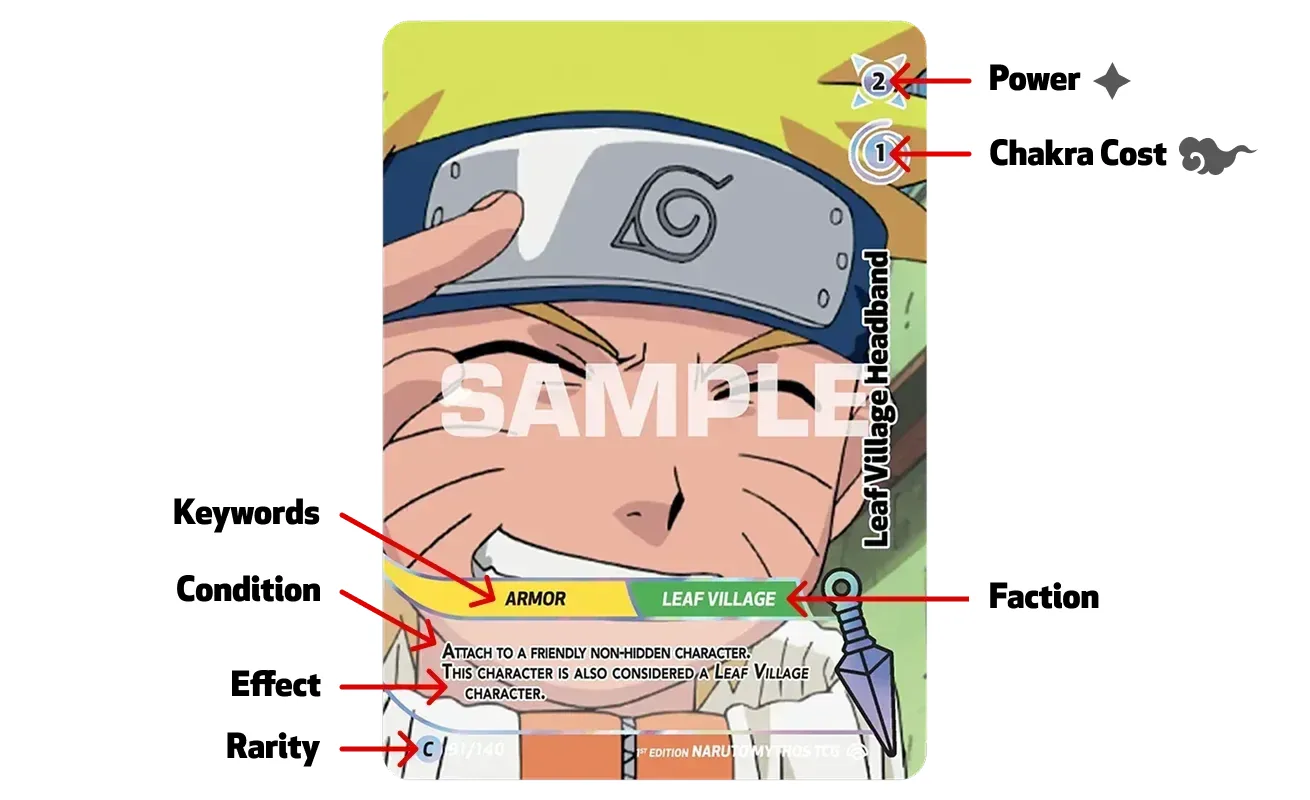
Shinobi Shiren added Attachments. The March 2026 rulebook has no section on them; the current one spends three pages on them. The rules:
- An Attachment needs a valid host, named in the condition line. Cicaboom's sample, Leaf Village Headband, reads "Attach to a friendly non-hidden character", costs 1 and carries 2 Power. Others attach to Missions.
- Each card can host one Attachment per player, so two at most. Playing a second of your own on the same host discards the first.
- Attachments are not Characters. Effects that target Characters ignore them, and face-up Attachments generate no Chakra in the Start phase.
- You can play one hidden under the normal hidden rules, but only if a valid host exists in that Mission at that moment.
- If the host stops meeting the condition — the headband's wearer gets hidden, say — the Attachment is discarded immediately. If the host leaves play, the Attachment goes with it.
- Power printed on an Attachment adds to its host Character's total, or to your total on a Mission for a Mission Attachment.
The glossary in one table
The rulebook's glossary, with the FAQ's clarifications where they change how a term plays:
| Term | What it means |
|---|---|
| MAIN | Triggers every time you play the character |
| UPGRADE | Triggers only when the character is played as an Upgrade |
| AMBUSH | Triggers only when the character is revealed from hidden |
| SCORE | Triggers only when you win the Mission |
| FIRST STRIKE | Triggers only if this is the first character you play this round |
| DUEL | Triggers only if the named character is present in this Mission, on either side |
| CHAKRA +X | X extra Chakra in each Start phase. Per the FAQ, you get nothing at the moment the card is played |
| POWERUP X | Put X Power tokens on a character — this one, unless another target is named |
| Printed Power | The number on the card, ignoring Power tokens, Attachments and other effects |
| Hide / Defeat / Move | Turn face-down / put in the owner's discard pile / place in another Mission |
| Take control | The card is temporarily yours, and returns to its owner if the card controlling it is hidden, leaves play or changes sides |
| Friendly / Enemy | Your side / the opponent's side. A character is not friendly to itself |
FIRST STRIKE and DUEL are not in the March 2026 rulebook's glossary; they are new to the current one.
When effects collide
The rulebook covers timing in a paragraph; the Game Mechanics page covers it properly. The essentials:
- Instant ↯ effects are optional unless the text says MUST. A card whose MUST effect you cannot carry out cannot be played at all, while "must, if able" lets you play it anyway. Once you apply an effect, you apply as much of it as you can.
- A card's own effects resolve top to bottom, but any effects its arrival triggers on cards already in play go first.
- Chains resolve newest first. The turn player picks the order of simultaneous triggers, and Mission effects always resolve last.
- Continuous effects are applied all at once to each card's "core" stats — printed Power plus Power tokens — which stops bonuses from feeding into each other.
- Multi-target effects take a snapshot: every target is fixed at once, before any of them changes.
- Per the FAQ, Power can go negative; per the rulebook glossary, your discard pile's order stays fixed unless an effect says otherwise.
Playing at a store or a Regional
Cicaboom's announcement pages for the first Store Championship season never stated a format, as our Store Championships piece found. The Tournament Rules document that took effect on 7 September 2026 — after that season closed on 12 July — now sets one for the tier:
| Event type | Required structure |
|---|---|
| Casual and weekly events | Organizer's choice; Swiss, Best-of-1, 30-minute rounds recommended |
| Store Championships | Swiss then a single-elimination Top Cut. Swiss must be Best-of-1 (30 minutes recommended); Top Cut is Best-of-1 or Best-of-3 at the organizer's choice |
| Regionals and above | Swiss then single elimination; the round structure is published on each event's own page |
The rest of what to know before you register:
- Minimum 4 players, or the event is cancelled. Swiss rounds scale from 3 (4–8 players) up to 11 (1,025–2,048).
- Rounds default to Best-of-1, 30 minutes. At time, the active player finishes their action or passes, the other player gets one action or passes, and a Mission evaluation runs immediately without the Edge changing hands. Most points wins; a tie goes to the Edge.
- Best-of-3 Top Cut rounds run on a chess clock of 10 to 15 minutes per player, with no time regained when the turn passes, and the loser of each game picks who starts the next.
- Sleeves are mandatory at Store Championships and above. Your Missions may use a different sleeve from your deck.
- No player-made proxies. A judge can issue one only for a card damaged during the event itself.
- Decklists follow the format "2x Gaara - Sand Coffin (1-120/130)": quantity, name, version, then set number, collection number and set size.
- Limited events exist too. Sealed lifts the two-copy cap but keeps the 30-card minimum and three Missions; a four-pack Booster Draft builds 20-card decks with four Missions.
What the rules still leave open
- Hand size. None of the rulebook, the FAQ or the Tournament Rules states a maximum.
- Regional structure. The Tournament Rules defer round counts and cut sizes to each event's own page, so two Regionals can run differently.
- Set 2's second wave. Cards tied to Special Pack Design A are not playable until it ships, and Cicaboom has not confirmed its October date.
- Set 3. Cicaboom's announcement for Akatsuki calls it the game's first step into NARUTO Shippuden. The rulebook has already been reissued to add one card type for Set 2; whether Set 3 brings another has not been announced.
None of that stops you playing tonight. Learn the scoring table before your first game, and everything else in this ruleset reads as tactics.
Rules above are read from Cicaboom's NARUTO Mythos TCG rulebook PDF (file dated 27 August 2026), the Tournament Rules in effect from 7 September 2026, and the official How to Play, Game Mechanics and FAQ pages, all checked on 28 September 2026.
Frequently Asked Questions
How many cards are in a NARUTO Mythos TCG deck?
How do you win NARUTO Mythos TCG?
How do hidden characters work in NARUTO Mythos TCG?
How does upgrading work in NARUTO Mythos TCG?
What does the Edge token do in NARUTO Mythos TCG?
Why is the first Mission worth so much in NARUTO Mythos TCG?
What tournament format do NARUTO Mythos TCG events use?
Can you play Gold Cards in a NARUTO Mythos TCG deck?
Keep Reading
- Naruto Card Game Blog Hub
- NARUTO Mythos TCG explained: publisher, sets, Gold Cards
- NARUTO Mythos TCG Store Championships: prizes and the first season
- Where NARUTO Mythos TCG is distributed: Breakflip and Zvezdar
- Naruto Card Game Explained: Bandai, Kayou or Mythos?
- What Bandai's rival NARUTO CARD GAME has printed so far
- How to Play the Gundam Card Game
- How to Play Disney Lorcana
- NARUTO Mythos TCG Rulebook (English PDF, file dated 27 August 2026) — deck building, setup, round phases, Hidden, Upgrade, Edge, Power tokens, Attachments, worked scoring example, glossary
- NARUTO Mythos TCG How to Play — card anatomy for Character, Mission and Attachment cards, game flow, rulebook download
- NARUTO Mythos TCG Game Mechanics — Instant and Continuous effects, core stats, trigger chains, snapshot targeting, priority and control
- NARUTO Mythos TCG FAQ — official rulings on Missions, Attachments, Upgrades, Hidden characters, deck size and alternate-art copies
- NARUTO Mythos TCG Tournament Documents — Tournament Rules and Tournament Infraction Guidelines
- NARUTO Mythos TCG Tournament Rules (in effect as of 7 September 2026) — deck construction, Legendary numbered cards, round structures per event type, time limits, sleeves, decklists, Limited formats
- Announcement: NARUTO Mythos TCG – Set 2 is Coming! — 4 September 2026 release, Special Pack Design A moved to an October second wave
- NARUTO Mythos TCG Collection Guide — rarity guide, Legendary gold cards, and the March 2026 rulebook version
- NARUTO Mythos TCG Rulebook V2 (March 2026) — the earlier version, with no Attachment section and no FIRST STRIKE or DUEL glossary entries
- NARUTO Mythos TCG Expands Further: Set 3 "Akatsuki" and New Territories Announced — Cicaboom, 27 May 2026; also states Set 2 does not release simultaneously worldwide (Europe and the UK: 4 September)
- NARUTO Mythos TCG Card Gallery — official card text, incl. Change of Mission Rank (103/140) and Tazuna, Master Bridge Builder (076/140)
Related Guides
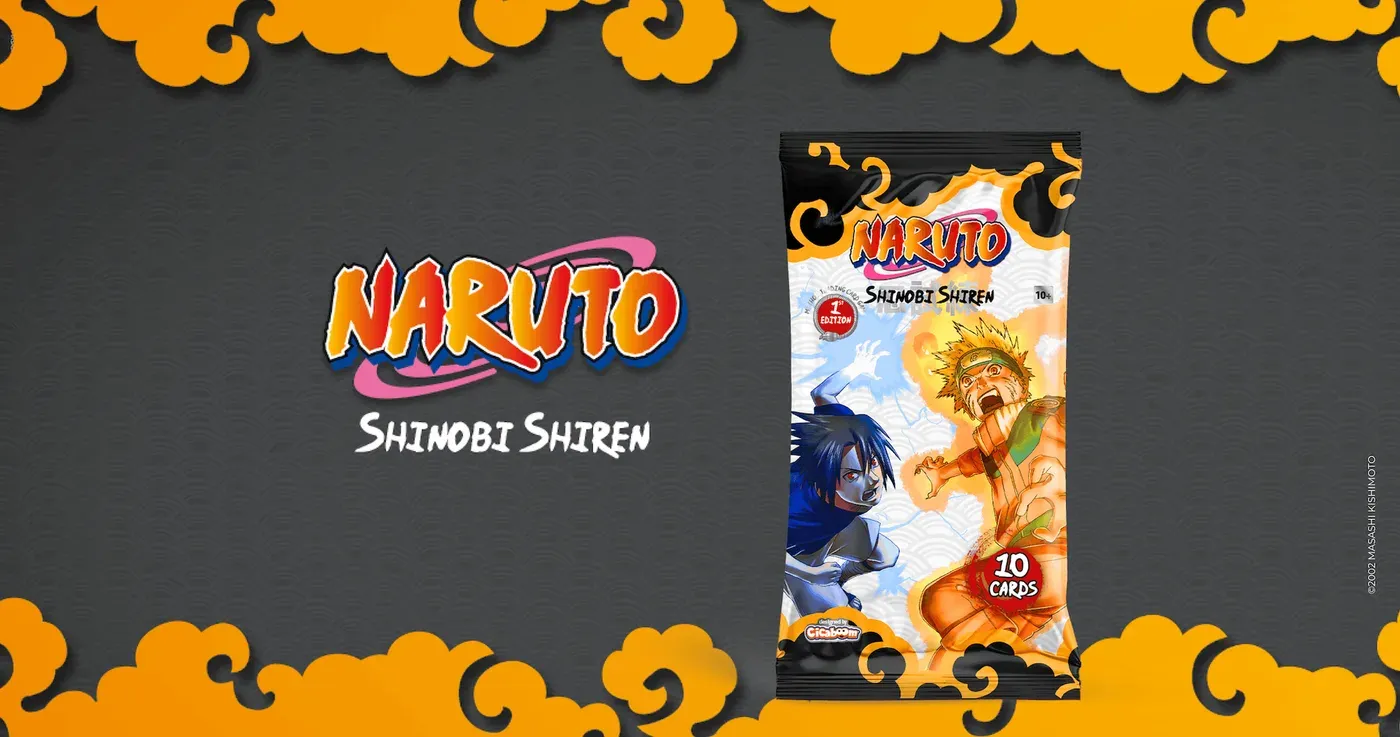
NARUTO Mythos TCG Shinobi Shiren: Set 2 Cards and Rarities
Set 2 of NARUTO Mythos TCG has been in European stores since 4 September, and Cicaboom's Products page still lists it as "Coming soon". The official Collection Guide says a great deal more: 150 numbered cards, a new Attachment card type, four rarities Set 1 never had, and serialized runs of 300, 400 and 1,500. Here is the whole set, rarity by rarity, checked against the official card gallery and events page.
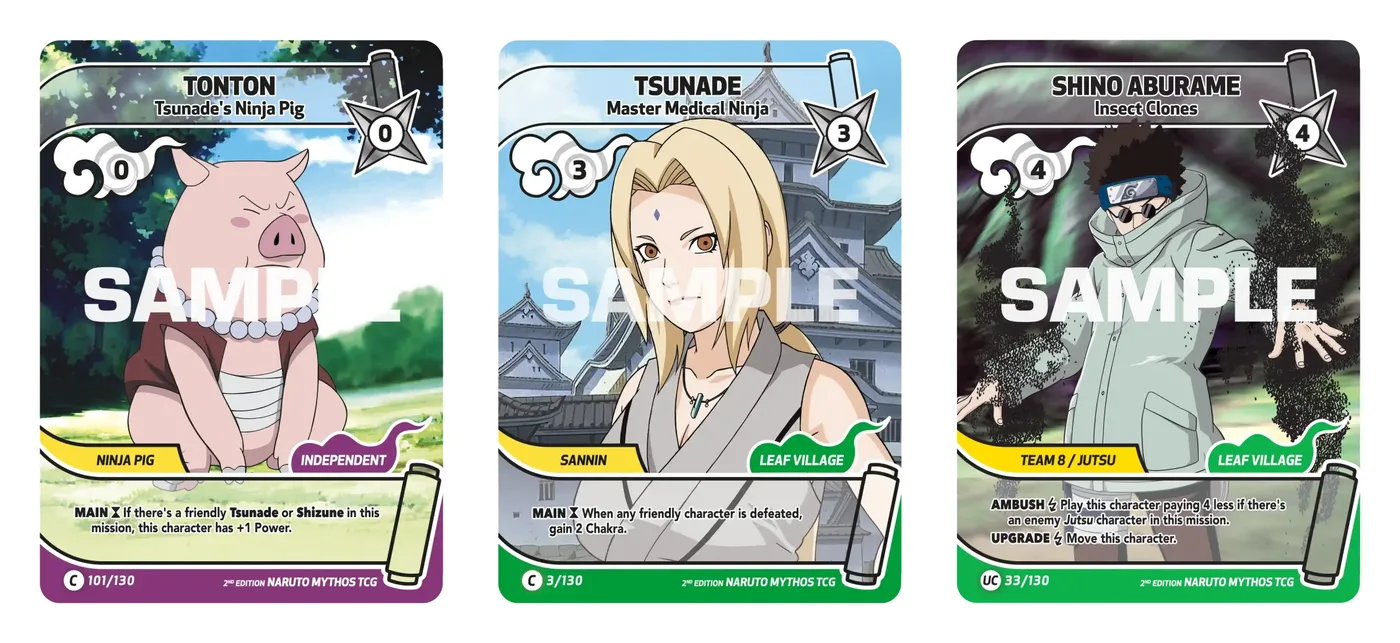
NARUTO Mythos TCG Orlando Regional: Results and Decklists
Cicaboom's website has not posted a result for either of its 2026 Regionals. The Orlando one is on TopDeck.gg anyway, the platform Cicaboom sent players to for registration, with final standings and 43 player-submitted decklists. The champion went 3-3 in the Swiss, took the last Top 16 seat on tiebreakers, and beat the only 6-0 player in the first round of the cut. Here is the bracket, the champion's 30 cards, and what the Top 16 had in common.
NARUTO Mythos TCG Store Championships: Two Cards, No Results
Our two existing NARUTO Mythos TCG pieces both mention Store Championships in passing — a line in a comparison table, a clause in an FAQ answer — and neither explains what one actually is. Cicaboom does, on a page it published back in June and never updated: a five-week European season with its own two promo cards, no format published anywhere, and (going by the news feed) zero results ever posted, the exact pattern we already found with the publisher's first Regional. The publisher's own two pages describing the season cannot even agree on the day it started.
NARUTO Mythos TCG: Breakflip and Zvezdar Disagree
Our own NARUTO Mythos TCG explainer, five days old, named Zvezdar Toys as the company bringing the game to Europe and North America — sourced to trade press, because Cicaboom's own site never spelled it out anywhere we could find. This morning Cicaboom published a company update naming a different company, Breakflip, as the coordinator for those exact regions, and stated in writing that Breakflip is 'not the distributor.' Its own Products page, three clicks away, still names Zvezdar for the same three regions using the same three email addresses. Zvezdar's own site still calls itself the official distributor. All three pages are live right now, and none of them mentions the other two.
Naruto Card Game Explained: Bandai, Kayou or Mythos?
Search "Naruto cards" and you get three unrelated products stacked on top of each other: a competitive TCG from Bandai that nobody can buy until Summer 2027, a line of Chinese-made collectible cards from Kayou that has been in Walmart since 2025, and a third game — Cicaboom's NARUTO Mythos TCG — that has been on European shelves since March 2026 and is already running sanctioned tournaments. Here is exactly what each one is, what each publisher has actually confirmed, and which one the person asking the question actually wants.
NARUTO Mythos TCG: The Card Game Already on Shelves
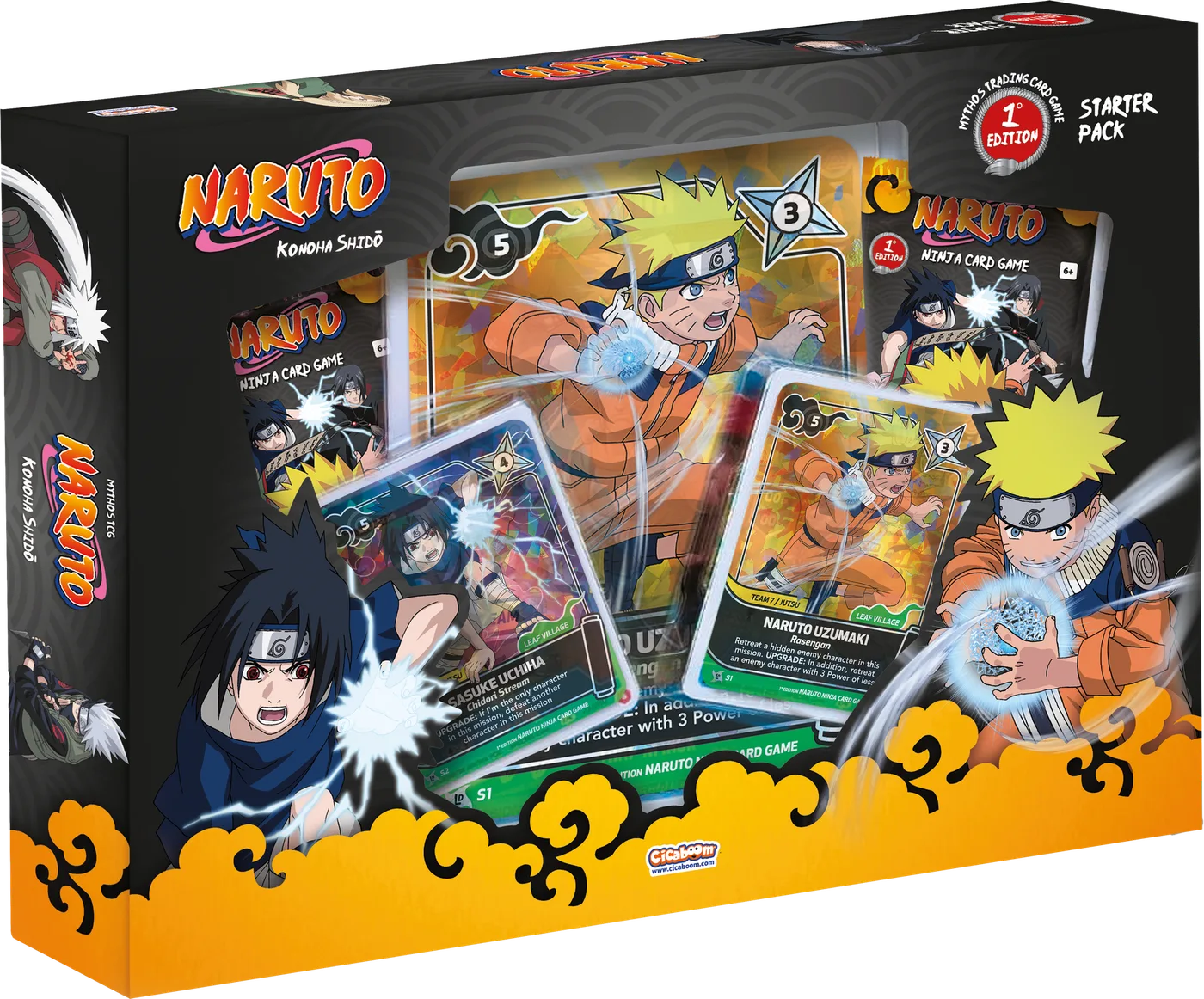
Our own coverage of this vertical has treated the Naruto card question as a two-way choice: Bandai's NARUTO CARD GAME, which does not release until Summer 2027, or Kayou's collectibles, which are not a game at all. There is a third product neither of those posts mentions. NARUTO Mythos TCG — published by Italy's Cicaboom — has been on European shelves since 13 March 2026, ships with a full public rulebook, and ran a three-day Regional Championship in Paris the week before this was published. Here is what it actually is, and where it leaves the "Bandai vs Kayou" framing.