Game Boy Tetris Explained: How It Differs From NES
Game Boy Tetris and NES Tetris share a points table, but the handheld game stops speeding up at level 20, pays a level-up Tetris at the old rate, deals the L about 10.7% of the time, and makes a held direction wait 23 frames.
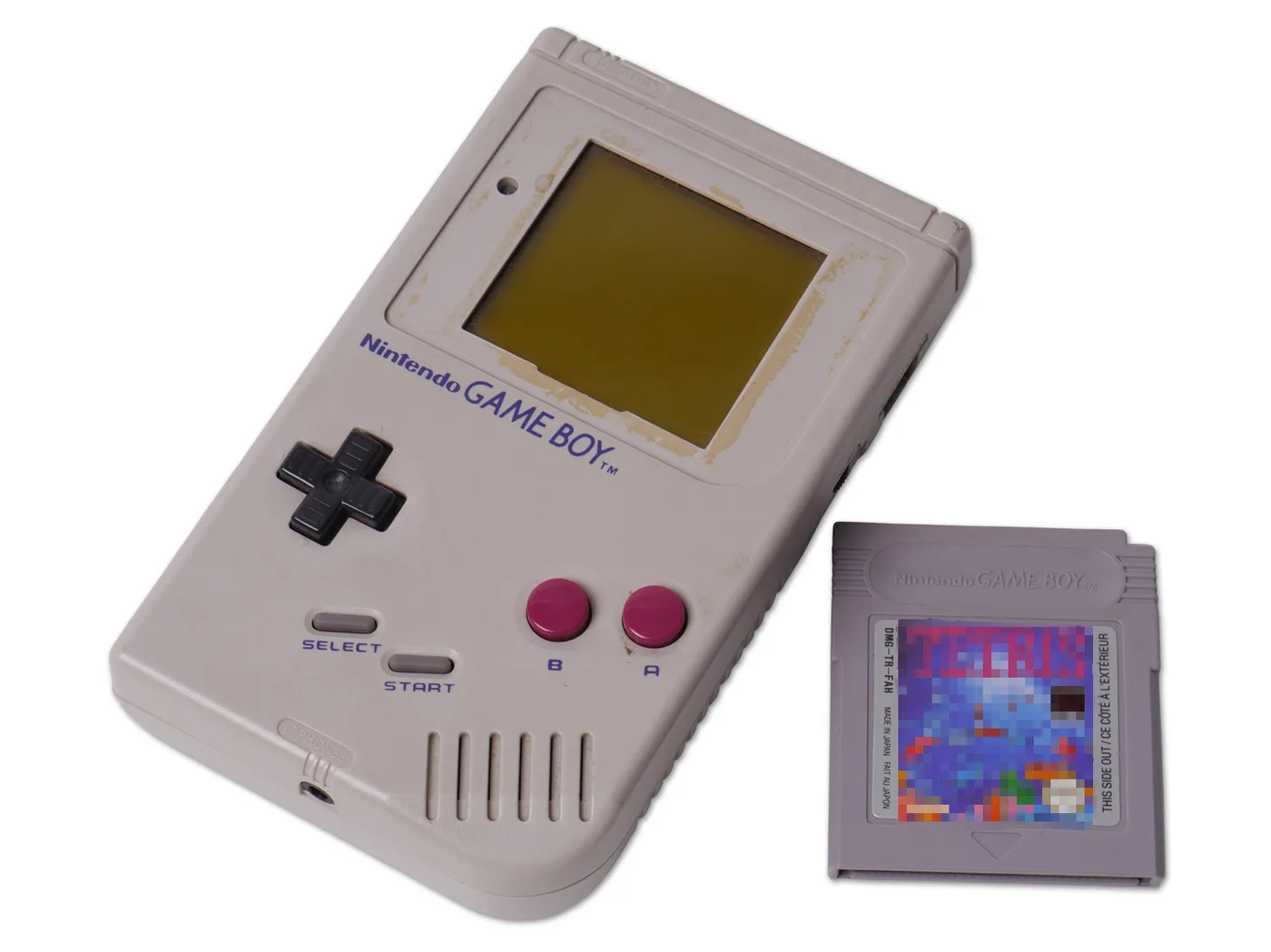
Game Boy Tetris deals the L piece about 10.7% of the time, where a fair deal would give it one piece in seven, 14.3%. The cause is a single bitwise OR in the routine that picks the next piece. The same cartridge stops speeding up at level 20, pays a level-up Tetris at the level you just left, and makes a held direction wait 23 frames before it starts repeating. NES Tetris, Nintendo's other Tetris from 1989, does none of those things, even though the two pay the same 40, 100, 300 and 1,200 points per clear.
This post takes the Game Boy version on its own terms: the two modes and the hidden heart setting, the speed table, the scoring order, the randomizer, movement, the top-out rule, link play, and where you can play it today. The mechanics come from vinheim3's tetris-gb-disasm, a commented disassembly of the ROM, checked against tetris.wiki, Hard Drop's wiki and Wikipedia. Where a number is our own reading or calculation from that code, the text says so. The NES game has its own coverage in our level transition and scoring guide and our DAS, hypertapping and rolling guide.
One version note before the numbers. The disassembly's rocket thresholds are 100,000, 150,000 and 200,000 points, and its level curve adds a level every 10 lines, which is what Hard Drop lists for version 1.1. Hard Drop describes an earlier Japanese version 1.0 with rockets 50,000 points sooner, 20 lines per level from level 9 up, and "Minuet" where 1.1 plays "Korobeiniki". Everything below is version 1.1.
Game Boy vs NES at a glance
| Game Boy Tetris (1989) | NES Tetris (1989, Nintendo) | |
|---|---|---|
| Playfield | 10 wide, 18 tall | 10 wide, 20 tall |
| Frame rate | 59.73 per second | 60.0988 per second |
| Start levels | 0 to 9 | 0 to 19, with 10 to 19 behind A plus Start |
| Last speed increase | Level 20, 3 frames per row | Level 29, 1 frame per row |
| First level-up | 10 x (start + 1) lines | The same for 0 to 9; sooner than that above 9, at 100 to 140 lines |
| Clear that crosses into a new level | Paid at the old level | Paid at the new level |
| Auto shift | Moves at once, waits 23 frames, then every 9 | Moves at once, waits 16 frames, then every 6 |
| Randomizer | Up to three rolls, with an OR test against two pieces | One reroll against the previous piece |
| Two players | Link Cable versus | No two-player mode |
| Rotation | Nintendo Rotation System, left-handed, no wall kicks | Nintendo Rotation System, right-handed, no wall kicks |
The NES column comes from tetris.wiki and Meat Fighter's breakdown of the NES game's code; the Game Boy column from the disassembly, tetris.wiki and Hard Drop. Neither game has hold or a hard drop, and both show one preview piece.
A-Type, B-Type and the heart
A-Type is the endless mode. You pick a start level from 0 to 9, and there is no hidden way past 9 like the NES's A-plus-Start trick. The first level-up comes at 10 x (start + 1) lines, then one every 10 lines, and the level stops rising at 20. The NES quirks that hold an 18 start for 130 lines come from starts above 9 and, per Meat Fighter, a level check that skips a decimal conversion. The Game Boy has neither: starts stop at 9, and its check converts your level to decimal digits before comparing it with the line count. We ran the level routine for all ten starts, and each one reaches level 20 at exactly 200 lines.
B-Type asks you to clear 25 lines. You choose a level from 0 to 9 and a height from 0 to 5, and each step of height adds two rows of randomly placed blocks, so height 5 starts you with 10 rows of junk in an 18-row well. Nothing is scored during play. When the 25 lines are done, the game counts your Singles, Doubles, Triples and Tetrises and pays each count at the B-Type level you picked, then adds your soft-drop points, which the disassembly tallies during play but only adds at the end.
The heart. Hold Down while you press Start to begin a one-player game from the title screen, and a heart appears beside the level number. In the disassembly, heart mode adds 10 to the level the game uses to look up gravity, capped at 20, so heart level 0 falls at level 10 speed and any heart level from 10 up runs at the game's top speed. Your score does not change: the points multiplier reads the real level, and tetris.wiki and Hard Drop both note that heart levels do not raise your score. What you get for the trouble is a heart symbol you can use in your high-score name.
The endings. Finish an A-Type game on 100,000 points or more and a rocket launches: small from 100,000, medium from 150,000, large from 200,000. Clear B-Type on level 9 and a troupe of musicians and dancers plays you out; do it from height 5 and the Buran shuttle launches after them, per Hard Drop and the ending code in the disassembly.
The speed table stops at level 20
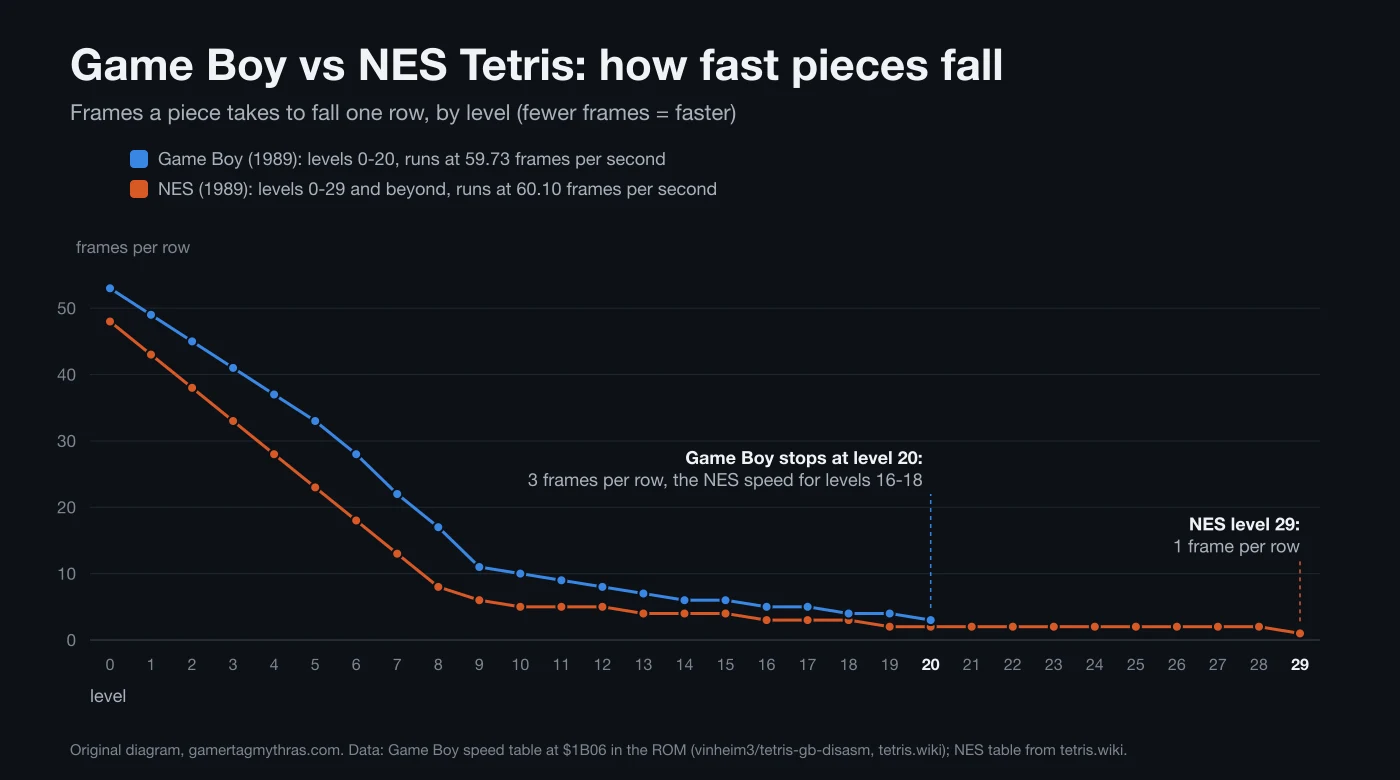
The Game Boy's gravity table sits at $1B06 in the ROM, with each entry stored as one less than the real frame count, per tetris.wiki and Hard Drop. Both wikis and the disassembly agree on the 21 values:
| Level | Game Boy frames per row | NES frames per row |
|---|---|---|
| 0 | 53 | 48 |
| 1 | 49 | 43 |
| 2 | 45 | 38 |
| 3 | 41 | 33 |
| 4 | 37 | 28 |
| 5 | 33 | 23 |
| 6 | 28 | 18 |
| 7 | 22 | 13 |
| 8 | 17 | 8 |
| 9 | 11 | 6 |
| 10 | 10 | 5 |
| 11 | 9 | 5 |
| 12 | 8 | 5 |
| 13 | 7 | 4 |
| 14 | 6 | 4 |
| 15 | 6 | 4 |
| 16 | 5 | 3 |
| 17 | 5 | 3 |
| 18 | 4 | 3 |
| 19 | 4 | 2 |
| 20 | 3 | 2 |
| 21 and up | No such level | 2, then 1 from level 29 |
Two things stand out. The Game Boy is slower than the NES at each of its 21 levels, by 5 frames at both level 0 and level 9. And its last speed, 3 frames per row at level 20, is the speed NES players meet at levels 16 to 18. At 59.73 frames per second that is about 20 rows a second, against about 30 at NES level 19 and 60 at NES level 29. Soft drop moves a piece one row every 3 frames, the same rate as level 20's gravity.
The gravity and lock delay guide covers how speed curves work across Tetris generally; the short version for the Game Boy is that its ceiling is a speed the NES game passes on the way to its hard part.
The level-up clear pays the old rate
Clears pay 40, 100, 300 or 1,200 points times (level + 1), the system tetris.wiki calls the original Nintendo scoring system, used in Nintendo's NES, Game Boy and Super NES versions. The difference is the order of operations. In the disassembly, a line clear only bumps a counter for that type of clear. The points are added later, after the cleared rows finish flashing, while the rows above shift down, and the level check runs later still, when the shift reaches row 3. So a clear is paid at the level you had before it. tetris.wiki's scoring page lists NES Tetris among the games that pay at the level after the clear instead.
An example. Start on 9 and sit at 96 lines. A Tetris takes you to 100 lines and level 10, and pays 1,200 x 10 = 12,000. On NES the same Tetris is paid at level 10, 13,200, which our transition guide walks through.
Three more scoring details:
- Soft drop points count only the rows of your last unbroken push before the piece locks, and the level does not multiply them, per tetris.wiki.
- The score stops at 999,999. A Tetris at level 20 is worth 1,200 x 21 = 25,200 points.
- Maxing out means playing at top speed. These figures are ours, from running the disassembly's rules for a game made only of Tetrises. From a level 9 start, that perfect game has 762,000 points when level 20 arrives at 200 lines, and reaches 999,999 on the 60th Tetris, at 240 lines. From level 0 it takes the 65th Tetris, at 260 lines. On NES, a perfect 18 or 19 start hits the cap before level 29. Hard Drop says a maxout before level 20 was "theoretically possible" in version 1.0, with its slower level curve; in 1.1 even the perfect game is 237,999 points short when level 20 arrives.
The randomizer runs on a bitwise OR
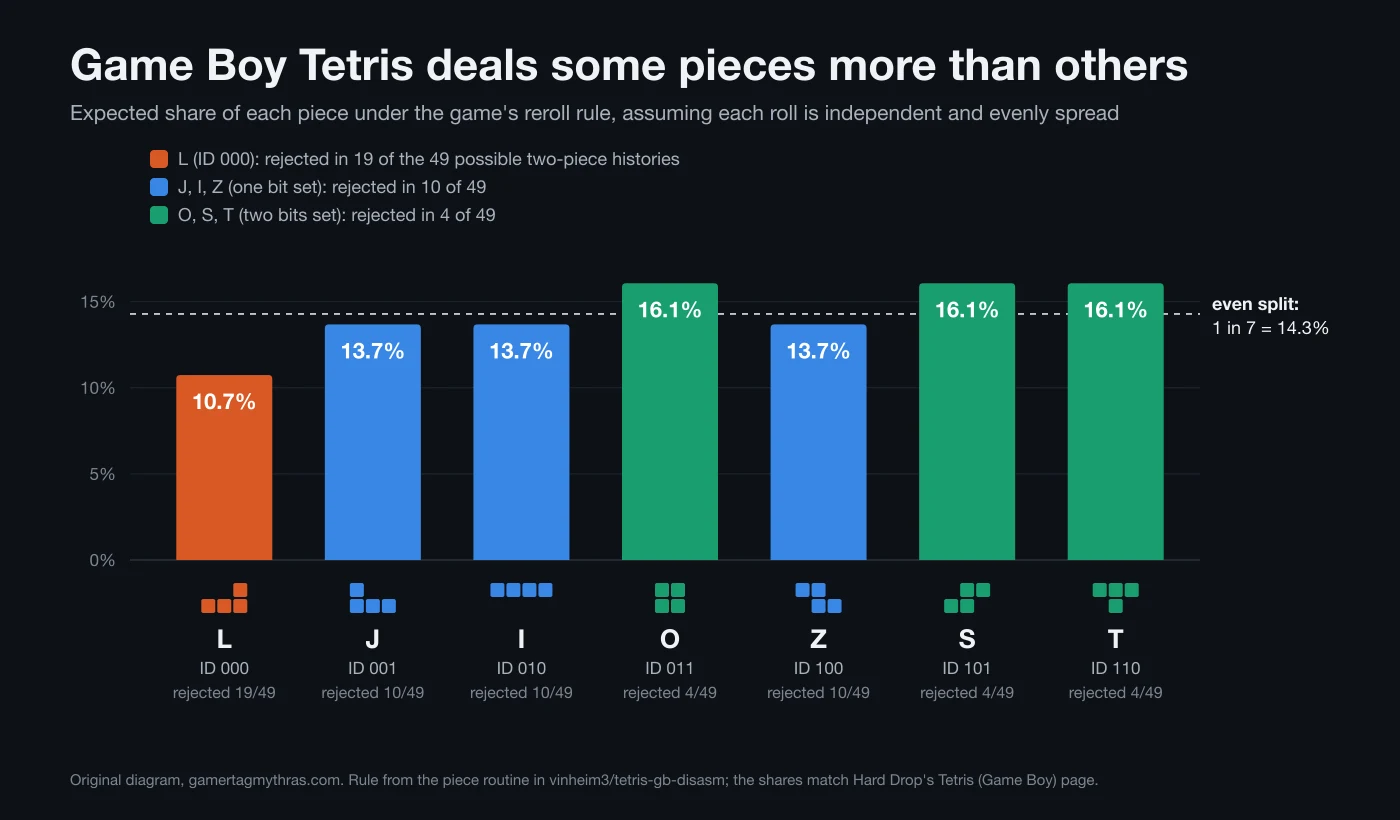
The game keeps three pieces lined up: the one entering play, the one in the preview window, and a hidden one behind it. Each new hidden piece is rolled from the Game Boy's divider timer, up to three times. On the first two rolls the game takes the candidate's ID, ORs it with the preview's ID and the entering piece's ID, and rolls again if the result equals the entering piece's ID. The third roll is kept whatever it is. Hard Drop's reading is that the rule was meant to make the same shape three times in a row less likely.
The IDs are 0 to 6, three bits each, and the OR test only rerolls when every 1 bit in the candidate and in the preview is already set in the entering piece. That is where the bias comes from:
| Piece | ID | Bits | Rejected in how many of the 49 two-piece histories | Expected share | One every (average) |
|---|---|---|---|---|---|
| L | 0 | 000 | 19 | 10.7% | 9.3 pieces |
| J | 1 | 001 | 10 | 13.7% | 7.3 pieces |
| I | 2 | 010 | 10 | 13.7% | 7.3 pieces |
| O | 3 | 011 | 4 | 16.1% | 6.2 pieces |
| Z | 4 | 100 | 10 | 13.7% | 7.3 pieces |
| S | 5 | 101 | 4 | 16.1% | 6.2 pieces |
| T | 6 | 110 | 4 | 16.1% | 6.2 pieces |
The L's ID has no 1 bits at all, so an L candidate can be thrown out whatever the entering piece is. O, S and T have two bits set, and none of the seven IDs contains them except themselves, so they are only rerolled when the entering piece is the same shape. The ID order comes from the disassembly's piece constants, and its tile data confirms which shape is which.
The expected shares are Hard Drop's figures, and our own run of the rule reproduces them. The same run puts the chance of a piece repeating the one before it at about 10.7%, against 14.3% for a fair deal, and three of the same piece in a row at about 0.34%, against 2.04%. So the rule does cut triples, and skews the mix while doing it.
One caveat on all of those numbers: they assume each roll is independent and evenly spread. The real rolls come from the divider timer, and a reroll reads it again moments after the first roll, so treat the chart as the bias the rule builds in, not as a count from real cartridges.
What it means at the stack: the L is the scarce piece. On average an L arrives once every 9.3 pieces, against once every 7.3 for a J and 6.2 for an O, S or T. The I arrives about once every 7.3 pieces, a little less often than a fair deal's once every 7. Our randomizers guide covers the NES reroll and modern 7-bag for comparison.
Movement: 23 frames, then every 9
Press left or right and the piece moves at once, and the game loads a counter with 23 ($17 in the code). Keep holding, and the piece moves again when the counter runs out, then every 9 frames after that. Hard Drop gives the same 23 and 9; tetris.wiki's Game Boy page says 24 frames. At 59.73 frames per second, 9 frames is about 6.6 shifts a second, against about 10 on NES.
The counter also explains a Game Boy version of the NES wall charge. This part is our reading of the disassembly. When a held move is blocked by the wall or the stack, the game sets the counter to 1, so it tries again on the next frame. The movement code does not run while no piece is in play, and nothing resets the counter when the next piece appears. So if you are still holding a direction when the new piece arrives, it shifts at once and then every 9 frames, without the 23-frame wait. If you are holding neither direction, the counter goes back to 23. Our NES DAS guide covers the NES version of the trick.
Rotation is the left-handed version of the Nintendo Rotation System, and like the NES's right-handed version it has no wall kicks: a rotation that would overlap a wall or a block is refused. A and B turn the piece in opposite directions. Select hides or shows the preview. The wall kicks guide covers both Nintendo variants.
Topping out takes two pieces
The first piece that locks in its spawn position, without having fallen a row, does not end the game. The second one does. tetris.wiki describes this as two consecutive pieces locking in their spawn positions. In the disassembly, the counter behind it is zeroed when a game starts, and nothing during play resets it, so by our reading the two do not have to be back to back.
Two players over the Link Cable
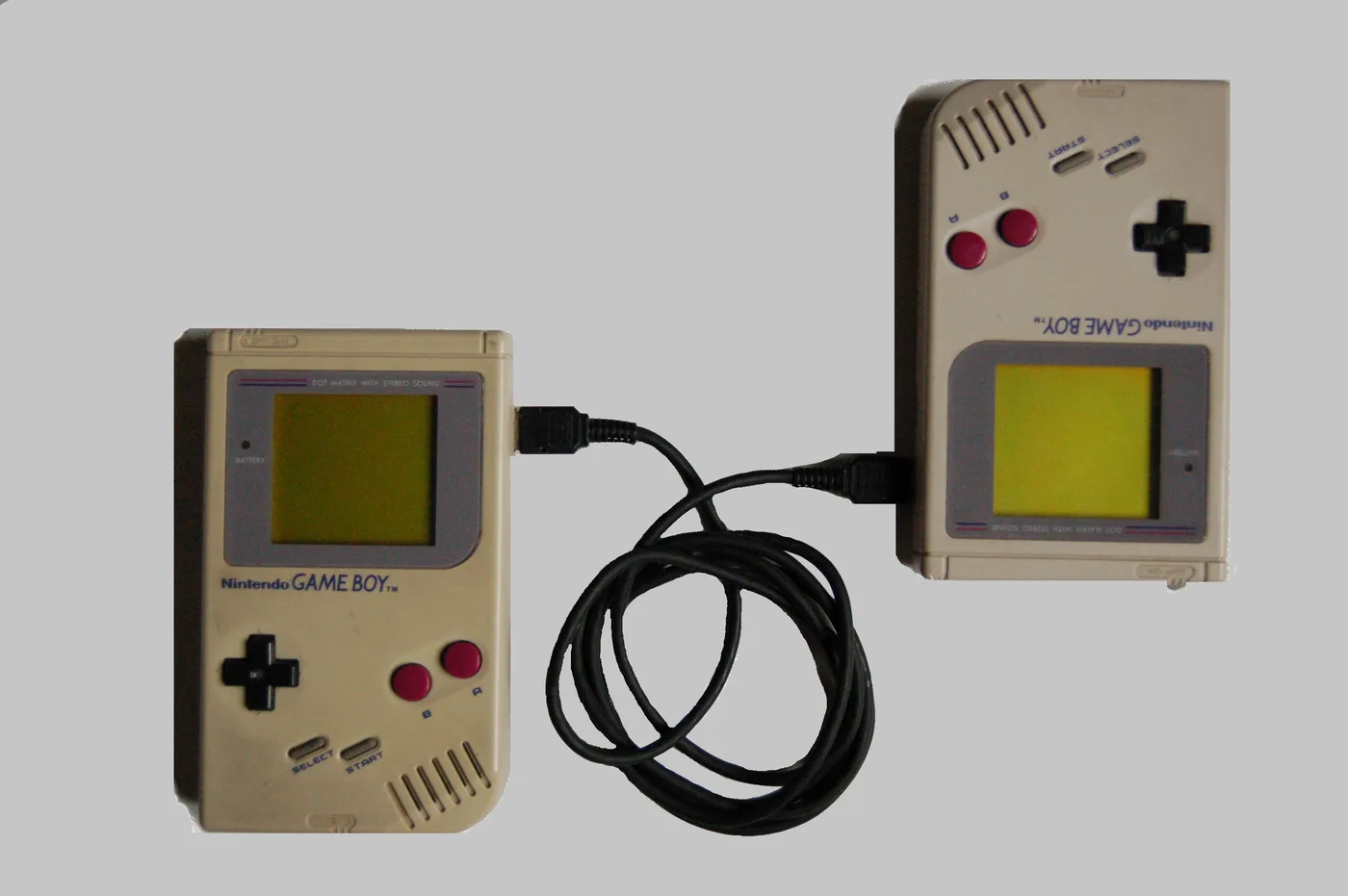
Wikipedia calls Game Boy Tetris the first game compatible with the Game Link Cable, and tetris.wiki calls it the first widely distributed Tetris with two-player garbage battles. On original hardware, each player needs their own Game Boy and their own cartridge.
The rules:
- A round is a race to 30 lines. You win it by clearing 30 lines first or by outlasting your opponent. Each player picks a starting height first.
- Garbage: a Double sends 1 line, a Triple 2 and a Tetris 4; a Single sends nothing. Those are the same values the general Guideline attack table in our scoring and attack guide gives for the same four clears.
- Same pieces, same holes. The Game Boy hosting the match builds a list of 256 pieces with the same OR rule and sends it across the cable, so both players get the same sequence. tetris.wiki adds that both get the same starting garbage, and that incoming garbage rows share one hole column, the same for both players.
- First to four round wins takes the match, per tetris.wiki.
Where to play it now
- Original hardware. Game Boy Tetris was bundled with the Game Boy in North America and Europe, though not in Japan, per tetris.wiki and Wikipedia.
- Nintendo 3DS. A Virtual Console release arrived in December 2011 without multiplayer, and Wikipedia says it was delisted in Europe and North America after 31 December 2014.
- Nintendo Switch. Tetris joined the Game Boy library for Nintendo Switch Online on 8 February 2023, and Nintendo's announcement lists online and local wireless two-player. Nintendo Life reported on 26 November 2025 that version 3.0.0 of the Game Boy app rebadged the app with Nintendo Classics branding and added in-game button remapping.
- Tetris DX is a different game. The 1998 Game Boy Color remake joined the same library as a surprise alongside NES Tetris, which Nintendo had announced for 12 December 2024. The update landed on the evening of 11 December in North America, already 12 December in Europe, per Nintendo, Gematsu and VGC. tetris.wiki lists it with a different rotation system and a level multiplier that stops at 21, and Wikipedia lists Ultra, 40 Lines and a versus mode against the CPU among its additions. If you want the 1989 rules above, open the original Tetris.
- Tetris Forever does not have it. The game is not among the 18 playable titles tetris.wiki lists for that collection; its Time Warp mode only drops you into a Game Boy-era ruleset for 20-second challenges. Our which Tetris to play guide covers what Tetris Forever does include.
This part is opinion. If you are coming from NES, start A-Type on 9: you get 100 lines at 11 frames per row, and you will reach level 20 at the same 200 lines as any other start. Turn the heart on once level 20 feels routine, because it gets you to top speed 100 lines sooner without changing a single point you score. More on the Tetris coverage hub.
Quick Action Checklist
- Expect the Game Boy to stop speeding up at level 20, at 3 frames per row, the NES speed for levels 16 to 18.
- Remember that every start from 0 to 9 reaches level 20 at 200 lines.
- Score a level-up clear at the old level: a Tetris from 96 to 100 lines on a level 9 start pays 12,000, not 13,200.
- Hold Down while pressing Start from the title screen for heart mode: faster gravity, same score.
- Plan around a scarce L, about 10.7% of pieces, and a slightly scarce I, about 13.7%.
- Keep holding a direction into the next piece if the last one was blocked; the shift comes at once instead of after 23 frames.
- Remember the first spawn-position lock is a warning; the second ends the game.
- In link play, send Doubles, Triples and Tetrises for 1, 2 and 4 lines, and race to 30 lines.
- On Switch, open Tetris in the Game Boy app for these rules; Tetris DX plays differently.
Frequently Asked Questions
How is Game Boy Tetris different from NES Tetris?
What is the max level in Game Boy Tetris?
How does heart mode work in Game Boy Tetris?
Why does Game Boy Tetris give fewer L pieces?
How does two-player work in Game Boy Tetris?
Can you play Game Boy Tetris on Nintendo Switch?
What score do you need for the rocket in Game Boy Tetris?
Keep Reading
- vinheim3/tetris-gb-disasm: commented Game Boy Tetris disassembly (MIT): piece routine, speed table at $1B06, level check, scoring order, DAS counter, heart mode, endings and two-player code
- tetris.wiki: Tetris (Game Boy): releases, modes, two-player rules, timings and speed table
- Hard Drop Tetris Wiki: Tetris (Game Boy): DAS, rockets and dancers, the OR randomizer and its piece shares, version 1.0 differences
- tetris.wiki: Scoring: the original Nintendo scoring system, soft drop points and which games pay at the level after the clear
- tetris.wiki: Top out: the Game Boy two-piece spawn-lock rule
- tetris.wiki: Nintendo Rotation System: right-handed (NES) and left-handed (Game Boy) variants
- tetris.wiki: Tetris (NES): frame rate, DAS, randomizer, gravity table and the missing two-player mode
- Meat Fighter: The Mechanics of Nintendo Tetris: the A-plus-Start hidden starts to level 19 and the level check that skips a BCD conversion
- tetris.wiki: Tetris Forever: playable games list and the Time Warp eras
- Wikipedia: Tetris (Game Boy video game): Link Cable, bundling, 3DS Virtual Console, Tetris DX and the Switch release
- Nintendo: Game Boy for Nintendo Switch Online, with Tetris online and local wireless two-player (8 February 2023)
- Nintendo: Tetris for NES and Tetris DX join the NES and Game Boy libraries (announcement dated 11 December 2024)
- Gematsu: Game Boy – Nintendo Switch Online adds Tetris DX (11 December 2024, 8:11 PM ET)
- VGC: Tetris (NES) and Tetris DX are now on Switch Online, after Nintendo announced NES Tetris for 12 December (12 December 2024)
- Nintendo Life: Game Boy app version 3.0.0, Nintendo Classics branding and button remapping (26 November 2025)
Related Guides
NES Tetris Level Transition and Scoring Explained
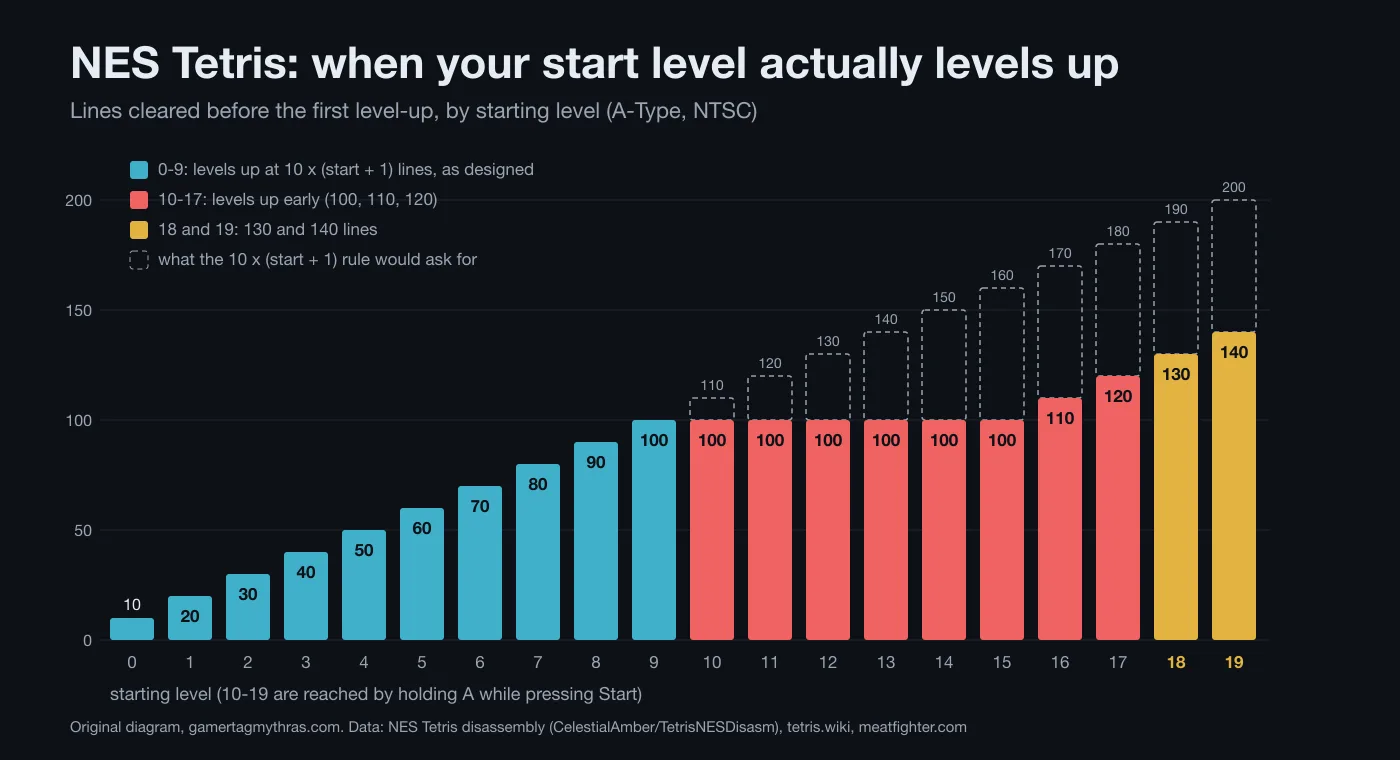
Start NES Tetris on 18 and you stay there for 130 lines. Start on 19 and it is 140. Start on 12 and it is 100. One missing conversion in the cartridge explains all three, and it also decides which clear gets paid at the higher rate.
Tetris Randomizers Explained: 7-Bag, TGM History Rolls, and Why NES Owed You Nothing
Every version of Tetris answers the same question differently: what comes next? The answer ranges from a shuffled bag with hard mathematical guarantees to a single polite reroll that owes you nothing, and knowing which one you are playing against changes how you stack.
NES Tetris DAS, Hypertapping and Rolling: How the Kill Screen Died
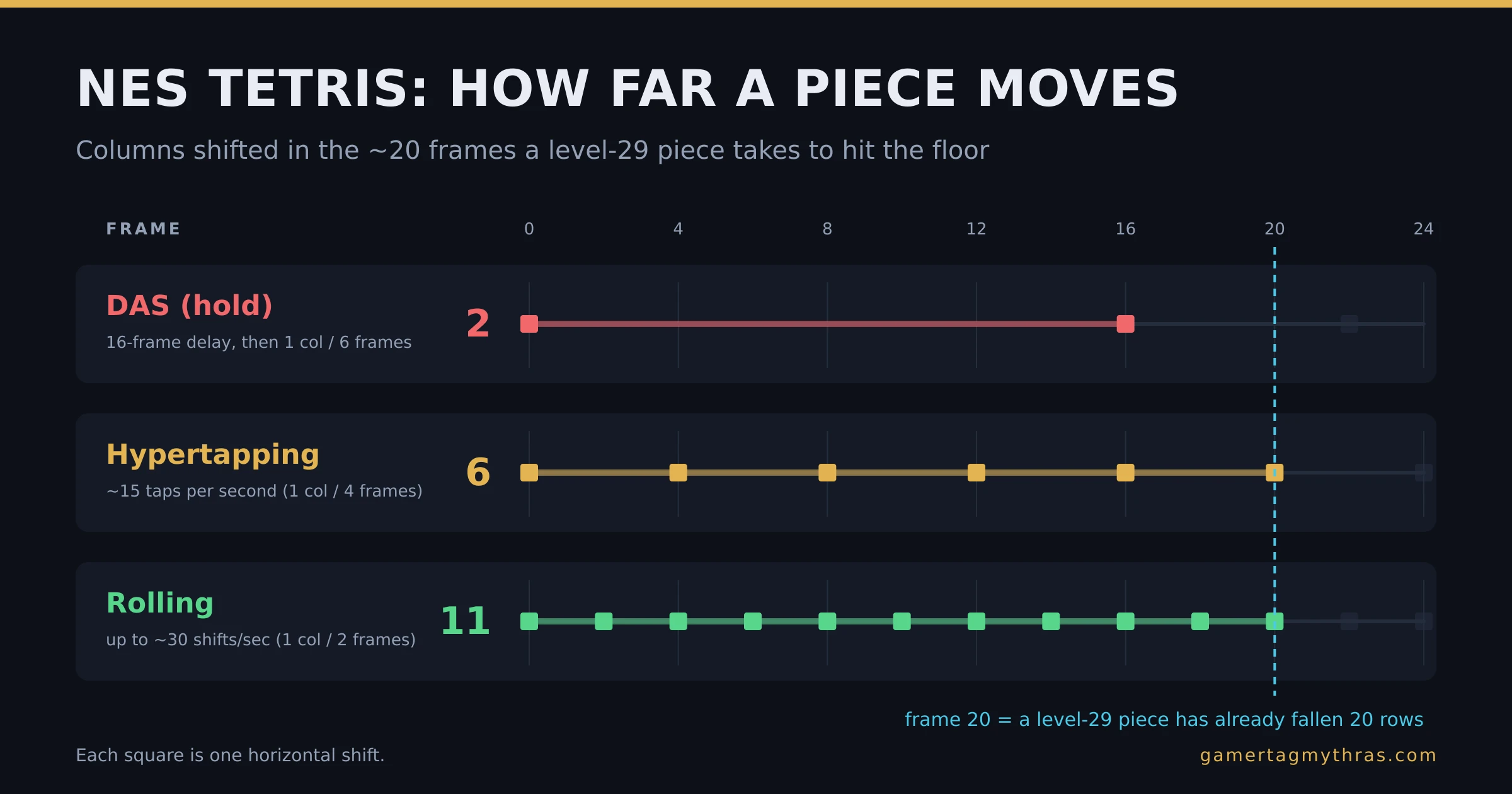
NES Tetris moves your piece sideways ten times a second. At level 29 a piece falls the whole well in twenty frames. That gap is why hypertapping and rolling exist, and why the kill screen is not a kill screen anymore.
Tetris Fumen Explained: Read, Make and Share Diagrams
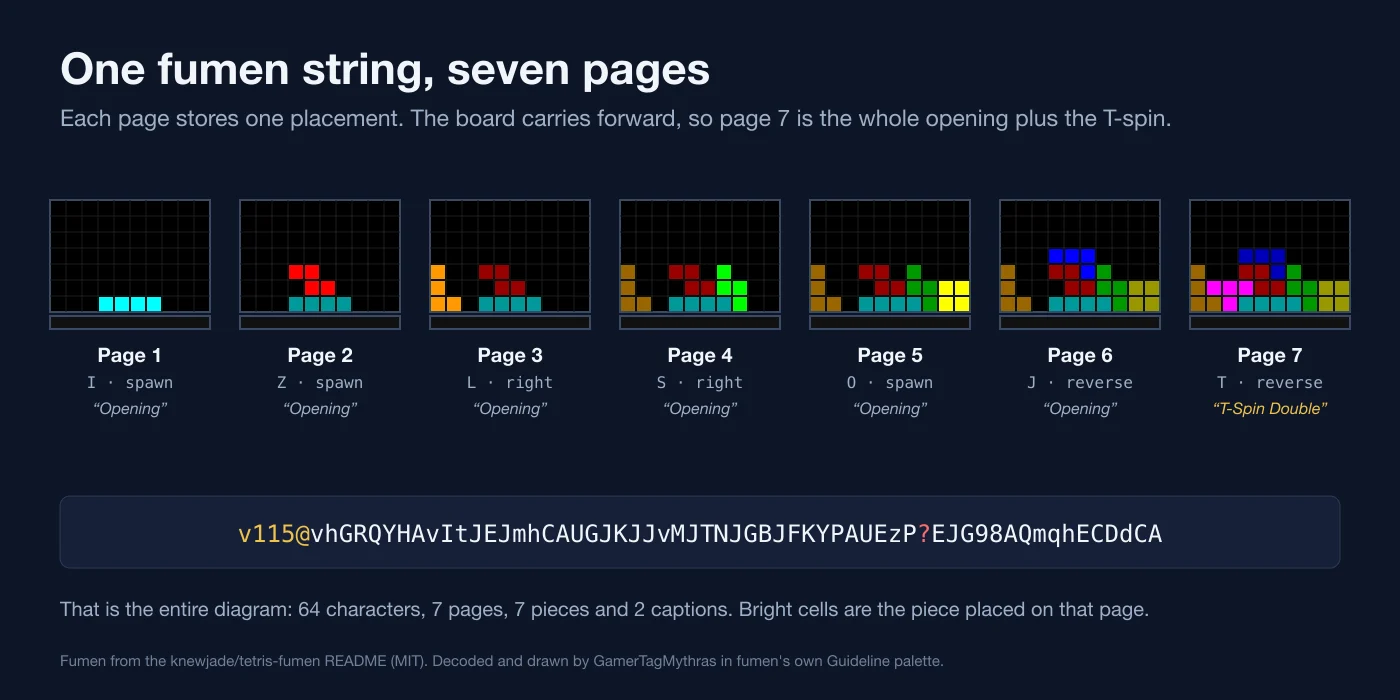
The v115@ string attached to Tetris setups is a whole multi-page board packed into a link. Here is what is inside it, which editor to open it in, what Lock, Rise and Mirror do, and where numbers like 84.64% come from.

Tetris Stacking Fundamentals: Build a Board That Wins
Most players do not lose to speed. They lose to a board they built themselves three minutes earlier. Here is how stacking actually works in modern Guideline Tetris, and the habits that stop you from burying your own well.

TGM4 Absolute Eye Modes Explained: Where to Start
Arika's first Grand Master in twenty years is not one game. It is six modes, four unlockable variants behind Normal, two control types that change the randomizer, and a 2,600-level Master mode that freezes your own stack. Here is what each one asks and where to start.