TGM4 Absolute Eye Modes Explained: Where to Start
Arika's first Grand Master in twenty years is not one game. It is six modes, four unlockable variants behind Normal, two control types that change the randomizer, and a 2,600-level Master mode that freezes your own stack. Here is what each one asks and where to start.
Arika's own website lists six modes for Tetris The Grand Master 4 -Absolute Eye-: MARATHON, NORMAL, ASUKA, MASTER, KONOHA and SHIRANUI. Normal is the one built to feel like the 1998 arcade original our Grand Master explainer takes apart, and it now hides four more modes behind it. Master borrows from T.A. Death and Shirase and then keeps going to level 2,600 while freezing your own stack. The rest is a 20G mode with an undo button, an All Clear puzzle mode with an illustration gallery, and a CPU ladder that runs past tier 100.
That explainer covers the series from 1998 to 2005 and gives TGM4 one paragraph. This is the rest: what each mode asks, what it grades, what unlocks behind it, and what the patches and the Switch port changed. Mode rules come from Arika's manual and site, tetris.wiki's TGM4 page, and Arika's own Steam patch notes through Ver. 2.3.0.0 of 12 August 2026. For price and platform next to every other Tetris, see which Tetris to play.
Pick a control type before you pick a mode
Arcade Mode asks for an operation type before it asks for a mode, and the choice changes more than the rotation.
| STANDARD | TGM | |
|---|---|---|
| Rotation | Super Rotation System, Guideline controls | Arika Rotation System with extended wall kicks |
| Drop buttons | Hard drop locks instantly; soft drop does not | Sonic drop (you can still slide and rotate after it) and soft lock; hold EXTRA to turn them into hard drop and soft drop |
| Randomizer | 7-bag that never deals S, Z or O first, labelled 7BS in game | IRM, a history-based randomizer like earlier TGM games |
| T-spin rewards | T-spin Doubles and Triples earn Master's T-SPIN medal; a T-spin Triple earns an Asuka Kita | Neither |
| Title colour | Silver | Bronze, and gold once you hold a title in both types |
The manual steers anyone who has not played much TGM toward Standard. Two exceptions to the randomizer row: Konoha always deals from IRM and Shiranui always deals from 7-bag, whichever type you pick, per tetris.wiki's randomizer page. Our randomizers guide covers how history rolls and bags differ.
The split used to be baked into the menu. Until Ver. 2.1.0 on 4 February 2026, Marathon and its Sprint and Ultra variants were Standard-only and Normal and its variants were TGM-only. That patch opened both families to both types, so a guide or video older than February 2026 is describing a menu you no longer have.
Two engine rules apply across the game, per tetris.wiki:
- 180-degree rotation is two 90s on one frame. Press two rotation buttons of the same direction together. Both quarter-turns have to succeed, so a 180 that needs a kick halfway can fail.
- Lock resets are capped at 8 moves and 2 rotations per piece. Hit either cap and the piece switches to step reset instead of locking outright. In TGM Type, falling a row restores both counters; in Standard it does not. Asuka has no cap at all, and Master and TGM Type's 4.1 use modified limits.
All six modes on one screen
| Mode | What Arika's manual says it is | Speed | Where it ends | Top title |
|---|---|---|---|---|
| Marathon (plus Sprint and Ultra) | Score attack in normal Tetris | Climbs level by level to about 2.4G at level 15 | 150 lines (Sprint: 40 lines; Ultra: 3 minutes) | None, score only |
| Normal | Race the clock to level 999 | The TGM1 curve, 20G from level 500 | Level 999 and a credit roll | Ten of Ten; GM grades in the unlockable variants |
| Asuka | Level as high as you can within the time limit, with rewind and infinity | 20G; Easy ramps up and reaches 20G at level 800 | Level 1,300 (Easy: 1,000) | ASUKA-MASTER; ASUKA GRAND-MASTER in Hard |
| Master | Every skill tested, top speed from the start | 20G from level 0 | Level 2,600 | GRAND-MASTER!, then Rounds and King of Rounds |
| Konoha | Big minos; each All Clear releases an illustration | Constant in Easy, rising in Hard | Top-out or time out; Easy also ends at 110 All Clears | KONOHA-MASTER for 110+ All Clears in Hard |
| Shiranui | Versus against CPU tiers you unlock by winning | Its own versus timings | Beating tier 101 | SHIRANUI-MASTER |
Marathon is the one mode with no grade. Every other mode has at least one title to earn, and earned titles show on the mode-select screen.
Big clears move the level counter further
How many levels a line clear is worth depends on the mode, per tetris.wiki:
| Line clear | Normal, Asuka, Master, 4.1 | Shiranui, 1.1, 2.1 | 3.1 | Konoha |
|---|---|---|---|---|
| Single | +1 | +1 | +1 | +2 |
| Double | +2 | +2 | +2 | +4 |
| Triple | +3 | +3 | +4 | +6 |
| Tetris | +6 | +4 | +6 | +12 |
In Normal, Asuka and Master a Tetris is worth +6 levels against +3 for a Triple: one more line cleared, double the credit. 3.1 keeps Terror-Instinct's exact table from our TGM explainer, +4 for a Triple and +6 for a Tetris. Konoha doubles everything. Master adds a second layer on top through medals, covered below.
Normal is TGM1 with a two-number grade
Normal is a 999-level time attack whose gravity follows the 1998 original's curve: the drop back to a crawl at level 200, then 20G from level 500. The TGM explainer has that table; the gravity and lock delay guide covers what 20G does to your hands.
What is new is the grade. Normal does not print a letter. It prints A of B, each a word from Zero to Ten.
- B is how far you got. It steps up every 111 levels (Eight covers 888 to 998), Nine means you topped out during the credit roll, and Ten means you cleared it.
- A is how well you got there. It rises for each section you clear with at least 1,000 points of section score, with levels 0 to 199 counting as one section, plus one more for an overall score target.
Because the two are counted separately, you can finish Ten of Nine: every quality check passed, and a top-out in the roll. Arika changed how Normal evaluates titles in Ver. 1.7.0 (22 July 2025), so grades from launch-era videos were earned under different rules.
Normal hides four more modes
Ver. 1.8.0 (5 September 2025) added a chain of variants behind Normal, reached by pressing right on the Normal tile. Each unlocks from progress in the one before it, and unlocks are tracked separately for Standard and TGM.
| Mode | Unlocks when | Modelled on | The twist | Top grade |
|---|---|---|---|---|
| 1.1 | You reach 999 in Normal | TGM (1998) | Grade is pure score | GM: 280,000 points under 8:55, then 6 Tetrises in the roll |
| 2.1 | You clear 1.1 | TAP's T.A. Death | 20G throughout; reach level 500 by 3:20 or the run ends there | Gm: 260,000 points under 5:00, then 8 Tetrises in the roll |
| 3.1 | You reach level 500 in 2.1 | Ti's Shirase | Runs to 2,000; cutoffs at 1,000 (4:01), 1,300 (4:30) and 2,000 (6:46); rising garbage; monochrome blocks from 1,000 | GM: level 2,000 under 6:46, then 21 roll points |
| 4.1 | GM in all three | Nothing earlier | 999 levels at a fixed 20G; an invisible roll with rising garbage | GM³ |
In 3.1, Triples, Tetrises and All Clears are each worth one roll point, and the roll itself is a 55-second 20G run with big pieces. tetris.wiki's 4.1 matches the hidden mode Arika added in Ver. 2.1.0: the Ver. 2.1.1 notes call that mode survival-focused and make its hold and preview settings follow your Options, and tetris.wiki records 4.1 launching with one preview and no hold before that change.
Asuka: 20G with an undo button
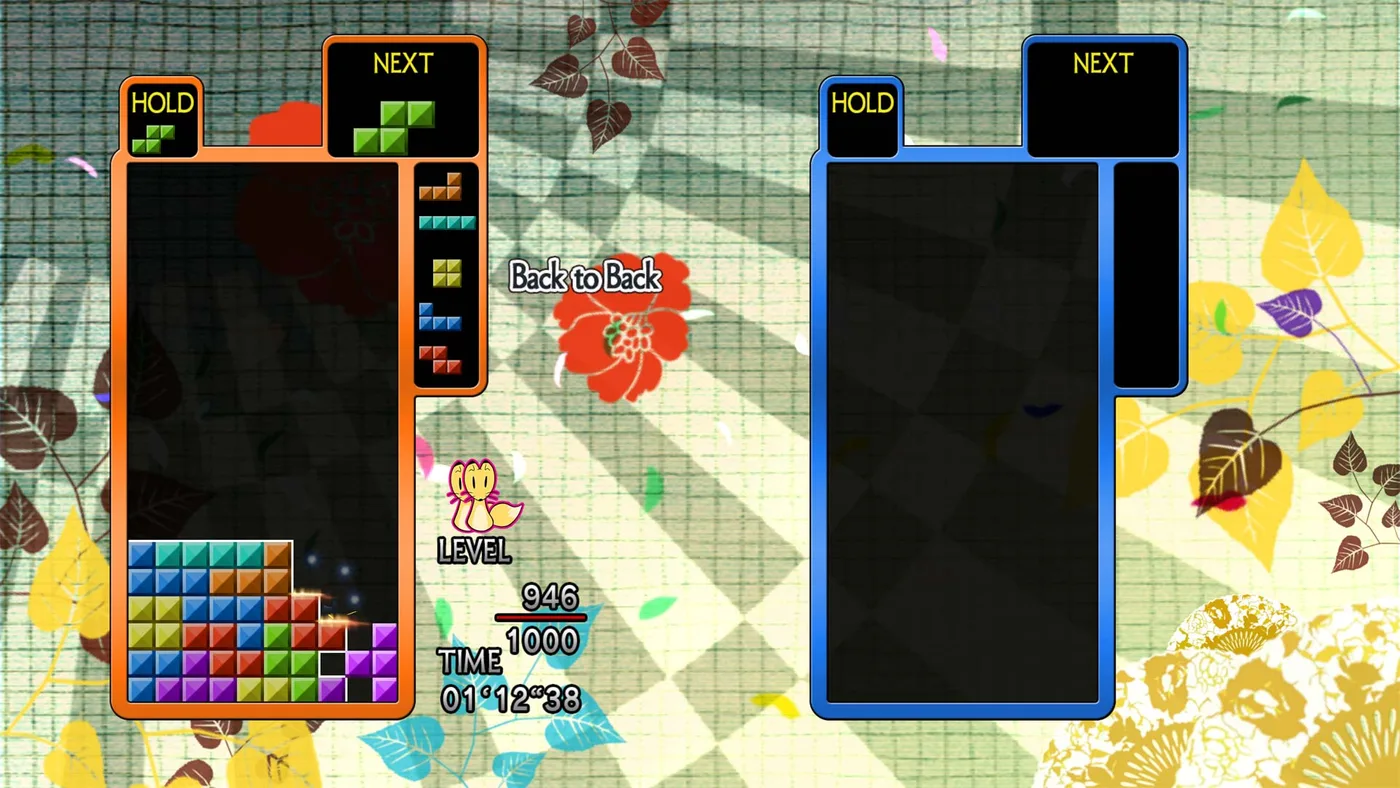
Arika's manual pitches Asuka at intermediate to advanced players and names two functions no other TGM4 mode has. Back Step rewinds a piece to the moment it appeared so you can place it again. Infinity lets a landed piece keep moving for as long as you keep moving or rotating it. tetris.wiki adds the limits: you can rewind as many times as you like and several pieces at once, but never back into the previous section.
The catch is the Kita. To pass each section's level stop you need at least one, earned with a Tetris, a T-spin Triple (Standard only) or an All Clear, which earns a bigger one. Without it, the clear that should carry you over the stop does not, and the fox above your level counter falls over.
From level 1,000 the Vanish phase starts: newly placed pieces fade out, and from 1,200 they disappear the moment they land. Pieces placed before 1,000 stay visible. Finish all 1,300 levels for ASUKA-MASTER.
Ver. 1.6.0 (2 July 2025) split Asuka three ways:
- Easy runs 1,000 levels with a 30-minute limit and no Vanish phase, on a slower curve that only reaches 20G at level 800. Its grade, Ae plus a number, rewards Kitas and subtracts Back Steps, and tetris.wiki's formula pays out per three Kitas in a section, so count in threes.
- Normal is the original 1,300-level mode.
- Hard needs the ASUKA-MASTER title, runs on a 4:30 limit, and turns Kitas into a currency that carries across sections and gets spent to clear them. Finishing it earns ASUKA GRAND-MASTER.
Arika's own development chat of 27 June 2025 went further and called Asuka Easy "easier" than the separate NORMAL mode. With rewind, infinity and a ramp that holds off 20G until level 800, it is a gentler way into 20G than Normal, which hits 20G at level 500 with no rewind, or Master, which starts there.
Master: 2,600 levels, and your stack turns on you
The manual's pitch is one line: every skill tested, and pieces fall at top speed from the start. Master runs 20G from level 0 and does not stop at 999.
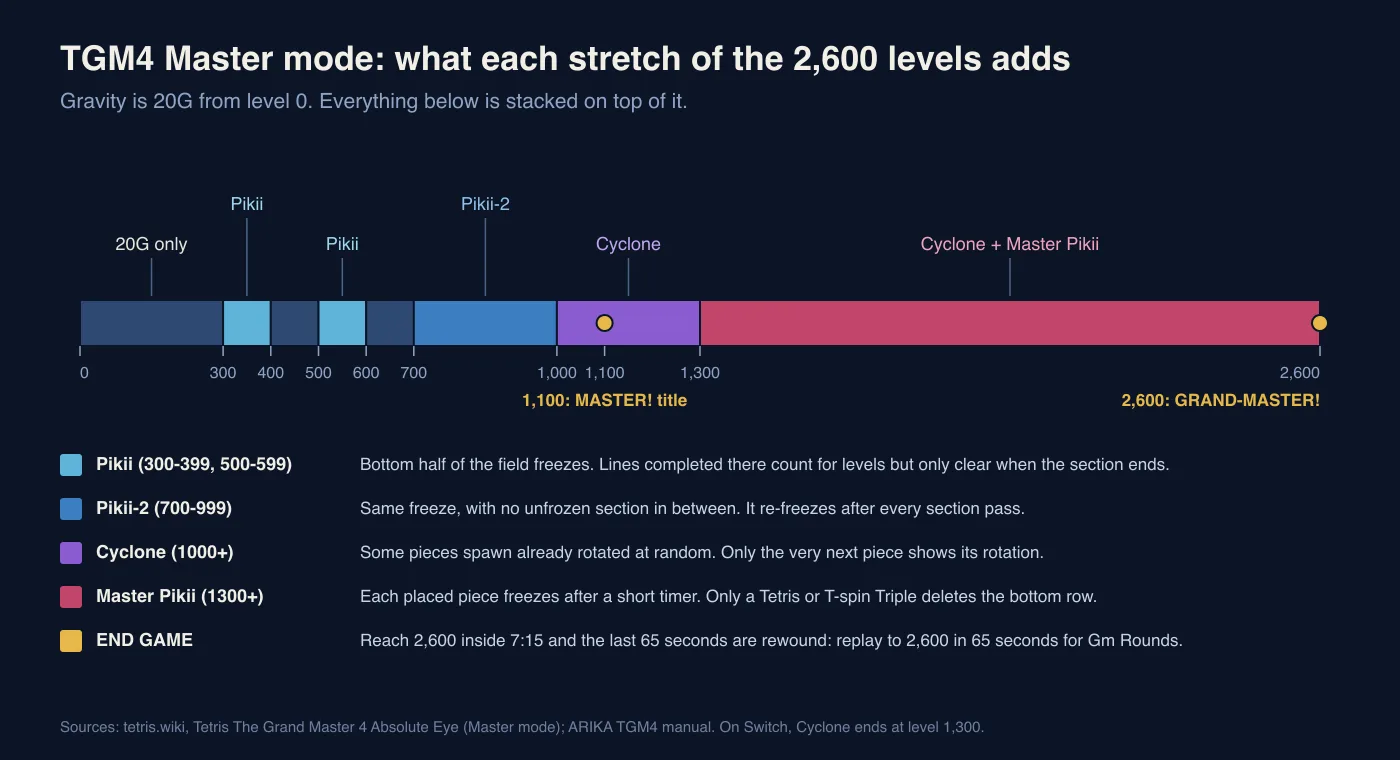
- Levels 0 to 299 are plain 20G.
- Pikii (300 to 399, 500 to 599) freezes the bottom half of the field. Lines you complete there count toward your level but stay on the board until the section ends.
- Pikii-2 (700 to 999) is the same freeze with no unfrozen section in between; it re-freezes after every section pass.
- Cyclone (1,000 onward) spawns some pieces already rotated at random, and only the very next piece shows its rotation. Since Ver. 1.1.0 the Mino Axis Display is forced on from level 1,000 to help you read it. Reaching 1,100 awards the MASTER! title.
- Master Pikii (1,300 onward) freezes every placed piece after a short timer. Frozen minos survive line clears. Per tetris.wiki, the only way to remove them is a Tetris or a T-spin Triple, which also deletes the bottom row.
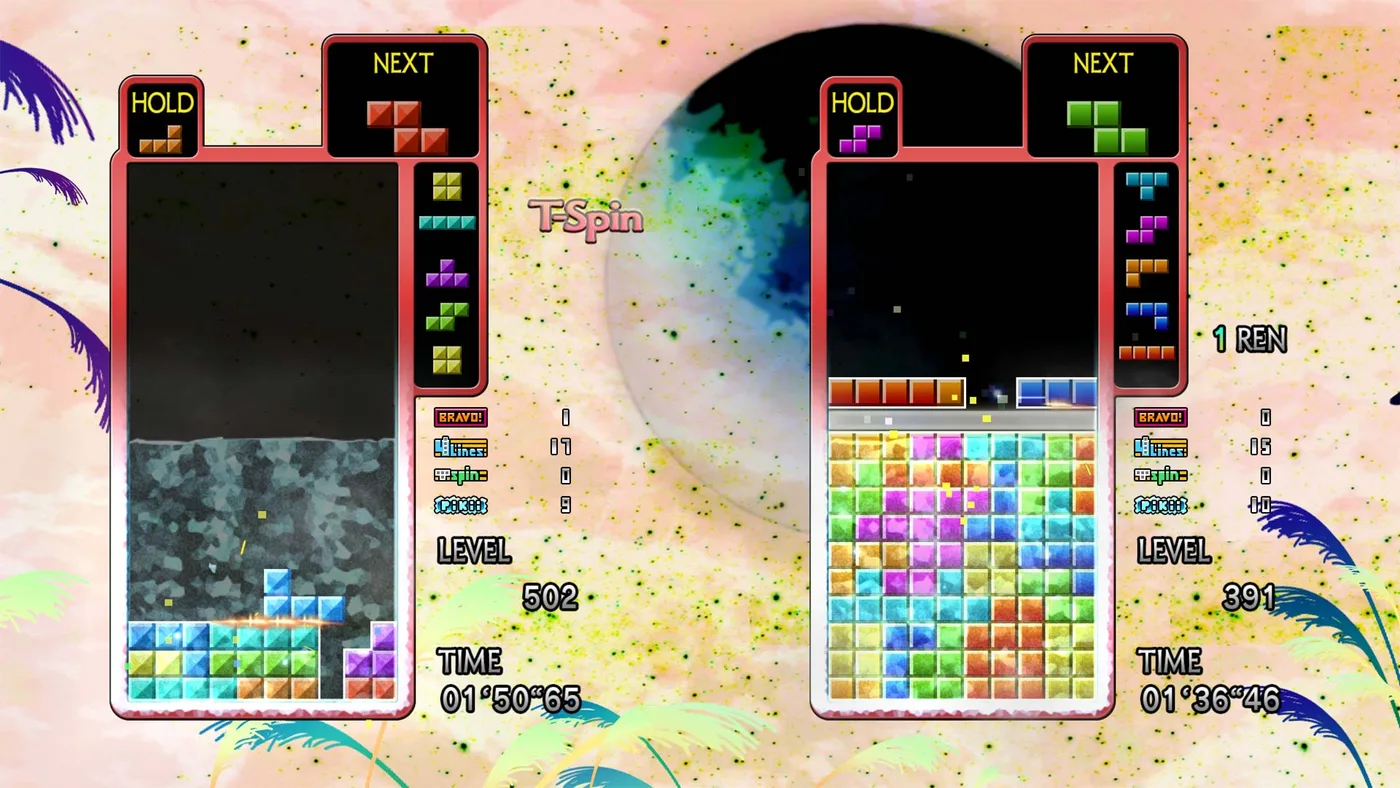
Medals are what make the second half survivable. The manual lists four, and tetris.wiki documents what each one buys:
| Medal | Earned by | Extra levels per clear | Master Pikii freeze time added |
|---|---|---|---|
| ALL CLEAR | An All Clear | +1 for every 6 medals | 2.5 frames per medal, rounded down |
| TETRIS | A Tetris | +1 for every 10 medals | 1 frame per medal |
| T-SPIN | A T-spin Double or Triple (Standard) | +1 for every 16 medals | 1 frame per medal |
| PIKII | A line cleared in the frozen area, from level 300 | +1 for every 28 medals | 3 frames per medal |
The freeze timer starts at just 2 frames, so every medal you bank before level 1,300 is extra time to place pieces once Master Pikii starts.
The finish has two layers. Reach 2,600 at any pace and you get GRAND-MASTER!. Reach it inside 7:15 and the END GAME starts: the game rewinds the last 65 seconds, unfreezes the field, and gives you 65 seconds to climb back to 2,600 on a different piece sequence. Make it for GRAND-MASTER! Rounds; get rewound below level 1,300 and still make it for King of Rounds.
tetris.wiki's list of Absolute-Eye masters gives the first verified 2,600 clears to Kirby703 on Standard (8 May 2025) and Yoshi100_Aus on TGM (12 May 2025). Ver. 1.4.0 shipped that same 12 May and dropped the requirement that the clear into 2,600 use only standard, unfrozen blocks.
Konoha: All Clears with big pieces
Konoha plays with big minos, and each All Clear gradually unlocks an illustration you can view later in the gallery. The manual's rules are short: an All Clear Guide shows placements at the start, the game ends when the stack reaches the top or the timer runs out, and clearing lines buys time back.
The numbers, per tetris.wiki:
| Clear | Time added |
|---|---|
| Single All Clear | 5 seconds |
| Double All Clear | 8 seconds |
| Triple All Clear | 11 seconds |
| Tetris All Clear | 15 seconds |
| Plain Tetris | 11 frames |
The clock starts at 2:00 on Standard and 4:10 on TGM and caps at 5:00. Past level 1,000 only Tetrises and Tetris All Clears add time, one second each.
Easy deals only L, J, I, T and O, never changes speed, ends at 110 All Clears, and only reaches the first 37 illustrations. Hard uses all seven pieces and runs until time runs out; 110 or more All Clears earns KONOHA-MASTER. The placement assist is on by default, costs nothing, and switches itself off after the 25th All Clear in a run. The fox's All Clear hints are not error-free and can miss one, so do not treat a missing hint as proof there is none. If flat-board All Clears are your weak spot, the perfect clear guide is the normal-sized version of the same skill.
Shiranui: a CPU ladder instead of an online lobby
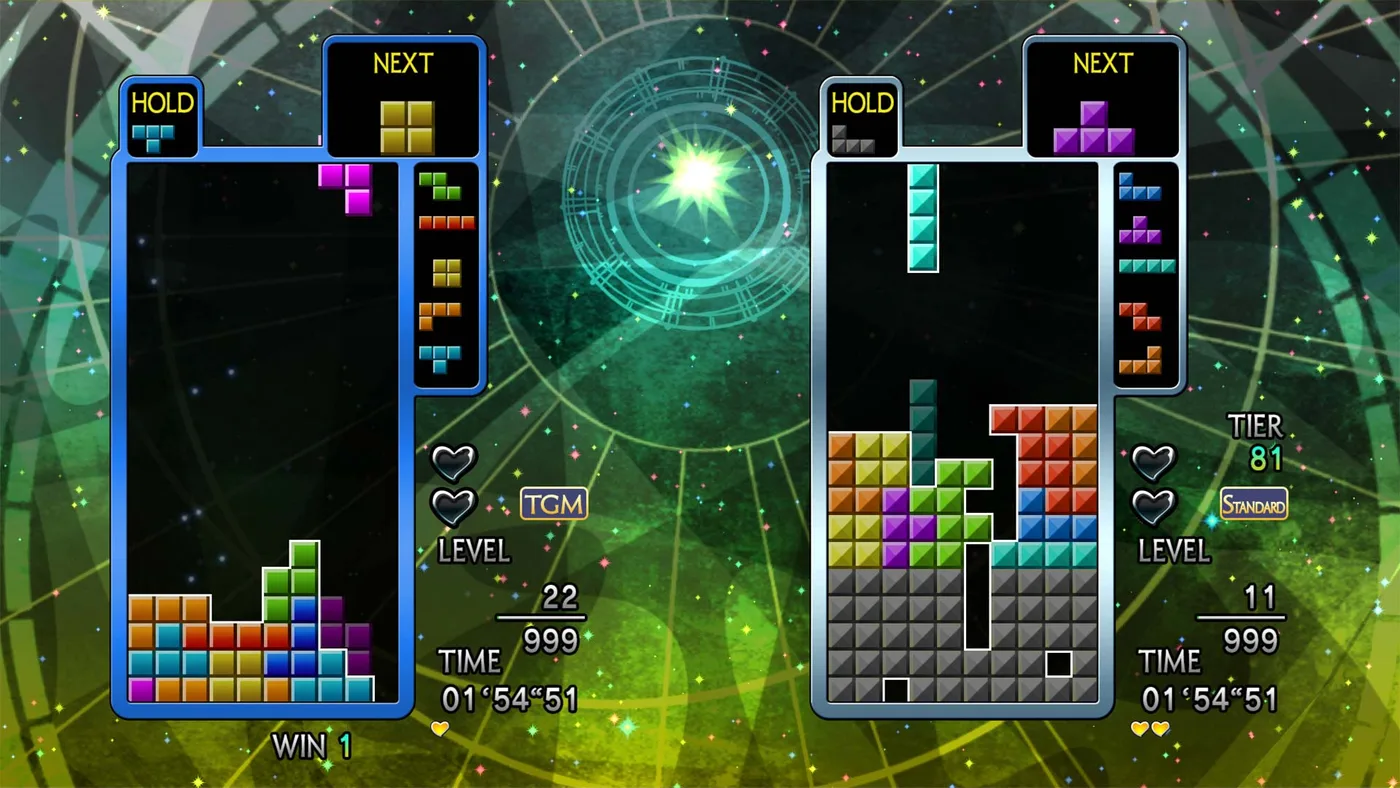
TGM4 has no online versus. Arika's site says players compete in local play, and Steam lists shared or split-screen PvP and Remote Play Together, not online PvP. Shiranui is the single-player answer.
Matches are best of three with two-minute rounds. You win a round by topping the CPU out, by having more levels when time expires, or by reaching level 999 first. The manual says tiers 1 to 5 are open at the start and wins unlock more. Per tetris.wiki, each win earns stars, the highest tier you unlock is the tier you beat plus your stars, and that scheme caps at 100. Beating tier 101 earns SHIRANUI-MASTER, and tiers 102 to 104, added in Ver. 1.1.3 (18 April 2025), are exhibition bouts under 20G, Konoha Hard and Konoha Easy settings. On Steam, tier 0 unlocks after 50 Shiranui games and is a bot trained on your own past games.
Ver. 2.1.2 (20 April 2026) eased the unlock conditions for tiers 101 to 104, and Arika's note said it is considering a downward difficulty adjustment after feedback that players feel they have no chance against the CPU's opening tempo.
Your control type changes the damage table, per tetris.wiki:
| Clear | Standard | TGM |
|---|---|---|
| Tetris | 4 | 5 |
| Back-to-back Tetris | 5 | 6 |
| T-spin Single | 2 | 2 |
| T-spin Double | 4 | 4 |
| T-spin Triple | 6 | Not available |
| Back-to-back T-spin | +1 line | No extra line, but the chain survives |
| All Clear | 10 | 10 |
Combos add the same amount under both types, topping out at +5 lines from an 11-combo. The trade is simple: TGM Type hits harder with Tetrises and gives up the T-spin Triple. Our openers guide covers what Standard Type's T-spin payoffs make possible from the first bag.
Practice, replays and local versus
Practice has three parts. Textbook walks through sample placements, T-spins and other movements, and in TGM Type shows how many frames you took. Game-mode practice loads any mode at a custom starting level with an optional Tetris Guide that suggests placements, set to favour Tetrises, T-spins, All Clears, survival or battle; those runs do not count for the rankings. Replay practice plays back saved runs, lets you replay under the same conditions, or races you against the replay on the 2P side.
Versus is local. A second player can press in during a solo run to start a challenge in whatever mode the first player picked, or you can open local versus from the menu, which runs at Shiranui's speed. Ver. 2.2.0.0 (17 June 2026) removed the Detailed Garbage Settings option from the versus settings screen.
What the Switch version changes
The Switch release landed on the Nintendo eShop on 4 June 2026 at 2,800 yen, per Gematsu's report of Arika's announcement. Arika's list of differences from Steam:
- Master difficulty adjusted, with some title names changed. tetris.wiki records the renamed grades as Grand-Master ns and notes that Cyclone ends at level 1,300 on Switch.
- Shiranui difficulty adjusted, again with renamed titles.
- CPU Level 0, the bot trained on your games, removed; Arika says this follows AI learning policy guidelines.
- Replay storage capped at about 16 MB, with in-menu deletion.
- One USB keyboard connection type, against six on Steam.
Steam changed too. Arika's 1 June 2026 notice set a revised price of 2,800 yen from after 4 June 2026, with overseas prices set per region. Steam's US price was $34.99 at launch, per an April 2025 archive of the store page, and it is $24.99 as of 28 September 2026.
The patches that moved the modes
TGM4 launched on Steam on 4 April 2025, and Arika has posted 37 patch notices on its Steam page since, from Ver. 1.0.2 on launch day to Ver. 2.3.0.0. tetris.wiki describes a mostly negative launch reception over bugs and missing keyboard remapping; on 28 September 2026 Steam's all-language summary reads Very Positive, 568 of 645 reviews. These are the patches that changed what the modes are, dated by Arika's Steam announcements:
| Date | Version | What changed |
|---|---|---|
| 11 Apr 2025 | 1.1.0 | Keyboard key binding; Mino Axis Display option, forced on after level 1,000 in Master |
| 18 Apr 2025 | 1.1.3 | Shiranui exhibition tiers 102 to 104 |
| 30 Apr 2025 | 1.2.0 | Master difficulty adjusted |
| 12 May 2025 | 1.4.0 | Master can reach 2,600 without the final clear using only standard blocks |
| 15 May 2025 | 1.4.1 | Marathon music changed to the officially mandated track |
| 2 Jul 2025 | 1.6.0 | Asuka Easy and Hard; a Konoha Easy category; Guideline revisions that changed versus attack power |
| 22 Jul 2025 | 1.7.0 | Sprint and Ultra under Marathon; every TGM-type mode except Konoha overhauled |
| 5 Sep 2025 | 1.8.0 | Normal's unlockable variants, starting with 1.1 |
| 4 Feb 2026 | 2.1.0 | Both control types on the Normal and Marathon families; hidden mode added |
| 20 Apr 2026 | 2.1.2 | Easier unlock conditions for Shiranui tiers 101 to 104 |
| 17 Jun 2026 | 2.2.0.0 | Versus Detailed Garbage Settings removed |
| 12 Aug 2026 | 2.3.0.0 | Audio rebalanced; an alternate sound-effect set |
Arika filed Ver. 1.4.1 as a Guideline compliance update, and tetris.wiki says The Tetris Company asked for it. The track is Korobeiniki, which our Guideline explainer covers as one of the Guideline's mandatory rules.
Two practical consequences. Replay compatibility broke at several of these versions, so an old replay may not load. And videos from before July 2025 show an Asuka with no Easy or Hard and a Marathon with no Sprint or Ultra.
Which mode to open first
This part is opinion, built on the rules above.
- New to 20G: Asuka Easy on Standard. Rewind, infinity and slower speeds mean a misdrop costs a button press and a little Ae grade instead of the run.
- Coming from TETR.IO or another Guideline client: Shiranui on Standard. It always deals from 7-bag, pays T-spins on Standard, and plays like ordinary Guideline versus, per tetris.wiki, so the skills you already have count from the first match. The which Tetris to play guide covers where TGM4 sits next to those clients.
- TGM veterans: Normal on TGM, then the 1.1 to 3.1 chain, which rebuilds the three arcade games' signature modes inside one menu.
- Master: after Asuka. The first 300 levels are plain 20G; from 300 on, bank medals, because the freeze timer at 1,300 starts at 2 frames.
- All Clear practice: Konoha Easy with the assist on, then Hard for the title.
Quick Action Checklist
- Choose Standard (SRS, hard drop, 7-bag, T-spin rewards) or TGM (ARS, sonic drop, history randomizer) before choosing a mode.
- Remember a 180 is two quarter-turns on one frame, and lock resets cap at 8 moves and 2 rotations before step reset.
- Build for Tetrises: in Normal, Asuka and Master a Tetris is +6 levels against +3 for a Triple.
- Read a Normal grade as A of B: A is section quality, B is progress, and Ten of Nine is possible.
- Unlock Normal 1.1, then 2.1, then 3.1 in each control type; GM in all three opens the hidden 4.1.
- In Asuka, earn a Kita every section with a Tetris, a T-spin Triple on Standard, or an All Clear, or the level stop will not open.
- In Master, bank medals before level 1,300, and aim for 2,600 inside 7:15 if you want the END GAME.
- In Konoha, chase multi-line All Clears: a Tetris All Clear adds 15 seconds.
- Climb Shiranui to tier 101 for SHIRANUI-MASTER; on Steam, tier 0 is a bot trained on your own games.
- On Switch, expect a retuned Master and Shiranui, no tier 0, and a 16 MB replay cap.
Frequently Asked Questions
What modes are in Tetris The Grand Master 4 Absolute Eye?
What is the difference between Standard Type and TGM Type in TGM4?
How do you get Grand Master in TGM4 Master mode?
What is Asuka mode in TGM4?
How do you unlock Normal 1.1, 2.1, 3.1 and 4.1 in TGM4?
Does TGM4 have online multiplayer?
What is different about TGM4 on Nintendo Switch?
Keep Reading
- ARIKA — TGM4 official site: the six game modes (Marathon, Normal, Asuka, Master, Konoha, Shiranui)
- ARIKA — TGM4 Steam manual: Standard vs TGM operation types, mode descriptions, Master medals, practice modes
- tetris.wiki — Tetris The Grand Master 4 Absolute Eye: rules, level advance, grades, mode mechanics and patch history
- tetris.wiki — TGM randomizer: 7BS in Standard, IRM in TGM Type, Konoha and Shiranui exceptions
- tetris.wiki — List of Absolute-Eye Masters: first Grand-Master and Rounds clears by date and version
- ARIKA on Steam — TGM4 patch notes Ver. 1.0.2 through 2.3.0.0, release-date and price-revision notices
- Gematsu — TGM4 Switch release date, price and Arika’s list of Switch-vs-Steam differences
- Steam — TGM4 store page: current price, player-mode categories and review summary
- Internet Archive — TGM4 Steam store page as captured 5 April 2025, showing the $34.99 launch price
Related Guides
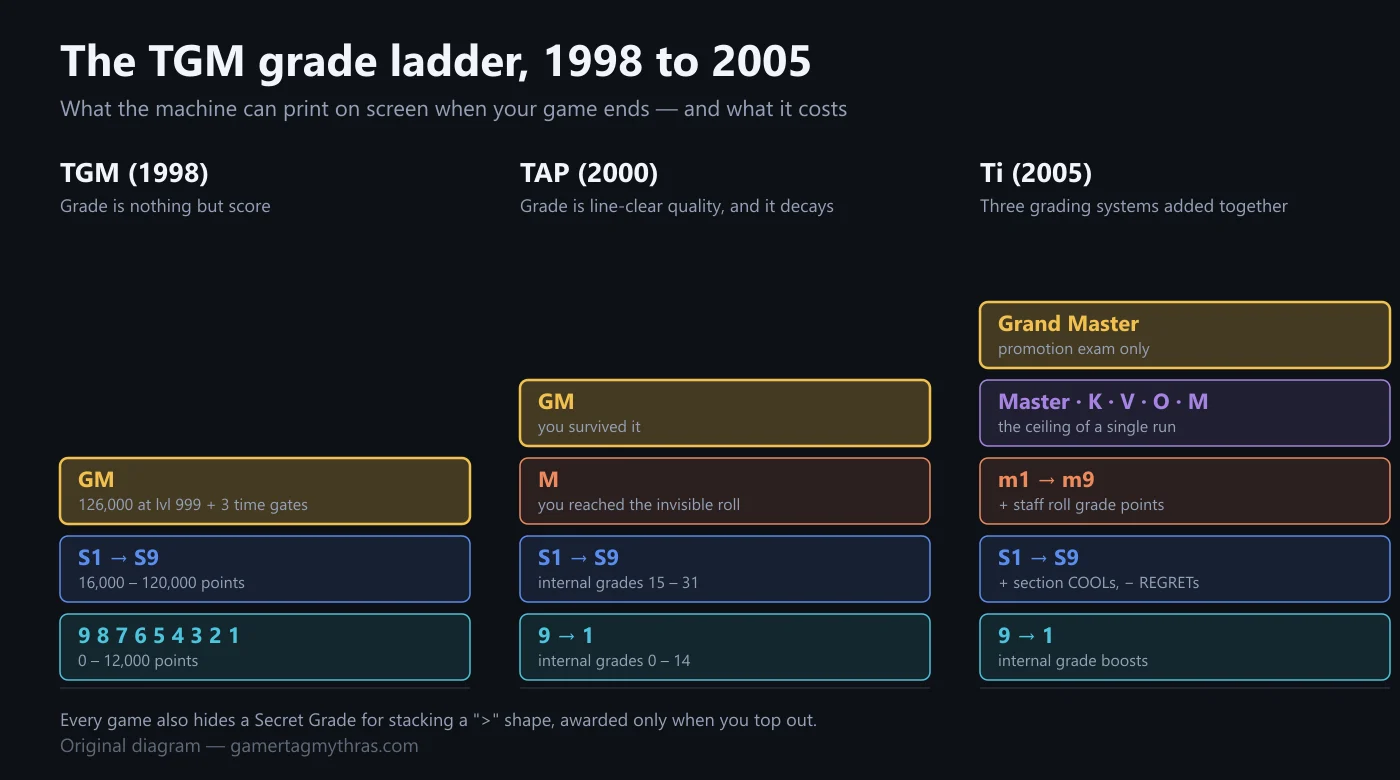
Tetris The Grand Master Explained: 20G, the Grade Ladder, and the Invisible Roll
Most Tetris games ask you to survive. Arika's ask you to justify yourself. Here is how the TGM series actually grades a run — the piece-counted level, the 20G cliff at level 500, TAP's decaying grade points, and the promotion exam standing between Ti players and Grand Master.
Tetris Gravity and Lock Delay Explained: The Speed Curve, the 15-Move Limit, and 20G
Every modern Tetris game runs on three clocks you never see: gravity, lock delay, and entry delay. All three are published numbers, and they explain exactly why level 15 feels like a different game than level 5.
Tetris DX Explained: How It Differs From Game Boy Tetris
Tetris DX keeps the 1989 Game Boy well and points table but changes how pieces move: a second rotation center that lets pieces climb walls, auto shift every 3 frames, a randomizer that deals the T about 24% of the time, and a seven-digit score.
Game Boy Tetris Explained: How It Differs From NES
Game Boy Tetris and NES Tetris share a points table, but the handheld game stops speeding up at level 20, pays a level-up Tetris at the old rate, deals the L about 10.7% of the time, and makes a held direction wait 23 frames.
Tetris Stacking Fundamentals: Build a Board That Wins
Most players do not lose to speed. They lose to a board they built themselves three minutes earlier. Here is how stacking actually works in modern Guideline Tetris, and the habits that stop you from burying your own well.
Tetris Fumen Explained: Read, Make and Share Diagrams
The v115@ string attached to Tetris setups is a whole multi-page board packed into a link. Here is what is inside it, which editor to open it in, what Lock, Rise and Mirror do, and where numbers like 84.64% come from.