Tetris 40-Line Sprint: How to Actually Get Faster
You finished a clean run and the clock still said 48 seconds. The gap between you and a sub-30 sprint is not talent — it is two measurable numbers, and both of them are trainable. Here is exactly what to work on.
You finished a clean run — no holes, four fat Tetrises, felt smooth — and the clock said 48 seconds. Meanwhile someone on TETR.IO just posted 22 and looked bored doing it. The gap is not reflexes and it is not talent. It comes down to two numbers you can measure and train, and almost nobody working on their sprint actually separates them in their head.
This guide is about 40 Lines, the sprint mode where you clear exactly 40 lines as fast as possible. It is the standard speed benchmark across TETR.IO, Jstris, Tetris Effect, Puyo Puyo Tetris, and NullpoMino, and it is the single best mode for turning raw play into a hard, comparable number. One detail people miss: in TETR.IO and Jstris the clock does not start when the level loads — it starts on your first input. You get to breathe, read your opening queue, and plan the first few placements before the timer moves. Wasting that free look is the first mistake.
Sprint rewards two things: speed and efficiency
Your finish time is basically one equation: pieces placed, divided by how fast you place them.
- Speed is your PPS — pieces per second. This is your raw hand speed plus how quickly you make decisions.
- Efficiency is how few pieces it takes you to clear 40 lines. Fewer wasted placements, fewer wasted keypresses per piece.
You can be fast and inefficient, and you will hit a wall. You can be efficient and slow, and you will hit a different wall. The players posting sub-25s times are strong at both, but the important part for you is that improving one does not require the other. On a bad hand day you can still grind efficiency. When your reads feel sharp you can push PPS. Knowing which one you are working on is half the battle.
A rough sense of the math: if you place the theoretical minimum number of pieces, your time in seconds is close to that piece count divided by your PPS. At 5 PPS that is around 20 seconds. At 3.3 PPS, about 30. At 1.7 PPS, right around a minute. The world record run sat near 7.5 PPS. Those are not different techniques — they are the same technique at different clock speeds.
What counts as a good 40-line time
Times get thrown around with zero context, so here is an honest ladder for modern Guideline sprint:
- Beginner: around 1:20. You are placing pieces safely but reacting to one piece at a time.
- Intermediate: about 30 seconds. You read the queue, keep the board flat, and rarely make holes.
- Experienced: roughly 25 seconds. Clean finesse, planned openings, comfortable at speed.
- Advanced / pro: around 20 seconds and under.
- World record tier: 40 lines in 13.430 seconds, set on TETR.IO by WestL at roughly 7.52 PPS with 100% finesse and only 101 pieces placed.
If you are sitting at 45–60 seconds, you are not "bad," you are just leaving efficiency on the floor. That is the good news, because efficiency is the cheaper number to fix.
The 100-piece rule
Here is the fact that reframes the whole mode: clearing 40 lines takes a minimum of 100 pieces. Do the arithmetic — 40 lines times 10 columns is 400 filled cells, and every tetromino fills exactly 4 cells, so 400 divided by 4 is 100. There is no way to do it in fewer.

That number is a ruler. WestL's record run used 101 pieces — one placement of overhead across the entire game. If your runs are eating 115, 120, 130 pieces, that surplus is pure wasted time no matter how fast your hands are. Every hole you dig, every S piece you jam somewhere ugly, every line you clear as a Single when a clean stack was right there — each of those is a piece you paid for and got nothing back.

So the first efficiency lever is simply: do not make holes, and do not create terrain your next pieces cannot fill. If you are shaky on that, the surface-reading habits in our Tetris stacking fundamentals guide are the prerequisite for everything here — sprint is just stacking fundamentals executed under a clock. Get your average piece count near 105 before you worry about your hands at all.
Finesse is not optional here
The second efficiency lever is keys per piece, or KPP — the average number of button presses you spend placing one piece. Finesse is the discipline of placing every piece in the fewest possible inputs, and in sprint it is not a nicety, it is the mechanism.
A good KPP target for sprint is 3.0. The best players get under 2.6. The difference between 3.0 and 4.5 KPP does not sound like much until you multiply by 100-plus pieces — that is well over a hundred extra keypresses across a run that lasts under a minute. Your fingers physically cannot do that in time.
The rule most sprint players learn the hard way is that perfect finesse is basically a requirement for low KPP. You cannot spam-tap a piece into position three times and still be efficient. If your finesse is loose, that is the highest-leverage thing you can fix, and it deserves its own dedicated practice — our Tetris finesse guide breaks down the two-input rule and the specific muscle-memory drills. Aim to keep your finesse faults under 15 across a full 40-line run; if you are faulting more than that, your hands are working against your stack.
One thing worth saying plainly: hold less. Every hold is at least one extra input, and beginners lean on it as a "I do not know where this goes" button. In sprint, if you are holding to defer a decision instead of to execute a plan, you are paying KPP for indecision.
Stacking style: 9-0 versus 6-3
There are two mainstream ways to arrange your board for speed, and the choice is real.
9-0 stacking keeps nine columns flat and level with a single empty well on the far edge — usually the right. It is the easier style to keep clean and to read, which is why most players learn it first, and it is the same structure you use to farm Tetrises everywhere else. The cost is that an edge well means your pieces travel the full width of the board, so you lean harder on your auto-shift to slide them over.
6-3 stacking puts the well roughly a third of the way in, splitting the field into a six-wide side and a three-wide side. That keeps the well much closer to where pieces spawn in the center, so pieces travel shorter distances and you spend fewer inputs and less auto-shift getting them home. That is exactly why the record run used a 6-3 approach with careful auto-shift preservation. The catch is that 6-3 is harder to keep tidy — you are managing two stacking zones instead of one clean field.

The honest recommendation: learn to run a clean 9-0 first. It removes variables while you build finesse and board reading. Move to 6-3 only once your 9-0 sprints are consistently clean and you have specifically hit a PPS ceiling you can trace to travel distance. Switching early just means being sloppy in a harder style.
Tuning handling: DAS and ARR
Handling is how the game translates a held direction into piece movement, and two settings dominate.
- DAS (Delayed Auto Shift) is the pause between pressing a direction and the piece beginning to auto-repeat across the board. Lower DAS means the slide kicks in sooner.
- ARR (Auto Repeat Rate) is how fast the piece moves once DAS has triggered. Lower ARR means it crosses the board faster; an ARR of 0 makes the piece effectively teleport to the wall or the next obstacle.
Most fast players run their ARR very low or at 0 and tune DAS down into a comfortable range. But do not just crank both to zero and expect magic — an ARR of 0 with reads that are not ready yet causes constant overshoot, where the piece slams past the column you wanted. Handling is personal calibration, not a copied config. Lower it in small steps, and only drop it further once your current setting feels effortless and accurate. The point of good handling is to remove input friction, not to outrun your own eyes.
A note on soft drop: in sprint you should be hard-dropping almost everything. Soft drop is for the rare piece you are threading into a specific slot. If you are riding soft drop to place flat pieces, that is time and inputs you are simply giving away — and it is the opposite of what T-spin setups train you to do, which is worth flagging because T-spins are a versus-mode scoring and attack tool, not a sprint tactic. In a 40-line race you want boring, flat, hard-dropped clears, not clever spins.
Skip the memorized opener
There is a temptation to memorize a hand-optimized opening sequence and replay it every game. Resist it. A 7-bag start can arrive in 5,040 different orders — that is 7 factorial, the number of ways to shuffle seven distinct pieces — and a memorized opener only helps on the small fraction of runs where your exact bag shows up. The rest of the time you are trying to force a plan the pieces do not support, which makes holes.
What actually transfers is general adaptability: the ability to look at any opening queue and build a fast, flat start on the fly. Reading the whole next queue — not the next piece, the whole queue — and planning two or three placements ahead is the skill that survives every bag. Openers are a garnish you add much later, once your fundamentals hold at speed. Build the reactions first.
Drills that shave real seconds
Deliberate practice beats mashing restart. In rough priority order:
- Piece-count sprint. Run 40 lines and ignore the clock entirely — just check your final piece count. Goal is to get consistently under 108, then under 104. This trains efficiency directly, which is your cheapest speed.
- Finesse-fault sprint. Run with your fault counter visible and try to finish a full 40 under 15 faults — the fault-free input patterns in the Tetris finesse guide are what you are drilling into muscle memory here. If your client shows KPP, chase 3.0.
- Metronome PPS. Pick a PPS just above your comfort zone and force yourself to place a piece on every beat. It feels reckless at first; it is how you raise your speed ceiling without your hands defaulting to their old pace.
- Same-well discipline. Run whole games keeping the well locked to one column so your placement pattern recognition gets column-specific and automatic.
Rotate through these instead of grinding full-speed runs and hoping the number drops. Full-speed runs measure your sprint; the drills are what change it. You can find the rest of our Tetris coverage on the Tetris hub.
Quick Action Checklist
- Use the free look before your first input — the sprint clock does not start until you move.
- Track two numbers, not one: your PPS (speed) and your piece count (efficiency).
- Chase a piece count near 100 first; surplus pieces are wasted time your hands cannot outrun.
- Never make a hole in a sprint — dig-outs blow your piece count instantly.
- Keep finesse faults under 15 and aim for 3.0 KPP or lower.
- Hold less; holding to defer a decision costs you inputs.
- Learn a clean 9-0 before you touch 6-3.
- Lower ARR and DAS in small steps, only when your current handling feels effortless.
- Hard-drop almost everything; save soft drop for real threading.
- Skip memorized openers and train reading the whole queue instead.
Frequently Asked Questions
What is a good 40-line sprint time?
Why does clearing 40 lines take at least 100 pieces?
Should I use hold in a sprint?
What DAS and ARR should I set for sprint?
Is 9-0 or 6-3 stacking better for sprint?
Should I do T-spins in a 40-line sprint?
Does the sprint timer start when the game loads?
Do I need to memorize an opener to go fast?
Keep Reading
Related Guides
TETR.IO Handling Settings Explained: DAS, ARR, SDF, DCD
TETR.IO gives you four handling numbers and explains none of them in the panel. One of them had its ceiling raised out from under a warning, and one is described differently by the two sources that document it. Here is the whole panel, with the version and date each behaviour arrived.
Tetris Finesse: Place Every Piece in Two Keypresses
Under SRS, every placement on the board is reachable in two keypresses before the drop. If you are spending five, you are not slow because of your hands — you are slow because of your habits.
NES Tetris Level Transition and Scoring Explained
Start NES Tetris on 18 and you stay there for 130 lines. Start on 19 and it is 140. Start on 12 and it is 100. One missing conversion in the cartridge explains all three, and it also decides which clear gets paid at the higher rate.
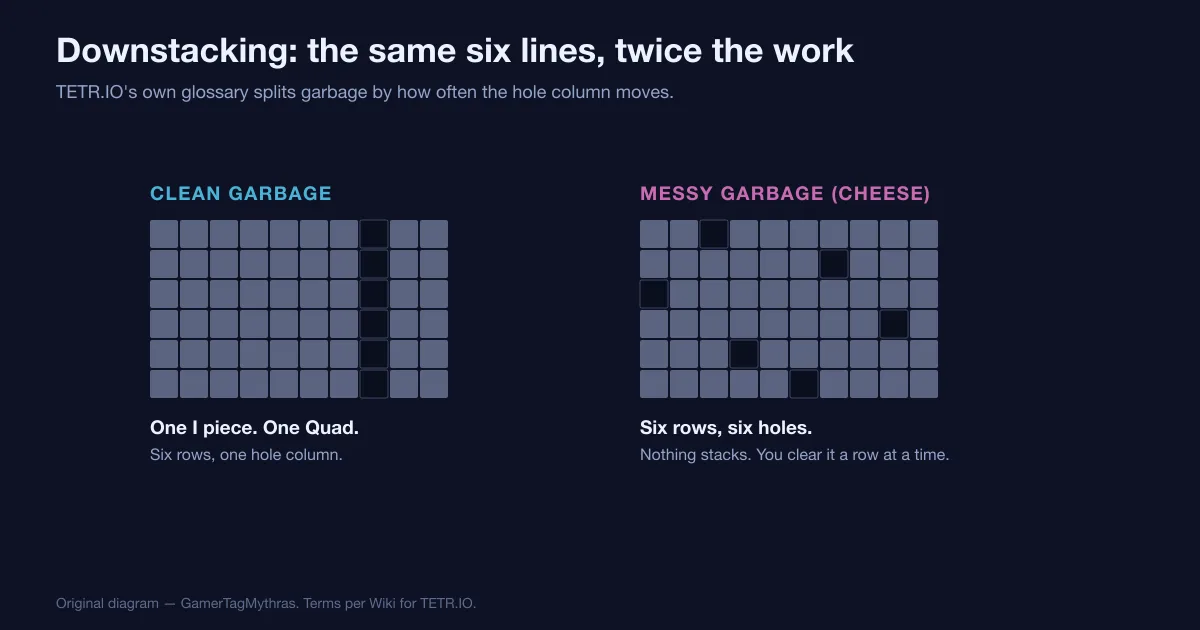
Tetris Downstacking: How to Dig Out of Garbage
Garbage is not one obstacle, it is two. Where the hole column sits from row to row decides whether six lines cost you one piece or six, and TETR.IO scores the lines you dig out at exactly the same rate as the lines you send.
Tetris Stacking Fundamentals: Build a Board That Wins
Most players do not lose to speed. They lose to a board they built themselves three minutes earlier. Here is how stacking actually works in modern Guideline Tetris, and the habits that stop you from burying your own well.
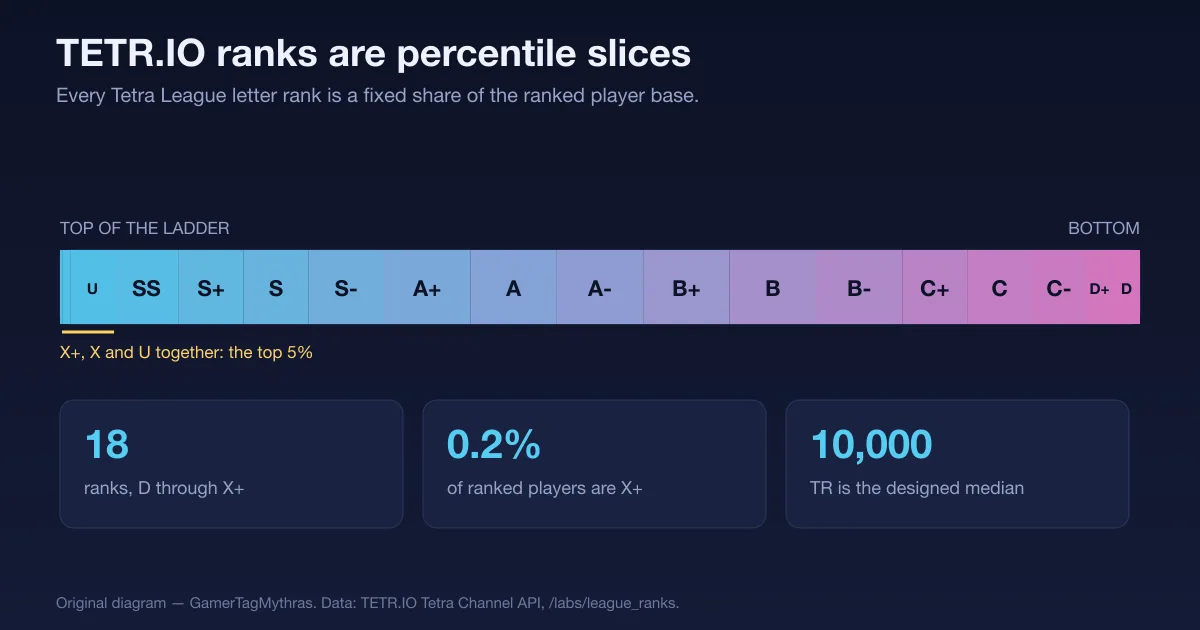
TETR.IO Ranks Explained: TR, Percentiles and Cutoffs
A Tetra League letter is not a skill score, it is a slice of the leaderboard — and TETR.IO publishes exactly how big each slice is, what TR it currently costs, and how fast the people inside it play.