Baldur's Gate 3 Critical Hits: What Actually Doubles
A natural 20 doubles your damage in Baldur's Gate 3 — but "doubled" hides real nuance: which half of that number actually doubles, which of the game's dozen crit-threshold sources stack together, and how "immune to critical hits" still lets a natural 20 miss outright. bg3.wiki's own combat-log breakdown settles all three.
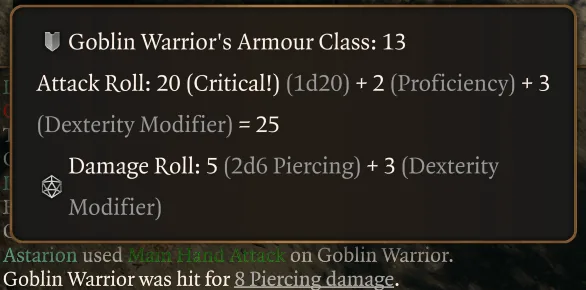
Roll a natural 20 in Baldur's Gate 3 and the game plays a flashy sound and the damage number jumps — the shorthand for that is "the hit just got doubled." That's true, but "doubled" is doing a lot of unstated work. bg3.wiki's own mechanics breakdown — pulled from the game's data and its combat log, not from forum consensus — is precise about exactly what doubles, exactly what doesn't, and names a dozen separate sources that can move the number you need away from a flat 20. None of that is written down anywhere you'd actually see it in a tooltip.
The rule in one sentence: dice double, flat numbers don't
Baldur's Gate 3 copies D&D 5e's critical hit rule without house-ruling it: land a natural 20 on an attack roll, and the attack automatically lands regardless of the target's Armour Class, then every die you'd normally roll for damage gets rolled twice. That includes your weapon's damage dice, and it includes bonus damage dice stacked on top of the attack — a Divine Smite, a Sneak Attack, a Battle Master combat manoeuvre, an elemental coating.
What it doesn't touch is anything that isn't a die. Ability score modifiers, your proficiency bonus, and a weapon's flat +1/+2/+3 enchantment bonus are all added exactly once, crit or not. A character swinging a +2 longsword with 20 Strength deals 1d8 + 2 + 5 on a normal hit and 2d8 + 2 + 5 on a crit — the d8 doubles, the +7 of flat bonus does not. That single distinction is why a high Strength score inflates your average normal hit far more than it inflates your average crit, and why gear built specifically around crit value chases extra dice rather than extra flat bonuses.
There's one flat-damage edge case worth knowing. Some attacks deal a fixed number instead of rolling dice at all — a Familiar's attack is the wiki's named example. Those can still land a critical hit off a natural 20; they just get nothing extra for it, because there's no die there to double.
Multi-attack abilities crit once per hit, not once per turn
An ability that rolls several attacks in a single action — Scorching Ray's three bolts, or the ranged version of Slashing Flourish — resolves each roll independently. Landing a natural 20 on bolt two doubles only that bolt's damage dice; bolts one and three succeed or fail on their own terms, unaffected. There's no "one crit per turn" ceiling the way Sneak Attack is limited to once per turn — a lucky enough Scorching Ray can crit on all three bolts in the same action, and each one is checked and doubled separately.
A natural 1 always misses, a natural 20 always lands
The two ends of the d20 are absolute, not just probable. A natural 1 on an attack roll is an automatic miss no matter how large your bonuses are — the game's own term for it is a "critical miss" — and a natural 20 is an automatic hit no matter how high the target's AC is. Neither cares what the arithmetic underneath would otherwise have said.
Two things complicate the natural-1 half specifically. Halfling Luck lets a Halfling reroll the first natural 1 rolled on an attack roll, ability check, or saving throw, and must use the new result. And melee attacks against a Downed character skip the roll entirely and are simply classified as critical hits outright — which is the actual mechanical reason "an enemy is standing next to your unconscious Cleric" is a five-alarm situation. A critical hit against a Downed character fails two death saving throws at once instead of one, so a single unanswered melee swing can be the difference between stable and dead. Our Honour Mode guide already tells you to pick up downed allies immediately; this is the specific arithmetic behind why that advice isn't exaggeration.
Twelve ways to lower the number you need
Several feats, class features, items and conditions reduce the roll needed for a crit below 20, and bg3.wiki is explicit that multiple sources stack — there's no named ceiling on how low the threshold can go.
| Source | Requirement | Effect |
|---|---|---|
| Champion Fighter — Improved Critical Hit | Level 3 subclass feature | -1, stacks with everything else |
| Hexblade's Curse | Hexblade Warlock level 1, applied directly or a 20% chance off Bind Hexed Weapon | -1 while the curse is active |
| Bloodthirst / The Dead Shot | Legendary dagger / rare weapon, Improved Critical passive | -1 each — the wiki notes both grant the same passive but still stack with each other |
| Duellist's Prerogative | Legendary rapier, Elegant Duellist, off-hand must be empty | Crits on 19 |
| Knife of the Undermountain King | Organ Rearranger passive | -1 |
| Unseen Menace | Only while the weapon itself is turned Invisible | -1 |
| Covert Cowl / Dark Justiciar Helmet | Covert Critical, only while Obscured | -1 |
| Shade-Slayer Cloak | Stealthy Critical, only while Hiding | -1 |
| Sarevok's Horned Helmet | Deathbringer's Sight | -1, stacks with the rest |
| Elixir of Viciousness | Consumable, one per Long Rest slot | -1 |
| Spell Sniper feat | Spell attacks only | -1 |
| A Most Bloody Inheritance | Dark Urge origin-exclusive condition | -2 |
Stack Champion Fighter's Improved Critical Hit with Sarevok's Horned Helmet and the threshold drops to 18 — two separate -1s that apply cleanly on top of each other, per the wiki's own note that combined reductions can push the number "below 19." Add a third source, such as the Elixir of Viciousness, and a martial build is landing crits on a 17 or better before Advantage even enters the picture.

Outside the ordinary tadpole tree covered in our illithid powers guide, full-illithid characters unlock a separate upgrade called Fierce Perilous Stakes that works the opposite direction: it drops the target's threshold by 5, stacks with itself, and makes that target Vulnerable to all damage for the duration — powerful against a boss, and, per the standard Perilous Stakes rule already covered there, Honour Mode restricts it to allies only.
Immune to crits doesn't mean immune to missing you
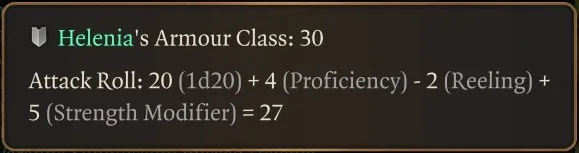
A short list of items flips the natural-20 rule in the other direction instead of bending it. Adamantine Scale Mail, Adamantine Splint Armour, the Adamantine Shield, the Grymskull Helm, the Helldusk Helmet and the Helm of Balduran all carry the same passive: while worn, a natural 20 rolled against the wearer stops being an automatic hit. It's simply treated as a roll of 20, full modifiers applied, checked against AC exactly like any other roll.
That produces a genuinely counterintuitive result the tooltip never spells out — stack enough AC on a crit-immune tank and a natural 20 can still miss outright, something that is flatly impossible against a target without that passive. Our best armour guide covers Adamantine Splint Armour as an anti-crit brick for exactly this reason.
The negation reaches further than it first looks. bg3.wiki flags this specific interaction as still needing more testing, but the documented behaviour is that guaranteed-crit sources — Hold Person, Hold Monster and attacking a Sleeping target, all of which normally hand melee attacks a free crit — stop guaranteeing anything once the target is wearing crit-immune gear; the attack just becomes a normal roll again. Luck of the Far Realms is the one named exception: because it converts an already-successful attack roll into a crit after the fact, rather than forcing the natural 20 in the first place, it keeps working even against an immune target, provided the hit landed at all.
Advantage nearly doubles your crit chance, not just your hit chance
Advantage is usually framed as an accuracy tool — reroll and keep the higher of two d20s. It does the same thing to your crit chance, and the numbers move further than the tooltip suggests: the only way to whiff a natural-1 crit-miss with advantage is for both dice to come up 1, a 1-in-400 chance (0.25%) instead of 1-in-20 (5%). The mirror image applies to natural 20s. bg3.wiki publishes the base advantage-on-crit math (5% to 9.75%); running that same formula across every threshold reduction and multiple-attack case gives the full picture:
| Crit threshold | No advantage | With advantage | Two attacks, advantage | Three attacks, advantage |
|---|---|---|---|---|
| 20 (default) | 5% | 9.75% | 18.55% | 26.49% |
| 19 (one -1 source) | 10% | 19% | 34.39% | 46.86% |
| 18 (two -1 sources) | 15% | 27.75% | 47.8% | 62.29% |
| 17 (three -1 sources) | 20% | 36% | 59.04% | 73.79% |
| 16 | 25% | 43.75% | 68.36% | 82.2% |
| 15 | 30% | 51% | 75.99% | 88.24% |
| 14 | 35% | 57.75% | 82.15% | 92.46% |
Read the last two columns as "the chance at least one attack this turn crits," since Extra Attack alone gets most martials to two swings by level 5. A Champion Fighter with advantage and Extra Attack is sitting at roughly a one-in-three chance (34.39%) of a crit somewhere in that turn off threshold reduction alone — nowhere near the 5% the unmodified tooltip implies, and before Action Surge or a third attack pushes it further still.
Karmic Dice can manufacture a crit, and hard shots are more likely to get one
Our Karmic Dice guide covers the debt-and-forced-success formula in full, so this is the one piece of it that guide doesn't spend time on. When Karmic Dice forces a failing roll through to a success, the game doesn't just wave the attack past AC — bg3.wiki's own description says the game "randomly chooses a d20 value among those that would have succeeded" and displays that as the roll, rather than simply overriding a pass/fail flag.
That detail has a consequence worth sitting with. The harder a shot was to land in the first place, the narrower the range of values that would have succeeded, and the closer that range sits to 20. Force a 30% attack roll through and the game is drawing from an eleven-wide band, 10 through 20 — plenty of room to land somewhere well short of a crit. Force through a shot that only had a 5% chance to land — the kind that needed a literal natural 20 to begin with — and there is exactly one value left in that range. It is always 20. It is always a crit. bg3.wiki names the pattern outright: an automatic success is more likely to be a critical hit the less likely the attack was to succeed on its own, and on an attack that could only ever succeed on a natural 20, a forced success always is one.
Quick reference
- Crits double every damage die — weapon dice and bonus dice like Divine Smite or Sneak Attack alike — but never flat modifiers, including ability scores, proficiency bonus, and a weapon's enchantment bonus.
- Fixed-damage attacks (Familiars) can crit but gain nothing from it, since there's no die to double.
- Multi-roll abilities like Scorching Ray crit per bolt, with no once-per-turn ceiling the way Sneak Attack has one.
- A natural 1 always misses and a natural 20 always lands, regardless of modifiers — except Halfling Luck's reroll, and melee attacks against a Downed target, which skip the roll and are always crits.
- A dozen named sources reduce the crit threshold by 1 or more, and they stack — Champion Fighter, Hexblade's Curse, several legendary weapons, Sarevok's Horned Helmet, Spell Sniper, and more.
- Crit-immune gear (Adamantine, Helldusk Helmet, Helm of Balduran) turns a natural 20 back into a normal roll against AC — high enough AC and it can still miss outright, and it cancels most guaranteed-crit sources except Luck of the Far Realms.
- Advantage nearly doubles crit chance on its own — 5% to 9.75% at the default threshold — and compounds hard with threshold reduction and multiple attacks.
- Karmic Dice's forced successes can be crits, disproportionately on shots that were unlikely to land in the first place.
Frequently Asked Questions
Does a critical hit double your total damage in Baldur's Gate 3?
What negates critical hits in Baldur's Gate 3?
Can critical hit threshold reduction stack in Baldur's Gate 3?
Does advantage increase your critical hit chance in Baldur's Gate 3?
Is a melee attack against a Downed character always a critical hit in Baldur's Gate 3?
Can Karmic Dice cause a critical hit that wasn't really a natural 20?
Keep Reading
- BG3 Wiki — Critical hit: what doubles, the full threshold-reduction and crit-immunity item lists, and guaranteed-crit sources
- BG3 Wiki — Dice rolls: Karmic Dice section, including the forced-success-can-crit mechanic
- BG3 Wiki — Dice rolls: the advantage/disadvantage critical-success and critical-failure probability table
- BG3 Wiki — Improved Critical Hit, the Champion Fighter's level 3 threshold-reduction passive
- BG3 Wiki — Spell Sniper feat, confirming the spell-attack-only crit threshold reduction
Related Guides
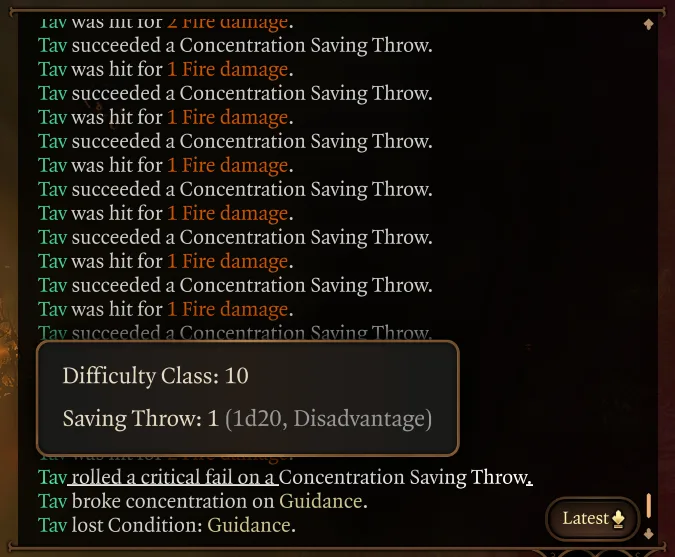
Baldur's Gate 3 Concentration: Why Your Spell Dropped
Baldur's Gate 3 ends concentration in more ways than the tabletop rules do: a natural 1 fails the save whatever your bonus, falling Prone ends it with no roll, and casting a second concentration spell after Haste on yourself costs you both. Here is what breaks it, temporary hit points and Rage included, the gear and feats that hold it, and the spells BG3 stopped making you concentrate on.
Baldur's Gate 3 Stealth: Where You Stand Beats the Roll
Baldur's Gate 3 only rolls a hiding character's Stealth in one of its three obscurity states; the other two decide whether you are found before Dexterity gets a vote. Here is how obscurity and darkvision work, why Fog and Darkness are different tools, what breaks Hiding, and the gear that switches on in the dark.

Baldur's Gate 3 Death Saves: What Actually Kills You
Baldur's Gate 3 keeps the tabletop shape of death saving throws and rewrites the details: no massive-damage deaths, no natural-20 comebacks, and failures that survive stabilising. Here is what kills a Downed character, what stops it, and what each way back from the dead costs.

Baldur's Gate 3 Initiative and Surprise: How to Go First
Tabletop D&D rolls initiative on a d20. Baldur's Gate 3 rolls it on a d4, which turns a +5 from Alert from a nudge into something close to a guarantee. Here is how turn order is built, what Surprised takes away, and the line-of-sight rule that decides whether your ambush gets a surprise round at all.

Baldur's Gate 3 Beginner Guide: What Nobody Tells You
The tutorial teaches you to move and attack. It does not teach you that advantage is worth more than any weapon you will find in Act 1, or that Withers will rebuild your entire character for 100 gold. Here is the actual onboarding.

Baldur's Gate 3 Wild Shape: It Can Kill You With No Save
An Owlbear form shows 65 hit points on a bar that looks nothing like your character sheet. That number is a mask, not a shield — bg3.wiki's own Wild Shape page spells out exactly what happens when it runs out, and it is not a knockdown. Here is the charge economy, what carries over and what shuts off, and the overflow rule that can end a character with no down-and-dying phase at all.